Olight makes some of the lights discussed here. Olight specs and prices come from its US product pages as of September 2026; every other fact links to its source. This guide covers listening, judging, lighting and calling for help. It gives no confrontation or weapons advice.
⚡ TL;DR
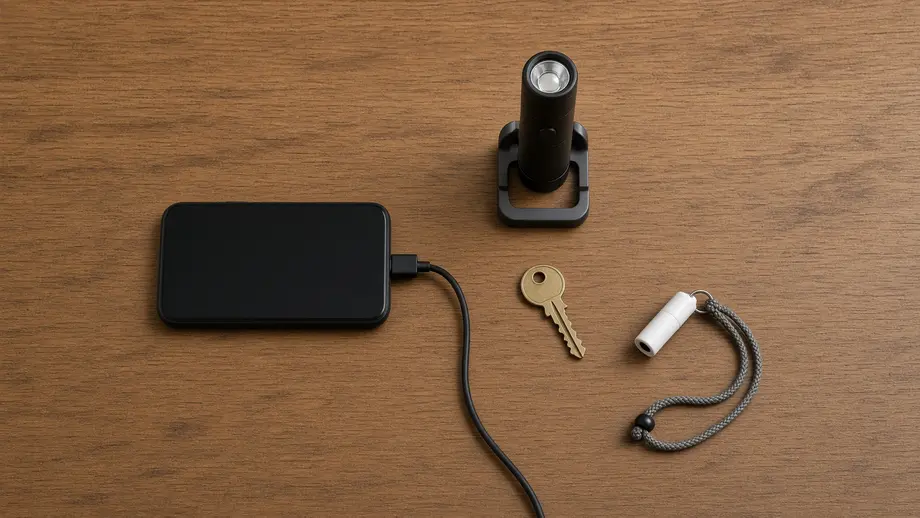
If you hear a noise at night at home, stay in your room, listen for 60 seconds and judge the sound before you move. Most night noises come from the house, the plumbing, an alarm or an animal. Glass breaking, voices or footsteps mean you lock your door and call 911. Keep a charged phone and a flashlight with a low mode by the bed.
This checklist shows what to keep within reach for a noise at night at home, the minimum spec that matters, and an example of each.
| Purpose | Recommended type | Minimum spec to look for | Example |
|---|---|---|---|
| Call for help | Charged cell phone | On the nightstand, charging, with emergency calling reachable from the lock screen | The phone you already own |
| See without lighting yourself up | Flashlight with a very low mode and a separate bright mode | A mode under 20 lumens you can reach first; a high mode you choose on purpose | Olight Baton 4 Pro (15-lumen Low, 1,600-lumen Turbo) |
| Light a whole room | Bedside lamp, wall switch or smart switch | Turns on from the bed or the doorway | Any lamp within arm's reach |
| Put a door between you and the sound | Bedroom door that locks | A lock you can set by touch in the dark | Existing door hardware |
| Signal people nearby | Emergency whistle | Small enough to hang by the bed or ride on your keys | Olight Titanium Emergency Whistle (7g) |
| Find out what the sound was | Outdoor lights and a doorbell or camera app | Switchable or viewable from the bedroom | Your porch light and any camera you already have |
📋 Table of Contents
- 1. The Short Answer: Listen, Judge, Call, and Look Last
- 2. What Could Be Causing My House to Make Noise at Night?
- 3. Why Do I Hear Noises at Night in My House?
- 4. What Are Some Strange Noises I Hear at Night?
- 5. How Can You Check a Noise Without Going Downstairs?
- 6. If You Decide on Checking a Noise: Position, Exit, Phone
- 7. How Should You Use a Flashlight When You Hear a Noise?
- 8. When Should You Call 911 About a Noise at Night?
- 9. What Do Burglary Statistics Say About Noises at Night?
- 10. What Should You Do the Morning After a Noise?
- 11. Which Flashlight Should You Keep by the Bed?
- 12. Why Doesn't This Guide Cover Confronting an Intruder?
- 13. Your Noise at Night at Home Plan: A 10-Minute Setup for Tonight
- 14. FAQ
The Short Answer: Listen, Judge, Call, and Look Last
When you hear a noise at night at home, the safe order is listen, judge, call, and only then look. Stay where you are for a minute and let the sound repeat or stop. Most sounds explain themselves. If anything points to a person inside, lock your door and call 911 from the room instead of walking into the dark to find out.
Police advice runs the same way. The Pleasanton, California police department's personal safety tips say: "Don't be afraid to call the police to investigate suspicious people, circumstances or strange noises. It's better to be safe than sorry." Indiana's Department of Homeland Security, in its home protection safety tips, tells households to "Designate a safe room that can be secured from the inside and educate all household members on where to go in a crisis," and adds: "Verify that the room has a charged cell phone and/or functioning landline phone, a flashlight, a first-aid kit and emergency water."
Walking downstairs to look has four costs. You leave the one room you can lock. You move toward a sound you can't yet explain. Your light tells anyone in the dark exactly where you are. And you spend the minute you could have used to call for help.
Here is a 60-second routine to run from bed before you decide anything. It is a way to organize what you hear, not an official protocol.
- Seconds 0 to 10: freeze and name the sound. Don't switch on a light yet. Is it a crack, a creak, a bang, a scratch, a chirp, a voice or breaking glass?
- Seconds 10 to 30: place it. Is it above you (attic or roof), inside a wall, below you, or outside?
- Seconds 30 to 60: note the pattern. Did it happen once? Does it repeat at a steady interval? Is it moving from room to room or getting closer?
- Decide. A sound you can explain goes on tomorrow's to-do list. A sound you can't explain gets checked from your room (see below). Any sign of a person means lock, call and stay put.
Safety note: If you think someone may be inside, don't go to see who it is and don't call out. Stay behind a locked door, keep your distance from the sound, call 911 and stay on the line. Police can check the house; you don't need to.
Keep one light where your hand lands without looking. A pocket-size light from Olight's range of EDC flashlights works on a nightstand as well as in a pocket, and the section on flashlight use below covers which mode to reach for first.
What Could Be Causing My House to Make Noise at Night?
Most noises that wake you come from the house itself: wood framing and floors moving as humidity and temperature change, water pipes banging when a valve shuts, a smoke alarm chirping for a new battery, or mice and rats that do their moving after dark. The sounds worth acting on are glass breaking, a door or window opening, voices, and footsteps that move from room to room.
Wood is the source of many creaks and pops. A University of Massachusetts Amherst building technology article on common failures in wood structures explains that "Fluctuations in relative humidity drives dimensional instability of wood," and that indoor humidity "can drop to 20% during cold periods and rise above 75% during humid summer months." On floors, it says "Squeaks result from wood rubbing against wood," often after a joist shrinks and leaves a gap under the subfloor.
Plumbing is next. The City of Durham, North Carolina, describes water hammer as "a banging or knocking sound that can occur in a water pipe," which happens "when the water in the pipe suddenly changes direction, for example when a faucet is turned off." A dishwasher, washing machine or toilet that finishes filling in the middle of the night can set it off.
Alarms chirp. The National Fire Protection Association's guidance on changing smoke alarm batteries says that for alarms with any battery other than a sealed 10-year type, "If that alarm chirps, warning the battery is low, replace the battery right away." For sealed 10-year alarms, it says to "replace the entire smoke alarm right away."
Rodents are active at night. University of California IPM's house mouse guide says "Mice are most active at night, but you might see them during daylight hours," and that outdoor mice "frequently enter homes in autumn when nighttime temperatures become colder." Its rat guide says "Rats are mostly active at night" and lists "Noises coming from the attic or drop ceilings" as a sign of rats.
This triage table matches common night sounds to their likely source and a first step. It is ordered from most routine to most urgent, not by measured frequency, because no national data rank household night noises.
| Sound | Where you hear it | Pattern | Likely source | First step |
|---|---|---|---|---|
| Single crack or pop | Walls, ceiling, attic | Isolated, often as the house heats or cools | Framing and trim moving with temperature and humidity | Note the time; no action tonight |
| One creak on a floor or stair | Floor above, stairs | Once, not repeated | Wood rubbing on wood where boards have shrunk | Listen for a second creak further along the same line |
| Bang or knock in a wall | Near the kitchen, laundry or a bathroom | Right after water stops running | Water hammer | Tomorrow, check which appliance just finished |
| Short high chirp | A ceiling | Repeats at a steady interval | Smoke alarm with a low battery | Replace the battery, or the whole alarm if it is a sealed 10-year model |
| Scratching, scurrying or gnawing | Attic, ceiling, inside walls | On and off through the night | Mice or rats | Plan to seal gaps in daylight |
| Scream outside | Yard, woods, street | Short bursts, often in winter | Red fox | Nothing to do from inside |
| One loud bang only you heard | Seems to come from everywhere | Once, as you fall asleep or wake | Possibly exploding head syndrome, a sleep event | Talk to a doctor if it keeps happening |
| Glass breaking, a door opening, voices, steps moving between rooms | Inside the house | Moving, repeating or getting closer | Possibly a person | Lock your door and call 911 |
Why Do I Hear Noises at Night in My House?
You hear more at night mainly because the house goes quiet. Traffic, voices, the TV and the dishwasher fade, so a small sound has less to compete with. At the same time, indoor temperature and humidity shift after dark, appliances cycle on their own schedules, and mice and rats do most of their moving while you sleep.
Season adds to it. Late September and October bring the first cold nights in much of the country, which is when UC IPM says outdoor mice tend to move indoors. The same weeks bring the heating system's first cycles of the year, which warm and cool ducts, pipes and framing after months of rest. And when daylight saving time ends on November 1, 2026, more of the evening happens in the dark, so you are more likely to be awake in a dark house when a sound starts.
Some sounds don't come from the house at all. The American Academy of Sleep Medicine describes exploding head syndrome as "a rare parasomnia in which affected persons awaken from sleep with the sensation of a loud noise," described as "A painless loud bang" or "A clash of cymbals." It says the cause "is not known" and that it "may occur more often when you are very tired or under stress." If you are the only person who heard a huge bang, nothing is out of place, and it happened right as you drifted off or woke, that is worth mentioning to a doctor.
This table sums up why nights sound louder than days, using the sources above.
| Reason | What changes after dark | What it sounds like |
|---|---|---|
| Less background noise | Traffic and household activity stop | Small sounds you never notice by day |
| Humidity and temperature swings | Wood shrinks and swells; ducts and pipes warm and cool | Pops, cracks, single creaks |
| Appliance cycles | Ice makers, dishwashers and toilets refill on their own timing | Knocks and bangs in walls |
| Nocturnal animals | Mice and rats forage; foxes call during mating season | Scratching overhead, screams outside |
| Your own sleep state | Drifting off or waking suddenly | A single loud bang no one else heard |
What Are Some Strange Noises I Hear at Night?
The strangest night noises usually have ordinary sources: a scream outside that turns out to be a fox, a single loud bang only you heard as you drifted off, a chirp from a smoke alarm, a knock in the wall after the dishwasher stops, or scratching overhead from rodents. Each one has a pattern you can recognize from bed, without opening your door.
The scream in the yard
A scream outside at 2 a.m. is one of the most alarming sounds a household can hear. New Hampshire Fish and Game's red fox profile notes that "Canids tend to be quite vocal," and that "High-pitched screams in the night that are often attributed to fisher cats are actually often noises from foxes." It puts fox mating season "from January until early March in New Hampshire." A fox call comes in short bursts and moves around the yard. A person in trouble usually calls words. If you hear words, call 911.
The chirp you can't locate
A smoke alarm chirp is short, high and repeats at a steady interval, which makes it hard to place in a quiet house. Stand under each alarm in turn in the morning. The U.S. Fire Administration's smoke alarm guidance says alarms "need to be replaced 10 years from the manufacture date," so check the date on the back while you are there.
The knock after the water stops
A single knock or a short series of bangs right after a toilet refills or a dishwasher drains is the pattern of water hammer. Durham's utility suggests running the tap at the highest fixture in the house for a minute or two every couple of weeks, and calling a licensed plumber for a pressure reducing valve or air chambers.
The scratching overhead
Scratching, light running and gnawing in a ceiling or wall, on and off through the night, points to rodents. UC IPM says house mice "can squeeze under gaps ¼ inch tall, and through openings 3/8 inch wide," so the fix is a daylight job with a flashlight, a ladder and steel or concrete patching, not a midnight search.
How Can You Check a Noise Without Going Downstairs?
You can check most noises without leaving your room: listen for a pattern, use what the house can show you through your phone or a window, and ask the people who live with you. Each method keeps you behind a door you control, with your phone in hand, while you work out whether the sound is the house or a person.
1. Listen for movement, not volume
Loudness tells you little. A pipe bang can be louder than a footstep. What matters is whether the sound moves. House noises stay where they are: the same joist, the same pipe, the same alarm. A person moves from the back door to the kitchen to the stairs. Run the 60-second routine above and note whether the sound changed location.
2. Let the house show you
Turn on outdoor lights from a bedroom switch or phone app if you have them. Pull up any doorbell or camera feed. If you look out a window, keep your own room dark: a lit room is easy to see into from outside, and a dark room is not. Indiana's home protection page also advises households to "Close all curtains and blinds at night," which makes the inside of the house harder to watch.
3. Account for everyone
Text or call the other adults in the house. Check the kids' and guests' rooms by message before you check them on foot. If everyone is accounted for and you still hear steps, that changes the picture.
This decision table turns those checks into one answer. It is a rule of thumb built from the sources in this guide, not a police standard: if two or more signals in the right-hand column show up, stop checking and call 911.
| Signal | Points to the house | Points to a person |
|---|---|---|
| Location | Stays in one place | Moves from room to room |
| Timing | Matches an appliance, heating cycle or chirp interval | Irregular, with pauses and restarts |
| Sound type | Crack, pop, knock, scratch, chirp | Glass, a door or window opening, voices, footsteps |
| Household | Someone is up, or a pet is loose | Everyone is accounted for and in bed |
| Outside view | Camera and yard show nothing unusual | A person, an open gate, or a door or window open that you closed |
| Repeat | Happens most nights | New tonight |
If You Decide on Checking a Noise: Position, Exit, Phone
If you still decide to look, set three things before you open the door: your position, your exit and your phone. Look from doorways and the top of the stairs instead of walking into rooms. Know which way you will go if the sound turns out to be a person. Have 911 ready to dial, and tell someone in the house what you are doing.
Set a stop rule before you start. The moment you see or hear any of the following, go back to your room, lock the door and call 911:
- A door or window open that you know you closed.
- Broken glass on the floor.
- A voice you don't recognize.
- A light moving somewhere in the house that isn't yours.
- Anything that makes you want to call out "Who's there?"
Pleasanton police give the same instruction for coming home to trouble: "If you arrive home and see evidence of a break-in do NOT go inside; leave and call 911." The logic carries over to your own hallway. Evidence of entry is the end of the check, not the start of a search.
This checklist sets out the preparation. Each line takes seconds.
| Before you step out | Why | What it looks like |
|---|---|---|
| Phone in hand, emergency dialer open | Calling takes longer than you think with shaking hands | Screen unlocked, 911 typed, thumb near the call button |
| Tell someone | Someone knows where you are and can call if you don't come back | A text or a whisper to a partner, or a note to the kids to stay put |
| Shoes on | Broken glass is a real risk in the dark | Slip-ons kept by the bed |
| Light plan | A beam shows where you are | Room switches first; flashlight on low, pointed at the floor |
| Exit plan | You need somewhere to go if the answer is a person | Back to the locked room, or out a door you are standing next to |
| Scope | Garages, basements and yards are the hardest places to check safely | Look from the top of the stairs or the doorway; don't go in or out |
Indiana's guidance also says to "Choose and practice various escape routes from the home." Do that in daylight, once, with everyone in the house. At 2 a.m. you will follow the route you have already walked.
How Should You Use a Flashlight When You Hear a Noise?
Use the lowest light that lets you see the floor, point it down, and switch it off between looks. A lit flashlight tells anyone in the dark exactly where you are, and a bright beam bounced off a white wall resets the dark-adapted eyes you spent minutes building. When you want to see a whole room, turn on the room light from the doorway instead of sweeping a beam.
Your eyes need time. The Webvision textbook, hosted on the National Library of Medicine's Bookshelf, explains in its chapter on light and dark adaptation that "The sensitivity of the rod pathway improves considerably after 5-10 minutes in the dark," and that full sensitivity comes "after about 40 minutes in the dark." It adds that "With increasing levels of pre-adapting luminances, the cone branch becomes longer while the rod branch becomes more delayed." Put simply, the brighter the light you look at, the longer your night vision takes to come back. If you want to protect night vision on purpose, a red light that preserves night vision is another option; neither Baton light in this guide has a red mode.
How much light each mode puts on a hallway wall
This table estimates how much light the Olight Baton 4 Pro puts on a surface at 1, 3 and 6 meters in each mode. Illuminance in lux equals peak intensity in candela divided by distance in meters squared. Olight publishes only the Turbo peak, 10,000 candela at 1,600 lumens. For the other modes, the estimate assumes the beam keeps the same shape, so candela scales with lumens: estimated candela = 10,000 × (mode lumens ÷ 1,600). All figures are based on Olight's rated output, not measured.
| Mode (Olight rating) | Estimated peak intensity | At 1 m | At 3 m | At 6 m |
|---|---|---|---|---|
| Turbo, 1,600 lumens | 10,000 cd (published) | 10,000 lux | 1,111 lux | 278 lux |
| High, 600 lumens | 3,750 cd | 3,750 lux | 417 lux | 104 lux |
| Med, 120 lumens | 750 cd | 750 lux | 83 lux | 21 lux |
| Low, 15 lumens | 94 cd | 94 lux | 10.4 lux | 2.6 lux |
| Moon, under 1 lumen | under 6.3 cd | under 6.3 lux | under 0.7 lux | under 0.2 lux |
The worked numbers: 10,000 ÷ 3² = 10,000 ÷ 9 = 1,111 lux. For Low, 10,000 × (15 ÷ 1,600) = 93.75 candela, and 93.75 ÷ 9 = 10.4 lux at 3 meters. Turbo therefore puts about 107 times as much light on the same spot as Low (10,000 ÷ 93.75 = 106.7). In a 3-meter hallway, Low is enough to see the floor, a toy on the stairs or an open door. Turbo is enough to light the whole hallway, and to make you the brightest thing in the house.
Know your switches before you need them
Olight's user manual for the Baton 4 Pro gives each switch a different job. For the side switch it lists "Single press the side switch." to turn the light on and off and "Quick double press the side switch." for Turbo. For the tail button it lists "When off, press the tail button." for High, which Olight rates at 600~120 lumens. The same manual lists a press-and-hold of the side switch from off for Moonlight, and a press-and-hold while on to change brightness.
That split matters at night. If you grab the light and press the tail, you get 600 lumens in your own face. Practice in daylight until your thumb finds the side switch first. Olight's manual also describes a lockout mode, and advises locking the light when carrying or transporting it. A locked light needs an unlock press before it will turn on, so a light that lives on the nightstand is easier to use unlocked, stood on end so the switch is easy to find.
Warning: The same manual lists "Quick triple press the side switch." for Strobe, so a fumbled press can start flashing. Press once more to turn it off. The manual also says: "Do not look directly at the light source or shine it in eyes, as this may cause temporary blindness and serious retinal damage." Never aim the beam or strobe at anyone's face, including a person you can't identify.
Match the light to the part of the house
This table shows which light to use first in each part of a noise check, and what the Baton 4 Pro mode that fits it is rated to deliver. The mode picks are editorial suggestions; the outputs and runtimes are Olight's ratings.
| Sub-scenario | Light to use first | Baton 4 Pro mode if you need a beam | Rated output and runtime | Where to aim | Water rating that matters |
|---|---|---|---|---|---|
| Bedroom, finding the phone and the door lock | None; your hand already knows the nightstand | Moon (press and hold the side switch from off) | Under 1 lumen, 100 days | Into your palm or the nightstand top | None indoors |
| Top of the stairs or a hallway | The hallway switch, from the doorway | Low | 15 lumens, 155 hours | The floor a step or two ahead | None indoors |
| Looking into a room from its doorway | The room's own switch | Med, as a backup | 120 lumens, 18 hours 30 minutes | Along the floor and door frames, never at a person | None indoors |
| Looking out at the yard | Outdoor lights on a switch or app, room kept dark | No beam through the glass | Not applicable | Nowhere; glare off glass blinds you | None indoors |
| Power outage night | The flashlight, since room lights are out | Low, stepping up to Med | 15 lumens, 155 hours; 120 lumens, 18 hours 30 minutes | The floor | None indoors |
| Outside, the next morning or after police have left | Daylight if you can wait | High, for short looks | 600~120 lumens, 200 + 20 minutes | Ground, gate and door frames | Rain: the light is rated IPX8 |
A power outage changes the plan, because room lights and cameras go dark with the grid. If you live where storms knock out power, keep the bedside light charged as part of your storm kit; the hurricane supplies storage guide covers how to keep lights and batteries ready through a long season.
When Should You Call 911 About a Noise at Night?
Call 911 when a sound points to a person inside or trying to get in: glass breaking, a door or window being forced, voices you don't know, or footsteps when everyone is accounted for. 911.gov defines an emergency as "any situation that requires immediate assistance from the police, fire department or ambulance." For outside sounds that don't threaten entry, use your police non-emergency number.
Make the call from behind a locked door. 911.gov's guide to calling 911 says to be ready for questions about "The location of the emergency, including the street address," "The phone number you are calling from," "The nature of the emergency," and details such as "a physical description of a person who may have committed a crime." It ends with an instruction worth memorizing: "Do not hang up until the call-taker instructs you to do so."
Speak if you can. The FCC's text-to-911 guide says "you should always make a voice call to 911 during an emergency whenever possible," and notes that text-to-911 "is only currently available in certain locations." Check whether your county accepts texts now, while it is quiet, so you know your fallback if you ever can't talk.
Here is an order for what to say, built from the 911.gov list. Practice it once out loud.
- Your street address, including the unit number and city.
- What you heard, in plain words: "I heard glass break downstairs and footsteps."
- Where you are: "I'm in the upstairs back bedroom with the door locked."
- Who else is in the house and where they are.
- Anything that helps officers arriving at the door: pets, a gate code, which door you will not be opening.
Then stay on the line and stay put. Indiana's guidance puts it in one line: "If the designated safe room is used, shelter in place until police arrive."
This table sorts common night situations by who to call. It follows the 911.gov definition of an emergency and the sources quoted earlier.
| What you notice | Who to call | Why |
|---|---|---|
| Glass breaking, a forced door or window, or unknown voices inside | 911 | Needs immediate police help |
| Someone trying door handles or windows from outside | 911 | Possible attempted entry |
| Footsteps inside when everyone is accounted for | 911 | Possible person inside |
| A smoke alarm sounding its full alarm, not a chirp | Get out, then call 911 | Possible fire |
| Loud voices or a party outside that doesn't involve your home | Police non-emergency line | No immediate threat to you |
| Scratching in the attic or walls | A pest professional or your state wildlife agency, in daylight | Not an emergency |
| Banging pipes | A licensed plumber, in daylight | Not an emergency |
| A steady chirp | Replace the battery or the alarm | Not an emergency |
For older relatives who live alone, the door-side scripts and help devices in our guide to self defense for seniors cover the daytime side of the same plan.
What Do Burglary Statistics Say About Noises at Night?
Federal survey data explain why staying put and calling makes sense. In a Bureau of Justice Statistics study of 2003 to 2007, a household member was home in about 28% of burglaries, and in 26% of those, someone at home became a victim of violence. Most night noises are not burglaries. The few that are carry real risk, which is why the plan above ends with a locked door and a phone call.
The source is the BJS special report Victimization During Household Burglary, published in September 2010 from National Crime Victimization Survey data. It found that "An estimated 3.7 million burglaries occurred each year on average from 2003 to 2007," and that "a household member was more likely to be present during a nighttime burglary (61%) than during one that occurred between the daytime hours of 6 am and 6 pm (33%)."
This table works through the report's own numbers. The calculations are ours; every input comes from the report's tables.
| Figure | BJS number (average per year, 2003 to 2007) | Calculation | What it means |
|---|---|---|---|
| Burglaries with a household member present | 1,024,230 | From Table 8 | About 28% of all burglaries |
| Present, and a household member suffered violence | 266,560 | 266,560 ÷ 1,024,230 = 26.0% | About 1 in 4 burglaries with someone home turned violent |
| Present, and the burglary happened between 6 p.m. and 6 a.m. | 626,150 of 1,021,430 (Table 9) | 626,150 ÷ 1,021,430 = 61.3% | Night is when people are home |
| Present, and the household member was asleep | 389,880 | 389,880 ÷ 365 = 1,068 | In 2003 to 2007, about 1,070 burglaries a day, on average, happened while someone in the home was asleep |
| Unlawful (no-force) entries into an occupied home, share through an open or unlocked door or window (Table 7) | 27.0% open plus 28.0% unlocked | 27.0% + 28.0% = 55.0% | More than half of no-force entries used an opening someone had left open or unlocked |
Two lessons come out of the table. First, if the noise is a person, the risk of meeting them in a dark hallway is real, so don't go looking. Second, among burglaries of occupied homes where the offender got in without force, 55% came through a door or window that was open or unlocked. Indiana's guidance says to "Lock or secure windows and doors, both while home and out of the house." A 30-second lock check before bed prevents more bad nights than any light.
Keep the limits in mind. The data are almost two decades old, they count burglaries rather than noises, and they can't tell you what your particular sound was. They make a case for a plan, not for fear.
What Should You Do the Morning After a Noise?
The next morning, do three things in daylight: walk around the outside of the house and look for signs of entry, fix whatever made the sound, and write down what happened and when. If you find a forced door, a cut screen or missing items, don't go inside to look around. Step away, call the police, and let them check first.
1. Walk the outside
Look at every door, window and screen at ground level, plus the garage door and any basement windows. You are looking for pry marks, a torn screen, a window lock that won't close, or footprints in soft soil under a window. Check the gate and any ladders.
2. Fix the cause
Match what you heard to the triage table. Replace a chirping alarm's battery, or the whole alarm if it is a sealed 10-year model. Walk the attic edge and the foundation with a flashlight and look for rodent gaps; UC IPM advises "eliminating all gaps and openings larger than ¼ inch" and notes that "Steel wool scouring pads make good temporary plugs but may rust over time." For banging pipes, try Durham's tap routine or book a plumber.
3. Log it and adjust the plan
Write down the time, the sound and where it came from. If it happens again at the same time, you have probably found an appliance cycle or a heating pattern. If you called 911, note the incident number. Then fix the weak point the night exposed: a bedroom door that doesn't lock, a phone left charging in the kitchen, a flashlight with a dead battery.
If you did find signs of a break-in, report it even if nothing was taken. In the BJS report, 78% of households with members present during a forcible burglary reported the crime to police, against 52% for unlawful entries and 62% for attempted forcible entries, though BJS notes those differences were not statistically significant. A report creates a record that helps patrols and any insurance claim.
Which Flashlight Should You Keep by the Bed?
Keep a flashlight by the bed that has a very low mode you can reach first and a bright mode you choose on purpose. The Olight Baton 4 Pro fits that pattern with two switches, a 15-lumen Low and a 1,600-lumen Turbo. The smaller Olight Baton 4 costs less and weighs less than half as much. Pair either one with an emergency whistle, and know what each can't do.
Olight Baton 4 Pro
The problem at night is getting a small amount of light first and a lot of light only when you decide to. The Olight Baton 4 Pro splits those jobs between a side switch and a tail button. Olight rates it at 1,600 lumens and 10,000 candela with a 200 m beam, IPX8, and 114 g (4.02 oz) with its 3,500 mAh 18650 battery included. It measures 111 × 23 mm and charges by USB-C or MCC magnetic cable, and the box includes an L stand, which keeps it upright on a nightstand. Its regular price is $69.99 (regular price, September 2026).
Olight lists these output levels and runtimes:
- Turbo: 1,600~600 lumens, 2 + 198 minutes
- High: 600~120 lumens, 200 + 20 minutes
- Med: 120 lumens, 18 hours 30 minutes
- Low: 15 lumens, 155 hours
- Moon: under 1 lumen, 100 days
- Strobe: yes (triple press of the side switch); SOS or beacon: no
What those runtimes mean for a bedside light: 155 hours of Low is 9,300 minutes, which covers 1,860 five-minute checks on one charge (9,300 ÷ 5). Med's 18 hours 30 minutes is 1,110 minutes, or 222 five-minute checks (1,110 ÷ 5). Turbo holds 1,600 lumens for 2 minutes before it drops to 600. These are based on Olight's rated runtimes, not measured. The manual lists a charge time of "4.5 h (MCC3) / 3.5 h (USB-C)."
Its limits: the tail button starts on High at 600 lumens, which is too bright for a first look inside the house, so practice the side switch. It has no red mode. And at 114 g it is a full-size pocket light, heavier than the Baton 4.
Olight Baton 4
The Olight Baton 4 is the smaller, lower-cost option at $54.99 (regular price, September 2026). Olight rates it at 1,300 lumens, 7,225 candela, 170 m, IPX8 and 52.5 g for the standard version. Its levels are Turbo 1,300~600~300 lumens (1.5 + 2.5 + 73 minutes), High 600~300~60 lumens (7 + 72 + 16 minutes), Med 60 lumens (8 hours), Low 12 lumens (35 hours) and Moon 0.5 lumens (30 days). The standard light charges with an MCC 1A magnetic cable; the Premium edition comes with a charging case that also charges it.
Its limits: one side switch runs everything, so there is no separate tail button for instant High. Low runs 35 hours against the Baton 4 Pro's 155, so it needs charging more often if it doubles as your outage light. It has no red mode. Olight's product page also lists several special editions of the Baton 4 as sold out, so check the color you want before you order.
Olight Titanium Emergency Whistle
A whistle covers the case where you can't reach your phone or can't talk. Ready.gov's emergency kit list includes a "Whistle (to signal for help)." The Olight Titanium Emergency Whistle weighs 7g, measures 0.35 in across and 2.09 in long, and costs $15.99 (regular price, September 2026). Hang it on the bed frame or keep it on your keys. Its limit is plain: it reaches only people close enough to hear, such as family in another room or a neighbor through a shared wall. It does not reach 911.
This table compares the three items on the specs that matter at the bedside, using Olight's published figures.
| Item | Lowest mode | Highest output | Peak intensity | Weight | Water rating | Regular price (September 2026) |
|---|---|---|---|---|---|---|
| Olight Baton 4 Pro | Moon, under 1 lumen (100 days) | 1,600 lumens | 10,000 cd | 114 g | IPX8 | $69.99 |
| Olight Baton 4 | Moon, 0.5 lumens (30 days) | 1,300 lumens | 7,225 cd | 52.5 g | IPX8 | $54.99 |
| Olight Titanium Emergency Whistle | Not a light | Not a light | Not a light | 7g | Not listed | $15.99 |
Why Doesn't This Guide Cover Confronting an Intruder?
This guide stops at listening, judging, lighting and calling for help, on purpose. Confronting a person in your home is a different decision, with laws that differ from state to state and skills that take real training. The police and emergency management sources quoted here put the priority on staying behind a locked door and calling 911, and that is the only plan this guide covers.
If you have questions about home defense law where you live, ask a local attorney or your police department's community outreach office. If a weapon is part of your household's plan, Indiana's guidance says to "seek training on how to properly use and secure the weapon." This guide does not go further than that.
Your Noise at Night at Home Plan: A 10-Minute Setup for Tonight
You can set up most of this plan tonight in about 10 minutes. Put the phone and a flashlight in the same spot by the bed, confirm your bedroom door locks, learn which switch gives you the low mode, and agree with everyone in the house on one rule: nobody goes looking alone. Then lock every door and window before bed.
- Put your phone on a charger on the nightstand, not in the kitchen.
- Stand a flashlight next to it, unlocked, and practice turning on the lowest mode by touch.
- Check that your bedroom door locks, and that you can lock it in the dark.
- Walk the house and lock every exterior door and window, including the one to the garage.
- Switch on, or set timers for, the outdoor lights.
- Hang a whistle where you can reach it from bed.
- Agree on the family rule: any noise with voices, glass or moving steps means lock, call 911 and stay put.
- Say the 911 script out loud once, starting with your full address.
- Put a note on tomorrow's list to replace any chirping alarm batteries and check the attic for gaps.
- If a noise does wake you, run the 60-second routine before you move.
FAQ
Changelog
- September 24, 2026: First published.