Olight makes some of the lights and the thermal monocular discussed here. Olight specs and regular prices come from its US product pages and user manuals as of September 2026; research findings and safety advice come from the studies, agencies and veterinary sources linked in each section.
⚡ TL;DR
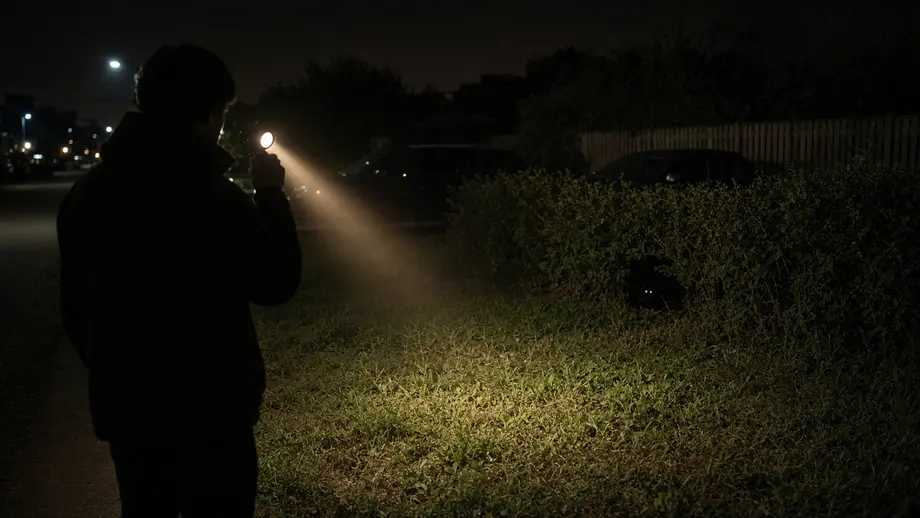
To find a lost pet at night, start where it got out and search slowly outward. Hold a light at eye level and sweep it low across hedges, decks and parked cars, looking for the glow of eyes. Walk quietly and speak softly. Don't shout or chase: a frightened dog or cat usually hides deeper or runs farther.
This table shows what you may notice when you try to find a lost pet at night, the likely reason and the first thing to do.
| What you notice | Likely reason | First move |
|---|---|---|
| Nothing at all in the first hour | Most missing cats hide close by; dogs often circle the area and rest in between | Search the first 40 m (131 ft) around the point of escape before driving anywhere |
| A pair of glowing eyes low in a hedge or under a car | Light bouncing off the reflective layer behind the eye | Stop, lower the beam off the face, crouch and speak in a normal voice |
| Eyes that move away each time you step closer | A dog in "survival mode" or a panicked cat | Sit down, stop moving toward it, put food on the ground and call for help |
| Your dog was seen at dusk, then sightings stopped | Dogs tend to circle and rest to save energy | Keep flyers up, set out food and scent at one spot, widen the radius |
| A glow you can't identify | Raccoons, opossums and other animals shine too | Confirm the shape, size and color before you approach |
| Your blue-eyed dog never shows eyeshine | Some dogs, mostly blue-eyed ones, lack the reflective layer | Scan for the outline and movement instead, or use thermal |
| Your pet is injured, trapped or in a storm drain | Needs rescue, not a search | Call animal control or an emergency vet right away |
The usual problem is panic: driving around, shouting a name, and a flashlight dying at 1 a.m. Research on missing cats links a slow physical search, including a walk at night with a flashlight, to better odds of finding the cat alive. The sections below show how to scan for eyes, where to look first and which lights last all night.
📋 Table of Contents
- 1. How Do You Find a Lost Pet at Night?
- 2. The Eyeshine Scan: Height, Angle and Speed
- 3. Lost Dog Search vs Lost Cat Search: How Behavior Changes the Plan
- 4. Will a Lost Dog Travel at Night?
- 5. Searching for a Cat at Night: Where Do Hidden Cats Turn Up?
- 6. Which Sounds Help and Which Push a Lost Pet Away?
- 7. Search Order: Concentric Rings From the Point of Escape
- 8. Where Should You Put Scent Items and Food?
- 9. Does Thermal Imaging Help Find a Lost Pet at Night?
- 10. What Lights and Gear Should You Bring?
- 11. When Should You Call for Help Instead of Searching Alone?
- 12. How Often Do Lost Pets Get Found?
- 13. How Long Do Dog Spirits Stay With You?
- 14. A Night Search Checklist You Can Follow Tonight
- 15. FAQ
How Do You Find a Lost Pet at Night?
You find a lost pet at night by searching a small area thoroughly before a large area loosely. Start at the point of escape, keep the light at eye level so eyeshine returns to you, and check every low, dark hiding spot in the first ring of yards. In a 2018 study of 1,210 missing cats, half of the cats found alive with a recorded distance were within 50 m of where they went missing.
That study, published in the journal Animals by Huang and colleagues, put the 75th percentile for those cats at 500 m. Its authors concluded that "thorough physical searching is a useful strategy, and should be conducted within the first week after cats go missing." Night work matters here. Among owners who walked the area at night with a flashlight or spotlight and found their cat alive, 53% (190 of 356) named it as the search method that helped most.
Dogs follow a different pattern. In a national survey of 1,015 pet-owning households by ASPCA researchers Weiss, Slater and Lord (2012), 49% of recovered dogs were found by the owner searching the neighborhood. Another 20% came home on their own, and 15% came back because of a tag or microchip.
For a cat, search close and slowly. For a dog, search the neighborhood, then shift to sightings, flyers, food and scent at one spot. Both need a light that runs for hours; Olight's EDC flashlights are pocket lights you will already have with you when a pet slips out.
The Eyeshine Scan: Height, Angle and Speed
The eyeshine scan works because dogs and cats have a mirror-like layer behind the retina that sends light back toward its source. Hold the light at eye level, not at your hip, so the returning glow reaches your eyes. Sweep the beam slowly and low, pause at each hedge, deck and car, and look just beyond the bright center of the beam.
The Texas Parks and Wildlife Department explains in its young naturalist article on eyeshine this: "Because eyeshine is directed back to the light source, you must be in the right spot to be able to see it, usually directly behind the light." It also gives the technique in plain words: "shine it in an arc around you and try to catch its reflection in the eyes of night creatures just beyond its circle of light."
How far from your eyes should the light be? The angle between the light and your eyes is set by simple geometry: angle = arctan(offset ÷ distance). This table uses three example offsets. Measure your own: a headlamp band sits about 5 cm (2 in) above the eyes, a light held against the cheek about 10 cm (4 in), and a light swinging at the hip about 60 cm (2 ft) below them. These are illustrative assumptions, not measured values.
| Where the light is | Offset from your eyes | Angle to a pet 5 m (16 ft) away | Angle at 10 m (33 ft) | Angle at 30 m (98 ft) |
|---|---|---|---|---|
| Headlamp on your forehead | 5 cm (2 in) | 0.57° | 0.29° | 0.10° |
| Handheld resting on your cheek | 10 cm (4 in) | 1.15° | 0.57° | 0.19° |
| Handheld at your hip | 60 cm (2 ft) | 6.84° | 3.43° | 1.15° |
The hip position puts your eyes about 12 times farther off the return path than a headlamp at every distance, and the gap is widest up close, where a hiding cat usually is. That is the geometric case for a headlamp or a raised handheld.
Use these three settings on the scan:
- Height: keep the light at eye level. With a handheld, rest it against your cheek or brace your wrist on your shoulder.
- Angle: aim low. Cats in the Huang study were most often found in a yard, under vegetation or shrubs, and under a patio, deck or porch. Sweep from ground level up to about knee height first, then check trees and roofs.
- Speed: move the beam slowly and stop at every likely hiding spot for a few seconds. A reflection can show for only a moment as the animal blinks or turns its head.
What color will you see? The American College of Veterinary Ophthalmologists says in its guide to why dogs' eyes shine at night that the tapetum's reflection "can vary from a green, blue, orange or yellow hue." It adds: "Some dogs, similar to humans, do not have a tapetum. This is most common in dogs with blue eyes." If your dog has blue eyes, don't rely on a bright glow. Scan for the outline and for movement.
Tip: Don't hold the beam on a pet's face once you have found it. Drop the bright center to the ground in front of the animal so it can still see you, then switch to a low mode or red light.
Lost Dog Search vs Lost Cat Search: How Behavior Changes the Plan
A lost dog search and a lost cat search need different plans because the animals behave differently once they are lost. Cats usually hide close to home and stay silent, so the search is slow and close. Dogs cover more ground and may run from people, including owners, so the plan leans on sightings, calm helpers, and food and scent left at one spot.
The recovery numbers show the gap. In the national survey published in 2012, 93% of lost dogs and 75% of lost cats were recovered. A 2007 study of lost pets in Montgomery County, Ohio, by Lord and colleagues found that 71% of lost dogs were recovered with a median time to recovery of 2 days. A companion study found that 53% of lost cats were recovered with a median of 5 days.
The Thomas J. O'Connor Animal Control and Adoption Center, which serves Springfield, Chicopee and Holyoke, Massachusetts, describes dog behavior bluntly in its lost dog guide: "Dogs in survival mode will even run from bonded owners, which is often surprising but completely normal." It adds that "Survival mode has nothing to do with breed, temperament, or attachment to a person."
This table sets the two searches side by side, using the studies above.
| Factor | Lost dog | Lost cat |
|---|---|---|
| Recovered (Weiss et al. national survey, published 2012) | 93% | 75% |
| Most common way they came back | Owner searched the neighborhood (49%) | Returned on its own (59%) |
| Median time to recovery (Lord 2007, Ohio) | 2 days | 5 days |
| Typical distance | Not measured in these studies; dogs often circle the area | Median 50 m; indoor-only cats median 39 m |
| Behavior when scared | May run from anyone, owner included | Hides silently in the nearest dark cover |
| Best search mode | Quiet sightings, flyers, food and scent at one spot | Slow, close eyeshine search, then a humane trap |
| Worst mistake | Chasing, group searches, yelling | Driving around instead of searching nearby yards |
Indoor-only cats stay closest: a median of 39 m in the Huang study, with a 75th percentile of 137 m. Cats allowed outside unsupervised had a median of 300 m, and a quarter were found more than 1,609 m (one mile) away.
Will a Lost Dog Travel at Night?
Yes, a lost dog can travel at night, but it usually doesn't cover ground in a straight line. The Springfield, Massachusetts animal control center notes that lost dogs "tend to circle, hunker, circle, hunker," and that fewer sightings usually mean the dog is resting between circuits to save energy. It still advises you to keep hanging flyers and expand the radius in case the dog has traveled.
The same guide warns that "predators are a real threat, especially between dawn and dusk," and that a dog in survival mode lumps people in with them.
Pressure changes the pattern. The guide says that "as soon as there is heavy foot/car traffic, a dog can feel hunted and will run in a panic, potentially into traffic."
For a night search, that means:
- Search with one or two calm people, not a crowd.
- Check sightings quickly, then back off. Don't chase a dog you have spotted.
- Walk the routes your dog knows from daily walks, where a helper can watch quietly.
Safety note: You are also a pedestrian on a night search. NHTSA's pedestrian safety guidance advises: "If there is no sidewalk, walk facing traffic and as far from traffic as possible." Wear something reflective and keep a light pointed at the ground ahead of you when you walk along a road.
Searching for a Cat at Night: Where Do Hidden Cats Turn Up?
When searching for a cat at night, check low, dark cover within a few houses of home first. In the Huang study, 83% of cats found alive were found outside. The most common spots were a yard, waiting outside the home, under vegetation, and under a patio, deck or porch. Another 11% were found inside someone else's house.
This table lists where the 485 cats found outside were located, from the same study, and how to check each spot with a light.
| Where the cat was found outside | Share of cats | How to check it at night |
|---|---|---|
| In a yard | 20% | Sweep the ground and fence lines at eye level, then check under steps and furniture |
| Waiting outside the home | 19% | Check doors, windows and porches every hour; leave the porch light low |
| Under vegetation or shrubbery | 16% | Crouch to shrub height and shine into the base of the plants |
| Under a patio, deck or porch | 10% | Lie down and shine along the gap; look for eyes, not the whole cat |
| Under a house | 5% | Check crawl space vents and gaps in the skirting |
| Storm drain or sewer | 4% | Look and listen at the grate; call animal control rather than climbing in |
| In a garage | 4% | Ask neighbors to open and check garages and sheds |
| Under a vehicle | 3% | Shine low across driveways and along parked cars |
| Up a tree | 1% | Scan branches last, after ground-level cover |
The table shows why "look up the trees" is often the wrong first move. Only 1% of these cats were up a tree, while at least 31% were in low cover: under shrubs, decks, houses, sheds, garages and vehicles. For the rare treed cat, the eye shine and beam methods in our coon hunting headlamp guide apply to tall trees too.
Ask neighbors before you walk their yards. In the same study, 46% of owners asked for and received permission to search neighbors' property slowly and methodically, and 62% of those cats were found alive. That was the highest found-alive rate of any physical search type listed.
Which Sounds Help and Which Push a Lost Pet Away?
Soft, familiar sounds help; loud, repeated calling and crowds usually hurt. Speak in your normal voice, use the words your pet hears every day, pause often to listen, and shake a treat bag or food bowl if that means dinner at home. Stop shouting a pet's name over and over. A frightened animal can hear the panic in it and stay hidden.
The research is more nuanced than "never call." In the Huang study, 93% of owners called their cat's name while searching. But among those who found their cat alive, only 34% named calling as the method that helped most. By comparison, 53% named the nighttime flashlight search. Calling doesn't hurt if it's calm. It's rarely what finds a hiding cat.
For dogs, the Springfield guide is direct. It recommends that owners "assume a dog is in survival mode, and avoid searching in groups, yelling out to a lost dog, attempt to catch, or post details on social media." It also asks that flyers and posts tell the public not to call out or chase the dog.
This table sorts common sounds by what they are likely to do, based on the guidance above.
| Sound | Likely effect | Use it? |
|---|---|---|
| Your normal voice saying familiar words | Reassures without sounding like a threat | Yes, then pause and listen |
| Treat bag, food can or bowl being tapped | Links you with food and home | Yes, especially for food-motivated pets |
| Long silent pauses | Lets you hear a meow, rustle or tags jingling | Yes, stop every few minutes |
| Shouting the name again and again | Can signal panic; pushes a scared dog away | No |
| A group of people calling from different sides | Can make a dog feel surrounded or hunted | No |
| Cars following the pet, horns | Can drive a dog into traffic | No |
One easy trick: record the treat bag or can opener on your phone and play it softly at each stop.
Search Order: Concentric Rings From the Point of Escape
Search in rings that start at the point of escape and grow outward, finishing each ring before you move on. Ring 1 is the first 40 m (131 ft), Ring 2 runs to 140 m (459 ft) and Ring 3 runs to 500 m (1,640 ft). The first two rings match the Huang study's figures for indoor-only cats, and Ring 3 reaches the distance within which three quarters of all found cats turned up.
Why not drive around the neighborhood? In the Huang study, owners who drove around had a found-alive rate of 52%, lower than the rates for yard searches (59%), slow methodical searches (60%) and searching neighbors' property with permission (62%). Driving covers distance but misses low hiding spots.
The ring sizes also show why a night plan needs priorities. This table computes the area of each ring (π × outer radius² minus π × inner radius²) and the distance you would walk to sweep it in lanes 10 m (33 ft) apart, checking about 5 m to each side. It then applies the walking speed the Federal Highway Administration's Manual on Uniform Traffic Control Devices (11th Edition, December 2023, Section 4I.06) uses for pedestrian signal timing: 3.5 feet per second, or about 1.07 m per second.
| Ring | Distance from escape point | Area | Walking needed at 10 m lane spacing | Minimum time at 3.5 ft/s, no stops |
|---|---|---|---|---|
| Ring 1 | 0 to 40 m (0 to 131 ft) | 5,027 m² (1.24 acres) | 503 m (0.31 mi) | 7.9 minutes |
| Ring 2 | 40 to 140 m (131 to 459 ft) | 56,549 m² (13.97 acres) | 5,655 m (3.51 mi) | 88 minutes |
| Ring 3 | 140 to 500 m (459 to 1,640 ft) | 723,823 m² (178.86 acres) | 72,382 m (44.98 mi) | 18.8 hours |
Here is the arithmetic for Ring 2: π × (140² − 40²) = π × 18,000 = 56,549 m². Divided by a 10 m lane spacing, that is 5,655 m of walking. At 1.0668 m per second, it takes 5,301 seconds, or about 88 minutes, with no stops at all. Real searching, with crouching, pausing and asking permission, takes several times longer. These are estimates, not measured search times.
So search Ring 1 twice in the first hour, fast and then slowly. Ring 2 is a full night for one person. Ring 3 is 144 times the area of Ring 1, so cover it over several days with flyers, neighbors, cameras and traps.
If the pet got out after the clocks changed in the fall, a search that starts after dinner now starts in full darkness. Our guide to the weekend daylight saving time ends covers how much earlier sunset arrives and which lights make a dark walk safer.
Where Should You Put Scent Items and Food?
Put scent items and food at one spot: the point of escape, which is usually your home. Set out your pet's bedding and a piece of your worn clothing, plus strong-smelling food scattered on the ground. Don't leave items everywhere the pet has been seen. One station gives a lost pet one clear place to return to, and a camera there confirms visits.
The Springfield animal control guide tells owners to scatter high-value food at the point of escape, with "no bowl," and adds: "Put out your dog's bedding/dirty laundry/familiar scent items at the point of escape as well." It explains that "dogs can smell approximately a football field away and naturally circle the area if not chased or pressured to relocate."
For cats, set the station by the door they know. In the Huang study, 38% of owners who used a trapping technique also set up a camera to confirm the cat was hiding nearby.
Then consider a humane trap. Among owners in the Huang study who used a trapping technique, 88% used a humane or drop trap, 65% of those cats were found alive, and 72% of the owners whose cat was found alive said the trap helped most. The 2012 national survey's authors reached a similar view: "Collars and ID tags or humane trapping could be valuable approaches." Ask your local animal control agency or shelter whether it lends traps and how often it requires them to be checked.
Check a set trap often. You may catch a neighbor's cat or a wild animal; ask animal control for help with wildlife.
Does Thermal Imaging Help Find a Lost Pet at Night?
Thermal imaging helps when a warm pet is in the open or in thin cover, and it fails when the pet is behind a solid barrier. A thermal monocular shows a cat on a lawn, a fence line or an open field edge even when its eyes are closed. It will not show a cat under a deck behind solid boards, inside a shed or behind a window.
Olight's product page for the TS004 thermal imaging monocular says it "effectively penetrates fog and dense vegetation." Read that as seeing heat through gaps in cover and seeing farther than your eyes do in fog. Teledyne FLIR, a thermal camera maker, states in its guide to what thermal imaging can see through that "thermal imaging cannot see through trees (or wood)." It also notes that "glass acts like a mirror for infrared radiation." The TS004 user manual answers the same question for walls, water and glass with a plain "No."
So how much of a real cat search can thermal cover? This table takes the spots where the 485 cats found outside turned up in the Huang study and sorts each by whether a thermal monocular has a clear line of sight to it. The sorting applies the FLIR and TS004 limits above; it is a planning estimate, not a measured detection rate.
| Where cats found outside were located (Huang study) | Share | Thermal line of sight | Better tool |
|---|---|---|---|
| In a yard | 20% | Clear, unless the cat is under furniture or steps | Thermal scan first, then white light to confirm |
| Waiting outside the home | 19% | Clear from the street or a window you have opened | Thermal or a quick porch check |
| Under vegetation or shrubbery | 16% | Partial: only through gaps in the leaves | Crouch and shine into the base of the plants |
| Under a patio, deck or porch | 10% | Blocked by solid boards; open gaps only | Flashlight along the gap, looking for eyes |
| Under a house | 5% | Blocked | Flashlight at vents and skirting gaps |
| Storm drain or sewer | 4% | Blocked | Listen at the grate; call animal control |
| In a garage | 4% | Blocked by walls and doors | Ask the owner to open and check it |
| Under a vehicle | 3% | Partial: only from a low angle at the side | Flashlight low along the car |
| Up a tree | 1% | Partial: branches and trunks block heat | Thermal on bare limbs, white light for the rest |
Add up the rows. Only 39% of these cats (yard plus waiting outside) sat where thermal has a clear view, and 20% sat in partial cover. At least 23% were behind solid cover that thermal can't see through, so the flashlight still does most of the work. Olight rates the TS004's identification distance at 91 m. In a neighborhood search, treat any warm shape as unconfirmed until you see it in white light, because raccoons, opossums and other cats glow the same way. Our thermal monocular for deer recovery guide works out how much ground each TS004 pixel covers at range, so this guide doesn't repeat that math.
Where thermal pays off in a pet search:
- Open lawns, parks and field edges beside your neighborhood
- Rooftops and the tops of fences, where a cat can sit out of flashlight reach
- Scanning a whole backyard in seconds before you walk it
- Checking a trap or food station from a distance without disturbing it
A flashlight does better under decks, porches and cars and inside dense shrubs.
What Lights and Gear Should You Bring?
Bring a headlamp for eyeshine and hands-free work, a handheld with a long-reaching spot beam for open ground, a spare light or battery, and a phone with a charged battery. Add treats, a slip lead or carrier, and a flyer with a recent photo. For a long search, choose lights by the runtime of the mode you will actually use, not the maximum output.
This table lists the gear for a night search and what each item is for.
| Item | Why you need it | Notes |
|---|---|---|
| Headlamp | Keeps the light next to your eyes for eyeshine; frees both hands | A red mode helps once the pet is found |
| Handheld light with a spot beam | Reaches across open lots, fields and backyards | Use the spot only for long views; drop to low for close cover |
| Spare light or charged battery | Long searches outlast one battery | Check the runtime of your walking mode before you leave |
| Treats or strong-smelling food | Rewards a pet for approaching; bait for a trap | Use food your pet already knows |
| Slip lead or cat carrier | Secures a frightened pet once it's close | Keep it out of sight until the pet is near |
| Phone with photos and your number | Show neighbors; take sighting reports | Save the numbers for animal control and nearby vets first |
| Reflective vest or armband | Makes you visible on roads | NHTSA advises walking facing traffic where there's no sidewalk |
| Flyers and tape | Leave a trail of contacts in Ring 2 and Ring 3 | Include "do not chase or call out" for a dog |
| Thermal monocular, if you have one | Scans open ground and rooftops quickly | Confirm every warm shape with a white light |
Runtime is where a search plan often fails, and a cat search runs for a week, not a night. The Huang study found a third of cats were recovered alive within 7 days, so plan for seven nights of searching. This table divides each mode's rated runtime by a 3-hour night search to show how many nights one full charge covers, and whether one charge lasts the first week. It's based on Olight's rated runtimes, not measured. The Marauder Mini manual notes that its runtime figures come from tests "performed indoors under a room temperature of 25 degrees celsius with windless conditions." Expect less on a cold night.
| Light and mode (Olight rating) | Rated runtime | 3-hour search nights per charge | Covers 7 nights on one charge? |
|---|---|---|---|
| Olight Perun 3, Low 30 lumens | 89 hours | 29.7 | Yes, about four weeks |
| Olight Perun 3, Med 120 lumens | 25 hours | 8.3 | Yes, with one night to spare |
| Olight Marauder Mini, Level 2 spotlight 100 lumens | 21.5 hours | 7.2 | Only just; recharge midweek |
| Olight Marauder Mini, Level 3 spotlight 200 lumens | 11.5 hours | 3.8 | No: charge every third night |
| TS004 thermal monocular | 11 hours | 3.7 | No, if left on the whole time; short scans stretch it |
| Olight Oclip 2 Pro, Low floodlight 10 lumens | 25 hours | 8.3 | Yes |
| Olight Oclip 2 Pro, Medium floodlight 100 lumens | 3 hours 45 minutes (product page); 3 h 30 min (user manual) | 1.25 (page) or 1.17 (manual) | No: charge it every day |
The pattern is simple. Walk on a low or middle mode, save the high modes for a few seconds of long-range looking, and put every light on the charger when you get home.
The headlamp: Olight Perun 3. The hard part of an eyeshine search is keeping the light next to your eyes for hours. The Perun 3 is a headlamp that also works as a handheld, with a 3,000-lumen maximum, 6,400 candela and a 160 m beam distance. Its modes are Turbo 3,000~800~600 lumens (2 + 180 + 30 minutes), High 600~120 lumens (300 + 30 minutes), Med 120 lumens (25 hours), Low 30 lumens (89 hours) and Moon 5 lumens (20 days), plus red light at 60 lumens (14 hours) and 15 lumens (70 hours). It is rated IP68 and weighs 150 g, and it sells for $89.99 (regular price, September 2026). The limit: 6,400 candela is a walking and close-search beam. For a field edge 100 m away, you want a dedicated thrower.
The thrower: Olight Marauder Mini with RGB. Open lots and back fields need reach. The Marauder Mini has a 90,000-candela spotlight rated at 600 m and a 7,000-lumen floodlight, with a rotary knob for seven levels and a toggle between spot and flood. Its Level 3 spotlight runs 200 lumens for 11.5 hours, and Level 2 runs 100 lumens for 21.5 hours. It also has red, green and blue LEDs, rated IPX8. The limits: it weighs 462 g (16.3 oz) with its battery and costs $199.99 (regular price, September 2026), and its 7,000-lumen floodlight is rated for 2 minutes before stepping down (7,000~1,600~900 lumens, 2 + 160 + 10 minutes). The black version was listed for sale when this was written; Olight lists the Desert Terrain and OD Green colors as sold out.
The backup clip light: Olight Oclip 2 Pro. A search needs a second light that rides on a jacket, a bag strap or a leash handle. The Oclip 2 Pro has a 530-lumen floodlight, a 3,906-candela spotlight rated at 125 m, a 40-lumen red light, a 115° head tilt and a clip that grips up to 14 mm. It weighs 75.5 g and sells for $54.99 (regular price, September 2026). The limits matter here. Its 600 mAh battery can't run the 100-lumen Medium mode for a whole 4-hour search. It's rated IP66, and the manual says: "Do not immerse the product in water or other liquids, as it will damage the product." The manual also labels it "Non-pet toys," so keep it on your jacket or bag and out of a pet's mouth. And in the cold, the manual says that "In environments below 0°C (32°F), the white light is limited to Low and Medium modes." The Oclip 2 user manual adds a caution for anyone with an implanted heart device: "If you have an ICD or pacemaker, avoid close or prolonged contact with this product to prevent possible interference."
The thermal option: TS004. Olight lists a 256 x 192 sensor, a 13 mm lens, 50Hz, NETD under 40mK, a detection distance of 410m, an identification distance of 91m, an 11-hour battery, IP67 and 330g, for $499.00 (regular price, September 2026). The limits are price and solid cover.
To read candela and beam distance before you buy, see flashlight throw vs flood. The Marauder Mini manual cites the ANSI FL1 method in its 2009 edition (ANSI/NEMA FL 1-2009); the current edition is ANSI/PLATO FL 1-2025, per PLATO's summary of the revision.
Warning: Don't shine a high mode into your pet's eyes, or anyone else's. The Oclip 2 manual warns: "Do not look directly at the light source or shine it into your eyes, as this may cause temporary blindness or permanent damage to your eyes."
When Should You Call for Help Instead of Searching Alone?
Call for help right away if your pet is injured, trapped, near a highway or in a storm drain, or if you believe it was stolen. Call animal control and nearby shelters on the first day in any case. The 2007 Ohio study found that owners who called an animal agency had a higher likelihood of recovering a lost dog, with a hazard ratio of 2.1.
The same study found owners were "less likely to recover their dogs if they believed their dogs were stolen (hazard ratio, 0.3)." That's a reason to report a suspected theft to police early. For cats, the companion study found that the most successful search method, neighborhood signs, worked only 12% of the time. That's why the slow physical search and the trap carry so much weight.
This table sorts common situations into keep searching yourself or call for help.
| Situation | Keep searching yourself | Call for help now |
|---|---|---|
| Cat hiding silently near home | Yes: slow eyeshine search, food station, camera, trap | If it's still missing after the first night, add shelters and flyers |
| Dog seen circling the neighborhood | Yes: quiet sightings, food and scent at one spot | Call animal control to report sightings and ask for support |
| Dog running along a busy road or highway | No | Call animal control or police; don't chase it toward traffic |
| Pet visibly injured or not moving | No | Call an emergency vet and animal control |
| Pet trapped in a storm drain, crawl space or wall | No | Call animal control or the non-emergency fire line |
| You believe the pet was stolen | No | Report to police and to animal control |
| Nothing after 24 hours | Keep the station and camera going | Visit shelters in person and check their found-animal lists |
Note: Check shelters in person when you can. In the Weiss 2012 survey, 6 of the 8 dog owners whose dogs were never found had visited a shelter, a small sample, so keep the physical search, flyers and food station going alongside shelter visits.
How Often Do Lost Pets Get Found?
Most lost pets are found. In a national survey of US households published in 2012, 93% of lost dogs and 75% of lost cats were recovered. Smaller local studies report lower rates: 71% of dogs and 53% of cats in one Ohio county. For cats, a close physical search in the first week gives the best documented odds.
Timing matters most for cats. In the Huang study of 1,210 missing cats, only 61% were found within one year, and 34% were recovered alive by the owner within 7 days. The authors report: "Few cats were found alive after 90 days." That's the case for searching hard in the first week, and for starting the first night.
Identification helps too. In the national survey, 15% of recovered dogs came back after someone contacted the owner because of a tag or microchip, and cats were less likely than dogs to have any type of identification. If your pet comes home, add a collar tag with your phone number and check that its microchip record has your current contact details.
How Long Do Dog Spirits Stay With You?
No one can measure how long a dog's spirit stays with you; that is a question of faith and personal belief, and traditions answer it differently. What is known is that grief after a pet dies has no fixed schedule. Cornell University's College of Veterinary Medicine says there is no "normal" way to grieve, "nor is there a prescribed timeline that grief will follow."
Some searches end with sad news, or with no answer at all. If that happens, the feelings can include guilt that you didn't search sooner or longer. Cornell's pet loss resources page lists "questioning the afterlife" among the spiritual parts of grief, alongside physical, emotional and social ones, and says: "No one needs to face grief alone."
Cornell runs a Pet Loss Support Hotline staffed by trained veterinary students at 607-218-7457. Its page notes that hours vary seasonally and that callers can stay anonymous. The same page lists online groups and other veterinary school support options.
A Night Search Checklist You Can Follow Tonight
This checklist puts the method to find a lost pet at night in order for one or two people on the first night. Repeat it on later nights, adjusting the start point to new sightings, while flyers, the food station, a camera and a humane trap do the wider work.
- Before you leave. Charge your phone, pick a headlamp and a handheld, and pack treats, a lead or carrier and a reflective vest.
- Search the house again. Check closets, under beds, inside furniture, the basement and the garage. In the Huang study, 4% of found cats were inside their own home.
- Set the station. Put bedding, worn clothing and food at the point of escape. Aim a camera at it if you have one.
- Sweep Ring 1 fast. Walk the first 40 m (131 ft) at eye level with the light, scanning low for eyeshine.
- Sweep Ring 1 slowly. Crouch at every shrub, deck, porch and car. Pause, listen and speak softly.
- Move to Ring 2. Work street by street out to 140 m (459 ft). Ask neighbors to check garages and sheds, and ask permission before you enter yards.
- Stop every few minutes. Turn the light off for 20 seconds and listen for meows, rustling or tags.
- Use thermal on open ground, if you have it. Scan lawns, rooftops and field edges, then confirm with a white light.
- If you see your pet, stop, lower the beam and crouch. Let a dog come to you. Don't grab a frightened cat from cover; keep watch and set a trap nearby if it retreats.
- Before bed. Check the station, log sightings with time and place, and call animal control and nearby shelters in the morning.
FAQ
Changelog
- September 24, 2026: First published.