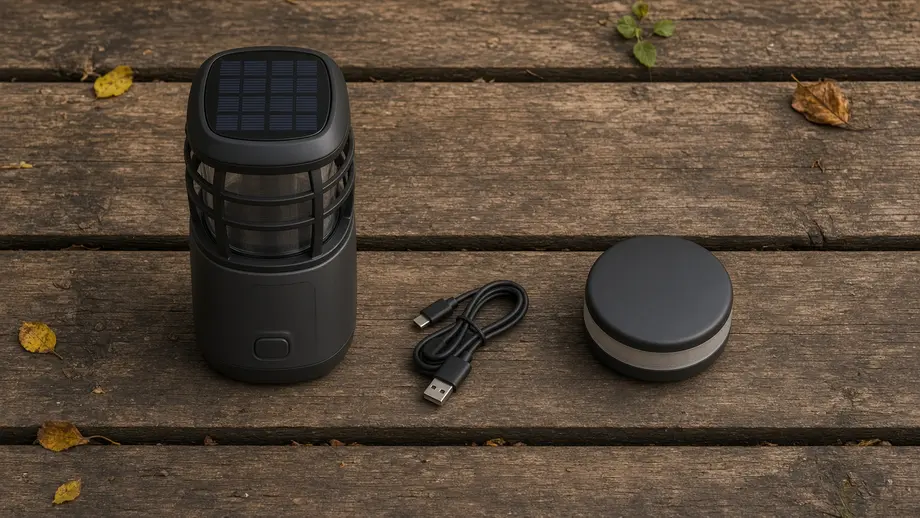
Olight makes some of the lights discussed here. Olight specs and prices come from its US product pages and user manuals as of September 2026; Goal Zero and LuminAID specs come from their makers' websites, and sun-hour data comes from the National Laboratory of the Rockies. Runtime, charge and cost figures below are arithmetic from those published numbers, not field measurements.
⚡ TL;DR
Rechargeable camping lights are the better main light for cooking, chores and night walks, because a cable or power bank fills them in hours and they store far more light. Solar camping lights make sense as a dim tent or table glow at sunny, open sites. At current U.S. electricity prices, free sunlight saves you less than half a cent per charge.
Here is the problem you are probably trying to solve. A solar lantern looks like it pays for itself, since it never needs an outlet. But state park and forest campsites are often under trees, fall weekends bring clouds, and nobody tells you how long that lantern will actually glow after a gray day. This guide answers that with the makers' own charge times and runtimes, plus the math.
This table sums up how rechargeable camping lights and solar camping lights compare, using the figures worked out later in this guide.
| Dimension | Rechargeable (Olight examples) | Solar (Goal Zero and LuminAID examples) | Who wins | By how much |
|---|---|---|---|---|
| Purchase price | $17.99 to $89.99 | $29.95 to $33.00 | Neither by type | The cheapest light in this comparison is rechargeable |
| Energy cost per full charge | 0.04 to 0.41 cents from the wall | Free from the sun | Solar | Under half a cent per charge |
| Time to a full charge | 1.5 hours (Oclip 2 Pro by USB-C) to under 4 hours (Perun 3) | 10 to 20 hours of strong sun (maker figures), or 2 to 4 average September days | Rechargeable | 2.5 to 13 times faster |
| Light stored per charge | 3,000 lumen-hours (Perun 3 on Med) | 210 lumen-hours (Crush Light on Low) | Rechargeable | About 14 times more |
| Shade and cloudy days | No effect | Charge drops sharply | Rechargeable | An overcast day refills roughly 5 to 10 percent (estimate) |
| A week with no outlet or power bank | Runs down | Refills on sunny days | Solar | The only type that recharges itself |
| Light for tasks | Up to 3,000 lumens and 160 m (Perun 3) | 60 to 75 lumens of lantern glow | Rechargeable | 40 or more times the peak output |
If you want to see the wider range first, Olight's camping flashlights and outdoor lights are grouped on one page. The sections below explain where each number comes from.
📋 Table of Contents
- 1. How Much Do Rechargeable and Solar Camping Lights Cost?
- 2. How Long Does It Take to Charge a Solar Lantern?
- 3. Runtime Comparison: How Long Each Light Lasts Over a Two-Night Weekend
- 4. What Does Each Night of Light Cost?
- 5. Where Solar Camping Lights Save and Where They Cut Corners: Battery, Panel and Water Resistance
- 6. When Should You Bring Both? A Family Campsite Setup
- 7. Myth: Leaving a Solar Light on the Dashboard Charges It Fully
- 8. What Is the Best Rechargeable Light for Camping?
- 9. What Is the Best Lighting for Camping?
- 10. Are There Any Rechargeable LED Camping Lights Available?
- 11. Who Should Choose Rechargeable Camping Lights, and Who Should Choose Solar?
- 12. Your Pre-Trip Checklist
- 13. FAQ
How Much Do Rechargeable and Solar Camping Lights Cost?
Rechargeable and solar camping lights overlap in price. In this comparison, the Olight Sphere Ambient Light costs $17.99, the Goal Zero Crush Light $29.95 and the LuminAID PackLite Nova USB $33.00. Rechargeable task lights cost more: $54.99 for the Olight Oclip 2 Pro and $89.99 for the Olight Perun 3. The extra money buys battery capacity and beam, not a power source.
So the "free sunlight" pitch does not come with a lower sticker price. A small solar lantern and a small rechargeable glow light cost about the same. The price jump comes when you move from a lantern to a task light with a real beam and a large battery.
This table lists each light's regular price and what that price buys, based on the makers' published specs in September 2026.
| Light | Type | Regular price | Max output | Battery | How it charges |
|---|---|---|---|---|---|
| Olight Sphere Ambient Light (Sphere C) | Rechargeable ambient light | $17.99 | 75 lumens | 700 mAh, 3.7 V (2.59 Wh) | USB-C |
| Goal Zero Crush Light | Solar lantern | $29.95 | 60 lumens | 1.85 Wh | Built-in panel or USB |
| LuminAID PackLite Nova USB (Original White) | Solar lantern | $33.00 | 75 lumens | Not listed | Solar or USB |
| Olight Oclip 2 Pro | Rechargeable clip light | $54.99 | 530 lumens (floodlight) | 600 mAh, 3.7 V (2.22 Wh) | USB-C or MCC |
| Olight Perun 3 | Rechargeable headlamp and flashlight | $89.99 | 3,000 lumens | 5,000 mAh, 3.6 V (18 Wh) | MCC3 magnetic cable |
Prices are regular prices as of September 2026: Olight's from its US store on September 24, and Goal Zero's and LuminAID's from their own sites on September 25. Solar specs in the rest of this guide come from the Goal Zero Crush Light page and LuminAID's lantern spec comparison; the Nova's price comes from its product page. The Olight Perun 3 Mini ($64.99) is another head-to-hand option, but its default Orange CW version showed Sold Out on September 24, 2026, so it is not a pick here.
How Long Does It Take to Charge a Solar Lantern?
A solar lantern needs 10 to 20 hours of sun for a full charge, going by its maker's figures. LuminAID lists 10 to 12 hours for the PackLite Nova and 16 to 20 hours for the larger PackLite Max. Goal Zero lists 20 hours on the Crush Light's built-in panel, compared with 2.5 hours from a USB source. One sunny day rarely fills either one.
The reason is panel size. Goal Zero lists the Crush Light's solar cell at about 0.12 W. Over its rated 20 hours, that cell delivers about 2.4 Wh (0.12 x 20) to store 1.85 Wh, so roughly 77 percent of what the panel makes ends up in the battery. The maker's 20-hour figure fits that picture.
How many hours of sun does a campsite actually get?
A typical U.S. campsite gets the equivalent of about 4 to 6 hours of full sun per day in September, and less in October. That comes from the PVWatts calculator run by the National Laboratory of the Rockies (NLR, formerly NREL), which averages decades of weather data, cloudy days included. The figures below are for a flat, unshaded surface, which is how a lantern lies on a picnic table.
This guide treats each kilowatt-hour of sunlight per square meter as one hour of the strong sun that makers' solar charge times assume, and divides the charge time by it. The result is the number of average days it takes to fill each lantern from empty.
This table shows NLR's average daily solar energy on a flat surface for six camping regions, and what it means for the two solar lanterns in this guide.
| Area (NLR PVWatts, flat surface) | September sun (kWh per m2 per day) | October sun | Crush Light: average September days to full (20 h) | Crush Light: average October days to full | Nova: average September days to full (10 to 12 h) |
|---|---|---|---|---|---|
| Great Smoky Mountains, Tennessee | 4.73 | 3.72 | 4.2 | 5.4 | 2.1 to 2.5 |
| Denver, Colorado | 5.34 | 3.89 | 3.7 | 5.1 | 1.9 to 2.2 |
| Seattle, Washington | 3.77 | 2.15 | 5.3 | 9.3 | 2.7 to 3.2 |
| North Conway, New Hampshire | 4.46 | 2.71 | 4.5 | 7.4 | 2.2 to 2.7 |
| Austin, Texas | 5.40 | 4.34 | 3.7 | 4.6 | 1.9 to 2.2 |
| Phoenix, Arizona | 6.09 | 4.85 | 3.3 | 4.1 | 1.6 to 2.0 |
Even in Phoenix in September, the Crush Light needs more than three average days of open sun to fill from empty. In a Seattle October, it needs over nine. LuminAID's own support page makes the same point in plainer terms: if the light is charging, "leave it to charge for a few hours by micro USB, or at least 1-2 full days in direct sun," according to its lantern FAQ.
Sky conditions then cut into that. The U.S. Department of Energy's solar radiation basics page says "Atmospheric conditions can reduce direct beam solar radiation by 10% on clear, dry days and by 100% during thick, cloudy days." The same page notes that the greatest amount of solar energy arrives around solar noon, and that Denver receives nearly three times more solar energy in June than in December. NLR's numbers agree: 7.38 in June against 2.31 in December for Denver. A fall camping trip starts with less sun than a July one.
LuminAID says you can still charge on gray days: "You can solar charge your LuminAID in cloudy or overcast weather, but be aware that it will take longer to charge."
The sun-hours budget: what one day of sun buys you
To turn those charge times into nighttime light, divide the sun hours your panel gets by the maker's charge time. That gives the share of the battery you refill that day. The estimate below starts from NLR's September average for the Great Smoky Mountains, 4.7 sun hours at an open site. It then assumes half that in dappled shade under trees and one hour's worth on a fully overcast day. Those two shade and cloud figures are round assumptions, not measurements, and the math assumes charge builds in proportion to sunlight, which is a simplification.
This table applies that budget to the Crush Light and the Nova, using each maker's charge times and runtimes.
| Day-two condition | Sun hours | Crush Light refill (20 h panel) | Nova refill (10 to 12 h) | Crush Light time on High (60 lm) | Crush Light time on Low (6 lm) | Nova time on its longest-running level |
|---|---|---|---|---|---|---|
| Open site, average September day (NLR data) | 4.7 | 24% | 39 to 47% | 43 minutes | 8.4 hours | 9.4 to 11.3 hours |
| Dappled shade under trees (assumed half) | 2.35 | 12% | 20 to 24% | 22 minutes | 4.2 hours | 4.8 to 5.8 hours |
| Overcast all day (assumed) | 1 | 5% | 8 to 10% | 9 minutes | 1.75 hours | 2 to 2.4 hours |
The math is simple enough to redo for your own site. For the Crush Light at an open site: 4.7 / 20 = 24 percent. On High, Goal Zero rates 3 hours, so 24 percent gives 0.24 x 180 minutes = 43 minutes. On Low, 0.24 x 35 hours = 8.4 hours. LuminAID lists the Nova's maximum runtime as 24 hours without naming the level, so the last column uses that figure: 0.39 x 24 = 9.4 hours and 0.47 x 24 = 11.3 hours.
To run the numbers for your own campground, enter its location in NLR's PVWatts calculator with a tilt of 0 degrees, read the monthly solar radiation for your trip month, and divide your lantern's solar charge time by it.
Tip: Before you buy a solar lantern, find its solar charge time on the maker's spec page and divide it by the hours of direct sun your campsite gets. If the answer is more than two days, treat it as a USB lantern that can top up in the sun, not a sun-only light.
Runtime Comparison: How Long Each Light Lasts Over a Two-Night Weekend
Over a two-night weekend, the Olight Perun 3 uses about 10 percent of one charge for an hour of chores and short walks each night, and the Oclip 2 Pro about 67 percent. As a four-hour table glow, the Sphere uses about 53 percent of its battery on red light. The Crush Light can do Low for both nights but needs day-two sun to run Medium.
The plan behind those numbers is a typical family night at camp. Each night has 1 hour of cooking and cleanup plus 15 minutes of bathroom and water-spigot walks for the task light (1.25 hours), and 4 hours of glow on the table or in the tent from about dusk to bedtime for the ambient light. Each share is hours used divided by the rated runtime for that mode.
This table uses the makers' published runtimes for each mode, not measurements; real runtimes shift with temperature and battery age.
| Light | Job | Mode (maker rating) | Hours per night | Share of a full charge per night | Two nights on one charge? |
|---|---|---|---|---|---|
| Olight Perun 3 | Chores and walks | Med, 120 lumens, 25 hours | 1.25 | 5% | Yes, about 10% used |
| Olight Oclip 2 Pro | Chores and walks | Floodlight Medium, 100 lumens, 3 hours 45 minutes | 1.25 | 33% | Yes, about 67% used |
| Olight Sphere (Sphere C) | Table and tent glow | Red Light High, 11~2 lumens, 580 + 320 minutes | 4 | 27% | Yes, about 53% used |
| Olight Sphere (Sphere C) | Bright white glow | White Light High, 75~22 lumens, 100 + 150 minutes | 4 | 96% | No, recharge after night one |
| Goal Zero Crush Light | Table glow | Medium, 25 lumens, 6 hours | 4 | 67% | Only with about 33% refilled on day two |
| Goal Zero Crush Light | Dim glow | Low, 6 lumens, 35 hours | 4 | 11% | Yes, about 23% used |
| LuminAID PackLite Nova | Dim glow | Longest-running level, 24 hours | 4 | 17% | Yes, about 33% used |
Read the Crush Light rows against the sun-hours budget above. Running Medium both nights needs a 33 percent refill on Saturday. An average September day at an open site gives about 24 percent, and dappled shade about 12, so on most sites you drop to Low on night two.
The Sphere's white mode is the one to watch. At 250 rated minutes on White Light High, four hours of bright white glow nearly empties it in one night. Switching to its 1-lumen White Light Low (40 hours) or red light stretches the same battery across the weekend.
For task lights, the gap is about battery size. The Perun 3's 18 Wh battery holds almost 10 times the energy of the Crush Light's 1.85 Wh pack. That is why a rechargeable headlamp can run for a whole weekend of chores without a top-up.
What Does Each Night of Light Cost?
Each night of light costs mostly the purchase price, not the energy. Recharging the Perun 3 from empty costs about 0.41 cents at the U.S. average residential electricity price, and the smaller lights cost about 0.04 to 0.06 cents. Spread over 30 camping nights, the purchase price works out to $0.60 a night for the Sphere and $3.00 for the Perun 3.
The electricity math uses the U.S. Energy Information Administration's average residential electricity price of 18.31 cents per kWh for July 2026, a preliminary figure. It also assumes that 80 percent of the energy from the wall ends up in the battery. For the Perun 3, whose user manual lists 18 Wh: 18 / 0.8 = 22.5 Wh, and 0.0225 kWh x 18.31 cents = 0.41 cents.
The Oclip 2 Pro's user manual lists 2.22 Wh (600 mAh at 3.7 V), and the Sphere C manual lists 2.59 Wh. The purchase share assumes 10 camping nights a year for three years. Lumen-hours per charge is output times rated runtime in the mode shown; for the Sphere's stepped white mode, it is 75 lumens for 100 minutes plus 22 lumens for 150 minutes.
This table breaks the cost of each light into energy and purchase price, using regular prices from September 2026.
| Light | Regular price | Battery energy | Electricity per full wall charge | Purchase price per night (30 nights) | Stored light per charge | Price per lumen-hour of stored light |
|---|---|---|---|---|---|---|
| Olight Perun 3 | $89.99 | 18 Wh | 0.41 cents | $3.00 | 3,000 lumen-hours (Med) | $0.030 |
| Olight Oclip 2 Pro | $54.99 | 2.22 Wh | 0.05 cents | $1.83 | 375 lumen-hours (Floodlight Medium) | $0.147 |
| Olight Sphere (Sphere C) | $17.99 | 2.59 Wh | 0.06 cents | $0.60 | About 180 lumen-hours (White Light High) | $0.100 |
| Goal Zero Crush Light | $29.95 | 1.85 Wh | 0.04 cents by USB, free by sun | $1.00 | 210 lumen-hours (Low) | $0.143 |
| LuminAID PackLite Nova | $33.00 | Not listed | Not calculable | $1.10 | Not calculable | Not calculable |
Two things stand out. First, sunlight saves at most about 0.04 cents per charge on a lantern the size of the Crush Light, or about a penny over 30 nights. Second, the most expensive light here, the Perun 3, has the lowest price per lumen-hour of stored light, because its battery is so much larger.
So the real case for solar is not money. It is being able to refill away from outlets and power banks, which matters on long off-grid trips, not on a weekend at a drive-in site.
Where Solar Camping Lights Save and Where They Cut Corners: Battery, Panel and Water Resistance
Solar camping lights save on the power source and give up battery size to do it. The Crush Light's 1.85 Wh pack fills from a panel of about 0.12 W, so a bigger battery would take even longer to fill from the sun. A rechargeable light has no panel to feed, so its battery size is not tied to how fast the sun can fill it.
Battery per dollar shows the trade-off. The Crush Light buys 0.062 Wh per dollar (1.85 / 29.95). The Sphere buys 0.144 Wh per dollar (2.59 / 17.99), and the Perun 3 0.200 Wh per dollar (18 / 89.99). You pay for the panel in stored energy.
Panel placement is the second trade-off. A solar lantern has to sit face-up in open sun all day to charge, which means leaving it on a picnic table or car roof while you are out hiking. A rechargeable light charges in a pocket or tent from a power bank, out of sight.
Water resistance depends on the model rather than the power source. Olight rates the Sphere at IP56 and says it "stays IP56 dust and water resistant, even with the charging port." The Oclip 2 Pro is rated IP66 and the Perun 3 IP68. LuminAID states an IP67 rating for its lanterns. Goal Zero's Crush Light page does not list an IP rating, so check before you leave one out in a storm.
Cold nights, hot cars and storage: battery temperature limits
Solar and rechargeable camping lights share the same weak point: a lithium battery that charges only within a set temperature range. Frost stops or slows charging, and a hot car can damage the battery. Neither type has an edge here, so plan charging for the warm part of the day and store every light somewhere cool.
This table lists the temperature and storage limits each maker publishes, in its own terms.
| Light | Charging temperature | Heat warning | Storage advice | Source |
|---|---|---|---|---|
| Olight Oclip 2 Pro | 0 to 45°C (32 to 113°F); cannot charge outside it | Do not place, charge or use it in a car where temperatures may exceed 60°C | "Charge the product completely before storing it for a long period" | Oclip 2 user manual |
| Olight Sphere C | Working temperature 0 to 40°C; may fail to charge above 40°C | Do not store it in a car where temperatures may exceed 60°C | Not stated | Sphere C user manual |
| Olight Perun 3 | Working temperature 0 to 40°C | Not stated | Not stated | Perun 3 user manual |
| LuminAID lanterns | Solar charging 32 to 113°F; charges below freezing, but more slowly | Turns on from -4 to 140°F; "Do not leave your LuminAID on a car dashboard" | Recharge in direct sun every 4 to 6 months | LuminAID FAQ |
| Goal Zero Crush Light | Not listed on the product page | Not listed | Not listed | Goal Zero product page |
Two practical rules come out of that table. On a frosty fall morning, wait until the air is above freezing before you plug in a light or set a lantern out to charge; LuminAID also recommends charging when it is warmer and running Medium or Low in sub-zero cold. After the trip, top every light up before it goes back in the gear bin, then check lanterns every few months.
Note: Solar lanterns still contain a lithium battery. Charge and store them by the same rules as any rechargeable light, and bring a USB cable in case the weather turns.
When Should You Bring Both? A Family Campsite Setup
Bring both when your group needs task light and a camp marker at the same time. A rechargeable headlamp or clip light handles cooking, dishes and night walks. A dim ambient light, solar or rechargeable, marks the table or tent so people can find their way back without every headlamp on at full power.
This is also the setup that keeps light where it is useful. DarkSky International and the Illuminating Engineering Society's Five Principles for Responsible Outdoor Lighting start from one line: "Light where you need it, when you need it, in the amount needed, and no more." The principles also say to "Use warmer-color lights where possible." The Sphere C manual lists its white light at 2,800 K, and its red modes suit the same goal.
That matters in parks. The National Park Service says, in its night skies overview, that "Ecosystems rely on natural cycles of light and dark." A 1-lumen glow on the table and a red headlamp mode in camp do the job without flooding the site next door.
A layered setup for a family of four on a two-night trip:
- One rechargeable task light per adult. The Olight Perun 3 headlamp wears on the head or works handheld, with a magnetic tail and clip, and runs 25 hours at 120 lumens.
- One clip light for the cook or the dishwasher. The Olight Oclip 2 Pro tilts its head 115 degrees and clips to objects up to 14 mm thick, so it can aim at a camp stove from a strap or pole.
- One ambient light on the table. The Olight Sphere Ambient Light glows in 360 degrees and has a magnetic base, or use a solar lantern if your site gets open sun.
- One power bank for the adults' lights, sized to refill the headlamps once.
- Kids get their own light with an adult deciding which one. The Sphere C manual warns to keep new and used batteries away from children and to stop using the product and keep it away from children if the battery compartment does not close securely.
For more head-worn options, compare Olight's headlamps or the side-by-side specs in our roundup of the best headlamps.
Myth: Leaving a Solar Light on the Dashboard Charges It Fully
A solar light on a car dashboard charges more slowly than one outdoors, and it can overheat. LuminAID says it does "not recommend solar charging indoors, because windows will filter light and reduce charging efficiency." A windshield is a window, so the same advice applies.
Heat is the bigger risk, because lithium batteries have firm temperature limits. Olight's Sphere C manual says: "Do not store the product in a car or places where the temperature may exceed 60°C, because it may deform or damage the product." It adds that when working above 40°C, "it may fail to charge the product."
Solar lantern makers say the same. LuminAID's FAQ warns: "Do not leave your LuminAID on a car dashboard. A hot car can exceed the safe temperature range for this product." The Oclip 2 manual goes further and says not to place, charge or use the light in a car where the temperature may exceed 60°C. So the dashboard fails twice: the glass cuts the light, and the heat can stop charging or harm the battery.
Warning: Do not leave any lithium-battery light, solar or rechargeable, on a dashboard or in a closed car in the sun. Charge solar lanterns outdoors in open sun, and charge rechargeable lights in the shade or indoors.
The better way to use car time is a USB port. Goal Zero rates the Crush Light at 2.5 hours from a USB source, so an hour's drive to the trailhead refills a meaningful share of it.
What Is the Best Rechargeable Light for Camping?
The best rechargeable light for camping is a headlamp that also works as a handheld flashlight, with red light and a long mid-level runtime. The Olight Perun 3 fits that brief: 3,000 lumens maximum, 120 lumens for 25 hours, 30 lumens for 89 hours, red light, IP68 and a magnetic tail, for $89.99. It charges fully in under 4 hours, according to its manual.
Its limits are real. At 150 g, it is heavier than a small clip light, and it charges through Olight's MCC3 magnetic cable rather than a standard USB-C port, so pack that cable. Olight also notes that the headlamp mounting bracket is metal and is expected to scratch the body if you take the light in and out repeatedly.
If you want a lighter light for tent chores, the Oclip 2 Pro weighs 75.5 g and switches between a 530-lumen floodlight, a 125-meter spotlight and red light. Its trade-off is runtime: 3 hours 45 minutes at 100 lumens on the floodlight, against 25 hours at 120 lumens on the Perun 3. For the cost side of that choice, see our breakdown of a rechargeable headlamp against AAA models.
What Is the Best Lighting for Camping?
The best lighting for camping is layered: a head-worn task light for each adult, a dim ambient light for the table or tent, and red light for late-night moves around camp. That combination lights the jobs that need it without leaving bright lanterns glaring across the site. Choose battery-powered lights, rechargeable or solar, over fuel lanterns inside tents.
The fuel point is a safety issue. The CDC's carbon monoxide basics says "CO is found in fumes produced any time you burn fuel in cars or trucks, small engines, stoves, lanterns, grills, fireplaces, gas ranges, or furnaces." It also says: "Never use a portable gas camp stove indoors." A tent is an enclosed space, so keep fuel-burning lanterns and stoves outside it.
Safety note: Use only battery-powered lights inside a tent. Keep propane, butane and liquid-fuel lanterns and stoves outdoors, well away from the tent door.
Here is how the three layers map to real brightness levels from the lights in this guide:
- Task layer: 100 to 120 lumens for cooking and dishes (Oclip 2 Pro Floodlight Medium or Perun 3 Med).
- Ambient layer: 1 to 25 lumens on the table (Sphere White Light Low at 1 lumen, Crush Light Medium at 25 lumens).
- Night-vision layer: red light at 4 to 60 lumens (Oclip 2 Pro Red Low at 4 lumens, Perun 3 Red Light High at 60 lumens).
Are There Any Rechargeable LED Camping Lights Available?
Yes. Rechargeable LED camping lights come as headlamps, clip lights, lanterns and ambient lights, and the solar lanterns in this guide also take a USB charge. From Olight, the Sphere, Oclip 2 Pro and Perun 3 all use built-in or included lithium-ion batteries charged by cable. Goal Zero's Crush Light and LuminAID's lanterns charge by sun or USB.
The label to check is how the light charges, not whether it says "rechargeable." Some lights charge through USB-C, which works with cables you already own. Others use a magnetic cable, which is harder to replace at a gas station. Olight notes that the Sphere C "will not include a USB-C cable," so add one to your bag if you do not already carry one. The Oclip 2 Pro ships with a USB-C cable and, per its manual, fills in 1 hour 30 minutes that way.
Who Should Choose Rechargeable Camping Lights, and Who Should Choose Solar?
Choose rechargeable camping lights if you camp on weekends, at wooded sites or in fall and winter, or if you need a beam for chores. Choose a solar lantern if you camp for a week or more without power banks at open, sunny sites and want a dim glow that refills itself. Families at drive-in sites can do well with both.
This table matches common camper types with the light type that fits them best and the reason.
| Camper | Better choice | Why |
|---|---|---|
| Weekend family at a wooded state park site | Rechargeable task lights plus a rechargeable or solar glow light | In the sun-hours estimate above, shade halves a solar refill |
| Fall or winter camper | Rechargeable | NLR data puts Seattle at 2.15 sun hours a day in October, so a Crush Light needs over nine days of sun to fill |
| Week-long camper at an open desert or beach site, no power bank | Solar lantern plus a rechargeable headlamp | Sunny days refill the lantern; the headlamp's larger battery covers chores |
| Backpacker counting ounces | Rechargeable headlamp; small solar lantern optional | One headlamp and a small power bank cover a short trip |
| Car camper with a USB port or power station | Rechargeable | Refills in hours; the solar panel adds little |
| Emergency kit that sits in a closet | Either, topped up every 4 to 6 months | LuminAID advises recharging stored lanterns every 4 to 6 months; solar adds a backup charging route in an outage |
Your Pre-Trip Checklist
Run through this checklist the week before you leave, so your camping lights, rechargeable or solar, are charged, packed and matched to your site. It takes about 10 minutes and uses the numbers from this guide. The goal is simple: no dead light on night two and no bright white lantern keeping the next site awake.
- Charge every rechargeable light to full, and check the Perun 3 has its MCC3 cable and the Sphere C a USB-C cable.
- Look up your campsite's sun hours for the trip month in NLR's PVWatts calculator (tilt 0). If the site sits under trees, plan on about half that.
- For each solar lantern, divide its maker's solar charge time by your expected sun hours. Anything over two days needs a USB top-up.
- Pack one power bank for the task lights.
- Set ambient lights to red or their lowest white level for the evening.
- Keep all lights off dashboards and out of closed cars in the sun.
- Keep fuel lanterns and stoves outside the tent.
For a weekend kit built around fixed budgets, see our guide to the best lights for festival camping, which pairs a clip light with the Sphere as a camp marker.
FAQ
Changelog
- September 23, 2026: First published.