Olight makes the lights compared here. Olight specs and regular prices come from its US product pages and user manuals as of September 2026. Lux, reach, heat and charging figures below are calculations from those published numbers, not measurements.
⚡ TL;DR
The best flashlight for overlanding is the Olight Marauder Mini 2 ($219.99): one 465 g light carries a spotlight rated at 750 m for reading the trail ahead and a floodlight for camp. We compared four Olight lights on published specs for scouting, camp, vehicle storage and charging. On a tighter budget, pair a Warrior X 4 with a Baton 4 Pro.
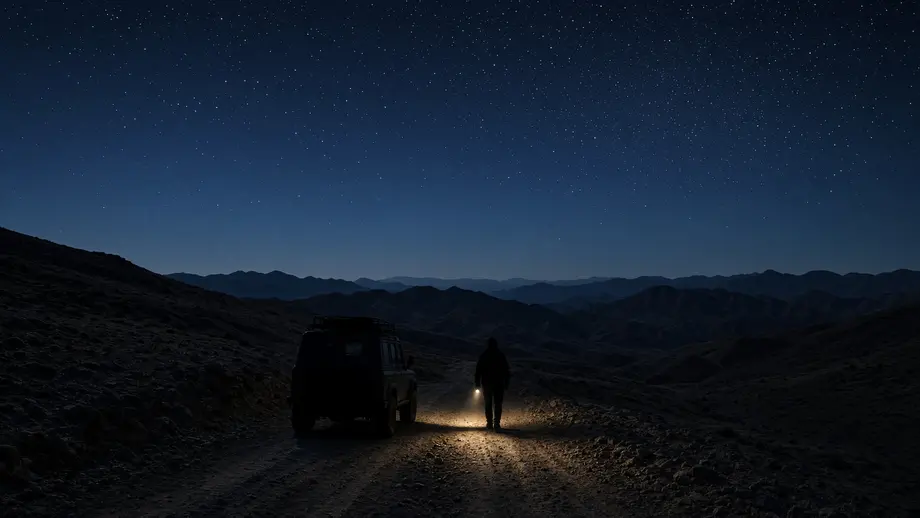
You roll into a wash after dark, the headlights stop at the first bend, and you need to know whether the track climbs out on the far side. A camp flood lights your boots and nothing else. A pocket thrower finds the far bank, then blinds you at the tailgate. This guide splits the job into trail lines and camp.
This table gives the best flashlight for overlanding by job, with Olight's ratings and regular prices.
| Job | Pick | Key specs (Olight ratings) | Regular price (Sept 2026) | Why |
|---|---|---|---|---|
| One light for trail lines and camp | Olight Marauder Mini 2 | Spotlight 140,000 cd, 750 m; floodlight up to 10,000 lm; red light; 465 g | $219.99 | Spot and flood channels in one body |
| Budget throw for scouting | Olight Warrior X 4 | 99,310 cd, 630 m; Regular Low 300 lm for 8 h; 249 g | $129.99 | Most reach per dollar; nothing below 300 lm |
| Grab light mounted in the cab | Olight Seeker 4 Pro | 4,600 lm, 16,895 cd, 260 m; holster with auto lock; 205 g | $139.99 | Holster and bracket fix it to a panel |
| Door-pocket backup and camp task light | Olight Baton 4 Pro | 1,600 lm, 200 m; Med 120 lm for 18 h 30 min; 114 g | $69.99 | Small, long low modes, written hot-car limit |
📋 Table of Contents
- 1. Quick Answer: What Is the Best Flashlight for Overlanding?
- 2. How Far Do You Need to See When You Scout a Trail Line on Foot?
- 3. Throw, Flood or Dual Beam: Which Overlanding Flashlight Type Fits Each Job?
- 4. Overlanding Flashlight Comparison: Output, Reach, Runtime, Weight and Price
- 5. Best Overlanding Flashlights by Job and Budget
- 6. Where Should a Flashlight Ride in the Vehicle?
- 7. How Do You Scout a Trail Line Without Dazzling Other Drivers?
- 8. Common Mistake: Believing More Lumens Means You See the Trail Better
- 9. Wildlife and Night Light Etiquette at Dispersed Camps
- 10. Charging on the Road: A Drive-Day Charging Schedule
- 11. What Flashlights Do Navy SEALs Carry, and What Should Overlanders Copy?
- 12. What Is the Best Flashlight for Camp When You Arrive by Vehicle?
- 13. How Many Lumens Is a Good Flashlight for Camping at a Vehicle Camp?
- 14. How the Numbers in This Guide Were Worked Out
- 15. Your Overlanding Light Checklist
- 16. FAQ
Quick Answer: What Is the Best Flashlight for Overlanding?
The best flashlight for overlanding is a dual-beam light, because scouting and camp pull in opposite directions. Scouting a wash or crest needs a tight beam that still lights the ground 150 m out. Camp needs a wide, low beam that does not glare. The Marauder Mini 2 has both channels. A thrower plus a small flood light does the same job for less.
Olight's full range of flashlights lists handheld, mounted and EDC lights, and the overall pick sits in the dual-beam Marauder series. Our best flashlights guide names the Baton 4 Pro its overall pick. Overlanding changes the answer because the vehicle carries the weight and trail lines run longer.
How Far Do You Need to See When You Scout a Trail Line on Foot?
Plan for about 150 m when you scout a trail line on foot at night, and treat 50 m as the minimum. At 50 m you read the surface you are about to drive: ruts, rocks, a washout. At 150 m you see where the track goes after a crest, a crossing or a fork. A light that cannot hold light at 150 m after its first minutes forces a second walk.
This table ties night obstacles to planning distances, not measurements.
| Obstacle | What you must see before you drive | Planning distance | Beam |
|---|---|---|---|
| Water crossing | Current, far bank, exit ramp | 30 to 80 m | Throw for the exit, flood at the edge |
| Blind crest | Where the track drops and turns | 50 to 150 m from the top | Throw |
| Fork or braided tracks | Which branch carries tire marks | 50 to 150 m | Throw, sweeping each branch |
| Rock step or washout | Line, clearance, depth of the cut | 5 to 50 m | Flood, low angle |
Safety note: At a crossing, light is for deciding, not for proving it is safe. The National Weather Service's Turn Around Don't Drown page says, "It takes just 12 inches of rushing water to carry away most cars and just 2 feet of rushing water can carry away SUVs and trucks." It adds, "It is NEVER safe to drive or walk into flood waters."
How much light reaches 50 m and 150 m?
Streamlight's ANSI/PLATO FL1 summary defines beam distance as "The distance from the device at which the light beam is 0.25 lux." Lux on a target equals candela divided by distance squared. This guide uses the same 0.25 lux at 150 m as its pass line; that is a bare minimum for tracing the track, not a comfortable working level.
This table shows each light at its peak and at a mode it can hold for a long stop. Estimates scale candela with lumens and assume the beam shape stays the same; they are based on Olight's rated figures, not measured.
| Light and mode | Lasts (Olight) | Candela | Lux at 50 m | Lux at 150 m | Holds 150 m? |
|---|---|---|---|---|---|
| Marauder Mini 2, spotlight 1,350 lm | 4 min | 140,000 (rated) | 56.0 | 6.22 | Yes |
| Marauder Mini 2, Level 2-2 spotlight 400 lm | 6 h, then 100 lm for 4 h | About 41,481 | 16.6 | 1.84 | Yes, for hours |
| Warrior X 4, Regular High 2,600 lm | 3 min | 99,310 (rated) | 39.7 | 4.41 | Yes |
| Warrior X 4, Regular High second step 1,000 lm | 140 min | About 38,196 | 15.3 | 1.70 | Yes, for over 2 hours |
| Seeker 4 Pro, Turbo 4,600 lm | 2.5 min | 16,895 (rated) | 6.76 | 0.75 | Only in Turbo |
| Seeker 4 Pro, High 1,200 lm | 135 min | About 4,407 | 1.76 | 0.20 | No |
| Baton 4 Pro, Turbo 1,600 lm | 2 min | 10,000 (rated) | 4.00 | 0.44 | Only in Turbo |
| Baton 4 Pro, Turbo second stage 600 lm | 198 min | About 3,750 | 1.50 | 0.17 | No |
The two throw lights hold the 150 m line for hours. The Warrior X 4's Regular Low runs 300 lumens, 30% of that 1,000-lumen step, so the same scaling puts about 0.51 lux at 150 m for its full 8 hours. The flood-leaning lights reach the line only in Turbo, for 2 to 2.5 minutes.
Throw, Flood or Dual Beam: Which Overlanding Flashlight Type Fits Each Job?
Throw lights read the trail line, flood lights run camp, and dual-beam lights do both with a switch. A thrower packs its lumens into a small hot spot, so it reaches far but shows little beside the track. A flood light spreads them wide, so it lights your hands and feet but fades fast with distance. Pick the type by the job you do most after dark.
This table compares the three types on overlanding jobs.
| Type | Olight example | Trail line at 150 m | Camp, tailgate and repairs | Main drawback |
|---|---|---|---|---|
| Throw | Warrior X 4 | Holds it 8 h at 300 lm | Too bright, glare off paint | No mode below 300 lm |
| Flood-leaning | Seeker 4 Pro, Baton 4 Pro | Only in Turbo | Good, with 50 lm and 15 lm low modes | Short reach after step-down |
| Dual beam | Marauder Mini 2 | 400 lm spot for 6 h | 150 lm flood for 27 h, red and side light | 465 g, $219.99 |
Our flashlight throw vs flood guide explains the optics. For overlanding, weight is the smallest cost of a dual-beam light, because it rides in the vehicle until you step out.
Overlanding Flashlight Comparison: Output, Reach, Runtime, Weight and Price
The Warrior X 4 gives the most reach per dollar, the Marauder Mini 2 the most capability, the Seeker 4 Pro the best mounting kit and the Baton 4 Pro the smallest body. All four are rated IPX8 for water, and none lists a dust rating, which matters on desert tracks.
This table puts the four lights side by side on Olight's ratings.
| Spec (Olight rating) | Marauder Mini 2 | Warrior X 4 | Seeker 4 Pro | Baton 4 Pro |
|---|---|---|---|---|
| Max output | 10,000 lm flood; 1,350 lm spot | 2,600 lm | 4,600 lm | 1,600 lm |
| Peak intensity and beam distance | 140,000 cd; 750 m | 99,310 cd; 630 m | 16,895 cd; 260 m | 10,000 cd; 200 m |
| Top mode steps | Spot 1,350~600~400 lm, 4 + 170 + 50 min | 2,600~1,000~300 lm, 3 + 140 + 20 min | 4,600~1,200~600 lm, 2.5 + 122 + 35 min | 1,600~600 lm, 2 + 198 min |
| Battery | 27.75 Wh | 5,000 mAh, 3.6 V (18 Wh calculated) | 18 Wh | 12.6 Wh |
| USB-C full charge | About 3.5 h | About 3.5 h | About 3.5 h, via holster | 3.5 h |
| Water and dust | IPX8 | IPX8 | IPX8 | IPX8 |
| Weight with battery | 465 g | 249 g | 205 g | 114 g |
| Regular price | $219.99 | $129.99 | $139.99 | $69.99 |
The International Electrotechnical Commission's IP ratings page explains, "The first numeral refers to the protection against solid objects and is rated on a scale from 0 (no protection) to 6 (no ingress of dust)." All four lights list an X there, so keep them in a case or holster on dusty tracks.
Best Overlanding Flashlights by Job and Budget
The best overlanding flashlight for most rigs is the Marauder Mini 2, because it removes the choice between reach and camp light. If $219.99 is too much, the Warrior X 4 and Baton 4 Pro together cost $199.98 and cover the same jobs with two lights. The Seeker 4 Pro fits drivers who want a mounted, locked grab light in the cab.
Olight Marauder Mini 2: Best Overall Flashlight for Overlanding
The Olight Marauder Mini 2 dual-beam flashlight solves the problem that one stop needs 150 m of reach and the next needs a dim camp glow. Olight lists "Five Lighting Configurations: Floodlight, spotlight, combined spotlight + floodlight, red light and side light." Level 2-2 runs the spotlight at 400~100 lumens for 6 + 4 hours; Level 1-2 gives 150 lumens of floodlight for 27 hours. The manual says it locks out "if no operation is made within 10 seconds after the indicators are off."
The limits: 465 g, and a rated working temperature of 0 to 40 °C. It costs $219.99 (regular price, September 2026). The box includes a dual USB-C wrist strap cable and a plastic protective case; the MCC3 cable is optional.
Olight Warrior X 4: Best Budget Throw for Scouting
The Olight Warrior X 4 tactical flashlight is the cheapest way to hold the 150 m line. Olight rates it at 2,600 lumens, 99,310 cd and 630 m, with Regular High at 2,600~1,000~300 lumens for 3 + 140 + 20 minutes and Regular Low at 300 lumens for 8 hours. Its manual lists a 2 m impact figure.
It is not a camp light: its dimmest white mode is 300 lumens, it has a tail switch only, and its manual describes no lockout. It costs $129.99 (regular price, September 2026), and the box includes a holster and a USB-C cable.
Olight Seeker 4 Pro: Best Grab Light Mounted in the Cab
The Olight Seeker 4 Pro flashlight is the only light here built to live on a vehicle panel. The box includes a vertical holster and a fixing bracket, and the manual says, "Please stick the 3M adhesive sticker on a flat and smooth wall or car panel." Holstering it locks it.
Olight rates it at 4,600 lumens and 260 m, with Med 300 lumens for 11 hours and Low 50 lumens for 60 hours. Its limit: after Turbo, its estimated reach falls short of 150 m. It costs $139.99 (regular price, September 2026).
Olight Baton 4 Pro: Best Door-Pocket Backup and Camp Task Light
The Olight Baton 4 Pro compact flashlight stays on you when you walk away from the rig. At 114 g and 111 mm, it runs 120 lumens for 18 hours 30 minutes and 15 lumens for 155 hours, enough for a camp evening or a tire change. The box includes an MCC3 cable and an L stand; USB-C charging takes 3.5 hours with your own cable.
Its manual is the one here with a written vehicle heat limit: "Do not store, charge, or use this light in a car where the temperature inside may exceed 60°C or in similar environments." It costs $69.99 (regular price, September 2026).
Where Should a Flashlight Ride in the Vehicle?
Keep your overlanding flashlight where you can reach it in the dark, where it cannot roll, and out of the sun. A door pocket or a holster on a shaded panel meets all three. The dashboard and rear window shelf fail the heat test, because cabin air in a parked vehicle can pass these lights' rated limits within the first half hour.
How hot does the cab get during a stop?
A Pediatrics study of a dark sedan on sunny days, summarized on PubMed, found "an approximately 40 degrees F increase in internal temperature for ambient temperatures spanning 72 to 96 degrees F," with "80% of the temperature rise occurring during the first 30 minutes." It also found, "Cracking windows open did not decrease the rate of temperature rise in the vehicle."
This table turns those averages into overlanding stops on a mild 75 °F sunny day. It estimates cabin air from the study's averages; it is not a reading from any vehicle.
| Stop on a 75 °F sunny day | Estimated cabin air | Past 40 °C (104 °F) working top: Marauder Mini 2, Warrior X 4, Seeker 4 Pro | Past 45 °C (113 °F) charging top: Baton 4 Pro | Past 60 °C (140 °F) storage limit: Baton 4 Pro |
|---|---|---|---|---|
| 30-minute scout on foot | 75 + 32 (80% of 40) = about 107 °F (42 °C) | Yes | No | No |
| 1-hour hike or town stop | 75 + 40 = about 115 °F (46 °C) | Yes | Yes | No |
| Any stop, light on the dashboard | Surface can reach 180 to over 200 °F (NWS) | Yes | Yes | Yes |
The first half hour matters most, and a cracked window does not buy time. The surface figure comes from the National Weather Service's heat and vehicles page, which says "a dark dashboard or seat can easily reach temperatures in the range of 180 to over 200°F."
Warning: Follow the Baton 4 Pro manual and do not store, charge or use it where the car interior may exceed 60 °C. Treat the 0 to 40 °C working range in the other three manuals the same way. When you leave the vehicle for more than a few minutes on a sunny day, take the lights with you, and never leave one on the dashboard.
Olight's warranty page excludes "Damage caused by improper storage, accidents, or abnormal operating conditions" from its lifetime warranty.
How Do You Scout a Trail Line Without Dazzling Other Drivers?
Scout on foot, off the traveled lane, with the beam aimed at the ground ahead of you, and drop to a low mode or cover the lens when headlights appear. Never aim a handheld light at a vehicle, and never scout with a light while driving. Vehicle lighting is set by FMVSS 108 and by state codes, so check your state's current statute before you mount or aim any light from a vehicle.
Federal Motor Vehicle Safety Standard No. 108, 49 CFR 571.108, says in S6.2.1: "No additional lamp, reflective device, or other motor vehicle equipment is permitted to be installed that impairs the effectiveness of lighting equipment required by this standard." Our night recovery off-road guide quotes California, Washington and Arizona aiming rules.
This table quotes one Minnesota statute and turns it into a habit. Other states differ.
| Statute | What it says (quoted) | What it means when you scout |
|---|---|---|
| Minnesota Statutes 169.64, subd. 1 | "Any lighted lamp or illuminating device upon a motor vehicle, other than a headlamp, a spot lamp, or an auxiliary driving lamp, which projects a beam of light of an intensity greater than 300-candle power, shall be so directed that no part of the beam will strike the level of the roadway on which the vehicle stands at a distance of more than 75 feet from the vehicle." | A light clipped to a rack or mirror may count as a device on the vehicle; aim it down within 75 feet (22.9 m), or carry it |
Each rated peak divided by 300 gives 33 times for the Baton 4 Pro (10,000 cd), 56 times for the Seeker 4 Pro (16,895 cd), 331 times for the Warrior X 4 (99,310 cd) and 467 times for the Marauder Mini 2 (140,000 cd). Candle power is an older unit, treated here as roughly equal to candela.
Common Mistake: Believing More Lumens Means You See the Trail Better
More lumens do not mean you see farther down the trail. Reach comes from candela, and a high-lumen flood can make the trail harder to read by lighting dust, rain and brush close to you. The Seeker 4 Pro's 4,600 lumens produce 16,895 cd; the Warrior X 4's 2,600 lumens produce 99,310 cd, about 5.9 times more at the beam center (99,310 ÷ 16,895).
Wildlife and Night Light Etiquette at Dispersed Camps
Use light to see the route and the camp, not to look for animals. Some states restrict casting light from roads at night, and land managers require designated routes. Keep beams low and inside camp, switch to red or side light after dinner, and aim scouting beams down the track, away from other camps.
Minnesota Statutes 97B.081, subd. 2, says that, except as provided in subdivision 3, "from two hours after sunset until sunrise, a person may not cast the rays of a spotlight, headlight, or other artificial light on a highway, or in a field, woodland, or forest to spot or locate a wild animal." Subdivision 3 exempts safety and normal vehicle operation that do not involve taking wild animals. Check your own state wildlife agency's current rules; our best spotlight for camping guide covers national park limits on viewing wildlife with a light.
The Bureau of Land Management's camping page says, "Vehicles must stay on designated roads and trails unless the area is specifically designated for off-road vehicle use." It recommends you "Camp within 150 feet of designated routes," which puts camp light in view of passing drivers, so aim it down and away from the road.
Charging on the Road: A Drive-Day Charging Schedule
Charge on the move, in the cooled cab, one light per USB-C port, and top up before the last hour of driving. Each light here takes about 3.5 hours from empty by USB-C, so a two-light kit needs about 7 hours on one port. Do not leave a light charging in a parked, sun-heated vehicle, since the Baton 4 Pro manual limits charging to 0 to 45 °C.
This table adds up energy and USB-C charge time for three kits, using Olight's rated full-charge times.
| Kit | Battery energy | USB-C time from empty, one port | Two ports |
|---|---|---|---|
| Marauder Mini 2 + Baton 4 Pro | 27.75 + 12.6 = 40.35 Wh | 3.5 + 3.5 = about 7 h | About 3.5 h |
| Warrior X 4 + Baton 4 Pro | 18 + 12.6 = 30.6 Wh | About 7 h | About 3.5 h |
| All four lights | 27.75 + 18 + 18 + 12.6 = 76.35 Wh | About 14 h | About 7 h |
Rated times assume the input each manual lists, such as 5 V 2 A for the Warrior X 4 and Seeker 4 Pro and 5 V 2.5 A for the Marauder Mini 2; a weaker vehicle port takes longer. The magnetic options are slower: the Marauder Mini 2's optional MCC3 takes about 6.5 hours and the Warrior X 4's optional MCC about 5 hours.
What Flashlights Do Navy SEALs Carry, and What Should Overlanders Copy?
No public U.S. Navy document we could find names a standard handheld flashlight for Navy SEALs; the brand lists online come from retailers and forums. What overlanders can copy is how duty gear is carried: in a fixed spot you find by feel, locked so it cannot switch on unseen, and run with one gloved hand.
This table checks each light here against those three carry habits, using what Olight's pages and manuals state.
| Light | Fixed spot in the vehicle | Locked in transit | Gloved operation |
|---|---|---|---|
| Seeker 4 Pro | Holster on the included bracket; locks when holstered | Auto lockout 10 s after the indicators go off | "Larger & Smoother Metal Switch" for "heavy gloves" (Olight) |
| Marauder Mini 2 | Included plastic case | Auto lockout 10 s after the indicators go off | Rotary selector and toggle switch |
| Baton 4 Pro | Door pocket | Manual lockout | Side and tail switches |
| Warrior X 4 | Included holster | No lockout in the manual | Tail switch |
The Baton 4 Pro manual gives the reason: "When carrying or transporting, ensure the flashlight is locked to prevent accidental activation that could lead to fire hazards." Because the Warrior X 4 manual describes no lockout, keep it in its holster, not loose in a bag.
What Is the Best Flashlight for Camp When You Arrive by Vehicle?
The best flashlight for a vehicle camp has a low flood mode that runs all evening, a red or dim mode for late hours, and a way to stand or hang it. The Marauder Mini 2 fits: 150 lumens of floodlight for 27 hours, red light and a side light. The Baton 4 Pro, with its included L stand, is the budget choice.
Put the light low and aim it at the work surface, not the reflective tailgate. For walk-in camps, our best tactical flashlight for camping guide weighs lockouts and low modes. For timber, our best flashlight for the woods guide picks the Baton 4 Pro for its flood-leaning beam and all-night low mode.
How Many Lumens Is a Good Flashlight for Camping at a Vehicle Camp?
At a vehicle camp, 100 to 150 lumens of flood is a good working level for cooking and chores, 15 to 25 lumens is enough to move around, and a few lumens of red keeps night vision for stargazing. Save 300 lumens and more for checking the track beyond camp. These are planning levels drawn from the modes each light offers.
This table maps camp jobs to modes, with Olight's rated runtimes.
| Vehicle camp job | Olight mode and rated runtime |
|---|---|
| Cooking at the tailgate, 120 to 150 lm | Marauder Mini 2 Level 1-2 floodlight 150 lm, 27 h; Baton 4 Pro Med 120 lm, 18 h 30 min |
| Walking around camp, 15 to 50 lm | Baton 4 Pro Low 15 lm, 155 h; Seeker 4 Pro Low 50 lm, 60 h |
| Glow after dinner, about 25 lm | Marauder Mini 2 side light 25~5 lm, 65 + 20 h |
| Stargazing, red | Marauder Mini 2 red 25 lm, 84 h |
| Checking the track, 300 lm or more | Warrior X 4 Regular Low 300 lm, 8 h |
Safety note: The Baton 4 Pro manual warns, "Do not look directly at the light source or shine it in eyes, as this may cause temporary blindness and serious retinal damage." The Marauder Mini 2 manual says, "Do not stare at operating light source."
How the Numbers in This Guide Were Worked Out
Every Olight number in this guide is copied from its US product page or user manual as of September 2026; every other number is a calculation shown in the text. Nothing was re-measured in the field.
This table sets out the source and method behind each figure.
| Measure | Source | Method | Count |
|---|---|---|---|
| Specs and runtimes | Olight product pages and manuals | Copied as published | 4 lights |
| Lux at 50 m and 150 m | Rated or estimated candela | Candela ÷ distance² | 8 modes |
| Candela at lower modes | Peak candela and lumens | Candela × mode lumens ÷ peak lumens | 4 modes |
| Cab heat by stop length | Pediatrics 2005; NWS; Olight manuals | 75 °F + 80% or 100% of a 40 °F rise | 3 stops |
| Carry habits | Olight product pages and manuals | Holster, lockout and switch as published | 4 lights |
| Charging | Olight manuals | Sum of rated times and Wh | 3 kits |
Your Overlanding Light Checklist
Use this checklist to set up the best flashlight for overlanding in your rig before the next trip. Pick a kit that holds the 150 m line, stow it cool and locked, charge it while you drive, and aim every beam at the ground, never at other drivers.
- Pick the kit: Marauder Mini 2 ($219.99), Warrior X 4 plus Baton 4 Pro ($199.98), or Seeker 4 Pro plus Baton 4 Pro ($209.98).
- Confirm your scouting light holds the 150 m line at a mode that outlasts your longest walk.
- Stow each light within reach, locked, and out of the sun; take it out of a parked vehicle on hot days.
- Charge in the cooled cab while driving, one light per port.
- Scout on foot with the beam down the track, and read your state's lighting and wildlife statutes.
- At camp, drop to 150 lumens of flood or less, then red or side light.
FAQ
Changelog
- September 24, 2026: First published.