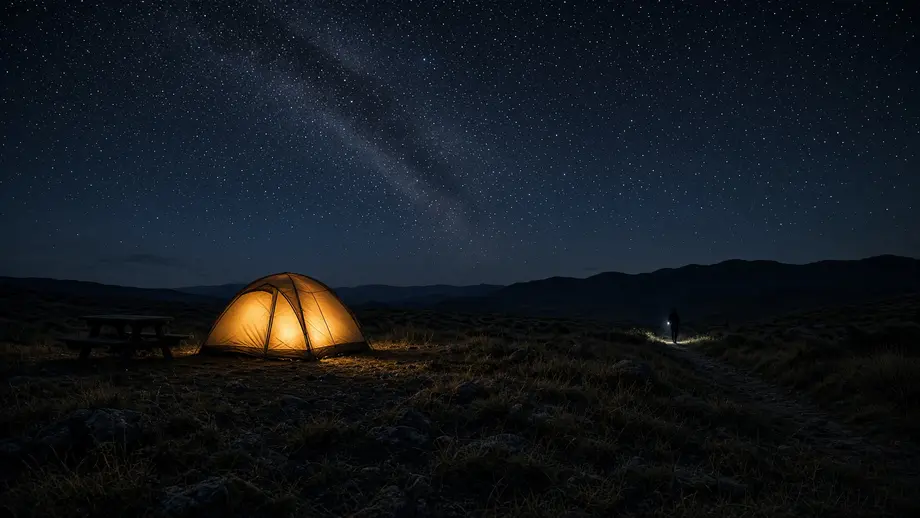
Olight makes the three lights compared here. Olight specs and regular prices come from its US product pages and user manuals as of September 2026; the scores, power figures and night-vision estimates below are our own arithmetic from those published numbers, not measurements.
⚡ TL;DR
The best tactical flashlight for camping is the Olight Warrior 3S ($119.95, regular price, September 2026). It drops to a 1-lumen Moon mode from the side switch, locks out both switches for the pack, and reaches 300 m. It scored 95 of 100 on our camp scorecard of three Warriors, ahead of the Warrior Ultra (92) and X 4 (45).
This table gives the best tactical flashlight for camping in each situation, using Olight's published ratings and regular prices in September 2026.
| Scenario | Pick | Key specs (Olight ratings) | Price (regular, September 2026) | Why |
|---|---|---|---|---|
| Best overall for camp and daily carry | Olight Warrior 3S | 1 lm Moon (55 days), 15 lm Low (130 h), 2,300 lm, 23,000 cd, 300 m, IPX8, 176 g | $119.95 | Dimmest mode, lockout that covers both switches, lowest price of the three: 95/100 |
| Rough trips and drops onto rock | Olight Warrior Ultra | 1 lm Moon, 15 lm Low (130 h), 2,500 lm, 26,000 cd, 320 m, 2 m drop rating (manual), 178 g | $139.99 | Same camp modes plus an O-Aluminum body and a 2 m drop rating: 92/100 |
| A second light for meadow and lakeshore scans | Olight Warrior X 4 | 99,310 cd, 630 m, USB-C charging, tail switch only, 249 g | $129.99 | By far the most reach, but a 300 lm floor and no lockout in its manual: 45/100 as a camp light |
| A tent with sleeping kids | Olight Warrior 3S kept by an adult, Moon stored, locked out at bedtime | 1 lm Moon from one side click; lockout blocks side and tail switches | $119.95 | Night checks stay at 1 lumen, and a locked light can't be fired by curious hands |
If you carry a tactical light every day, you know its camp problems. A light tail tap throws 200 lumens across the tent. A friend squeezes the light and a strobe goes off next to a sleeping child. Or you open your pack in the morning and find the light warm and the battery drained.
You don't need a second light to fix that, just the right model set up before the trip. This guide compares three lights from Olight's tactical flashlights range on camp jobs: how dim each goes, what a stray press does, where strobe hides, and how far each reaches. Every calculation shows its formula, so you can redo it for any of Olight's flashlights or another brand's.
📋 Table of Contents
- 1. Can a Tactical Flashlight Double as a Camp Light?
- 2. Tactical Flashlight vs Camping Flashlight: Tail Switch, Instant-On, Strobe and Throw
- 3. Tactical Camping Flashlight Comparison: Warrior 3S vs Warrior Ultra vs Warrior X 4
- 4. What Is the Best Flashlight for Camp?
- 5. How Many Lumens Is a Good Flashlight for Camping?
- 6. Does Strobe Have a Use at Camp, and When Does It Backfire?
- 7. Can You Set a Tactical Flashlight to Turn On in Low Mode?
- 8. Will a Tactical Flashlight Turn On by Itself in a Backpack?
- 9. How Much Night Vision Does One Turbo Check Cost?
- 10. What Flashlights Do Navy SEALs Carry?
- 11. Common Myths: Brighter Is Safer, and Camp Lights Don't Need a Lockout
- 12. Safety Limits: Eyes, Kids and High-Lumen Tactical Lights
- 13. Best Tactical Flashlight for Camping: Your Pre-Trip Checklist
- 14. FAQ
Can a Tactical Flashlight Double as a Camp Light?
Yes, a tactical flashlight can double as a camp light if it has a true low mode, a way to reach that low mode without passing through a bright one, and a lockout for the pack. Use Moon or Low, 1 to 15 lumens, around camp, Medium for paths, and save turbo and strobe for short checks and emergencies. The Warrior 3S and Warrior Ultra meet all three conditions. The Warrior X 4's lowest setting is 300 lumens.
For cooking, pitching and the 2 a.m. walk alone, a headlamp with a red mode is the better tool; our guide to the best camping headlamp scores those, and our best flashlights roundup names the Perun 3 headlamp as its camping pick. This guide is for the tactical handheld you already carry.
Tactical Flashlight vs Camping Flashlight: Tail Switch, Instant-On, Strobe and Throw
A tactical flashlight differs from a camping flashlight in four places: a tail switch that fires on the first press, direct access to turbo, a strobe mode, and a focused beam built for distance. Each one helps on patrol and causes a specific camp problem. Most of the fixes are settings and habits, not a different light, as long as the model offers a low mode and a lockout.
This table maps each tactical feature to its camp side effect and the fix, using the three Warrior models as examples.
| Tactical feature | What it does at camp | The fix |
|---|---|---|
| Two-stage tail switch | A light tap still gives 200 lumens (Warrior 3S, Warrior Ultra) or 300 lumens (Warrior X 4) | Use the side switch at camp; keep the tail for trail checks |
| Direct turbo | One firm press puts 2,300 to 2,600 lumens into the tent | Lock out before bed and before packing |
| Strobe | Scares kids and bothers neighbors; the X 4's listed 13 Hz sits in the range Epilepsy Action links to photosensitive seizures | Keep the tail switch in a setting without strobe |
| Focused TIR optic or deep head | A small hot spot glares off tent walls and pots | Aim at the ground or bounce off a surface |
| Cool white LED | Ultra lists 6,500K; X 4 lists 5,700 to 6,700K; both manuals list CRI 70 | Stay on low; carry a red or warm light for night-sky time |
| No red mode | Every white press resets dark-adapted eyes | Pair with a red-light headlamp |
The last two rows are limits no setting can fix. DarkSky's Five Principles for Responsible Outdoor Lighting, published with the Illuminating Engineering Society, say light should be "no brighter than necessary" and warm-colored "where possible," which a cool white light meets only on its lowest modes. What the tail switch and heat path add to the bill is covered in our tactical flashlight price breakdown.
Tactical Camping Flashlight Comparison: Warrior 3S vs Warrior Ultra vs Warrior X 4
Among tactical camping flashlights in Olight's Warrior line, the Warrior 3S and Warrior Ultra share the same camp-friendly modes, 1-lumen Moon and 15-lumen Low for 130 hours, and differ mainly in body, drop rating and price. The Warrior X 4 is a different tool: about four times the candela and 630 m of reach, but a 300-lumen floor and no documented lockout.
This table lists each light's official ratings, including the lowest mode, which decides how the light behaves inside a tent.
| Spec (Olight rating) | Warrior 3S | Warrior Ultra | Warrior X 4 |
|---|---|---|---|
| Max output | 2,300 lumens | 2,500 lumens | 2,600 lumens |
| Peak intensity | 23,000 cd | 26,000 cd | 99,310 cd |
| Beam distance | 300 m | 320 m | 630 m |
| Turbo or High runtime | 2,300~805~253 lumens, 2.5 + 160 + 39 minutes | 2,500~800~250 lumens, 2.5 + 162 + 39 minutes | Regular High 2,600~1,000~300 lumens, 3 + 140 + 20 minutes |
| Medium | 200 lumens, 13 hours | 200 lumens, 13 hours | Tactical Med 1,000~300 lumens, 150 + 20 minutes |
| Lowest mode | Moon 1 lumen, 55 days | Moon 1 lumen, 55 days | Regular Low 300 lumens, 8 hours |
| Brightest ÷ dimmest | 2,300 ÷ 1 = 2,300 | 2,500 ÷ 1 = 2,500 | 2,600 ÷ 300 = 8.7 |
| Switches | Side switch + two-stage tail switch | Side switch + two-stage tail switch | Tail switch only |
| Lockout (user manual) | Yes, blocks side and tail | Yes, blocks side and tail | None described |
| Water and drop | IPX8, 1.5 m | IPX8, 2 m | IPX8, 2 m |
| Weight with battery | 176 g | 178 g | 249 g |
| Charging | MCC3 magnetic cable (included) | MCC3 magnetic cable (included) | USB-C cable (included) or MCC3 (sold separately) |
| Price (regular, September 2026) | $119.95 | $139.99 | $129.99 |
The "brightest ÷ dimmest" row is the camp number to watch: the 3S and Ultra dim to about 1/2,300 and 1/2,500 of their peak, so one light covers the tent and the treeline, while the X 4 dims only to about one-ninth.
This table explains how we scored each light for camp use. Each criterion is applied once per light, from the source named in the second column.
| Criterion (weight) | Evidence | How points were given |
|---|---|---|
| Lowest white output (20) | Product page lighting levels | 1 lm or less = 20; 2 to 15 lm = 12; 16 to 100 lm = 5; above 100 lm = 0 |
| Misfire protection (20) | User manual | Lockout that blocks both switches = 12; proximity sensor = 8 |
| Strobe separation (15) | User manual, in Configuration 1 (3S, Ultra) or Regular mode (X 4) | Strobe needs a multi-click or a mode change = 15; strobe on a single press = 0 |
| Camp-level runtime (15) | Runtime at the lowest non-Moon white level | 100 h or more = 15; 24 to 99 h = 10; 8 to 23 h = 5; under 8 h = 0 |
| Reach (10) | Peak candela | 50,000 cd or more = 10; 20,000 to 49,999 = 7; below 20,000 = 4 |
| Toughness and carry (10) | Manual drop rating, weight | 2 m = 5, 1.5 m = 3; 180 g or less = 5, 181 to 250 g = 3 |
| Price (10) | Regular US price, September 2026 | $120 or less = 10; up to $130 = 7; up to $140 = 5 |
This table shows the resulting scores, criterion by criterion.
| Criterion | Warrior 3S | Warrior Ultra | Warrior X 4 |
|---|---|---|---|
| Lowest white output (20) | 20 (1 lm) | 20 (1 lm) | 0 (300 lm) |
| Misfire protection (20) | 20 | 20 | 0 |
| Strobe separation (15) | 15 | 15 | 15 |
| Camp-level runtime (15) | 15 (130 h at 15 lm) | 15 (130 h at 15 lm) | 5 (8 h at 300 lm) |
| Reach (10) | 7 | 7 | 10 |
| Toughness and carry (10) | 8 | 10 | 8 |
| Price (10) | 10 | 5 | 7 |
| Total (100) | 95 | 92 | 45 |
The sums: 20 + 20 + 15 + 15 + 7 + 8 + 10 = 95; 20 + 20 + 15 + 15 + 7 + 10 + 5 = 92; 0 + 0 + 15 + 5 + 10 + 8 + 7 = 45. The X 4 gets full strobe marks because Regular mode has no strobe, but it loses the two rows that decide how a light behaves in a tent.
Olight Warrior 3S: Best Tactical Flashlight for Camping Overall
The hard part of camping with a tactical light is reaching a dim mode without passing through a bright one. The Olight Warrior 3S solves it with its side switch: hold it for over one second from off for Moon, and its manual adds, "If the memorized mode is moonlight, simply click the switch to access it." Olight lists "Up to 55 days of runtime," but that is the 1-lumen Moon. The levels you will live on are Low, 15 lumens for 130 hours, and Medium, 200 lumens for 13 hours.
Its limits: it charges only by the MCC3 magnetic cable, not your phone's USB-C cable; its manual lists a 1.5 m drop rating against 2 m for the other two; and like every light here, it has no red mode.
Olight Warrior Ultra: Best for Rough Trips and Drops
On a trip where the light will fall off a boulder or bounce in a truck bed, the Olight Warrior Ultra is the stronger pick. It keeps the 3S's camp modes and adds an O-Aluminum body that Olight says is "built to withstand 2-meter drops."
The trade-offs: it costs $20.04 more than the Warrior 3S, and its jagged strike bezel, which Olight calls "ideal for glass-breaking," can snag tent mesh, so keep it in the included holster near tents. Its manual lists a working temperature of 0 to 40°C; below freezing, carry it in an inside pocket.
Olight Warrior X 4: Best for Long-Range Eyeshine Checks, Not for the Tent
When something moves at the far edge of a meadow, the Olight Warrior X 4 has about four times the candela of the other two and a 630 m rating. It is also the only one of the three that charges from an ordinary USB-C cable, which its manual says takes about 3.5 hours, so it can share a power bank with your phone.
For close work, though, it is the wrong light. Its dimmest setting, 300 lumens, is brighter than the last turbo stage of the other two (253 and 250 lumens), and its manual describes no lockout. Use it as a scanner and pair it with a headlamp. Our guide to flashlight throw vs flood explains the beam trade-off, and our pick of the best spotlight for camping covers lights built only for eyeshine and lost-gear searches.
What Is the Best Flashlight for Camp?
The best flashlight for camp is the one that does your campsite's hardest job at the lowest brightness. For cooking and tent chores, that is a headlamp with a red mode. For one handheld that also carries daily and checks the trail, it is a tactical light with a 1-lumen mode and a lockout, such as the Warrior 3S. Very few campers need 600 m of throw.
If you already own a headlamp, pick the handheld for what the headlamp can't do: reach down a trail, check a noise at the tree line, or signal a car at the trailhead. If you don't, buy the headlamp first. Backpackers counting grams should carry a tactical light only if they need that reach, and two lights on different batteries mean one failure never leaves you in the dark.
How Many Lumens Is a Good Flashlight for Camping?
A good flashlight for camping needs 1 to 15 lumens for the tent and table, about 200 lumens for walking paths, and 800 lumens or more only for scanning a treeline or a far sound. Olight's Warrior 3S manual lists a rated beam distance for each mode: 25 m on Low, 90 m on Medium, 180 m on High and 300 m on Turbo.
Those per-mode distances turn a lumen question into a distance question. This table matches common camp jobs to the Warrior 3S mode that covers them, using the manual's beam distances and the product page's runtimes.
| Camp job | Typical distance | Warrior 3S mode | Rated beam distance (user manual) | Rated runtime (product page) |
|---|---|---|---|---|
| Finding a zipper pull or pill bottle in the tent | Arm's length | Moon, 1 lumen | Not listed | 55 days |
| Cooking, dishes, reading a map at the table | 0.5 to 2 m | Low, 15 lumens | 25 m | 130 hours |
| Checking a campsite edge or a trail junction | 30 to 90 m | Medium, 200 lumens | 90 m | 13 hours |
| Scanning a treeline or finding eyeshine | 100 to 180 m | High, 800 lumens | 180 m | 166 + 39 minutes |
| A few seconds of maximum reach | Up to 300 m | Turbo, 2,300 lumens | 300 m | 2.5 minutes before step-down |
Rated beam distance is the point where the beam fades to a very dim level under the test standard, not where you can recognize what you see, so go one mode higher to identify something. The manual calls its figures "test results based on ANSI/NEMA FL1-2009 Standard," an older edition, and our flashlight runtime explainer shows how step-downs change an evening.
Tip: At camp, read the lowest number on a spec sheet first. A light that can't go below 100 lumens is too bright inside a tent, whatever its turbo.
Does Strobe Have a Use at Camp, and When Does It Backfire?
Strobe has little use at a campsite. None of the three Warriors lists an SOS or beacon mode, and a flashing white light mostly startles people and wildlife that are already awake. Strobe backfires when it fires by accident, near sleeping kids, or near anyone sensitive to flashing light. The fix is a setting that keeps strobe off the tail switch.
The seizure risk is specific. Epilepsy Action, a UK charity, says in its guide to photosensitive epilepsy that a light "may be most likely to trigger a seizure if it flashes or changes colour at a rate between 10 and 25 flashes per second," and that "Most cases of photosensitive epilepsy develop in people under 20 years old." Olight lists the Warrior X 4's strobe as "13Hz at 2,600 lumens," inside that range, and publishes no strobe frequency for the other two.
Here is where strobe hides on each light, and how to leave it, from the user manuals:
- Warrior 3S: a quick side-switch triple click, or a hard tail press in Configuration 2 (never in the factory Configuration 1). Single click or hold the side switch to exit.
- Warrior Ultra: "Quickly press the switch three times or more to activate Strobe," or a firm tail press and hold in Configuration 2. Press or hold the side switch to exit.
- Warrior X 4: only in Tactical mode, where the manual says "Press to turn on Strobe, press again to turn off." To switch modes, turn the light on, "unscrew the tail cap until the light goes out," then tighten it again.
Warning: Before a family trip, check which configuration or mode your light is in. A Warrior X 4 left in Tactical mode latches a 13 Hz strobe on a single firm press, and it keeps flashing until someone presses again.
Can You Set a Tactical Flashlight to Turn On in Low Mode?
Partly. On the Warrior 3S and Warrior Ultra, the side switch remembers Moon, Low, Medium or High, so if you turn the light off in Moon, one click brings it back in Moon. The tail switch can't be set that low: in the factory setting a light tap always gives Medium, 200 lumens. On the Warrior X 4, a tail tap in Regular mode gives 300 lumens, its lowest output.
This table maps common camp moments to the input that gives the right output on each light, taken from the user manuals.
| Camp moment | Warrior 3S or Warrior Ultra (Configuration 1) | What you get | Warrior X 4 (Regular mode) |
|---|---|---|---|
| Waking at 2 a.m. inside the tent | Single click on the side switch, with Moon stored as the last mode | Moon, 1 lumen | Tail tap gives 300 lumens; use a headlamp instead |
| Cooking or reading a map at the table | Turn on, press and hold the side switch, release at Low | Low, 15 lumens | Tail tap, 300 lumens aimed at the ground |
| Walking to the restroom | Same side-switch hold, released at Medium | Medium, 200 lumens | Tail tap, 300 lumens |
| A noise at the tree line | Firm tail press, or a fast double click on the side switch | Turbo, 2,300 or 2,500 lumens | Firm tail press, 2,600 lumens |
| Bedtime, or before the light goes in a pack | Hold the side switch about 2 seconds from off | Lockout: Moon comes on briefly, then off; both switches blocked | No lockout described; holster it with the tail clear |
Two manual details matter at camp. High is remembered only briefly: the 3S manual says High is memorized "for 1 minute before reverting to medium mode," and the Ultra manual says "High mode will automatically switch to Medium mode after 1 minute of use." And "Strobe and turbo mode cannot be memorized," in the 3S manual's words, so a side click never starts in either one.
Will a Tactical Flashlight Turn On by Itself in a Backpack?
It can, and it has happened at scale. In 2022 the U.S. Consumer Product Safety Commission announced a recall of about 215,100 Olight M2R Pro and Warrior Mini flashlights that "can be turned on inadvertently and overheat while stored in the holster or a consumer's pocket." Current Warrior 3S and Warrior Ultra models add a lockout covering both switches; the Warrior X 4 manual describes none.
A pack full of soft gear pressing on a tail switch is the same risk. The 3S and Ultra also have a proximity sensor that dims the light when the lens is blocked and turns it off if the blockage lasts more than 1 minute, but it covers only the top levels: Olight's 3S page names "high, turbo or strobe mode," and the Ultra manual names the same three. Medium, the mode a light tail tap latches, is not covered.
This table estimates the average power a light would turn into heat if it latched on inside a pack. It uses the 18 Wh battery listed in the Warrior Ultra and Warrior X 4 manuals (the Warrior 3S lists the same 3.6 V, 5,000 mAh cell: 3.6 × 5 = 18 Wh) and the rated runtimes. It is arithmetic, not a measurement.
| Accidental activation | What latches | Rated runtime | Proximity sensor covers it? | Average power, at most |
|---|---|---|---|---|
| Warrior 3S or Ultra, Configuration 1, light tail tap | Medium, 200 lumens | 13 hours | No | 18 ÷ 13 = 1.4 W |
| Warrior 3S or Ultra, Configuration 1, firm tail tap | Turbo, then steps down | 2.5 + 160 + 39 minutes (3S) | Yes | Off after about 1 minute if the lens stays blocked |
| Warrior 3S or Ultra, Configuration 2, any tail press | Momentary only; off on release | Only while something presses the switch | Yes, on Turbo and Strobe | Stops when the pressure stops |
| Warrior X 4, Regular mode, firm tail press | High, 2,600 lumens, then steps down | 3 + 140 + 20 = 163 minutes | Not listed | 18 ÷ (163 ÷ 60) = 6.6 W |
Each average assumes the whole 18 Wh is used within the rated runtime, so the real figure can only be lower. Still, 1.4 W for 13 hours in a closed pack is not trivial, and 6.6 W for nearly three hours is almost five times that rate. Configuration 2 stops a stray press from latching the light, but it puts strobe on a hard press; a lockout avoids that trade.
Warning: The Warrior 3S manual says, "Please lock out the switches if the flashlight is left unused, carried, or transported," and "DO NOT cover the flashlight's head or place the head on the ground when the flashlight is on." Never stand a lit Warrior face-down on a sleeping pad. Carry a Warrior X 4 in its holster with the tail clear of other gear.
All three are rated IPX8, but the 3S manual adds that "The tail switch may not work while immersed in sea water or other conductive media," so rinse and dry the tail after a saltwater day.
How Much Night Vision Does One Turbo Check Cost?
One bright white check can cost everyone who sees it 20 to 40 minutes of night vision. A National Park Service article on dark adaptation says rhodopsin, the pigment behind night vision, "takes from 20 to 40 minutes" before people start benefiting from it, and that "It only takes a few seconds of bright light" to break it down. Four bright checks can eat up most of a three-hour evening.
The NPS dark adaptation article adds that "deep red lights do not trigger the neutralization of the rhodopsin," and none of the three Warriors has a red mode. This table estimates how much of a 180-minute evening goes to re-adapting after bright white checks. It assumes each check is seen, recovery takes 20 to 40 minutes, and checks are at least 40 minutes apart so recovery periods don't overlap.
| Bright white checks in the evening | Re-adaptation time (20 to 40 min each) | Share of a 180-minute evening |
|---|---|---|
| 1 | 20 to 40 minutes | 11% to 22% |
| 2 | 40 to 80 minutes | 22% to 44% |
| 4 | 80 to 160 minutes | 44% to 89% |
The arithmetic is checks × recovery ÷ 180: 4 × 20 ÷ 180 = 44% and 4 × 40 ÷ 180 = 89%. A check on Low, aimed at the ground and away from faces, costs far less. The National Park Service's camp etiquette page puts it plainly: "Keep lights shielded and pointing down." With a Warrior, that means Moon or Low from the side switch, the head angled at your feet, and turbo only after you have told the group.
What Flashlights Do Navy SEALs Carry?
No public U.S. Navy or Naval Special Warfare document we could find names the flashlight SEALs carry, so model lists online are claims, not Navy specifications. What is public is the standard behind any flashlight's headline numbers, and those numbers describe short bursts at full output. For a camper, the useful question is the other end of the spec sheet, how low and how long a light can run.
The standard itself now separates bursts from sustained light. PLATO says its ANSI/PLATO FL 1-2025 revision adds a test for turbo and boost modes, which "allow a light to produce an exceptionally high level of output for a short period," measured between one and 10 seconds. The Warrior manuals cite older editions: ANSI/NEMA FL1-2009 for the 3S and X 4, FL 1-2019 for the Ultra. A patrol light is chosen for the 3S's 2,300 lumens for 2.5 minutes; a camp light for its 1 lumen for 55 days.
Common Myths: Brighter Is Safer, and Camp Lights Don't Need a Lockout
Two myths about tactical lights at camp cause most of the trouble: that more lumens make you safer, and that a lockout only matters on a duty belt. In a campsite, more lumens mostly mean more glare and lost night vision, and a pack is where accidental activation is most likely to go unnoticed for hours.
- "More lumens is safer at camp." Safety comes from seeing your footing without blinding others. The Warrior 3S reaches 25 m on Low and 90 m on Medium; turbo's 300 m helps for seconds, then costs everyone's dark adaptation.
- "A lockout is for police, not campers." The CPSC recall involved lights stored in holsters and pockets. A pack is a pocket nobody checks for hours.
- "The proximity sensor makes a lockout unnecessary." It covers High, Turbo and Strobe only, not the Medium a tail tap latches.
Safety Limits: Eyes, Kids and High-Lumen Tactical Lights
Never shine a tactical light into anyone's eyes, and don't hand a 2,000-plus-lumen light to a child as their camp light. The Warrior 3S manual warns that doing so "may cause temporary blindness, or permanent damage to the eyes," and the Warrior Ultra manual says "Do not stare at operating light source." Give kids their own low-output light, and keep the Warrior with an adult.
The American Academy of Ophthalmology's answer to whether a newer, brighter flashlight can harm your eyes is more reassuring: flashlights "are unlikely to cause damage because the light is not as tightly focused as with a laser." The practical camp risk is a dazzled adult on a rocky path or a child near a fire. If anyone in the group has photosensitive epilepsy, keep strobe off for the whole trip.
Safety note: The Warrior Ultra and Warrior X 4 manuals list a working temperature of 0 to 40°C (104°F), and the National Weather Service says a dark dashboard or seat "can easily reach temperatures in the range of 180 to over 200°F." So keep the lights off the dashboard and out of a sunny car. On a hot afternoon, follow the Warrior 3S manual: "DO NOT activate turbo mode repeatedly under high temperature to prevent the flashlight body from overheating and hurting the user's hand."
Best Tactical Flashlight for Camping: Your Pre-Trip Checklist
Before you pack the best tactical flashlight for camping, spend ten minutes setting it up at home. Most camp problems with tactical lights, from tent glare to strobe misfires, come from settings nobody checked. Work through this list in order, and repeat the lockout every night of the trip.
- Pick for the tent, not the treeline. Choose a light that goes to 1 lumen, such as the Warrior 3S or Warrior Ultra. If you own a Warrior X 4, add a headlamp.
- Check the tail setting. Warrior 3S and Ultra: Configuration 1. If a hard press gives strobe, press hard and hold the tail switch, click the side switch once, then release. Warrior X 4: Regular mode.
- Store Moon as the start-up mode. Hold the side switch over one second from off and let go as soon as Moon comes on, then click off. Keep holding to about 2 seconds and the light locks out instead.
- Practice the lockout in the dark. Hold the side switch about 2 seconds from off; hold over one second to unlock.
- Charge fully and pack the right cable. The 3S and Ultra need the MCC3 magnetic cable; the X 4 ships with USB-C.
- Plan bright checks. Tell the group before turbo, and keep checks short.
- Pack a red light. None of these Warriors has one.
FAQ
Changelog
- September 24, 2026: First published.