Olight makes the lights recommended here. Olight specs and regular prices come from its product pages and user manuals as of September 2026. Light levels are calculated from rated outputs and published specs, not measured. Health and safety guidance comes from the AAP, CDC, NIH, CPSC and the studies linked in each section.
⚡ TL;DR
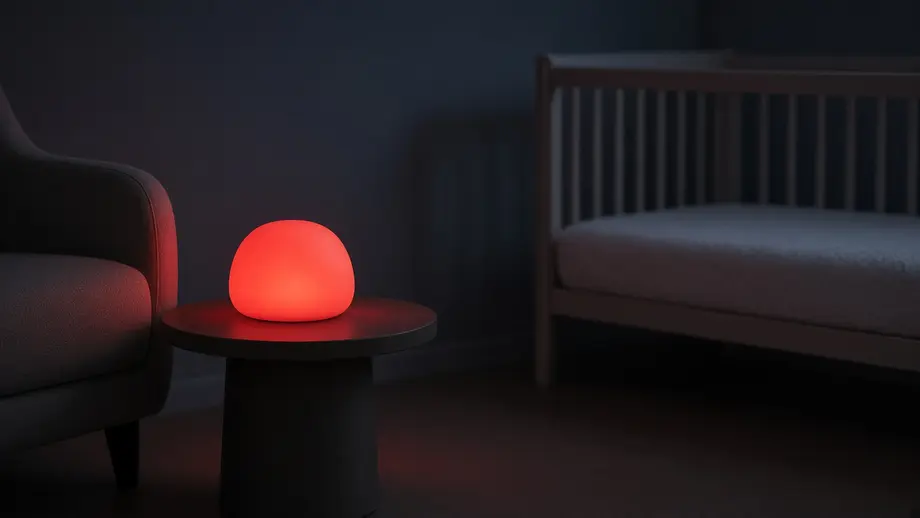
The best nursery night light for night feeds is dim, red or warm white, and sits low beside your feeding chair, out of your baby's line of sight. Aim for about moonlight at the crib, far under the 8 lux Harvard Health links to melatonin effects. Keep a physical button within reach and your phone at minimum brightness.
The trouble at 3 a.m. is a narrow window. Flip on the ceiling light and the baby drifting off mid-feed is wide awake, and so are you. Stay in total darkness and you fumble the latch and misread the ounce lines on a bottle. Reach for your phone and the brightest light in the room is inches from your face. This guide puts numbers on "dim enough" and shows where each light goes.
This table is the short nursery night light kit, with the minimum spec worth accepting for each job.
| Night feeding light job | Recommended type | Minimum spec to look for | Recommended model |
|---|---|---|---|
| Feeding and latch light beside the chair | Rechargeable dimmable ambient light with a button on the body | Red mode near 0.5 lumens, warm white low near 1 lumen, works without a phone | Olight Sphere Ambient Light (Sphere C), $17.99 |
| Bedtime routine and wind-down lamp | Dimmable smart bulb in a lamp you already own | 2700K warm white, stepless dimming, schedules | Olight Aurevo Smart Bulb, $9.99 |
| Floor glow from the door to the chair | USB-powered strip set to red, mounted low and far from the crib | Red at 8 lumens across 16.4 ft, returns to its last setting | Olight Ostrip, $12.99 |
| Power outage and dropped-pacifier backup | Keychain flashlight with a low mode | 5-lumen low mode, 12-hour runtime, aimed at the floor | Olight i1R 2 Pro, $21.99 |
| Your phone | Not a light source | Minimum brightness plus Night Shift or Extra dim | Settings you already have |
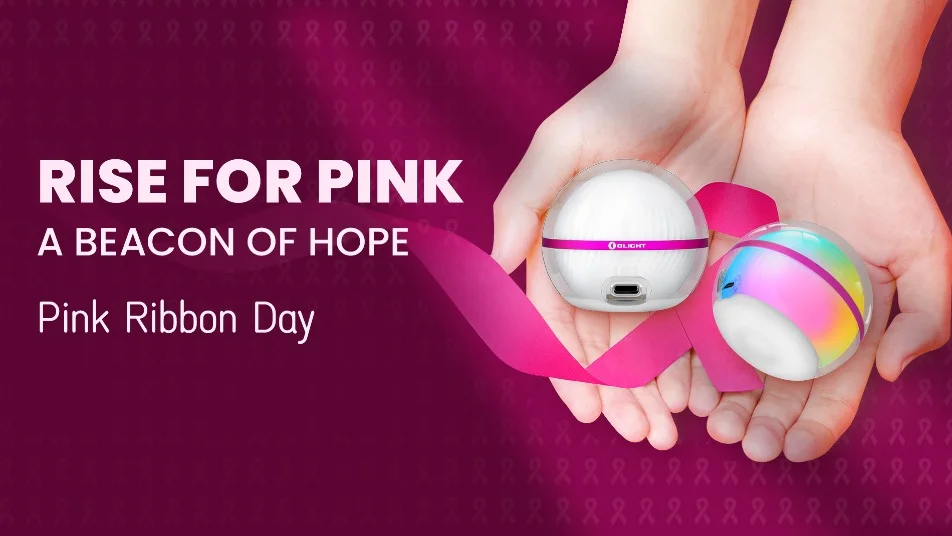
Olight sells the Sphere among its app-controlled ambient lights, but at 3 a.m. the button matters more than the app.
📋 Table of Contents
- 1. Should a Nursery Have a Night Light?
- 2. Why Do Bright and Blue-White Lights Wake Everyone Up?
- 3. What Color Night Light Is Best for a Baby: Red or Warm White?
- 4. How Bright Should a Nursery Night Light Be?
- 5. Where Should You Put a Night Light in a Nursery?
- 6. Why Is Your Phone the Brightest Light in the Room at 3 AM?
- 7. A 3 AM Night Feed, Step by Step
- 8. How Long Will a Rechargeable Night Light Last Through Night Feeds?
- 9. What Is the Best Night Light for a Nursery?
- 10. A Nursery Lighting Setup Under $30
- 11. Is It Better for Babies to Sleep With a Night Light?
- 12. Night Feed Lighting Checklist
- 13. FAQ
Should a Nursery Have a Night Light?
Yes, but mainly for you, not your baby. A breastfed newborn feeds about 8 to 12 times in 24 hours, so you need to see a latch, a bottle or a diaper several times a night. The AAP's advice is to keep those feeds dim, and a baby does not need a light on to sleep. Use the light during the feed, then switch it off.
The CDC says "Your baby will breastfeed about 8 to 12 times in 24 hours" and that a newborn "may want to eat as often as every 1 to 3 hours," later settling to every 2 to 4 hours. The AAP's safe sleep tips for sleep-deprived parents say: "Nighttime feedings are not play time. Keep the lights dim and the environment boring, so that your baby learns they should sleep after the nighttime feeding." Its page on preemie sleep patterns adds "minimal or soft lighting" and notes that "a soft night-light may be reassuring to you both."
For the first months, the "nursery" may be your own bedroom: the NIH's Safe to Sleep campaign recommends room sharing, saying "It is also safer to share your room with baby than to put baby in their own room." So the light must stay out of your baby's eyes and away from a sleeping partner while lighting your hands.
Why Do Bright and Blue-White Lights Wake Everyone Up?
Light at night tells the brain's clock it is daytime and suppresses melatonin, the hormone that makes you sleepy. Blue wavelengths do this most strongly, and brightness counts too: Harvard Health says even eight lux can have an effect. A 2001 study that exposed adults to single-color light between 2:00 and 3:30 a.m. found the 446 to 477 nm blue band most potent.
That study, an action spectrum for melatonin regulation in the Journal of Neuroscience, ran 627 nighttime tests from 420 to 600 nm and identified "446-477 nm as the most potent wavelength region providing circadian input for regulating melatonin secretion." Its test hours match a typical night feed.
Harvard Health's summary of blue light at night covers brightness: "A mere eight lux - a level of brightness exceeded by most table lamps and about twice that of a night light - has an effect." Any light can suppress melatonin, it adds, but "blue light at night does so more powerfully."
Young children look even more sensitive than adults. In a 2022 study of evening light and melatonin in preschool-aged children, 36 children aged 3 to 4.9 years saw one hour of light before bedtime, at 5 to 5,000 lux. The authors reported: "Melatonin levels were suppressed between 69.4% and 98.7% (M = 85.4 ± 7.2%) during light exposure across the full range of intensities examined." Even the 5 to 40 lux group averaged 77.5% suppression. Those children were older than a newborn and saw light for an hour, so the numbers don't transfer directly to a feed, but they show that 5 lux is not dim for a young child.
This table sums up what each study found and what it means for a night feed.
| Source | Who and what | Key finding | What it means at 3 a.m. |
|---|---|---|---|
| Journal of Neuroscience, 2001 | 72 adults, single-color light at 2:00 to 3:30 a.m. | 446 to 477 nm (blue) is the most potent band | Avoid blue and cool white light at night |
| Harvard Health | Summary of sleep research | "A mere eight lux" has an effect | Keep light at the eyes far below 8 lux |
| Journal of Pineal Research, 2022 | 36 children aged 3 to 4.9, one hour before bed | 69.4% to 98.7% suppression from 5 to 5,000 lux | Children react even at 5 lux, so aim lower |
| Life, 2025 | 12 adults, red (631 nm) vs blue (464 nm) for 3 hours | Both suppressed melatonin at first; red allowed recovery | Red is gentler, but dim still matters |
| Scientific Reports, 2016 | Preterm infants, brief light during nursing care | Short light breaks did not stop day-night rhythm | A few minutes of warm white for a diaper change is fine |
What Color Night Light Is Best for a Baby: Red or Warm White?
Red is the least disruptive color for a night light, and warm white is the practical second choice when you need to see true colors. Harvard Health advises using dim red lights for night lights. Red sits at the long end of the visible band, around 700 nm according to NASA, far from the 446 to 477 nm blue band. Brightness still matters more than color.
Harvard Health puts it directly: "Red light is less likely to shift circadian rhythm and suppress melatonin." NASA's overview of visible light wavelengths says "red has the longest wavelength, at around 700 nanometers." Olight does not publish the wavelength of the Sphere's red LEDs.
Red is gentler, not neutral. A 2025 study of red and blue LED light over three hours in 12 adults found that "After one hour, both lights suppressed melatonin." Under red light, melatonin then recovered, while blue kept it suppressed, so the authors "highlight red light as a less disruptive alternative for nighttime environments." Dim red still beats bright red.
Red has one drawback: every color looks red or black under it, so you can't judge a rash or the color of spit-up. That is where warm white earns a place. As Apple's Night Shift on the Mac guide notes, "Warmer color temperatures show more yellow and less blue." Olight's user manual lists the Sphere C's white light at 2800K and CRI 80, and the Aurevo bulb adjusts from 2700K to 6500K. If the Kelvin scale is new to you, start with what is color temperature.
Short bursts of white are not a crisis. A 2016 study on nighttime light exposure in preterm infants compared white light with red light the infants could not perceive during night care. Care every 3 to 4 hours with light for under 15 minutes "does not prevent the infants from developing circadian rest-activity patterns, or proper body growth as long as the infants are exposed to regular light-dark cycles." Those were preterm babies in a hospital unit, but the finding supports red for the feed and a few minutes of warm white when you need color.
This table compares the night light colors for a nursery.
| Light color | Blue content | What you can see | Best night-feed use | Sphere C setting (Olight rating) |
|---|---|---|---|---|
| Red | Very little | Shapes, the latch, a bottle outline; colors look red or black | Feeding, burping, quick crib checks | Red Light Low 0.5 lumens; Red Light High 11~2 lumens |
| Warm white (2700K to 2800K) | Less than cool white | True colors, ounce lines, diaper tabs | Diaper changes, mixing formula | White Light Low 1 lumen; 2800K per the manual |
| Cool white (5000K and up) | Most | Everything, with glare | Daytime only | Not recommended at night |
| Blue or green | High to moderate | Poor detail | Avoid at night | Colored modes, avoid for feeds |
How Bright Should a Nursery Night Light Be?
A nursery night light should put no more than about 0.1 lux on your baby's eyes, roughly typical moonlight, and about 0.1 to 1 lux on your hands for a feed. Brief diaper changes can go up to about 4 lux, the level Harvard Health's figures imply for a plug-in night light. These are working targets built from published research, not an official standard.
Astronomers at the University of Vienna found that typical moonlight is dimmer than often quoted: "typical lunar illuminance is around 0.05 to 0.1 lux at temperate latitudes during the summer." Harvard's figures put a typical night light near 4 lux, and the preschool study saw strong suppression at 5 lux.
To turn rated lumens into lux, treat the Sphere C, with its 360-degree light-emitting surface, as a point source that spreads its output evenly:
- Intensity (candela) = lumens ÷ 4π
- Illuminance (lux) = candela ÷ distance in meters squared
For Red Light Low: 0.5 ÷ (4 × 3.1416) = 0.0398 candela. At 0.5 m, where your hands are: 0.0398 ÷ 0.25 = 0.16 lux. At 2 m, a common chair-to-crib distance: 0.0398 ÷ 4 = 0.01 lux, a tenth of moonlight.
This table applies the same math to four Sphere C modes. Values are based on Olight's rated output, not measured, and ignore light reflected from walls.
| Sphere C mode (Olight rating) | Candela (lumens ÷ 4π) | Lux at 0.5 m (your hands) | Lux at 1 m | Lux at 2 m (the crib) |
|---|---|---|---|---|
| Red Light Low, 0.5 lumens | 0.040 | 0.16 | 0.04 | 0.01 |
| White Light Low, 1 lumen | 0.080 | 0.32 | 0.08 | 0.02 |
| Red Light High, 11 lumens | 0.875 | 3.5 | 0.88 | 0.22 |
| White Light High, 75 lumens | 5.97 | 23.9 | 5.97 | 1.49 |
Both low modes land inside the targets. White Light High puts about 24 lux on your hands, three times Harvard's 8-lux mark.
The same math rules out a full-power lamp. An Aurevo bulb at its rated 800 lumens, in an open lamp 2.5 m from the crib, gives 800 ÷ 4π = 63.7 candela, and 63.7 ÷ 6.25 = 10.2 lux at the crib. To reach 1 lux, it would need about 6.25 × 4π = 78.5 lumens, roughly 10% of its rating. Olight does not publish the Aurevo's lowest dimmed output, so check it by eye first.
You don't need a lux meter. Use this check with the light in its night position:
- Sit in the feeding chair in the dark and let your eyes adjust for two minutes.
- You should see the latch or the bottle nipple without leaning toward the light.
- Your baby's face should look darker than your hands; if not, move the light behind your shoulder.
- From the chair, you should see the crib's outline but not the sheet's pattern.
This table sets the light targets for each part of the night, using the calculated values above.
| Sub-scene | Light at your baby's eyes | Light on your hands | Color | Runtime need | Placement or water note |
|---|---|---|---|---|---|
| Feeding in the chair | About 0.1 lux or less | About 0.1 to 1 lux | Red | 1 to 3 hours a night | Side table, opposite your baby's head |
| Diaper change | Brief, face kept out of the glow | Up to about 4 lux | Warm white | A few minutes per change | Light behind your shoulder, never above the pad |
| Bottle prep | None, away from the baby | Enough to read ounce lines | Warm white | A few minutes | Kitchen counter; keychain light aimed down |
| Crib check | About 0.01 lux, like the Sphere's red low at 2 m | Not needed | Red | Seconds | Never aim a light into the crib |
| Path from the door | Minimal | A floor-level glow | Red | All night, or on a timer | 3 feet or more from the crib; IP24 strip, controller kept dry |
| Power outage | Minimal | 5 lumens aimed at the floor | Cool white | Up to 12 hours on Low | IPX8 keychain light on your keys |
Where Should You Put a Night Light in a Nursery?
Put the night light low, at or below lap height, on the side of your body away from your baby's head, and at least 3 feet from the crib. Light should land on your hands and the floor, not in your baby's eyes, and no light, projector or cable belongs inside the crib.
Feeding chair
Set the light on a side table opposite your baby's head. If you cradle your baby in your left arm, the light goes on your right, so your arm shades your baby's face while your hands stay lit. The Sphere C looks like a ball, but its manual says "Do not use as a ball for hitting or throwing," and carries a battery warning: "Keep new and used batteries away from children."
Changing table
Use warm white here, placed behind your shoulder or to one side. A baby on a changing pad lies looking up, so any light above the pad goes straight into their eyes.
Crib
The NIH says to "Remove everything from baby's sleep area, except a fitted sheet covering the mattress." Lie flat in your baby's sleep spot once: if you can see a glowing light surface, move the light. If drafts or a warm charger near the crib worry you, our guide to a thermal camera for baby rooms shows how to spot where heat and cold collect.
Path from the door
A red floor glow lets you cross the room with nothing switched on. Mount a strip along a baseboard on the far side of the room from the crib. The CPSC's warning about corded baby monitors, issued with a 2011 recall after two strangulation deaths, says parents "should never place these and other corded cameras within three feet of a crib." Apply the same 3-foot rule to strip lights, lamp cords and charging cables.
Warning: Never shine a flashlight into the crib. Olight rates the i1R 2 Pro at 580 candela on High. If candela scales with its 180 to 5 lumen outputs, Low is about 580 × 5 ÷ 180 = 16 candela, or 16 lux on a face 1 meter away (an estimate from rated figures, not measured), four times a plug-in night light. Point it at the floor.
A CPSC recall of AmerTac night lights described how "An electrical short circuit in the night light can cause it to overheat and smolder or melt, which can burn consumers or result in fire." Use an open outlet where bedding and curtains can't fall against it.
This table turns the safety rules that affect nursery lighting into specific actions.
| Rule | Source | What to do with your lights |
|---|---|---|
| "never place these and other corded cameras within three feet of a crib" | CPSC | Keep lamp cords, strip cables and chargers at least 3 feet from the crib |
| "Remove everything from baby's sleep area, except a fitted sheet covering the mattress" | NIH Safe to Sleep | No light, projector or cable in or on the crib |
| "Keep new and used batteries away from children" | Sphere C user manual | Keep the Sphere and any keychain light out of reach |
| "Bulb gets hot during operation; do not touch to avoid burns." | Aurevo user manual | Use a shaded lamp placed where no one can grab the bulb |
| "Do not shine directly into eyes to prevent temporary blindness or permanent retinal damage" | Aurevo user manual | Aim lamps away from the crib and changing pad |
| "Do not use this product as emergency lighting or for exits" | Ostrip user manual | Treat the strip as a glow, and keep a battery light for outages |
Why Is Your Phone the Brightest Light in the Room at 3 AM?
Your phone is often the brightest light in a dark nursery because it sits inches from your face. Calculated from Apple's published iPhone 16 specs, a screen at its 1000-nit typical maximum puts about 220 lux on your eyes at 20 cm, roughly 28 times Harvard Health's 8-lux mark. At its 1-nit minimum, the same screen gives about 0.2 lux.
The math: illuminance at the eye is roughly nits × screen area ÷ distance squared. Apple's iPhone 16 specs list a 6.1-inch diagonal, a 2556-by-1179-pixel resolution, "1000 nits max brightness (typical)" and "1 nit minimum brightness." That gives a screen of about 0.00913 square meters. At 20 cm this shortcut runs about 10% high.
A 2017 motion-capture study of smartphone viewing distance found a mean of 20.3 cm sitting and 16.4 cm lying down. A 2011 study of smartphone font size and viewing distance found a mean of 36.2 cm for reading text messages. At 20.3 cm and 1000 nits: 1000 × 0.00913 ÷ 0.0412 = 222 lux.
This table shows the result at four brightness levels and two distances. All values are calculated, not measured.
| Screen brightness | Lux at 20.3 cm (sitting, 2017 study) | Lux at 36.2 cm (reading texts, 2011 study) | Compared with Sphere C Red Light Low at 0.5 m (0.16 lux) |
|---|---|---|---|
| 1000 nits (typical maximum) | 222 | 70 | About 1,400 times brighter at 20.3 cm |
| 100 nits | 22 | 7.0 | About 140 times brighter |
| 10 nits | 2.2 | 0.70 | About 14 times brighter |
| 1 nit (minimum) | 0.22 | 0.07 | About the same |
At 16.4 cm, lying down, the maximum reaches about 340 lux. The AAP warns that "Blue light from phones, computers, tablets, TV, and even nightlights, can trick the brain into thinking that it's daytime."
Three settings bring a phone close to night-light levels:
- Night Shift (iPhone): Apple's Night Shift guide says it "automatically adjusts the colors of your display to the warmer end of the spectrum." Schedule it to run all night.
- Reduce White Point (iPhone): Under Settings, Accessibility, Display & Text Size, Apple's display settings guide says to "Turn on Reduce White Point to tone down the intensity of bright colors."
- Extra dim (Android): Google's Android display settings help explains that on Pixel 10 and later, Extra dim sits in the Quick Settings brightness slider; on Pixel 9 and earlier, it is under Settings, Accessibility.
Tip: Set these up in daylight and leave the phone face down during the feed. Log feeds once the baby is back in the crib.
A 3 AM Night Feed, Step by Step
A good 3 a.m. feed uses three light levels in order: the lowest red to pick up and settle your baby, warm white only for tasks that need color, and darkness again before your baby goes back in the crib. Set everything up at bedtime. Here is the sequence with a Sphere C at the chair and an Ostrip along the far wall:
- At bedtime, set the Sphere on the side table and the strip to its lowest red. The Ostrip manual says it "works in the memorized mode and brightness when powered on," so it returns to dim red each night.
- When your baby stirs, walk to the crib by the red floor glow. Leave the Sphere off.
- Pick up your baby and sit down. The Sphere C manual says: "When the light is off, press and hold to enter the default White Light Low," a 1-lumen, 2800K glow. Release as soon as it lights: the same manual says a 2-second hold from off locks the light.
- Switch to red. A single press moves from white light to red light in the mode cycle. Then press and hold to dim; the manual says holding changes "the brightness level steplessly." Practice in daylight.
- Feed and burp in red. Your hands sit about 0.5 m from the light, at about 0.16 lux on Red Light Low.
- Change the diaper in warm white only if you need to see color, keeping your baby's face out of the direct glow.
- Put your baby down in the dark. Double press to turn the Sphere off before you stand.
- Leave the phone face down, or use minimum brightness with Night Shift on.
For bottle feeds, use a low warm light in the kitchen or point a keychain light at the counter to read the ounce lines. Mixing formula is the one task where a few more lumens make sense.
Safety note: A very dim room and a comfortable chair make it easy to doze off mid-feed. The NIH warns that "Couches and armchairs are never safe places for babies to sleep. These surfaces are extremely dangerous when an adult falls asleep while feeding, comforting, or snuggling with baby." If you might fall asleep while feeding in your bed, Safe to Sleep says to clear soft items and bedding from your side of the bed first, then put your baby back in their own sleep space when you finish.
How Long Will a Rechargeable Night Light Last Through Night Feeds?
On its lowest red setting, a Sphere C should last about 8 to 25 nights of feeds per charge, based on Olight's rated 25-hour runtime, not measured. That assumes 3 to 4 night feeds with 20 to 45 minutes of light each. White low gives about 13 to 40 nights; full white only 1 to 4.
Here is the math. Across an 8-hour night, feeds every 2 to 3 hours mean about 3 to 4 wakings (8 ÷ 3 = 2.7, rounded up; 8 ÷ 2 = 4). This guide assumes 20 to 45 minutes of light per waking; adjust it to your baby. That gives 3 × 20 minutes = 1 hour to 4 × 45 minutes = 3 hours of light per night. Nights per charge = rated runtime ÷ hours of light per night.
This table applies that math to each light's rated runtime. Values are based on Olight's rated runtimes, not measured.
| Light and mode | Olight rated runtime | Nights per charge at 3 hours a night | Nights per charge at 1 hour a night |
|---|---|---|---|
| Sphere C, Red Light Low (0.5 lumens) | 25 hours | 8.3 | 25 |
| Sphere C, White Light Low (1 lumen) | 40 hours | 13.3 | 40 |
| Sphere C, Red Light High (11~2 lumens) | 580 + 320 minutes (15 hours) | 5 | 15 |
| Sphere C, White Light High (75~22 lumens) | 100 + 150 minutes (4.2 hours) | 1.4 | 4.2 |
| i1R 2 Pro, Low (5 lumens) | 12 hours | 4 | 12 |
The original Sphere, with a magnetic cable, is rated at 16 hours on Red Light Low (5.3 to 16 nights). "580 + 320 minutes" means 11 lumens first, then 20% output for 320 minutes, per the manual.
- Charge once a week, in the daytime and outside the crib area. Olight notes that "The purchase of Sphere C will not include a USB-C cable," so keep one at your charging spot, not by the crib or changing table.
- Watch for flicker. The manual says "When the battery is nearing depletion, the output will start to flicker." Charge it the next morning.
- Check the indicator when you turn the light off: green means 50% to 100%, yellow 10% to 49%, red below 10%.
- Plan for the time change. When daylight saving time ends on November 1, 2026, the bedtime routine runs under lamp light longer. A weekly charge still covers it.
What Is the Best Night Light for a Nursery?
The best night light for a nursery has a true red mode under 1 lumen, a warm white low mode, a physical button you can find in the dark, a battery that lasts a week of feeds, and no cord near the crib. Among Olight's lights, the Sphere Ambient Light fits best; the Aurevo, Ostrip and i1R 2 Pro fill supporting roles.
For the feeding chair: Olight Sphere Ambient Light ($17.99, regular price, September 2026). The Sphere C gives you dim red or warm light from a body button, with Red Light Low at 0.5 lumens for 25 hours and White Light Low at 1 lumen for 40 hours. Olight lists countdown timers in the app, IP56 and drop resistance to 1.5 meters. Its limits: the manual says it enters sleep mode after 30 minutes off, and "In sleep mode, it cannot be controlled via the app and needs to be awakened before control is possible." It starts in white, so there is a brief 1-lumen white step. For pairing details, see our guide to choosing an app controlled light.
For the bedtime routine: Olight Aurevo Smart Bulb ($9.99, regular price, September 2026). For winding down at 7 p.m., the Aurevo gives 800lms, 2700K ~ 6500K color temperature and CRI above 80 at 8W. Its manual lists Schedule and Gradient settings, so a warm, dim scene can start before bedtime. Its limits: schedules need Wi-Fi and the Olight app, it goes dark in a power outage, and the manual labels it "NOT FOR EMERGENCY LIGHTING." Olight does not publish its lowest dimmed output, so treat it as a bedtime lamp first.
For the floor path: Olight Ostrip ($12.99, regular price, September 2026). For crossing a dark room without lighting the crib, the Ostrip is a 16.4 ft strip of 5050 RGB LEDs on 5V/1A USB power, with Red Light rated at 8~55 lumens. Across 5 meters, 8 lumens is 1.6 lumens per meter, a faint red line. The controller button reaches red without the app. Its limits: no white LEDs, an IP24 rating with a controller the manual says to keep dry, and an 8-lumen minimum that is brighter in total than the Sphere's red low.
For outages and backup: Olight i1R 2 Pro ($21.99, regular price, September 2026). When a power cut takes out every plug-in and Wi-Fi light, the i1R 2 Pro is a 22 g keychain light rated at 180 lumens for 23 minutes on High and 5 lumens for 12 hours on Low, IPX8. A slight clockwise twist of the tailcap gives low mode, per the manual. Its limits: cool white only, no red mode, and a focused beam too intense to aim near a baby. Its manual warns: "DO NOT shine the light directly into human eyes." Keep it on your keys, out of your baby's reach.
Where Olight doesn't fit: none of these lights has a dedicated amber button mode or a published output below 0.5 lumens, and none is a plug-in with an automatic dusk sensor. The Aurevo can mix warm colors in the app, but Olight publishes no output figure for them. For a light that turns on by itself at dusk, a plug-in model is simpler.
This table compares the four lights on the specs that matter for night feeds.
| Model | Night-feed role | Lowest rated output | Colors | Runtime at lowest | Power | Water rating | Regular price (September 2026) |
|---|---|---|---|---|---|---|---|
| Sphere Ambient Light (Sphere C) | Feeding chair | Red Light Low 0.5 lumens | Red, 2800K white, colors | 25 hours | Built-in 3.7V 700mAh battery, USB-C | IP56 | $17.99 |
| Aurevo Smart Bulb | Bedtime lamp | Not published | 2700K ~ 6500K white, RGB | Mains powered | 8W bulb in your lamp | Not for damp places | $9.99 |
| Ostrip | Floor glow | Red Light 8 lumens | Red, green, blue | USB powered | 5V/1A USB | IP24 | $12.99 |
| i1R 2 Pro | Outage backup | Low 5 lumens | Cool white | 12 hours | 130mAh built-in battery | IPX8 | $21.99 |
A Nursery Lighting Setup Under $30
For under $30, pair an Olight Sphere Ambient Light at the feeding chair ($17.99) with an Olight Aurevo Smart Bulb in a lamp you already own ($9.99). That comes to $27.98 at regular prices. The Sphere handles every feed without a phone, and the Aurevo gives you a warm bedtime lamp on a schedule.
This table shows the under-$30 setup and its running total.
| Item | Role | Regular price (September 2026) | Running total |
|---|---|---|---|
| Olight Sphere Ambient Light (Sphere C) | Red and warm white feeding light beside the chair | $17.99 | $17.99 |
| Olight Aurevo Smart Bulb | Warm 2700K bedtime lamp on a schedule | $9.99 | $27.98 |
The total assumes you own a lamp for the bulb. Beyond the budget, the Ostrip adds a red floor path for $12.99 and the i1R 2 Pro an outage backup for $21.99. For grandparents, a night light for elderly parents faces a related trade-off, but it has to support walking rather than feeding.
Is It Better for Babies to Sleep With a Night Light?
Not for sleep itself. A regular light-dark cycle helps a baby build a day-night rhythm, so darkness between feeds is the better default. A dim light kept out of your baby's view is unlikely to harm their eyes: a 1999 report that linked night lights to nearsightedness was not confirmed by later studies. Turn the light off when the feed ends.
A 1999 paper in Nature on myopia and ambient lighting at night reported "a strong association between myopia and night-time ambient light exposure during sleep in children before they reach two years of age." A 2000 study in Nature on myopia and ambient night-time lighting reported: "we have been unable to find a link between night-time nursery lighting and the development of myopia in a sample of schoolchildren." A 2001 study of 1,001 children in Singapore, myopia and night lighting in children, found myopia in 33.1% of those who slept with a night light before age 2 and 31.4% of those who slept in the dark, and concluded: "Myopia is not associated with night light in Asian populations."
So the case for turning the light off is about rhythm, not eyes: bright days and dark nights.
As your baby grows, the answer changes. The AAP notes in its guide to childhood fears that "A fear of being alone in the dark, for example, is a common childhood fear," and its toddler bedtime tips list "a light left on" among the comforts a child may ask for. The same rules then apply: red or warm, as dim as your child accepts, out of direct view.
Night Feed Lighting Checklist
Run this ten-point checklist the evening before your first night home, then once a week. It keeps your nursery night light doing its one job, which is lighting your hands while your baby stays in the dark, and it takes about ten minutes.
- The night light sits on a side table at or below lap height, on the side away from your baby's head.
- You have practiced the button pattern, including the short hold, in daylight.
- From the chair, your baby's face looks darker than your hands.
- Lying flat in your baby's sleep spot, you cannot see any glowing light surface.
- Every cord, strip cable and charger is at least 3 feet from the crib.
- Nothing is in the crib except a fitted sheet.
- Any plug-in night light sits in an open outlet, clear of bedding and curtains.
- Your phone has Night Shift or Extra dim scheduled, and it stays face down during feeds.
- The rechargeable light was charged this week.
- A backup flashlight is on your keys for outages.
FAQ
Changelog
- September 24, 2026: First published.