Olight makes some of the lights discussed here. Olight specs and regular prices come from its product pages and user manuals as of September 2026. Health and safety facts come from the CDC, NIH and the other public sources linked in each section. The lighting and runtime math is our own arithmetic from published figures.
⚡ TL;DR
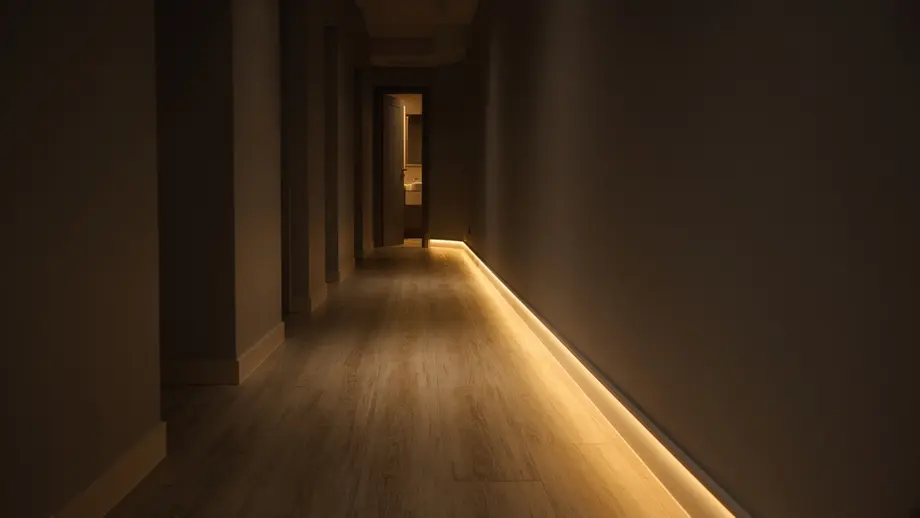
The best night light for elderly people is a continuous, low, warm line of light along the floor from bed to toilet, not one bright plug-in at each end of the hall. Add a light that can be switched on before feet touch the floor, keep every emitter below eye level, and keep one battery light by the bed for outages.
This night light for elderly checklist turns that answer into five jobs, with the minimum spec for each and one example.
| Job | Recommended type | Minimum spec to look for | Example (September 2026) |
|---|---|---|---|
| Light the path from bed to bathroom | Low LED strip along the baseboard or under the bed frame | Warm white or amber, dimmable to a low level, on a dusk-to-dawn schedule | Olight Ostrip 2 (5 m strip, trim or extend to 10 m, Basic Timer, $45.99) |
| Switch on a light before standing up | Bedside lamp with voice control, or a light with a button you can reach lying down | Works from bed without walking to a wall switch | Olight Aurevo Smart Bulb (800 lumens, Alexa voice control, $9.99) |
| Mark the bathroom door and toilet | Low glow in the bathroom doorway | Visible from the bed, no bare emitter in view | Ostrip 2 around the door frame, or a Sphere on a metal surface |
| Keep some light through a power cut | Battery light at the bedside | Runs a full night on a low mode | Olight Sphere Ambient Light (Sphere C: Red Light High 11~2 lumens for 580 + 320 minutes, $17.99) |
| Grab-and-go backup | Small flashlight on the nightstand | Uses a battery you already stock | Olight i3E EOS (one AAA, 90 lumens, $12.99) |
Anyone caring for an aging parent knows the problem. The 2 a.m. bathroom trip happens with blood pressure that may drop on standing, eyes that recover slowly from bright light, and a plug-in night light that glares up close and is useless three steps later. The strip, bulb and Sphere above sit in Olight's range of app-controlled ambient lights, but for an older adult the schedule and the button matter more than the app.
📋 Table of Contents
- 1. Why Do So Many Elderly Falls Happen on the Way to the Bathroom at Night?
- 2. How Does Aging Change Night Vision?
- 3. Continuous Floor Lighting vs Plug-In Night Lights: Which Lights the Path Better?
- 4. Hallway Lighting: Where to Put a Strip and How Dim to Run It
- 5. What Is the Best Motion Sensor Night Light for Elderly People?
- 6. Glare Control: Why Night Lights Belong Below Eye Level
- 7. Bedroom Lighting: A Light You Can Reach Before Your Feet Touch the Floor
- 8. Bathroom Lighting to Prevent Falls at Night: The Toilet Is the Target
- 9. Are Night Lights Good for Seniors?
- 10. What Are the Best Lights for Elderly People?
- 11. What Is the Best Nightlight for Dementia Patients?
- 12. Power Outage Setup: Lights That Keep Working When the Grid Doesn't
- 13. Night Lights for the Elderly: A Room-by-Room Checklist
- 14. FAQ
Why Do So Many Elderly Falls Happen on the Way to the Bathroom at Night?
Night trips stack several fall risks into a few minutes. The person stands up right after lying down, blood pressure can dip, the room is dark, and the bathroom itself is where many injuries happen. The CDC reports that more than one out of four older people falls each year. Lighting can't fix balance or blood pressure, but it can remove the "can't see the floor" part of the risk.
The CDC's older adult falls data adds that "Falling once doubles your chances of falling again," and counts about 4.5 million emergency department visits a year from falls among older people. The CDC does not break home falls down by hour, so distrust any precise "most falls happen at 3 a.m." claim. What research does show is that each piece of the night trip carries risk:
- Getting up to urinate. A 2020 systematic review and meta-analysis in the Journal of Urology found that nocturia is probably associated with an approximately 1.2-fold increased risk of falls, with an annual risk difference of 7.5% among the elderly.
- Standing up. The CDC's postural hypotension brochure lists symptoms that can happen "When standing or sitting up suddenly," "In the morning when blood pressure is naturally lower," and "When straining on the toilet." Its advice: "Get out of bed slowly. First sit up, sit on the side of the bed, then stand up."
- The toilet itself. A CDC analysis of 2008 emergency department data in MMWR found that injuries on or near the toilet rose from 4.1 per 100,000 people aged 15 to 24 to 266.6 per 100,000 among people 85 and older, and that 51.7% of bathroom injuries in the 85-and-older group happened on or near the toilet.
So the high-risk moments are the first steps after standing and getting up from the toilet, and that is where the plan below puts the most light.
How Does Aging Change Night Vision?
Three changes matter at night. Older eyes take much longer to recover their night sensitivity after bright light, less light reaches the retina, and glare from a bright point of light is harder to handle, especially with cataracts. Together they mean an older adult needs steady light on the floor and the doorway, with no bright flashes and nothing shining straight into the eyes.
Slower dark adaptation. A study of 94 adults from their 20s to their 80s in Vision Research opens with the finding that "Older adults have serious difficulty seeing under low illumination and at night, even in the absence of ocular disease." After exposure to a bright bleaching light, the time needed to get back within 0.3 log units of baseline night sensitivity increased 2.76 minutes per decade. Across six decades that is 2.76 × 6 = 16.6 extra minutes for an 80-year-old compared with a 20-year-old. So if a bright bathroom light goes on, the hallway back to bed stays hard to see far longer than the walk takes.
Less light reaching the retina. An analysis in the British Journal of Ophthalmology states that "Retinal illumination decreases with ageing due to pupillary miosis and reduced crystalline lens light transmission especially of short wavelengths." In plain terms, the same night light looks dimmer to a grandparent than to a grandchild.
Glare and cataracts. The National Eye Institute says more than half of all Americans age 80 or older either have cataracts or have had surgery to remove them, and it lists "Lamps, sunlight, or headlights seem too bright" and seeing "a halo around lights" among the symptoms. The American Optometric Association notes that cataracts can cause "decreased contrast sensitivity" and "increased sensitivity to glare" in its guide to senior vision.
This table turns each change into what it means on the way to the bathroom and the lighting fix that follows from it.
| Age-related change | What it means at 2 a.m. | Lighting fix |
|---|---|---|
| Slower dark adaptation (about 2.76 more minutes per decade to recover after bright light) | A bright bathroom light leaves the hallway black on the way back | Keep one steady low level for the whole route; avoid switching on full-power light mid-trip |
| Less light reaching the retina | A night light that looks fine to you looks dim to them | Light the floor itself, not just a glowing dot on the wall |
| Glare and cataracts | A bare bulb at eye level dazzles and leaves halos | Hide emitters below eye level or behind a lip; point light down |
| Reduced contrast | Floor edges, rugs and door thresholds blend together | Continuous light along edges and doorways gives outlines to follow |
Continuous Floor Lighting vs Plug-In Night Lights: Which Lights the Path Better?
A continuous strip along the floor spreads light far more evenly than point night lights. In our geometry model, a single plug-in night light leaves the far end of a 4-meter hallway about 500 times dimmer than the spot beside it, and two night lights still leave a 35-to-1 dip in the middle. A baseboard strip keeps the path within about 2 to 1.
In a 2011 Lighting Research Center study in BMC Geriatrics, 24 older adults walked a path under ceiling lights, under two conventional plug-in night lights, and under the same night lights plus lines of light outlining the path. The night lights delivered 0.015 lux at the eye. For the people at higher risk of falling, average walking speed was 86 cm/s under ceiling light, 76 cm/s under night lights alone and 81 cm/s with the path lines added. A follow-up in Age and Ageing found that people standing up did better with a night lighting system that added horizontal and vertical lines of light than with plug-in night lights, with results similar to high ambient light. Outlines and even light on the walking plane beat a brighter single point.
Our numbers come from geometry, not a light meter. For a source at height h, a walking line x meters from the wall, and a point d meters along the hall, floor light is proportional to h ÷ (h² + x² + d²)^1.5. We assumed a night light in an outlet 0.3 m (12 inches) up, a strip at 0.1 m (4 inches), a walking line 0.4 m (16 inches) from the wall, and a 4 m (13 ft) hallway. Real products aren't even emitters, so read the results as shape, not lux.
This table shows relative floor light along the walking line for each layout, with each layout's brightest point set to 100.
| Distance along a 4 m hallway | One night light at the start | Two night lights, one at each end | Continuous strip along the baseboard |
|---|---|---|---|
| 0 m | 100 | 100 | 51 |
| 0.5 m | 35 | 36 | 90 |
| 1 m | 8.9 | 9.4 | 98 |
| 2 m (middle) | 1.4 | 2.8 | 100 |
| 3 m | 0.4 | 9.4 | 98 |
| 4 m | 0.2 | 100 | 51 |
| Brightest ÷ dimmest | about 524 to 1 | about 35 to 1 | about 2 to 1 |
For the strip, integrating the same formula along a strip of length L gives h ÷ (h² + x²) × [(L − d) ÷ √(h² + x² + (L − d)²) + d ÷ √(h² + x² + d²)]. At the middle of the hall that is 0.588 × (0.979 + 0.979) = 1.15, and at either end 0.588 × 0.995 = 0.585, about 2 to 1.
The rule that follows: a strip's ends are only half as bright as its middle, so run it about 0.5 m (20 inches) past the bedside and the bathroom door. With that overlap, the model puts the path's ends at about 90% of the middle.
Hallway Lighting: Where to Put a Strip and How Dim to Run It
Run the strip low on the wall or under the bed frame, along the side of the path the person walks, and continue it into the bathroom doorway. Set it to warm white or amber at the lowest level that still shows the floor edge, and schedule it for dusk to dawn so nobody has to find a switch or an app at night.
The Olight Ostrip 2 ($45.99, regular price, September 2026) fits the continuous-strip job. Olight lists a 5-meter strip "with adhesive backing" that "can be trimmed to length, or extended to a maximum of 10 meters," with dedicated warm and cool white LEDs alongside RGB. The manual lists brightness from 1% to 100% and a "Basic Timer: Set on/off times with color/brightness," which is what makes it work for someone who won't open an app at night.
Use this sequence for a bed-to-bathroom run:
- Measure the route from the bedside to the toilet, adding about 0.5 m at each end.
- Mount the strip at baseboard height or under the bed frame, on the side the person keeps a hand toward.
- Clean the surface first. Olight's manual does not recommend the adhesive on unpainted brick, logs, uneven surfaces or wallpaper.
- In the app, choose warm white or amber, turn off dynamic and music modes, and dim until you can just see the floor edge and the door threshold from bed.
- Set a Basic Timer from bedtime to after sunrise (the dementia study below used 7:00 p.m. to 7:00 a.m.).
- Walk the route yourself at night, room lights off, before the person uses it.
The Ostrip 2's limits: it has no motion or daylight sensor, its manual says "Do not use the product for emergency lighting/exit," and Olight rates the strip IP65 "For strip part only. Controller is not included," so keep the controller dry and outside the bathroom.
Note: Olight's product page lists the Ostrip 2 input as "USB-A DC 5V/1A 5W" with a 2 m cable, while the manual lists a 24V 3A adapter and a 1.5 m cable. Check what arrives in the box and plan the outlet location around it.
Clock timers need a nudge twice a year. When daylight saving time ends on November 1, 2026, sunset moves an hour earlier on the clock, so move a fixed evening start time back to match.
What Is the Best Motion Sensor Night Light for Elderly People?
The best motion sensor night light for elderly people sees the person sitting on the edge of the bed, before the first step, and stays on longer than the longest bathroom visit. A sensor that only sees the hallway, or one that times out while someone sits on the toilet, creates the exact dark moment you are trying to remove. If you can't meet both conditions, use a dusk-to-dawn schedule instead.
The CDC's Check for Safety checklist asks, "Is the path from your bed to the bathroom dark?" and answers, "Put in a nightlight so you can see where you're walking. Some nightlights go on by themselves after dark." A light that is already on needs no sensing at all.
If you do use sensors, do the timing math. The speed below is the 76 cm/s the 2011 study recorded for higher-risk older adults under night lights; the distances are an example.
This worksheet times each part of an example night trip and shows what a sensor has to do at each point.
| Segment of the trip | Example distance | Time at 0.76 m/s | What the sensor must do |
|---|---|---|---|
| Sitting up and sitting on the bed edge (CDC advice) | 0 m | Pause before standing | Detect the person on the bed edge, before they stand |
| Bed to bedroom door | 3 m (10 ft) | 3 ÷ 0.76 = 3.9 s | Already be on; a sensor at the door lights the first 3.9 s too late |
| Bedroom door to bathroom door | 2 m (6.5 ft) | 2 ÷ 0.76 = 2.6 s | Stay on through the doorway |
| Bathroom door to toilet | 1.1 m (3.5 ft) | 1.1 ÷ 0.76 = 1.4 s | Light the toilet area |
| Seated on the toilet | 0 m | Your own number, in minutes | Timeout longer than the longest visit |
| Return trip | 6.1 m (20 ft) | 6.1 ÷ 0.76 = 8.0 s | Re-trigger at once when the person stands |
The walking takes about 8 seconds each way. The long part is sitting still. A bathroom sensor that needs movement can time out right before the person stands, which the CDC lists as a moment when postural hypotension symptoms can appear. So the bathroom timeout should exceed the longest visit plus a margin, or the bathroom glow should run on a schedule.
None of the Olight lights in this guide has a motion sensor; they run on schedules, voice, app or a button. If you want motion sensing, add a plug-in sensor light on the bed side of the room and keep the strip as the steady path light.
Tip: Aim the sensor low at the side of the bed, not across the room at the door. Then sit on the bed edge in the dark and swing your legs down. If the light doesn't come on before your feet touch the floor, move it.
Glare Control: Why Night Lights Belong Below Eye Level
Keep every light source below the eyes of a person lying in bed or walking, and aim the light at the floor and door edges rather than at faces. Glare from a bare LED at eye level shrinks what older eyes can see in the dim parts of the room, and cataracts make it worse. A light that looks bright but hides the floor is doing the wrong job.
The dementia study below solved glare with a simple part: "To prevent glare, the lights included a small 'lip' to remove direct view of the light so that the light was visible only indirectly." Copy that by mounting a strip under a bed rail, a shelf lip or inside a baseboard channel, diodes pointing down. Olight's manuals agree: the Ostrip 2 manual says, "Do not direct the light into the human eye, as this may cause temporary blindness or permanent damage to the retina," and the Aurevo manual says, "The bulb is very bright; do not look directly into it."
Flashlights need the same care. The i3E EOS manual rates the light at 500 cd. Illuminance equals candela ÷ distance², so the beam delivers 500 ÷ 1² = 500 lux at 1 meter and 500 ÷ 2² = 125 lux at 2 meters, based on Olight's rated intensity, not measured. That is more than 30,000 times the 0.015 lux the 2011 study's night lights put at the eye. Aim it at the floor 1 to 2 meters ahead, never at a face.
This table lists common placements, whether each one causes glare, and a better alternative.
| Placement | Glare risk | Better alternative |
|---|---|---|
| Plug-in night light in an outlet facing the bed | High: bare glow in view of someone lying down | Shielded strip under the bed frame |
| Lamp with an exposed bulb on the nightstand | High when switched on at full power | Shaded lamp, dimmed or set to warm white |
| Strip on top of a baseboard, diodes facing the room | Medium: visible dots at low eye angles | Strip on the underside of a ledge, or aimed at the floor |
| Glow around the bathroom door frame, facing the bed | Low if dim and shielded | Keep it at the lowest level that still outlines the door |
| Flashlight aimed at a partner's face | High | Aim at the floor 1 to 2 m ahead |
Bedroom Lighting: A Light You Can Reach Before Your Feet Touch the Floor
The bedroom needs a light that comes on while the person is still sitting on the bed. The CDC checklist asks, "Is the light near the bed hard to reach?" and answers, "Place a lamp close to the bed where it's easy to reach." A lamp that answers to voice, a button within arm's reach, or a strip already on by schedule all meet that test.
Bed setup matters as much as the light. MedlinePlus recommends a bed that is low, so that your feet touch the floor when you sit on the edge of the bed, and "good lighting, especially for the path from the bedroom to the bathroom and in the bathroom and any stairs."
The Olight Aurevo Smart Bulb ($9.99, regular price, September 2026) puts a bedside lamp on voice control. Olight lists 800 lumens, 2700K to 6500K, CRI above 80, a rated 8W and a 15,000-hour lifespan, with control through the Olight app or Alexa. In a nightstand lamp, it turns on by voice with no reaching, and its manual lists "Schedule, Do Not Disturb, Default Light, and Gradient" settings, so it can come up warm and low at night.
The Aurevo's limits decide where it belongs:
- Voice control needs Wi-Fi, an app login and Alexa; without internet it works only from its switch.
- The lamp switch must stay on, or neither Alexa nor the app can turn it back on.
- Its manual says, "Do not use in damp places like bathrooms to avoid short circuits," and it is marked "NOT FOR EMERGENCY LIGHTING."
- At 800 lumens it is a lamp, not a night light. Set a warm, dim default so a sleepy "lights on" command doesn't flood the room.
If apps and voice assistants frustrate the person, a plain lamp with a large, lighted switch within reach does the same job. For how voice and app control behave when the Wi-Fi drops, see this guide to choosing an app controlled light.
Bathroom Lighting to Prevent Falls at Night: The Toilet Is the Target
In the bathroom, the goal is to see the toilet, the grab bar and the floor edge without switching on the full vanity light. A dim glow that stays on for the whole visit matters most, because the riskiest moment is standing back up. CDC data show more than half of bathroom injuries among people 85 and older happen on or near the toilet.
Three setups work, from simplest to most involved:
- Doorway glow. Continue the hallway strip around the inside of the bathroom door frame, low, so the toilet area picks up spill light. Keep the controller outside the room and dry.
- Battery glow on a metal surface. The Olight Sphere Ambient Light ($17.99, regular price, September 2026) has a magnetic base and an IP56 rating, and Olight's product page says it stays IP56 "even with the charging port." On a metal shelf it glows all night with no outlet.
- Switched overhead light plus a night level. If the bathroom light is on a dimmer, a low preset can serve at night. Have an electrician handle any fixture work.
The CDC checklist also recommends grab bars next to the toilet and inside the tub, and a non-slip mat in the tub or shower. Light helps a person find the grab bar; it can't replace one.
Safety note: Keep plug-in and mains-powered lights away from water. The Aurevo manual rules out damp places like bathrooms, and the Ostrip 2 manual says not to immerse the strip or its controller in water. Among the glow lights in this guide, only the battery-powered Sphere carries an IP rating that covers the whole unit.
Are Night Lights Good for Seniors?
Yes, when they light the path rather than the bed. The CDC, MedlinePlus and the Alzheimer's Association all recommend night lighting between the bedroom and the bathroom. The best setup keeps light low and warm, on the floor and doorways, and out of the sleeper's eyes, because light at night has been linked to poorer sleep and metabolic health in older adults.
The case for keeping them dim comes from sleep research. Harvard Health notes that "A mere eight lux - a level of brightness exceeded by most table lamps and about twice that of a night light - has an effect" on circadian rhythm and melatonin, and advises: "Use dim red lights for night lights." A Northwestern study of 552 adults aged 63 to 84 in the journal Sleep concluded that "Habitual LAN in older age is associated with concurrent obesity, diabetes, and hypertension", where LAN means light at night. That is an association, not proof that night lights cause disease, but it argues for the least light that still makes the trip safe.
This framework reconciles the two goals of seeing the floor and sleeping well.
| Goal | Where the light goes | How much | Color |
|---|---|---|---|
| See the floor and edges | Floor plane and door outlines | Enough to see the floor edge and threshold from bed | Warm white or amber |
| Protect sleep | Away from the pillow; nothing shining at the eyes | The 2024 dementia study calibrated its lights to 0.5 lux or less at the eye, 2 m away | Red or amber at the lowest levels |
| Stand up safely | Bedside and toilet area | Brighter than the path, on demand | Warm white |
| Walk back to bed | Same path, same light | Unchanged, so eyes don't have to re-adapt | Unchanged |
Parents choosing a nursery night light for 3 a.m. feeds face the same trade-off; for older adults the light must also support walking, so it belongs on the floor.
What Are the Best Lights for Elderly People?
The best lights for elderly people come in layers: a continuous low path light from bed to bathroom, a bedside light that works before standing, a dim glow at the toilet, bright general light for daytime tasks, and a battery light for outages. No single product covers all five. Match each layer to the person's habits, grip and comfort with technology.
This table lists the Olight options for each layer, the official ratings that matter for the job, and the limit to know before buying.
| Model | Layer | Olight ratings that matter here | Limit | Regular price (September 2026) |
|---|---|---|---|---|
| Ostrip 2 | Path light | 5 m strip, trim or extend to 10 m; warm and cool white plus RGB; Basic Timer; IP65 strip only | No motion sensor; not for emergency lighting; controller must stay dry | $45.99 |
| Aurevo Smart Bulb | Bedside lamp | 800 lumens; 2700K to 6500K; CRI above 80; 8W; Alexa voice control | Needs Wi-Fi; not for bathrooms; not for emergency lighting | $9.99 |
| Sphere Ambient Light (Sphere C) | Bathroom glow and outage backup | 75 lumens max; White Light Low 1 lumen for 40 hours; Red Light Low 0.5 lumens for 25 hours; IP56; magnetic base; 93 g | 75 lumens is a glow, not a room light; a 2-second hold from off locks it | $17.99 |
| i3E EOS | Nightstand flashlight | 90 lumens; 500 cd; 44 m; one AAA; IPX8; 19.4 g | One mode only; twist switch needs two hands | $12.99 |
The Sphere suits someone who doesn't want an app, with one catch. Olight's Sphere C manual says that when the light is off, "press and hold to enter the default White Light Low," a 1-lumen glow, and a double press turns it off. But holding the button for 2 seconds from off locks the light, and a 1-second press and hold unlocks it. Show the person the short hold, and tape a note beside the light.
The Olight i3E EOS is not a night light. It has one 90-lumen output, far brighter than a path light, and it turns on with a twist. The product page describes a "Simple head twist to activate," while the manual says to fully tighten the tailcap clockwise. Either way, twisting takes two hands and some grip, a poor fit for arthritic fingers, so keep it as an outage backup.
For light outside the bedroom, such as the front door, the porch and calling for help, see the guide to self defense for seniors.
What Is the Best Nightlight for Dementia Patients?
The best nightlight for dementia patients gives even, steady, low light with no shadows, flashing or color changes, outlines the bathroom door so it is visible from bed, and runs on a schedule the person never has to operate. In a 2024 trial, amber LED strips around the bathroom door frame were linked to 34% fewer nighttime falls than standard night lights, a difference that did not reach statistical significance.
The study, published in the Journal of the American Medical Directors Association, placed three strips of amber LEDs around the bathroom or entry door frame in the rooms of 38 assisted living residents with dementia. The lights faced the bedroom "to be clearly visible from the bed," were calibrated to 0.5 lux or less at the eye 2 meters away, and ran from 7:00 p.m. to 7:00 a.m. The comparison was two standard 0.5W warm-white LED night lights. The authors reported "The incidence density for falls was 34% lower in the intervention condition than the control condition," with a P value of 0.18; a larger trial is under way, so treat it as promising, not proven.
The Alzheimer's Association explains why even light matters. Its sleep and sundowning page warns that "Low lighting can increase shadows, which may cause the person to become confused by what they see." Its home safety guide adds, "Changes in levels of light can be disorienting," and recommends, "Use night lights in hallways, bedrooms and bathrooms."
A setup that follows those findings:
- Outline the bathroom door frame with a strip facing the bed. Two sides plus the top of a 36 × 80 inch opening is 80 + 80 + 36 = 196 inches, about 4.98 m. That just fits one 5 m Ostrip 2, so measure your own door before cutting.
- Choose amber or warm white in a fixed, static mode. Turn off dynamic, flash and music modes, which change the light and can add confusion.
- Dim it until you can see the door outline from the pillow but no individual diodes.
- Schedule it on in the evening and off after sunrise, so the person never touches a control.
- Keep light levels even between the bedroom, hallway and bathroom, as the Alzheimer's Association advises.
The Ostrip 2 is not the trial's light and Olight publishes no lux figure, so this adapts the layout rather than copying it. The Sphere's manual calls it a "Non-pet toy" and says not to use it "as a ball for hitting or throwing." A glowing ball within reach may invite handling by someone with dementia, so mount it by its magnet out of easy reach, or use the fixed strip instead.
Power Outage Setup: Lights That Keep Working When the Grid Doesn't
Plan the night route for a power cut separately, because plug-in and smart lights go dark with the grid. Keep one battery glow light that can run a whole night and one small flashlight on the nightstand, both charged or stocked. Ready.gov's advice is direct: "Have flashlights for every household member."
Ready.gov's power outage guidance also says to "Plan for batteries and other alternative power sources." The Ostrip 2 and Aurevo manuals both rule out emergency lighting, so neither belongs in the outage plan.
The Sphere C covers the glow: Olight rates Red Light High at 580 + 320 minutes, longer than a 7 p.m. to 7 a.m. night, on a built-in 700mAh battery. The i3E EOS manual rates 45 minutes on the included alkaline AAA and 70 minutes on a 900mAh NiMH cell. If each bathroom trip keeps it on for 2 minutes, that is 45 ÷ 2 = 22 trips on alkaline, or 70 ÷ 2 = 35 on NiMH. At two trips a night, one cell lasts about 11 or 17 nights of outages, based on Olight's ratings, not measured.
The manual says to "take out the battery if you are storing the flashlight for a long period of time to prevent the battery from leaking," but a nightstand light is in use, so leave the cell in and check it monthly. Keep spare AAA cells in a sealed bin, following the humid-climate advice in this guide to hurricane supplies storage.
Warning: Don't use candles for a night route. An older adult carrying a flame to the bathroom, or leaving one burning while asleep, adds a fire risk to a fall risk. Battery lights solve both.
Night Lights for the Elderly: A Room-by-Room Checklist
Walk the route yourself, bed to toilet and back, once in daylight and once at night with the house lights off. Every line should be true before you're done; together they cover the places where night lights for the elderly do the most work.
This senior home lighting checklist lists the check, the fix and a quick way to confirm it at night.
| Room or area | Check | Fix | Night confirmation |
|---|---|---|---|
| Bedroom | Can a light come on before feet touch the floor? | Voice-controlled lamp, reachable button, or a scheduled strip | Sit on the bed edge in the dark and switch it on without standing |
| Bedroom | Is any light shining at the pillow? | Move or shield it; aim it at the floor | Lie down and look for visible diodes or bulbs |
| Bedroom | Is the bed low enough that feet reach the floor? | Adjust the bed height (MedlinePlus) | Sit on the edge; both feet flat |
| Hallway | Is the path lit end to end, with no dark gap? | Continuous strip, extended 0.5 m past each end | Walk it slowly; you should never lose the floor edge |
| Hallway | Are cords, rugs and clutter off the route? | Tape or remove them (CDC checklist) | Walk it with a flashlight aimed at the floor |
| Hallway | Do scheduled lights match sunset after the clocks change? | Update timers when daylight saving time ends | Check the first evening after the change |
| Bathroom | Is the door outlined and visible from bed? | Low strip around the door frame | Look from the pillow |
| Bathroom | Does light stay on while seated? | Scheduled glow, or a sensor timeout longer than a visit | Sit for your longest normal visit and see if it stays on |
| Bathroom | Are there grab bars by the toilet and tub? | Install them (CDC checklist) | Find the bar by feel and sight in the night light |
| Stairs | Is there a light and switch at the top and bottom? | Have an electrician add them (CDC checklist) | Switch on from either end |
| Whole route | Will anything light the route in a power cut? | Charged Sphere on a low mode plus a stocked flashlight | Flip the breaker for the bedroom circuit and walk the route |
Three actions to take tonight, before you buy any night light for elderly family members: put a battery light and a flashlight on the nightstand, walk the route in the dark yourself, and note every point where you lose sight of the floor. Those points are where the strip, the doorway glow or the bedside lamp go first.
FAQ
Changelog
- September 24, 2026: First published.