Olight makes the lights recommended here. Olight specs and regular prices come from its US product pages and user manuals as of September 2026. Cost, spare, battery and charging figures are our own arithmetic from those published numbers, not measurements.
⚡ TL;DR
A group flashlight purchase pays off when everyone carries the same light: one spare fits anyone, one cable charges every unit, and one ten-minute lesson teaches the whole group. For 20 people, pick the battery platform first, buy one member model plus one leader model, add three spare lights, number every unit and log losses.
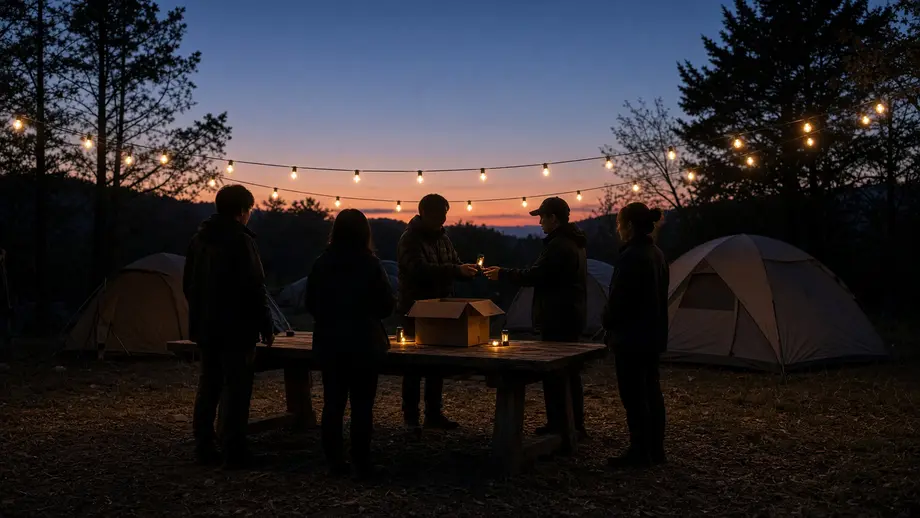
The usual problem is the opposite. A scout troop, church volunteer crew or youth camp shows up with 20 lights from 20 homes. Half need AAA cells, some need a cable nobody packed, and one kid's light turns on in the bag and is dead by dinner. At 9 p.m., no spare fits and no leader knows how to work it.
This equipment list turns the group flashlight purchase into five decisions you can make before the budget meeting. Prices are Olight's single-unit regular prices; Olight publishes no group or volume pricing.
| Use | Recommended type | Minimum spec to accept | Olight example (regular price) |
|---|---|---|---|
| Member light (everyone) | One model for all members, clip-on or keychain size | IPX5 or better, one battery or cable type, cannot switch on in a pack; a low mode if members do tent chores | Olight Oclip ($29.99), or Olight i3E EOS ($12.99) if one 90-lumen level is enough |
| Leader light | One model for all adults, brighter and longer running | 100 lumens or more for 3+ hours, a red mode, reach past 100 m | Olight Oclip 2 Pro ($54.99) or Olight Perun 3 ($89.99) |
| Headlamp for everyone | One headlamp model with the band included | A red mode, a steady mode that lasts a full evening, IPX7 or better | Olight Perun 3 ($89.99) |
| Spare lights | Extra units of the member model | 3 spares for 20 people at a 5% per-trip failure rate (see the spare table) | Same as the member light |
| Spare power | One cell type or one cable type for the whole group | Enough cells or charges for your longest trip | Ostation Series AAA NiMH 4-pack ($5.49) for AAA kits |
| Adult key-ring backup | Tiny rechargeable light, adults only | Works with no spare parts | Olight imini 2 ($19.99) |
📋 Table of Contents
- 1. Group Flashlight Purchase Quick Answer: Spares and Training Beat Specs
- 2. Should Everyone Have the Same Model?
- 3. Why Pick the Battery Platform First?
- 4. Bulk Headlamp Buying: Charging 20 Lights Overnight
- 5. What Is the Best Budget Headlamp for Groups?
- 6. Scout Troop Gear Budget: Three Kits for 20 People
- 7. Scene Requirements: Tent, Trail, Service Night and Outage
- 8. How Many Spare Flashlights Should a Group Buy?
- 9. Marking, Sign-Out and Returns
- 10. Ten-Minute Light Training for the Whole Group
- 11. How Do I Buy Flashlights for a Group?
- 12. FAQ
Group Flashlight Purchase Quick Answer: Spares and Training Beat Specs
For a group flashlight purchase, the biggest gains come from standardizing, not from buying the brightest light. Identical lights give you interchangeable spares, one battery or cable type, and one set of instructions. Those three decide whether a light still works at 10 p.m. on the second night; peak lumens rarely do.
The National Park Service lists lighting among its Ten Essentials and says: "Headlamps are the recommended light source because they are hands-free. Be sure to pack extra batteries." Extra batteries only help a group if they fit every light in it.
So the order of decisions here is fixed: battery platform, member model, leader model, spares, then marking and training. Browse Olight's full range of flashlights before you narrow the list; if you only want one light for yourself, start with the best headlamps instead.
Should Everyone Have the Same Model?
Yes, for members of a group, everyone should have the same model, and adult leaders should share a second model. Two models is the practical limit. With one member model, any spare replaces any light, one battery type or cable covers the group, and a leader can fix any light in the dark. A mixed pile of personal lights needs a spare for every model.
It also means one lesson: leaders teach one on/off sequence, one low mode and one red-light shortcut, and scouts help each other because every light works the same way.
The cost is real too. Everyone gets the same compromise: a strong hiker may want more reach, and a younger child may find a clip light harder to aim than a headlamp. Buying 20 of anything also means one up-front bill instead of families paying for their own gear. The leader model covers reach and runtime for the few people who need it.
This table compares a group where everyone brings their own light with a standardized kit, using an illustrative mix of six models (your own count may differ).
| Item to manage | 20 people bring their own (6 models, illustrative) | Standardized kit (1 member model + 1 leader model) |
|---|---|---|
| Battery or cable types to pack | Up to 6 | 1 for members, 1 for leaders |
| Spare lights to cover every member | At least 6 (one per model), and more for common models | 3 of the member model (see the spare table) |
| Button sequences leaders must know | Up to 6 | 2 |
| Chance a spare fits a failed light | Only if that model has a spare | Every time for members |
| Who pays | Each family | The group budget, once |
| Loss log you can act on | Hard to compare across models | Loss rate per model per trip |
For one person, a second flashlight should fill a gap the first one leaves. A group works the other way: members repeat each other, and only the leader light fills the gaps.
Why Pick the Battery Platform First?
Pick the battery platform first because it decides your spares, your charging plan and how you travel. A group has three realistic options: disposable or NiMH AAA cells, a built-in battery charged by USB-C, or a removable lithium-ion cell such as a 21700. AAA kits are cheapest and easiest to resupply anywhere. Built-in batteries need no loose cells but need charging time and outlets.
This table shows how many cells or charges one person needs per trip, based on Olight's rated runtimes, for the number of hours each person actually runs the light. Pick your own hours from past trips.
| Hours of use per person per trip | i3E EOS, alkaline AAA (45 min each) | i3E EOS, NiMH AAA (70 min each) | Oclip on Med, 100 lm (90 min per charge) | Oclip on Low, 10 lm (12 h per charge) | Perun 3 on Med, 120 lm (25 h per charge) |
|---|---|---|---|---|---|
| 1 hour | 2 cells (60 ÷ 45 = 1.33) | 1 cell (60 ÷ 70 = 0.86) | 1 charge | 1 charge | 1 charge |
| 2 hours | 3 cells (120 ÷ 45 = 2.67) | 2 cells (120 ÷ 70 = 1.71) | 2 charges (120 ÷ 90 = 1.33) | 1 charge | 1 charge |
| 4 hours | 6 cells (240 ÷ 45 = 5.33) | 4 cells (240 ÷ 70 = 3.43) | 3 charges (240 ÷ 90 = 2.67) | 1 charge | 1 charge |
| 16 members at 2 hours each | 48 alkaline cells | 32 NiMH cells | 32 charges | 16 charges | 16 charges |
Counts include the cell already in the light and round up. They use rated runtimes, not measurements; see why real flashlight runtime rarely matches the chart. An AAA kit needs a real cell budget, while a clip-light kit on Low or a Perun 3 kit on Med needs little spare power for a weekend.
AAA kits: cheapest to resupply
The Olight i3E EOS is the lowest-cost standard light here at $12.99. It weighs 0.68 oz (19.4 g), is 2.38 in long, is rated IPX8, reaches up to 44 meters and runs on one AAA cell. Its manual lists 90 lumens, 500 cd, 1.5 m impact resistance, and alkaline, NiMH or L92 cells.
The limit is clear: one output level, with no low mode for reading in a tent and no red light. It is a twist light (fully tighten the tailcap to turn it on, per the manual), and for a youth group that simplicity is a plus: nobody gets stuck in strobe.
NiMH cells lower the running cost. Olight's Ostation Series AA/AAA Batteries Pack lists its AAA cells at 950mAh, and the AAA 4-pack costs $5.49. The same page lists the AA version with "a cycle life of over 300 times and a charge retention over 70% after 12 Months." You need a NiMH charger for them. Olight's Ostation X lists $119.99 (regular price, September 2026, for the AA version its page shows by default), charges 1 to 4 cells at a time and lists 2.5 to 3.8 hours per charge. At four cells per round, 40 cells take 10 rounds, so start charging days before the trip. With no charger, store-bought alkaline AAA cells work too.
To skip loose cells at keychain size, the Olight i1R 2 Pro ($21.99) has a built-in battery: 180 lumens for 23 minutes, 5 lumens for 12 hours, 48 m and IPX8, with a 100-minute maximum full charge per its manual. It costs $9.00 more per light than the i3E EOS, or $171.00 across 19 member lights.
For summer storage, the i3E EOS manual says to "take out the battery if you are storing the flashlight for a long period of time to prevent the battery from leaking."
Built-in USB-C kits: no loose cells
The Olight Oclip ($29.99) is the member light for a rechargeable kit. It has white light up to 300 lumens and a red light at 4 lumens, a clip that grips objects up to 14 mm thick, and a magnetic base. Olight rates it at 68 m, 1,156 candela and IPX5, with a weight of 1.06 oz (30 g). Its modes run High 300~180 lumens for 1 + 60 minutes, Med 100 lumens for 90 minutes, Low 10 lumens for 12 hours, Moon 1.5 lumens for 30 hours and red 4 lumens for 5 hours.
The clip makes it hands-free without a headband. Scouting America's Scout Life magazine suggests this in its headlamp and flashlight buying guide: "Consider a headlamp or flashlight with a clip so you can attach it to the brim of your cap."
The Oclip has limits a group leader should know. Olight rates it IPX5, and the manual says not to "immerse the product in water or other liquid," so it is not the light for canoe trips. The manual also says only low and medium brightness are available below 32°F (0°C), and it lists a working temperature of 0 to 40°C, so winter campouts need a different plan.
Removable 21700 kits: longest runtime per light
The Olight Perun 3 ($89.99) uses a customized 3.6V 5000mAh 21700 cell. It comes with a headband, a magnetic tail, a clip, a lanyard and an MCC3 magnetic charging cable. It is rated at 3,000 lumens, 6,400 candela, 160 m and IP68, with Med at 120 lumens for 25 hours and red light at 60 lumens for 14 hours or 15 lumens for 70 hours.
Its charging cable is the catch for a group. Olight lists the MCC3 magnetic cable as the Perun 3's charging type and lists no USB-C port, so a headlamp whose cable goes missing cannot be charged until another MCC3 turns up. Olight's cable page lists the Perun 3 as MCC3-compatible; keep two extra cables in the leader bag. Spare 21700 cells cost $26.95 each on Olight's battery page, which also lists the Perun 3 as compatible. Olight's warranty page names built-in batteries but not removable cells, so treat spare 21700s as consumables.
Note: Write the chosen platform into the group's gear list, so a family buying its own replacement knows which battery or cable to match.
Bulk Headlamp Buying: Charging 20 Lights Overnight
To charge 20 rechargeable lights overnight, size the charging station from the rated input of one light times the number of lights. Based on Olight's manuals, 20 Oclips draw about 100 watts at once and finish in about 1.5 hours; 20 Perun 3 headlamps draw about 200 watts and need under 4 hours each. A 10-port charger splits either job into two rounds.
This table shows the charging math for a full kit, based on the input and charging time printed in each user manual, not measured.
| Kit | Rated input per light (manual) | Power for 20 at once | Time per round (manual) | With a 10-port USB charger |
|---|---|---|---|---|
| 20 × Oclip | 5V/1A = 5 W | 20 × 5 W = 100 W | About 1.5 hours | 2 rounds, about 3 hours |
| 20 × Perun 3 | 5 V 2 A = 10 W | 20 × 10 W = 200 W | Under 4 hours | 2 rounds, under 8 hours |
| 4 × Oclip 2 Pro (leaders) | Not listed | Not listed | 1 h 30 min via USB-C | 1 round |
A 10-port charger only works this way if each port supplies the rated current, so check the per-port rating, not just the total wattage. Two rounds of Oclip charging fit between dinner and lights-out; charge a Perun 3 kit the night before.
Charging a whole kit also concentrates lithium-ion batteries in one room. The U.S. Fire Administration's battery safety page says: "Do not charge them at temperatures below 32 degrees F (0 degrees C) or above 105 degrees F (40 degrees C)." It also says to "Stop using lithium-ion batteries if you notice an odor, change in color, too much heat, change in shape, leaking or odd noises."
Safety note: Charge the kit on a hard, non-flammable surface with an adult present, not in a pile of sleeping bags. Set aside any light that feels hot, swells or smells odd for a warranty claim; Olight's policy covers built-in battery and charging issues under normal use.
What Is the Best Budget Headlamp for Groups?
The best budget headlamp for groups is the one you can buy in identical units, with a red mode and a steady mode that lasts a full evening. Among Olight lights in stock in September 2026, the Perun 3 is the headlamp that ships with its band, at $89.99. On a tighter budget, a clip light on a cap brim or pack strap does the headlamp's job for about a third of the price.
Olight's Perun 3 Mini ($64.99 regular price) would be the natural budget headlamp, but its default version showed Sold Out on Olight's US product page on September 24, 2026, as were two Premium versions. Do not build a group plan around a light you cannot buy in quantity.
That leaves two practical routes for bulk headlamp buying:
- Headlamp for everyone: 20 Perun 3 headlamps. Every member gets a band, IP68 protection, red light and 25 hours at 120 lumens. It is the most capable kit and the most expensive.
- Clip light as a headlamp substitute: 16 Oclips for members, clipped to a cap brim or shoulder strap, plus a brighter light for each leader. You give up the adjustable tilt of a headband and some water resistance, and save $60.00 per member at regular prices ($89.99 − $29.99).
Do not plan on a strap for the base Oclip: Olight's $7.99 Oclip Series Headlamp Strap lists compatibility with the Oclip Pro, Oclip Pro S and Oclip Ultra only. Both routes are hands-free, which is the NPS's reason for recommending headlamps. For tilt and spacing once the group is moving, see our guide to picking a hiking headlamp for pre-dawn group starts, or compare every Olight option with a band in the rechargeable headlamps category.
Scout Troop Gear Budget: Three Kits for 20 People
A 20-person kit costs about $21 per person on the AAA route, about $39 on the clip-light route and about $106 for a headlamp for everyone, at Olight's regular September 2026 prices. Each kit below assumes 16 members and 4 adult leaders, three spare member lights, and the spare power that platform needs. Your own roster and loss rate will change the totals.
The Barriers to Abuse section of Scouting America's Guide to Safe Scouting (online edition, which carries no edition date; text as posted in September 2026, so check it before each season) says: "Two registered adult leaders 21 years of age or over are required at all Scouting activities, including all meetings." The example uses four adults, one per four youth; adjust it to your roster.
This table prices the three kits at Olight's regular prices as of September 2026 (not promotional or member prices).
| Kit | Member lights (16 + 3 spares) | Leader lights (4) | Spare power | Total | Per person (÷ 20) |
|---|---|---|---|---|---|
| 1. AAA basic | 19 × Olight i3E EOS at $12.99 = $246.81 | 4 × Olight Oclip at $29.99 = $119.96 | 10 × Ostation AAA NiMH 4-packs at $5.49 = $54.90 (40 cells) | $421.67 | $21.08 |
| 2. Rechargeable clip light | 19 × Olight Oclip at $29.99 = $569.81 | 4 × Olight Oclip 2 Pro at $54.99 = $219.96 | USB-C cables come in the box | $789.77 | $39.49 |
| 3. Headlamp for everyone | 23 × Olight Perun 3 at $89.99 = $2,069.77 (20 in service + 3 spares) | Included in the 23 | 2 × 21700 5000mAh cells at $26.95 = $53.90 | $2,123.67 | $106.18 |
The totals leave out a NiMH charger (Kit 1; at the Ostation X's listed $119.99 it adds $6.00 per person), spare MCC3 cables (Kit 3), tax and shipping. They are single-unit regular prices, not a quote; do not assume any group discount until Olight gives you one in writing.
Kit 1: AAA basic, about $21 per person
Kit 1 fits a Cub Scout pack, a vacation Bible school or a first-year camp. Every member gets a 90-lumen twist light that runs on a cell any store sells, and the 40 NiMH cells give each of the 19 member lights two cells. Leaders carry Oclips for Low, red light and a clip.
Two weak points. At two hours of use a night, each member needs two NiMH cells per night, so 40 cells cover one night, not a weekend, and the leader bag holds the rest of the supply. And the Oclip's 68 m falls short of the 100 m leader target in the equipment list; four Oclip 2 Pro lights instead add $100.00 ($219.96 − $119.96), or $5.00 per person.
Kit 2: Rechargeable clip light, about $39 per person
Kit 2 fits a scout troop, a youth group that meets weekly or a volunteer crew. Every member gets red light, a Low mode that lasts 12 hours and a clip for hands-free use. Leaders carry the Olight Oclip 2 Pro. It adds a 125 m spotlight for head counts across a field, a floodlight up to 530 lumens, red light at 4 lumens for 27 hours, IP66 and 2.0 m impact resistance.
Buy the standard Oclip 2 Pro ($54.99) unless you want the dock: it ships with a USB-C cable and also charges by MCC, while the Premium version adds a 1,000 mAh Mobile Charging Dock. The Oclip 2 manual says: "Do not immerse the product in water or other liquids, as it will damage the product."
Kit 3: Headlamp for everyone, about $106 per person
Kit 3 fits an adult volunteer team or a high-adventure crew that works outdoors at night. Everyone gets a real headband, IP68 protection and a battery that lasts a weekend at Med, and one spare fits anyone, adults included.
It is also the hardest kit to fund at once. One path: start with Kit 2 and add Perun 3 headlamps for older members as the budget allows.
Scene Requirements: Tent, Trail, Service Night and Outage
Group lighting needs change by scene: tent chores need a low mode, night hikes need runtime and a hands-free mount, service projects near roads need visibility, and power outages need a long steady mode. Match the member light to your most common scene and cover the rest with the leader light.
This table lists what each common group scene asks of a light, with the minimum that meets it.
| Scene | Output that works | Runtime needed | Water rating | Kit that fits |
|---|---|---|---|---|
| Tent and camp chores | 1 to 10 lumens, plus red | An evening at Low | Any | Kit 2 or 3; Kit 1 has one 90 lm level only |
| Campfire program or stargazing | Red light, or Moon | 1 to 2 hours | Any | Kit 2 (red 4 lm for 5 h) or Kit 3 (red 15 lm for 70 h) |
| Night hike on a trail | 100 lumens for leaders, 10 to 100 lumens for members | The whole hike | IPX4 or better for rain | Kit 3; Kit 2 with Oclips clipped to cap brims |
| Service night near a road or parking lot | White light for tasks, plus reflective vests | 1 to 3 hours | IPX4 or better | Kit 2 or 3 |
| Power outage at the meeting hall | 10 to 120 lumens, steady | Several hours | Any | Kit 3 (Med 120 lm for 25 h) or Kit 2 on Low |
| Canoe, creek or beach trip | Any | Trip length | IPX7 or IPX8, since the light may go in the water | Kit 1 (i3E EOS IPX8) or Kit 3 (Perun 3 IP68); not the Oclip or Oclip 2 Pro |
Kit 2 is the best all-rounder for land trips but should stay out of the canoe. Kit 3 covers every row, at five times Kit 1's cost ($106.18 ÷ $21.08 = 5.0).
How Many Spare Flashlights Should a Group Buy?
A group of 20 should carry about three spare lights if roughly 1 in 20 lights fails, gets lost or goes dead on a typical trip. That covers about 98% of trips at that rate. If your log shows 1 in 50, two spares cover 99% of trips; if it shows 1 in 10, you need four spares to cover about 96%.
These percentages come from the binomial formula. If each of 20 lights has the same chance p of being lost, broken or dead on a trip, the chance that k or fewer fail is the sum of C(20, i) × p^i × (1 − p)^(20 − i) for i = 0 to k. For p = 5%, the chance that none fail is 0.95^20 = 0.358, and exactly one is 20 × 0.05 × 0.95^19 = 0.377, so one spare covers 0.736, or 73.6% of trips.
This table shows the share of trips that a given number of spares covers, for three per-trip failure rates. The rates are inputs for you to replace with your own log, not measured data.
| Spare lights carried | p = 2% (1 in 50) | p = 5% (1 in 20) | p = 10% (1 in 10) |
|---|---|---|---|
| 0 | 66.8% | 35.8% | 12.2% |
| 1 | 94.0% | 73.6% | 39.2% |
| 2 | 99.3% | 92.5% | 67.7% |
| 3 | 99.9% | 98.4% | 86.7% |
| 4 | 100.0% | 99.7% | 95.7% |
| 5 | 100.0% | 100.0% | 98.9% |
| Expected failures per trip (20 × p) | 0.4 | 1.0 | 2.0 |
Two lessons. Spares equal to the expected failures are not enough: at p = 5% you expect one failure per trip, but one spare covers only 73.6% of trips. And the rate matters more than group size: at a 95% target, raising the rate from 5% to 10% adds a fourth spare for 20 people, while five more people at 5% still need only three spares (96.6% coverage for 25).
The formula assumes independent failures, and often they are not: below 32°F the Oclip manual limits every Oclip in the kit to Low and Med at once.
Tip: Log dead batteries as failures, not only lost or broken lights. A dead light at the trailhead is as useless as a lost one, and it is the failure spare cells and charging rules prevent.
Marking, Sign-Out and Returns
Mark every group light with a number, sign lights out and back in on one sheet, and log the reason every time a light fails or goes missing. Numbered lights turn "we lost some flashlights" into a loss rate per trip, the number the spare table needs, and show which lights keep coming back broken.
Number the lights 01 to 20, with spares as S1 to S3. Engrave the number, or use a paint pen under clear heat-shrink tubing so it survives pockets. Add a group name and phone tag if the light has a lanyard hole, and color-code by patrol so each patrol leader counts only their own lights.
This sign-out sheet holds everything you need to track returns and calculate your own loss rate.
| Light # | Issued to | Date out | Check out (on, low, red, charge or cells) | Date in | Check in (condition, missing parts) | Leader initials |
|---|---|---|---|---|---|---|
| 01 | Name of member | Trip date | All modes work, charged | Return date | Returned, clip bent | Initials |
| S1 | Spare, leader bag | Trip date | Charged, locked out | Return date | Issued to member 07 on night 2 | Initials |
Run the check at every handout and every return: switch on, find Low, find red if the model has it, and check the charge indicator or swap in a fresh cell. The Oclip manual lists its indicator as green at 60 to 100%, orange at 30 to 60% and red below 30%.
At season's end, divide total failures by light-trips. If 20 lights went on 10 trips and 9 failed, the per-trip rate is 9 ÷ 200 = 4.5%, the number for next year's spare plan. Store built-in-battery lights charged (the Oclip manual says: "Charge the product completely before storing it for a long period.") and pull cells from AAA lights.
Olight's lifetime warranty and return policy (last updated June 3, 2026) gives flashlights and built-in rechargeable batteries a lifetime warranty (products purchased after 2023), MCC cables 1 year, and clips and lanyards none. It excludes "Loss or theft," so lost lights come out of the spare budget. For lights bought through a dealer or third-party platform, it says to "contact the original seller first for return or refund requests." Its claim form asks for the model and serial number, so record each light's serial number next to its group number in the kit binder.
Ten-Minute Light Training for the Whole Group
Teach the whole group three things in ten minutes: how to turn the light on, off and to its lowest mode; how to use red light and where to aim; and how to lock the light before it goes in a pack. With one member model, you teach each step once, then members check each other.
The plan for the first meeting with a new kit:
- Minutes 0 to 3: on, off and lowest mode. Everyone turns the light on, finds the lowest mode, turns it off, then finds the lowest mode again without looking.
- Minutes 3 to 6: red light and aim. Everyone switches to red, then practices pointing the beam at the ground in front of the person they are talking to. Scout Life explains: "Shining a beam into someone’s eyes can disrupt their night vision for up to 30 minutes."
- Minutes 6 to 9: lockout and packing. Everyone locks the light, tries to turn it on, then unlocks it. Then they pack it where they can reach it in the dark.
- Minute 9 to 10: buddy check. Pairs swap lights and repeat step 1, which works because every light is the same.
This table lists the button sequences to teach for each model, taken from Olight's user manuals and product pages.
| Model | On and off | Lowest mode | Red light | Lock before packing |
|---|---|---|---|---|
| Olight i3E EOS | Tighten the tailcap (manual) or twist the head (product page) | One level only, 90 lumens | None | Twist it fully off; there is no electronic lockout |
| Olight Oclip | Single press | From off, press and hold 1 second for Moonlight | Double press, on or off | From off, press and hold about 2 seconds |
| Olight Oclip 2 Pro | Single press of the side button | From off, press and hold for Moonlight (1 lumen) | Turn the selector to red | From off, press and hold the side button more than 2 seconds |
| Olight Perun 3 | Single press of the switch | From off, press and hold over 1 second for Moonlight (5 lumens) | From off, double press for red Low; double press again for red High | From off, press and hold about 2 seconds until the light goes off; hold over 1 second to unlock |
The Oclip manual says: "If the product is carried, transported, please lock the product." Scout Life warns that "lights with sliding buttons can accidentally be turned on in your pack, killing the batteries or bulb." A twist light like the i3E EOS just needs to be twisted fully off.
Warning: The Oclip manual says: "Do not look directly at the light source or shine it into your eyes, as this may cause temporary blindness or permanent damage to your eyes." Make "beam on the ground" a group rule from the first meeting.
For younger members, adults should handle cells and charging; the Oclip 2 manual says: "Keep new and used batteries away from children." The Olight imini 2 (50 lumens for 60 minutes, charged from a USB plug in its magnetic cap) is a handy key-ring backup for adults, but its manual says to keep the product "away from children to avoid accidental swallowing," so do not issue it to young members.
How Do I Buy Flashlights for a Group?
To buy flashlights for a group, count your people and leaders, choose one battery platform, pick one member model and one leader model, add spares from your loss rate, confirm stock for the full quantity, and submit one purchase order with a line for every item. Then number the lights before the first trip.
The steps in order:
- Count the roster. Members and adult leaders separately, sized to your largest regular trip.
- Pick the battery platform. AAA for cost and resupply, built-in USB-C for no loose cells, 21700 for the longest runtime.
- Pick one member model and one leader model. Check the scene table against the trips you actually run.
- Set the spare count. Use your loss log; with no log, start at three spares for 20 people.
- Confirm stock. The store must supply the full quantity in one model and color. A partial order breaks the standard.
- Write the purchase order. Use the template below.
- Receive, number and check. Number every light, run the check-out routine once, then charge or load cells.
Olight publishes no volume discounts, bulk minimums or group eligibility rules. Its ODealer menu lists a Bulk Order Application, a quote form that asks for the product name, quantity, delivery needs and your target price; Olight says its sales team will "personally reach out within 24 hours with a competitive, no-obligation quote." The Dealers and Wholesale page in that menu is a reseller application, not a troop channel. Get any quote in writing before the budget vote.
Travel plans belong in step 2. The TSA's What Can I Bring page for flashlights allows flashlights in carry-on and checked bags. The FAA's guidance on airline passengers and batteries says "Spare lithium batteries (including power banks and portable chargers) must be carried on and cannot be checked." AAA alkaline and NiMH cells are allowed in both, protected from short circuit. The FAA ties its allowance to personal use, so have each traveler carry the spares for their own light.
This Kit 2 purchase order template can go straight to a treasurer; swap the lines for Kit 1 or Kit 3.
| Line | Item | Qty | Unit price (regular, September 2026) | Line total | Purpose |
|---|---|---|---|---|---|
| 1 | Olight Oclip, one color | 19 | $29.99 | $569.81 | 16 member lights plus 3 spares |
| 2 | Olight Oclip 2 Pro, standard version | 4 | $54.99 | $219.96 | Leader lights with spotlight and red light |
| 3 | Labels, paint pen, clear heat-shrink tubing | 1 set | Local price | Local price | Numbering 01 to 20 and S1 to S3 |
| 4 | 10-port USB charger with per-port current listed | 1 | Local price | Local price | Charging the kit in two rounds |
| 5 | Sign-out binder with order confirmation | 1 | Local price | Local price | Loss log and warranty claims |
| Total (Olight lines) | 23 lights | $789.77 | $39.49 per person for 20 people |
Plan for the end of the kit's life too. The EPA's page on used household batteries says: "In most communities, alkaline and zinc carbon batteries can be safely put in your household trash." For rechargeable cells, it says: "Do not put rechargeable batteries in the trash or municipal recycling bins." The EPA still recommends recycling alkaline cells, so budget one drop-off for every retired cell.
Your action list before the next meeting:
- Pick Kit 1, 2 or 3 from the cost table, based on your trips and your budget.
- Put the spare count from the spare table into the purchase order.
- Place the group flashlight purchase as one order of one model and color.
- Number the lights and print the sign-out sheet.
- Book ten minutes at the first meeting for training.
- Log every failure, and recalculate the spares at season's end.
FAQ
Changelog
- September 24, 2026: First published.