Olight makes some of the lights discussed here. Olight specs and regular prices come from its US product pages and user manuals as of September 2026. Navigation rules are quoted from the Electronic Code of Federal Regulations. Every beam, visibility and buoyancy figure below is arithmetic from published ratings, with the formula shown.
⚡ TL;DR
A night fishing light setup on a boat needs two separate systems: the navigation lights the federal rules require from sunset to sunrise, and a dim red or low white work light aimed down at your hands. A bright white deck light ruins your night vision and can hide other boats' lights, so keep a handheld spotlight for short, deliberate checks only.
Here is the whole kit in one table, from the light at your hands to the backup in your pocket; each night fishing light in it has one job.
| Use | Recommended type | Minimum spec to look for | Olight option (regular price, September 2026) |
|---|---|---|---|
| Rigging, baiting, unhooking | Clip light or headlamp with a red mode | Red mode of 5 lumens or less, a white Low near 10 lumens, a head you can aim down | Olight Oclip 2 Pro, $54.99 |
| Hands-free light if you might go in the water | Headlamp rated for immersion | IP68 or IPX8, red mode, a lanyard point | Olight Perun 3, $89.99 |
| Being seen by other boats | The boat's installed navigation lights | Sidelights, sternlight or all-round white per 33 CFR Part 83 | Not a flashlight job; Olight's US store doesn't list navigation lights |
| Finding markers, pots, docks and the shoreline | Handheld spotlight | High candela, IPX8, a holster or lanyard | Olight Warrior X 4, $129.99 |
| Budget backup light | Small clip light | Red mode, magnet, clip | Olight Oclip, $29.99 (spray only, not immersion) |
| Backup sound signal | Whistle kept on your PFD or keys | Loud, corrosion-proof, always on you | Olight Titanium Emergency Whistle, $15.99 |
If you fish from a boat after dark, you probably know the moment. Someone flips on the cockpit floodlight to retie a leader, and the water beyond the gunwale goes black. The bobber is gone, the far shore is gone, and the running lights of the boat coming up the channel are lost in the glare. Turn the light off and you sit half-blind for minutes while your eyes recover.
The fix is the right light in the right place, at the right level. This guide splits boat lighting into three jobs, shows the math behind each recommendation, and ends with a mounting plan. If you are still shopping for gear beyond the boat, Olight's range of outdoor flashlights and headlamps covers the handheld and head-worn lights discussed here.
📋 Table of Contents
- 1. Night Fishing Light Setup on a Boat: The Quick Answer
- 2. What Lights Should Be on a Boat at Night? Navigation, Work and Search Lights
- 3. Why Does a White Work Light Make the Water Disappear?
- 4. Rigging and Baiting When Boat Fishing at Night: How Much Light and Where to Aim It
- 5. What Is the Best Light for Night Fishing?
- 6. Do Fish Like Light at Night When Fishing?
- 7. Do You Need a Light for Night Fishing?
- 8. What Happens When a Light Goes Overboard: Tethers, Floats and Water Ratings
- 9. Searchlight Use on a Boat: Reach per Mode Without Blinding Other Boats
- 10. Olight Lights for Boat Fishing: Where Each One Fits and Where It Doesn't
- 11. A Boat Lighting Plan: Where Each Light Mounts
- 12. FAQ
Night Fishing Light Setup on a Boat: The Quick Answer
The best night fishing light setup on a boat keeps navigation, work and search lighting apart. Run the required navigation lights whenever you're out from sunset to sunrise. Work under red or a white mode near 10 lumens, aimed at your hands and below the gunwale. Use a handheld spotlight in short bursts to find markers and the shoreline, then switch it off.
Mixing those jobs causes the trouble. A work light bright enough to flood the deck also spills over the side, where it glares off the water and can be seen from far away. A spotlight left on while you drift makes it harder for other skippers to read your navigation lights. A headlamp on high forces your eyes back into daylight vision every time you glance at the console.
The sections below take each job in turn, and the action list at the end pulls them into one pre-trip routine.
What Lights Should Be on a Boat at Night? Navigation, Work and Search Lights
A boat at night carries three kinds of light. Navigation lights are fixed lights whose colors, arcs and ranges are set by federal rules so other boats can read your heading. Work lights are dim, local lights for your hands and deck. Search lights are aimed beams for finding objects. Only navigation lights are required, and the other two must not interfere with them.
On U.S. inland waters, the rules come from the Inland Navigation Rules in 33 CFR Part 83, which, as Rule 1 puts it, "apply to all vessels upon the inland waters of the United States." The same rule ties them to the international collision regulations and adds that "All vessels complying with the construction and equipment requirements of the International Regulations are considered to be in compliance with these Rules."
The key requirement for a power boat under 12 meters (about 39 feet) is short. Rule 23 says such a vessel "may, in lieu of the lights prescribed in paragraph (a) of this Rule, exhibit an all-round white light and sidelights." Rule 21 defines sidelights as "a green light on the starboard side and a red light on the port side," each covering 112.5 degrees of the horizon.
Visibility is written into the rules too. For a vessel under 12 meters, Rule 22 sets minimum ranges of 2 miles for a masthead light, 1 mile for a sidelight and 2 miles for a sternlight or an all-round white light. The annex that sets the intensity of those lights measures range in nautical miles, and the NIST guide to units lists 1 nautical mile = 1852 m.
This table turns the rules that matter to a small fishing boat into plain actions, with the rule number so you can check the text.
| Situation | What the rule says (quoted) | What you do |
|---|---|---|
| Any night trip | Lights rules "shall be complied with from sunset to sunrise" (Rule 20(b)) | Navigation lights on from sunset, even when you only plan to drift |
| Extra lights on board | "no other lights shall be exhibited, except such lights as cannot be mistaken for the lights specified in these Rules or do not impair their visibility or distinctive character, or interfere with the keeping of a proper lookout" (Rule 20(b)) | No red or green work light where it could read as a sidelight from outside; keep work and deck lights low, shielded and aimed inboard |
| Deck lights at anchor | A vessel at anchor "may... also use the available working or equivalent lights to illuminate her decks" (Rule 30(c)) | A deck light is allowed at anchor, as long as it doesn't hide the anchor light or spill over the side |
| Power boat under 12 m underway | May show "an all-round white light and sidelights" (Rule 23(d)) | Check the all-round light isn't blocked by a raised T-top, rod rack or console |
| Rowboat or sailboat under 7 m without fixed lights | Must "have ready at hand an electric torch or lighted lantern showing a white light" (Rule 25(d)) | A handheld white light is the legal minimum; keep it within reach |
| Anchored, boat under 50 m | "may exhibit an all-round white light where it can best be seen" (Rule 30(b)) | Show an anchor light when you stop to fish at anchor |
| Anchored, boat under 7 m, away from traffic | Not required to show the anchor lights "when at anchor, not in or near a narrow channel, fairway, anchorage, or where other vessels normally navigate" (Rule 30(e)) | Only applies well away from channels; showing a light anyway costs nothing |
| Boat under 12 m, sound signals | Must have "some other means of making an efficient sound signal" (Rule 33(b)) | Carry a horn or whistle you can reach |
| Getting another boat's attention | May make "light or sound signals that cannot be mistaken for any signal authorized elsewhere in these Rules, or may direct the beam of her searchlight in the direction of the danger, in such a way as not to embarrass any vessel" (Rule 36) | Point the spotlight at the hazard, not into the other helm |
One definition surprises many anglers. Rule 3 defines a vessel engaged in fishing as one using gear "which restricts maneuverability, but does not include a vessel fishing with trolling lines or other fishing apparatus which do not restrict maneuverability." A recreational boat casting or trolling with rod and reel generally shows ordinary power-boat or anchor lights, not the special fishing-vessel lights of Rule 26.
The color rule behind Rule 20(b) matters for work lights. From outside the boat, a red light low on the port side or a green one on the starboard side can be taken for a sidelight, and a bright white deck light can swamp the real sidelights beside it. A deep-red clip light worn on your cap and aimed down at a tackle tray stays inside the boat; the same light hung on the port rail and pointed outboard doesn't.
Why Does a White Work Light Make the Water Disappear?
A white work light makes the water disappear because it pulls your eyes out of night vision. The rods that handle low-light vision take many minutes to reach full sensitivity, and a bright light resets that progress in seconds. Meanwhile, light spilling over the side lights up spray, rails and the water's surface near you, so distant, dim objects lose contrast.
The timing comes from vision science. Webvision, the University of Utah's online vision textbook, explains in its chapter on light and dark adaptation that "The sensitivity of the rod pathway improves considerably after 5-10 minutes in the dark," and that the eye's threshold keeps falling until it levels off "after about forty minutes in the dark."
Brighter light makes the recovery longer. The same chapter notes that "With increasing levels of pre-adapting luminances, the cone branch becomes longer while the rod branch becomes more delayed." A 10-lumen glance at a knot costs less than a full floodlight session, which is why the level you choose matters as much as the color.
Red helps because of how rods respond to different wavelengths. Webvision notes that "the rods are much more sensitive than the cones to short wavelengths once the rods have dark adapted," while with "light of long wavelengths such as extreme red," the gap closes, "due to rods and cones having similar sensitivities to light of long wavelengths." White light includes the short wavelengths; deep red leaves them out. That is why a dim red light is the usual choice for keeping night vision. Olight lists the red LED in the Oclip at 620 to 625 nm.
How bright a small light looks from another boat
There is a second reason to keep work light low and aimed inboard: other boats can see it from surprisingly far away. The Coast Guard's technical annex gives the formula used to size navigation lights. 33 CFR 84.14 calculates minimum intensity as I = 3.43 × 10^6 × T × D² × K^-D, where T is a threshold of 2 × 10^-7 lux, D is range in nautical miles, and K is 0.8, "corresponding to a meteorological visibility of approximately 13 nautical miles." Its table lists 0.9 candelas for 1 nautical mile and 4.3 candelas for 2.
You can rerun the formula yourself: 3.43 × 10^6 × 2 × 10^-7 = 0.686, so I = 0.686 × D² ÷ 0.8^D. For D = 1, that is 0.686 ÷ 0.8 = 0.86 candela; for D = 2, it is 0.686 × 4 ÷ 0.64 = 4.29 candelas. Both round to the table's values. In other words, a sidelight on a small boat only needs about 0.9 candela to meet its 1-mile range.
Now compare that with ordinary hand lights. Olight publishes candela only at maximum output, so the estimates below scale peak candela by the ratio of mode lumens to maximum lumens. That is an assumption, not a published figure, and it applies only when someone looks straight down the beam in clear air.
This table estimates the beam-center intensity of low modes, based on Olight's rated candela and lumens, not measured, and compares it with the 0.9-candela sidelight minimum.
| Light and mode | Estimated candela (formula) | Times the 1-mile sidelight minimum (0.9 cd) | Range by the 84.14 formula, looking down the beam |
|---|---|---|---|
| Oclip, Moonlight 1.5 lm | 1,156 × 1.5 ÷ 300 = 5.8 cd | About 6 times | About 2.3 nautical miles |
| Oclip 2 Pro, spotlight Moon 1 lm | 3,906 × 1 ÷ 400 = 9.8 cd | About 11 times | About 2.8 nautical miles |
| Perun 3, Moon 5 lm | 6,400 × 5 ÷ 3,000 = 10.7 cd | About 12 times | About 2.9 nautical miles |
| Warrior X 4, Low 300 lm | 99,310 × 300 ÷ 2,600 = 11,459 cd | About 12,700 times | Well past the horizon; see note |
The point isn't that someone will spot your headlamp from three miles off; haze, background lights and the horizon cut real ranges short. The point is that even a 1-lumen spot beam, pointed across the water, can be as intense as the lights other skippers use to judge your heading. That is the concern behind Rule 20(b)'s limit on extra lights, whose exceptions turn on whether a light can be "mistaken for" navigation lights or would "impair their visibility or distinctive character." Aim work light down, and a stray beam stops competing with your sidelights.
The lookout window: why a few minutes of lost night vision matters
Rule 5 says "Every vessel shall at all times maintain a proper look-out by sight and hearing as well as by all available means appropriate in the prevailing circumstances and conditions so as to make a full appraisal of the situation and of the risk of collision." You can put a number on how much time that lookout has to work with.
A knot is 1,852 ÷ 3,600 = 0.514 m/s, per the NIST definition cited above. Two boats closing head-on at 20 knots each approach at 40 × 0.514 = 20.6 m/s. A small boat's sidelight only has to be visible at 1 nautical mile, so from the first moment it can be seen, you have about 1,852 ÷ 20.6 = 90 seconds before the boats meet.
This table works the same arithmetic for a few common cases, using the Rule 22 ranges for boats under 12 meters.
| Situation | Closing speed | Time from 1-mile sidelight range | Time from 2-mile all-round white range |
|---|---|---|---|
| You drift, another boat runs at 10 knots | 5.1 m/s | About 6 minutes | About 12 minutes |
| You drift, another boat runs at 30 knots | 15.4 m/s | About 2 minutes | About 4 minutes |
| Head-on, both at 20 knots | 20.6 m/s | About 90 seconds | About 3 minutes |
| Head-on, both at 25 knots | 25.7 m/s | About 72 seconds | About 2.4 minutes |
Set those windows against Webvision's 5 to 10 minutes for rod sensitivity to improve considerably. A careless blast of white light while another boat is approaching can take your eyes out of the game for longer than the whole encounter lasts. That is the practical case for red and low white on a boat, and for keeping the helm dark while underway.
Rigging and Baiting When Boat Fishing at Night: How Much Light and Where to Aim It
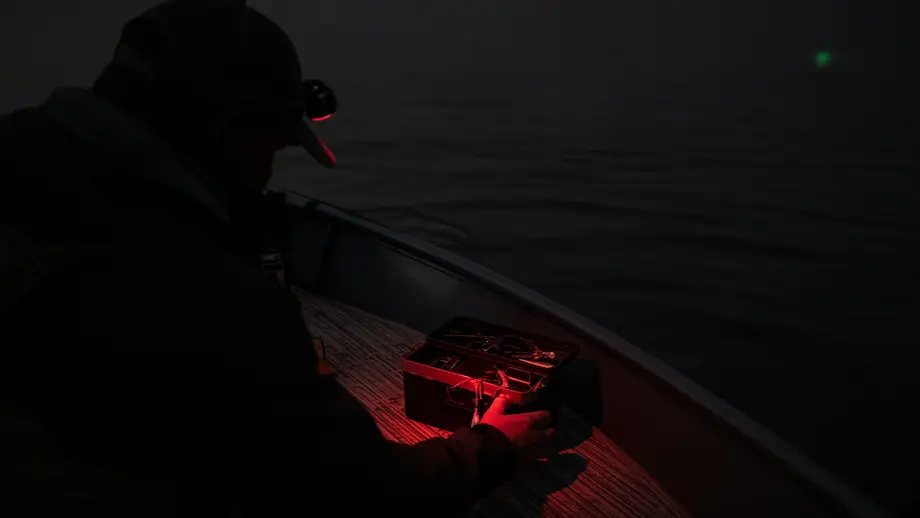
When boat fishing at night, most close work needs far less light than people think. Tying knots, baiting hooks and unhooking fish all happen within arm's length, so a red mode or a white mode around 10 lumens, aimed at your hands, is usually enough. The aim matters as much as the level: point the light down into the boat and keep it off the water.
On a boat, stray light has more places to go than on a bank. White gelcoat, stainless rails and a wet deck bounce light back up toward your face. The water beside the hull reflects it outward. A headlamp that sits on your forehead also lights the air right in front of your eyes when there is mist or spray. All three reduce what you can see beyond the gunwale.
This table sets starting points for the main jobs on a small fishing boat, by mode and by where the light should point.
| Sub-scene | Light color and level to start with | Where to aim it | Runtime to plan for | Water exposure |
|---|---|---|---|---|
| Tying knots, baiting hooks | Red, lowest level (4 to 15 lm on the lights here) | Down at your hands, below the gunwale | The whole trip on red | Spray and wet hands |
| Unhooking fish, handling hooks | Red first; white Low near 10 lm if you can't see the barb | Into the boat, not over the side | Short bursts | Splashes, slime |
| Choosing a lure color, checking line for nicks | White Low 10 to 30 lm | Into the tackle tray | Seconds at a time | Spray |
| Reading a chart or gauge not backlit | Red, lowest level | Shield with your hand | Seconds at a time | Spray |
| Netting a fish at the side | White floodlight around 100 lm, briefly | Down at the water right at the net | Under a minute | Splashes; possible drop |
| Checking the anchor line or a cleat | White Low | At the fitting | Seconds at a time | Heavy spray on the bow; possible drop |
| Finding a marker, pot float or dock | Spotlight, lowest mode that reaches it | At the object, never at a helm | Seconds at a time | Spray; drop risk near the rail |
Three habits make the table work in practice.
- Pre-set before dark. Learn from your light's manual which mode it starts in after you switch it off, and select red or Low at the dock so the first click in the dark isn't full power.
- Use your hand as a hood. Cupping the light or aiming it past your palm cuts the spill that reaches the water and the other anglers.
- Turn it off between jobs. A light that stays on while you wait for a bite keeps your eyes partly adapted to it.
Tip: Stick a small strip of dark tape on the side of the boat where your work light usually rests. It gives your hand a fixed point to find in the dark, and it keeps you from setting a lit light on the gunwale where it shines out over the water.
What Is the Best Light for Night Fishing?
The best light for night fishing from a boat is a hands-free light with a dim red mode and a low white mode, backed by the boat's navigation lights and a handheld spotlight kept off most of the time. On Olight's current lineup, that means an Oclip 2 Pro on a cap or PFD for close work, or a Perun 3 headlamp if you want an immersion rating.
Every light here already has far more white output than you need at the rail. What separates them on a boat is how low they go, how they mount, whether they have red, and what happens when they get wet.
This scene-parameter table compares Olight's published specs for each option, all from Olight's US product pages in September 2026.
| Light | Max white output | Lowest white mode | Red (high / low) | Peak intensity and beam distance | Water rating | Weight | Mounting |
|---|---|---|---|---|---|---|---|
| Oclip 2 Pro | 530 lm flood, 400 lm spot | 1 lm Moon, 144 h | 40 lm for 4 h / 4 lm for 27 h | 3,906 cd, 125 m | IP66 | 75.5 g | Clip up to 14 mm, tail and clip magnets, 115° tilt |
| Perun 3 | 3,000 lm | 5 lm Moon, 20 days | 60 lm for 14 h / 15 lm for 70 h | 6,400 cd, 160 m | IP68 | 150 g | Headband, magnetic tail, clip, lanyard |
| Oclip | 300 lm | 1.5 lm Moon, 30 h | 4 lm for 5 h (one level) | 1,156 cd, 68 m | IPX5 | 30 g | Clip up to 14 mm, magnetic base |
| Warrior X 4 | 2,600 lm | 300 lm Low, 8 h | None | 99,310 cd, 630 m | IPX8 | 249 g | Holster, tail switch |
Beam distance in that table follows the ANSI/PLATO FL 1 standard, whose current edition is ANSI/PLATO FL 1-2025 (Olight's Perun 3 manual cites the 2019 edition). It is the distance at which the beam falls to 0.25 lux, which Pelican's summary of the flashlight standard describes as "approximately the equivalent of the light emitted from the full moon." On a boat, read it as the reach for spotting a float or a piling, not as how far away others can see you; the navigation-light math above covers that.
One page detail needs a note. The Oclip 2 Pro's spec table lists its throw as "426.5 ft (125 m)." That foot figure converts to 130 m; 125 m converts to about 410 ft. The same page's highlights describe "a 125-meter spotlight," so this guide uses 125 m.
If you mainly fish from shore and want a price-tier breakdown of head-worn options, see our pick of the best headlamp for fishing under $100. This guide stays on the boat.
Do Fish Like Light at Night When Fishing?
Some fish do respond to light at night, but usually indirectly. Steady lights near or under the water attract insects and small baitfish, and predators such as crappie follow the food. A headlamp flicked on for a few seconds to tie a knot isn't an attractor light. Rules on using light to draw fish vary by state, so check before you rig one.
Missouri's Department of Conservation describes the chain in its crappie fishing tips: "Artificial lights such as floodlights on docks, street lights and commercially available floating and submersible lights attract insects and small baitfish that will in turn attract crappie." Notice what the agency lists: fixed dock floods, street lights and purpose-built floating or submersible lights, left on in one place.
That is a different tool from anything in this guide. None of these hand lights is sold as an attractor light, and the Oclip 2 Pro manual says "Do not immerse the product in water or other liquids, as it will damage the product." Olight's US store doesn't list a submersible fishing light, so if you want an attractor light, buy one made for the job and check your state's rules first.
What the agency quote doesn't tell you is that a bright white beam swept across a quiet spot will draw fish, and it doesn't settle whether a brief beam spooks them. Species, water clarity and the time a light stays on all matter. Until you have your own observations, the practical rule is simple: keep hand lights off the water you are fishing, and let dedicated attractor lights do attracting, where they are legal.
This table quotes two states' rules on using lights to take fish, to show how far they can differ.
| State | What the rule says (quoted) | What it means for a boat angler |
|---|---|---|
| Missouri | "As an aid to fishing methods, an artificial light may be used only above the water surface. However, while fishing by pole and line only, underwater lights may be used to attract fish." (Missouri fishing regulations) | Pole-and-line anglers may use underwater attractor lights; other methods are limited to lights above the surface |
| Minnesota | "A person may not use artificial lights to lure or attract fish or to see fish in the water while spearing, except that while angling or spearing, a person may: (1) affix a lighted artificial bait with hooks attached to the end of a fishing line; or (2) use a lighted decoy for spearing." (Minnesota Statutes 97C.335) | Attractor lights are out; lighted lures are allowed; the section says the restrictions "do not apply to bow fishing" |
Two states, two opposite answers on the same green light hanging over the side. Read your own state wildlife agency's current fishing regulations, including any special rules for the lake or river you plan to fish.
Do You Need a Light for Night Fishing?
Yes. On a boat you need two kinds of light: the navigation lights the rules require from sunset to sunrise, and a hand light to work and move safely. Even the smallest boats aren't exempt from carrying a light. A rowboat or small sailboat without fixed lights must keep a white flashlight or lantern ready to show in time to prevent a collision.
The navigation requirement is written plainly. Rule 20 says the lights rules "shall be complied with from sunset to sunrise." It adds that during those hours "no other lights shall be exhibited, except such lights as cannot be mistaken for the lights specified in these Rules or do not impair their visibility or distinctive character, or interfere with the keeping of a proper lookout."
For small unpowered boats, Rule 25 makes a flashlight the legal minimum. A vessel under oars that doesn't show sailing-vessel lights "shall exhibit an all-round white light or have ready at hand an electric torch or lighted lantern showing a white light which shall be exhibited in sufficient time to prevent collision." The same wording applies to sailboats under 7 meters. If you fish from a kayak, the same logic applies; our guide to night kayaking flashlights covers the paddling side.
Anchoring has its own rule. Rule 30 lets a vessel under 50 meters "exhibit an all-round white light where it can best be seen" at anchor. Boats under 7 meters are excused only when they are "not in or near a narrow channel, fairway, anchorage, or where other vessels normally navigate." If you anchor on a channel edge, beside a bridge piling or at a marina mouth, other vessels normally navigate there, so the exemption doesn't cover you. Rule 30(g) also excuses boats under 20 meters "at anchor in a special anchorage area designated by the Coast Guard," which means an area named in the Coast Guard's anchorage regulations (33 CFR Part 110), not any quiet cove.
What Happens When a Light Goes Overboard: Tethers, Floats and Water Ratings
Any of the hand lights in this guide will sink if it goes over the side, because each is denser than water. A water rating only decides whether the light still works if you get it back. Tether anything you use near the rail, add a float if you want it to stay on the surface, and match the water rating to how wet the job gets.
You can check the sinking claim with Olight's published weight and dimensions. A light's real volume can't be larger than the box or cylinder that encloses it, so dividing its weight by that outer volume gives the lowest density it could possibly have. Fresh water is 1.00 g/cm³, and a James Cook University research summary uses 1.025 g/cm³ for saltwater.
This table shows that minimum density for each light, based on Olight's rated weight and dimensions, not measured; any value above 1.025 means the light sinks in both fresh and salt water.
| Light | Published weight | Enclosing shape from published dimensions | Outer volume | Lowest possible density | Result |
|---|---|---|---|---|---|
| Warrior X 4 | 249 g | Cylinder 149 mm long, 39.5 mm across at the head | π × 1.975² × 14.9 = 182.6 cm³ | 249 ÷ 182.6 = 1.36 g/cm³ | Sinks |
| Perun 3 | 150 g | Cylinder 116.8 mm long, 28 mm across at the head | π × 1.4² × 11.68 = 71.9 cm³ | 150 ÷ 71.9 = 2.09 g/cm³ | Sinks |
| Oclip 2 Pro | 75.5 g | Box 60.2 × 28 × about 35 mm | 6.02 × 2.8 × 3.5 = 59.0 cm³ | 75.5 ÷ 59.0 = 1.28 g/cm³ | Sinks |
| Oclip | 30 g | Box 48.5 × 21 × 23 mm | 4.85 × 2.1 × 2.3 = 23.4 cm³ | 30 ÷ 23.4 = 1.28 g/cm³ | Sinks |
Because the real volume is smaller than each outer shape, the true densities are higher still, so the conclusion holds with room to spare. The same arithmetic gives you a safe rule for sizing a float: pick one rated to hold at least the light's full weight. The light's own volume adds some lift, so the full weight is a conservative target, never an undersized one.
Water ratings are a separate question. The Perun 3 is rated IP68 and the Warrior X 4 IPX8, both immersion ratings. Olight's product pages don't list a test depth or time for either, so treat the rating as a margin for a drop and a quick retrieval, not as a license to use the light underwater. Our guide to the IPX8 meaning explains what that covers and why the depth is set by the maker. The Oclip 2 Pro's IP66 and the Oclip's IPX5 are spray and jet ratings. Castle Compliance, a test lab, notes that "IEC 60529 explicitly states that immersion (IPX7 / IPX8) and water jets (IPX5 / IPX6) are different types of ingress tests," in its IEC 60529 testing guide.
The manuals are blunt about the spray-rated lights. The Oclip manual says "Do not immerse the product in water or other liquid," and the Oclip 2 Pro manual adds that immersion "will damage the product." Use them for rain and spray, and keep them off the bow in a chop unless they are tethered.
Tether points differ by light. The Perun 3 ships with a "Lanyard (Pin Included)," according to its package contents. The Oclip has a lanyard hole, per its user manual. The Oclip 2 Pro's page says "loops, hooks, and carabiners keep your hands free." The Warrior X 4 comes with a holster, which keeps it off the deck but doesn't stop it going over if you drop it while using it.
Safety note: A light going overboard is a nuisance; a person going overboard is an emergency. Wear your PFD at night, clip your hand light and whistle to it, and agree with everyone aboard who calls "man overboard" and who keeps pointing at the person in the water.
Searchlight Use on a Boat: Reach per Mode Without Blinding Other Boats
A handheld spotlight on a boat is for short, aimed checks: finding a channel marker, a crab pot float, a dock piling or the shoreline. Choose it by candela, since reach depends on peak intensity, and use the lowest mode that reaches the object. Never hold a beam on another boat's helm, and switch off as soon as you have seen what you needed.
The Warrior X 4 shows how much reach you get at each step, since Olight publishes its runtime per mode. The estimates below scale its 99,310-candela peak by mode lumens, based on Olight's rated candela and lumens, not measured, and use the FL 1 definition of beam distance at 0.25 lux.
This table estimates Warrior X 4 reach by mode, with the runtime Olight lists for each, and sets that reach against the 1-nautical-mile range a small boat's sidelights must meet.
| Warrior X 4 mode | Output (Olight rating) | Runtime (Olight rating) | Estimated candela | Estimated beam distance (2 × √cd) | Share of 1 nautical mile (1,852 m) |
|---|---|---|---|---|---|
| Regular Low | 300 lm | 8 hours | 99,310 × 300 ÷ 2,600 = 11,459 cd | About 214 m | About 12% |
| Tactical Med | 1,000~300 lm | 150 + 20 minutes | 99,310 × 1,000 ÷ 2,600 = 38,196 cd | About 391 m | About 21% |
| Regular High | 2,600~1,000~300 lm | 3 + 140 + 20 minutes | 99,310 cd | 630 m (Olight rating) | About 34% |
Two things stand out. First, the 300-lumen Low still reaches about 214 m, enough for a marker or dock within about 200 m, and it runs 8 hours. Full output steps down after 3 minutes anyway, per Olight's 3 + 140 + 20 minute rating. Second, even at full output the beam covers only about a third of a nautical mile, while the same beam is visible to other boats miles away. A spotlight lights objects far closer than the distance at which other boats can see it. For choosing a spotlight by the reach a job needs, see our guide to the rechargeable spotlight, which covers boat, farm and search use.
That gap is why Rule 36 matters. It allows any vessel to "direct the beam of her searchlight in the direction of the danger, in such a way as not to embarrass any vessel," per 33 CFR 83.36. Light the hazard, not the skipper.
The Coast Guard's operating rules for inspected passenger vessels spell out the same courtesy in plain words. 46 CFR 78.27-1 states: "No person shall flash or cause to be flashed the rays of a search light or other blinding light onto the bridge or into the pilothouse of any vessel under way." Matching sections sit in the Coast Guard's rules for tank, cargo and other inspected vessel types. They are written for those commercial vessels, not private fishing boats, but the standard carries over: the helm of any boat coming toward you is the one place your beam should never land.
The Oclip and Oclip 2 Pro manuals make the same point for the person holding the light: "Do not look directly at the light source or shine it into your eyes, as this may cause temporary blindness or permanent damage to your eyes."
Warning: The Warrior X 4 has a 13 Hz strobe at 2,600 lumens, which is 13 × 60 = 780 flashes a minute. Rule 21(f) defines a flashing light as one "flashing at regular intervals at a frequency of 120 flashes or more per minute," and Rule 36 limits attention signals to ones "that cannot be mistaken for any signal authorized elsewhere in these Rules." Don't use strobe to signal other boats; for searching, use a steady beam.
If you're comparing spotlights, our explainer on flashlight throw vs flood shows how to read candela against lumens before you buy.
Olight Lights for Boat Fishing: Where Each One Fits and Where It Doesn't
Each Olight option below solves one boat-lighting problem. The Oclip 2 Pro handles close work from a cap or PFD strap, the Perun 3 covers anglers who might go in the water, the Warrior X 4 is the search light, the Oclip is the budget backup, and the titanium whistle covers sound signaling. Each also has limits worth knowing before you buy.
Olight Oclip 2 Pro: the light at your hands ($54.99)
The Olight Oclip 2 Pro pairs "a 115° head tilt with 360° clip rotation," and Olight says "Set the angle once and it holds." Clipped to a cap brim or a PFD strap, it tilts down into the boat. Its red runs 4 lumens for 27 hours, and its white spotlight and floodlight go down to 1 lumen.
The flood's 100-lumen Medium runs 3 hours 45 minutes, which suits netting a fish, and tail and clip magnets let it sit on a steel fitting.
Limits: it is IP66, not an immersion rating, and its 125 m throw is for the deck and the near water, not a spotlight's job. The manual also says "In 0°C to 10°C conditions, the white light Turbo will be unavailable," and advises anyone with an ICD or pacemaker to "avoid close or prolonged contact with this product." If you want an immersion rating instead, look at the Perun 3.
Olight Perun 3: the headlamp that can go in the water ($89.99)
If you wade off the boat, fish from a small hull that ships water, or simply fear dropping a headlamp over the side, the Olight Perun 3 headlamp is the in-stock pick with an immersion rating. It is IP68, and its red runs 70 hours at 15 lumens or 14 hours at 60 lumens.
White modes run 5 lumens for 20 days, 30 lumens for 89 hours and 120 lumens for 25 hours. Its Turbo steps from 3,000 to 800 to 600 lumens over 2 + 180 + 30 minutes. It lifts out of the headband to work as a handheld light with a magnetic tail, and it ships with a lanyard.
Limits: at 150 g, it is twice the weight of the Oclip 2 Pro. Its lowest red, 15 lumens, is brighter than the Oclip family's 4-lumen red, so shield it more carefully near the helm. Olight also notes that the "Headlamp mounting bracket is METAL - it is expected to scratch the body of the torch if taken in / out repeatedly." Its manual lists a working temperature of 0 to 40°C.
The smaller Perun 3 Mini (IPX8, 54 g, $64.99, red 45 lumens for 150 minutes or 5 lumens for 19 hours) would also fit, but Olight's US store showed its default Orange CW version as sold out on September 24, 2026.
Olight Warrior X 4: the search light ($129.99)
The Olight Warrior X 4 tactical flashlight lists 2,600 lumens, 99,310 candela and a 630 m beam distance, with an IPX8 rating and a holster. Its tail switch lets you fire short checks without fumbling for a side button in the dark.
Limits: it has no red mode and no mode below 300 lumens, so it is the wrong light for close work. At 249 g, it is the heaviest light here. Olight lists its uses as night security and patrol, law enforcement, hunting, search and rescue, self-defense and outdoors, so it isn't sold as a marine light. Keep the spotlight job and the work-light job in separate lights. Its Regular High holds 2,600 lumens for 3 minutes before stepping down; our guide to the best rechargeable spotlight for hunting compares how larger spotlights hold output over long sessions.
Olight Oclip: the budget backup ($29.99)
The Olight Oclip clip light weighs 30 g, clips onto objects up to 14 mm thick, and has a magnetic base. It offers 4-lumen red for 5 hours, 10-lumen white for 12 hours and a 1.5-lumen Moonlight for 30 hours, which makes it a good spare to clip inside a hatch.
Limits: it is IPX5, the lowest rating in this guide, and its manual says not to immerse it. Its single red level runs 5 hours, which won't cover a long night as your main light. Treat it as a backup or a light for a passenger, not the one you rely on at the rail.
Olight Titanium Emergency Whistle: the sound signal backup ($15.99)
Rule 33(b) asks boats under 12 m for "some other means of making an efficient sound signal" if they don't carry the prescribed appliances. The Olight Titanium Emergency Whistle weighs 7 g and is titanium, so it won't rust on a PFD zipper. Olight doesn't state a Coast Guard approval or a sound level for it, so treat it as a personal backup that stays with you if you end up in the water, not as the boat's only sound signal.
A Boat Lighting Plan: Where Each Light Mounts
A good night fishing light plan gives each light a fixed home, so you can find it by touch and it never points where it shouldn't. Navigation lights stay where the builder installed them. The work light rides on your head, cap or PFD. The spotlight lives in a holster or bracket near the helm. The backup light and whistle ride on your PFD.
This placement table turns the plan into a checklist for the ramp.
| Light | Where it lives | How it is secured | What to check before dark |
|---|---|---|---|
| Sidelights and all-round white | Where the builder fitted them | Fixed | Both colors lit, nothing blocking the all-round light |
| Work light (Oclip 2 Pro or Perun 3) | Cap brim, headband or PFD strap | Clip plus a short tether | Red or lowest white pre-selected; charged |
| Spotlight (Warrior X 4) | Holster near the helm or console | Holster; back in it after each check, never set loose on the gunwale | Charged; you can reach it without looking |
| Backup light (Oclip) | Inside a hatch, or clipped to a passenger | Clip or magnet | Charged; red mode works |
| Whistle | On your PFD | Lanyard or ring | Reachable with one hand |
| Anchor light, if separate | Highest clear point | Fixed or clamped | Visible all round, not hidden by people or rods |
Note: None of the hand lights here is a navigation light. A flashlight taped to a rail doesn't give other boats the colors and arcs that Rules 21 and 22 describe, so fix a failed navigation light before you head out rather than improvising.
Here is the action list to run through on your next trip.
- Test the navigation lights at the dock and confirm the all-round white light isn't blocked.
- Charge every hand light and set each night fishing light to red or its lowest white mode.
- Clip the work light where it aims down at your hands, and tether it.
- Holster the spotlight within reach of the helm, and plan to use its lowest mode first.
- Clip a whistle and a backup light to your PFD, and wear the PFD.
- Check your state's current fishing regulations if you plan to use any light to attract fish.
- Once underway, keep the helm dark and let your eyes adapt before you pick up speed.
FAQ
Changelog
- September 24, 2026: First published.