Olight makes the lights discussed here. Specs and regular prices come from Olight's US product pages and manuals, September 2026. Calculations use Olight's rated figures, not measurements.
⚡ TL;DR
The best flashlight for the woods is a flood-leaning light with a walking mode that lasts all night, not the longest thrower. Comparing four Olight lights on their published specs, the Olight Baton 4 Pro wins: a 200 m beam, 15 lumens for 155 hours and 114 g, for $69.99. Add a thrower such as the Warrior X 4 only for clearings and eyeshine.
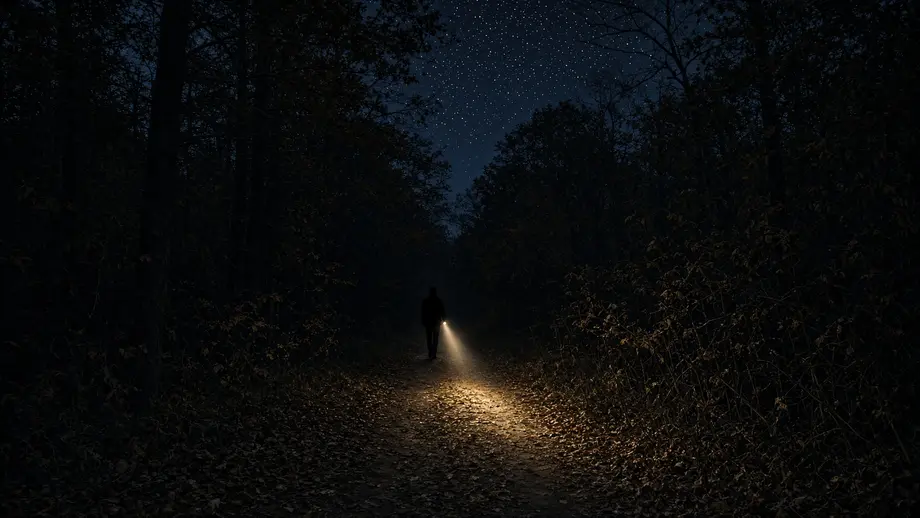
Here is the problem. Point a 600-meter spotlight into the trees and you get a white wall of lit leaves ten steps ahead while your boots stay dark. Carry a wide, floody light and you can't tell whether two green dots across a clearing belong to a deer or a loose dog. The fix is to match the beam to how far you can see.
This table gives the best flashlight for the woods in each situation, using Olight's published ratings and regular prices from its US store in September 2026.
| Situation | Pick | Key specs (Olight ratings) | Price (regular, September 2026) | Why |
|---|---|---|---|---|
| Best overall for trails and dense timber | Olight Baton 4 Pro | 10,000 cd; 200 m; 120 lm for 18 h 30 min; 15 lm for 155 h; IPX8; 114 g | $69.99 | Flood-leaning beam, all-night low mode, pocket size |
| Rain, cold hands, wide brush | Olight Seeker 4 Pro | 16,895 cd; 260 m; 300 lm for 11 h; stepless knob; IPX8; 205 g | $139.99 | Glove-friendly dimming, auto lockout, holster in the box |
| Hands-free flood and SOS | Olight Perun 3 | 6,400 cd; 160 m; 120 lm for 25 h; red light; SOS; IP68; 150 g | $89.99 | The only light here with SOS and red modes |
| Clearings and eyeshine | Olight Warrior X 4 | 99,310 cd; 630 m; lowest mode 300 lm for 8 h; IPX8; 249 g | $129.99 | Reach across open ground; too bright for close brush |
📋 Table of Contents
- 1. What Is the Best Flashlight for the Woods?
- 2. Dense Brush, Open Timber or a Clearing: How Far Can You Actually See?
- 3. Why Does a Spotlight Look Worse in Thick Brush?
- 4. Lumens, Candela or Beam Distance: Which Spec Matters Most in the Woods?
- 5. Woods Flashlight Comparison: Output, Reach, Runtime, Weight and Price
- 6. How Do Rain and Fog Change What a Flashlight Can Do?
- 7. How Do You Use a Flashlight to Identify Animal Eyeshine in the Woods?
- 8. Common Mistake: Choosing the Longest Throw for the Woods
- 9. Lost in the Woods After Dark: Signals, a Backup Light and a Battery Plan
- 10. What Flashlights Do Navy SEALs Carry?
- 11. Which Flashlight Is the Most Rugged?
- 12. What Is the Best Flashlight for Outdoors?
- 13. How to Check a Flashlight in Your Own Woods
- 14. Best Flashlight for the Woods: Your Action List
- 15. FAQ
What Is the Best Flashlight for the Woods?
The best flashlight for the woods lights the ground and brush around you, reaches through open timber when the trees thin, and runs a walking mode for a whole night. The Olight Baton 4 Pro meets all three: 10,000 candela for a 200 m rated beam, 120 lumens for 18 hours 30 minutes, 15 lumens for 155 hours, IPX8, and 114 g.
Why not the farthest light? A 630 m rating describes open air; in timber, the first trunk stops the hotspot. Olight lists all its flashlights in one catalog, and its outdoor flashlights page collects camping lights and headlamps. When you shop for the best flashlight for woods walking, shortlist by beam shape and low-mode runtime before maximum lumens.
The Baton 4 Pro is also the overall pick in our best flashlights guide. Our guide to flashlight throw vs flood names the dual-beam Marauder Mini 2 as a one-light answer to both jobs; in the woods we'd split the kit instead. A Baton 4 Pro plus a Warrior X 4 weighs 363 g and costs $199.98, against 465 g and $219.99, and gives you two batteries. The West Virginia Division of Natural Resources lists "flashlights (more than one)" in its woods survival kit.
Dense Brush, Open Timber or a Clearing: How Far Can You Actually See?
In the woods, the farthest thing you can see sets how much throw you need, not the number on the box. Thick understory can stop your view within a few paces, open mature timber lets you see much farther between trunks, and clearings or old roads open to a field's width. Pace your own sight lines, then pick the beam.
Pacing is a forester's tool. North Carolina State Extension's guide to compass and pacing says "One pace equals two steps, beginning and ending on your dominant foot," and gives an example: "if it takes you 13 paces to cover 66 feet, then each of your paces is 5.08 feet." It warns that "in brushy or rocky areas, its accuracy diminishes," so treat the result as an estimate.
Stand where you walk at night, face 10 directions, and count paces to the farthest spot where you could still see a person. Take the median. At 8 paces and 5.08 feet per pace, your sight line is 8 × 5.08 = 40.6 feet, about 12.4 m.
This table matches sight-line bands to a beam. The cutoffs are our own working bands, not a forestry standard.
| Your median sight line | Typical place | What you need to light | Beam to favor | Starting mode (Olight example) |
|---|---|---|---|---|
| Under 15 m (about 50 ft) | Thick regrowth, laurel tangles, summer understory | Ground, roots, the next few trunks | Wide, low output | Baton 4 Pro Med 120 lm; Perun 3 Low 30 lm |
| 15 to 50 m (50 to 165 ft) | Mature hardwoods, older pine stands, leaf-off woods | Trail ahead and movement between trunks | Flood-leaning with a usable center | Baton 4 Pro High 600 lm; Seeker 4 Pro Med 300 lm |
| Over 50 m (165 ft) | Clearings, field edges, logging roads | Eyeshine across open ground | Throw | Warrior X 4 Regular High, 2,600 then 1,000 lm |
Why Does a Spotlight Look Worse in Thick Brush?
A spotlight looks worse in thick brush because its hotspot hits leaves a few steps away long before it reaches anything you care about. Light falls with the square of distance, so a leaf 2 m away in the same part of the beam gets 225 times the light that reaches an animal 30 m away. Your eyes adjust to the bright leaves, and the target looks darker.
HyperPhysics at Georgia State University shows that light from a point source is "one fourth as much at 2 meters" as at 1 meter. So the ratio between the light on the nearest leaf and on your target is (target distance ÷ leaf distance)², whatever flashlight you use.
This table shows that brush glare ratio for three leaf distances and three target distances.
| Nearest leaf in the beam | Target at 15 m | Target at 30 m | Target at 60 m |
|---|---|---|---|
| 1 m away | Leaf gets 225 times the target's light | 900 times | 3,600 times |
| 2 m away | 56 times | 225 times | 900 times |
| 5 m away | 9 times | 36 times | 144 times |
More output raises the leaf and the target by the same factor. The National Weather Service makes a related point about glare for drivers in its fog driving tips: "Using high beam lights causes glare, making it more difficult for you to see what's ahead of you on the road." Aim the hotspot through gaps, lower the output until the leaves stop dazzling you, and walk with a wide beam.
Lumens, Candela or Beam Distance: Which Spec Matters Most in the Woods?
In the woods, the spec that matters most is the runtime of the mode you will actually walk by, then candela for reach, then maximum lumens. Maximum output lasts minutes. The Baton 4 Pro holds 1,600 lumens for 2 minutes before 600 lumens for 198 minutes, and a walk out usually happens on a mode far below either.
Read each light's low modes first; the comparison table below lists them. The outlier is the Warrior X 4, which can't go below 300 lumens, more than roots at your feet need, and holds it for only 8 hours.
Candela comes second, for clearings. Check the edition behind the numbers: the Seeker 4 Pro and Perun 3 manuals cite ANSI/PLATO FL 1-2019, the Warrior X 4 manual cites ANSI/NEMA FL 1-2009, and PLATO has since published ANSI/PLATO FL 1-2025.
Woods Flashlight Comparison: Output, Reach, Runtime, Weight and Price
The four lights below cover woods jobs from pocket carry to long-range eyeshine. The Baton 4 Pro and Perun 3 are flood-leaning walking lights, the Seeker 4 Pro adds output and a glove-friendly knob, and the Warrior X 4 is the thrower. Only the Perun 3 has red and SOS modes.
This forest flashlight comparison lists Olight's rated figures and regular prices from its US store in September 2026.
| Light | Max output | Peak intensity | Beam distance | Stage after turbo | Low mode | Red or SOS | Weight | Water rating | Regular price |
|---|---|---|---|---|---|---|---|---|---|
| Olight Baton 4 Pro | 1,600 lm | 10,000 cd | 200 m | 600 lm, 198 min | 15 lm, 155 h | No | 114 g | IPX8 | $69.99 |
| Olight Seeker 4 Pro | 4,600 lm | 16,895 cd | 260 m | 1,200 lm, 122 min | 50 lm, 60 h | No | 205 g | IPX8 | $139.99 |
| Olight Perun 3 | 3,000 lm | 6,400 cd | 160 m | 800 lm, 180 min | 30 lm, 89 h | Both | 150 g | IP68 | $89.99 |
| Olight Warrior X 4 | 2,600 lm | 99,310 cd | 630 m | 1,000 lm, 140 min | 300 lm, 8 h (lowest) | No | 249 g | IPX8 | $129.99 |
Olight Baton 4 Pro: Best Overall Flashlight for the Woods
The hard part of a woods walk is the long middle: an hour or more on a narrow trail. The Olight Baton 4 Pro handles it with 120 lumens for 18 hours 30 minutes, while 10,000 candela still reaches 200 m when the timber opens. It has side and tail switches, charges by USB-C or MCC3, and ships with an MCC3 cable and an L Stand.
Its limits: no red light and no SOS mode. The manual warns: "When carrying or transporting, ensure the flashlight is locked to prevent accidental activation that could lead to fire hazards." It also says "Do not put a hot light into any type of fabric bag or fusible plastic container," not to use it "in a car where the temperature inside may exceed 60°C," and "Do not immerse the flashlight in seawater or other corrosive media as it will damage the product."
The price is $69.99 (regular price, September 2026) for the default Matte Black CW Circuit Tree SKU. The page lists six other finishes, including Orange CW, OD Green CW and a Stars & Stripes Edition; check the price shown for the one you pick.
Olight Seeker 4 Pro: Best for Wet Nights and Gloved Hands
Cold, wet hands fumble small buttons. The Olight Seeker 4 Pro uses a large knob; Olight says you can "rotate for step-less dimming to your own comfortable brightness level, allowing for easy operation even with heavy gloves." Its manual adds: "After being turned off, it will be locked out automatically if no operation is made within 10 seconds after the indicators are off." The holster comes in the box.
Its limits: 205 g, no red light, no SOS, a 5-lumen Moon, and a working temperature of 0 to 40 °C in the manual. The $139.99 regular price (September 2026) is for the default Matte Black CW (5700~7000K) SKU. The spec sheet also mentions a neutral white LED (4000K~5000K) and a 350 g Silver-Plated Bronze version, so check which versions the page offers when you order.
Olight Perun 3: Best Hands-Free Flood With SOS
You need your hands for branches and a map. The National Park Service's Ten Essentials page says: "Headlamps are the recommended light source because they are hands-free. Be sure to pack extra batteries." The Olight Perun 3 works as a headlamp or handheld, with a headband, magnetic tail, clip and lanyard.
It has the one mode the others lack. Its manual says: "Quickly press the switch three times or more to enter SOS mode (No Timer mode)." Red light runs at 60 lumens for 14 hours or 15 lumens for 70 hours.
Its limits: 6,400 candela and 160 m are short for a clearing, it charges only by its MCC3 magnetic cable, and the manual lists 0 to 40 °C. The price is $89.99 (regular price, September 2026) for Black, the only color listed.
Olight Warrior X 4: Best for Clearings and Eyeshine, Not for Brush
At a field edge, reach finally matters. The Olight Warrior X 4 is rated at 99,310 candela and 630 m, and Olight says it "balances the spot and spill well." Its Regular High runs 2,600~1,000~300 lumens for 3 + 140 + 20 minutes, so you scan on the 1,000-lumen stage.
In brush it is the wrong tool: tail switch only, a 300-lumen floor, and no Moon, red or SOS. The manual lists 0 to 40 °C. The price is $129.99 (regular price, September 2026) for Matte Black; the page notes the Glacial Valley and Flat Dark Earth versions are sold out. Carry it as the second light, not the only one.
How Do Rain and Fog Change What a Flashlight Can Do?
Fog and heavy rain scatter light on the way to a target and again on the way back, so a thrower loses most of its advantage. In fog with a quarter-mile visibility, about 56% of the light survives the round trip to a target 30 m away and only 14% at 100 m, before counting the glare that droplets bounce back at you.
Those figures come from two published relationships. Mark Z. Jacobson's Fundamentals of Atmospheric Modeling slides at Stanford give the Koschmieder equation for meteorological range: x = 3.912 ÷ σ, where σ is the extinction coefficient. The National Weather Service issues a Dense Fog Advisory when "visibilities frequently drop to one-quarter of a mile or less," about 402 m.
The math: σ = 3.912 ÷ 402 m = 0.0097 per meter. Light crosses the fog twice, so the surviving share is e^(−2 × σ × distance): at 30 m, e^(−0.584) = 0.558. Half is gone at 0.693 ÷ (2 × σ), about 36 m. These are model estimates, not field measurements.
This table shows the share of light that survives the round trip at four visibility levels.
| Visibility (meteorological range) | At 10 m | At 30 m | At 60 m | At 100 m | Half the light lost at |
|---|---|---|---|---|---|
| 1,000 m (light haze) | 92% | 79% | 63% | 46% | 89 m |
| 402 m (NWS dense fog threshold) | 82% | 56% | 31% | 14% | 36 m |
| 200 m | 68% | 31% | 10% | 2% | 18 m |
| 100 m | 46% | 10% | 0.9% | under 0.1% | 9 m |
The model leaves out backscatter, the glow of lit droplets between you and the target, which makes a bright beam look worse still. In fog, step down, favor flood, and try holding the light below eye level; if the glare drops, keep it there. For rain, all four lights are rated IPX8 or IP68.
How Do You Use a Flashlight to Identify Animal Eyeshine in the Woods?
To identify animal eyeshine in the woods, hold the light beside your eyes, sweep a slow arc through the gaps between trunks, and use the lowest mode that reaches your sight line. Then note how high the eyes sit and how they move before you guess at a species. Eyeshine returns toward the light source, so a light held at the hip hides most of it.
The Texas Parks and Wildlife Department explains in its eyeshine article that light strikes a mirror-like membrane behind the retina "and is reflected back through the eye to the light source." You "must be in the right spot to be able to see it, usually directly behind the light," and it suggests you "shine it in an arc around you."
In timber, trunks cut that arc into short windows, so the scan changes with your sight line. This scan plan ties the sight-line bands from earlier to a light, a starting mode and a way to hold it. The mode choices are our starting points, not official guidance.
| Where you are | Where eyes usually show | Light and starting mode | How to hold and sweep | When eyes appear |
|---|---|---|---|---|
| Thick brush, sight line under 15 m | Ground and knee height, just past the first trunks | Perun 3 on your head, Low 30 lm | Turn your head slowly; the beam stays beside your eyes | Stop, note the height, and leave the animal a way out |
| Open timber, 15 to 50 m | Gaps between trunks, ground to chest height | Baton 4 Pro High 600 lm, held against your cheek | Sweep one gap at a time and pause a second in each | Step sideways to open a new gap instead of walking toward the eyes |
| Clearing or field edge, over 50 m | Open ground and the far tree line | Warrior X 4 on its 1,000-lumen stage, held beside your eye | One slow arc along the far edge, then off | Back away if the eyes come closer |
| Overhead, any band | Branches and crowns | Headlamp tilted up, or a handheld at your cheek | Sweep the crown slowly from trunk to tip | Keep your distance and move on |
A headlamp solves the hardest part of this, keeping the beam next to your eyes while your hands push branches aside, which is why the Perun 3 leads the brush row. For eyeshine high in a tree, our coon hunting headlamp guide works through the candela a crown needs. For a missing dog or cat, see how to find a lost pet at night.
Warning: Shining wildlife can be illegal in some seasons or when you carry a weapon, and rules differ by state. Read your state wildlife agency's current regulations and our overview of hunting with a light laws before you scan a field.
Safety note: If the eyes belong to a bear, follow the National Park Service's bear safety guidance: "Identify yourself by talking calmly so the bear knows you are a human and not a prey animal." It also says, "Above all, keep your distance from bears!"
Common Mistake: Choosing the Longest Throw for the Woods
The most common mistake is buying the longest-throw light for the woods and then walking with it. The beam overshoots the sight line, lights the nearest leaves hundreds of times brighter than the trail, and offers no low mode for the hours between. Match reach to the clearings, and let a flood light do the walking.
Two related mistakes: judging by maximum lumens, which last 2 to 3 minutes on these lights, and carrying one light. Our second flashlight guide covers pairing.
Lost in the Woods After Dark: Signals, a Backup Light and a Battery Plan
If you are lost in the woods at night, official guidance points the same way: stop, and unless you have a clear way out, stay where you are and signal. The National Park Service says to flash the SOS pattern, "Three times quickly, three times slowly, three times quickly," and warns that signaling drains batteries, so plan the battery for the whole dark window.
The Park Service's Outdoor Emergency Plan says: "Leave your Trip Plan with a Trusted Contact who is not going on the trip with you." Once lost: "Stay put – Changing location will make it difficult for authorities to find you. Move only if there is an immediate threat to life." And on light: "Use your flashlight wisely as this will drain the batteries."
New York's Department of Environmental Conservation teaches STOP in its lost in the woods guidance, starting with "S is for Sit Down," and its last step asks you to "Decide if you should try to make it out of the woods or stay put until morning." It also says: "Bring a watch and know what time it gets dark." The West Virginia DNR adds that "flashlight beams (flicking flashlight on and off), or other signals repeated in a series of three represent the universal distress signal."
How long is the dark? The U.S. Naval Observatory's Sun and Moon data service gives civil twilight times. In the Adirondacks (44.1° N, 73.9° W), civil twilight ends at 17:00 on November 15, 2026 and begins at 06:21 the next morning: 13 hours 21 minutes of dark.
This table budgets that night: 30 minutes walking to a safe spot, 60 minutes of shelter tasks on a low mode, and a 1-minute signal every 15 minutes (53 minutes), light off otherwise. Each minute uses 1 ÷ (rated minutes) of a charge, based on Olight's rated runtimes, not measured.
| Light | Walk 30 min | Tasks 60 min | Signal 53 min | Share of charge used | Nights per charge |
|---|---|---|---|---|---|
| Baton 4 Pro | Med 120 lm: 30 ÷ 1,110 = 2.7% | Low 15 lm: 60 ÷ 9,300 = 0.6% | High 600 lm: 53 ÷ 200 = 26.5% | 29.8% | 3.4 |
| Seeker 4 Pro | Med 300 lm: 30 ÷ 660 = 4.5% | Low 50 lm: 60 ÷ 3,600 = 1.7% | High 1,200 lm: 53 ÷ 135 = 39.3% | 45.5% | 2.2 |
| Perun 3 | Med 120 lm: 30 ÷ 1,500 = 2.0% | Low 30 lm: 60 ÷ 5,340 = 1.1% | High 600 lm: 53 ÷ 300 = 17.7% | 20.8% | 4.8 |
| Warrior X 4 | Low 300 lm: 30 ÷ 480 = 6.3% | Low 300 lm: 60 ÷ 480 = 12.5% | Tactical Med 1,000 lm: 53 ÷ 150 = 35.3% | 54.1% | 1.8 |
Signaling, not walking, drains the battery, so ration it and signal more when you hear searchers. Olight doesn't publish a Perun 3 SOS runtime, so its row uses High. The schedule is our example, not an official rule.
Safety note: The NPS list is short: stay put, conserve energy, find shelter, keep warm and signal for help. Move "only if there is an immediate threat to life."
What Flashlights Do Navy SEALs Carry?
No public U.S. Navy document that we could find names the flashlights SEALs carry, so "SEAL" model lists online are marketing claims. For the woods, the lesson worth copying is redundancy: the National Park Service tells hikers to pack extra batteries, and the West Virginia DNR lists more than one flashlight in its survival kit.
New York's DEC suggests carrying key items, "such as matches, flashlight, and navigation materials," on your person, not in your backpack: a Baton 4 Pro in a pocket, a Perun 3 in the pack.
Which Flashlight Is the Most Rugged?
No single number proves a flashlight is rugged. Compare four published specs: drop height, water rating, working temperature and warranty. All four lights here carry IPX8 or IP68, their manuals list drop figures of 1.5 to 2 m, and none is rated below 0 °C, which matters on a November night in the woods.
Streamlight's summary of the flashlight standard defines impact resistance as "The degree to which a portable light resists damage when dropped on a solid surface."
This table lists the durability figures Olight publishes for each light.
| Light | Water rating | Drop figure (manual) | Working temperature (manual) |
|---|---|---|---|
| Baton 4 Pro | IPX8 | 1.5 m | 0 to 45 °C |
| Seeker 4 Pro | IPX8 | 1.5 m | 0 to 40 °C |
| Perun 3 | IP68 | 1.5 m | 0 to 40 °C |
| Warrior X 4 | IPX8 | 2 m | 0 to 40 °C |
Olight's current warranty page lists "Flashlights / Weapon Lights / Lanterns" at "Lifetime Warranty" and notes "(Products purchased after 2023 are only eligible.)" Holsters, clips and lanyards have none. The printed Warrior X 4 manual still gives a 5-year term; the current page governs.
What Is the Best Flashlight for Outdoors?
The best flashlight for outdoors in general is the same kind that works in the woods: IPX8 or IP68, a low mode that runs through a night, and enough reach for open ground. The Baton 4 Pro fits most people. Choose the Seeker 4 Pro for gloved hands, and add a Perun 3 when you need a headlamp.
If your night outdoors ends at a camp rather than a trailhead, a light that doubles as a lantern saves packing one. The Olight Prowess is a flashlight with a second, rear-facing light. Olight says its front light delivers a "max output of 5,000 lumens across 5 levels, illuminating up to 245 meters," while its "Warm White 360° Reverse Light" offers "smooth stepless dimming and a max output of 800 lumens." The price is $139.99 (regular price, September 2026).
Its limits: the US page lists no per-mode runtimes, weight or water rating, so it can't join the tables above, and you can't budget a night on it the way you can with the other four. Treat it as a camp and car light, and carry one of the rated lights for the walk.
How to Check a Flashlight in Your Own Woods
You can check any flashlight in your own woods in about 30 minutes with a reflective trail marker and your paced stride. Run each check where you walk at night, in dry weather first and in fog when you can, and compare lights on the same night at the same spots.
This table gives a simple field method: the check, the gear, how to do it and how often to repeat it.
| Check | Gear | How to do it | Repeats |
|---|---|---|---|
| Sight line | Calibrated pace | Count paces to the farthest spot you could still see a person, in 10 directions; take the median | Once in leaf-on and once in leaf-off season |
| Walking mode | The light on Med or Low | Walk 100 paces; note whether roots show clearly 2 to 3 paces ahead | 3 walks per mode |
| Brush glare | The light on High | Aim into the nearest bush, then through a gap; note which view shows the trail farther | 3 spots |
| Reach and eyeshine | Reflective marker at 30 and 60 paces | Find the lowest mode that shows it; compare the light at your hip and beside your eye | Each light |
Best Flashlight for the Woods: Your Action List
The best flashlight for the woods is the one whose beam fits your sight lines and whose battery covers a full night. Use this list to set up a woods kit and check it before your next trip.
- Pace your sight lines on the routes you walk at night.
- Choose a flood-leaning main light with a walking mode of at least 18 hours, such as the Baton 4 Pro at 120 lumens.
- Add a second light on its own battery: a Perun 3 for hands-free use and SOS, or a Warrior X 4 for clearings.
- Leave a trip plan with someone at home, and check when civil twilight ends.
- Charge both lights and pack each one's cable.
- If you get lost, stay put and signal: three quick flashes, three slow, three quick.
FAQ
Changelog
- September 24, 2026: First published.