Olight makes the lights compared here. Olight specs and regular prices come from its US product pages and manuals as of September 2026; press counts, output ratios and charging estimates are our arithmetic, not measurements.
⚡ TL;DR
The best headlamp for dog walking on suburban sidewalks is the Olight Oclip 2 Pro ($54.99): a 530-lumen floodlight whose head tilts 115°, so you can drop the beam to the curb when a neighbor approaches, plus 4- and 40-lumen red. We compared five Olight setups. If you never wear a cap, the Oclip Pro S on its strap ($47.98) wins.
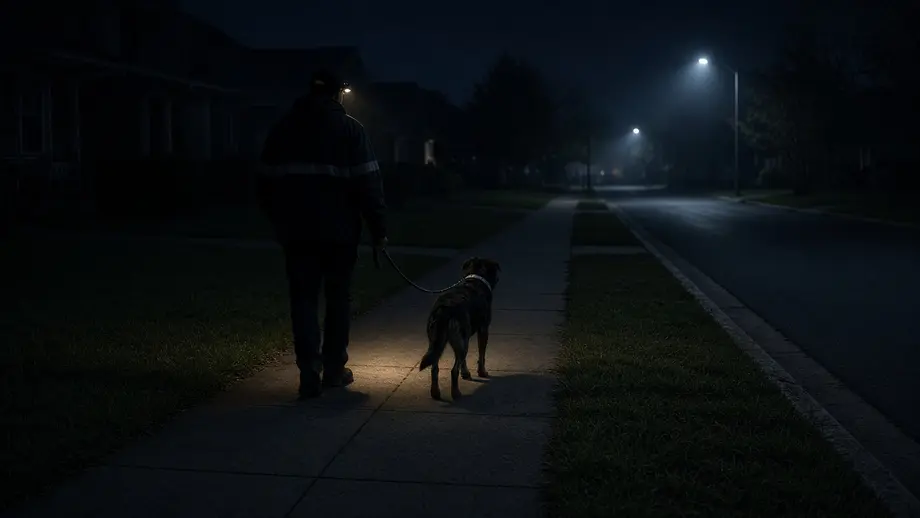
A night dog walk asks a lot of two hands. One holds the leash, the other holds a bag, and a handheld flashlight ends up in your armpit. Then the light causes trouble: a narrow beam loses the dog in the grass, and a bright one blinds the neighbor walking toward you. This guide picks lights for that job, counts the presses each takes to dim, and cites agency advice on being seen.
This table sums up the best headlamp for dog walking by situation, with Olight's ratings and regular prices from September 2026.
| Situation | Pick | Key specs (Olight ratings) | Regular price | Why |
|---|---|---|---|---|
| Suburban sidewalks, cap or jacket collar | Olight Oclip 2 Pro | 530 lm flood; 115° tilt; red 40 and 4 lm; 75.5 g; IP66 | $54.99 | Tilts the beam off faces without a button press |
| No cap: a strap headlamp | Oclip Pro S + Oclip Series Headlamp Strap | 600 lm; 10 lm for 27 h; red 40 and 4 lm; 53 g light | $47.98 | Lightest strap kit with red, on a strap Olight lists as compatible |
| Long, unlit or rainy walks | Olight Perun 3 | 3,000 lm; 120 lm for 25 h; red 60 and 15 lm; 150 g; IP68 | $89.99 | Months of walks per charge; the only immersion rating among head-worn picks |
| Backup on the leash handle | Olight i1R 2 Pro | 180 lm; 5 lm for 12 h; 22 g; IPX8 | $21.99 | Twist-on light for the bag pickup |
📋 Table of Contents
- 1. Quick Answer: What Is the Best Headlamp for Walking a Dog?
- 2. Headlamp vs Flashlight for Dog Walking: Hands, Beam and Aim
- 3. What Is the Best Type of Flashlight for Walking Dogs?
- 4. How Bright Should a Dog Walking Headlamp Be? Streetlit Blocks, Parks and Unlit Roads
- 5. Red Light on a Dog Walk: When It Helps and When White Is Better
- 6. Best Headlamp for Dog Walking Compared: Specs and Prices
- 7. Controls in the Dark: How Many Presses to Dim, Go Red or Lock?
- 8. Common Mistake: Walking Toward People on Your Brightest Mode
- 9. What Are the Best Lights for Dog Walking at Night?
- 10. How Do Drivers See You and Your Dog on a Night Walk?
- 11. How Often Will You Charge? A Winter Dog-Walk Schedule
- 12. How This Guide Compared the Lights
- 13. Your Best Headlamp for Dog Walking Checklist
- 14. FAQ
Quick Answer: What Is the Best Headlamp for Walking a Dog?
The best headlamp for walking a dog is a light worn at head height with a wide floodlight, a 1 to 10 lumen mode, red light, and a fast way to get the beam out of other people's eyes. The Olight Oclip 2 Pro meets all four on a cap brim or jacket collar. Without a cap, choose the Oclip Pro S on the Oclip Series Headlamp Strap.
Why does the pick differ from our other guides? Our best headlamps roundup names the Perun 3 its overall winner, and our best headlamp under 50 guide picks the Oclip Pro S strap kit. A suburban dog walk is short, daily, and full of people and cars, so aim matters most, and the Oclip 2 Pro is the only light here with a hinged head.
The catch is the mount. Olight's strap page lists the Oclip Pro, Oclip Pro S and Oclip Ultra as compatible and leaves out the Oclip 2 series, so the Oclip 2 Pro rides on a cap brim, collar or chest strap. Olight lists all its headlamps on one page.
Headlamp vs Flashlight for Dog Walking: Hands, Beam and Aim
A headlamp beats a handheld flashlight for dog walking because it frees both hands and points where you look. A handheld aims precisely but fights the leash and the bag. A clip light on a cap or collar sits between them: hands-free like a headlamp and, on the Oclip 2 Pro, aimable like a flashlight.
The leash hand matters most when the dog lunges. If you use a retractable leash, the AKC's guide to retractable leashes warns, "Regardless of the material, never grab hold of the leash while your dog is moving as you could be injured." A hand that is not holding a light can stay on the handle and its brake.
This table compares four ways to carry a light on a dog walk.
| Mount | Hands free | Follows your eyes | Aim below other people's eyes |
|---|---|---|---|
| Handheld flashlight | No | If you point it | Yes, by wrist |
| Strap headlamp (Perun 3, Oclip Pro S) | Yes | Yes | Only by tilting mount or head |
| Clip light on cap brim (Oclip 2 Pro) | Yes | Yes | Yes, 115° head tilt; brim must fit the 14 mm clip |
| Clip light on collar or chest strap (Oclip 2 Pro) | Yes | No, follows your body | Yes, tilt head down |
Warning: The Oclip 2, Oclip Pro S and Oclip Ultra manuals each say, "If you have an ICD or pacemaker, avoid close or prolonged contact with this product to prevent possible interference." That applies to any clip light worn on a jacket collar, chest strap or pocket. The same manuals list "Non-pet toys," so keep clip lights out of chewing range.
What Is the Best Type of Flashlight for Walking Dogs?
The best type of flashlight for walking dogs is a wide floodlight you can wear, not a long-throw spotlight you hold. At the end of a standard six-foot leash, your dog can be anywhere in a circle 3.7 meters (12 feet) across, and a floodlight covers that circle. Keep a spotlight mode for checking down a dark lot or into bushes. Prefer a handheld? Our best flashlights for dog walking guide covers those.
The AKC lists situations where you "should opt for a standard six-foot leash," and says "Dog trainers recommend beginning leash training with a 4-6-foot nylon leash." Six feet is 1.83 m, so the leash circle is 2 × 1.83 = 3.66 m wide, or π × 1.83² = 10.5 m² of ground. The dog can be beside you as easily as ahead, where a narrow spot beam misses it.
Beam distance matters little here. Under ANSI/PLATO FL1 (current edition FL 1-2025; Olight's manuals cite FL 1-2019), beam distance is, in Streamlight's FL1 summary, "The distance from the device at which the light beam is 0.25 lux." Any of these beams reaches past a 3.7 m circle; what matters is spread. The Oclip 2 Pro and Oclip Ultra put flood and spot on a selector; the Oclip Pro S and Perun 3 each have one white beam.
Tip: On the Oclip 2 Pro, leave the selector on the floodlight for the walk. Switch to the spotlight only to check a far corner, then switch back before you meet anyone.
How Bright Should a Dog Walking Headlamp Be? Streetlit Blocks, Parks and Unlit Roads
A dog walking headlamp needs far less than its maximum. Under streetlights, a 1 to 10 lumen mode shows the leash, the curb and the bag. On an unlit park path, about 100 to 120 lumens shows the dog and the ground around it. Save 300 lumens or more for short checks, because high modes drain small clip lights fast and dazzle anyone facing you.
On the picks, that means Moon or Low under streetlights (1 or 10 lumens on the Oclips, 5 or 30 on the Perun 3), Medium on dark paths, and High only briefly.
Red Light on a Dog Walk: When It Helps and When White Is Better
Red light helps when you stop, wait or talk, because a dim red beam disturbs your night vision, and other people's, less than white. White is better for the bag pickup, where you need to see the ground clearly, and a 1 to 10 lumen white mode does that without much glare. Use low white to find the pile and red while you stand.
The National Park Service's article on dark adaptation and red flashlights explains: "It only takes a few seconds of bright light to cause the rhodopsin to decay into two parts with a photosensitive reaction, and the rods stop working." It adds, "even a bright red light can reduce the rhodopsin so a dim red light is best for maximizing after-dark eye behavior." That favors the lowest red modes: 4 lumens on the Oclip 2 Pro and Oclip Pro S, 15 lumens on the Perun 3.
For the pickup itself, the CDC's page on dogs and your health says "Always pick up dog poop and dispose of it properly," and to wash your hands "After contact with dog saliva or poop, even if you use a bag."
Best Headlamp for Dog Walking Compared: Specs and Prices
On published specs, the Oclip 2 Pro, Oclip Pro S and Oclip Ultra share a 10-lumen Low and 100-lumen Medium, so battery use per walk is close; they differ in red light, aiming and mounting. The Perun 3 carries far more battery and the only IP68 rating, at 150 g. The i1R 2 Pro is a 22 g backup.
This table lists every setup we compared on Olight's published ratings.
| Setup | Max output | Peak intensity | Beam distance | Low / Medium runtime | Red light | Weight | Water | Regular price |
|---|---|---|---|---|---|---|---|---|
| Oclip 2 Pro | 530 lm flood; 400 lm spot | 3,906 cd | 125 m | 10 lm, 25 h / 100 lm, 3 h 45 min (manual: 3 h 30 min) | 40 lm, 4 h; 4 lm, 27 h | 75.5 g | IP66 | $54.99 |
| Oclip Pro S + strap | 600 lm | 1,600 cd | 80 m | 10 lm, 27 h / 100 lm, 3.5 h | 40 lm, 3.5 h; 4 lm, 26 h | 53 g (light) | IPX6 | $47.98 |
| Perun 3 | 3,000 lm | 6,400 cd | 160 m | 30 lm, 89 h / 120 lm, 25 h | 60 lm, 14 h; 15 lm, 70 h | 150 g | IP68 | $89.99 |
| Oclip Ultra + strap | 530 lm flood; 450 lm spot | 505 cd flood; 4,225 cd spot | 45 m flood; 130 m spot | 10 lm, 27 h / 100 lm, 3.5 h | None | 55 g (light) | IPX6 | Strap $7.99; light on product page |
| i1R 2 Pro | 180 lm | 580 cd | 48 m | 5 lm, 12 h / 180 lm, 23 min (High) | None | 22 g | IPX8 | $21.99 |
The Oclip 2 Pro spec sheet lists "426.5 ft (125 m)," but 426.5 ft is 130 m; the manual says 125 m. And the i1R 2 Pro manual measures runtime to "50% of the initial value," not FL1's 10%, so its hours are not directly comparable.
Olight Oclip 2 Pro: Best Overall for Suburban Sidewalks
Sidewalk walks are about aim. The Olight Oclip 2 Pro clip light ($54.99, regular price, September 2026) solves it mechanically. Olight says "The dual-axis system pairs a 115° head tilt with 360° clip rotation," and "Set the angle once and it holds." The clip "grips objects up to 14 mm thick, including collars, straps, and MOLLE webbing."
Floodlight modes: Turbo 530~300~100 lumens for 1 + 58 + 5 minutes; High 300~100 lumens for 60 + 5 minutes; Medium 100 lumens (3 hours 45 minutes on the page, 3 hours 30 minutes in the manual); Low 10 lumens for 25 hours; Moon 1 lumen for 144 hours. Red: 40 lumens for 4 hours or 4 lumens for 27 hours. It charges by USB-C in 1 h 30 min, or 1 h 15 min with an optional MCC cable.
The limits: no Olight-listed headband, 75.5 g, and IP66 with a warning: "Do not immerse the product in water or other liquids, as it will damage the product." On a jacket collar, heed the manual's pacemaker warning quoted above. The Premium version adds a charging dock.
Olight Oclip Pro S on the Oclip Series Headlamp Strap: Best Strap Headlamp
Without a cap, use a strap. The Olight Oclip Series Headlamp Strap ($7.99, regular price, September 2026) lists "Oclip Pro, Oclip Pro S and Oclip Ultra" as compatible, and Olight's page title calls it reflective. With the Olight Oclip Pro S ($39.99, regular price, September 2026, black), the kit is $47.98.
The Oclip Pro S weighs about 53 g: Turbo 600~300~100 lumens for 1 + 50 + 30 minutes, High 300~180~100 lumens for 1 + 95 + 10 minutes, Medium 100 lumens for 3.5 hours, Low 10 lumens for 27 hours, Moon 1 lumen for 144 hours, and red 40 lumens for 3.5 hours or 4 lumens for 26 hours. It also has a red flash: "When the light is off, quickly double press the button to enter Red Flashing."
The limits: the strap sets the angle, so aiming down means tilting the light or your head. The selector has a 365 nm UV position, and the manual says, "Do not look directly at the light source or shine it into your eyes," so check the selector before you press. It is IPX6 with the same no-immersion warning.
Olight Perun 3: Best for Long, Dark or Wet Walks
The Olight Perun 3 ($89.99, regular price, September 2026, black) suits long walks on unlit roads, heavy rain, or rare charging. It ships with a headband, lanyard and MCC3 cable and is rated IP68. Modes: Turbo 3,000~800~600 lumens for 2 + 180 + 30 minutes; High 600~120 lumens for 300 + 30 minutes; Medium 120 lumens for 25 hours; Low 30 lumens for 89 hours; Moon 5 lumens for 20 days; red 60 lumens for 14 hours or 15 lumens for 70 hours.
In lockout, "you can press and hold the switch (for less than 1 second) to access Moonlight and release it to exit."
The limits: 150 g on your forehead, which our guide to headlamp comfort explains how to spread. Its 30-lumen Low is three times the Oclips' Low, so passing people means Moonlight or red. Olight notes the mounting bracket "is METAL - it is expected to scratch the body of the torch if taken in / out repeatedly," and the manual lists a working temperature of 0 to 40 °C.
Olight i1R 2 Pro: Backup Light on the Leash Handle
A backup matters most at the bag pickup. The Olight i1R 2 Pro keychain light ($21.99, regular price, September 2026, Flow finish by default) weighs 22 g, is rated IPX8 and rides on a bag-dispenser ring. The manual says: "Slightly tighten the tailcap clockwise to turn on the light and access low mode. Fully tighten the tailcap to access high mode." Low is 5 lumens for 12 hours; High is 180 lumens for 23 minutes. The limits: a twist switch usually takes two hands, there is no red light or lockout, and the manual warns, "DO NOT shine the light directly into human eyes."
Olight Oclip Ultra: Strap-Compatible, but No Red Light
The Olight Oclip Ultra fits the same strap and adds a 450-lumen, 130 m spotlight beside its 530-lumen flood, handy when your dog fixes on something across a dark field. It weighs 55 g and shares the 10-lumen, 27-hour Low. The limit: its third selector position is 800 mW UV, not red, so it ranks below the Oclip Pro S for dog walks. The rest of the family is on the Oclip series page.
Controls in the Dark: How Many Presses to Dim, Go Red or Lock?
The fastest glare fix is one physical move, and only the Oclip 2 Pro has one without a button: tilt the head down. On the Oclip Pro S and Perun 3, holding the button while on cycles Low, Medium, High, so stepping down from Medium flashes High first. Turning off, then holding for Moonlight, avoids that.
This table counts the actions each manual describes for four dog-walk jobs.
| Job | Oclip 2 Pro | Oclip Pro S | Perun 3 | i1R 2 Pro |
|---|---|---|---|---|
| Dim white for the pickup, from off | Hold: Moon 1 lm (1) | Hold: Moon 1 lm (1) | Hold over 1 s: Moon 5 lm (1) | Slight twist: Low 5 lm (1) |
| Glare off someone approaching, from Medium | Tilt head down (0 presses) | Press off, hold for Moon (2) | Press off, hold for Moon (2) | Twist off (1) |
| Red light | Selector to red, press (2) | Selector to RGB, press (2) | Double press from off: 15 lm (1) | None |
| Lock before pocketing | Hold over 2 s from off | Hold about 2 s from off | Hold about 2 s from off | No lockout listed |
The Oclip Pro S and Oclip 2 manuals both say, "If the product is carried or transported, please lock it." The Oclip Pro S RGB side turns on "at the last memorized brightness level," so check which color comes up.
This table divides the walking mode's lumens by the passing mode's, assuming the beam keeps its shape as output drops.
| Light | Walking mode | Passing modes | Output cut |
|---|---|---|---|
| Oclip 2 Pro | Flood Medium 100 lm | Low 10; red 4; Moon 1 | 100 ÷ 10 = 10×; 100 ÷ 4 = 25×; 100 ÷ 1 = 100× |
| Oclip Pro S | Medium 100 lm | Low 10; red 4; Moon 1 | 10×; 25×; 100× |
| Perun 3 | Medium 120 lm | Low 30; red 15; Moon 5 | 120 ÷ 30 = 4×; 120 ÷ 15 = 8×; 120 ÷ 5 = 24× |
| i1R 2 Pro | High 180 lm | Low 5 | 180 ÷ 5 = 36× |
The Perun 3's Low cuts Medium only four times, so it needs Moonlight (24×) to come close to the Oclips' 25× red cut.
Common Mistake: Walking Toward People on Your Brightest Mode
The common mistake is keeping a high mode on as someone approaches, then looking at them. A headlamp points where your face points, so a greeting puts the brightest part of the beam in their eyes. Step down or tilt before they reach you, and look at their feet.
NHTSA's report to Congress on nighttime glare describes it for drivers: "The greater the intensity of the glare light, and the closer the glare light is to where one is looking (such as along a two-lane rather than along a four-lane highway), the greater the disability glare."
The Oclip 2 manual says, "Do not look directly at the light source or shine it into your eyes, as this may cause temporary blindness or permanent damage to your eyes," and the Perun 3 manual says, "Do not stare at operating light source." We suggest the same aim around dogs: light the ground near them, not their faces.
What Are the Best Lights for Dog Walking at Night?
The best lights for dog walking at night are a set: a headlamp for walking your dog at night, with flood and red, reflective material on the leash and collar, and a small backup. The AKC recommends reflective leashes and collars for night walks, and PennDOT tells pedestrians to "wear reflective materials or carry a flashlight at night."
The AKC's guide to choosing a dog leash says, "If you walk your dog at night close to a road, a leash with reflective material is a safer option. Thin retractable cords are difficult to see in the dark." Its dog collar guide says, "A reflective dog collar helps both you and your pet remain visible in dim lighting."
From the picks above, that kit is an Oclip 2 Pro or Oclip Pro S up front, on roads without sidewalks an optional second Oclip Pro S on Red Flashing, clipped facing back on your jacket or pack, and an i1R 2 Pro on the leash handle. If your dog slips its collar in the dark, our guide on how to find a lost pet at night covers light use and search patterns.
How Do Drivers See You and Your Dog on a Night Walk?
Drivers see you through light you emit and light you reflect, and it matters: GHSA reports that 76.5% of 2024 pedestrian deaths with known lighting conditions happened after dark. NHTSA and PennDOT advise sidewalks when available, facing traffic when not, and PennDOT adds reflective material or a flashlight at night.
GHSA's July 2026 pedestrian fatality release says "An overwhelming majority (76.5%) of pedestrian fatalities with known lighting conditions occurred after dark, regardless of whether there was artificial lighting," and "62.2% of pedestrian fatalities occurred where there was no sidewalk." NHTSA's pedestrian safety page reports, "In 2024, 7,080 pedestrians were killed and more than 71,000 pedestrians were injured nationwide." The figures cover all pedestrians, not only dog walkers.
This table lines up the agencies' own words with the part of your setup each concerns.
| Official advice (verbatim) | Source | Where it fits |
|---|---|---|
| "Walk on sidewalks whenever they are available. If there is no sidewalk, walk facing traffic and as far from traffic as possible." | NHTSA | On roads, your headlamp faces oncoming cars |
| "Watch for cars entering or exiting driveways or backing up in parking lots." | NHTSA | A head-worn light turns as you check each driveway |
| "See and be seen – drivers need to see you to avoid you. Wear bright clothing during the day, and wear reflective materials or carry a flashlight at night." | PennDOT | Your light plus a reflective layer |
| "Make sure your dog wears reflective gear in low-light." | AKC | Reflective collar or leash |
PennDOT's wording is from its pedestrian safety tips; the AKC line is from its guide to lunging on leash.
Safety note: Follow your state's current pedestrian rules.
How Often Will You Charge? A Winter Dog-Walk Schedule
On two 25-minute walks a day, the Oclip 2 Pro and Oclip Pro S need a charge about every 15 days and the Perun 3 about every 76 days, based on Olight's rated runtimes, not measurements. Across the 133-day dark season from November 1, 2026 to March 14, 2027, that is about 8.5 charges for an Oclip and under 2 for the Perun 3.
The dates come from our daylight saving time ends guide, which applies 15 U.S.C. 260a. Our profile: each walk spends 21 minutes on Low and 4 on Medium, so a day uses 42 minutes of Low and 8 of Medium. For the Oclip 2 Pro, 42 ÷ 1,500 + 8 ÷ 225 = 0.028 + 0.036 = 6.4% of a charge a day.
This table applies that profile to each setup's rated Low and Medium runtimes.
| Setup | Low (rated) | Medium (rated) | Charge used per day | Days per charge | Charges for 133 days |
|---|---|---|---|---|---|
| Oclip 2 Pro | 10 lm, 1,500 min | 100 lm, 225 min (manual 210) | 6.4% (6.6%) | 15.7 (15.1) | 8.5 (8.8) |
| Oclip Pro S or Oclip Ultra | 10 lm, 1,620 min | 100 lm, 210 min | 42 ÷ 1,620 + 8 ÷ 210 = 6.4% | 15.6 | 8.5 |
| Perun 3 | 30 lm, 5,340 min | 120 lm, 1,500 min | 42 ÷ 5,340 + 8 ÷ 1,500 = 1.3% | 75.8 | 1.8 |
| i1R 2 Pro | 5 lm, 720 min | High 180 lm, 23 min | 42 ÷ 720 + 8 ÷ 23 = 40.6% | 2.5 | Not a main light |
The Oclip 2 Pro Premium's dock gives "twice the total runtime," about 31 days per charge. The warnings also leave a reserve: the Oclip 2 manual says the light "flashes to indicate low battery when the battery level drops below 10%." Ten percent of the 1,500-minute Low is 150 minutes, six 25-minute walks. The Perun 3 indicator turns red at 5 to 10%, or 267 to 534 minutes of its 30-lumen Low.
Note: The Oclip 2 and Oclip Pro S manuals say that below 0 °C (32 °F) "the white light is limited to Low and Medium modes," and the Perun 3 manual lists a working temperature of 0 to 40 °C.
How This Guide Compared the Lights
Every figure here is an Olight rating from its US product pages or manuals, a quotation from a public agency, or arithmetic on those numbers. Nothing was re-measured, so you can repeat each step with the spec sheets, the linked sources and a calculator.
This table lists each measure, its source, the method and the count.
| Measure | Source | Method | Count |
|---|---|---|---|
| Lumens, candela, beam distance, runtime, weight, water rating | Olight US product pages (September 24, 2026) and manuals | Copied as published; page and manual conflicts shown | 5 setups |
| Regular price | Olight US store | Default listing, non-promotional | 5 setups plus strap |
| Presses and output cuts | Olight manuals, rated lumens | Counted steps; lumen ratios | 4 lights |
| Charging cadence | Rated Low and Medium runtimes | Minutes used ÷ rated minutes | 5 setups |
| Leash circle | AKC six-foot leash | 2 × 1.83 m; π × 1.83² | 1 |
| Visibility and pickup advice | NHTSA, GHSA, PennDOT, AKC, CDC, NPS | Quoted verbatim, linked | 6 organizations |
Your Best Headlamp for Dog Walking Checklist
Use this checklist to choose the best headlamp for dog walking and set it up before your next evening walk. Work through it at home with the light and its manual, so each setting is familiar before you meet a neighbor in the dark.
- Pick the mount. Cap or collar most nights: Oclip 2 Pro ($54.99). No cap: Oclip Pro S on the strap ($47.98). Long, unlit or rainy walks: Perun 3 ($89.99).
- Walk on a low mode. Moon or Low under streetlights, Medium on dark paths, High only for short checks.
- Practice the glare move. Tilt the Oclip 2 Pro head, or press off and hold for Moonlight on the others.
- Learn red and lockout before you need them.
- Add reflectors to the leash and collar, per the AKC, and to your own layer, per PennDOT.
- Hang a backup such as the i1R 2 Pro on the leash handle.
- Charge on a schedule: about every two weeks for an Oclip, about every 2.5 months for the Perun 3.
FAQ
Changelog
- September 24, 2026: First published.