Olight makes some of the lights discussed here. Olight specs come from its product pages and user manuals as of September 2026; other brands' specs come from their makers.
⚡ TL;DR
The brightest headlamp for hunting is the one that holds a useful level the longest, not the one with the biggest peak number. On Olight's Perun headlamps, the top setting lasts 2 minutes. Olight's Perun 3 is rated at 3,000 lumens for 2 minutes, then 800 lumens for 180 minutes. Compare the held level, the lowest mode and the beam before max lumens.
A 3,000-lumen headlamp brings three problems to a hunt. Max output drops within minutes. Up close, wet leaves, pale grass and snow bounce the light back into your eyes. And every gram rides on your forehead all night. This guide shows when max lumens help, when a lower level shows you more, and which numbers to check on Olight's headlamps or any other brand's before you buy.
This table gives the short answers for choosing the brightest headlamp for hunting.
| Question | Short answer |
|---|---|
| What number matters most? | The level a headlamp holds after it steps down, and for how long. Perun 3: 800 lumens for 180 minutes after a 2-minute burst at 3,000 |
| How bright for walking in and setup? | 30 to 120 lumens. Perun 3 Low is 30 lumens for 89 hours; Med is 120 lumens for 25 hours |
| How bright for a long blood trail? | A held 300 to 600 lumens. Perun 3 High holds 600 lumens for 300 minutes |
| When does max output help? | Short looks: a creek bank, a lost trail, a downed animal in thick cover |
| When does it work against you? | Close range on snow, pale grass and wet leaves; near a partner's eyes; after your eyes have adapted to the dark |
| Brightest Olight headlamp | Olight Perun 3: 3,000 lumens, 6,400 candela, 160 m, IP68, $89.99 (regular price, September 2026) |
| Need more reach? | Pair the headlamp with a handheld such as the Olight Warrior X 4: 99,310 candela, 630 m |
📋 Table of Contents
- 1. Lumens, Candela and Beam Distance: What a Headlamp Spec Sheet Means
- 2. What Headlamp Has the Highest Lumens?
- 3. Does a 3,000-Lumen Headlamp Look Twice as Bright as a 1,250-Lumen One?
- 4. Perun 3 vs Perun 3 Mini: How Long Does Each Brightness Level Hold?
- 5. Why Does Max Brightness Glare Off Leaves, Grass and Snow?
- 6. How Many Lumens Are Good for a Hunting Headlamp?
- 7. How Bright Should a Headlamp Be for Blood Tracking?
- 8. Common Myths About the Brightest Headlamp for Hunting
- 9. Heat, Eyes and Pockets: Using a 3,000-Lumen Headlamp Safely
- 10. What's the Best Headlamp for Hunting?
- 11. Before Your Next Hunt: A Brightness Checklist
- 12. FAQ
Lumens, Candela and Beam Distance: What a Headlamp Spec Sheet Means
Lumens measure the total light a headlamp puts out. Candela measures the intensity of the brightest part of the beam, and beam distance is where that beam falls to 0.25 lux. Under ANSI/PLATO FL 1, standard-mode output is read 30 seconds after switch-on, so a max-lumen figure describes the start of a run, not the hour you spend following a trail.
Streamlight's summary of the standard defines beam distance as "The distance from the device at which the light beam is 0.25 lux." It defines run time as lasting from the 30-second reading "until the light output drops to 10% of the initial value," so a run time includes every lower stage.
The current edition is ANSI/PLATO FL 1-2025. PLATO, the standards developer, says earlier editions "did not provide a method for testing and reporting performance results for modes lasting less than 30 seconds." The 2025 revision adds a burst method aimed at "helping consumers distinguish a brief burst of maximum output from performance that can be sustained over a longer period." The Perun 3 manual cites the earlier FL 1-2019 edition for its figures.
This table lists the headlamp specs that matter on a hunt, with the ranges found on the lights in this guide.
| Concept | Unit | Range on the lights in this guide | How to judge it for hunting |
|---|---|---|---|
| Max output | Lumens | 1,250 (Perun 3 Mini) to 4,000 (Fenix HP35R) | A burst figure; check how many minutes it lasts |
| Held output after step-down | Lumens | 350 (Perun 3 Mini) to 800 (Perun 3) | The figure to compare for tracking and long walks |
| Peak beam intensity | Candela | 6,000 (Perun 3 Mini) to 6,400 (Perun 3); 99,310 on the Warrior X 4 handheld | Sets reach; a wide headlamp beam spends more of its light near your feet |
| Beam distance | Meters | 155 (Perun 3 Mini) to 450 (Fenix HP35R) | The point where the beam falls to 0.25 lux, a dim edge |
| Lowest white mode | Lumens | 2 (Perun 3 Mini) to 5 (Perun 3) on the Olight headlamps | A dim first step keeps your eyes adapted to the dark |
| Weight as listed | Grams | 54 (Perun 3 Mini, light with battery) to 433 (Fenix HP35R Standard, with battery and headband) | It rides on your forehead all night |
What Headlamp Has the Highest Lumens?
Among headlamps whose makers publish full specs, the highest figure in this guide is the Fenix HP35R at 4,000 lumens, powered by a separate battery case. The brightest of Olight's Perun headlamps is the Perun 3 at 3,000 lumens from a single 21700 cell. Some marketplace listings print far bigger numbers; look for a stated test method and a runtime for each level before you trust one.
Fenix lists the HP35R at 4,000 max lumens and 1476 feet (450 meters), with a 10000mAh battery pack and a weight of 433 g for the Standard edition "including battery and headband." It is rated IP66 and sells for $229.95. The page warns: "The lamp will accumulate a lot of heat when used at high output levels for extended periods." It also lists an "Intelligent brightness downshifting function to avoid potentially dangerous high temperature(s) at close-range lighting." Its operating section puts the step-down point at 55°C/131°F; its FAQ says 60°C/140°F.
The Olight Perun 3 is rated at 3,000 lumens, 6,400 candela and 160 m, IP68, and weighs 150 g with its battery. It runs on a customized 5000 mAh 21700 cell and charges with an MCC3 magnetic cable. The default Black version lists $89.99 (regular price, September 2026), with the headband, MCC3 cable and lanyard in the box. Its 3,000 lumens is 2.4 times the Perun 3 Mini's 1,250, yet its 6,400 candela is only 400 more than the Mini's 6,000.
Our guide to fake lumens covers the warning signs of an inflated claim. If you want reach rather than a brighter headlamp, see Olight's hunting lights.
This table compares the brightest headlamps in this guide by what happens after the peak.
| Headlamp | Rated max | How long max lasts | Level after the drop | Weight as listed | Power | Regular price (September 2026) |
|---|---|---|---|---|---|---|
| Fenix HP35R (Standard) | 4,000 lm, spot plus flood | Not stated in the maker's text | Steps down "a few lumens" at 55°C/131°F (operating section) or 60°C/140°F (FAQ) | 433 g with battery and headband | 10000mAh battery case on a cable | $229.95 |
| Olight Perun 3 | 3,000 lm | 2 minutes | 800 lm for 180 minutes, then 600 lm for 30 minutes | 150 g, light with battery | 5000 mAh 21700 | $89.99 |
| Olight Perun 3 Mini (CW) | 1,250 lm | 2 minutes | 350 lm for 60 minutes | 54 g, light with battery | 650mAh 16340 | $64.99 listed; every version Sold Out |
The Fenix wins on peak and reach but weighs 283 g more than the Perun 3 (433 − 150 = 283), plus a cable to its battery case. Olight does not list the Perun 3 headband's weight, so the real gap is somewhat smaller.
Does a 3,000-Lumen Headlamp Look Twice as Bright as a 1,250-Lumen One?
No. Perceived brightness grows far more slowly than light output. A 2010 paper in Psychologia summarizes Stevens's law for a white disk in a dark room as a power function with an exponent of 0.33. By that rule, the Perun 3's 2.4 times the lumens of a Perun 3 Mini should look only about 1.33 times as bright.
The paper, from University of Tokyo researchers, puts it plainly: "Thus, if we increase object luminance ten-fold, brightness perception would be expected to double." So perceived ratio = (lumen ratio)^0.33.
This table applies that exponent to rated lumen pairs from this guide. It assumes the same beam shape and the same scene, so the results are estimates based on Olight's and Fenix's rated lumens, not measured.
| Comparison | Lumen ratio | Expected perceived ratio (lumen ratio^0.33) |
|---|---|---|
| Fenix HP35R 4,000 vs Perun 3 3,000 | 1.33 | 1.10 |
| Perun 3 3,000 vs Perun 3 Mini 1,250 | 2.4 | 1.33 |
| Perun 3 Turbo 3,000 vs its held 800 | 3.75 | 1.55 |
| Perun 3 Turbo 3,000 vs High 600 | 5 | 1.70 |
| Perun 3 Turbo 3,000 vs Med 120 | 25 | 2.89 |
Three things follow. To look twice as bright, a light needs about 8 times the output (2^(1 ÷ 0.33) ≈ 8.2). The Perun 3's drop from 3,000 to 800 lumens cuts the light by 73% but should look only about 35% dimmer (1 ÷ 1.55 ≈ 0.65). And an extra 1,000 lumens at the top buys roughly a 10% brighter look. The exponent comes from a lab disk, so treat these as rough guides.
Perun 3 vs Perun 3 Mini: How Long Does Each Brightness Level Hold?
The Perun 3 holds far more light than the Perun 3 Mini once the first two minutes pass. Counting only the stages Olight lists, the Perun 3 stays at 500 lumens or more for 300 minutes on High. The Perun 3 Mini stays at 300 lumens or more for 77 minutes at best. Both run their peak for 2 minutes.
On Turbo, Olight's stage chains put the Perun 3 at 3,000, 800 and 800 lumens at 30 seconds, 3 minutes and 10 minutes, and the Perun 3 Mini at 1,250, 350 and 350. The Warrior X 4 handheld is included as a control for a two-light setup.
This table counts minutes at or above four output levels, using each setting's rated stage chain (based on Olight's rated output and runtime, not measured).
| Light and setting (Olight chain) | Minutes at 1,000 lm or more | Minutes at 500 lm or more | Minutes at 300 lm or more | Minutes at 100 lm or more |
|---|---|---|---|---|
| Perun 3 Turbo: 3,000~800~600 lumens, 2 + 180 + 30 minutes | 2 | 212 | 212 | 212 |
| Perun 3 High: 600~120 lumens, 300 + 30 minutes | 0 | 300 | 300 | 330 |
| Perun 3 Med: 120 lumens, 25 hours | 0 | 0 | 0 | 1,500 |
| Perun 3 Mini CW Turbo: 1,250~350 lumens, 2 + 60 minutes | 2 | 2 | 62 | 62 |
| Perun 3 Mini CW High: 500~350 lumens, 2 + 75 minutes | 0 | 2 | 77 | 77 |
| Perun 3 Mini CW Med: 100 lumens, 4.5 hours | 0 | 0 | 0 | 270 |
| Warrior X 4 Regular High: 2,600~1,000~300 lumens, 3 + 140 + 20 minutes | 143 | 143 | 163 | 163 |
| Warrior X 4 Regular Low: 300 lumens, 8 hours | 0 | 0 | 480 | 480 |
The counts are simple sums: Perun 3 Turbo stays at 500 lumens or more for 2 + 180 + 30 = 212 minutes, while High holds 600 lumens for 300. That makes High, not Turbo, the Perun 3 setting for a long track. Turbo's held 800 lumens is a third more light, but by the Stevens estimate it looks only about 10% brighter (1.33^0.33 ≈ 1.10), and it gives up 88 minutes above 500 lumens.
The Perun 3 Mini's 650mAh 16340 cell suits a walk-in and setup, not a multi-hour recovery. Every version, including the Premium editions that add a charging case, showed Sold Out on Olight's page in September 2026, so it is not a main pick here.
Why Does Max Brightness Glare Off Leaves, Grass and Snow?
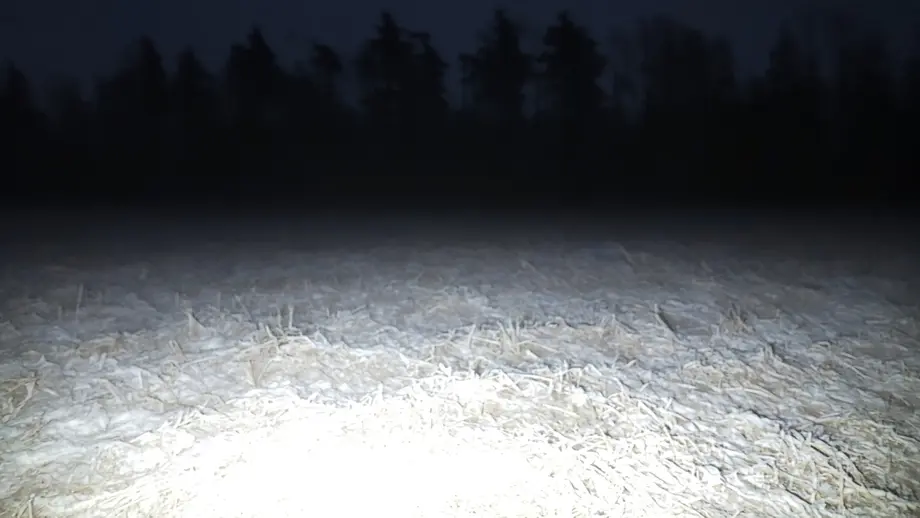
Light falls off with the square of distance, so the ground a few feet ahead gets far more light than anything farther out. With the same part of the beam, a patch 2 m away receives (40 ÷ 2)² = 400 times the illuminance of a target 40 m away. Turbo raises both by the same factor, and your eyes adapt to the bright foreground.
HyperPhysics, the Georgia State University physics reference, notes that "Point sources of gravitational force, electric field, light, sound or radiation obey the inverse square law." A headlamp is not a bare point source, but past a short distance its beam follows the same falloff.
The surface matters as much as the distance. NASA's Earth Observatory gives an albedo of about 0.84 for an ice-covered Earth and about 0.14 for a dark green forest canopy. The National Snow and Ice Data Center adds that "Clean snow, however, reflects most of the visible sunlight, creating a white appearance." Using NASA's ice figure as a stand-in for clean snow, the 400-to-1 distance ratio grows to roughly 400 × (0.84 ÷ 0.14) = 2,400 to 1 against a dark, vegetation-toned target at 40 m. The albedo figures describe sunlight, so this is an order-of-magnitude estimate.
This table shows the foreground-to-target illuminance ratio for common hunting sight lines. It uses the inverse-square law only and assumes the same beam intensity at both points.
| Where you look up close | Where the target is | Illuminance ratio | What to do |
|---|---|---|---|
| Leaf litter 1 m below you while tracking | Next blood spot 5 m ahead | (5 ÷ 1)² = 25 | Use a level where the near leaves keep their texture |
| Wet grass 2 m ahead on a field edge | Path 10 m ahead | (10 ÷ 2)² = 25 | Tilt the lamp so the hot spot lands farther out |
| Brush 3 m ahead | Downed animal 30 m into cover | (30 ÷ 3)² = 100 | Use a handheld and hold it off to the side |
| Snow 2 m ahead on the walk out | An opening 40 m ahead | (40 ÷ 2)² = 400; about 2,400 after albedo | Drop to Low or Med; save Turbo for brief looks |
Your eyes pay for glare. Webvision, the University of Utah's vision reference, describes dark adaptation as "how the eye recovers its sensitivity in the dark following exposure to bright lights." It also notes that "With increasing levels of pre-adapting luminances, the cone branch becomes longer while the rod branch becomes more delayed." In its dark adaptation curve, threshold keeps falling until about forty minutes in the dark.
Tip: If the ground at your feet turns white and featureless, step down one level before you step up. Going from Turbo to Med cuts the light 25 times, yet by the Stevens estimate it looks only about 2.9 times dimmer.
How Many Lumens Are Good for a Hunting Headlamp?
For most hunting jobs, a headlamp needs 30 to 120 lumens for walking and setup, and a held 300 to 600 lumens for tracking or finding a downed animal. Anything above that is a short-look setting. On the Perun 3, that maps to Low (30 lumens, 89 hours), Med (120 lumens, 25 hours) and High (600 lumens for 300 minutes).
The walking band keeps the foreground from washing out and costs your dark adaptation the least. The tracking band tops out at 600 lumens because that is the level the Perun 3 holds above 500 lumens the longest.
The Perun 3's white ladder is also spaced evenly for the eye. Each step is 4 to 5 times the one below it: 30 to 120 is 4 times, 120 to 600 is 5 times, and 600 to 3,000 is 5 times. By the Stevens exponent, each step looks about 1.6 to 1.7 times brighter (4^0.33 ≈ 1.58; 5^0.33 ≈ 1.70), so every press is a clear change you can judge in the dark.
A practical way to use the bands:
- Truck and tailgate: Moonlight (5 lumens, 20 days) or Red Low (15 lumens, 70 hours).
- Walk-in on a known trail: Low, 30 lumens.
- Rough ground and climbing into a stand: Med, 120 lumens.
- Blood trail or search: High, 600 lumens held.
- A lost trail or thick cover: Turbo for seconds, then back.
Once the animal is found, the job changes from seeing far to seeing close. Our field dressing light setup covers a second light for that work.
How Bright Should a Headlamp Be for Blood Tracking?
A held 300 to 600 lumens covers most blood trails. More light does not make dark blood stand out against pale leaves, because both brighten by the same factor. Start on a mid level, keep the beam low and close, and use max output only for short looks into a creek bottom or thick cover. On the Perun 3, High holds 600 lumens for 300 minutes.
The contrast math is short. A leaf with reflectance ρ₁ and a blood spot with reflectance ρ₂, lit by the same illuminance E, have a contrast of (ρ₁E − ρ₂E) ÷ ρ₂E = (ρ₁ − ρ₂) ÷ ρ₂. The E cancels, so once you have enough light to see detail, more lumens raise glare and adaptation cost without raising contrast. What changes contrast is the light's color and angle, which is the question our guide to blood light for hunting takes on.
Tracking also has a legal side, and no state text here sets a brightness limit. Iowa Code §481A.137(1) says: "While taking or attempting to take game or fur-bearing animals, a person shall not abandon an injured game or fur-bearing animal without making a reasonable effort to retrieve the animal from the field." Kentucky's deer rule, 301 KAR 2:172 Section 3(1), reads: "A deer hunter shall not: (a) Take a deer except during daylight hours; (b) Use dogs, except leashed tracking dogs, to recover a wounded deer;"
Neither text says whether you may carry a gun or bow while you track after dark, and Kentucky's legislative site also flags a proposed version of 301 KAR 2:172, so check it again before the season. Rules on carrying a light and a weapon after dark vary by state, species and season. Our guide to hunting with a light laws compares 12 states.
Warning: Read your state wildlife agency's current regulations before you track after legal hours. The quotes above were checked in September 2026; your state's regulations in force on the day you hunt are the ones that apply.
Common Myths About the Brightest Headlamp for Hunting
The biggest myth is that the highest lumen number buys the most useful light. Rated specs show that reach follows candela, peaks last minutes, and the eye compresses brightness. Check these points before you buy a powerful headlamp for hunting.
This table lists common misconceptions about bright hunting headlamps, the facts, and the basis for each.
| Myth | Fact | Basis |
|---|---|---|
| More lumens means you see farther | Reach follows candela. The Perun 3 has 2.4 times the Perun 3 Mini's lumens but reaches 160 m against 155 m | Olight specs: 6,400 cd vs 6,000 cd; beam distance defined at 0.25 lux |
| Max output can stay on all night | Both Perun headlamps hold their peak for 2 minutes | Olight stage chains: 3,000~800~600 and 1,250~350 lumens |
| Twice the lumens looks twice as bright | It takes about 8 times the light to look twice as bright | Exponent of 0.33 reported in Psychologia (2010) |
| More light shows blood better | Contrast between two surfaces under the same light does not change with brightness | (ρ₁ − ρ₂) ÷ ρ₂, the illuminance cancels |
| The brightest headlamp replaces a handheld | A thrower has far more candela: the Warrior X 4 is rated at 99,310 cd, about 15.5 times the Perun 3's 6,400 | Olight specs; 99,310 ÷ 6,400 ≈ 15.5 |
| Turbo is the best mode for a long track | Perun 3 High stays above 500 lumens 88 minutes longer than Turbo | 300 minutes vs 212 minutes from Olight's chains |
Heat, Eyes and Pockets: Using a 3,000-Lumen Headlamp Safely
A high-output headlamp makes heat, sits close to your skin and can dazzle a partner. The Perun 3 user manual carries the caution "Do not stare at operating light source". Use the lockout in a pack, keep the lens clear of your hat brim, and turn your head away before you talk to anyone.
The Perun 3 user manual explains its proximity sensor: if the lens is covered before Turbo starts, or within 0.5 seconds after, the light switches to High. If it stays covered for over 1 minute, the light turns off and does not return to Turbo. A hood or low hat brim over the lens can trigger this.
Heat is why every headlamp here steps down after minutes; our thermal step down flashlight explainer covers the physics. Cold is the other limit: the Perun 3 manual lists a working temperature of 0-40°C, so a hunt below 32°F is outside its rated range.
Safety note: Switch to Low or red before you face a hunting partner, and never check whether a light is on by looking into the lens.
Per the Perun 3 manual, the lockout is set by holding the switch for about 2 seconds from off, until the light goes off again. In lockout, a hold under 1 second gives Moonlight only while you hold it.
What's the Best Headlamp for Hunting?
For most hunters, the Olight Perun 3 is the best headlamp for hunting among the lights compared here and, at 3,000 lumens, the brightest headlamp for hunting in Olight's Perun line. It offers 3,000 lumens for short looks, 600 lumens held for 300 minutes on High, a 5-lumen Moonlight, two red levels and IP68. It also lifts out of the band to work as a handheld. Pair it with a handheld thrower if you need reach past 160 m.
The walk-in, the track and the drag on one charge. A hunting night needs a dim light for an hour, a strong held light for hours and a burst now and then. The Perun 3 covers all three from one 5000 mAh cell. It is also the overall pick in our roundup of the best headlamps.
Where the Perun 3 falls short. It weighs 150 g with its battery before the headband, nearly three times the Perun 3 Mini's 54 g. Its 6,400 candela limits reach to 160 m, and the manual lists CRI 70. Olight's product page also notes that the headlamp mounting bracket is metal and is expected to scratch the light's body if you take it in and out repeatedly. Its dimmest red setting is 15 lumens; Olight lists no lower red level.
The handheld partner for reach. A far clearing or a dark creek bottom needs a tight beam, not more headlamp lumens. The Olight Warrior X 4 is rated at 2,600 lumens, 99,310 candela and 630 m, IPX8, 249 g with battery. On Regular High it runs 2,600~1,000~300 lumens for 3 + 140 + 20 minutes, so it holds 1,000 lumens for 140 minutes. The Matte Black version lists $129.99 (regular price, September 2026), with a holster and USB-C cable in the box; its manual notes the MCC cable is sold separately. Its limits: its lowest level is 300 lumens, far too bright for walking in; it has no red light; it runs from a tail switch only; and it weighs 249 g in the hand.
Other choices. The Fenix HP35R buys about a 10% brighter look than the Perun 3 by the Stevens estimate, for 433 g, a battery case and $229.95. The 54 g Perun 3 Mini is a good walk-in lamp when back in stock, but not for a long recovery.
Before Your Next Hunt: A Brightness Checklist
Before you trust the brightest headlamp for hunting on a real night, set it up at home in the dark. Learn the button path to each level, confirm the held level outlasts your longest likely track, and plan a second light for reach. The steps use the Perun 3 controls from its user manual.
- Find Moonlight from off. On the Perun 3, press and hold the switch for over one second to get Moonlight, so the first light you see is 5 lumens, not your last setting.
- Find red from off. Double press the switch while the light is off for Red Low, 15 lumens, and double press again to switch between Red Low and Red High, 60 lumens. For white Low, 30 lumens, turn the light on and press and hold to cycle Low, Medium and High.
- Practice Turbo and back. With the light on, double press quickly for Turbo and double press again to return to the previous level.
- Know what the light remembers. Turbo is memorized as High, and High is memorized as Medium if the light stays off for over 1 minute.
- Plan the track on High, not Turbo. High holds 600 lumens for 300 minutes; Turbo stays above 500 lumens for 212.
- Walk the dark yard on Low. If the ground at your feet looks white, you are too bright for walking.
- Lock it before it goes in the pack, and pack a handheld such as the Warrior X 4 for reach.
- Charge both lights the night before, and reread your state's night light rules for the species and season.
FAQ
Changelog
- September 24, 2026: First published.