Olight makes some of the lights discussed here. Olight specs and regular prices come from its US product pages and user manuals as of September 2026; other brands' figures come from their makers. Every efficiency, lux and brightness figure below is our own arithmetic from those published numbers, not a lab measurement.
⚡ TL;DR
Fake lumens usually come from one of three gaps: no ANSI FL1 method behind the number, a reading taken at switch-on instead of after 30 seconds, or a battery setup the listing never states. Check those three first. Then divide the claimed lumen-hours by the battery's watt-hours; any figure above 683 is physically impossible.
This table matches the most common signs of fake lumens to their usual cause and the fix, so you can check a listing in a few minutes.
| Symptom on the listing | Likely cause | What to do |
|---|---|---|
| A lumen number with no mention of ANSI/PLATO FL 1 | The figure was not produced by the standard method | Treat it as unverified and ask which FL1 edition was used |
| One huge "max" figure and no runtime for each level | A switch-on peak or a short burst sold as the headline | Look for stage-by-stage runtimes, such as "1,600~600 lumens, 2 + 198 minutes" |
| Hours of high output from one small battery | The claim needs more energy than the battery holds | Run the battery energy test below; walk away above 683 lumen-hours per watt-hour |
| An LED model named next to a lumen figure many times its data sheet | Chip lumens, a cold reading or invention | Run the emitter check below |
| Different lumen numbers for the same light | A different battery in each number | Compare lights on the battery that ships in the box |
| Candela and beam distance that disagree | Not FL1 math, where distance equals 2 × √candela | Halve the distance, square it and compare with the candela |
| "1 million candlepower" or "3W LED" wording | Pre-FL1 marketing language | Ask for FL1 lumens and candela instead |
Here is the problem. Two lights at the same price claim 1,000 and 9,000 lumens, and the gap cannot be that large. The checks below use only what a listing or manual already shows, plus, if you want to go further, a handheld lux meter and a tape measure.
📋 Table of Contents
- 1. Fake Lumens Quick Answer: Check the Label, the Timing and the Battery
- 2. Chip Lumens vs Out-the-Front Lumens: Where Inflated Lumen Claims Start
- 3. How Big Is the Gap Between Peak and 30-Second Lumens?
- 4. What Does It Mean When a Flashlight Has No ANSI FL1 Label?
- 5. The Battery Energy Test: Can the Battery Pay for Those Lumens?
- 6. How Do I Tell How Many Lumens My Flashlight Is?
- 7. Five Red Flags of Fake Lumens on a Listing
- 8. Four Olight Lights Run Through the Checks
- 9. Is a 200,000 Lumen Flashlight Real?
- 10. Is 3000 Lumens Brighter Than 2000 Lumens?
- 11. Are High Lumen Flashlights Illegal?
- 12. When to Return or Report a Light Instead of Testing It Yourself
- 13. Your Fake Lumens Action Checklist
- 14. FAQ
Fake Lumens Quick Answer: Check the Label, the Timing and the Battery
To spot fake lumens, check three things in order: whether the listing names the ANSI/PLATO FL 1 standard, whether it gives runtime for each brightness stage so you know when the number was read, and whether it states the battery the rating assumes. A claim that passes all three is comparable. A claim that fails all three is marketing, not measurement.
Why these three? The FL1 standard defines light output as "the total quantity of emitted overall light energy," according to Streamlight's ANSI/PLATO FL1 summary, and it starts the clock "30 seconds after the light is turned on with fresh batteries." That gives you a method, a moment and a battery condition. A claim that states all three can be compared; one that drops any of them can't.
Here is what each check looks like in practice:
- The label. Look for "ANSI/PLATO FL 1" and an edition year in the manual or on the box. Olight's i3T 2 EOS manual, for example, states: "Above data are tested per ANSI/PLATO FL 1-2019 standard in Olight's labs for reference."
- The timing. A runtime line such as "1,600~600 lumens, 2 + 198 minutes" tells you the peak lasts 2 minutes. A single number with no runtime tells you nothing about how long it lasts.
- The battery. The same light can carry two honest numbers. Olight lists the i3T 2 EOS at 200 lumens on its included AAA alkaline cell, and says a 10440 lithium-ion cell "can boost the maximum output up to 300 lumens."
The rest of this guide adds two tests that don't depend on trusting anyone's label. To see Olight's range with stage-by-stage specs, browse its flashlights.
Chip Lumens vs Out-the-Front Lumens: Where Inflated Lumen Claims Start
Chip lumens are what an LED produces on its own, usually in a short pulse at 25 °C. Out-the-front lumens are what leaves the finished flashlight after heat, driver and optic losses. FL1 counts only the second. The U.S. Department of Energy says those losses can cut efficacy by more than 30%, so a listing that quotes chip lumens overstates real output by roughly that much or more.
The gap starts with how LEDs are rated. A Department of Energy fact sheet on the energy efficiency of LEDs explains that "LED package efficacy is typically determined using brief pulses of light (rather than continuous operation) at a fixed ambient temperature (25 °C), which does not correspond to real world operating characteristics." Once the LED sits in a flashlight head, "Thermal effects, driver losses, and optical inefficiencies all combine to reduce the efficacy of LED luminaires compared to the included LED packages," and "these loss mechanisms can result in a decrease in efficacy of greater than 30%."
Here is how that plays out in numbers. Suppose an LED data sheet supports 1,000 lumens at the drive current a light uses. A 30% loss leaves 1,000 × 0.70 = 700 lumens out the front. If the listing prints 1,000, it has overstated output by 1,000 ÷ 700 = 1.43 times, or 43%, before any other exaggeration.
The emitter check
Some listings name the LED, which lets you check its maker's data sheet. Cree LED's XLamp XM-L2 data sheet lists a maximum drive current of 3,000 mA, notes that the parts are "Binned at 85 °C," and adds that "Flux values @ 25 °C are calculated and for reference only." For its T6 flux bin, the sheet lists a minimum of 280 lumens at 700 mA and a calculated minimum of 699 lumens at 2,000 mA, both at 85 °C.
Now apply an energy ceiling. The sheet lists a typical 3.02 V at 3,000 mA, so one XM-L2 at maximum current draws about 3.02 × 3 = 9.06 W. Even at the DOE's long-range target of 266 lumens per watt for LED packages, that is about 9.06 × 266 = 2,410 lumens. A claim of 10,000 lumens from one such LED needs 10,000 ÷ 9.06 = about 1,104 lumens per watt, above the physical limit of 683 explained below, so it cannot be true.
This table turns the chip-to-front gap into a quick reference.
| Rating type | Where it comes from | Conditions | Counts optic and heat losses? |
|---|---|---|---|
| Chip or LED lumens | The LED maker's data sheet | Short pulse, fixed temperature (25 °C or 85 °C, as stated) | No |
| "Up to" lumens with no method named | Not stated | Not stated | Unknown |
| ANSI/PLATO FL 1 lumens | Integrating sphere measurement of the finished light | 30 seconds after switch-on, fresh batteries | Yes |
| FL 1-2025 burst lumens | Integrating sphere, short-duration method | Read between 1 and 10 seconds, stopwatch icon | Yes, but only for the burst |
How Big Is the Gap Between Peak and 30-Second Lumens?
For standard modes, FL1 takes its reading starting 30 seconds after switch-on, so a flash of higher output in the first seconds is not the rated figure. Since ANSI/PLATO FL 1-2025, a burst lasting under 30 seconds can be rated separately, read between 1 and 10 seconds and marked with a stopwatch icon. The bigger gap comes later, when the light steps down to a level it can hold.
PLATO, the standard's developer, explains the 2025 change in ANSI/PLATO FL 1-2025: What Changed and Why It Matters. Earlier editions "did not provide a method for testing and reporting performance results for modes lasting less than 30 seconds." Under the new method, "Lumen output, beam distance and peak beam intensity are measured between one and 10 seconds," and runtime ends when output drops to 90% of the highest reading in those first 10 seconds. PLATO adds that "A shaded table row and stopwatch icon distinguish short-duration performance claims from standard operating modes."
So a burst figure can be honest. What makes it misleading is presenting it without the icon, the shaded row or the seconds it lasts. This table compares how an honest listing and an inflated one present the same short peak.
| What to look for | Honest peak claim | Inflated peak claim |
|---|---|---|
| How long the peak lasts | Minutes or seconds printed next to it, such as "2 + 198 minutes" | No time at all, or "up to" with no runtime |
| The level after the peak | The sustained level named in the same line, such as "1,600~600 lumens" | Only the peak appears anywhere on the page |
| Burst vs standard mode | Under FL 1-2025, a burst under 30 seconds sits on a shaded row with a stopwatch icon | Burst and standard figures mixed in one line |
| Test basis | An edition named, such as "ANSI/PLATO FL 1-2019 standard in Olight's labs" | A vague "lab" or "real lumens" line with no standard named |
| Runtime | Stage times that add up to the total runtime | A long runtime printed next to the peak, as if both hold together |
A step-down also looks smaller than the numbers suggest. Flashlight maker Nitecore's ANSI FL1 guide gives the rough rule used here: "for a light to appear twice as bright to the eye, four times the intensity is required." In other words, apparent brightness scales with about the square root of output.
This table applies that square-root rule to round step-down shares, so you can judge any stage chart without a meter.
| Output after the step-down, as a share of the headline | Looks about this bright | What it means for a claim |
|---|---|---|
| 75% | 87% (√0.75) | Hard to notice; a flat, conservative rating |
| 50% | 71% (√0.50) | Noticeable in a side-by-side check |
| 25% | 50% (√0.25) | Clearly dimmer, and common after a 2-minute turbo |
| 10% | 32% (√0.10) | The FL1 runtime end point; suspicious if it arrives within minutes on a full charge |
A light that falls to a quarter of its headline has lost about half its apparent brightness, which you will notice but which is not the collapse the numbers suggest. For how much output high-lumen lights still deliver once the peak ends, see our ranking of the best high-lumen rechargeable flashlights at minute three.
What Does It Mean When a Flashlight Has No ANSI FL1 Label?
A flashlight with no ANSI FL1 label has a lumen figure produced by an unknown method. It might be an honest lab reading, chip lumens, a switch-on peak or a number copied from a competitor. The standard is voluntary, so a missing label is not proof of fraud, but it removes your ability to compare that light with any other.
Nitecore's guide to the 2009 edition states plainly that "Adherence to the FL1 Standard is voluntary." It also names the vague claims FL1 was written to replace. On "3W LED," it says LEDs "rarely operate at the rated power, so this doesn't really have any meaning." If a listing still leads with phrases like that, it is using language that predates the standard.
A label also tells you which edition applies. The current edition is ANSI/PLATO FL 1-2025, but many lights on sale were rated to earlier ones, and Olight's manuals show two: the Seeker 4 Pro manual says its data "are tested per ANSI/PLATO FL 1-2019 standard in Olight's labs for reference," while the Marauder Mini 2 manual names ANSI/NEMA FL 1-2009 and adds that "The tests are performed indoors under a room temperature of 25 degrees celsius with windless conditions."
What to do when there is no label:
- Ask the seller which FL1 edition and which battery produced the figure. A maker that ran the tests can answer in one line.
- Look for candela and beam distance. If both are listed, check that the distance equals about 2 × √candela.
- Run the battery energy test in the next section. It needs no label at all.
For a full walk-through of the six FL1 numbers and how each is produced, read our guide to the ANSI FL1 standard.
The Battery Energy Test: Can the Battery Pay for Those Lumens?
The battery energy test checks whether a lumen claim fits the energy stored in the battery. Multiply lumens by hours to get lumen-hours, then divide by the battery's watt-hours. The result is the average lumens per watt the claim implies. The steady Olight modes checked here imply 58 to 185, below the Department of Energy's 266 target for bare LED packages. Anything above 683 is physically impossible.
The 683 figure is not a rule of thumb. It comes from the definition of the candela. NIST's page on the SI definition of the candela explains that the defining constant "Kcd, is equal to 683 lumens per watt," fixed for monochromatic light at a frequency of 540 × 10¹² Hz, which the eye sees as green. No light source can turn one watt into more than 683 lumens, and white light does worse. The DOE fact sheet cited above targets 266 lumens per watt for LED packages and "LED luminaire efficacy exceeding 200 lm/W" for complete fixtures.
Here is the test, step by step:
- Find the battery's watt-hours. If only milliamp-hours and volts are listed, multiply them and divide by 1,000: 3,500 mAh × 3.6 V ÷ 1,000 = 12.6 Wh.
- Pick a steady mode, one with a single lumen figure and no step-down, and multiply its lumens by its hours to get lumen-hours.
- Divide lumen-hours by watt-hours. Because the hours cancel, the result is the average lumens per watt the claim implies.
- Compare: below about 200 is plausible for a good LED light, 200 to 266 deserves a hard look, and above 683 is impossible.
Why a steady mode? A turbo line stacks several stages, and each stage can sag before it ends, because FL1 runtime runs until output falls to 10% of the starting reading. A steady Low or Medium mode has one number and runs long enough to use most of the battery, so the result is cleaner. For a listing that only prints a turbo line, multiply each stage by its time and add them up; the answer is an upper bound, and a claim that fails even that generous math fails outright.
Here is the calculation for the Olight Seeker 4 Pro's Medium mode, based on Olight's rated figures, not measured:
- Battery: 5,000 mAh × 3.6 V ÷ 1,000 = 18 Wh, which matches the 18 Wh printed in its manual.
- Lumen-hours: 300 lumens × 11 hours = 3,300.
- Implied efficiency: 3,300 ÷ 18 = about 183 lumens per watt on average.
- Verdict: below the DOE's 266 package target and under the 200 mark, so the rating is plausible.
It helps to know the ceiling before you read a listing. This table shows how much light common batteries could deliver at the DOE's 200 lm/W fixture target and at the 683 lm/W physical limit, based on published capacities, not measured.
| Battery | Energy | Most lumen-hours at 200 lm/W | Hours of 1,000 lm at 200 lm/W | Minutes of 10,000 lm at the 683 lm/W limit |
|---|---|---|---|---|
| One AAA alkaline, light load | 1.8 Wh or less | 360 | 0.36 (about 22 min) | 7 |
| One 18650, 3,500 mAh, 3.6 V | 12.6 Wh | 2,520 | 2.5 | 52 |
| One 21700, 5,000 mAh, 3.6 V | 18 Wh | 3,600 | 3.6 | 74 |
| One 32650, 7,500 mAh, 3.7 V | 27.75 Wh | 5,550 | 5.6 | 114 |
| Twelve 21700 cells, 4,000 mAh each, 3.6 V assumed | 172.8 Wh | 34,560 | 34.6 | 708 |
Read the last column as a hard wall. Even a perfect light, turning every watt into the greenest possible light with zero losses, could not run 10,000 lumens from one 18650 cell for more than about 52 minutes (12.6 × 683 ÷ 10,000 = 0.86 hours). Real white LED lights sit far below that limit.
This table runs the test on steady Olight modes and on made-up listings of the kind the checks are meant to catch. Olight rows are based on Olight's rated figures, not measured.
| Claim | Battery energy | Lumen-hours claimed | Implied average lm/W | Verdict |
|---|---|---|---|---|
| Olight Baton 4 Pro, Low: 15 lm for 155 h | 12.6 Wh | 2,325 | 185 | Plausible |
| Olight Seeker 4 Pro, Med: 300 lm for 11 h | 18 Wh | 3,300 | 183 | Plausible |
| Olight Marauder Mini 2, Level 1-2 floodlight: 150 lm for 27 h | 27.75 Wh | 4,050 | 146 | Plausible |
| Olight i3T 2 EOS, Low: 5 lm for 21 h | 1.8 Wh or less (one AAA) | 105 | 58 or more | Plausible |
| Hypothetical: 5,000 lm for 2 h on one 21700 | 18 Wh | 10,000 | 556 | Not credible: about twice the DOE package target |
| Hypothetical: 10,000 lm for 3 h on one 18650 | 12.6 Wh | 30,000 | 2,381 | Impossible: 3.5 times the physical limit |
The twelve-cell row uses Imalent's published MS32 pack of twelve 21700 cells at 4,000 mAh each. Imalent does not state a pack voltage, so we assumed the 3.6 V nominal voltage Olight prints for its own lithium-ion cells: 12 × 4.0 Ah × 3.6 V = 172.8 Wh.
AAA lights need care, because alkaline capacity changes with the load. Energizer's E92 AAA data sheet charts a little under 1,200 mAh at a 25 mA drain and under 500 mAh at 500 mA, and warns that its values "are for reference purposes and not intended for specific calculations." Take 1.5 V × 1.2 Ah = 1.8 Wh as a generous ceiling. The i3T 2 EOS's Low mode, 5 lumens for 21 hours, is 105 lumen-hours, or at least 105 ÷ 1.8 = 58 lumens per watt. Its High line, (200 × 7 + 100 × 28) ÷ 60 = 70 lumen-hours, delivers less, which fits the lower capacity at high drain. A AAA listing that claims 1,000 lumens for an hour would need 1,000 ÷ 1.8 = 556 lumens per watt, about double the DOE package target, so treat it as fake.
Passing this test shows only that a claim is possible on a fresh cell at room temperature. Cold weather and an aging battery both cut real runtime, as our guide to flashlight runtime explains.
How Do I Tell How Many Lumens My Flashlight Is?
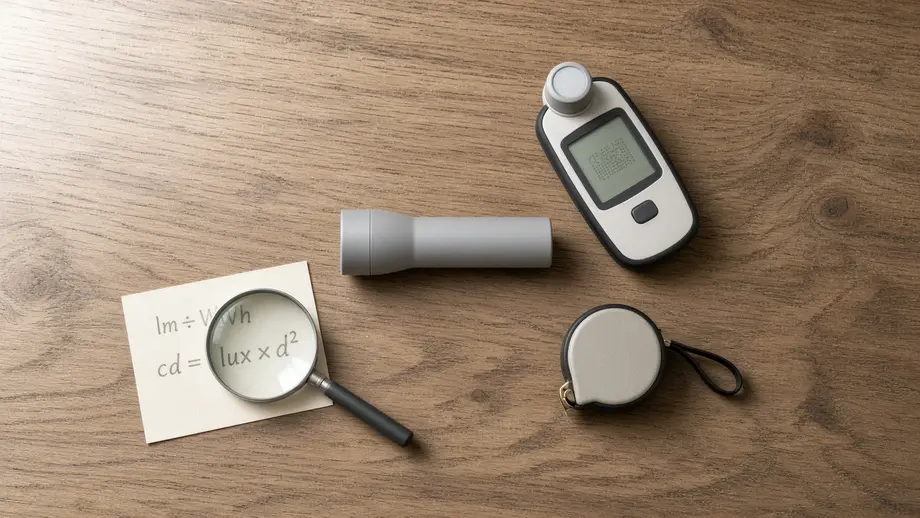
You can't measure true lumens at home, because that takes an integrating sphere that captures every ray. You can check the two things that expose inflated claims: peak intensity and step-down. Measure the lux at the hotspot from 5 meters, multiply by 25 to get candela and compare with the rating. Then log the reading over 10 minutes and compare it with the published stages.
The method rests on one formula: candela = lux × distance² (meters). Because FL1 beam distance is also calculated from candela, one reading checks two numbers on the box.
This table lists the tools for the home check and what each contributes.
| Tool to verify flashlight lumens at home | What it does in the check | Accuracy to expect |
|---|---|---|
| Handheld lux meter | Reads illuminance at the hotspot | Example: a Lutron LX-101A carries a manufacturer-rated ±5% of reading |
| Tape measure, 5 m or longer | Sets the distance from the lens to the sensor | A 5 cm miss at 5 m is 1% of distance, or about 2% of candela |
| Tripod, stand or books | Holds the light still and level | Keeps the hotspot on the sensor between readings |
| Phone stopwatch | Times readings at 30 s, 2 min, 3 min and 10 min | Seconds matter only for the first reading |
| Fully charged battery | Matches FL1's "fresh batteries" condition | A partly drained cell can lower the reading |
| Notebook or spreadsheet | Records lux and time for the step-down log | None |
Follow these steps:
- Charge the battery fully and let the light cool to room temperature.
- In a dark room or outdoors at night, set the light on a stand exactly 5 meters from the meter's sensor, measured from the lens.
- Switch to the mode you want to check, start the stopwatch and aim so the brightest part of the hotspot sits on the sensor.
- At 30 seconds, record the highest lux you can find by nudging the aim slightly.
- Multiply by 25 (5²) to get candela. Compare with the rated figure.
- Keep recording at 2, 3 and 10 minutes without moving anything. Divide each reading by the 30-second reading and compare the ratios with the published stages.
Here is what the numbers should look like for rated candela, based on Olight's rated figures, not measured: the Baton 4 Pro's 10,000 cd should read 10,000 ÷ 25 = 400 lux at 5 m, the Seeker 4 Pro's 16,895 cd should read about 676 lux, and the Marauder Mini 2's 140,000 cd spotlight should read 5,600 lux. For a small light like the i3T 2 EOS, rated 963 cd, measure at 3 m instead: 963 ÷ 9 = 107 lux.
How accurate is the home method?
Add up the error sources. The meter: ±5% in the Lutron example above. Distance: ±1% at 5 m becomes about ±2% after squaring. Aim: missing the center of the hotspot can only lower the reading. That puts a careful home reading within roughly ±7% of the true value, before unit-to-unit variation. The researchers who documented that Lutron meter in a 2026 smartphone illuminance dataset also caution that "cosine response and spectral response under LED illumination may deviate from ideal behavior."
So read the result as a band, not a verdict. Within about ±15% of the rated candela, the rating is consistent. Below about 70% on a fresh battery, something is wrong with either the rating or the unit. Phone light-meter apps don't carry a rated accuracy, so use one only to compare ratios, such as the 30-second reading against the 3-minute reading, with the same phone in the same spot.
The step-down log is the most revealing part. If the beam shape stays the same, lux falls in the same proportion as lumens. The Baton 4 Pro's turbo line, 1,600~600 lumens, predicts a 3-minute reading of about 600 ÷ 1,600 = 37.5% of the 30-second reading. If a light you own drops to 10% of its starting reading within a few minutes on a full charge, its headline was a peak it could not hold.
Tip: Keep the light on its stand for the whole log. Holding it by hand cools the body and can change how fast it steps down, so a handheld log will not match a published stage chart.
Five Red Flags of Fake Lumens on a Listing
Five red flags sum up the checks in this guide: a number with no method, a number with no runtime, a number the battery cannot pay for, a number far above the named LED's data sheet, and beam figures that fail their own math. One flag calls for questions. Two or more are reason to walk away.
- No method. No mention of ANSI/PLATO FL 1, no edition year, no "measured by" line. The fix is to ask; an honest maker can name the edition.
- No runtime per level. A max figure without the minutes it lasts. Honest listings show every stage, the way Olight writes "4,600~1,200~600 lumens" next to "2.5 + 122 + 35 minutes."
- Impossible energy. Lumen-hours divided by battery watt-hours above 683. Run the battery energy test before you pay.
- LED mismatch. A named emitter plus a figure many times its data sheet output. One XM-L2 at its 3,000 mA maximum draws about 9 W, which caps it near 2,410 lumens even at the DOE's 266 lm/W target.
- Beam math that doesn't add up. FL1 beam distance is the point where the beam falls to 0.25 lux, so distance equals 2 × √candela. A claim of 1,000 m with 20,000 cd fails: 2 × √20,000 is about 283 m. Our ANSI FL1 guide, linked above, runs this check on real spec sheets, so it is not repeated here.
Four Olight Lights Run Through the Checks
Run through the checks, the four Olight lights here hold up: each publishes runtime for every stage, states its battery, gives a candela figure you can check with a lux meter and implies 58 to 185 average lumens per watt on a steady mode. Three name an FL1 edition in their manuals; the Baton 4 Pro's manual doesn't.
This table collects the results and the lux you should expect in the home check. Figures are based on Olight's rated specs, not measured, with regular prices as of September 2026.
| Light | Regular price | Headline and first sustained stage | FL1 edition in manual | Battery stated | Expected lux at 5 m (rated cd ÷ 25) | Implied lm/W, steady mode | Best use of the headline |
|---|---|---|---|---|---|---|---|
| Olight i3T 2 EOS | $19.99 | 200 lm for 7 min, then 100 lm | ANSI/PLATO FL 1-2019 | One 1.5 V AAA alkaline, included | 39 (963 cd) | 58 or more (Low) | Short tasks on one AAA |
| Olight Baton 4 Pro | $69.99 | 1,600 lm for 2 min, then 600 lm | Not named in the manual | 3,500 mAh, 3.6 V 18650 | 400 (10,000 cd) | 185 (Low) | Pocket light that holds 600 lm |
| Olight Seeker 4 Pro | $139.99 | 4,600 lm for 2.5 min, then 1,200 lm | ANSI/PLATO FL 1-2019 | 5,000 mAh, 3.6 V 21700 | 676 (16,895 cd) | 183 (Med) | Long walks at 1,200 lm |
| Olight Marauder Mini 2 | $219.99 | 10,000 lm for 2 min, then 2,500 lm | ANSI/NEMA FL 1-2009 | 7,500 mAh, 3.7 V, 27.75 Wh 32650 | 5,600 (140,000 cd spotlight) | 146 (Level 1-2 floodlight) | Searching wide areas |
The Olight i3T 2 EOS is the honest budget case: 200 lumens on a AAA alkaline cell for 7 minutes, then 100 lumens for 28 minutes, and 5 lumens for 21 hours. Its limit is the battery. An alkaline AAA loses capacity fast at high drain, so for long bright runs it is the wrong light, and the "up to 300 lumens" figure applies only with a 10440 cell.
The Olight Baton 4 Pro (1,600 lumens, 10,000 cd, 200 m, 114 g) shows a believable pocket rating: 600 lumens for 198 minutes after a 2-minute peak, and a Low mode that implies 185 lumens per watt. Two limits: 1,600 lumens is a 2-minute figure, so buy it for the 600, and its manual lists the 3,500 mAh, 3.6 V, 12.6 Wh battery but no FL1 edition.
The Olight Seeker 4 Pro (4,600 lumens, 16,895 cd, 260 m, 205 g) passes every check, and a fresh unit should read about 676 lux at 5 m. High holds 1,200 lumens for 135 minutes before stepping to 600 and 300. The trade-off is size; at 133 mm and 205 g, it rides in a holster, not a coin pocket.
The Olight Marauder Mini 2 (10,000 lumens, 140,000 cd, 750 m, 465 g) has a big number that is real but brief: 10,000 lumens for 2 minutes, then 2,500. Its product page lists a working temperature of 0 to 40 °C, so it is the wrong pick for searching in below-freezing weather. If your first light already covers pocket duty, our guide to choosing a second flashlight explains when a light like this fills a real gap.
Is a 200,000 Lumen Flashlight Real?
A 200,000-lumen flashlight is real as a large searchlight, not as a pocket light. Imalent lists its MS32 at 200,000 lumens from 32 Cree XHP70.2 LEDs and a twelve-cell 21700 pack, weighing 3.1 kg, with the peak lasting 45 seconds before 40,000 lumens for 40 minutes. A palm-sized light claiming 200,000 lumens fails the battery energy test by a wide margin.
Imalent's MS32 product page lists 200,000 lumens, 655,000 cd, a 1,618 m beam distance and a "Battery pack(21700-4000mAh*12)." Its own MS32 overview adds "32 × CREE XHP70.2," a weight of "3.1 kg (with battery)" and a turbo row of "200,000 → 40,000" lumens for "45 s + 40 min."
Run the checks and the claim holds together. The turbo line works out to (200,000 × 0.75 + 40,000 × 40) ÷ 60 = about 29,167 lumen-hours, or about 169 lumens per watt from the assumed 172.8 Wh pack, below the DOE's 266 target. And 200,000 ÷ 32 = 6,250 lumens per LED is a 45-second figure, while the sustained 40,000 is 1,250 per LED.
Now try the same claim on a light the size of a Baton 4 Pro. Its 12.6 Wh cell would run 200,000 lumens for at most 12.6 × 683 ÷ 200,000 = 0.043 hours, or about 2.6 minutes, even at the physical limit and with zero losses. Any small light advertising 200,000 lumens for "hours" is selling fake lumens.
Size is the honest tell: the MS32 weighs about 6.7 times as much as the 465 g Marauder Mini 2 (3,100 ÷ 465). To picture what lower outputs look like first, see our guide to how bright is 2000 lumens, which maps lumen levels to everyday light sources.
Is 3000 Lumens Brighter Than 2000 Lumens?
Yes, 3,000 lumens is 50% more light than 2,000 lumens if both figures are FL1-rated, but it won't look 50% brighter. By Nitecore's rough rule that four times the intensity looks twice as bright, 1.5 times the output looks about 1.22 times as bright (√1.5). With the same beam shape, it also reaches about 22% farther.
The distance follows from FL1 math: beam distance is 2 × √candela, and with the same optic, candela rises in step with lumens. A 2,000-lumen light rated at 200 m would reach about 200 × 1.22 = 245 m at 3,000 lumens.
Two things can flip the answer. First, the beam: a 2,000-lumen thrower can outreach a 3,000-lumen flood light, because distance depends on candela, not lumens. Our guide to beam distance explains why. Second, the step-down: a 3,000-lumen light that drops to 800 after 2 minutes is dimmer for the rest of your walk than a 2,000-lumen light that holds 1,200.
Are High Lumen Flashlights Illegal?
No federal statute we could find sets a lumen limit for owning or carrying a handheld flashlight. What the law restricts is how a light is used and how it is sold: states such as Minnesota and Washington restrict shining lights to find wildlife, and federal law bars deceptive advertising, which is where fake lumens can run into trouble. Check your own state's current rules before using a bright light around animals, roads or aircraft.
The federal statute on aiming at aircraft, 18 U.S.C. § 39A, applies to "Whoever knowingly aims the beam of a laser pointer at an aircraft," and it defines a laser pointer as a device "designed or used to amplify electromagnetic radiation by stimulated emission." That describes a laser, not an LED flashlight. Still, never aim a flashlight at a pilot or driver.
On the selling side, the rule is about the claim, not the light. A seller who prints a lumen figure the light cannot deliver is making an advertising claim, and the next section quotes the federal law that covers it and where to report a listing.
State wildlife laws are where lumens meet real rules. Two examples, quoted from the official statute sites:
- Minnesota. Minnesota Statutes § 97B.081 says that, with listed exceptions, "a person may not cast the rays of a spotlight, headlight, or other artificial light on a highway, or in a field, woodland, or forest, to spot, locate, or take a wild animal while having in possession" a firearm, bow or similar implement. Without such implements, the same section bars casting those rays to spot or locate a wild animal "from two hours after sunset until sunrise."
- Washington. Under RCW 77.15.450, "A person is guilty of spotlighting big game in the second degree if the person hunts big game with the aid of a spotlight, other artificial light, or night vision equipment while in possession or control of a firearm, bow and arrow, or cross bow." The statute makes that a gross misdemeanor.
Neither statute mentions a lumen number. A 300-lumen light used to spot deer in Minnesota after the cutoff can break the rule, while a 10,000-lumen light used to check your own backyard for a lost dog is not what the statute targets. Rules change, and other states write theirs differently, so read your state wildlife agency's current regulations.
Safety note: Bright beams can hurt eyes. Olight's i3T 2 EOS manual warns: "Do not look directly at the light source or shine on the eyes, it may cause temporary blindness or permanent damage to the eyes." Keep high modes pointed at the ground or the target, never at people, drivers or aircraft.
When to Return or Report a Light Instead of Testing It Yourself
Test at home only to confirm that an honest rating fits your unit. Return the light when a fresh, fully charged unit reads well under its rating or steps down far faster than published. Report it when the listing is impossible on paper or the light is unsafe. Never open a battery or driver to find out.
The legal basis is Section 5 of the FTC Act, codified at 15 U.S.C. § 45, which reads: "Unfair methods of competition in or affecting commerce, and unfair or deceptive acts or practices in or affecting commerce, are hereby declared unlawful." The Federal Trade Commission's truth in advertising page states that "federal law says that ad must be truthful, not misleading, and, when appropriate, backed by scientific evidence." The FTC's consumer guide to shopping for light bulbs notes that "The Lighting Facts label is on light bulb packages"; for flashlights, the comparable yardstick is the voluntary FL1 method. Deceptive listings can be reported at ReportFraud.ftc.gov, and product hazards to the Consumer Product Safety Commission through SaferProducts.gov.
This table sorts common situations into test, return or report.
| Situation | Home check or not | What to do |
|---|---|---|
| Rated light, you want to confirm your unit | Home check: lux at 5 m and a 10-minute log | Keep it if candela reads within about ±15% |
| Fresh, fully charged unit reads under 70% of rated candela | Stop testing | Return or exchange under the seller's policy |
| Output collapses to about 10% within minutes on a full charge | Stop testing | Return; compare the log with the published stages first |
| Listing fails the battery energy test (above 683 lumen-hours per Wh) | No test needed | Don't buy; if you already did, return and report the listing to the FTC |
| Light gets too hot to hold, smells of burning or the battery swells | Stop using it at once | Don't open it; report the hazard to SaferProducts.gov |
| Seller will not name an FL1 edition or battery | No test needed | Buy from a maker that publishes its method and stages |
Warning: Don't try to verify a light by opening the head or the battery compartment beyond normal battery changes. Olight's i3T 2 EOS manual says simply: "Do not disassemble the product." A damaged lithium-ion cell is a fire risk.
Your Fake Lumens Action Checklist
Before you pay for any high-lumen light, run the three quick checks, then the battery energy test, and keep a lux meter reading for anything you already own. Those steps take about ten minutes and catch fake lumens without trusting the label. Choose the light by the stage you will use, not the headline.
- Find "ANSI/PLATO FL 1" and an edition year in the listing or manual.
- Read the runtime for each stage and circle the first sustained level.
- Note the battery the rating assumes and compare lights on the battery in the box.
- Divide lumen-hours by battery watt-hours; question anything above 200, reject anything above 683.
- Halve the beam distance, square it and compare with the rated candela.
- If an LED is named, check its data sheet ceiling and take off about 30% for losses.
- On a light you own, read lux at 5 m after 30 seconds, multiply by 25 and log the drop for 10 minutes.
- Return units that read under 70% of rated candela on a full charge; report impossible listings to the FTC.
FAQ
Changelog
- September 24, 2026: First published.