Olight makes some of the lights discussed here. Olight specs and prices come from its US product pages and user manuals as of September 2026; alloy and finish data come from the suppliers, standards and agencies linked in each section. The calculations are our own estimates from published numbers, not lab measurements.
⚡ TL;DR
Aluminum flashlight material is two choices, not one. The alloy grade, such as 6061-T6 or 7075-T6, sets strength, dent resistance and how fast heat moves through the body. The anodized finish, Type II or Type III hardcoat, sets scratch and corrosion resistance. When you shop, look for the alloy with its temper and the anodize type, not the words "aircraft grade."
Most product pages make that hard. A listing says "aerospace-grade aluminum" and stops there. Then the light rides with your keys for a month, every edge turns silver, and you can't tell whether you bought a soft alloy, a thin finish, or both. Even one brand can describe the same metal two ways: Olight rates the alloy behind its OAL flashlights at "1.73×" 6061 on some pages and "nearly twice" on others. This guide separates the two, puts numbers on each, and ends with a checklist for any spec sheet.
This table answers the aluminum flashlight material questions most buyers ask first.
| Question | Short answer |
|---|---|
| What decides durability? | The alloy resists dents and bent threads; the anodized layer resists scratches and corrosion |
| What does "aircraft grade" mean? | No single alloy. Flashlight makers usually mean 6061-T6 or 7075-T6, so ask for the four digits |
| 6061-T6 or 7075-T6? | 7075-T6 yields at 503 MPa against 276 MPa, but it conducts heat about 22% less (130 vs 167 W/m·K) |
| Type II or Type III anodizing? | Type III hardcoat defaults to 0.002 inch (about 50 µm) under MIL-PRF-8625F; Type II is thinner and easier to dye bright colors |
| Does the material change runtime? | Not directly. Battery, driver and step-down set runtime; the body only moves heat |
| What is Olight OAL? | Olight's proprietary aluminum alloy, rated by Olight at 1.73× (on some pages nearly 2×) 6061; its composition is not published |
📋 Table of Contents
- 1. What Decides Aluminum Flashlight Material: Alloy or Anodizing?
- 2. What Is Aircraft Grade Aluminum?
- 3. 6061-T6 vs 7075-T6: Which Alloy Grade Is Tougher?
- 4. How Much Harder Is OAL Than 6061 Aluminum?
- 5. Olight OAL vs 6061 and 7075: Where Each Model Sits
- 6. Does Alloy Grade Change How Long Turbo Lasts?
- 7. What Is the Difference Between Type II and Type III Anodizing?
- 8. Is Anodized Aluminum Durable?
- 9. Titanium, Stainless Steel and Copper: Flashlight Body Material Compared
- 10. Common Misconceptions About Anodized Aluminum Flashlights
- 11. Which Olight OAL Flashlight Fits How You Carry?
- 12. Aluminum Flashlight Material Checklist Before You Buy
- 13. FAQ
What Decides Aluminum Flashlight Material: Alloy or Anodizing?
Both decide it, but they guard against different failures. The alloy is the metal itself: it resists dents, bent threads and cracked heads, and it carries heat from the LED to your hand. The anodized layer is a skin of aluminum oxide grown out of that metal: it resists scratches, sweat and corrosion. A hard finish over a soft alloy still dents, and a strong alloy under a thin finish still scuffs.
The finish is not paint. The Federal Aviation Administration's Aviation Maintenance Technician Handbook–General (FAA-H-8083-30B) explains that "Anodizing merely increases the thickness and density of the natural oxide film." The same handbook sorts wrought aluminum by main alloying element: 6xxx alloys use magnesium and silicon, 7xxx alloys use zinc, and T6 means "solution heat-treated and then artificially aged."
This framework table maps the failures people complain about to the part of the material that controls each one, and to the spec line that tells you about it.
| Failure you worry about | Controlled mainly by | What to look for on the spec sheet |
|---|---|---|
| Dent or flat spot after a drop on concrete | Alloy strength and wall thickness | Alloy and temper (6061-T6, 7075-T6, OAL); drop height in meters |
| Silver scratches from keys and coins | Anodize type and thickness | "Type III" or "hard anodized" |
| White spots or pitting after salt or sweat | Alloy corrosion rating and sealing | Alloy series; sealed finish |
| Faded color after a summer on the dashboard | Dye and seal in the anodized layer | Color and finish type |
| Hot head during long high-output use | Heat budget of the whole light | Step-down figures in the runtime table |
What Is Aircraft Grade Aluminum?
Aircraft grade aluminum is a marketing phrase, not an alloy designation. Aircraft use several wrought alloys, and flashlight makers who use the phrase usually mean 6061-T6 or 7075-T6. Those two differ a lot: 7075-T6 is about 80% stronger in yield, while 6061-T6 resists corrosion and conducts heat better. If a listing says "aircraft grade" without four digits and a temper, you can't tell which one you are buying.
Kaiser Aluminum's 7075 data sheet says the alloy "is heavily utilized by the aircraft and ordnance industries because of its superior strength." Its 6061 data sheet states the trade-off plainly: "Corrosion resistance and appearance after anodizing are superior to all other screw machine alloys while strength is the lowest."
Olight's own labels show how loose the wording gets. Its optic mount page says "Aircraft-Grade 6061 Aluminum," its Seeker 3 page says "aerospace-grade aluminum alloy," its Marauder Mini 2 page lists "A6061-T6 Aluminum Alloy," and many pages list only "Aluminum Alloy." Only the lines with numbers tell you the grade.
6061-T6 vs 7075-T6: Which Alloy Grade Is Tougher?
7075-T6 is the tougher alloy against bending and denting. Kaiser lists its typical yield strength at 503 MPa and its Brinell hardness at 150, against 276 MPa and 95 for 6061-T6. 6061-T6 wins elsewhere: it has a better corrosion rating, a better anodizing response, more stretch before it breaks (17% vs 11% elongation) and about 28% more thermal conductivity. Neither is simply better.
This table puts Kaiser's typical values side by side, with the ratio of 7075-T6 to 6061-T6 in the last column.
| Property (typical, T6/T651 temper) | 6061-T6 | 7075-T6 | 7075 ÷ 6061 |
|---|---|---|---|
| Yield strength | 276 MPa (40 ksi) | 503 MPa (73 ksi) | 1.82 |
| Elongation | 17% | 11% | 0.65 |
| Brinell hardness (500 kg, 10 mm ball) | 95 | 150 | 1.58 |
| Thermal conductivity at 20 °C | 167 W/m·K | 130 W/m·K | 0.78 |
| Density | 2.70 g/cm³ | 2.80 g/cm³ | 1.04 |
| General corrosion rating (A best to E) | B | C | Lower for 7075 |
| Anodize response (A best to C) | A | B | Lower for 7075 |
So a 7075-T6 body of the same shape resists permanent bending about 1.8 times better, weighs about 4% more and moves heat about 22% more slowly. Kaiser's footnote also says alloys rated C, D or E "generally should be protected at least on faying surfaces," so a 7075 light leans on its anodizing more than a 6061 light does.
This parameter table turns those properties into a buyer's scale. The coating row uses Table IV of MIL-PRF-8625F.
| Concept | Unit | Typical range | How to judge it |
|---|---|---|---|
| Yield strength | MPa | 276 (6061-T6) to 503 (7075-T6) | Higher resists dents and bent tubes, most of all in thin walls |
| Hardness | Brinell (HB) | 95 (6061-T6) to 150 (7075-T6) | Higher resists dings in the metal; the finish still decides scratches |
| Anodic coating thickness | inch (µm) | Type II 0.00007 to 0.0010 (about 2 to 25); Type III 0.0005 to 0.0045, 0.002 (50) nominal | A Type II range this wide means you should ask for the number |
| Drop rating | m | 1.5 (Baton 4 Pro manual) to 2 (Warrior Ultra page, Baton Ultra manual) | A pass/fail limit under set conditions, not a promise about every fall |
How Much Harder Is OAL Than 6061 Aluminum?
Olight rates OAL at 1.73 times 6061, but its pages don't agree on what is being multiplied. The Arkfeld Ultra page calls OAL "1.73x as hard as standard 6061 aluminum alloy," the Warrior Ultra page says "1.73× stronger than 6061," and the Seeker Ultra page says "nearly twice as hard as standard 6061 aluminum." Olight names no hardness scale, test or alloy series, so treat the figure as Olight's claim.
The iUltra page says "1.73× harder," the Oclip Ultra page "nearly 2x stronger." Hardness and strength are different properties. This table applies each multiplier to Kaiser's typical 6061-T6 values; it is arithmetic on Olight's claim, not a measurement of OAL.
| If the multiplier applies to | 6061-T6 base (Kaiser) | × 1.73 | × 2 ("nearly twice") | 7075-T6 for reference |
|---|---|---|---|---|
| Brinell hardness | 95 HB | 164 HB | 190 HB | 150 HB |
| Yield strength | 276 MPa | 477 MPa | 552 MPa | 503 MPa |
Read either way, the claim lands near 7075-T6: 164 HB is about 9% above its 150 HB, and 477 MPa is about 5% below its 503 MPa. That does not make OAL a 7xxx alloy; Olight does not publish its composition. It means the claimed gain over 6061-T6 is about the size of the 6061-to-7075 step, if Olight measured on Kaiser's basis.
Hardness is not the same as scratch life. The Aluminum Anodizers Council's application guideline for hardcoat anodizing warns: "It should be noted that the hardness results cannot be used to prove the wear resistance." For scratches, the finish still does most of the work.
Olight OAL vs 6061 and 7075: Where Each Model Sits
Olight's product pages name three aluminum materials: 6061 (sometimes A6061-T6 or AL6061-T6), 7075-T6 on several Osight red dot sights, and its proprietary OAL on every Ultra light and some optics. Many other pages say only "aluminum alloy," and none of the OAL pages names a finish type, so read each line for what it does and does not say.
This table maps the material each model lists on its Olight product page, with the finish or wear wording the page uses.
| Olight model | Type | Body material as Olight lists it | Finish or wear wording on the page |
|---|---|---|---|
| Baton 4 Pro | EDC flashlight | 6061 Aluminum | No finish type listed |
| Baton Ultra | EDC flashlight | OAL™ (O-Aluminum) | "superior strength and scratch resistance" |
| Warrior Ultra | Tactical flashlight | O-Aluminum | "resists scratches and dings with ease" |
| Arkfeld Ultra | Flat EDC flashlight | O-Aluminum | "1.73x as hard as standard 6061 aluminum alloy"; matte finish |
| iUltra | Keychain light | OAL™ (O-Aluminum) | "exceptionally durable and scratch-resistant" |
| Oclip 2 Ultra | Clip light | OAL (body); AL6061-T6 (clip components) | "scratch-resistant finish" |
| PL X | Rail-mounted light | 6061 Aluminum | "Type III hard anodized finish" |
| Osight S / Osight X | Pistol red dot sights | OAL (optic); AL6061 + PC (charging cover) | No finish type listed |
| Osight R | Enclosed red dot sight | 7075-T6 Aluminum | No finish type listed |
Two patterns stand out. Olight names "Type III" only on weapon-mounted gear: the PL X page and the ORH/ORL optic mounts ("Type III hard-anodized 6061 aluminum body"). For the handheld lights, OAL models included, the finish type is not published, so don't assume Type III. And not every metal part of an OAL light is OAL: the Oclip 2 Ultra lists AL6061-T6 for its clip components.
The Baton pair shows what OAL does not change. Olight lists the 6061 Baton 4 Pro at 114 g and the OAL Olight Baton Ultra flashlight at 115 g, which fits Kaiser's densities (2.70 against 2.80 g/cm³ for 6061 and 7075): an alloy change was never going to make a light lighter. Both use a 3,500 mAh 18650 and list the same High runtime. If a scuffed finish doesn't bother you, the Baton 4 Pro costs $30 less ($69.99 against $99.99, regular prices, September 2026); beam and drop-rating differences are in our Baton 4 vs Baton 4 Pro comparison.
Does Alloy Grade Change How Long Turbo Lasts?
Not directly. Runtime comes from the battery, the driver and the step-down program; the alloy only changes how quickly heat spreads from the LED to the outer shell. Between 6061-T6 and 7075-T6 the difference is modest, about 22% in conductivity. Between aluminum and titanium or stainless steel, the gap is large enough to change how a light has to be designed.
Heat conduction along a wall follows Fourier's law: temperature drop = heat flow × path length ÷ (conductivity × cross-section area). Take a tube with the Warrior Ultra's listed 29 mm diameter and an assumed 2 mm wall: its cross-section is π × (14.5² − 12.5²) = 169.6 mm². Push an illustrative 10 W (a round number, not an Olight figure) along 20 mm of that wall. For 6061-T6 the drop is 10 × 0.020 ÷ (167 × 0.0001696) = 7.1 °C. The table repeats the sum with each supplier's published conductivity; these are estimates, not measurements.
| Body metal | Thermal conductivity | Temperature drop along 20 mm of wall at 10 W | Source of conductivity |
|---|---|---|---|
| Copper C11000 | about 391 W/m·K (226 Btu/ft·h·°F) | 3.0 °C | Copper Development Association |
| 6061-T6 aluminum | 167 W/m·K | 7.1 °C | Kaiser Aluminum |
| 7075-T6 aluminum | 130 W/m·K | 9.1 °C | Kaiser Aluminum |
| 316/316L stainless steel | 16.3 W/m·K | 72 °C | AMETEK Superior Tube |
| Ti-6Al-4V titanium | 6.7 W/m·K | 176 °C | AMETEK Superior Tube |
The aluminum rows are close: 7075-T6 adds about 2 °C, small next to what the step-down program does, so an OAL or 7075 body will not rescue or ruin a turbo mode. Titanium is different: the LED end would sit about 176 °C hotter, so a titanium light needs a shorter heat path, a copper or aluminum core, or lower output. If your light dims after a minute or two on high, the whole light's heat budget is the cause, which our guide to the thermal step down flashlight explains with Olight's published turbo figures.
The finish helps a little. The ThermoWorks emissivity table lists anodized aluminum at 0.77 and polished aluminum at 0.05. Radiated heat is emissivity × σ × area × (T⁴ − T_room⁴), with σ = 5.670374419 × 10⁻⁸ W m⁻² K⁻⁴ per NIST. For a 50 °C case in a 25 °C room, σ × (323.15⁴ − 298.15⁴) = 170 W/m². The same tube, 140 mm long, has π × 0.029 × 0.140 = 0.0128 m² of outer area, so it radiates 0.77 × 170 × 0.0128 = about 1.7 W anodized against 0.1 W polished. ThermoWorks cautions that emissivity changes with texture, color and temperature.
What Is the Difference Between Type II and Type III Anodizing?
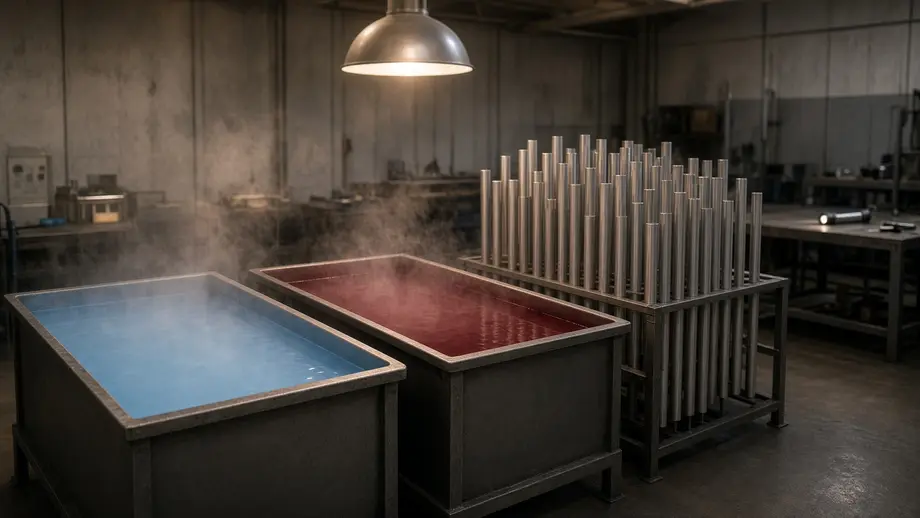
Type II is conventional sulfuric acid anodizing: thin, and easy to dye in bright colors. Type III, or hardcoat, grows a thicker, denser layer under colder, higher-voltage conditions, so it resists abrasion far better. Both are defined in the US military specification MIL-PRF-8625F with Amendment 2 (November 23, 2020), which sets a 0.002 inch (2 mils, about 50 µm) nominal thickness for Type III unless the contract or drawing says otherwise.
Older spec sheets still say "MIL-A-8625." The Defense Logistics Agency's ASSIST record for MIL-PRF-8625 lists Revision F Amendment 2 as the active document; its cover says it supersedes MIL-A-8625F with Amendment 1 (September 15, 2003). Anoplate's hardcoat anodize page describes the Type III process as "sulfuric acid cooled to nearly freezing, and applied voltages upwards of 100 volts," producing "a harder, denser, thicker, and more abrasion resistant coating."
Note: "HA3" or "HA III" on a listing is trade shorthand, not a MIL-PRF-8625F designation; the specification names only Types (I, IB, IC, II, IIB, III) and Classes (1 non-dyed, 2 dyed). Read it as a Type III claim and ask for the thickness if it matters.
This standards table maps clauses of MIL-PRF-8625F with Amendment 2, read from the ASSIST copy, to what each one means for a flashlight buyer.
| Clause (MIL-PRF-8625F Amdt 2) | What the specification says | What it means for a flashlight |
|---|---|---|
| 1.2.1 Types | Type II "Sulfuric acid anodizing"; Type III "Hard anodic coatings" | "Type III" is the only hardcoat designation |
| 1.2.2 Classes | Class 1 "Non-dyed"; Class 2 "Dyed" | A black or colored hardcoat light is Type III Class 2 |
| 3.7.2.1 Thickness | Nominal "0.002 inch (2 mils)"; not to vary more than "±20 percent" up to 2 mils | The default hardcoat is about 40 to 60 µm |
| 3.7.2.2 Abrasion resistance | Unsealed Type III wear index at most 1.5 mg per 1,000 cycles (3.5 on alloys with 2% copper or more) | A measurable wear limit, which "scratch-resistant" on a product page is not |
| 3.8.2 Type III sealing | "shall not be sealed where the main function of application is to obtain the maximum degree of abrasion or wear resistance" | A sealed hardcoat trades some abrasion resistance for corrosion resistance |
| 3.7.1.3 Light fastness | Dyed coatings limited to a Delta E of 3, determined "only when specified in the contract" | Fade resistance is optional, so sun fading is not ruled out |
| 3.4.3 Alloy limit | No Type III on alloys above 5.0 percent nominal copper unless the contract allows it | 6061 (0.15 to 0.40% copper) and 7075 (1.20 to 2.00%) both qualify, per Kaiser's limits |
Hardcoat also limits color. Anoplate says that for dyed hardcoat "black is by far the most commonly specified," while other colors "are not as decorative and uniform appearing." A bright blue, orange or red light is worth a question: the finish may be Type II.
The part also grows. Anoplate says that for Type III "½ of the coating thickness penetrates into the surface of the parts while the other 1/2 builds up on the surface." At 0.002 inch, a tube's outside diameter grows by 2 × 0.001 = 0.002 inch, about 0.05 mm: invisible on the body, but it matters on fine threads. The FAA handbook adds that "The anodic coating is a poor conductor of electricity," so contact rings stay bare.
Is Anodized Aluminum Durable?
Yes, against the things that ruin bare aluminum: corrosion, sweat and everyday abrasion. MIL-PRF-8625F notes that "All anodic coatings are harder than the substrate material." It is less durable against sharp impacts, and it can't be patched invisibly: the FAA handbook says a damaged anodic coating "can only be partially restored by chemical surface treatments." Hardcoat resists wear better than Type II, and sealing improves corrosion resistance.
MIL-PRF-8625F also warns that "All anodic coatings are brittle and may crack and spall due to force fittings," which is why a hard knock on an edge can chip the skin where the metal only dents. Sealing is a trade-off: Anoplate lists hardcoat's "Increased abrasion resistance (best when unsealed)" and "Increased corrosion resistance (best when sealed)," and says "all dyed hardcoat anodize is required to be sealed in order to ensure the dye won't fade or bleach out." Its sulfuric anodize page warns that dyed films "have a tendency to bleach under prolonged direct sunlight," so a dashboard light can fade with the coating intact.
Drop ratings measure something else. Streamlight's summary of the ANSI/PLATO FL1 definitions states: "Dropped samples must not exhibit any cracks or breaks and must remain fully functional in order to pass the Impact Resistance test." A chipped finish is not a failure. The current edition is ANSI/PLATO FL 1-2025; PLATO's publication announcement lists "Enhanced durability testing integrating impact resistance with water and dust ingress protection" among its changes, while the iUltra and Arkfeld Ultra manuals cite FL 1-2019. Our ANSI FL1 explainer covers each spec-sheet number.
Titanium, Stainless Steel and Copper: Flashlight Body Material Compared
Aluminum is the lightest common flashlight body material and one of the best at spreading heat. Per unit volume, Ti-6Al-4V titanium is 64% heavier than 6061 and conducts heat about 25 times more slowly. 316L stainless steel is almost three times as heavy with one-tenth the conductivity. Copper conducts about 2.3 times as well as 6061 but weighs 3.3 times as much.
The weight gap is easy to underrate. The same plain tube (140 mm long, 2 mm wall) holds 169.6 mm² × 140 mm = 23.75 cm³ of metal: about 64 g in 6061-T6, 36% of the Warrior Ultra's listed 178 g. In Ti-6Al-4V it would weigh 105 g, in 316L stainless 190 g and in copper 212 g, so the last two outweigh the whole aluminum light. These are shell-only estimates, not measurements, using AMETEK Superior Tube's Ti-6Al-4V data sheet (4.43 g/cm³, 6.7 W/m·K), its 316/316L data sheet (7.99 g/cm³, 16.3 W/m·K) and the Copper Development Association's C11000 page (specific gravity 8.91; 226 Btu/ft·h·°F, about 391 W/m·K).
Common Misconceptions About Anodized Aluminum Flashlights
The biggest misconception about anodized aluminum flashlights is that one label covers everything: that "aircraft grade" means strong, that "anodized" means scratch-proof, or that a harder alloy means longer turbo. Each mixes up the alloy, the finish and the electronics. The table sets each one against its source.
| Misconception | Fact | Basis |
|---|---|---|
| "Aircraft grade" means 7075 | It is a marketing phrase; 6061 is also labeled that way | Olight's optic mounts say "Aircraft-Grade 6061 Aluminum" |
| A harder alloy means scratch-proof | Hardness results cannot prove wear resistance; the finish decides scratches | Aluminum Anodizers Council guideline |
| A 2 m drop rating means the finish won't chip | FL1 impact resistance checks for cracks, breaks and function, not cosmetic marks | Streamlight's ANSI/PLATO FL1 summary |
| Every hardcoat is fade-proof | Light fastness is checked only when the contract calls for it | MIL-PRF-8625F Amdt 2, 3.7.1.3 |
Which Olight OAL Flashlight Fits How You Carry?
Choose OAL when scratches and dings are what wear your lights out: keys in the same pocket, duty belts, glove boxes and job sites. Skip it when budget matters more than the finish, because Olight's 6061 versions share batteries and runtime. Each pick names the carry problem, the official spec that addresses it, and its limit.
Keys in the same pocket. The Olight iUltra OAL keychain flashlight weighs 20 g, puts out 80 lumens with 196 candela and 28 m of reach, and is rated IPX6; Olight calls its OAL body "1.73× harder than 6061." The limit is runtime: 50 minutes at 80 lumens from a 10180 80 mAh battery, so treat it as a door-and-keyhole light. Its manual says to "Keep the product out of reach of children to prevent accidental swallowing," so it belongs on an adult's key ring. It lists at $29.99 (regular price, September 2026); for other options, see our keychain flashlight guide.
Duty belt and hard use. The Olight Warrior Ultra tactical flashlight uses O-Aluminum, is "built to withstand 2-meter drops," and is rated IPX8. It lists 2,500 lumens, 26,000 candela and 320 m, at 178 g with a 5,000 mAh 21700 battery. The limit: OAL doesn't change the heat budget. Turbo runs 2,500~800~250 lumens for 2.5 + 162 + 39 minutes, so the level you live with is 800 lumens. It lists at $139.99 (regular price, September 2026).
Flat carry with extra light sources. The Olight Arkfeld Ultra flat EDC flashlight is O-Aluminum with a matte finish and a glass lens. It lists 1,400 lumens, 2,630 candela and 103 m, with Turbo at 1,400~420 lumens for 4 + 121 minutes, at 119 g and IPX7, plus a 900 mW UV light and a green laser. It lists at $119.99 (regular price, September 2026); in September 2026 only Olive Green CW was in stock.
Warning: The Arkfeld Ultra has a UV light and a green laser. Never shine either at anyone's eyes, including pets, and don't give the light to children. The product page lists the laser as Class 3R, while the user manual lists two laser versions, 0.39 mW (Class 1) and 5 mW (Class 3R); check the label on your unit. The manual states: "Caution: Do not stare at operating light source."
The same alloy on an optic. The Olight Osight S red dot sight lists OAL™ for the 27.5 g optic (IPX7) and AL6061 + PC for its charging cover, at $249.99 (regular price, September 2026).
When OAL isn't the answer. If you need more light for longer, compare sustained output and battery size first, then pick the finish. Our best flashlights guide ranks lights by use case, and Olight's EDC flashlights page lists the pocket range in both 6061 and OAL.
Aluminum Flashlight Material Checklist Before You Buy
Use this aluminum flashlight material checklist on any spec sheet, from any brand. It separates the alloy from the finish, flags claims that need a second look, and keeps runtime with the battery and step-down figures. If a listing can't answer the first two questions, treat its durability claims as marketing.
- Find the alloy and temper. Look for 6061-T6, 7075-T6 or a named alloy such as OAL. Treat "aircraft grade" alone as no information.
- Find the finish type. Look for "Type III," "hardcoat" or "hard anodized," ideally with MIL-PRF-8625 or a thickness. If the page doesn't say, ask, especially for bright colors.
- Match the alloy to your risk. Drops and dents favor 7075-T6 or OAL; salt air and sweat favor 6061-T6 or a sealed finish.
- Read hardness claims as claims. Ask which property and test a multiplier refers to.
- Read the drop rating as a function test. A 1.5 m or 2 m rating says the light should still work, not that it will look new.
- Judge runtime separately. Compare the sustained level and minutes in the runtime table, not the body metal.
- Clean it gently. The FAA handbook bars "steel wool, steel wire brushes, or harsh abrasive materials on any aluminum surface"; use a soft cloth and mild soapy water.
FAQ
Changelog
- September 24, 2026: First published.