Olight makes the lights compared here. Olight specs and regular prices come from its US product pages and user manuals as of September 2026. Runtime, beam, battery and cost figures below are our own calculations from those published numbers, not measurements.
⚡ TL;DR
Baton 4 vs Baton 4 Pro is a choice between size and stamina. Buy the Baton 4 ($54.99) if you want a 52.5 g pocket light for short tasks. Buy the Baton 4 Pro ($69.99) if you need 600 lumens for longer than a few minutes: Olight rates it for 200 minutes at that level, against 7 for the Baton 4.
On paper the two lights sit 300 lumens and $15 apart, so the Pro looks like a small step up. The bigger gap is inside the tube. The Pro's 18650 cell stores about 5.4 times the energy of the Baton 4's 16340, and the Pro adds a tail switch and USB-C charging. The Baton 4 answers with a body 48 mm shorter and less than half the weight.
This Baton 4 vs Baton 4 Pro difference summary uses Olight's published ratings; the last column shows how big each gap is.
| Dimension | Baton 4 | Baton 4 Pro | Which is better | By how much |
|---|---|---|---|---|
| Peak output | 1,300 lumens | 1,600 lumens | Baton 4 Pro | 300 lumens (23% more) |
| Peak intensity | 7,225 candela | 10,000 candela | Baton 4 Pro | 38% more |
| Beam distance | 170 m | 200 m | Baton 4 Pro | 30 m (18% farther) |
| Time at 600 lumens | 7 minutes (High) | 200 minutes (Turbo or High) | Baton 4 Pro | About 28 times longer |
| Battery energy | 2.34 Wh (650 mAh 16340) | 12.6 Wh (3,500 mAh 18650) | Baton 4 Pro | About 5.4 times more |
| Low mode | 12 lumens for 35 hours | 15 lumens for 155 hours | Baton 4 Pro | 4.4 times longer |
| Length | 63 mm | 111 mm | Baton 4 | 48 mm shorter |
| Weight | 52.5 g | 114 g | Baton 4 | 61.5 g lighter (54% less) |
| Switches | Side switch | Side switch and tail switch | Baton 4 Pro | Adds a tail switch |
| Charging | MCC magnetic cable or charging case, about 1 hour | USB-C about 3.5 hours or MCC3 about 4.5 hours | Depends | Baton 4 fills faster; Pro takes any USB-C cable |
| Charging case | Fits the Charging Case for Baton 4 | Not on the case's list | Baton 4 | Five extra full charges |
| Water and drop | IPX8, 1.5 m | IPX8, 1.5 m | Tie | None |
| Regular price | $54.99 | $69.99 | Baton 4 | $15 less |
📋 Table of Contents
- 1. Baton 4 vs Baton 4 Pro: Which One Should You Buy?
- 2. Spec-by-Spec Olight Baton Comparison: Every Published Number
- 3. How Long Does Each Baton Hold 600 Lumens?
- 4. Beam Comparison: How Far Does Each Baton Reach After the Step-Down?
- 5. Size and Weight: How Different Do They Feel in the Pocket and Hand?
- 6. Charging and Accessories: MCC, USB-C and the Charging Case
- 7. Which Baton to Buy: Who Should Pick Each Light?
- 8. Is the Olight Baton 4 Worth the Money?
- 9. Which Baton Flashlight Is the Best?
- 10. Which Flashlight Is Better for EDC, the ArkPro or the Baton 4?
- 11. Should You Upgrade If You Already Own One?
- 12. Baton 4 vs Baton 4 Pro Buying Checklist
- 13. FAQ
Baton 4 vs Baton 4 Pro: Which One Should You Buy?
Choose the Baton 4 if the light has to disappear in a pocket and most of your use lasts under five minutes at a time. Choose the Baton 4 Pro if you walk dogs, check property or work in the dark for longer stretches, want a tail switch, or run your household on USB-C cables. Both lights are rated IPX8 and for 1.5 m drops.
Both belong to Olight's lineup of Baton flashlights, and both use a TIR optic, a side switch and a lockout mode. That shared DNA is why the spec sheets look so close. The split shows up when you ask the light to keep working after the first burst.
Here is the short version by question:
- Need light for 10 seconds to 5 minutes, many times a day? The Olight Baton 4 does it at half the weight.
- Need 600 lumens for a 20-minute property check? Only the Olight Baton 4 Pro holds that level; the Baton 4 drops to 300 lumens after 7 minutes.
- Travel for a week without outlets? The Baton 4 plus its charging case carries more light energy than the Pro, as the charging section below works out.
- Want the longest reach in a Baton? Neither. The Baton Ultra is rated at 300 m.
Note: The Baton 4 comes in two versions. The standard box holds the light, an MCC magnetic cable and a pouch. The Premium Edition box swaps the MCC cable and pouch for the charging case, a USB-C cable for the case, a lanyard and a cleaning cloth. In September 2026 Olight's Baton 4 page showed $54.99 for the OD Green option and listed several colors, including several Premium versions, as sold out. The case is also sold on its own for $39.99, which is the price used in this guide.
Spec-by-Spec Olight Baton Comparison: Every Published Number
Olight's spec sheets show the Baton 4 Pro ahead on every output, runtime and battery line, and the Baton 4 ahead on length, weight, diameter, price and charging time. Both lights list IPX8 water resistance, a TIR optic and a 1.5 m drop rating. Where a number appears on both the product page and the manual, such as the Baton 4's 52.5 g weight, the two sources match.
This Olight Baton comparison table copies every level and runtime stage from Olight's US product pages, with manual-only figures marked.
| Spec | Baton 4 | Baton 4 Pro |
|---|---|---|
| Max output | 1,300 lumens | 1,600 lumens |
| Max intensity | 7,225 candela | 10,000 candela |
| Beam distance | 557 ft (170 m) | 656 ft (200 m) |
| Turbo | 1,300~600~300 lumens; 1.5 + 2.5 + 73 minutes | 1,600~600 lumens; 2 + 198 minutes |
| High | 600~300~60 lumens; 7 + 72 + 16 minutes | 600~120 lumens; 200 + 20 minutes |
| Medium | 60 lumens; 8 hours | 120 lumens; 18 hours 30 minutes |
| Low | 12 lumens; 35 hours | 15 lumens; 155 hours |
| Moon | 0.5 lumens; 30 days | Under 1 lumen; 100 days |
| Strobe | Yes, 13Hz at 1,300 lumens | Yes |
| Battery | Customized 650mAh 3.6V IMR 16340 (2.34 Wh per manual) | 3,500 mAh 3.6V 18650 |
| Switches | Side switch | Side switch and tail switch |
| Charging | MCC 1A magnetic cable or charging case; about 1 hour either way (manuals) | USB-C / MCC; 3.5 h USB-C, 4.5 h MCC3 (manual) |
| Size | 63 × 21 mm (2.48 × 0.83 in) | 111 × 23 mm (4.37 × 0.9 in) |
| Weight with battery | 52.5 g (1.85 oz) | 114 g (4.02 oz) |
| Body | Aluminum alloy | 6061 aluminum |
| Light source | High Performance CW LED; 5700~7000K, CRI 70 (manual) | High Performance LED; CRI not listed |
| Water resistance | IPX8 | IPX8 |
| Drop rating | 1.5 m (manual) | 1.5 m (manual) |
| Working temperature | 0-40°C (manual) | 0~45°C (manual) |
| In the box | Standard: light with battery and pocket clip, MCC cable, pouch. Premium: light, charging case, USB-C cable, lanyard, cleaning cloth | Light with battery, MCC3 cable, L stand |
| Regular price, September 2026 | $54.99 | $69.99 |
The Baton 4 manual says its figures were "tested per ANSI/PLATO FL 1-2019 standard in Olight's labs for reference." The Pro's manual lists the same kinds of figures without naming the edition. Under ANSI FL1, runtime is measured, in the words of Streamlight's FL1 summary, "from the initial light output value (that's 30 seconds after the light is turned on with fresh batteries) until the light output drops to 10% of the initial value."
The same summary defines beam distance as "the distance from the device at which the light beam is 0.25 lux." That definition lets you check a spec sheet with one formula. Light from a small source falls off with the square of distance; HyperPhysics at Georgia State University explains that "any point source which spreads its influence equally in all directions without a limit to its range will obey the inverse square law." So lux equals candela divided by distance squared, and the 0.25 lux distance works out to 2 × √candela.
Run the check on both lights:
- Baton 4: √7,225 = 85, and 2 × 85 = 170 m. That matches Olight's 170 m.
- Baton 4 Pro: √10,000 = 100, and 2 × 100 = 200 m. That matches Olight's 200 m.
- Baton Ultra, for reference: √22,500 = 150, and 2 × 150 = 300 m. Also a match.
All three published beam distances are consistent with their candela ratings. That matters because every beam figure later in this guide starts from those candela numbers.
Tip: One edition note. PLATO, which develops the standard, announced a revised ANSI/PLATO FL 1-2025 in February 2026 that adds "a standardized test method for Short-Duration Elevated Brightness," meaning turbo. The Baton 4 manual cites the 2019 edition and the Pro's manual names none, so read each turbo figure as a starting value and the second number as the one you will live with.
How Long Does Each Baton Hold 600 Lumens?
The Baton 4 Pro holds 600 lumens for about 200 minutes; the Baton 4 holds 600 lumens for 7 minutes on High, or for 2.5 minutes after its Turbo burst, then drops to 300. That roughly 28-fold gap, based on Olight's rated runtime stages and not measured, is the difference the headline lumen numbers hide.
The runtime comparison below reads straight from Olight's stage tables. It lists how long each light stays at or above a given output before stepping lower.
| Output held | Baton 4 | Baton 4 Pro | Gap |
|---|---|---|---|
| 1,000 lumens or more | 1.5 minutes (Turbo) | 2 minutes (Turbo) | 0.5 minutes |
| 600 lumens or more | 7 minutes (High); 4 minutes (Turbo) | 200 minutes (Turbo or High) | About 28 times |
| 300 lumens or more | 79 minutes (High: 7 + 72) | 200 minutes | About 2.5 times |
| 100 lumens or more | 79 minutes (High) | 18 hours 30 minutes at 120 lumens (Medium) | About 14 times |
| Low | 12 lumens for 35 hours | 15 lumens for 155 hours | 4.4 times |
| Moon | 0.5 lumens for 30 days | Under 1 lumen for 100 days | 3.3 times |
The Baton 4's first minutes are strong. Its Turbo line runs 1,300 lumens for 1.5 minutes, then 600 for 2.5 minutes, then 300 for 73 minutes. Its High line starts at 600 and holds that for 7 minutes before settling at 300 for 72 more. The Pro skips the middle step entirely: after 2 minutes at 1,600 it sits at 600 lumens for 198 minutes.
Olight doesn't publish why each light steps down when it does. Heat is one documented reason LEDs get dimmed. A U.S. Department of Energy fact sheet on LED thermal management says excess heat's "short-term (reversible) effects are color shift and reduced light output." A 52.5 g body has less metal to soak up heat than a 114 g body, so a shorter high stage is what you would expect. Our guide to the thermal step down flashlight covers that mechanism in detail. For buying, the stage table is the number to plan around.
Light budget per charge
Another way to compare runtime is to add up the total light each mode delivers per charge. Multiply each stage's lumens by its minutes, add the products, and divide by 60 to get lumen-hours. Our guide to flashlight runtime worked out the Baton 4 side of this; here is the Pro alongside it.
- Baton 4 Turbo: (1,300 × 1.5) + (600 × 2.5) + (300 × 73) = 1,950 + 1,500 + 21,900 = 25,350 lumen-minutes, or 422.5 lumen-hours.
- Baton 4 Pro Turbo: (1,600 × 2) + (600 × 198) = 3,200 + 118,800 = 122,000 lumen-minutes, or 2,033 lumen-hours.
This table applies the same arithmetic to every mode, based on Olight's rated stages, not measured.
| Mode | Baton 4 light budget | Baton 4 Pro light budget | Pro ÷ Baton 4 |
|---|---|---|---|
| Turbo | 422.5 lumen-hours | 2,033 lumen-hours | 4.8 |
| High | 446 lumen-hours (26,760 lumen-minutes) | 2,040 lumen-hours (122,400 lumen-minutes) | 4.6 |
| Medium | 480 lumen-hours (60 × 8) | 2,220 lumen-hours (120 × 18.5) | 4.6 |
| Low | 420 lumen-hours (12 × 35) | 2,325 lumen-hours (15 × 155) | 5.5 |
The ratios land between 4.6 and 5.5, close to the 5.4-fold battery gap (12.6 Wh ÷ 2.34 Wh). In plain terms, the Pro gives you about five Baton 4 charges' worth of light in one tube. Mode choice decides how fast you spend that budget, not how big it is.
How often you'd recharge each light
A light budget is abstract, so this table turns it into recharge intervals for three common habits. It assumes each session starts at the named level and that each light turns battery into light at the same rate across a mode's stages. Those are simplifications of Olight's rated figures, not measurements. The third column adds the Charging Case for Baton 4, which Olight says can fully charge the light five times, for six charges in total.
| Habit | Baton 4 | Baton 4 Pro | Baton 4 with charging case |
|---|---|---|---|
| 20-minute dog walk on Medium (Baton 4 at 60 lumens, Pro at 120) | 480 ÷ 20 = 24 walks | 1,110 ÷ 20 = 55 walks | 24 × 6 = 144 walks |
| 5-minute yard check at 600 lumens on High | 26,760 ÷ 3,000 = about 8.9 checks | 122,400 ÷ 3,000 = about 40.8 checks | 8.9 × 6 = about 53.5 checks |
| 6-hour power-outage night on Low (12 vs 15 lumens) | 35 ÷ 6 = about 5.8 nights | 155 ÷ 6 = about 25.8 nights | 5.8 × 6 = 35 nights |
Two results stand out. On the dog walk, the Pro gives you twice the light and still lasts 2.3 times as many walks. And a Baton 4 with its case outlasts a bare Pro on every habit, at the cost of carrying the case.
Cold shortens all of these numbers. Battery University notes that "a battery that provides 100 percent capacity at 27°C (80°F) will typically deliver only 50 percent at –18°C (0°F)," and that the loss "will recover in room temperature." On a smaller cell, losing half leaves very little: about 1.17 Wh in the Baton 4 against about 6.3 Wh in the Pro.
Beam Comparison: How Far Does Each Baton Reach After the Step-Down?
At switch-on, the Baton 4 Pro reaches 200 m against the Baton 4's 170 m, an 18% gap you would barely notice. After the step-down the gap widens. Five minutes into Turbo, the Pro still puts about 4.2 lux on a target 30 m away, while the Baton 4 puts about 1.9 lux, based on Olight's rated candela and stages, not measured.
To estimate the beam after a step-down, start from candela per lumen. The Baton 4 delivers 7,225 ÷ 1,300 = 5.6 candela per lumen, and the Pro delivers 10,000 ÷ 1,600 = 6.3. If the beam keeps its shape when output drops, candela falls in proportion to lumens. That's an assumption, since Olight publishes candela only at the top level.
Then use the two formulas from the spec section: lux at a distance = candela ÷ distance², and beam distance = 2 × √candela. At 30 m, the divisor is 900.
This table applies those steps at four points in a session. Figures are calculated from Olight's rated candela, not measured.
| Point in the session | Baton 4 output | Baton 4 candela and reach | Baton 4 lux at 30 m | Baton 4 Pro output | Baton 4 Pro candela and reach | Baton 4 Pro lux at 30 m |
|---|---|---|---|---|---|---|
| Turbo, first minute | 1,300 lm | 7,225 cd; 170 m | 8.0 | 1,600 lm | 10,000 cd; 200 m | 11.1 |
| Turbo, minute 3 | 600 lm | 3,335 cd; 115.5 m | 3.7 | 600 lm | 3,750 cd; 122.5 m | 4.2 |
| Turbo, minute 5 | 300 lm | 1,667 cd; 81.7 m | 1.9 | 600 lm | 3,750 cd; 122.5 m | 4.2 |
| Medium, any time | 60 lm | 333 cd; 36.5 m | 0.37 | 120 lm | 750 cd; 54.8 m | 0.83 |
The sample math for minute 5: 7,225 × 300 ÷ 1,300 = 1,667 cd; 1,667 ÷ 900 = 1.85 lux; 2 × √1,667 = 81.7 m. For the Pro: 10,000 × 600 ÷ 1,600 = 3,750 cd; 3,750 ÷ 900 = 4.17 lux; 2 × √3,750 = 122.5 m.
So the Pro's real beam advantage is 2.25 times the light on a 30 m target from minute 4 onward, not the 30 m printed on the box. If you check a fence line or a long driveway, that is the number that shows.
Beam color is the other difference, and the published data is thin. The Baton 4 manual lists "CCT: 5700~7000K" and "CRI:70," which is cool white. A DOE fact sheet on LED color says "a source with a CRI in the 70s would be considered acceptable for interior applications, whereas the 80s would be considered good and the 90s excellent." Olight doesn't list a CRI for the Pro, so neither light is a pick for judging wire or paint colors.
Size and Weight: How Different Do They Feel in the Pocket and Hand?
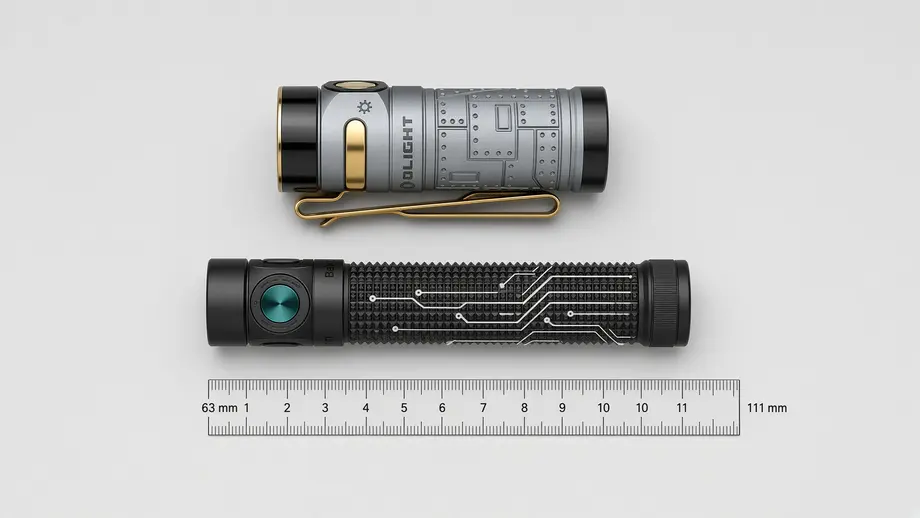
The Baton 4 is 63 mm long and weighs 52.5 g; the Baton 4 Pro is 111 mm and 114 g. That makes the Pro about 1.8 times as long, 2.2 times as heavy and roughly 2.1 times the volume. Olight's page puts the Baton 4 this way: "Almost shorter than your index finger." The Pro is a palm-length tube with room for a tail switch.
The volume figure comes from treating each body as a plain cylinder, which ignores the clip, the head and the knurling:
- Baton 4: π × 10.5² × 63 = about 21,800 mm³, or 21.8 cm³.
- Baton 4 Pro: π × 11.5² × 111 = about 46,100 mm³, or 46.1 cm³.
Divide battery energy by those volumes and the Pro packs about 0.27 Wh per cm³ against the Baton 4's 0.11, roughly 2.5 times as much. By weight it is 0.11 Wh per gram against 0.045. Put simply, the Baton 4 pays for its size with energy. Each extra gram of Pro is mostly battery.
In the hand, the difference is the grip, not the diameter. The two bodies are 21 mm and 23 mm across, only 2 mm apart. A 111 mm body leaves room for your fingers around the barrel and your thumb on the tail switch. With a 63 mm body, your thumb reaches for the side switch, and the whole light sits inside a loose fist.
Carry gear differs too. Olight's Baton 4 package list includes a pocket clip and a pouch. The Pro's package list names the light, an MCC3 magnetic charging cable, an L stand and a manual. The stand helps a round light stay put on a table instead of rolling off.
Charging and Accessories: MCC, USB-C and the Charging Case
The Baton 4 has no USB-C port. It charges from Olight's MCC magnetic cable or inside the Charging Case for Baton 4, in about an hour either way. The Baton 4 Pro charges by USB-C in about 3.5 hours or by MCC3 in about 4.5 hours, according to its manual, and it isn't on the case's compatibility list. How you charge other devices should weigh on the choice.
Charging speed looks lopsided until you divide by capacity. The Baton 4 takes about 1 hour to store 2.34 Wh, or roughly 2.3 Wh per hour. The Pro takes 3.5 hours over USB-C to store 12.6 Wh, or about 3.6 Wh per hour; over MCC3 it is about 2.8. Charging tapers near full, so treat these as averages. The Pro takes longer to fill but gains light faster per hour plugged in.
The cable matters more than the clock. A standard Baton 4 with a lost MCC cable can't recharge until you replace it, unless you own the charging case, which itself refills over USB-C. The Pro's USB-C port takes a standard USB-C cable, and the Pro's manual lists a 5 V 1.5 A input for it. If your car, desk and bag already hold USB-C cables, that alone can decide it.
The charging case, run through the numbers
The Olight Charging Case for Baton 4 costs $39.99 (regular price, September 2026). Olight says it "can fully charge the Baton 4 flashlight 5 times" and can also charge a phone over USB-C. The Premium Edition manual lists the case at 142 g with a "5000mAh 3.6V (18Wh)" battery and a rated capacity of "2650mAh (5V/2.4A)." The same manual lists 1 hour to charge the Baton 4 in the case and 2.5 hours to refill the case from a 5 V 2 A (10 W) USB-C source.
Here is what those figures mean for the flashlight, based on Olight's ratings, not measured:
- Energy the case delivers to the light: 5 charges × 2.34 Wh = 11.7 Wh.
- Rated output at 5 V: 2.65 Ah × 5 V = 13.25 Wh. So 11.7 ÷ 13.25 = 88% of rated output reaches the flashlight's cell, and 11.7 ÷ 18 = 65% of the cell's nominal energy.
- Carried weight: 52.5 g + 142 g = 194.5 g. Olight's product page lists the Premium set at 194 g, which agrees.
- Total light energy per trip: 2.34 Wh in the light plus 11.7 Wh from the case = 14.04 Wh, about 11% more than the Pro's 12.6 Wh.
One number on the page needs a flag. Olight says the case gives the flashlight "a max runtime of 190 days." Six full charges at the Baton 4's rated 30 days of Moon mode multiply to 180 days. Treat about six months at 0.5 lumens as the realistic ceiling.
This table compares the three ways to carry a Baton 4-size light, using Olight's ratings.
| Setup | In your pocket | Total carried | Light energy per trip | Medium runtime | Low runtime | Regular price |
|---|---|---|---|---|---|---|
| Baton 4 alone | 52.5 g | 52.5 g | 2.34 Wh | 8 hours at 60 lumens | 35 hours at 12 lumens | $54.99 |
| Baton 4 with charging case | 52.5 g | 194.5 g | 14.04 Wh | 48 hours at 60 lumens (8 × 6) | 210 hours at 12 lumens (35 × 6) | $94.98 if bought separately |
| Baton 4 Pro | 114 g | 114 g | 12.6 Wh | 18 hours 30 minutes at 120 lumens | 155 hours at 15 lumens | $69.99 |
The case wins on total runtime and lets the pocket stay light, since the case can ride in a bag. The Pro wins on weight carried and on sustained brightness, because a Baton 4 still steps from 600 to 300 lumens after 7 minutes no matter how many charges wait in the case.
Safety note: The charging case is a lithium-ion power bank. The FAA's PackSafe rules say spare lithium batteries, "including power banks and cell phone battery charging cases, must be carried in carry-on baggage only," and the TSA adds that power banks "are prohibited in checked luggage." The FAA's own tip for sizing one is "multiply the battery voltage by the Amp hours (Ah)"; the case's 18 Wh sits well under the FAA's 100 Wh per-battery limit.
Spare cells differ as well. Olight sells an IMR16340 650mAh cell and lists it as compatible with the Baton 4. Olight's standalone 18650 3500mAh listing names other models and not the Baton 4 Pro, and the Pro's manual says: "Proprietary battery; do not remove for charging." Plan on recharging the Pro in the light rather than swapping cells.
Which Baton to Buy: Who Should Pick Each Light?
Pick by how long you use light at a stretch and how you charge. Short, frequent use and minimum weight point to the Baton 4. Sessions over 7 minutes at 600 lumens, gloves, a tail switch or USB-C point to the Baton 4 Pro. Long trips away from outlets point to the Baton 4 with its case, and long range points to the Baton Ultra.
This table matches common users to the light whose published specs fit them, and names the limit of each pick.
| Who you are | Pick | The spec that decides it | The limit |
|---|---|---|---|
| Office or city carry, keys and quick checks | Baton 4 | 63 mm, 52.5 g | 600 lumens lasts 7 minutes |
| Nightly dog walker, 20 to 60 minutes | Baton 4 Pro | 120 lumens for 18 hours 30 minutes | 114 g in the pocket |
| Rural property or long driveway checks | Baton 4 Pro | 600 lumens for 200 minutes | 200 m rated reach |
| Gloves at work or in winter | Baton 4 Pro | Tail switch for momentary Turbo | Longer body |
| Week-long trip without outlets | Baton 4 with charging case | Six full charges, 14.04 Wh | 194.5 g total to pack |
| Home outage backup in a drawer | Baton 4 Pro | 15 lumens for 155 hours | No headband for hands-free use |
| Farthest reach in the series | Baton Ultra | 22,500 candela, 300 m | $99.99 regular price |
| Color-critical tasks such as wiring | Neither | Baton 4 lists CRI 70; Pro lists none | Consider a light that publishes a high CRI |
The tail switch is the feature most shoppers underrate. The Pro's manual says, for High: "When off, press the tail button." It also shows press-and-hold on the tail for momentary Turbo. Olight describes the shared Baton Ultra layout this way: "the textured tail switch provides quick access to High and Turbo modes with momentary and constant-on control." With the Baton 4, every mode goes through one side button: a double press for Turbo, a long press to cycle Low, Medium and High.
The Baton 4 has one control the Pro's manual doesn't list: an auto shut-off timer. Its manual says the light "can be set to automatically turn off after two preset periods: a long period (9 minutes) and a short period (3 minutes)." That helps if you read in bed or light a task and forget to switch off.
Is the Olight Baton 4 Worth the Money?
Yes, if size is the feature you are paying for. At $54.99 (regular price, September 2026), the Baton 4 puts 1,300 lumens, a 170 m beam and IPX8 sealing in a 52.5 g body. It is poor value if you need sustained light: its 2.34 Wh cell holds 600 lumens for 7 minutes, and $15 more buys the Pro's 200.
Here is what the extra $15 for the Pro buys, based on Olight's rated figures, not measured:
- Battery: 12.6 − 2.34 = 10.26 Wh more, or about $1.46 per added watt-hour.
- Sustained light: 200 − 7 = 193 more minutes at 600 lumens, or about 8 cents per added minute.
- Reach: 30 m more, or 50 cents per added meter.
- Controls and charging: a tail switch and a USB-C port.
What you give up is 61.5 g and 48 mm, plus the charging case option. For many pocket carriers, that trade isn't worth it. A light that rides in a coin pocket every day beats a better light left on the dresser, which is the case for the Baton 4.
The Baton 4 isn't the right light in three cases. You need hands-free light, and it has no headband mount. You need color accuracy, and it lists CRI 70. Or you need more than a few minutes at 600 lumens, as the runtime section above shows.
Which Baton Flashlight Is the Best?
For most buyers the best Baton is the Baton 4 Pro, the same light our best flashlight guide names overall. The Baton 4 is best when weight matters most. The Baton Ultra is best when reach matters most: it's rated at 22,500 candela and 300 m for $99.99. The Baton 4 with its charging case is best for trips away from outlets.
This table sets the three current Baton models side by side, including the Baton 4 Pro vs Baton Ultra details, from Olight's US pages.
| Spec | Baton 4 | Baton 4 Pro | Baton Ultra |
|---|---|---|---|
| Regular price, September 2026 | $54.99 | $69.99 | $99.99 |
| Max output | 1,300 lumens | 1,600 lumens | 1,800 lumens |
| Max intensity | 7,225 cd | 10,000 cd | 22,500 cd |
| Beam distance | 170 m | 200 m | 300 m |
| Candela per lumen | 5.6 | 6.3 | 12.5 |
| Turbo stages | 1,300~600~300 lumens; 1.5 + 2.5 + 73 minutes | 1,600~600 lumens; 2 + 198 minutes | 1,800~600 lumens; 1.5 + 198 minutes |
| High, Medium, Low, Moon | 600~300~60 lm; 60 lm 8 h; 12 lm 35 h; 0.5 lm 30 days | 600~120 lm; 120 lm 18 h 30 min; 15 lm 155 h; under 1 lm 100 days | Same as Baton 4 Pro |
| Weight and size | 52.5 g; 63 × 21 mm | 114 g; 111 × 23 mm | 115 g; 113 × 23 mm |
| Body and LED | Aluminum alloy; High Performance CW LED | 6061 aluminum; High Performance LED | OAL (O-Aluminum); Olight EIP 1 LED |
| Drop rating (manual) | 1.5 m | 1.5 m | 2 m |
The Olight Baton Ultra shares the Pro's battery and nearly all of its runtime table, so it isn't a runtime upgrade. What changes is the beam: 12.5 candela per lumen against 6.3 means the Ultra concentrates about twice as much of each lumen into the hotspot. At its 600-lumen stage, that works out to 12.5 × 600 = 7,500 cd and 2 × √7,500 = 173 m, more than the Baton 4 reaches on full Turbo. Olight also lists an "ultra-low Duv of < 0.006 across all modes" for its EIP 1 LED, which describes a neutral, non-green white.
The Ultra costs $30 more than the Pro for 12,500 more candela and 100 m more reach, about 30 cents per added meter. The trade-off is a tighter beam: if most of your use is inside 20 m, the Pro's lower candela-per-lumen ratio suggests a broader beam for close work.
Which Flashlight Is Better for EDC, the ArkPro or the Baton 4?
For pure pocket carry, the Baton 4 is better: it weighs 52.5 g against 115 g and is about half the ArkPro's 124 mm length. The ArkPro is better if you want more tools in one light: flood and spot beams, 365 nm UV and a green laser, plus a 7.4 Wh battery that runs 15 lumens for 72 hours. It costs from $99.99.
The two lights solve different problems. The ArkPro is a flat 124 × 27 × 16 mm slab rated at 1,500 lumens, 10,640 candela and 205 m. Its manual lists a 2,000 mAh, 7.4 Wh battery, more than three times the Baton 4's 2.34 Wh. It is rated IPX7 against the Baton 4's IPX8, and its white Low mode runs 15 lumens for 72 hours on the flood lens.
This table compares the two as everyday carry lights, from Olight's pages and manuals.
| EDC factor | Baton 4 | ArkPro | Better for EDC |
|---|---|---|---|
| Weight | 52.5 g | 115 g | Baton 4 |
| Length and thickness | 63 mm long, 21 mm round | 124 mm long, 16 mm thick | Baton 4 for short pockets; ArkPro for thin profiles |
| Light sources | One white LED | Flood, spot, 365 nm UV, green laser | ArkPro |
| Battery | 2.34 Wh | 7.4 Wh | ArkPro |
| Low mode | 12 lumens, 35 hours | 15 lumens, 72 hours (flood) | ArkPro |
| Water resistance | IPX8 | IPX7 | Baton 4 |
| Regular price | $54.99 | From $99.99 | Baton 4 |
If a flat body appeals to you, the fairer rival for the ArkPro is the Baton 4 Pro, since they weigh within 1 gram of each other. Our flat flashlight comparison covers that pairing, including how many jeans pockets are deep enough for each light. For other shapes and sizes, browse Olight's EDC flashlights.
Warning: The ArkPro's green laser is a Class 3R beam of up to 5 mW. Its manual says, "Do not look directly at the light source or shine it into your eyes." Never point it at people, pets, vehicles or aircraft. Under 18 U.S.C. § 39A, anyone who "knowingly aims the beam of a laser pointer at an aircraft" faces fines or up to 5 years in prison. For a child's light, choose a white-light-only model and supervise use.
Should You Upgrade If You Already Own One?
If you own a Baton 4 and your complaint is runtime, a $39.99 charging case solves more of it than a new light. It adds five full charges and keeps the 52.5 g carry. Upgrade to the Baton 4 Pro only if you need 600 lumens for longer than 7 minutes at a stretch, a tail switch, or USB-C charging.
This table matches the usual complaint to the cheapest fix among current Olight products, using regular prices from September 2026.
| You own | Your complaint | Fix | Cost | Why it works |
|---|---|---|---|---|
| Baton 4 | "It dims after a few minutes" | Baton 4 Pro | $69.99 | 600 lumens for 200 minutes instead of 7 |
| Baton 4 | "It runs flat on weekend trips" | Charging Case for Baton 4 | $39.99 | Five extra full charges; 48 hours at 60 lumens in total |
| Baton 4 | "I keep losing the magnetic cable" | Charging Case for Baton 4, or a Baton 4 Pro | $39.99 or $69.99 | The case charges the light and refills over USB-C; the Pro charges from standard USB-C cables |
| Baton 4 | "I want more reach" | Baton Ultra | $99.99 | 300 m against 170 m |
| Baton 4 Pro | "It's too big for my pocket" | Add a Baton 4 as a second light | $54.99 | 63 mm and 52.5 g; keep the Pro in a bag or car |
| Baton 4 Pro | "I want more throw, same runtime" | Baton Ultra | $99.99 | Same 3,500 mAh battery, 2.25 times the candela |
Owning both is a reasonable end state. The Baton 4 rides in a pocket for the daily 30-second jobs, and the Pro lives in the car, the go-bag or the nightstand for the 20-minute ones. The two don't share a battery or a charger, so budget a cable for each.
Baton 4 vs Baton 4 Pro Buying Checklist
Use this checklist to settle Baton 4 vs Baton 4 Pro in a few minutes. Each step points to a spec you can confirm on Olight's product page or in the manual, so you are comparing the light you will use, not the headline number.
- Time your longest regular task. Under 7 minutes at 600 lumens, the Baton 4 covers it; longer, choose the Pro.
- Check your pocket. Measure the pocket you actually use; the Baton 4 needs 63 mm of depth, the Pro 111 mm.
- Look at your cables. If you want one USB-C cable for everything, the Pro fits; if you are happy with a magnetic MCC cable, the Baton 4 is fine.
- Price the whole setup. Baton 4 alone is $54.99, Baton 4 plus a separate case is $94.98, and the Pro is $69.99.
- Decide whether you need a tail switch. Gloves, winter and quick momentary bursts favor the Pro.
- Check reach needs. If you need more than 200 m, skip both and look at the Baton Ultra.
- Learn the lockout on day one. The Baton 4 manual says to "press and hold the button (for about 2 seconds) until the Moonlight mode turns on and off." The Pro's manual tells you to "ensure the flashlight is locked" when carrying or transporting it.
- Plan for cold. If you use the light below freezing, keep it in an inside pocket and expect shorter runtimes, more so on the Baton 4.
FAQ
Changelog
- September 24, 2026: First published.