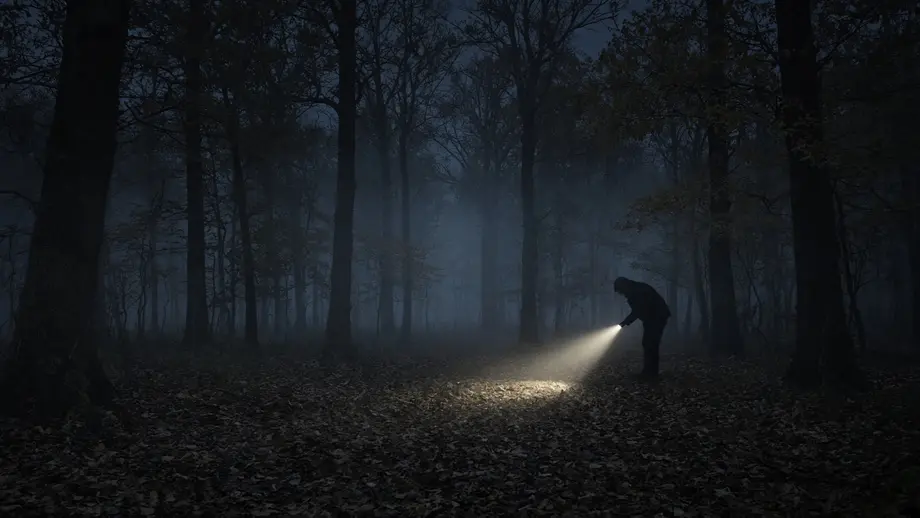
Olight makes some of the lights discussed here. Olight specs and regular prices come from its US product pages and user manuals as of September 2026; other brands' specs come from their makers. The absorption, illuminance and runtime figures below are calculations from published data, not field measurements.
⚡ TL;DR
A blood light for hunting helps most on green grass, snow and pale rock, where a blue-green beam turns red blood dark against a brighter background. On brown leaf litter, dark soil and wet ground, plain white usually wins, because blood's red hue is the cue your eyes use. Red light is the worst choice for finding blood. No light makes blood glow.
You waited, and now the trail is a few drops on oak leaves almost the same color as the blood. Blood light boxes promise that blood will "pop," and forums swear by green, blue, strobes and UV. This guide shows what optics research supports, runs the absorption math and ends with a trail routine.
This table summarizes where a filtered or colored blood light for hunting beats plain white. Ratings follow the published absorption data and sources cited below, not field trials.
| Dimension | Plain white light | Filtered or colored blood light (blue-green bias) | Which is better | By how much |
|---|---|---|---|---|
| Blood on green grass | Red on green: strong hue contrast | Dark blood on lighter green | Either | Small |
| Blood on tan or brown leaves | Red on red-brown: weak | Blood darkens more than dry leaves | Filtered, on pale leaves | Moderate; shadows darken too |
| Blood on snow | Red on white: very strong | Dark on white: very strong | Either | None worth paying for |
| Blood on dark soil or wet leaves | Low contrast | Low contrast | Neither | Use flagging and a grid search |
| Reading blood color for hit clues | Shows red, dark red, froth | Color lost | White | Large |
| Walking, footing, checking shapes | Full-color scene | Tinted scene | White | Large |
| Red-green color deficient hunters | Hue cue may fail | Turns hue into light vs dark | Filtered | Can be large |
| Red light | Not applicable | Blood reflects red almost like leaves | Worst for blood | Blood nearly vanishes |
📋 Table of Contents
- 1. Quick Answer: Does a Blood Light for Hunting Beat Plain White?
- 2. How Does a Blood Tracking Light Work? Hemoglobin Absorption Explained
- 3. Blood Tracking Light Colors on Five Grounds: Leaves, Grass, Snow, Rock and Dark Soil
- 4. Fresh Blood vs Two-Hour-Old Blood: Does the Best Light Change?
- 5. Will an UV Light Pick Up Deer Blood?
- 6. What Is a Red Light Good For When Hunting?
- 7. How Much Light Reaches a Blood Spot 1, 3 and 5 Meters Ahead?
- 8. What Is the Best Blood Tracking Light for Hunting?
- 9. Dedicated Blood Lights vs Plain White: Who Should Buy Which?
- 10. Common Myths About Blood Tracking Lights
- 11. Tracking After Dark: What State Rules Say About Lights, Dogs and Guns
- 12. A Blood-Trail Light Routine: Step-by-Step Checklist
- 13. FAQ
Quick Answer: Does a Blood Light for Hunting Beat Plain White?
Only on some ground. Fresh blood absorbs 450 nm blue and 540 nm green light about 87 to 103 times more strongly than 630 nm red, so a blue-green beam makes it look dark. That helps on grass, snow and pale rock. On brown leaves and wet soil, the background darkens too, and white light's red-versus-brown color cue often works better.
White light gives you a hue cue: blood looks red, leaves brown or green. A blue-green light gives you a brightness cue: blood looks black. Which wins depends on the ground, the blood's age and your color vision. So carry a dimmable white light first and a colored light as an optional second tool. Olight groups its long-throw hunting flashlights in one collection.
How Does a Blood Tracking Light Work? Hemoglobin Absorption Explained
A blood tracking light works by using colors that blood absorbs and the background reflects. Hemoglobin, the pigment in red blood cells, absorbs violet, blue and green light heavily and red light very weakly. Under a blue-green beam, blood returns little light and looks dark. Under red light, blood reflects almost as much as the leaves around it.
The Oregon Medical Laser Center (OMLC) biomedical optics site, run by Scott Prahl and Steve Jacques, publishes Prahl's compiled molar extinction coefficients for hemoglobin and notes that "A typical value of x for whole blood is x=150 g Hb/liter." For oxygenated hemoglobin (HbO2), the form in fresh bright blood, the table lists 53,236 cm⁻¹/M at 540 nm, 62,816 at 450 nm and 610 at 630 nm. Green over red is 53,236 ÷ 610 ≈ 87; blue over red is 62,816 ÷ 610 ≈ 103. The ratio is wavelength-specific: at 500 nm it is 20,932.8 ÷ 610 ≈ 34.
To picture it, use the Beer-Lambert relation the page gives: absorbance A = coefficient × concentration × path length. Concentration is 150 ÷ 64,500 = 0.00233 mol/L. Light on a blood film lying on a leaf passes through the film, reflects off the leaf and passes back, so the share returned is 10^(−2A).
This table applies that method to a 10 µm smear and a 50 µm drop edge. Both thicknesses are illustrative, the concentration is OMLC's typical human value, and scattering is ignored, so these are estimates from published coefficients, not measurements of deer blood.
| Light color (wavelength) | HbO2 coefficient, cm⁻¹/M | Light returned, 10 µm film | Light returned, 50 µm film | Blood looks |
|---|---|---|---|---|
| Near UV (396 nm) | 231,612 | 8.4% | about 0% | Black |
| Violet (414 nm, hemoglobin peak) | 524,280 | 0.4% | about 0% | Black |
| Royal blue (450 nm) | 62,816 | 51.0% | 3.5% | Dark |
| Green (540 nm) | 53,236 | 56.5% | 5.8% | Dark |
| Amber (590 nm) | 14,400.8 | 85.7% | 46.2% | Mid-tone |
| Red (630 nm) | 610 | 99.3% | 96.8% | Nearly as bright as the leaf |
Worked example, 50 µm at 540 nm: A = 53,236 × 0.00233 × 0.005 cm = 0.619; the round trip doubles it to 1.238; 10^(−1.238) = 0.058, so about 5.8% of the green light comes back. A thin smear still returns about half the green light, so faint spots stay hard with any color.
Forensic examiners use the same physics. Foster + Freeman, a forensic light source maker, writes that "Blood has a strong absorption peak at around 412nm," and that under violet light and a matched filter, "bloodstains often appear significantly darker than the surrounding substrate."
Blood Tracking Light Colors on Five Grounds: Leaves, Grass, Snow, Rock and Dark Soil
The best color depends on the ground. A dark-blood effect needs a background that reflects the beam's color. Green grass, snow and pale rock do; brown leaf litter reflects some; dark soil and wet leaves reflect little of anything. Treat the table below as a prediction to confirm on your own ground before the season.
NASA's Earth Observatory explains that "The pigment in plant leaves, chlorophyll, strongly absorbs visible light (from 0.4 to 0.7 µm) for use in photosynthesis." It absorbs least in the green, which is why leaves look green. In fall, University of Illinois Extension notes that "Tannins cause the autumn browns and coppers seen in fall in a lot of in oaks and beech trees." Brown and copper leaves reflect more red and orange than blue, which is why red blood hides on them under white light.
Dark ground defeats every color. Foster + Freeman notes that on darker substrates, "both the blood and the surface absorb significant amounts of visible white light."
This table predicts how each color performs on five common tracking grounds, based on the absorption data above.
| Ground | Plain white | Blue-green blood light | Red light | Best first choice |
|---|---|---|---|---|
| Green grass or clover | Red on green; easy | Dark on reflective green | Blood and grass look alike | White; blue-green as a check |
| Tan or brown leaf litter | Red on red-brown; hard | Blood darkens more than dry leaves | Blood nearly vanishes | Try both; blue-green on pale, dry leaves |
| Snow | Red on white; very easy | Black on white; very easy | Low contrast | White, dimmed for glare |
| Gray rock or gravel | Red on gray; good | Dark on gray; good | Poor | White |
| Dark soil, mud, wet leaves | Poor | Poor | Very poor | Flag the last blood and grid search |
The National Eye Institute says "About 1 in 12 men have color vision deficiency," and the most common type "makes it hard to tell the difference between red and green." For those hunters, a light that turns blood into a dark spot can matter far more. When a trail dies on dark ground, stop hunting pinpricks and consider a thermal monocular for deer recovery where your state allows it.
Tip: Before the season, put a few drops of blood saved from a previous harvest on grass, dry leaves and a rock after dark. Look at each spot from standing height with your white light, then any colored light you own.
Fresh Blood vs Two-Hour-Old Blood: Does the Best Light Change?
Slightly. Fresh blood is mostly oxygenated hemoglobin and looks bright red. As it dries, hemoglobin converts to other forms and the stain turns red-brown. That weakens white light's hue cue on brown leaves, while the dark-blood effect under blue-green light remains, because the stain still absorbs strongly at short wavelengths.
University of Amsterdam researchers documented "the transition of oxy-hemoglobin into met-hemoglobin and hemichrome" in ageing bloodstains (Forensic Science International, 2011). Their samples ran from 0 to 60 days under controlled conditions, so the paper gives no two-hour color for a deer trail. Foster + Freeman describes dried blood as having "a distinct red-brown appearance."
Serum is a separate problem. A 2020 Journal of Forensic Sciences paper noted that "serum may become separated from blood during clotting" and "dries relatively clear on certain objects." Clear serum carries little hemoglobin, so no absorption trick darkens it. In practice:
- Minutes old and wet: read color and froth with white light; that is your hit information.
- Drying on leaf litter: alternate white and, if you carry one, a blue-green light.
- Soaked into soil, or washed by rain or dew: check leaf undersides and stems, then flag and search in lanes.
- Clots ringed by clear fluid: treat the clots as the trail marks.
More lumens will not rescue an old trail. Our guide on the brightest headlamp for hunting shows why brightness does not raise blood-to-leaf contrast.
Will an UV Light Pick Up Deer Blood?
Not the way crime shows suggest. Whole blood does not glow under a hunting UV flashlight. It absorbs near-UV and violet light strongly and looks dark. What can glow is the background. For a deer trail, a UV light is a weak tool compared with white.
At 396 nm, near the output of common 395 nm UV lights, the absorption table shows a 10 µm film returning only about 8.4% of the light. Foster + Freeman states that "blood isn't typically considered to be fluorescent," and that sometimes "fluorescence can be induced in the substrate itself," leaving the stain dark against a glowing background.
The 2020 study found "ultraviolet (UV) at 365 nm (UV365) was effective in the detection of even small amounts of blood plasma and serum, compared with UV at 395 nm, which was not." That finding concerns human serum on lab materials, not deer blood on leaves. Our UV flashlight explainer covers 365 nm versus 395 nm.
Safety note: If you try a UV light on a trail, do not look into the emitter, and keep the beam off skin and eyes.
What Is a Red Light Good For When Hunting?
A red light is good for keeping night vision while you walk in, read a map, sort gear or climb down from a stand. It is poor for blood tracking. Blood reflects red light almost as well as the leaves and grass around it, so a red beam hides the contrast you need. Switch to white at the first blood.
The math: at 630 nm, even a 50 µm film of fresh, oxygenated blood returns about 96.8% of the light. Dim light adds a second problem. Hanover College's perception lab explains that at night "longer wavelengths (reds) of light will appear darker, whereas shorter wavelengths (blues) will appear relatively brighter," so "red objects become more difficult to see at night than blue or green objects with similar reflectance values." Under too little light, red drops read as black.
The same source gives red its real job: "Red light is less likely to affect our dark adaptation than other colors." Use red for the walk in, white from the first drop.
How Much Light Reaches a Blood Spot 1, 3 and 5 Meters Ahead?
Plenty, on any decent steady mode. A handheld at hip height on a 300-lumen setting puts roughly 8 lux on the ground 5 m ahead, about 33 times the 0.25 lux that defines rated beam distance. The limit on a blood trail is contrast and angle, not raw brightness, so pick a mode you can hold for hours.
Streamlight's summary of ANSI/PLATO FL 1 defines beam distance as "The distance from the device at which the light beam is 0.25 lux." That figure assumes a target facing the light; the ground does not. From height h, a spot x meters ahead sits at slant distance d = √(h² + x²), and flat-ground illuminance is E = I × h ÷ d³, where I is beam intensity in candela. Our guide to beam distance covers lux and candela basics.
This table scales each light's rated peak candela by the mode's share of maximum lumens, assuming the beam keeps its shape, the hotspot is on the spot and the light is 1.0 m above ground. Figures are based on Olight's rated candela and lumens, not measured.
| Light and mode (Olight rating) | Estimated intensity | Ground lux, 1 m ahead | Ground lux, 3 m ahead | Ground lux, 5 m ahead |
|---|---|---|---|---|
| Seeker 4 Pro Med, 300 lumens, 11 hours | 16,895 × 300 ÷ 4,600 ≈ 1,102 cd | 390 | 35 | 8.3 |
| Seeker 4 Pro Low, 50 lumens, 60 hours | 16,895 × 50 ÷ 4,600 ≈ 184 cd | 65 | 5.8 | 1.4 |
| Seeker Ultra Med, 300 lumens, 12.5 hours | 17,600 × 300 ÷ 4,800 = 1,100 cd | 389 | 35 | 8.3 |
| Baton 4 Pro Med, 120 lumens, 18 hours 30 minutes | 10,000 × 120 ÷ 1,600 = 750 cd | 265 | 24 | 5.7 |
| Baton 4 Pro High, 600 lumens for 200 minutes | 10,000 × 600 ÷ 1,600 = 3,750 cd | 1,326 | 119 | 28 |
Example, Seeker 4 Pro Med at 5 m: d = √(1² + 5²) = 5.10 m; E = 1,102 ÷ 132.6 ≈ 8.3 lux.
Two results matter. The ground at your feet gets 390 ÷ 8.3 ≈ 47 times the light of the spot 5 m out, which is why the next drop looks faint while leaves under your boots glare; aim the hotspot 3 to 5 m ahead. And height changes the angle. At 5 m ahead the factor h ÷ d³ is 0.0075 from 1.0 m and 0.0115 from 1.7 m, about 1.5 times more light from head height. At 1 m ahead it reverses: 0.354 from hip height against 0.222 from head height. A headlamp lights the trail ahead; a handheld held low lights the spot you are studying and lets you rake the beam across leaves.
What Is the Best Blood Tracking Light for Hunting?
For most hunters, the best blood tracking light for hunting is a dimmable white handheld with a long steady mode, such as the Olight Seeker 4 Pro: 300 lumens for 11 hours, stepless dimming and a locking holster, at $139.99 regular price. Add a small red-capable clip light for the walk in, and a colored blood light only if your ground or eyes call for it.
Dimming finds the level where blood still reads red without glaring leaves, and a long steady mode covers the track and drag. Our breakdown of hunting light price maps budgets to these needs.
This table compares each Olight light as a hunting flashlight for blood tracking. The last column divides rated steady-mode runtime by an example 90-minute track, based on Olight's rated runtimes, not measured.
| Light (regular price, September 2026) | Peak output and intensity | Steady tracking mode | Weight, water rating | Example 90-minute tracks per charge |
|---|---|---|---|---|
| Seeker 4 Pro ($139.99) | 4,600 lumens, 16,895 cd, 260 m | Med 300 lumens, 11 hours | 205 g, IPX8 | 11 ÷ 1.5 = 7.3 |
| Seeker Ultra ($169.99) | 4,800 lumens, 17,600 cd, 265 m | Med 300 lumens, 12.5 hours | 220 g, IPX8 | 12.5 ÷ 1.5 = 8.3 |
| Baton 4 Pro ($69.99) | 1,600 lumens, 10,000 cd, 200 m | Med 120 lumens, 18 hours 30 minutes | 114 g, IPX8 | 18.5 ÷ 1.5 = 12.3 |
| Oclip 2 Pro ($54.99) | Floodlight 530 lumens; spotlight 3,906 cd, 125 m | Floodlight Medium 100 lumens, 3 hours 45 minutes | 75.5 g, IP66 | 3.75 ÷ 1.5 = 2.5 |
Olight Seeker 4 Pro: Best Hunting Light for Blood Trails
The trail problem is holding a level that shows red without flattening the leaves, for hours. On the Olight Seeker 4 Pro, Olight says you can "rotate for step-less dimming to your own comfortable brightness level, allowing for easy operation even with heavy gloves." Med holds 300 lumens for 11 hours, and the manual says the light locks when put back in its holster switched off.
Its limits: the manual lists CRI 70 for both the Cool White (5700~7000K) and Neutral White (4000~5000K) versions, and a 0-40°C working temperature, so on a freezing night keep it in an inside pocket between looks. It lists at $139.99 (regular price, September 2026). The box holds the vertical holster, USB-C cable and a holster fixing bracket; the MCC3 cable is optional.
Olight Baton 4 Pro: The Pocket Option
If your tracking light must also be your everyday light, the Olight Baton 4 Pro weighs 114 g and runs 120 lumens for 18 hours 30 minutes on Med. Its tail button gives momentary Turbo for a quick look at a shape ahead. It lists at $69.99 (regular price, September 2026), with an MCC3 cable and L Stand in the box.
On wide leaf litter you may step up to High, 600 lumens for 200 minutes. The manual warns: "Do not look directly at the light source or shine it in eyes, as this may cause temporary blindness and serious retinal damage." It also says to lock it for transport, not to leave it in a car that may exceed 60°C, and not to immerse it "in seawater or other corrosive media."
Olight Oclip 2 Pro: A Clip Light for the Walk In
The Olight Oclip 2 Pro is the second light, not the trail light. Clip it to a pack strap for red light on the walk in and hands-free flood while you flag. It lists at $54.99 (regular price, September 2026); the Premium version adds a 1,000 mAh Mobile Charging Dock. The Oclip 2 series manual says "Do not immerse the product in water or other liquids," and that below 0°C (32°F) "the white light is limited to Low and Medium modes." The same manual also cautions anyone with an implanted heart device: "If you have an ICD or pacemaker, avoid close or prolonged contact with this product to prevent possible interference."
Olight Seeker Ultra and the Warrior Ultra
The Olight Seeker Ultra ($169.99) runs the same 300-lumen Med 1.5 hours longer. Our spotlight guide picks it for blood tracking, and that pick stands; the Seeker 4 Pro leads here because it costs $30 less. The Olight Warrior Ultra, one of Olight's tactical flashlights, is rated at 26,000 cd and 320 m, reach a blood trail rarely needs. Its Med is 200 lumens for 13 hours, and it uses a dual switch rather than a rotary dimmer, so it fits better as a scanning light than as a trail light.
Warning: None of these Olight lights has a blue, green or amber blood mode. If you track on pale leaf litter or have red-green color deficiency, pair a white light with a dedicated colored light.
Dedicated Blood Lights vs Plain White: Who Should Buy Which?
Buy a dedicated deer hunting blood light if you often track on pale leaf litter, green fields or snow, or struggle to tell red from green. Stick with a quality white light if you track on dark, wet ground, read blood color for hit clues, or need one light for the whole night.
NEBO says its IllumaTrace Blood Tracker uses "an alternating strobe affect that vivifies and dulls blood." It lists White (170 lumens): 2.5 hours / 80 meters and IllumaTrace Blood Tracker (150 lumens): 3 hours / 75 meters, IP67, at $69.99 (the page lists range as both 262-292 feet and 246-262 feet). Primos describes its Bloodhunter HD lights as using "patented filter technology that minimizes earth tones." By rated figures, NEBO's blood mode covers 3 ÷ 1.5 = 2 example tracks per charge, against 7.3 for the Seeker 4 Pro on Med.
This table matches hunters to the light type that fits them.
| You are | Choose | Why |
|---|---|---|
| Tracking hardwoods with brown leaves | White light plus a colored second light | Brown litter is where filtered beams can help |
| Tracking fields, food plots or snow | Quality white light | Red on green or white is already strong |
| Red-green color deficient | Colored blood light plus white | Converts hue into light and dark |
| Reading hit clues from blood color | White light | Only white shows red, dark red and froth |
| Carrying one light all night | Dimmable white with a 10+ hour Med | Covers walk, track, drag and camp |
Common Myths About Blood Tracking Lights
The biggest myth is that a blood tracking light makes blood glow. It does not. Blood absorbs short-wavelength light, so the most any filtered or colored beam can do is make blood darker than a lighter background. Each myth below fails on that same physics, with a correction you can use.
- "Red light finds blood." Red protects night vision but hides blood: a 50 µm film returns about 96.8% of 630 nm light.
- "UV makes deer blood light up." 395 nm UV is absorbed; the 365 nm serum result comes from lab work on human serum.
- "More lumens show more blood." Two surfaces under the same light keep the same contrast as brightness rises.
- "A blood light replaces method." On dark, wet ground, no color gives contrast; flag and grid search.
Tracking After Dark: What State Rules Say About Lights, Dogs and Guns
Rules for tracking a wounded deer after dark differ by state. In the three examples below, they focus on who may carry a firearm, whether dogs may help and whether someone must call a conservation officer first. Before any night track, read your state's current digest, including any limits on lights after legal hours.
New York. The DEC's Leashed Tracking Dog License Guide, the study guide for its license exam, says: "In New York State, tracking can legally occur during the day or night." It adds: "During an evening search, only the handler is allowed to carry a firearm." The handler "must contact an environmental conservation officer (ECO) by telephone or in person before searching for a wounded animal with their tracking dog." The DEC's leashed tracking dog license page says the license covers deer or bear "that are dead, wounded or injured during any big game hunting season."
Ohio. The Ohio Hunting and Trapping Regulations 2026-27, effective September 1, 2026, say a deer hunter may "Use a leashed dog to recover a wounded deer." A deer hunter may not "Possess a loaded firearm during any of the deer firearms seasons at any time other than 30 minutes before sunrise to 30 minutes after sunset," nor pursue wounded deer "from private property without the written permission of the landowner."
Texas. The TPWD Hunting Means and Methods page says: "No more than two dogs may be used to trail a wounded deer in all counties; however, in Jasper, Newton, Sabine, and San Augustine counties, a person may trail a wounded deer with no more than two leashed dogs held by the person in control of the dogs." It adds: "A 'wounded deer' is a deer leaving a blood trail."
This table turns those texts into actions.
| State | Source | What it covers | What you do |
|---|---|---|---|
| New York | NYSDEC tracking dog guide and license page | Licensed handlers may track day or night; at night only the handler carries a firearm | Hire a licensed tracker, who calls an ECO first |
| Ohio | ODNR 2026-27 digest | Leashed dog allowed; no loaded firearm outside legal hours in gun seasons | Unload by 30 minutes after sunset; get landowner permission to cross |
| Texas | TPWD Outdoor Annual | Up to two dogs to trail a deer leaving a blood trail | Keep the light on the trail, never on live game |
Our guide to hunting with a light laws compares spotlighting rules across 12 states.
Warning: Rules change. The regulations in force on the day you hunt are the ones that apply, so read your state wildlife agency's current digest and call its enforcement line if anything is unclear.
A Blood-Trail Light Routine: Step-by-Step Checklist
Use this routine with any blood light for hunting or white handheld. It keeps night vision for the walk, uses white where color matters and saves a colored light for hard ground. Practice it once in the yard so the button presses are automatic before a real track.
- At the shot: note the time, the deer's line of travel and the last place you saw it.
- Walking in: use dim red, such as the Oclip 2 Pro's 4-lumen red.
- At the first blood: switch to a steady white mode of about 120 to 300 lumens. Read color and froth.
- Aim the hotspot 3 to 5 m ahead, and hold the light low to study one spot.
- On pale leaves or grass, when drops thin out: try a blue-green light as a second look.
- Flag every find so you can sight back down the line.
- When the trail stops on dark, wet ground: grid search from the last flag.
- Follow your state's rules on firearms, dogs and calling the agency; lock your lights before they go in the pack.
FAQ
Changelog
- September 24, 2026: First published.