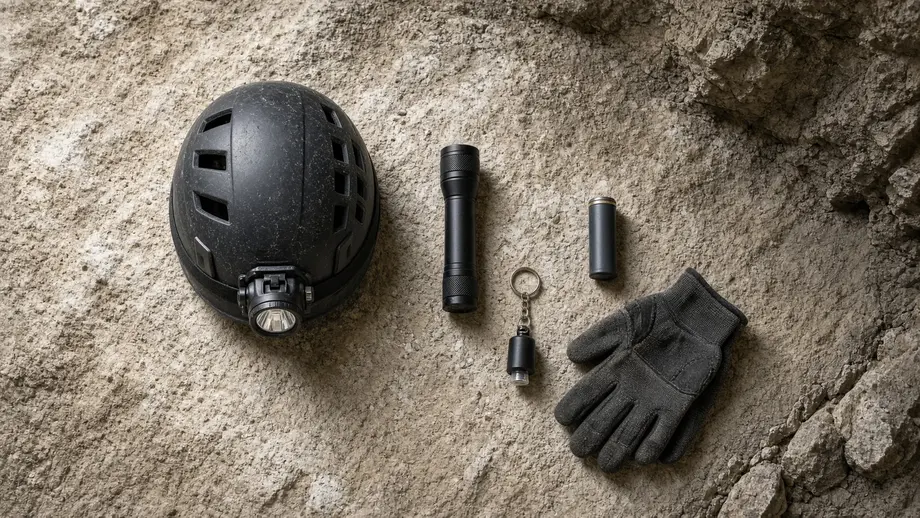
Olight makes some of the lights discussed here. Olight specs and regular prices come from its product pages and user manuals as of September 2026; caving rules come from the agencies and organizations linked in each section.
⚡ TL;DR
A caving headlamp is only one part of a safe lighting kit. Every person underground should carry three independent light sources, each with its own power, and one of them should be mounted on the helmet. Pick the primary by its runtime at a usable medium mode, then pick two backups that share nothing with it: no battery, no switch, no charger.
The problem this rule solves is simple. A cave has no natural light past the entrance, so when your only light dies, you can't see your hand, the floor or the way out. The National Speleological Society's accident journal, American Caving Accidents (2009 to 2010 incidents), describes how lost cavers end up in trouble: "Many escalate to the "stranded" category when batteries run out or flashlights are broken."
This caving headlamp quick-reference table sums up the rule and the numbers to check before you buy.
| Question | Short answer |
|---|---|
| How many lights per person? | At least three, each able to get you out on its own |
| Where does the primary go? | On the helmet, so both hands stay free for climbing and crawling |
| What spec matters most? | Rated hours at a medium mode (roughly 100 lumens), not the turbo figure |
| What does "independent" mean? | Separate battery, switch and body; ideally a different battery type |
| What water rating fits wet caves? | IPX7 or IPX8 immersion, or IP68 if you also want a dust-tight rating |
| What should backups prove? | That each one alone can light your whole exit at a walking pace |
📋 Table of Contents
- 1. The Quick Answer: Three Independent Lights, Three Independent Power Sources
- 2. Why Three? The Failure Math Behind the Rule
- 3. Primary, Backup, Emergency: Building a Caving Headlamp Kit
- 4. What Does "Independent Power" Mean for Spelunking Lights?
- 5. How Long Will Your Caving Lights Last If You're Stranded?
- 6. Mud, Water and Impact: How Caves Wear Out Lights
- 7. Helmet Mounting and Cable Management
- 8. What to Do When Your Lights Fail Underground
- 9. What Is the Best Headlamp for Caving?
- 10. What Is the Best Headlamp for Spelunking Underground?
- 11. What Headlamps Do Navy SEALs Use?
- 12. Caving Light Myths vs Facts
- 13. A Caving Light Checklist You Can Verify
- 14. FAQ
The Quick Answer: Three Independent Lights, Three Independent Power Sources
The three-light rule means every caver carries at least three light sources that can each work without the others. The National Speleological Society's Minimum Impact Caving guidelines put it plainly: "Each caver wears a helmet with a light attached. Each caver carries water, food, a bottle for urine, and three sources of light with extra batteries (and bulbs if not LED)."
Federal cave permits turn the same rule into a condition of entry. The Bureau of Land Management's Bloomington Cave entrance permit from its St. George Field Office in Utah requires "at least three sources of light, one of which will be attached to the helmet," and states that "Candles, matches and cigarette lighters are not acceptable as second light sources." The BLM Roswell Field Office's cave entrance permit application (January 2007 form) says each caver must carry "at least three sources of light, preferably electric," and its safety list calls for a "MINIMUM OF THREE SEPARATE LIGHTING SYSTEMS FOR EACH PERSON. HAVE SPARE BATTERIES AND BULBS."
Parks that allow self-guided caving make the same point in plainer words. Lava Beds National Monument in California tells visitors on its caving page: "Don't rely on your cellphone as a flashlight. Bring several "real" sources of light. We recommend both a headlamp and a handheld flashlight for each person." Texas Parks and Wildlife's caves at state parks page tells cavers to "carry extra lights, don't cave in rainy weather, dress appropriately."
Rules differ by cave and land manager, so read the permit for your cave. Three lights is the NSS baseline, the common rule in the permits above and a sound default anywhere. If you want a wider view of lights built for trails, camps and caves, Olight groups them under outdoor flashlights.
Why Three? The Failure Math Behind the Rule
Three lights make a total blackout very unlikely, as long as the lights fail independently. If each light has a small chance of failing on a trip, the chance that all of them fail is that chance multiplied by itself once per light. Adding a second light cuts the risk sharply; a third cuts it again. Shared weak points undo most of that gain.
Here is the arithmetic, with an illustrative failure chance. Assume each light has a 5% chance of failing during one trip (p = 0.05). That number is an assumption for the example, not a measured rate for any product. The chance that every light fails is p raised to the number of lights:
- One light: 0.05 = 5%, or about 1 trip in 20.
- Two lights: 0.05 × 0.05 = 0.0025 = 0.25%, or 1 trip in 400.
- Three lights: 0.05 × 0.05 × 0.05 = 0.000125 = 0.0125%, or 1 trip in 8,000.
This table shows how the numbers change if you assume a more or less reliable light.
| Assumed failure chance per light, per trip | One light | Two independent lights | Three independent lights |
|---|---|---|---|
| 10% | 1 in 10 | 1 in 100 | 1 in 1,000 |
| 5% | 1 in 20 | 1 in 400 | 1 in 8,000 |
| 2% | 1 in 50 | 1 in 2,500 | 1 in 125,000 |
The math only works if the failures are independent. Suppose all three lights run on batteries from the same old pack, or all three ride in the same pack that floods. Call the chance of that shared failure c. The total blackout risk becomes c + (1 − c) × p³. With c = 1% and p = 5%, that is 0.01 + 0.99 × 0.000125 = 0.0101, or about 1%. That is roughly 81 times the 0.0125% you get from three truly separate lights (1.01 ÷ 0.0125 ≈ 81).
A third light that shares a battery, a switch or a storage spot with the first one adds weight without adding much safety.
Primary, Backup, Emergency: Building a Caving Headlamp Kit
A caving headlamp kit has three jobs. The primary lights the whole trip from your helmet. The backup takes over if the primary dies and should be able to walk you out at a normal pace. The emergency light is the last line: small, simple and stored somewhere the other two aren't. Each role has its own specs to check.
The primary does the most work, so it needs long runtime at a medium setting, a hands-free mount and a water rating that covers immersion. The backup can be a second headlamp or a compact light you can hold in your teeth or clip to a strap. The emergency light should run on a different battery type and live in a different pocket.
This table lists what each role needs, the unit to read on the spec sheet, a typical range and how to judge whether it's enough.
| Concept | Unit | Typical range for this role | How to judge if it's enough |
|---|---|---|---|
| Primary runtime at medium | Hours | 10 to 30 hours at about 100 to 120 lumens | At least twice your planned time underground |
| Primary low-mode runtime | Hours | 30 to 100 hours at 10 to 30 lumens | Enough to wait for help through a night and a day |
| Backup output | Lumens | 100 to 500 lumens at its main setting | Can you see the floor 10 m ahead at a walking pace? |
| Backup runtime | Hours | 3 to 12 hours on a low setting | Covers your full exit time from the deepest point |
| Emergency runtime | Minutes to hours | 45 minutes to 12 hours | Plus spare cells if the rated time is short |
| Water rating | IP code | IPX7, IPX8 or IP68 | Immersion rated if the route has pools, streams or crawls in water |
| Beam distance | Meters | 40 to 160 m at max output | Rated at max; your working distance is far shorter |
An Olight example makes the roles concrete. The Olight Perun 3 headlamp ($89.99, regular price, September 2026) fits the primary role on paper: Olight rates it at 120 lumens for 25 hours and 30 lumens for 89 hours on a 5,000 mAh 21700 battery, with IP68 protection. For backup and emergency, two small keychain lights on separate batteries cover the other roles, as the next section shows.
What Does "Independent Power" Mean for Spelunking Lights?
Independent power means no single battery, charger or battery type can take out more than one of your spelunking lights. The strongest setup mixes battery formats: a removable rechargeable cell in the primary, a sealed built-in battery in the backup and an ordinary AAA cell in the emergency light. You can't recharge underground, so the charge you carry in is all you have.
Here is how the three Olight lights in this kit divide their power, based on Olight's product pages and manuals.
| Role | Light | Battery | Can you swap it in the cave? | Olight-rated runtime |
|---|---|---|---|---|
| Primary | Olight Perun 3 | Customized 3.6V 5000mAh 21700 lithium-ion | Yes, with a spare 21700 | 120 lumens for 25 hours; 30 lumens for 89 hours |
| Backup | Olight i1R 2 Pro | Built-in 3.7V 130mAh 10220 lithium-ion | No | 180 lumens for 23 minutes; 5 lumens for 12 hours |
| Emergency | Olight i3E EOS | One AAA cell (alkaline included) | Yes, with spare AAA cells | 90 lumens; 45 minutes on alkaline, 70 minutes on NiMH (user manual) |
A runtime budget you can check
Use this method to size your power, then plug in your own trip. The inputs are your planned hours underground and a reserve factor you choose. This example uses an 8-hour trip and a 2× reserve, so the primary should cover 16 hours.
- Primary on Med: the Perun 3's rated 25 hours at 120 lumens is 25 ÷ 16 = 1.56 times the target. A spare Olight 21700 5000mAh battery ($26.95, regular price, September 2026) doubles that to 50 hours at the same rated level.
- Primary on Low: at 30 lumens the rated 89 hours is 5.6 times the target, useful if you stop and wait.
- Backup: the i1R 2 Pro's 12 hours at 5 lumens is enough to shuffle along a known passage, and 23 minutes at 180 lumens is for short, hard sections.
- Emergency: at 45 minutes per alkaline AAA, a 3-hour exit needs 180 ÷ 45 = 4 cells. Energizer's E92 alkaline AAA datasheet lists a typical weight of 11.5 grams, so four cells weigh about 4 × 11.5 = 46 grams.
These totals are based on Olight's rated runtimes, not measured in a cave. Olight's Perun 3 manual states: "Above data are tested per ANSI/PLATO FL 1-2019 standard in Olight's labs for reference." That is the 2019 edition; the current edition is ANSI/PLATO FL 1-2025. Under the FL1 method, as summarized by Streamlight's FL1 explainer, runtime ends when output "drops to 10% of the initial value," so the last hours of any rating are dimmer than the first. For more on why ratings and trail results differ, see our guide to flashlight runtime.
The i1R 2 Pro's manual uses a gentler cutoff: "The running time is the time when the brightness attenuates to 50% of the initial value after the battery is fully charged." So its 12-hour Low rating ends while the light is still at half its starting output.
Dropping one mode is the cheapest way to stretch a trip, and the ratings show which light gains the most. On the Perun 3, going from Med to Low cuts output by 4 times (120 ÷ 30) and multiplies rated hours by 3.56 (89 ÷ 25). On the i1R 2 Pro, going from High to Low cuts output by 36 times (180 ÷ 5) and multiplies rated time by about 31 (720 minutes ÷ 23). These are ratios of Olight's ratings, not measured values.
Note: The i3E EOS manual lists AAA alkaline, NiMH and L92 lithium cells as usable. Energizer's L92 lithium AAA datasheet gives an operating range of -40°C to 60°C and a typical weight of 7.6 grams, versus 11.5 grams for the E92 alkaline. Olight rates runtime only for alkaline and NiMH, so treat lithium AAA runtime as unrated.
Cold, charging and storage
Rechargeable cells need care before the trip, not during it. The U.S. Fire Administration's lithium-ion battery safety page says "Do not charge them at temperatures below 32 degrees F (0 degrees C) or above 105 degrees F (40 degrees C)," so charge everything at home the night before. The same page says to "Stop using lithium-ion batteries if you notice an odor, change in color, too much heat, change in shape, leaking or odd noises."
Cave air is usually cool, not freezing. Mammoth Cave National Park says on its cave tours page that "deep cave temperature is 54ºF (12ºC)," which falls inside the 0 to 40°C working temperature printed in the Perun 3 manual. Ice caves are different: Lava Beds lists caves with year-round or winter ice floors, so check your light's working range before an ice cave trip.
How Long Will Your Caving Lights Last If You're Stranded?
If you're stranded underground, hours of light matter far more than lumens. Drop every light to its lowest usable mode and use only one light at a time. By Olight's ratings, the Perun 3 runs 5 lumens for 20 days on Moon, enough for a multi-day wait on one charge. For moving, a steady 100 to 120 lumens covers most passages, and 30 lumens lets you move slowly.
This matters because being stranded is how lost-caver incidents turn serious. The NSS accident report quoted above says lost cavers escalate to "stranded" when batteries run out, and that when found they often need treatment for hypothermia. Staying put only works if your light lasts as long as the wait.
Rated beam distance won't help here. Under ANSI/PLATO FL1, beam distance is "The distance from the device at which the light beam is 0.25 lux," per the Streamlight summary, and Olight rates it at maximum output: 160 m for the Perun 3, 48 m for the i1R 2 Pro and 44 m for the i3E EOS (the i3E EOS manual adds 500 cd). Olight doesn't publish candela or beam distance for lower modes, so plan your exit around the light you'd have left, not the one you started with.
This table assumes a 72-hour wait for rescue, an example figure rather than a typical one, and compares it with each light's rated runtime.
| Light and mode | Olight-rated output and runtime | Hours left after a 72-hour wait | Best use while stranded |
|---|---|---|---|
| Perun 3, Moon | 5 lumens for 20 days (480 hours) | 480 − 72 = 408 hours | Steady light around you while you wait |
| Perun 3, Low | 30 lumens for 89 hours | 89 − 72 = 17 hours | Short moves to a drier or safer spot |
| Perun 3, red (low) | 15 lumens for 70 hours | 70 − 72 = 2 hours short | Checking gear or a partner without dazzling them |
| i1R 2 Pro, Low | 5 lumens for 12 hours | 12 − 72 = 60 hours short | Brief checks only; it can't cover the wait alone |
| i3E EOS, alkaline AAA | 90 lumens for 45 minutes per cell | 72 × 60 ÷ 45 = 96 cells needed | Signaling when you hear rescuers, not waiting |
The practical reading: a primary with a deep low mode is what makes "stay put" a workable plan. On Moon, one Perun 3 charge would still have 408 of its 480 rated hours left after the example wait. The keychain lights can't do that job; save them for moving and signaling. These figures come from Olight's rated runtimes, not a test, and cold or an aging cell will shorten them.
The Perun 3 also has a red light rated at 60 lumens for 14 hours and 15 lumens for 70 hours. Red is useful for reading a map or checking a partner's gear without dazzling them, but it doesn't replace white light for footing on wet rock.
Mud, Water and Impact: How Caves Wear Out Lights
Caves attack lights in three ways: water gets past seals, mud packs into switches and threads, and rock knocks lights off helmets or crushes them in tight squeezes. A good caving headlamp handles all three with an immersion rating, a switch you can work with muddy gloves and a published drop rating. Your habits matter as much as the specs.
Water ratings are easy to misread. The International Electrotechnical Commission's IP ratings page says the code "Avoids confusion over vague marketing terms like "waterproof."" It explains that the first numeral runs from 0 to 6 ("no ingress of dust") and the second from 0 to 9. The full test conditions sit in the IEC 60529 standard itself.
This table translates the relevant IEC 60529 test levels into what they mean underground, based on the test summary published by Castle Compliance, an ISO 17025 lab.
| IEC 60529 level | Test summary (Castle Compliance) | What it means in a cave | Lights in this guide |
|---|---|---|---|
| IP6X | "Dust tight"; talcum powder chamber under reduced pressure | Rated against fine dust; mud is not part of the test | Perun 3 (IP68) |
| IPX6 | Powerful water jets | Drips, spray and splashes; not an immersion test | Oclip 2 Pro (IP66; its manual says not to immerse it) |
| IPX7 | "Immersed at 1m above bottom for 30 minutes" | A slip into a shallow pool | None here |
| IPX8 | "Immersion with depth and duration > IPX7. (Test level by agreement)" | An accidental dunk in a pool or stream; Olight doesn't publish the test depth or time for these lights | i1R 2 Pro, i3E EOS, Perun 3 Mini |
Castle Compliance also points out that "IEC 60529 explicitly states that immersion (IPX7 / IPX8) and water jets (IPX5 / IPX6) are different types of ingress tests." That means an IPX8 light isn't automatically rated for jets, and an IP66 light isn't rated for immersion. For a closer look at the top rating, see our explainer on IPX8 meaning.
Lab ratings don't tell you how lights actually fail in a cave. This table lists the failure modes that matter most underground and how to prevent each one.
| Failure mode | What causes it | How to prevent it |
|---|---|---|
| Light floods | Worn or dirty O-ring, cap not fully closed, a rating below immersion | Clean and check seals before each trip; carry immersion-rated backups |
| Switch jams | Mud packed around a button or twist head | Rinse after every trip; choose lights you can work with gloves on |
| Light is knocked off | Helmet strikes on low ceilings, loose mount | Secure the mount and add a tether; check fit before the trip |
| Battery drains in the pack | Button pressed by gear during a squeeze | Use lockout or unscrew the cap a quarter turn on backups |
| Primary dims early | Cold, an old cell or long time on high | Run Med, carry a charged spare, retire old cells |
| All lights die together | Shared batteries, one storage spot, one charger | Mix battery types and store each light in a different place |
Impact ratings are published for some of these lights. The Perun 3 manual shows 1.5 m, the i1R 2 Pro manual shows 1.5 m, the i3E EOS manual lists "IMPACT RESISTANCE 1.5m," and Olight lists the Oclip 2 Pro at 2.0 m. Under FL1, per the Streamlight summary, "Dropped samples must not exhibit any cracks or breaks and must remain fully functional in order to pass the Impact Resistance test." That's a drop onto a hard surface, not a crush in a squeeze, so pad your backups inside a pocket or a small pouch.
Mud also carries a conservation problem. Lava Beds says people can "potentially spread the fungus" that causes white-nose syndrome in bats between caves, and its white-nose syndrome page asks: "If you have gear that has been used in caves or mines outside of Lava Beds National Monument, please leave these items at home." Clean your lights after every trip and follow the decontamination rules of the next cave you visit.
Helmet Mounting and Cable Management
Your primary light belongs on a helmet with a chinstrap, because caving takes both hands and your head is what hits the rock. Mount the light so it sits centered and snug, route any strap or cord where it can't snag, and tether it so a knock can't send it down a crack. Test the whole setup at home before the trip.
Helmets come first. The BLM Roswell application requires "either an ANZI-certified construction-grade hard hat or UIAA- approved caving or rock-climbing helmets, with non-elastic chin strap fastened at all times while in the cave." (The spelling is the BLM's.) Lava Beds reports that "The #1 injury we see are nasty cuts and bumps on the head, all of which are preventable." A light that rides on the helmet also keeps the beam pointed where you look.
The Perun 3 has a limitation here. Olight sells it with a headband and a metal mounting bracket, but it doesn't list a caving helmet adapter. Before you rely on it as a primary, stretch the headband around your helmet shell and shake your head hard. If it slides, that isn't a mount you can trust in a crawl, and a light built for helmet mounting is the better choice for that job.
Use these mounting habits whatever light you carry:
- Center the light on the front of the helmet and tilt it slightly down, so the beam lands where your feet go next.
- Tuck strap ends and lanyards under the band. Loose loops catch on formations and rope.
- Tether the primary with a short cord to the helmet so a knock leaves it dangling, not lost.
- Keep the backup on your body, not in a pack you might drop at a pit: a chest pocket or a shoulder strap works.
- Put the emergency light and its spare cells in a different pocket from the backup, ideally in a small sealed bag.
The Olight Oclip 2 Pro ($54.99, regular price, September 2026) can serve as a hands-free backup: Olight says its clip "grips objects up to 14 mm thick, including collars, straps, and MOLLE webbing," its head tilts 115°, and it has a red light. Its limit for caving is water. It's rated IP66, not for immersion, and the Oclip 2 user manual is explicit: "Do not immerse the product in water or other liquids, as it will damage the product." Carry it only in dry caves. On any route with pools, streams or wet crawls, make an IPX8 light your backup instead. The Oclip 2 user manual adds a caution for anyone with an implanted heart device: "If you have an ICD or pacemaker, avoid close or prolonged contact with this product to prevent possible interference."
Tip: Practice switching to your backup in full darkness at home, with gloves on. If you can't find and turn on each light by feel in under a minute, change where you carry it.
What to Do When Your Lights Fail Underground
When your primary fails, stop moving, stay where you are and switch to your backup before you take another step. Then work out why the first light failed, decide as a group whether to continue or turn back, and start the exit while you still have two lights left. If all your lights fail, stay put and wait for your partners or rescuers.
This step-by-step response keeps a light failure from turning into a lost-caver incident:
- Freeze. Moving in the dark is how cavers fall. Hold your position and call out to your group.
- Switch to the backup by feel. Turn it on before you do anything else, then use it to check your footing.
- Diagnose the primary. Is it a dead cell, a loose cap, water or a jammed switch? Swap in the spare battery if you have one.
- Make the turnaround call. If the primary can't be fixed, the trip is over. You're now on your second of three lights, which is the point the rule was built for.
- Exit at the backup's pace. Put the person with the weakest light in the middle of the group, so lights ahead and behind cover them.
- If every light fails, stay put. Sit, stay warm and wait. The ACA notes that "When found, lost cavers often require treatment for hypothermia, sometimes including hospitalization."
That last step depends on something you do before the trip. The TPWD page tells cavers to "let someone know when to expect your return and where you plan to go (file a caving plan)." A surface contact with your route and return time is what turns "wait" into a plan instead of a hope.
Warning: Don't try to feel your way out along an unfamiliar passage in total darkness. The ACA 2009 to 2010 report notes that "Drowning incidents are infrequent in "dry caving," but have occurred when cavers became trapped by flooding or when they attempted to free-dive through sumped passages."
What Is the Best Headlamp for Caving?
The best headlamp for caving is one that runs a medium level for longer than your trip with a big reserve, carries an immersion rating, mounts firmly on your helmet and takes a battery you can swap underground. Brand matters less than that list. Treat any single headlamp, however good, as one of three lights rather than the whole plan.
Among Olight's current lights, the Perun 3 (3,000 lumens, 6,400 candela, 160 m, IP68) matches most of that list on paper. Olight rates its modes as follows: Turbo 3,000~800~600 lumens for 2 + 180 + 30 minutes; High 600~120 lumens for 300 + 30 minutes; Med 120 lumens for 25 hours; Low 30 lumens for 89 hours; Moon 5 lumens for 20 days; red light 60 lumens for 14 hours or 15 lumens for 70 hours. It weighs a listed 150 g and has a glove-friendly metal side button.
Its limits for caving are just as clear. Turbo lasts 2 minutes before it steps down, so it's a ceiling-scanning mode, not a travel mode. It charges through a magnetic MCC3 cable, so you can't top it up underground. And as noted above, Olight lists no helmet adapter, so check the fit on your own helmet.
The Olight Perun 3 Mini (1,250 lumens, 155 m, IPX8, 54 g with battery) would make a lighter second headlamp, but its default Orange CW version was listed as Sold Out at Olight's US store on September 24, 2026, so it isn't a pick in this guide. For a full comparison of headlamps across brands, see our roundup of the best headlamps, or browse Olight's headlamps.
What Is the Best Headlamp for Spelunking Underground?
For casual spelunking in a lava tube or a developed wild cave, the best setup is a comfortable headlamp with 100 or more lumens for at least as many hours as you'll be underground, plus a handheld backup and a small emergency light. Beginners don't need an expedition light. They need three reliable lights and a helmet.
Lava Beds' advice for its self-guided caves is a good template for beginners: a helmet, "both a headlamp and a handheld flashlight for each person," and starting at an easy cave. It even notes that Mushpot Cave is "the only cave we have illuminated with lighting," which tells you what to expect everywhere else. For a beginner-level primer on headlamp choice for this use, see our earlier guide to the headlamp for spelunking underground.
A small, low-cost backup pair works well for this kind of trip. The Olight i1R 2 Pro keychain light ($21.99, regular price, September 2026; 180 lumens, 580 candela, 48 m, IPX8, 22 g) has a built-in USB-C rechargeable battery rated for 12 hours at 5 lumens. Its manual warns: "The output brightness will decrease as the battery power decreases." The Olight i3E EOS keychain light ($12.99, regular price, September 2026; 90 lumens, 44 m, IPX8, 19.4 g) runs on one AAA cell you can buy anywhere.
Both are twist-operated with no button to press by accident in a pocket, but both are handheld. Neither is a hands-free light, and the i3E EOS runs only 45 minutes on the included alkaline cell, so pack spares.
What Headlamps Do Navy SEALs Use?
The U.S. Navy doesn't publish a list of the headlamps its SEAL teams carry, and we found no official Navy source that names a model. What is public is how tactical headlamps are designed: helmet mounts that fit night vision gear, red and infrared modes and controls you can use by feel. Most of those features don't transfer directly to caving.
Infrared doesn't help a caver unless you're wearing night vision. The features that carry over are the ones cave permits already demand: a secure helmet mount, controls you can work with gloves and a backup with its own power. Our guide to search and rescue headlamps covers the public gear lists from rescue teams, which are closer to what a caver needs.
Caving Light Myths vs Facts
A lot of caving light advice comes from camping habits that don't hold up underground. The biggest myths are that a bright phone is a real light, that more lumens mean a safer trip, and that one great headlamp with spare batteries counts as three lights. Each one fails for a reason you can check.
This table lists the common misunderstandings, the facts and where they come from.
| Myth | Fact | Basis |
|---|---|---|
| A phone flashlight counts as a light source | Lava Beds tells visitors not to rely on a cellphone as a flashlight | NPS Lava Beds caving page |
| One headlamp plus spare batteries is three lights | A broken switch or flooded body takes out the light no matter how many cells you carry | NSS guidelines and BLM permits call for three sources of light, not three batteries |
| More lumens make a caving headlamp safer | Hours at a usable level matter more; the Perun 3's 3,000-lumen turbo lasts 2 minutes before it steps down | Olight Perun 3 product page |
| Candles and lighters make fine backups | The Bloomington Cave permit says they are "not acceptable as second light sources" | BLM St. George Field Office permit |
| Any IP rating is fine for wet caves | IPX6 covers water jets; only IPX7 and IPX8 cover immersion | IEC 60529 test summary by Castle Compliance |
| The rated runtime is full brightness to the end | FL1 runtime runs until output drops to 10% of the starting value | Streamlight's FL1 summary |
A Caving Light Checklist You Can Verify
Use this checklist the night before and again at the cave entrance. Every line is something you can confirm with your own eyes: a light turning on, a seal seated, a cell swapped, a plan filed. If any line fails, fix it or change the trip. The three-light rule only protects you if all three lights actually work.
The night before:
- Primary headlamp fully charged and a charged spare battery packed.
- Backup charged; run it for a minute on each mode.
- Emergency light fitted with a fresh cell and spare cells in a sealed bag.
- O-rings and caps cleaned and checked on every light.
- Runtime budget done: primary Med hours at least twice the planned trip.
- Caving plan filed with a surface contact: route, group, return time.
At the entrance:
- Helmet on with chinstrap fastened; primary centered, snug and tethered.
- Backup and emergency lights in two different places on your body, not in the pack.
- Each person can turn on each light by feel.
- Group agrees on the turnaround rule: the trip ends when anyone is down to two lights.
After the trip:
- Rinse mud off lights and threads, dry them and recharge.
- Retire any cell that looks swollen or smells odd.
- Clean gear before visiting a different cave, following that cave's white-nose syndrome rules.
Safety note: None of these lights replaces training. The NSS lists local caving clubs, called grottos, on its find a grotto page; going with an experienced group is the fastest way to learn the routes, rules and rescue plans for caves near you.
Your action list, in order: pick a primary caving headlamp by its medium-mode hours and mount it on a real helmet; add two backups on different battery types; run the runtime budget for your planned trip; practice the light-failure drill in the dark; file a caving plan every time.
FAQ
Changelog
- September 24, 2026: First published.