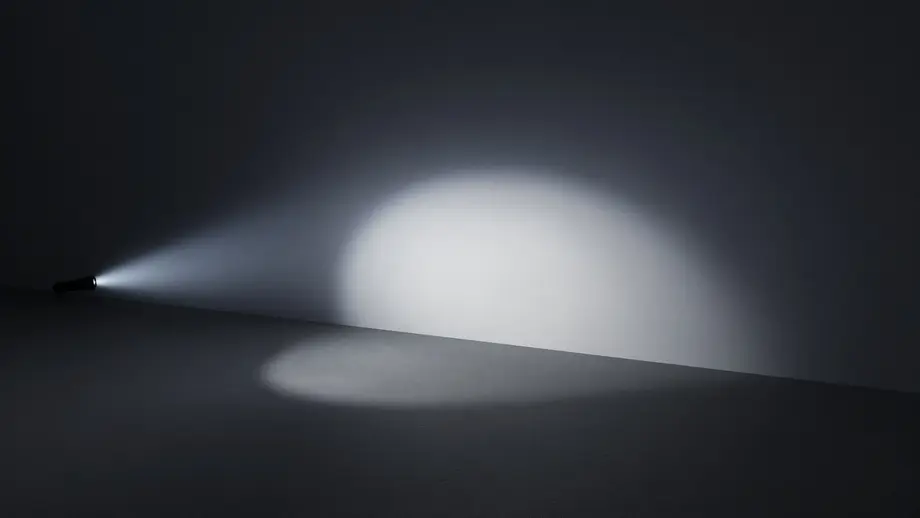
Olight makes some of the lights discussed here. Olight specs and regular prices come from its US product pages and user manuals as of September 2026. Every lux figure below is a calculation from published numbers, based on Olight's rated lumens and candela, not measured.
⚡ TL;DR
You cannot convert lumens to lux with lumens alone. Lux is lumens per square meter, so you also need the area the light lands on. For a flashlight, that means the beam angle and the distance, or the candela rating. This page gives a lux chart for eight beam angles at six distances, plus steps to run the math yourself.
A product page lists 1,600 lumens, a lighting guide asks for 300 lux on a page, and most online calculators quietly assume an area you never chose.
This table shows what a lumens to lux conversion needs, and the formula for each case.
| What you know | How to calculate illuminance | Worked example |
|---|---|---|
| Lumens and the lit area | lux = lumens ÷ area in m² | 300 lm spread evenly over 2 m² = 150 lux |
| Lumens, full beam angle θ and distance d | lux ≈ lumens ÷ [π × (d × tan(θ ÷ 2))²] | 1,000 lm in a 30° beam at 5 m ≈ 177 lux average |
| Candela and distance | lux = candela ÷ d² | 16,895 cd at 8 m ≈ 264 lux at beam center |
| Foot-candles | lux = foot-candles × 10.764 | 20 fc ≈ 215 lux |
| Lumens only | No valid answer | Find the beam angle or the candela first |
📋 Table of Contents
- 1. Quick Answer: You Need Beam Angle and Distance to Convert Lumens to Lux
- 2. How Do You Convert Lumens to Lux?
- 3. What Is the Formula for Illuminance?
- 4. Lumens to Lux Conversion Chart by Beam Angle and Distance
- 5. Why Candela Converts to Lux More Accurately Than Lumens
- 6. How Many Lux Do I Need to Read?
- 7. Lux Targets for Common Tasks: Reading, Fine Work, Walking and Inspection
- 8. Can You Measure Lux With Your Phone?
- 9. Flashlight Lux Calculator: A Worked Example
- 10. Common Conversion Mistakes and How to Avoid Them
- 11. Your Lumens to Lux Checklist
- 12. FAQ
Quick Answer: You Need Beam Angle and Distance to Convert Lumens to Lux
To convert lumens to lux, divide the lumens that land on a surface by that surface's area in square meters. A flashlight's lumen rating counts all its light, not the light on your target, so you first need the beam angle and distance to find the lit area. If the maker lists candela, skip the area: lux at the beam center equals candela divided by distance squared.
Lumens describe light leaving a flashlight; lux describes light arriving at one spot. The same 1,000 lumens give about 1,663 lux across a 10° beam at 5 m and about 38 lux across a 60° beam, a 44-fold spread from one lumen figure.
So when you compare flashlights for a task with a lux target, write down rated lumens, rated candela and the working distance first. If a spec-sheet unit is unclear, our list of flashlight terms defines each in one sentence.
How Do You Convert Lumens to Lux?
Convert lumens to lux in four steps. Pick the full beam angle, measure the distance to the target, find the radius of the lit circle as distance × tan(angle ÷ 2), then divide the lumens by the circle's area, π × radius². The answer is the average lux across the spot, assuming every lumen lands evenly inside it.
Here is the method with a 1,000-lumen light, a 30° beam and a wall 5 m away:
- Half the beam angle: 30° ÷ 2 = 15°. The tangent of 15° is 0.268.
- Radius of the lit circle: 5 m × 0.268 = 1.34 m.
- Area of the circle: π × 1.34² = 5.64 m².
- Average illuminance: 1,000 lm ÷ 5.64 m² = 177 lux.
The answer assumes all 1,000 lumens land inside the circle, and evenly. Real flashlights lose some light to a dim spill ring and are brighter at the center, so treat the result as an upper-bound average, not a meter reading.
This table defines each quantity, its typical range and how to judge it.
| Concept | Unit | Typical range you will see | How to judge it |
|---|---|---|---|
| Luminous flux (total output) | lumen (lm) | Under 1 to 10,000 lm across Olight modes | Sets the light budget, not the light on target |
| Luminous intensity (beam center) | candela (cd) | About 18 cd on a moonlight mode to 140,000 cd on a search light | Divide by distance squared to get lux at the beam center |
| Illuminance (light on a surface) | lux (lx) | 0.25 lx (FL1 beam-distance limit) to 10,000 lx (IES top category) | Compare with the IES task table below |
| Beam angle (full cone) | degrees | 5° spot to 120° flood | Wider angle spreads the same lumens over more area |
| Distance | meters | 0.3 m for reading to 50 m for a yard | Doubling it cuts lux to one quarter |
What Is the Formula for Illuminance?
The formula for illuminance is E = Φ ÷ A: luminous flux in lumens divided by the area it falls on in square meters, giving lux. For a small source seen from a distance, a second form applies: E = I ÷ d², where I is luminous intensity in candela and d is distance in meters.
The International Commission on Illumination (CIE) defines illuminance in CIE S 017:2020 as the "density of incident luminous flux with respect to area at a point on a real or imaginary surface," and adds that "The illuminance is expressed in lux (lx = lm·m−2)." Its entry for luminous intensity defines it as "density of luminous flux with respect to solid angle in a specified direction," expressed in candela, where cd = lm·sr−1.
NIST's SI Brochure, SP 330 (2019 edition), lists the same chain in its table of derived units: the lumen as lm = cd sr and the lux as lm/m². It also states, "Lumen and lux are derived from the base unit candela." For US spec sheets that use foot-candles, NIST SP 811, Appendix B.9 gives the factor: 1 footcandle = 10.76391 lux.
The candela form needs one caution. CIE's luminous intensity entry notes that "For practical realization of the quantity, the source is approximated by a point source." A flashlight head behaves like a point only from well back, which is why the 1 m column of the chart below is the least reliable.
This table lists the standards behind every formula on this page, with the version of each.
| Source and version | Clause or entry | What it fixes |
|---|---|---|
| CIE S 017:2020 ILV | 17-21-060, illuminance | lx = lm·m−2, so E = Φ ÷ A |
| CIE S 017:2020 ILV | 17-21-045, luminous intensity | cd = lm·sr−1; point-source approximation |
| NIST SP 330, 2019 edition | Table of derived units | lm = cd sr; lx = lm/m² |
| NIST SP 811, Appendix B.9 | Footcandle to lux | Multiply by 10.76391 |
| ANSI/PLATO FL 1 (via Streamlight's summary; current edition FL 1-2025) | Peak beam intensity, beam distance | Candela on the beam axis; 0.25 lux limit |
| IESNA Lighting Handbook, 9th edition | Figure 10-9 | Task categories from 30 to 10,000 lux |
Lumens to Lux Conversion Chart by Beam Angle and Distance
The chart gives average lux per 1,000 lumens for eight full beam angles at six distances, using lux = 1,000 ÷ [π × (d × tan(θ ÷ 2))²]. Multiply by your lumens ÷ 1,000 to scale it; a 1,600-lumen light is 1.6 times the listed value. It assumes all lumens land evenly inside the cone, so read it as an upper-bound average.
This chart covers distances from arm's length to a large yard.
| Full beam angle | 1 m | 3 m | 5 m | 10 m | 25 m | 50 m |
|---|---|---|---|---|---|---|
| 5° (narrow spot) | 166,980 lx | 18,550 lx | 6,680 lx | 1,670 lx | 267 lx | 66.8 lx |
| 10° | 41,590 lx | 4,621 lx | 1,663 lx | 416 lx | 66.5 lx | 16.6 lx |
| 20° | 10,240 lx | 1,138 lx | 410 lx | 102 lx | 16.4 lx | 4.1 lx |
| 30° | 4,433 lx | 493 lx | 177 lx | 44.3 lx | 7.1 lx | 1.8 lx |
| 45° | 1,855 lx | 206 lx | 74.2 lx | 18.6 lx | 3.0 lx | 0.74 lx |
| 60° | 955 lx | 106 lx | 38.2 lx | 9.5 lx | 1.5 lx | 0.38 lx |
| 90° (wide flood) | 318 lx | 35.4 lx | 12.7 lx | 3.2 lx | 0.51 lx | 0.13 lx |
| 120° | 106 lx | 11.8 lx | 4.2 lx | 1.1 lx | 0.17 lx | 0.04 lx |
Read the chart in two directions. Across a row, 3 m gives one ninth of the 1 m value and 10 m one hundredth. Down a column, halving the beam angle roughly quadruples the lux, because the lit area shrinks with the square of the radius. That second pattern is the one lumen ratings hide.
Treat the 1 m cells as rough, since a narrow beam may not be fully formed that close, and remember the chart ignores spill. For how far a beam carries rather than how much light it puts on a surface, see our guide to flashlight throw vs flood.
Why Candela Converts to Lux More Accurately Than Lumens
Candela converts to lux more accurately because it describes the beam center, the spot you aim at, while lumens count every direction. Under ANSI/PLATO FL1, peak beam intensity is the maximum intensity, typically on the beam axis, so lux at the center is simply candela ÷ distance². Lumens need a beam angle that makers rarely publish, and a wrong guess moves the answer about threefold.
Streamlight's ANSI/PLATO FL1 summary defines peak beam intensity as "The maximum luminous intensity typically along the central axis of a cone of light," reported in candela, and beam distance as "The distance from the device at which the light beam is 0.25 lux." Our ANSI FL1 guide covers the other ratings, and our beam distance explainer shows how that limit turns candela into meters.
Here is how much a beam-angle guess can mislead. The Olight Seeker 4 Pro is rated at 4,600 lumens and 16,895 candela. At 8 m, the candela route gives 16,895 ÷ 64 = 264 lux at the beam center. The lumen route gives 736 lux if you guess a 20° beam and 69 lux if you guess 60°. The first guess overshoots by 2.8 times; the second undershoots by 3.8 times.
You can also ask what beam angle a light's own ratings imply. Divide rated lumens by rated candela to get a solid angle in steradians, then convert: full angle = 2 × arccos(1 − steradians ÷ 2π). The result is the "equivalent even-beam angle," the width of an imaginary flat, even beam that would produce the rated candela from the rated lumens. It is a calculation, not a figure Olight publishes.
This table converts four Olight ratings into equivalent even-beam angles, so you know which chart row to read for each light.
| Light (Olight rating) | Rated lumens | Rated candela | Lumens ÷ candela | Equivalent even-beam angle | Nearest chart row |
|---|---|---|---|---|---|
| Marauder Mini 2 spotlight (assumes the 140,000 cd belongs to the spotlight) | 1,350 lm | 140,000 cd | 0.0096 sr | About 6.3° | 5° to 10° |
| Baton 4 Pro | 1,600 lm | 10,000 cd | 0.160 sr | About 25.9° | 20° to 30° |
| Seeker 4 Pro | 4,600 lm | 16,895 cd | 0.272 sr | About 33.9° | 30° |
| Perun 3 | 3,000 lm | 6,400 cd | 0.469 sr | About 44.5° | 45° |
Plug an equivalent angle back into the chart formula and it lands close to the candela answer. For the Olight Baton 4 Pro, 1,600 lumens across 25.9° at 10 m gives about 96 lux, against 10,000 ÷ 100 = 100 lux by candela; the 4% gap comes from treating the target as a flat disk. Real hotspots are narrower and spill wider, so the equivalent angle predicts the beam center well and the edges poorly.
The Olight Marauder Mini 2 shows where the lumen route is the only one left. Olight lists one maximum intensity, 140,000 candela, for the whole light and no candela for the floodlight alone. Its floodlight at Level 1-2 is rated at 150 lumens for 27 hours; from the chart, that is about 143 lux at 1 m over a 60° flood, or 48 lux over 90°. With no published flood angle, only a lux meter narrows that range.
How Many Lux Do I Need to Read?
For reading, the IESNA Lighting Handbook, 9th edition (2000), assigns category D, 300 lux (30 fc), to casual reading in a chair or at a desk, and category E, 500 lux (50 fc), to serious reading. OSHA's workstation guidance gives 20 to 50 foot-candles, about 215 to 538 lux, for paper tasks. The low modes below reach 300 lux within about an arm's length.
The categories come from Figure 10-9, "Determination of Illuminance Categories," in the IESNA Lighting Handbook, 9th edition. Category D covers "Performance of visual tasks of high contrast and large size." The handbook's design guide lists reading in a chair as D when casual and E when serious. Designers should use the IES's current documents; for flashlight users, these categories remain a public yardstick.
OSHA's Computer Workstations eTool, as posted in September 2026, says: "Generally, for paper tasks and offices with CRT displays, office lighting should range between 20 to 50 foot-candles." It also advises supplemental task lighting "to adequately illuminate writing and reading tasks."
A flashlight is a task light, so the useful question is how far away a given mode reaches a reading level. This table estimates that distance for four low and medium modes, scaling each light's rated candela by the mode's lumens and solving d = √(candela ÷ lux).
| Mode (Olight rating) | Estimated beam-center candela | Distance for 300 lux (IES D) | Distance for 500 lux (IES E) |
|---|---|---|---|
| Seeker 4 Pro Moonlight, 5 lumens, 15 days | 16,895 × 5 ÷ 4,600 = 18.4 cd | 0.25 m | 0.19 m |
| Baton 4 Pro Low, 15 lumens, 155 hours | 10,000 × 15 ÷ 1,600 = 93.8 cd | 0.56 m | 0.43 m |
| Seeker 4 Pro Low, 50 lumens, 60 hours | 16,895 × 50 ÷ 4,600 = 183.6 cd | 0.78 m | 0.61 m |
| Baton 4 Pro Medium, 120 lumens, 18 hours 30 minutes | 10,000 × 120 ÷ 1,600 = 750 cd | 1.58 m | 1.22 m |
These are beam-center estimates from Olight's rated candela and lumens, not measured, assuming the beam keeps its shape as output drops. At 0.61 m, the Seeker 4 Pro's 33.9° equivalent beam spans about 0.37 m, wider than a letter page; at 0.43 m, the Baton 4 Pro's 25.9° beam spans about 0.20 m, a little narrower than the page's 0.216 m, so its edges read lower.
For special visual tasks, the IES handbook adds: "Higher recommended levels are often achieved by moving the light source closer to the task." Moving closer is free, while a higher mode costs runtime: the Baton 4 Pro runs 155 hours on Low but 18 hours 30 minutes on Medium.
Safety note: Bounce the beam off the page, not toward your face. The Baton 4 Pro user manual warns, "Do not look directly at the light source or shine it in eyes, as this may cause temporary blindness and serious retinal damage." It also warns, "Do not obstruct the light-emitting port at close range; the energy emitted may cause nearby objects to ignite," so never rest a lit head on a book or fabric.
Lux Targets for Common Tasks: Reading, Fine Work, Walking and Inspection
Most everyday tasks fall between 30 and 1,000 lux. The IESNA 9th edition sets 30 lux for public spaces, 50 lux for short visits, 100 lux for simple working spaces, 300 to 1,000 lux for common visual tasks by contrast and size, and 3,000 to 10,000 lux for tasks near the threshold of vision. Convert any foot-candle figure by multiplying by 10.764.
This table lists the seven IES categories, their handbook descriptions and what each means for a handheld light.
| IES category (9th edition) | Illuminance | IES description | What it means with a flashlight |
|---|---|---|---|
| A | 30 lx (3 fc) | Public spaces | Finding your way; Baton 4 Pro Low reaches it out to √(93.8 ÷ 30) = 1.8 m |
| B | 50 lx (5 fc) | Simple orientation for short visits | Walking a hallway or stairway (listed as B in the design guide) |
| C | 100 lx (10 fc) | Working spaces where simple visual tasks are performed | Finding a tool, reading a large label at a few meters |
| D | 300 lx (30 fc) | Visual tasks of high contrast and large size | Casual reading; checking a breaker label |
| E | 500 lx (50 fc) | High contrast and small size, or low contrast and large size | Serious reading; small print on a part |
| F | 1,000 lx (100 fc) | Visual tasks of low contrast and small size | Fine work; close inspection of a dark part |
| G | 3,000 to 10,000 lx (300 to 1,000 fc) | Visual tasks near threshold | Supplementary task lighting held close to the work |
For inspection, the design guide's industrial section lists D when simple, F when difficult and G when exacting. The handbook describes category G as tasks with "very small or very low contrast critical elements" and says levels "should be achieved with supplementary task lighting." That is the role a flashlight plays best. Our pen light guide works through close-range inspection with a much smaller light.
Run the conversion backward to find how many lumens must land on a spot to reach a category. The answer is lux × area, and it is independent of beam angle. This table gives the lumens needed inside a round spot of four diameters.
| Target | 0.5 m spot (0.196 m²) | 1 m spot (0.785 m²) | 2 m spot (3.14 m²) | 5 m spot (19.6 m²) |
|---|---|---|---|---|
| A, 30 lx | 6 lm | 24 lm | 94 lm | 589 lm |
| B, 50 lx | 10 lm | 39 lm | 157 lm | 982 lm |
| C, 100 lx | 20 lm | 79 lm | 314 lm | 1,963 lm |
| D, 300 lx | 59 lm | 236 lm | 942 lm | 5,890 lm |
| E, 500 lx | 98 lm | 393 lm | 1,571 lm | 9,817 lm |
| F, 1,000 lx | 196 lm | 785 lm | 3,142 lm | 19,635 lm |
These are lumens that must land inside the spot, so a flashlight's rated output must be higher. Lighting a 2 m circle to reading level takes at least 942 lumens on target, which no low mode supplies. For what those levels look like in a room, our guide answers how bright is 2000 lumens.
Can You Measure Lux With Your Phone?
You can get a rough lux reading with a phone, but not a reliable one without calibration. In a 2017 study in Applied Sciences, an uncalibrated phone ambient light sensor read with an absolute error of 39.08% against a calibrated lux meter, falling to 8.41% after calibration. The authors call phones useful "when high precision of data is not required."
The study, Smartphones as a Light Measurement Tool by Gutierrez-Martinez and colleagues, compared three phones with a calibrated PCE-174 lux meter under a dimmable 220 W incandescent bulb in a dark room. The authors note the phone sensor "is only able to read direct light," and that calibration "requires the use of a calibrated luxmeter, which is not a common device for users."
That result has boundaries: three older phones, one incandescent source and indoor levels up to several hundred lux. It says nothing about a flashlight hotspot of thousands of lux or about current models. The IES handbook's footnote to Figure 10-9 allows measured values within ±10% of a recommendation, a tolerance the uncalibrated phone missed.
If you still want to check the chart with a phone, keep the method consistent:
- Work in a dark room with the phone flat on the target, its light sensor (usually near the earpiece) facing the light, at a taped distance.
- Switch on and wait 30 seconds, the point at which FL1 takes its initial output reading.
- Take three readings with the hotspot on the sensor and keep the highest.
- Compare with candela ÷ distance², and use the ratio to correct later readings on the same phone.
Note: Olight's figures come from lab conditions. The Marauder Mini 2 manual says its data are "tested per ANSI/NEMA FL 1-2009 standard in Olight's labs for reference" and that "The tests are performed indoors under a room temperature of 25 degrees celsius with windless conditions." The current edition is ANSI/PLATO FL 1-2025. Backyard readings will differ.
Flashlight Lux Calculator: A Worked Example
Suppose you need 100 lux (IES category C) to find tools on a garage floor. How far does the Seeker 4 Pro's Medium mode reach that level? About 3.3 m, with 122 lux at the beam center at 3 m, based on Olight's rated candela, not measured. Repeat these steps for any light.
- Write down the ratings. The Seeker 4 Pro lists 4,600 lumens and 16,895 candela at Turbo, and Medium at 300 lumens for 11 hours.
- Scale the candela to your mode. Assuming the beam keeps its shape: 16,895 × 300 ÷ 4,600 = 1,102 candela.
- Find lux at your distance. 1,102 ÷ 3² = 122 lux at 3 m; 1,102 ÷ 5² = 44 lux at 5 m.
- Solve for the distance that meets the target. d = √(1,102 ÷ 100) = 3.3 m for 100 lux, and √(1,102 ÷ 50) = 4.7 m for 50 lux (IES category B).
- Check the width. With the 33.9° equivalent angle, the spot at 3.3 m is about 2 × 3.3 × tan(16.9°) = 2.0 m across.
- Cross-check with the chart. Reading 300 lumens across 33.9° at 3 m from the chart formula gives about 115 lux, within 7% of the candela answer.
The result: Medium puts category C light on a circle about 2 m wide out to roughly 3.3 m, for 11 hours. To reach 100 lux on a wall 6 m away, you need 100 × 6² = 3,600 candela, which means High (1,200 lumens for 135 minutes, about 4,407 cd) rather than Medium.
The Seeker 4 Pro costs $139.99 (regular price for the Matte Black CW listing, September 2026) and weighs 205 g in its standard finishes. Its manual lists a working temperature of 0 to 40 °C and says the ratings are "tested per ANSI/PLATO FL 1-2019 standard in Olight's labs for reference." The limit: at 133 mm and 205 g it is not a pocket light. The Baton 4 Pro ($69.99, regular price for the default Matte Black CW Circuit Tree listing, September 2026) is, and it reaches 100 lux out to √(750 ÷ 100) = 2.7 m on Medium.
Warning: Do not leave either light charging or stored in a hot car. The Baton 4 Pro manual says, "Do not store, charge, or use this light in a car where the temperature inside may exceed 60°C or in similar environments," and, "When carrying or transporting, ensure the flashlight is locked to prevent accidental activation that could lead to fire hazards."
Common Conversion Mistakes and How to Avoid Them
Most conversion errors come from dropping the area term: treating a lumen rating as light on the target, trusting a calculator's hidden assumption, or reading FL1 beam distance as a comfortable seeing distance. Every fix comes back to the same formula: lux equals lumens per square meter, or candela divided by distance squared.
This table lists the common misconceptions, the correct statement and the source or calculation behind it.
| Misconception | Fact | Basis |
|---|---|---|
| 1 lumen equals 1 lux | Only when 1 lumen lands evenly on exactly 1 m² | NIST SP 330: lx = lm/m² |
| An online calculator can turn flashlight lumens into lux | It needs an area or beam angle, or it assumes one for you | E = Φ ÷ A |
| More lumens always put more lux on a target | The Seeker 4 Pro (4,600 lm, 16,895 cd) gives 42 lux at 20 m; the Baton Ultra (1,800 lm, 22,500 cd) gives 56 lux | lux = cd ÷ d² from Olight ratings |
| Lux falls in step with distance | It falls with distance squared: twice as far, one quarter the light | Chart rows |
| FL1 beam distance is where you can see well | It is where the beam falls to 0.25 lux, below IES category A (30 lux) by a factor of 120 | Streamlight FL1 summary |
| A phone app reading settles an argument | One study found 39.08% error before calibration | Gutierrez-Martinez et al., 2017 |
The third row surprises buyers. The Seeker 4 Pro has about 2.6 times the lumens of the Baton Ultra, yet the Baton Ultra puts about 33% more light on the beam center at any distance, while the Seeker 4 Pro lights a far wider circle.
Your Lumens to Lux Checklist
Use this list whenever you need to turn a lumen rating into a lux figure for a real task. It takes a calculator and a spec sheet, and it shows when the numbers are good enough and when only a calibrated meter will settle the question.
- Take the lux target from the IES table: 50 lux to walk, 300 to read, 500 for small print, 1,000 for fine work.
- Measure the working distance in meters.
- If the light lists candela for your mode, compute candela ÷ distance². If it lists candela only at maximum, scale it by the mode's lumens.
- If it lists only lumens, run the chart at a tight and a wide beam angle and see whether both clear your target.
- For the spot width, use 2 × distance × tan(equivalent angle ÷ 2).
- Prefer moving closer over turning the light up, since runtime drops fast at higher modes.
- If you need a certified number for work, use a calibrated lux meter, not a phone app.
FAQ
Changelog
- September 25, 2026: First published.