Olight makes some of the lights discussed here. Olight specs and regular prices come from its US product pages and user manuals as of September 2026; LED component figures come from their makers. The ratios and percentages below are calculations from those published numbers, not lab measurements.
⚡ TL;DR
What is COB in a flashlight? COB stands for chip-on-board: many small LED chips mounted close together on one board under a single phosphor coating, so they glow as one even panel of light. COB is still LED technology. It gives wide, even light up close but a weak long-distance beam. In business email, COB usually means close of business.
You have probably seen COB printed on a magnetic hood light or a camp lantern, right next to a big lumen number. Then the questions start. Is it brighter than the LED flashlight you already own? Why does it light a whole engine bay but barely reach the end of the driveway? And why do red and brown wires look alike under it? This guide answers each one with the makers' own figures.
This table gives short answers to the questions people ask most about what a COB light is and when to buy one.
| Question | Short answer |
|---|---|
| What is a COB LED? | Many bare LED chips on one substrate under one shared phosphor coating |
| Is COB different from LED? | No. COB is a way of packaging LED chips, not a different kind of light source |
| Is COB brighter? | Not by default. Total output depends on each light's rated lumens, not on the emitter type |
| What is it good for? | Wide, even light at close range: engine bays, workbenches, campsites and power outages |
| Where does it fall short? | Long-distance beams, because a large glowing surface is hard to focus |
| What should you check? | Rated lumens, color rendering (CRI), color temperature, runtime and water resistance |
📋 Table of Contents
- 1. What Does COB Stand for in Lighting?
- 2. How Is COB Different From SMD and Single-Emitter LEDs?
- 3. Is COB Brighter Than LED?
- 4. What Is a COB Flashlight Used For?
- 5. Why Is a Long Beam Hard for a COB Light?
- 6. Common COB Myths: What the Specs Actually Say
- 7. How to Choose a COB Flashlight or Work Light
- 8. Olight Options for Wide, Even Light
- 9. Checklist: Choosing a COB Light for Your Job
- 10. FAQ
What Does COB Stand for in Lighting?
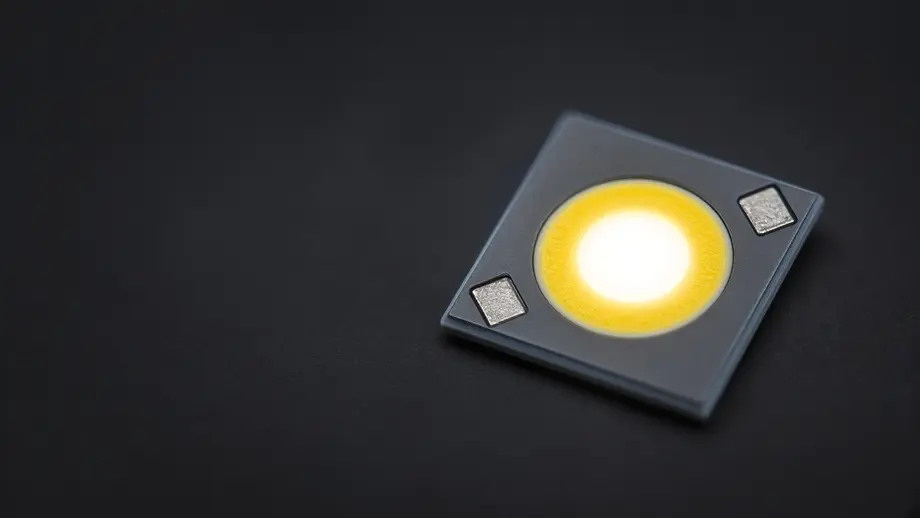
In lighting, COB stands for chip-on-board. LED maker Lumileds, in its guide to CoB LEDs, describes a COB LED as "a single device with many LED chips mounted on a thermally efficient substrate placed below a uniform phosphor coating." Each chip is a bare die with no package or lens of its own, so the chips can sit very close together on the board.
That construction is what gives COB its look. When a COB is switched on, it "appears more like a lighting panel than multiple individual lights," according to an introduction to COB LEDs published by electronics distributor DigiKey, which adds that a COB module typically combines nine or more chips. Lumileds notes that a single COB can contain hundreds of chips forming a dense array.
The white light itself comes from the same basic process used in most white LEDs. The chips emit blue light, and the phosphor layer converts it to white. The U.S. Department of Energy's LED color fact sheet explains that white LED light is most often made by combining a blue or near-ultraviolet emitting die with a yellow-emitting phosphor, or with a mix of phosphors that produces a broad range of wavelengths.
This table breaks a COB LED into its main parts and what each one does, based on Lumileds' description.
| Part | What it does |
|---|---|
| LED chips (bare dies) | Indium gallium nitride chips that emit blue light when energized |
| Substrate (the "board") | Holds the chips close together and carries heat away from them |
| Phosphor coating | One layer over the whole array converts blue light to white at a set color temperature |
| Two terminals | A single positive and negative connection powers every chip in the array |
How Is COB Different From SMD and Single-Emitter LEDs?
The difference is packaging. SMD means surface-mount device: a packaged LED soldered onto a circuit board. Small mid-power SMDs are often used in rows, while high-power emitters such as Lumileds' LUXEON HL4Z are also surface-mount packages with one small light-emitting surface. A COB places many bare chips under one coating to form a larger glowing surface.
Each layout changes how the light looks, how it is wired and how easily it can be focused. Lumileds points out that an array of packaged LEDs needs power traces routed to each LED, while a COB runs its whole array from one two-wire supply. It also notes that a COB's color is potentially more consistent, because one phosphor coating covers every chip instead of each LED carrying its own.
This table compares the three layouts on the points that matter in a flashlight or work light.
| Feature | COB LED | Array of small SMD LEDs | Single high-power LED (also SMD) |
|---|---|---|---|
| Construction | Many bare chips on one substrate under one phosphor coating | Several packaged LEDs, each with its own phosphor, soldered to a board | One surface-mount package with a small emitting area |
| Appearance when lit | One continuous panel of light | Separate points of light unless a diffuser blends them | One small, very bright point |
| Light-emitting surface | Large; Lumileds' LUXEON CoB Core Range spans 6.5 mm to 32.8 mm | Spread across the board | Small; Lumileds lists 2.16 mm × 2.16 mm for its LUXEON HL4Z |
| Wiring | One two-wire supply for the whole array | Power traces routed to each LED | One emitter to drive |
| Color consistency | One shared coating, potentially more consistent | Each LED has its own coating | One emitter, one coating |
| Beam control | Wide, even light is easy; a narrow beam needs a larger optic | Depends on the optics used with each LED | A small source suits a tight, long-reaching beam |
The substrate also matters for heat. DigiKey notes that a COB's ceramic or aluminum substrate acts as an efficient heat transfer medium when it is paired with an external heat sink. This helps because a COB's chips put all of their heat into one small spot.
Flashlight spec sheets rarely name the package type. If you browse Olight's flashlights, you will see lumens, candela, beam distance and runtime listed for each model, and those ratings tell you more about how a light will behave than a COB or SMD label does.
Is COB Brighter Than LED?
COB isn't brighter than LED, because a COB is an LED package, one way of arranging LED chips. Lumileds says a dense COB can "produce more light output from a smaller area than is generally possible with an array of packaged LEDs." A single high-power emitter uses a far smaller light-emitting surface, and total output still depends on rated lumens.
Total output depends on the design as a whole: how many chips are used, how hard they are driven, how well heat is removed and how much light the optics pass through. Efficacy, or lumens per watt, also varies by emitter; Lumileds, for example, lists 157 lm/W for its LUXEON HL4Z.
Heat is a key limit in a handheld light. The Department of Energy's thermal management fact sheet for white LEDs says excess heat affects performance and that "the short-term (reversible) effects are color shift and reduced light output while the long-term effect is accelerated lumen depreciation." A small flashlight body has limited room to shed heat, so a COB and a single emitter face the same constraint when they are pushed hard.
Compare two lights by their published ratings rather than the emitter type on the box. Check rated lumens for total output and candela for reach, and compare runtime at the level you will actually use. For a sense of what different lumen levels look like, see how bright 2,000 lumens is.
What Is a COB Flashlight Used For?
A COB flashlight or work light is used where you want wide, even light up close: under a car hood or a sink, across a workbench, inside a tent or around a room during a power outage. Without a focusing optic, its large glowing surface spreads light across the whole work area with no tight hot spot, but that spread leaves little peak intensity, so it does a poor job of lighting things far away.
COB LEDs are common in fixed lighting. DigiKey describes their primary use as replacements for metal-halide lamps in high-bay lighting, street lights, and high-output track lights and downlights, and Lumileds says that anyone who walks through a store or home with recessed or track lighting likely experiences light from a COB. The same traits, a compact source and an even output, also suit portable work lights and camp lights.
This table matches common close-range tasks with the reason even light helps and the feature worth looking for.
| Task | Why wide, even light helps | Feature to look for |
|---|---|---|
| Engine bay or under-sink repair | Lights the whole work area instead of one bright circle | A magnetic base, hook or clip for hands-free use |
| Workbench and garage | Spreads light across tools and parts with softer shadow edges than a single small emitter | A stand or hanging option and a long medium-mode runtime |
| Campsite and tent | Covers the ground and tent walls around you | Low modes and a red light to protect night vision |
| Power outage | Fills a room so people can move around safely | Long runtime on a low setting |
| Wiring, paint or first aid | Makes colors easier to judge when the light also has high CRI | A stated CRI of 90 or higher |
Where a COB falls short is reach. If you need to check a fence line, read a trail sign 50 meters ahead or search a yard, you want a focused beam with high candela. Nitecore's guide to the FL1 standard gives a quick way to read a spec sheet: "well-focused spot beams can be over 100 cd/lm, tactical flashlights are typically between 20-100 cd/lm, and work lights are less than 10 cd/lm." Divide a light's candela by its lumens to see which group it falls into. Our guide to beam distance explains how candela, not lumens, sets that number.
If you need a COB-style light for winter jobs, our roundup of work lights for cold garages and outdoor job sites compares picks for low temperatures.
Why Is a Long Beam Hard for a COB Light?
A COB struggles with long-distance beams because its light-emitting surface is large. Optics focus light best from a small source, and LEDiL, a maker of LED optics, notes that "a larger LES generally makes it more difficult to achieve ultra-narrow beams." To get a narrow, far-reaching beam from a large COB, a light would need a much bigger lens or reflector, which is hard to fit in a pocket-size flashlight.
LEDiL's article on narrowing beam angles spells out the trade-off: "If further reduction of the deviation angle is needed, either the optic must be enlarged or the LED's LES reduced." It adds that narrow beams "produce a higher candela peak and can achieve high intensity with fewer lumens than wider beams." In practice, that favors a large COB for broad flood light and a small emitter for a focused, far-reaching beam.
Lumileds' own figures show the size gap: it lists its LUXEON CoB Core Range with light-emitting surfaces from 6.5 mm to 32.8 mm across, while its LUXEON HL4Z high-power emitter delivers 635 lumens (typical) from a 2.16 mm × 2.16 mm surface. Even Lumileds' high-density Core Range COBs, which it says focus on achieving the highest center beam candlepower, come with light-emitting surfaces of 6 mm to 11 mm.
This table compares those published COB surface sizes with the HL4Z's 2.16 mm square, treating each COB surface as a circle of the listed diameter.
| Light-emitting surface | Width vs HL4Z (2.16 mm) | Area | Area vs HL4Z (4.67 mm²) |
|---|---|---|---|
| LUXEON HL4Z, 2.16 mm × 2.16 mm | 1.0× | 4.67 mm² | 1× |
| High-density COB, 6 mm | 2.8× | 28.3 mm² | 6× |
| Core Range COB, 6.5 mm (smallest) | 3.0× | 33.2 mm² | 7× |
| High-density COB, 11 mm | 5.1× | 95.0 mm² | 20× |
| Core Range COB, 32.8 mm (largest) | 15.2× | 845 mm² | 181× |
Even the smallest COB here, the 6 mm high-density part, is nearly three times as wide as the single emitter and six times its area. By LEDiL's rule, holding the same narrow beam from that wider source needs a larger optic, which is why compact COB lights are built as floodlights.
A small keychain light shows the other approach. The Olight i3E EOS (90 lumens, 44 m, IPX8) uses one Philips LUXEON TX LED and a TIR lens that, according to Olight's product page, focuses the light to reach up to 44 meters. Beam distance comes from peak intensity in candela, not total lumens, so a compact source behind a focusing optic can match the reach of a much brighter light that spreads its output wide. If you are deciding between a wide and a narrow beam in general, our guide to choosing a throw vs flood flashlight covers reflectors, TIR lenses and how to read beam distance in more detail.
Common COB Myths: What the Specs Actually Say
Most confusion about what a COB is comes from six claims that sound right on a store shelf but don't match the makers' own data. COB is not a separate technology from LED, it is not brighter by default, and it does not guarantee accurate color, cool running or submersion-proof housing. The table below sets each myth against the fact and the source you can check.
This table lists the six most common COB misconceptions, the fact that corrects each one and where that fact comes from.
| Misconception | Fact | Basis |
|---|---|---|
| COB is a different technology from LED | A COB is an LED package: many bare LED chips under one phosphor coating | Lumileds' definition of a CoB LED |
| A COB light is always brighter | Output depends on rated lumens, drive current, heat and optics, not the package name | Lumileds; each light's lumen rating |
| More lumens means more reach | Reach follows candela. The 90-lumen i3E EOS is rated at 44 m, almost as far as a 530-lumen floodlight rated at 45 m | Olight product pages |
| COB means accurate color | CRI is a separate spec. Lumileds' Core Range COBs span CRI 70 to 95 | Lumileds product listing; DOE CRI fact sheet |
| COB lights run cool | Excess heat causes color shift and reduced output in any white LED | DOE thermal management fact sheet |
| A water-resistant work light can go underwater | Splash and jet ratings differ from immersion ratings, and some manuals forbid immersion | IEC IP code; Olight IP guide; Oclip 2 user manual |
The 45 m floodlight in the third row is the floodlight channel of Olight's first-generation Oclip Ultra, rated at 530 lumens. The spotlight in the same body runs on the same battery with fewer lumens, yet Olight rates it at 130 m. The beam shape, not the lumen count, decided the reach.
How to Choose a COB Flashlight or Work Light
Choose a COB flashlight by the job first, then check five specs: rated lumens for the area you need to light, color rendering (CRI) if colors matter, color temperature, runtime at the brightness you will use most, and water resistance. Hands-free mounting matters too, because most close-range tasks keep both hands busy.
If you need to judge colors, check color rendering. A Department of Energy fact sheet on LED color describes the Color Rendering Index as a score that averages eight standard test colors and typically runs from 0 to 100. It says a CRI in the 70s is generally acceptable for interior lighting, the 80s are good and the 90s are excellent. The same fact sheet notes that saturated red, measured separately as R9, matters for skin tones.
Color temperature is a separate spec. It describes how warm or cool the light itself looks, not the color of the objects it lights, and the Department of Energy notes that within the same product family, higher color temperature LEDs tend to be more efficacious than lower color temperature versions. Our guide to neutral white vs cool white covers how to pick a tint.
Olight's Perun 3 Mini shows the trade-off in one model. Olight sells it as a cool-white version at CRI 70 and 5,700 K to 6,700 K, and as a neutral-white High CRI version at CRI 90 and 4,000 K to 5,000 K. It lists one set of runtimes for both, so the output cost of truer color can be read level by level.
This table sets the two Perun 3 Mini versions side by side from Olight's spec sheet and shows each High CRI figure as a share of the cool-white one.
| Level or rating | Cool white, CRI 70 | Neutral white High CRI, CRI 90 | High CRI as a share of cool white |
|---|---|---|---|
| Turbo | 1,250~350 lumens | 920~276 lumens | 74% (920 ÷ 1,250) |
| High | 500~350 lumens | 400~280 lumens | 80% (400 ÷ 500) |
| Med, 4.5 hours on both | 100 lumens | 85 lumens | 85% (85 ÷ 100) |
| Low, 30 hours on both | 10 lumens | 10 lumens | 100% |
| Peak intensity | 6,000 candela | 4,416 candela | 74% (4,416 ÷ 6,000) |
| Beam distance | 155 m | 133 m | 86% (133 ÷ 155) |
The cost of better color shrinks as you step down. At Turbo the High CRI version gives up about 26% of its output; its warmer tint may explain part of that, given the DOE note on color temperature above. At the medium level most close work runs on, the gap is 15 lumens, and at Low there is none. For color work at arm's length, judge the medium-mode figures, not the headline lumens.
This table lists each spec, its unit, the range you will see on real spec sheets and how to tell whether a number is enough for your job.
| Spec | Unit | Typical range on real spec sheets | How to tell if it is enough |
|---|---|---|---|
| Rated output | Lumens (lm) | 85 lm (Perun 3 Mini High CRI, Med) to 3,000 lm (Perun 3, Turbo) on the Olight lights here | Size the job to the medium mode, which runs far longer than turbo |
| Beam shape | Candela per lumen (cd/lm) | Under 10 for work lights; over 100 for well-focused spot beams (Nitecore) | Under 10 means a wide beam suited to close work |
| Color rendering | CRI, 0 to 100 | 70 to 95 across Lumileds' Core Range COBs; CRI 70 and CRI 90 on the two Perun 3 Mini versions | 90 or higher for wire colors, paint or first aid |
| Color temperature | Kelvin (K) | 2,200 K to 6,500 K across Lumileds' Core Range; 4,000 K to 6,700 K on the Olight whites here | Cool white for more output; neutral for a softer, truer look |
| Runtime | Hours at a named mode | 3 hours 45 minutes (Oclip 2 Pro floodlight, 100 lm) to 25 hours (Perun 3 Med, 120 lm) | Divide the runtime by the length of your typical job |
| Water resistance | IP code second digit, 0 to 9 | IPX4 splash to IP68 | IPX4 for rain and splashes; IPX7 or IPX8 if it may end up underwater |
| Mounting | Mount type | Magnet, hook, clip, stand or headband | Both hands stay free for the task |
The IEC, which created the IP ratings, says the second numeral "rates the enclosure's protection against liquids" on a scale from 0 to 9. Olight's guide to IP waterproof ratings groups IPX3 to IPX4 as splash proof, IPX5 to IPX6 as water jets, IPX7 as temporary immersion and IPX8 as continuous submersion.
CRI has limits. The same DOE fact sheet says CRI "cannot predict the visual ranking of a set of lighting products when white LED sources (either PC or RGB) are included in the set," and that there is no substitute for visual evaluation when color appearance is critical.
Tip: If color matters for your work, look at red and brown wires or a printed color chart under the light before you rely on it. Do it at the brightness you will actually work at, because a turbo test tells you little about a medium-mode job.
Olight Options for Wide, Even Light
None of the Olight lights below is described as COB on its product page, but each covers a close-range job people buy COB lights for. The Oclip 2 Pro puts a floodlight and a spotlight in one magnetic clip light, the Perun 3 is a headlamp with a 25-hour medium mode, and the Perun 3 Mini comes in a CRI 90 version for color work. Each has a limit worth knowing before you buy.
The Olight Oclip 2 Pro ($54.99, regular price, September 2026) is the closest fit for COB-style jobs. Olight says one selector switches between "a floodlight with up to 530 lumens, a 125-meter spotlight, and red light to help preserve night vision." Its head tilts 115°, the clip rotates 360°, and Olight says "tail and clip magnets turn it into a magnetic work light." It is rated IP66 and weighs 75.5 g. The limits: its floodlight holds 100 lumens for 3 hours 45 minutes on Medium, Olight lists no CRI or floodlight candela, and the user manual says, "Do not immerse the product in water or other liquids, as it will damage the product." Cold is the other limit for winter work: the manual says, "In environments below 0°C (32°F), the white light is limited to Low and Medium modes." You can compare the rest of the Olight Oclip series on the series page.
The Olight Perun 3 ($89.99, regular price, September 2026) is a headlamp that also works as a handheld light: 3,000 lumens, 160 m, IP68 and 150 g. For long jobs it runs 120 lumens for 25 hours, and its red light runs 60 lumens for 14 hours or 15 lumens for 70 hours. The limit is color: its user manual lists the cool white LED at 5,700 K to 6,700 K and CRI 70, so it is not the light for judging wire colors.
The Olight Perun 3 Mini is the pick when color matters more than runtime. Its High CRI version is rated CRI 90 at 4,000 K to 5,000 K, 920 lumens, 133 m and IPX8, and the light weighs 54 g with its battery. Olight lists $64.99 (regular price, September 2026) for the cool-white version. The limits: its medium level runs 85 lumens for 4.5 hours on a 650 mAh battery, and the High CRI user manual gives a working temperature of 0 to 40 °C, so it is a poor fit for an unheated winter garage.
Match the light to the job. Pick the Oclip 2 Pro when you need to stick a light to a hood and switch between flood and spot, the Perun 3 when a job or an outage runs for hours, and the Perun 3 Mini High CRI when you have to tell red from brown. If your jobs run longer than an hour at 300 lumens, plan to recharge the Oclip 2 Pro between them or pair it with a headlamp.
Safety note: Don't look into any of these lights at close range. The Oclip 2 user manual warns that looking directly at the light source "may cause temporary blindness or permanent damage to your eyes," and it also says not to place, charge or use the light where the temperature may exceed 60 °C.
Checklist: Choosing a COB Light for Your Job
Once you know what a COB is, use this checklist to decide in five minutes whether a COB light, a flashlight or both fit your job. Each step points to a number you can find on the spec sheet or in the manual, so you are not choosing by the COB label alone. Work down the list in order and stop when a step rules a light out.
- Name the job and the distance. Work at arm's length favors a wide flood beam; a fence line or a trail sign needs candela.
- Divide candela by lumens. Under 10 cd/lm reads as a work light; over 100 reads as a spotlight.
- Check the medium-mode runtime and divide it by your typical job length.
- If you judge wire colors, paint or wounds, look for CRI 90 or higher and check colors under the light.
- Match the IP rating to the wettest place the light will go, and read the manual for immersion warnings.
- Pick the mount your hands need free for: magnet, clip, hook, stand or headband.
FAQ
Changelog
- September 26, 2026: First published.