Olight makes the lights discussed here. Olight specs, cold-weather limits and regular prices come from its US product pages and user manuals as of September 2026. The output shares, coverage areas and charges per shift below are calculations from those published numbers, not measurements.
⚡ TL;DR
A cob work light or any wide-flood clip light keeps working in a cold garage, but its battery sets the rules. Every Olight manual here puts 0 °C (32 °F) at the bottom of its working or charging range, and the Oclip 2 drops to Low and Medium white light below freezing. Pair a magnetic flood light with a headlamp, and keep the spare warm.
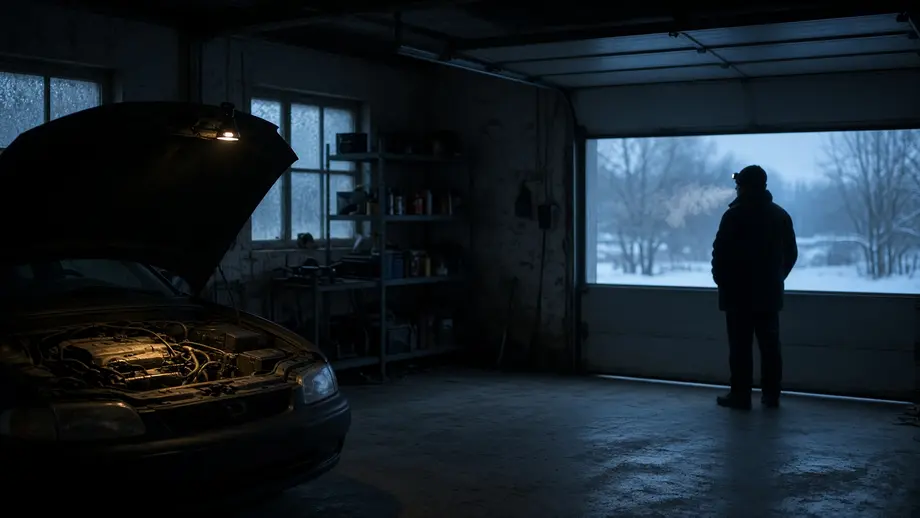
If you work in an unheated garage or on a winter site, you know the pattern. The light will not go to Turbo at 4 p.m., the charging indicator flashes red in a cold truck, and a small button disappears under insulated gloves. This guide lists each light's cold limits from its manual, shows how much area a cold-limited mode covers and plans charges for a 10-hour shift.
This cob work light kit table lists each winter job, the light type that fits, the minimum spec to look for and the Olight model that meets it, with regular prices from September 2026.
| Job | Recommended type | Minimum spec for cold work | Recommended model (regular price) |
|---|---|---|---|
| Task light on a hood, panel door or steel stud | Magnetic clip flood light | Flood beam, a Medium mode that stays available below 0 °C, magnets, lockout | Olight Oclip 2 Pro ($54.99) |
| Long task shifts with fewer trips to a charger | Clip light with a charging dock | Dock that doubles total runtime, charged above 0 °C | Olight Oclip 2 Ultra Premium ($94.99) |
| Budget clip light for dry indoor bays | Magnetic clip light | Low and Medium below 0 °C; IPX6, not for immersion | Olight Oclip Pro S ($39.99) |
| Filling the shadow your body throws | Headlamp | 100 lumens or more for a full shift, glove-friendly switch | Olight Perun 3 ($89.99) |
| Pocket backup and outdoor site walk-arounds | Small handheld | Lockout, IPX8, 60 lumens for 8 hours | Olight Baton 4 ($54.99) |
📋 Table of Contents
- 1. Quick Answer: What Work Light Setup Survives a Cold Garage?
- 2. Do LED Work Lights Work in the Cold?
- 3. Is a COB Work Light Better in the Cold Than a Clip Flood Light?
- 4. Cold Limits by Model: What Each Olight Manual Says
- 5. How Much Area Can a Cold-Limited Work Light Cover?
- 6. What Is the Best Magnetic Work Light for a Cold Garage?
- 7. How Long Do Work Lights Last on a Charge?
- 8. Gloves, Switches and Cold Hands: Which Controls Work in Winter?
- 9. Scene Settings: Cold Garage, Outdoor Job Site and Panel Work
- 10. Electrician Flashlight Safety in the Cold: What OSHA and NFPA 70E Say
- 11. Five Winter Work Lights: Where Each Fits and Where It Doesn't
- 12. Winter Work Light Checklist
- 13. FAQ
Quick Answer: What Work Light Setup Survives a Cold Garage?
Use two lights and a warm pocket. A magnetic flood light such as the Oclip 2 Pro sits on the hood or panel door and lights the task. A headlamp fills the shadow your body makes. The light you are not using rides inside your coat. Olight's cold limits on its clip lights start at 10 °C (50 °F), so choose your modes before the job, not in the middle of it.
Olight groups its magnetic clip lights on one series page, and its EDC flashlights page covers small handhelds for the pocket. For head-worn options beyond the Perun 3, our best headlamps guide compares ten rechargeable models.
Do LED Work Lights Work in the Cold?
Yes, the LEDs do. In a U.S. Department of Energy case study, the GSA chose LED fixtures for a federal parking garage in Fairbanks, Alaska, partly for their "instant-on even in the cold" start. The weak link in a portable work light is the lithium-ion battery, which delivers less power when cold and should not be charged below 0 °C (32 °F). A cold-weather work light is really a battery plan.
The DOE case study notes that in Fairbanks "winter-time lows can drop as low as 50°F below zero," and that "The lighting products that are chosen must be able to function across this wide range of temperatures." Those were hard-wired fixtures, so no battery limits applied.
Charging is where the limit is sharpest. The US Fire Administration says: "You should store lithium-ion batteries at room temperature when possible. Do not charge them at temperatures below 32 degrees F (0 degrees C) or above 105 degrees F (40 degrees C)." Cell maker Molicel publishes a similar split: its INR-21700-P42A data sheet lists "Charge 0°C to 45°C" and "Discharge -40°C to 60°C." The light's own rating still comes from its maker, and Olight's manuals start at 0 °C.
How much does cold cost? Molicel's INR-21700-P50B page gives a 10-second peak power table for a 5.0 Ah 21700 cell at -10 °C (14 °F) and 25 °C (77 °F). Olight does not name the cells in its lights, so this table is an example of how one maker's cell behaves, not a rating of any Olight light.
| State of charge | Peak power at 25 °C | Peak power at -10 °C | Share kept at -10 °C |
|---|---|---|---|
| 100% | 397 W | 238 W | 238 ÷ 397 = 60% |
| 50% | 288 W | 133 W | 133 ÷ 288 = 46% |
A cold, half-drained cell in this example keeps less than half its 25 °C peak power. That is peak power, not runtime, and Olight publishes no sub-zero runtime for any light here. For what cold does to runtime at 0 °C, see our flashlight runtime guide.
Is a COB Work Light Better in the Cold Than a Clip Flood Light?
Not by itself. A cob work light (chip-on-board) and a clip flood light both use LEDs, and LEDs start in cold air. In winter, what separates two lights is the battery, the charging circuit, the modes the maker allows in the cold and the switch you must press in gloves. Olight does not describe any light in this guide as COB, so compare flood lights on those four points.
If a cob work light's manual gives no working or charging temperature range, assume it is rated for room temperature only.
Cold Limits by Model: What Each Olight Manual Says
Every light in this guide stops at 0 °C (32 °F) somewhere in its manual. The Oclip 2 series and Oclip Pro S describe cold behavior: no white Turbo from 0 to 10 °C, only Low and Medium white light below 0 °C, and no charging below 0 °C. The Perun 3 and Baton 4 list a 0 to 40 °C working range and describe no sub-zero behavior.
This table lists each model's working, charging and cold-weather limits exactly as its user manual states them.
| Model | Working range | Charging range | 0 to 10 °C (32 to 50 °F) | Below 0 °C (32 °F) |
|---|---|---|---|---|
| Oclip 2 Pro and Oclip 2 Ultra | Specification table: 0 to 45 °C for operating and charging | Will not charge below 0 °C or above 45 °C; red indicator flashes | White Turbo unavailable | White light Low and Medium only; UV Low only (Ultra) |
| Oclip Pro S | 0-40 °C | Will not charge below 0 °C or above 50 °C | White Turbo unavailable | White light Low and Medium only; UV Low only |
| Perun 3 | 0-40°C | No separate range stated | Nothing stated | Outside the rated range |
| Baton 4 | 0-40°C | No separate range stated | Nothing stated | Outside the rated range |
The Oclip 2 user manual words it this way: "In environments below 0°C (32°F), the white light is limited to Low and Medium modes, and the UV light is limited to Low mode only." It adds, "The product cannot be charged in environments below 0°C or above 45°C. The red indicator will flash rapidly as a reminder," and "In 0°C to 10°C conditions, the white light Turbo will be unavailable." The Oclip Pro S manual sets the same mode limits but a higher charging ceiling: "The product cannot be charged in environments below 0°C or above 50°C." Note the two different Oclip Pro S numbers: a 40 °C working ceiling and a 50 °C charging cutoff.
The thermometer rule: how much output each clip light keeps
This table turns the manual notes into the brightest white mode each clip light allows in each temperature band, and the share of peak output that leaves you, based on Olight's rated lumens.
| Light | 10 °C (50 °F) and above | 0 to 10 °C: brightest allowed | Below 0 °C: brightest allowed |
|---|---|---|---|
| Oclip 2 Pro floodlight | Turbo 530 lm | High 300 lm: 300 ÷ 530 = 57% | Medium 100 lm: 100 ÷ 530 = 19% |
| Oclip 2 Ultra floodlight | Turbo 580 lm | High 300 lm: 300 ÷ 580 = 52% | Medium 100 lm: 100 ÷ 580 = 17% |
| Oclip Pro S white light | Turbo 600 lm | High 300 lm: 300 ÷ 600 = 50% | Medium 100 lm: 100 ÷ 600 = 17% |
Below freezing, each clip light keeps about one-fifth or less of its peak. One more limit applies indoors: the Oclip 2 manual says "During charging, the white light is limited to Low and Medium modes," so running the light on its dock or a cable in a warm cab also caps it at Medium.
Tip: Stick a cheap dial thermometer on the garage wall at bench height. At 10 °C or below, start your clip light in High or Medium on purpose instead of discovering the Turbo lockout mid-task.
How Much Area Can a Cold-Limited Work Light Cover?
Less than most people expect. OSHA's construction lighting table sets 10 foot-candles for shops and electrical equipment rooms and 3 for field maintenance areas. A foot-candle is one lumen per square foot, so a 100-lumen Medium mode can bring at most 10 square feet up to 10 foot-candles, and only if every lumen lands on the work.
29 CFR 1926.56, Table D-3, assigns 10 foot-candles to "General construction plant and shops," with examples that include "mechanical and electrical equipment rooms" and "carpenter shops." It assigns 3 foot-candles to "General construction areas, concrete placement, excavation and waste areas, accessways, active storage areas, loading platforms, refueling, and field maintenance areas." A home garage is not an OSHA workplace, but the table is a useful benchmark. NIST's SI conversion factors give the same factor, 10.763 91 lux, for one footcandle and for one lumen per square foot, so 10 foot-candles is about 107.6 lux.
This table shows the largest area each light's cold-permitted mode could bring to those two levels, using area = lumens ÷ foot-candles. It is based on Olight's rated lumens, not measured, and assumes all output lands on the work surface, which no real light achieves.
| Light and mode (when allowed) | Rated output | Largest area at 10 fc (shops, equipment rooms) | Largest area at 3 fc (field maintenance) |
|---|---|---|---|
| Oclip 2 Pro flood, Medium (below 0 °C) | 100 lm | 100 ÷ 10 = 10 sq ft | 100 ÷ 3 = 33 sq ft |
| Oclip 2 Pro flood, High (0 to 10 °C) | 300~100 lm, 60 + 5 min | 300 ÷ 10 = 30 sq ft | 300 ÷ 3 = 100 sq ft |
| Oclip Pro S, Medium (below 0 °C) | 100 lm | 10 sq ft | 33 sq ft |
| Perun 3, Med (0 °C and up) | 120 lm | 12 sq ft | 40 sq ft |
| Baton 4, Med (0 °C and up) | 60 lm | 6 sq ft | 20 sq ft |
Ten square feet is roughly a 3 by 3.3 ft patch: one panel or one side of an engine bay. A clip light is a task light in winter, not a room light. For the room, use a mains-powered stand light; our work light stand guide covers height, tip-over and beam spread.
What Is the Best Magnetic Work Light for a Cold Garage?
For cold task work, the Olight Oclip 2 Pro is the best magnetic work light here. It has tail and clip magnets, a 115° tilting head, a 530-lumen floodlight and a Medium mode it keeps below freezing. Its limits are real: it must not be immersed, it loses Turbo below 10 °C, and Medium lasts under 4 hours. For a cheaper clip light, the Oclip Pro S follows the same cold rules.
The Olight Oclip 2 Pro clip light ($54.99, regular price, September 2026) is rated IP66 with 2.0 m impact resistance and weighs 75.5 g with its 600 mAh battery. Olight says, "Tail and clip magnets turn it into a magnetic work light," and the clip "grips objects up to 14 mm thick." Floodlight modes: Turbo 530~300~100 lumens for 1 + 58 + 5 minutes, High 300~100 lumens for 60 + 5 minutes, Medium 100 lumens, Low 10 lumens for 25 hours, Moon 1 lumen for 144 hours. Spotlight modes: Turbo 400~270~90 lumens for 1 + 58 + 5 minutes, High 270~90 lumens for 60 + 5 minutes, Medium 90 lumens, Low 9 lumens for 25 hours, Moon 1 lumen for 144 hours. Red light: 40 lumens for 4 hours or 4 lumens for 27 hours.
The Medium runtime differs between Olight's two sources: the product page lists 3 hours 45 minutes, and the user manual lists 3 h 30 min for both beams. This guide plans with the shorter figure. The manual lists full charge times of 1 h 30 min by USB-C, 1 h 45 min by the Charging Dock and 1 h 15 min by MCC cable.
Olight publishes no magnet pull-force rating, so treat the clip as the secure mount. The manual warns that "The switch is a magnetically sensitive component, and proximity to strong magnets may affect its functionality," so keep it off magnetic parts trays. Its aluminum body gets as cold as the car it sits on, and OSHA's cold stress guide advises, "Avoid touching cold metal or wet surfaces with bare skin."
Safety note: If you clip an Oclip 2 or Oclip Pro S to a coat front or chest strap, follow the manual: "If you have an ICD or pacemaker, avoid close or prolonged contact with this product to prevent possible interference." The Oclip 2 manual also says, "Do not immerse the product in water or other liquids, as it will damage the product," and "Do not look directly at the light source or shine it into your eyes, as this may cause temporary blindness or permanent damage to your eyes."
How Long Do Work Lights Last on a Charge?
At the steady modes you can use in the cold, from 3.5 to 25 hours on Olight's room-temperature ratings. The Oclip 2 Pro floodlight runs Medium for 3 h 30 min per its manual, the Baton 4 runs 60 lumens for 8 hours, and the Perun 3 headlamp runs 120 lumens for 25 hours, enough for two full shifts on one charge.
This table plans a 10-hour winter shift at each light's cold-permitted steady mode: how many charged lights to rotate so you never charge on site, and how long refilling them takes indoors. It is based on Olight's rated runtimes and manual charge times, not measured, and not adjusted for cold.
| Light and steady mode | Rated runtime | Charged lights to rotate for 10 hours | Full charge per light (manual) | Refill time on one charger |
|---|---|---|---|---|
| Oclip 2 Pro flood, Medium 100 lm | 3 h 30 min (manual); 3 h 45 min (page) | 10 ÷ 3.5 = 2.9, so 3 | 1 h 30 min by USB-C | 3 × 1.5 = 4.5 h |
| Oclip 2 Ultra Premium flood, Medium 100 lm, with dock | 3 h 30 min × 2 = 7 h | 10 ÷ 7 = 1.4, so 2 kits | 1 h 45 min by dock | Each dock also needs refilling |
| Oclip Pro S, Medium 100 lm | 3.5 h | 10 ÷ 3.5 = 2.9, so 3 | About 1.5 hours | 3 × 1.5 = 4.5 h |
| Baton 4, Med 60 lm | 8 h | 10 ÷ 8 = 1.25, so 2 | About 1 hour | 2 × 1 = 2 h |
| Perun 3, Med 120 lm | 25 h | 10 ÷ 25 = 0.4, so 1 | Under 4 hours | Under 4 h; one charge covers 2.5 shifts |
Every recharge must happen at 0 °C or warmer, so plan it for a break in the truck cab or shop. OSHA's cold stress guide already tells employers to "give workers frequent breaks in warm areas," and those breaks are your charging windows. The Oclip 2 manual says the Premium dock "doubles the light's total runtime when fully charged," but a dock in a sub-zero pocket or truck bed cannot top up the light, because the light itself will not charge below 0 °C.
Rotating lights through a warm pocket beats charging on site. Three charged Oclip 2 Pro lights cover 3 × 3.5 = 10.5 hours, and refilling all three takes 4.5 hours on one USB-C cable, which fits overnight indoors.
Gloves, Switches and Cold Hands: Which Controls Work in Winter?
Big, separate controls work best in gloves. OSHA's cold stress guide tells workers to "Use insulated gloves to protect the hands (water resistant if necessary)," and notes that in the cold the body shifts blood flow away from the hands. Olight calls the Perun 3's large metal side button "glove-friendly." The smaller side buttons need a try with your own gloves.
This table lists each light's controls as Olight describes them, with a glove check to run at home before the first cold job.
| Light | Controls (Olight) | Lockout | Glove check before the job |
|---|---|---|---|
| Oclip 2 Pro / Ultra | Side button plus a rotating selector for flood, spot and red (Ultra adds UV) | Hold side button over 2 s from off | Can you feel the selector detents and hit the button without switching beams? |
| Oclip Pro S | Side switch plus a rotating selector for UV, white and color light | Hold the button about 2 s from off | Can you tell white from UV by feel alone? |
| Perun 3 | "Large Metal Side Button: Enables simple, glove-friendly operation" | Hold about 2 s from off | Can you double-press for Turbo and hold for mode changes? |
| Baton 4 | Metal side switch | Hold about 2 s from off | Can you find the switch on a 63 mm body? |
OSHA lists losing coordination and fumbling "with items in the hand" among the symptoms of hypothermia. If you start fumbling a switch you normally work without thinking, treat it as a warning about you, not the light.
Scene Settings: Cold Garage, Outdoor Job Site and Panel Work
Each winter scene needs a different light level, runtime and water rating. A cold garage bench needs a clip light at the task and a headlamp. An outdoor site needs immersion-rated lights for snow and a headlamp for walking. Panel work needs a mounted flood light outside the enclosure and nothing conductive near energized parts.
This scene table sets the light level, runtime, water rating and picks for each winter sub-scene.
| Sub-scene | Light level benchmark | Runtime to plan | Water rating to look for | Olight picks |
|---|---|---|---|---|
| Cold garage bench or engine bay | 10 fc shop level on a small patch | 3 to 4 hours per clip light on Medium | IP66 or better near slush | Oclip 2 Pro plus Perun 3 |
| Outdoor job site walk and staging | 3 fc for field maintenance and accessways | A full shift without charging | IPX8 or IP68 in snow | Perun 3 plus Baton 4 |
| Electrical room or panel in winter | 10 fc for electrical equipment rooms | A full panel job on Medium | IP66 is enough indoors | Oclip 2 Pro on the door, Perun 3 on the head |
Cold garage lighting
Put the clip light on the hood edge or a steel shelf to light the task from the side, wear the headlamp for your own shadow, and keep a second clip light warm inside your coat. The Oclip 2 manual also says, "Do not obstruct the lens, or else the energy emitted from the light may cause the object to burn," so do not lay it face-down on a fender cover or rag.
Outdoor job site lighting
Outdoors, wear the Perun 3 (IP68) for walking and staging, and carry the Baton 4 (IPX8) for spot checks into trenches and truck beds. Both ratings suit snow better than the Oclip 2's IP66 or the Oclip Pro S's IPX6, so keep clip lights at sheltered tasks. Remember that OSHA's 3 foot-candle row covers "accessways" and "field maintenance areas," not the whole lot at night.
Electrical rooms and panels in winter
Stick the flood light on the outside of the enclosure door, aim it in and expect no Turbo below 10 °C. Our electrician flashlight guide covers panel placement, glare and wire colors.
Electrician Flashlight Safety in the Cold: What OSHA and NFPA 70E Say
Cold does not change the electrical rules, and a flashlight is never an insulating tool. OSHA requires insulated tools where a tool might contact exposed energized parts, and it bars construction work near a circuit unless the circuit is de-energized and grounded or guarded by insulation. NFPA 70E, now in its 2027 edition, is the consensus standard NFPA says assists in complying with those OSHA rules.
This rules table quotes each provision and states what it means for a work light on a cold job.
| Source and version | Text (quoted) | What it means for a work light |
|---|---|---|
| 29 CFR 1910.335(a)(2)(i)(2)(i)), general industry | "When working near exposed energized conductors or circuit parts, each employee shall use insulated tools or handling equipment if the tools or handling equipment might make contact with such conductors or parts." | A metal flashlight is not insulated handling equipment; keep it out of reach of live parts |
| 29 CFR 1926.416(a)(1)(1)), construction | "No employer shall permit an employee to work in such proximity to any part of an electric power circuit that the employee could contact the electric power circuit in the course of work, unless the employee is protected against electric shock by deenergizing the circuit and grounding it or by guarding it effectively by insulation or other means." | Light placement never substitutes for de-energizing or guarding |
| NFPA 70E, 2027 edition | "Originally developed at OSHA's request, NFPA 70E helps companies and employees avoid workplace injuries and fatalities due to shock, electrocution, arc flash, and arc blast, and assists in complying with OSHA 1910 Subpart S and OSHA 1926 Subpart K." | Follow your employer's 70E-based electrical safety program |
OSHA's electrical standards page lists NFPA 70E as a national consensus standard and notes, "These are NOT OSHA regulations."
Warning: A flashlight is not an insulated tool and not electrical protective equipment. Every light in this guide has a metal body (aluminum alloy or OAL, per Olight's specs), and Olight lists no electrical insulation rating or hazardous-location certification for any of them. De-energize, test and lock out under your employer's program before relying on any light near a panel.
Five Winter Work Lights: Where Each Fits and Where It Doesn't
Each light below fills one job in a cold kit. The Oclip 2 Pro is the task light, the Oclip 2 Ultra Premium stretches clip-light runtime with its dock, the Oclip Pro S is the budget clip light, the Perun 3 is the headlamp and the Baton 4 is the pocket backup. Each has one clear winter limit, listed at the end of its entry.
Olight Oclip 2 Ultra Premium: longer clip-light shifts
The Oclip 2 Ultra Premium ($94.99, regular price, September 2026) adds a 1,000 mAh Charging Dock to a 79.5 g light with an OAL body. Floodlight: Turbo 580~300~100 lumens for 1 + 57 + 5 minutes, High 300~100 lumens for 60 + 5 minutes, Medium 100 lumens for 3 hours 30 minutes, Low 10 lumens for 25 hours, Moon 1 lumen for 144 hours. Spotlight: Turbo 450~270~90 lumens for 1 + 57 + 5 minutes, High 270~90 lumens for 60 + 5 minutes, Medium 90 lumens for 3 hours 30 minutes, Low 9 lumens for 25 hours, Moon 1 lumen for 144 hours. Red light runs 40 lumens for 3 hours or 4 lumens for 22 hours, and UV runs 800~300 mW for 3 + 135 minutes or 300 mW for 140 minutes. Limit: below 0 °C, UV is Low only and white light is Low and Medium only, and the dock is rated IPX6.
Olight Oclip Pro S: the budget clip light
The Olight Oclip Pro page now sells the Oclip Pro S ($39.99, regular price, September 2026): 53 g, 1,600 candela, 80 m, IPX6. White light: Turbo 600~300~100 lumens for 1 + 50 + 30 minutes, High 300~180~100 lumens for 1 + 95 + 10 minutes, Medium 100 lumens for 3.5 hours, Low 10 lumens for 27 hours, Moon 1 lumen for 144 hours. It also has red, green, blue and 365 nm UV light. Limit: its manual says, "Do not immerse the product in water or other liquids, as it will damage the product," so keep it to dry bays.
Olight Perun 3: the headlamp
The Olight Perun 3 headlamp ($89.99, regular price, September 2026) is rated 3,000 lumens, 6,400 candela, 160 m and IP68 at 150 g. Modes: Turbo 3,000~800~600 lumens for 2 + 180 + 30 minutes, High 600~120 lumens for 300 + 30 minutes, Med 120 lumens for 25 hours, Low 30 lumens for 89 hours, Moon 5 lumens for 20 days, red light 60 lumens for 14 hours or 15 lumens for 70 hours. Its magnetic tail lets you "attach it to any iron surface." Limit: its manual lists a 0-40°C working range and cautions, "Do not stare at operating light source."
Olight Baton 4: the pocket backup
The Olight Baton 4 ($54.99, regular price, September 2026, standard version) is 63 mm long and 52.5 g, rated 1,300 lumens, 7,225 candela, 170 m and IPX8. Modes: Turbo 1,300~600~300 lumens for 1.5 + 2.5 + 73 minutes, High 600~300~60 lumens for 7 + 72 + 16 minutes, Med 60 lumens for 8 hours, Low 12 lumens for 35 hours, Moon 0.5 lumens for 30 days. It charges by MCC magnetic cable, and the Premium edition's 5,000 mAh charging case can also recharge it. Limit: a 0-40°C working range and no magnet or headband listed on its page.
Winter Work Light Checklist
Use this checklist before the first cold job of the season. Each step comes from the manual limits, OSHA text and calculations above, so you can check every line against your own lights, gloves and shift length before the temperature drops.
- Put a thermometer where you work. At 10 °C (50 °F) or below, plan without Turbo on the Oclip 2 and Oclip Pro S; below 0 °C, plan on Medium.
- Size the task, not the room. A 100-lumen Medium covers about 10 sq ft at shop levels at best; bring a stand light for the room.
- Count lights per shift. Divide your shift length by the Medium runtime, round up, and charge that many lights indoors the night before.
- Carry the spare inside your coat, locked. The Oclip 2 manual says, "If the product is carried or transported, please lock it."
- Try every switch in the gloves you will wear.
- Keep magnetic clip lights off chest pockets if you have an ICD or pacemaker, and never immerse the Oclip 2 or Oclip Pro S.
- Near panels, treat every light as conductive and follow your NFPA 70E-based program.
- Check any cob work light's manual for its working and charging range before you buy.
FAQ
Changelog
- September 26, 2026: First published.