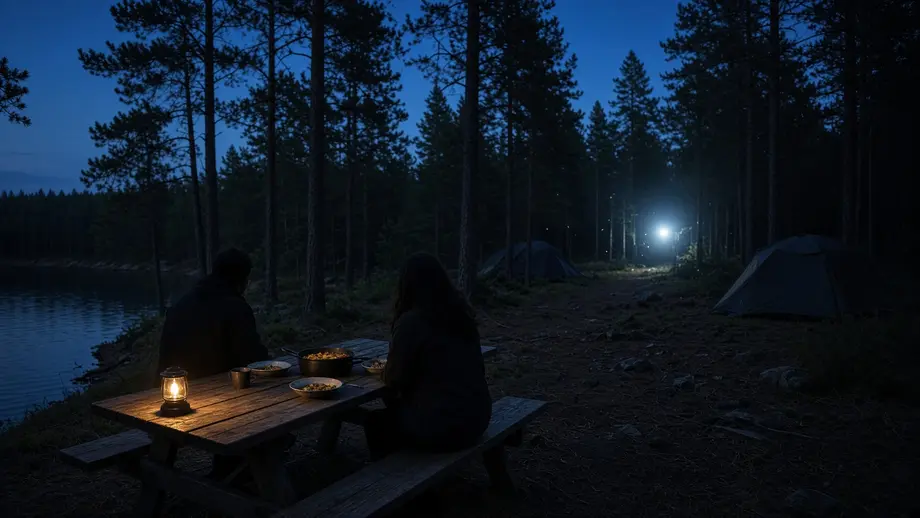
Olight makes the lights recommended here. Olight specs and regular prices come from its US product pages and user manuals as of October 2026. The crossover distances, dimming limits and per-1,000 figures below are calculations from published numbers, not field measurements.
⚡ TL;DR
Camping lights that don't attract bugs do not exist, but you can cut how many gather at your table. Use a warm, dim light at the table, red light for faces and tasks, and one cool white decoy light 10 to 15 m away. Insects that fly close to a light tend to get trapped circling it, so make the brightest light a decoy away from your dinner.
You know the scene: the lantern goes on the picnic table at dusk, moths orbit it, and gnats land in the chili. A yellow bulb helps, but not the way the ads say. Below: what light-trap studies found, then a placement plan with the math.
This table lists camping lights that don't attract bugs as much as a bare white lantern, by job, with the floor each light should meet.
| Use | Recommended type | Key parameter floor | Recommended model (Olight rating) |
|---|---|---|---|
| Table glow | Warm white 360° glow, dimmable | Stated color temperature under 3,000 K; lowest mode about 1 lumen | Olight Sphere C: 2,800 K, White Low 1 lm for 40 h |
| Decoy post, 10 to 15 m out | Cool white light you can hang | A steady mode near 30 lumens for a whole evening | Olight Perun 3: Low 30 lm for 89 h, magnetic tail |
| Faces, knots and plates | Headlamp or clip light with red | A red mode under 20 lumens | Perun 3 red Low 15 lm (70 h); Oclip 2 Pro red Low 4 lm (27 h) |
| Cooking at the stove | Floodlight you can aim down | A tilting head and about 100 lumens for a meal | Oclip 2 Pro: flood Medium 100 lm for 3 h 45 min, 115° tilt |
| Mosquito bites | Not a light | An EPA-registered skin repellent | No light replaces it |
📋 Table of Contents
- 1. Quick Answer: Are There Camping Lights That Don't Attract Bugs?
- 2. Why Do Bugs Swarm Camp Lights? Wavelength, Brightness and the Dorsal Tilt
- 3. Cool White, Warm White, Amber and Red: What Light-Trap Studies Found
- 4. Are There Any Outdoor Lights That Do Not Attract Bugs?
- 5. What Lights Attract the Least Amount of Bugs?
- 6. Which Light Does Not Attract Insects?
- 7. The Decoy Plan: A Bright Light Away and a Dim Camping Light for the Table
- 8. Campsite Lighting by Sub-Scene: Table, Stove, Decoy, Tent and Path
- 9. Night Fishing Lights That Don't Attract Bugs: Docks and Shorelines
- 10. Does Red Light Mean Zero Bugs at the Table?
- 11. Do Camping Lanterns With Bug Zappers Work?
- 12. Common Myth: LEDs Emit No UV, So They Don't Attract Bugs
- 13. Lights Don't Repel Mosquitoes: Pair Them With Real Bug Control
- 14. Olight Picks for a Low-Bug Camp Table, and Where They Fall Short
- 15. Your Low-Bug Camp Table Checklist
- 16. FAQ
Quick Answer: Are There Camping Lights That Don't Attract Bugs?
Not completely, but warm, dim and shielded camping lights draw the fewest bugs. University of Florida extension guidance and two peer-reviewed light-trap studies agree that ultraviolet and blue light attract the most insects, and filtered amber or warm light fewer. No lamp in those studies drew zero. The biggest gains come from using less light, keeping it low and moving the brightest light away from people.
The 2015 Los Angeles light-trap study puts the limit plainly: "All lamp types attracted more arthropods than the no-light control." If you are building a kit, Olight groups its outdoor and camping lights by use.
Why Do Bugs Swarm Camp Lights? Wavelength, Brightness and the Dorsal Tilt
Bugs swarm camp lights for two reasons. Most night-flying insects see ultraviolet, blue and green best, so cool white light looks bright to them. And a 2024 Nature Communications study found that flying insects turn their backs toward a light, a reflex that normally keeps them level under the night sky but traps them in loops around a lamp.
The University of Florida IFAS Extension exterior lighting guide says, "Insects see between 300nm to 650nm, including ultraviolet light, but really prefer between 300 to 420nm." It adds, "A lightbulb's UV output is the #1 factor in attracting insects."
In the Nature Communications study, Fabian and colleagues used motion capture and stereo video and found that "Contrary to the expectation of attraction, insects do not steer directly toward the light." They conclude that "artificial lights may only trap passing insects rather than attract them directly from farther away," and that "reducing unnecessary, unshielded, upward-facing lights and ground reflections can mitigate the impact on flying insects at night." For a table light, that means low, shielded and pointed down.
Cool White, Warm White, Amber and Red: What Light-Trap Studies Found
Light-trap studies rank blue-rich white light as the most attractive and filtered amber as the least, but the ranking is not a simple color temperature cutoff. In Peru, a 3,200 K white LED drew far more insects than 2,700 K yellow-filtered and 2,200 K amber-filtered lamps. In Los Angeles, LEDs with the same 2,700 K rating drew different numbers of insects.
This table sets out what each study or extension source compared, what it found, and how far its result carries to a camp table.
| Source and setting | Lamps compared | Finding | Limit for a camp table |
|---|---|---|---|
| Deichmann et al. 2021, lowland rainforest, northern Peru | White LED 3,200 K; yellow-filtered 2,700 K; amber-filtered 2,200 K; unlit control | White drew far more insects; amber drew the fewest overall | Tropical site never lit before; filtered lamps, not plain warm LEDs |
| Longcore et al. 2015, three Los Angeles County sites | Tuned LEDs at 3,510, 2,704 and 2,728 K; commercial 2,700 K LEDs and CFLs; unlit control | Tuned 2,700 K LEDs drew fewer insects than a commercial LED of the same rating; every lamp beat the control | Pan traps, 32 nights; indoor-type bulbs |
| UF/IFAS Extension buying guide | LEDs by color temperature; yellow bug lights | Under 3,600 K rated "most effective at decreasing insects"; cool white "slightly attractive to bugs" | Rule of thumb for porch bulbs, not a trap study |
The Peru study by Deichmann and colleagues in Insect Conservation and Diversity states that "White lamps (3200 K) attracted far more insects, both morphospecies and individuals," than the yellow or amber lamps. Note the number: 3,200 K counts as warm white under the UF guide's 3,600 K line, and it still lost badly to filtered amber.
The UCLA-run study of tuned LED lamps adds a second caveat: "not all lights with the same colour temperature are equally attractive to arthropods." Its authors report that "our two tuneable 2700 K LEDs were 20% and 21% less attractive to all orders combined than the commercial 2700 K LED," and that the tuned lamps drew "around three times fewer Hemiptera."
What the published percentages mean per 1,000 insects
This table converts published figures into insects per 1,000.
| Published figure | Calculation | Per 1,000 insects |
|---|---|---|
| Tuned 2,700 K LED: 20% less attractive than a commercial 2,700 K LED | 1,000 x (1 - 0.20) | About 800 at the tuned LED per 1,000 at the commercial one |
| Second tuned 2,700 K LED: 21% less attractive | 1,000 x (1 - 0.21) | About 790 per 1,000 |
| Hemiptera (true bugs): around three times fewer at the tuned LEDs | 1,000 / 3 | About 330 true bugs per 1,000 |
| Bug zapper: 31 biting flies of 13,789 insects | 31 / 13,789 x 1,000 | About 2.2 biting flies per 1,000 killed |
| Bug zapper: 6,670 aquatic insects of 13,789 | 6,670 / 13,789 x 1,000 | About 484 aquatic insects per 1,000 |
The first two rows matter most: two bulbs with the same label differed by about a fifth. A rated color temperature gives the direction, not the size, of the effect, and your campsite's insects may respond differently.
Are There Any Outdoor Lights That Do Not Attract Bugs?
No outdoor light is invisible to every insect. Amber-filtered LEDs, yellow bug bulbs and warm white LEDs all draw fewer insects than cool white or ultraviolet sources, but each still draws some. University of New Hampshire Extension says yellow lights "are not a cure-all," and the Peru study found click beetles and fungus flies preferred amber light.
UNH Extension's bug-friendlier lighting article adds, "The wavelengths visible to insects vary by type." The Peru study's abstract says amber lamps "attracted the fewest morphospecies and individuals overall but were the most attractive for a limited group of insects, including elaterid beetles (click beetles) and mycetophilid flies (fungus flies)."
Of the light types you can bring to camp, a battery lantern with a stated warm white color temperature is the most practical. Yellow bug bulbs fit an RV awning circuit, not a rechargeable lantern. The UF guide lists incandescent bulbs among the types "highly attractive to insects," so leave old filament-bulb lanterns at home.
What Lights Attract the Least Amount of Bugs?
Lights with little ultraviolet or blue output attract the least amount of bugs: amber-filtered LEDs first, then yellow bug lights and warm white LEDs. Among lights in a typical camp kit, a warm white lantern turned down low and a red task light draw the fewest. Lower color temperature helps, but spectrum and placement matter too, so dim and shield whichever light you choose.
The UF guide's buying rule puts the line at 3,600 K: LEDs below it are among those "most effective at decreasing insects," and LEDs above it "attract more insects." Treat that line as generous. The Peru study's 3,200 K white sits on the warm side of it and still drew far more insects than the 2,200 K amber lamps. This table places the Olight lights in this guide against both reference points.
| Olight light and mode | Published color data | Versus UF's 3,600 K line | Versus the Peru study lamps (3,200 / 2,700 / 2,200 K) | Job at a buggy camp |
|---|---|---|---|---|
| Sphere (original) white | 2,700 K, CRI 80 (user manual) | Below | Same rating as the yellow-filtered lamp, but not filtered | Table glow |
| Sphere C white | 2,800 K, CRI 80 (user manual) | Below | Between the white and yellow lamps | Table glow |
| Sphere and Sphere C red | Red; no wavelength published | Not rated in kelvin | Not comparable | Tent, late table talk |
| Perun 3 white | Cool white LED, 5,700~6,700 K (product page) | Above | Far cooler than the study's white | Decoy post, search |
| Perun 3 red | 60 or 15 lumens; no wavelength published | Not rated in kelvin | Not comparable | Faces, knots, tent |
| Oclip 2 Pro flood and red | No color temperature published | Not rated | Not comparable | Brief cooking; red for walking |
No published study has counted insects at these Olight lights, so the table shows where their numbers fall, not how many insects each one draws. The Sphere's app also offers colored modes. The UF guide says insects primarily see "ultraviolet (UV), blue, and green," so keep the table on white or red, not a blue or green scene, while bugs are out.
Which Light Does Not Attract Insects?
The only light that does not attract insects is no light. Every lamp you can see by is bright to some insect. What you control is how much light is on, where it sits and how long it burns. UF/IFAS Extension says turning outdoor lights off "is the best option although not always feasible," so switch off whatever nobody is using.
Run one table light, not three; every extra lantern is another trap. Start it at the lowest level you can eat by; the Sphere C manual says that when the light is on, you "press and hold to change the brightness level steplessly."
The Decoy Plan: A Bright Light Away and a Dim Camping Light for the Table
A decoy light is a brighter, cooler light placed away from the table so insects passing through camp meet it first. Put it 10 to 15 m out and keep the table light at a few lumens or less. No published study has trialed a decoy at a camp table, so treat this plan as a reasoning framework built from light-trap findings and simple geometry, not a proven method.
It follows the Fabian finding that lights trap passing insects. A decoy cannot clear insects already circling the table light or stop mosquitoes, which home in on people. Expect it to thin the crowd, not empty it.
Where does the table light stop winning?
Light from a small source falls with the square of distance. Treat each light as a point that spreads its lumens evenly, and the spot where both look equally bright sits this far from the table light:
Crossover distance = gap ÷ (1 + √(decoy lumens ÷ table lumens))
Inside that distance the table light looks brighter to an insect; outside it, the decoy does. This table applies the formula to Olight's rated modes with a 10 m gap. These are estimates based on Olight's rated lumens, not measured.
| Table light (Olight rating) | Decoy (Olight rating) | Calculation, 10 m gap | Table light wins within |
|---|---|---|---|
| Sphere C White Low, 1 lm | Perun 3 Low, 30 lm | 10 ÷ (1 + √30) = 10 ÷ 6.48 | 1.5 m |
| Sphere C Red Low, 0.5 lm | Perun 3 Low, 30 lm | 10 ÷ (1 + √60) = 10 ÷ 8.75 | 1.1 m |
| Sphere C White Low, 1 lm | Perun 3 Med, 120 lm | 10 ÷ (1 + √120) = 10 ÷ 11.95 | 0.8 m |
| Sphere C White High after step-down, 22 lm | Perun 3 Med, 120 lm | 10 ÷ (1 + √5.45) = 10 ÷ 3.34 | 3.0 m |
| Sphere C White High after step-down, 22 lm | Perun 3 Low, 30 lm | 10 ÷ (1 + √1.36) = 10 ÷ 2.17 | 4.6 m |
| Sphere C White High, first 100 min, 75 lm | Perun 3 Med, 120 lm | 10 ÷ (1 + √1.6) = 10 ÷ 2.26 | 4.4 m |
The last three rows are the common mistake: on White High, the table light dominates 3 to 4.6 m, the whole table and the benches. At 1 lumen against a 30 lumen decoy, the circle shrinks to about 1.5 m.
The model treats insects as if they compare lumens, but the Longcore team found that "the spectral composition of the lamps was significantly more important than the range in illumination produced (275–1830 lux)." The Perun 3's 5,700~6,700 K white should therefore out-pull a 2,800 K glow by more than lumens alone suggest, which favors the decoy, but nobody has measured by how much. The Perun 3 also throws a beam rather than an even glow. Treat the distances as a guide to the ratio, not a boundary.
How dim does the table light need to be?
Turn the formula around and you get a dimming budget. If people sit within 1.5 m of the table light, and you want the decoy to look brighter at the edge of that circle facing it, the table light must stay at or below decoy lumens × (1.5 ÷ (gap − 1.5))². This table works that out; again, these are estimates from rated lumens, not measured.
| Gap to decoy | Multiplier (1.5 ÷ (gap − 1.5))² | Decoy on Perun 3 Low, 30 lm | Decoy on Perun 3 Med, 120 lm |
|---|---|---|---|
| 6 m | (1.5 ÷ 4.5)² = 0.111 | Table up to 3.3 lm | Table up to 13.3 lm |
| 10 m | (1.5 ÷ 8.5)² = 0.031 | Up to 0.9 lm | Up to 3.7 lm |
| 15 m | (1.5 ÷ 13.5)² = 0.012 | Up to 0.4 lm | Up to 1.5 lm |
| 20 m | (1.5 ÷ 18.5)² = 0.0066 | Up to 0.2 lm | Up to 0.8 lm |
A closer decoy lets the table run brighter, but at 6 m its trapped insects sit almost at your elbow. At 10 m with the decoy on Med, the table can run at about 3.7 lm. Olight publishes no lumen figure between the Sphere C's 1 lumen White Low and its White High, so dim it by eye to just above its lowest white. With the decoy on Low at 10 m, only the 0.5 lumen red Low fits the budget. That 10 m, Med-decoy setup is the sweet spot in this model.
How far does a light's pull reach? The IGB press release on a German field study says "moths are attracted to street lamps within a radius of approximately 23 metres." A street lamp is far brighter than a camp light, so a decoy 10 to 15 m out competes with the table light rather than replacing it.
Decoy placement checklist: the reasoning behind each step
- Dim first. If the table works at 1 lumen, you may not need a decoy; any added light adds insects.
- Pick a cool white decoy, such as the Perun 3 on Low, so it outshines the warm table light to insects.
- Set it 10 to 15 m away. Closer puts its catch at your elbow; farther makes the dimming budget very tight.
- Put it on the side insects come from. In the Delaware zapper survey below, nearly half the catch was aquatic insects, so at a lake the shore side is a reasonable guess, not a proven rule.
- Hang it at head height, aimed at the ground or a trunk away from tents and neighbors.
- Keep the table light low, at the table's far end, per the Fabian advice against "unshielded, upward-facing lights."
- Turn the decoy on first, and both off when dinner ends.
Campsite Lighting by Sub-Scene: Table, Stove, Decoy, Tent and Path
Each part of a campsite needs a different light and carries a different bug risk. The table and stove, where insects hurt most, get the warmest, dimmest or shortest light; the decoy gets the coolest, steadiest light; the tent and path need only red or a few lumens.
This table sets the needs for each sub-scene on a buggy summer evening.
| Sub-scene | Light color | Output range | Runtime for one evening | Water and handling | Bug note |
|---|---|---|---|---|---|
| Dinner table | Warm white or red | 0.5 to 4 lm | 3 to 4 hours | Rain-rated; Sphere is IP56 | Next to food, so keep it lowest |
| Stove and prep | White, aimed down | About 100 lm | 30 to 60 minutes | Clip or magnet; Oclip 2 Pro is IP66 | Short, downward, off before you sit |
| Decoy post | Cool white | 30 to 120 lm | The whole meal | Hangable; Perun 3 is IP68 | Brighter and cooler than the table |
| Tent interior | Red or warm white | Under 5 lm | 30 minutes | Indoor | Zip the door before switching on |
| Path to restroom | Red, or white Low | 4 to 30 lm | 10 to 20 minutes per trip | Rain-rated headlamp | Red keeps the beam out of the trees |
Night Fishing Lights That Don't Attract Bugs: Docks and Shorelines
Night fishing lights that don't attract bugs follow the camp-table rules: red or dim warm light at your hands, white only when needed, and nothing bright hung over your tackle. Many insects come off lakes and streams, so a dock light sits where they emerge and draws more traffic than a dry campsite.
Iowa State University Extension's summary of the Delaware zapper survey reports, "The largest number of insects (6,670 = 48.4%) were harmless, nonbiting aquatic insects from nearby rivers and streams." That was a backyard trap, not a dock, but the lesson carries:
- Headlamp on red for knots and hooks. The Perun 3 lists red High at 60 lumens for 14 hours and red Low at 15 lumens for 70 hours.
- Any area light behind you on the bank, where it works as a decoy and keeps glare off the water.
- Mind salt water. The Sphere C manual says, "Do not immerse the flashlight in seawater or other corrosive media as it will damage the product."
For headlamps scored for shore anglers, see our guide to the best headlamp for fishing.
Does Red Light Mean Zero Bugs at the Table?
No. Red light draws fewer insects than white, but it does not mean zero bugs, and it does not repel anything. Red sits near the long-wave edge of what most insects see, so a red table light is a low-draw choice. Some insects still see it, and a red light bright enough to eat by still traps whatever passes close.
The Longcore paper sums up the general pattern: "most insects are attracted to blue and UV, but some orders are also attracted to red and green." It also notes that house flies show "positive phototaxis to green and red lights in addition to UV." Red's cost: it hides whether chicken is cooked or a speck is a tick, so check with white briefly.
On the Sphere C, red Low is 0.5 lumens for 25 hours, and red High steps from 11 to 2 lumens over 580 + 320 minutes, per Olight. Red Low suits late conversation; red High is about the floor for passing dishes.
Do Camping Lanterns With Bug Zappers Work?
Camping lanterns with bug zappers kill insects, but rarely the biting ones you care about. A University of Delaware survey of backyard zappers found only 31 biting flies among 13,789 insects killed, or 0.22%. Zappers use ultraviolet light, the color most attractive to insects, so they add one more insect magnet to camp, and most mosquito species ignore them.
The University of Delaware's 1996 report on the survey reports entomologist Doug Tallamy's point that "most species of mosquitoes don't respond to black lights." The University of Arizona Cooperative Extension's mosquito guide says of ultraviolet light traps, "These are not effective on mosquitoes and attract and kill many harmless and beneficial insects."
Common Myth: LEDs Emit No UV, So They Don't Attract Bugs
LEDs emit little ultraviolet light, but they still attract bugs. The blue part of a white LED's spectrum is visible to most insects, and UF/IFAS Extension says cool white LEDs are "slightly attractive to bugs." A UCLA study found that even 2,700 K LEDs differed by about three times in how many true bugs they drew.
The myth has a true core: the UF guide says LED bulbs "produce very little to no UV light which makes them less visible to insects." The mistake is jumping from "less UV" to "invisible."
Note: UNH Extension gives the short version: "Combining warm-toned yellow lighting with as little use of exterior lights as possible will be your best combination." At camp, that rules out a cool white lantern hung over the table.
Lights Don't Repel Mosquitoes: Pair Them With Real Bug Control
No light repels mosquitoes. Mosquitoes find people from a distance mainly by the carbon dioxide you breathe out, then by sight, warmth and skin odor up close. A warm table light cuts moths and gnats but does little about bites. For bites, use an EPA-registered repellent and long sleeves at dusk, and place lights so they don't add to the problem.
The same Arizona Extension guide says carbon dioxide draws them from a distance; closer in, "light is a midrange cue," and skin odors take over at close range.
This table shows what each tool at a camp table does and does not do.
| Tool | What it changes | What it does not do |
|---|---|---|
| Warm or red table light | Fewer moths, midges and gnats | Stop mosquitoes, which home in mainly on your breath |
| Decoy light 10 to 15 m away | May catch insects passing through camp | Pull insects off people |
| Turning lights off | Ends the trap | Help you eat in the dark |
| EPA-registered repellent | Reduces bites | Keep moths out of food |
Safety note: The EPA's repellent search tool lists "only skin-applied repellent products registered by EPA," and says to "always read the product label before using the product."
Olight Picks for a Low-Bug Camp Table, and Where They Fall Short
Three Olight lights cover the decoy plan: the Sphere as the warm, dimmable table light, the Perun 3 as the cool white decoy or a red headlamp (one unit cannot do both at once), and the Oclip 2 Pro as the aimable cooking and walking light. Each has limits.
Olight Sphere: the table light
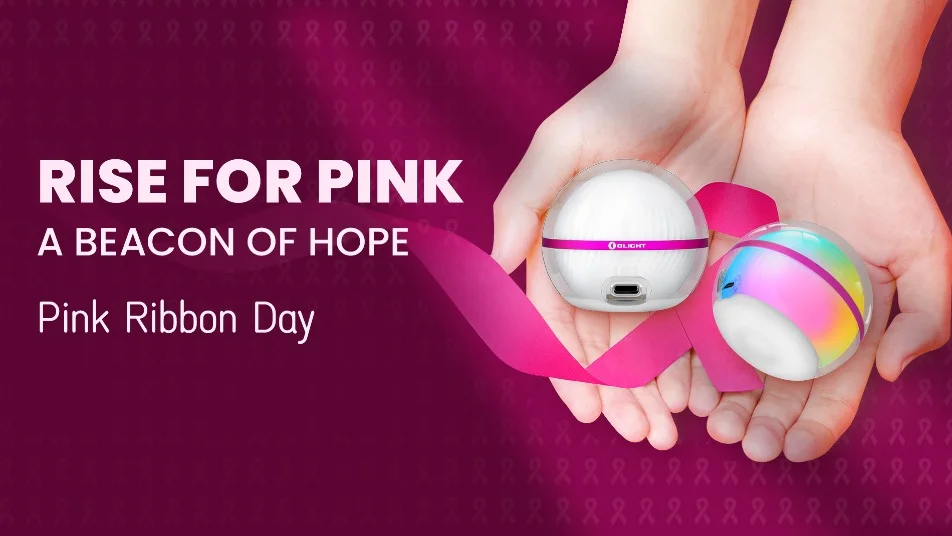
The Olight Sphere Ambient Light handles the hardest job: a table light warm and dim enough not to become the swarm's center. Olight lists White Low at 1 lumen for 40 hours, White High at 75~22 lumens (Sphere C) or 75~25 lumens (Sphere) over 100 + 150 minutes, and red Low at 0.5 lumens. The manuals give 2,800 K for the Sphere C and 2,700 K for the Sphere. It weighs 93 g and is rated IP56 with 1.5 m impact resistance.
The page lists the Sphere C in Blue or Stellar Sky at $17.99 and the original Sphere at $19.99 (regular prices, October 2026). Olight notes, "The purchase of Sphere C will not include a USB-C cable." The original Sphere charges by MCC-1A magnetic cable.
The limits: 75 lumens won't light a group site, and the app's blue and green modes suit nights without bugs. The Sphere C manual also warns, "Do not store the product in a car or places where the temperature may exceed 60°C, because it may deform or damage the product."
Olight Perun 3: the decoy or the red headlamp
The Olight Perun 3 headlamp ($89.99 in every listed color, regular price, October 2026) makes a strong decoy because it is cool white at 5,700~6,700 K and runs Low at 30 lumens for 89 hours or Med at 120 lumens for 25 hours. The box includes a headband, MCC3 magnetic charging cable and lanyard; it is rated IP68 and weighs 150 g.
The catch: on the decoy post, it is not on your head, so you need a second headlamp, and its cool white beam makes it a poor table light. Olight notes the headband bracket "is METAL - it is expected to scratch the body of the torch if taken in / out repeatedly."
Tip: Lock the Perun 3 before packing. Its manual says to "press and hold the switch (for about 2 seconds until the flashlight is off) to enable the lockout mode."
Olight Oclip 2 Pro: the stove and path light
The Olight Oclip 2 Pro clip light handles short white jobs: flood Medium at 100 lumens for 3 hours 45 minutes, a 115° head tilt, and red at 40 lumens for 4 hours or 4 lumens for 27 hours. It weighs 75.5 g and is rated IP66. It costs $49.99 in black or orange and $54.99 in blue; the Premium version adds a 1,000 mAh charging dock at $74.99, or $79.99 in blue (regular prices, October 2026). Its white runtime suits cooking, not a whole evening, and Olight publishes no color temperature for it.
The clip is magnetic. If you clip it to a jacket for the walk to the restroom, heed the Oclip 2 manual: "If you have an ICD or pacemaker, avoid close or prolonged contact with this product to prevent possible interference."
For lanterns at three prices, see our guide to the best lantern for camping. For charging choices on a long trip, our comparison of rechargeable camping lights and solar models covers the trade-offs.
Your Low-Bug Camp Table Checklist
Use camping lights that don't attract bugs as one part of a plan: warm and dim at the table, red for tasks, one cool white decoy 10 to 15 m out, and repellent for mosquitoes. Run through this list at dusk on the first evening.
- Cook the main meal before full dark when you can.
- Set the table light to warm white or red. With a decoy on Perun 3 Med at 10 m, keep the table at about 3.7 lumens or less.
- Hang the decoy on the shore or brush side, beam toward the ground or a trunk, away from tents.
- Turn the decoy on first and the table light second.
- Apply an EPA-registered repellent and switch everything off when the table clears.
FAQ
Changelog
- October 1, 2026: First published.