Olight makes the lights discussed here. Olight specs and regular prices come from its US product pages and user manuals as of October 2026. IP definitions come from the IEC and accredited test labs. The particle ratios, test-time math and field-charging counts below are calculations from published figures, not lab measurements.
⚡ TL;DR
A dust proof flashlight is one whose IP code starts with a 5 or a 6: IP5X means dust-protected and IP6X means dust-tight under IEC 60529. An X in that place means no dust rating was claimed. For desert camps and dirt trails, an IP6X light with no port to open, such as the IP68 Olight Perun 3, is the safer pick.
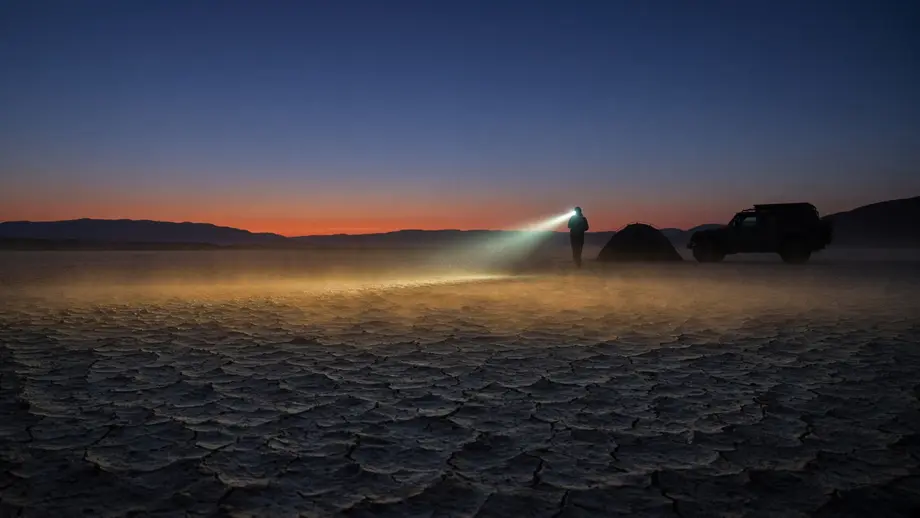
If you ride dirt roads or camp on a dry lake bed, you know the symptoms: a gritty switch, a charging port full of fine sand, a scratched lens. The product page says only "IPX8," which says nothing about dust. This guide explains the first digit, which parts fail first, and how to clean a light safely.
This table compares a dust proof flashlight with an IP6X rating against an IPX8 light with no dust claim, using two Olight lights and their published ratings.
| Dimension | Olight Perun 3 (IP68) | Olight Warrior 3S (IPX8) | Which is better | By how much |
|---|---|---|---|---|
| Dust rating claimed | 6, dust-tight | X, none claimed | Perun 3 | A rated result versus no rating |
| Immersion rating | 8 (depth not printed) | 8 (depth not printed) | Tie | Same digit, no depth on either page |
| Charging | MCC3 magnetic cable, no port to open | MCC3 magnetic cable, no port to open | Tie | Both charge through the tail contact |
| Hands-free use | Headband included | Holster included, no headband | Perun 3 | Headlamp versus handheld |
| Beam distance | 160 m | 300 m | Warrior 3S | 1.9 times the reach |
| Weight with battery | 150 g | 176 g | Perun 3 | 26 g lighter |
| Regular price | $89.99 | $119.95 | Perun 3 | $29.96 less |
Pick the Perun 3 when dust and wind are the main threat and you want both hands free. Pick the Warrior 3S when you need to see far down a trail and can keep its magnetic tail clean.
📋 Table of Contents
- 1. Quick Answer: How Do You Tell If a Flashlight Is Dust Proof?
- 2. How Do You Read an IP Code? What the First Digit Means Under IEC 60529
- 3. Is IPX8 Dust Proof?
- 4. Which Parts Fail First in Sand? A Particle-Size Map
- 5. Dust-Related Designs Compared: Magnetic Charging, Covered USB-C, Twist Caps and Buttons
- 6. Dust Proof Flashlight Habits for Deserts, Dry Lakes and Off-Road Dust
- 7. Common Mistakes: Blasting Compressed Air and Opening the Tail on the Sand
- 8. How to Clean Sand and Dust Off a Flashlight, Step by Step
- 9. Which Dust Proof Flashlight Fits Your Trip?
- 10. Which Flashlight Do Navy SEALs Use?
- 11. Are There Any Flashlights That Are Intrinsically Safe?
- 12. What Is the Brightest Flashlight I Can Legally Own?
- 13. Your Dust Proof Flashlight Checklist
- 14. FAQ
Quick Answer: How Do You Tell If a Flashlight Is Dust Proof?
Read the first digit after "IP." A 6 means the maker claims the dust-tight result, a 5 means dust-protected, and an X means no dust rating was claimed. If there is no dust digit, judge the design instead: a magnetic or covered charging contact, a switch you don't have to twist, a tail cap you never open in the field, and a lens you can keep covered.
Those checks matter even on an IP6X light. The rating describes a closed light in a lab chamber, not an open port, a tail cap unscrewed in the wind or a lens wiped with a gritty sleeve. Olight groups its outdoor flashlights on one page, and each spec block lists the IP code.
This checklist turns the quick answer into a buying screen. Score one point for each yes; three or more suits a desert kit.
- Is the first IP digit a 5 or a 6?
- Does it charge without exposing a socket, through a magnetic tail or a covered port?
- Can you switch it on and off without turning threads?
- Does the manual give a dust or cleaning instruction you can follow?
- Can you carry it in a closed pouch or holster?
How Do You Read an IP Code? What the First Digit Means Under IEC 60529
The first digit of an IP code rates protection against solid objects, from 0 to 6, and the second rates water, from 0 to 9. The IEC states that the first numeral runs "from 0 (no protection) to 6 (no ingress of dust)." So for dust, only 5 and 6 count. A 4 only keeps out objects larger than 1 mm, per Keystone's IP4X test summary, and most sand grains are smaller than that.
The IEC's IP ratings page gives that scale and points readers to the standard for test conditions. The current text is IEC 60529:1989+AMD1:1999+AMD2:2013, edition 2.2, per the IEC Webstore listing. The accredited lab Keystone Compliance summarizes the two dust levels in its IP5X and IP6X guide. For IP5X, "dust must not enter in a sufficient quantity to interfere with the satisfactory operation of the equipment." For IP6X, "A dust tight enclosure is defined as having a degree of protection where no ingress of dust."
The IP6X test by the numbers
Castle Compliance, another accredited lab, lays out the chamber method in its dust ingress testing guide. The talc passes a mesh with "50μm wire, 75μm gap," the chamber holds "2kg of powder per cubic meter," and a vacuum line draws air out of the product. The lab adds, "For IP6X (Dust Tight), the standard allows no leeway. All IP6X tests must be performed as Category 1 (Vacuum)."
This table turns those published test parameters into plain numbers. The arithmetic is ours, from Castle's figures.
| Test parameter (Castle Compliance) | Published value | Worked out | What it tells you |
|---|---|---|---|
| Largest talc particle | Passes a 75 µm mesh gap | 75 µm = 0.075 mm | As fine as very fine sand, finer than all coarser sand |
| Air drawn through the product | 80 times its internal volume | 80 ÷ 60 per hour = 1.33 h; 80 ÷ 40 per hour = 2 h | A light that leaks a little finishes in 1.3 to 2 hours |
| Time cap for tight seals | 8 hours | 8 ÷ 2 = 4 times the fast case | Tight seals get the longest exposure |
| Maximum vacuum | 20 mbar (2 kPa) | 2 ÷ 6.895 = 0.29 psi | A gentle pull, not a pressure blast |
| Category for lights | Category 1, vacuum | Castle lists "lights" among products whose heat makes air "expand and contract" | Covers the warm-cool breathing of a running light |
For flashlights, PLATO's FL 1-2025 announcement lists "The addition of dust protection ratings (IP5X and IP6X) aligned with international enclosure protection standards." Its summary of the changes says the method lets a product warm up first and "does not require drilling a hole in the product to create a vacuum." The Perun 3 manual cites ANSI/PLATO FL 1-2019, so read its 6 as the IEC 60529 numeral; our ANSI FL1 guide covers the other numbers.
Is IPX8 Dust Proof?
No. In IPX8, the X means the maker claimed no dust rating, and the 8 covers continuous immersion only. That does not prove dust gets in; a body sealed for immersion may block a lot of dust. It means nobody published a dust result, so you can't count on one. On an IPX8 light, judge dust protection by the port, switch and threads.
Castle Compliance notes that dust "works its way into microscopic gaps that water often bridges over." For the water side of the code, our guide to IPX8 meaning covers depth and duration.
This table lists what each Olight light in this guide prints for its IP code, and what that means on a dusty trail.
| Light | IP code on the product page | Dust digit | Dust-related manual line | Field reading |
|---|---|---|---|---|
| Perun 3 | IP68 | 6, dust-tight | None in the English manual | Rated dust-tight when closed |
| Oclip 2 Pro | IP66 | 6, dust-tight | "Do not place the light in a dusty environment, as dust may enter the switch and cause functional failure." | Body rated, switch still at risk |
| Warrior 3S | IPX8 | None claimed | "The magnetic tail is easy to attract iron debris." | Treat as unrated for dust |
| Baton 4 Pro | IPX8 | None claimed | "Keep the tail charging port clean and dry." | Treat as unrated; use the MCC contact outdoors |
| i1R 2 Pro | IPX8 | None claimed | None on dust | Twist operation moves threads constantly |
The Oclip 2 Pro row is the lesson. Its page lists IP66, yet its manual still keeps it out of dusty places, because a dust digit describes the sealed body, not every moving part.
Which Parts Fail First in Sand? A Particle-Size Map
Particle size decides where grit does damage. Silt and clay are finer than the 75 µm talc used for IP5X and IP6X tests, so they test seals and switch boots. Sand grains from 150 µm up are too large to slip through a sound seal, but they scratch lenses and grind threads. A dry lake bed is mostly the first problem. A dune camp is mostly the second.
Colorado State University Extension's soil texture guide lists the standard soil particle size classes. The military's sand and dust method, MIL-STD-810H Method 510.7, "defines dust as particulates less than 150 μm in diameter," and sand as "particulates in the range from 150 to 850 μm in diameter." It describes dust as particles that "penetrate into cracks, crevices, bearings, and joints," and sand as causing "abrasion (erosion) or clogging effects of sharp-edged particles."
This table maps each particle class against the IP test talc and the MIL-STD-810H line, and names the flashlight part it threatens. The ratios divide the class size by the 75 µm mesh gap.
| Particle class (CSU Extension) | Size | Versus 75 µm test talc | MIL-STD-810H class | Part most at risk |
|---|---|---|---|---|
| Clay | Under 0.002 mm | Under 0.03 times | Dust | Seals, switch boots, port contacts |
| Silt | 0.002 to 0.05 mm | 0.03 to 0.67 times | Dust | Seals, switch boots, port contacts |
| Very fine sand | 0.05 to 0.10 mm | 0.67 to 1.3 times | Dust | Port sockets, switch edges |
| Fine sand | 0.10 to 0.25 mm | 1.3 to 3.3 times | Dust up to 0.15 mm, then sand | Threads, port sockets, lens |
| Medium sand | 0.25 to 0.5 mm | 3.3 to 6.7 times | Sand | Threads, lens, tail contacts |
| Coarse sand | 0.5 to 1.0 mm | 6.7 to 13.3 times | Sand up to 0.85 mm | Lens and threads |
Read the table from both ends. Clay, silt and very fine sand are the powder an IP6X rating was written for. Coarser grains ride on the threads, which is why opening a tail cap on the ground does damage no rating covers.
Dust-Related Designs Compared: Magnetic Charging, Covered USB-C, Twist Caps and Buttons
The charging and switch design decides how often you expose the inside of a light in the field. A magnetic tail contact never opens. A USB-C port behind a cover or a twist cap opens every time you charge. A light you twist to switch on moves its threads every time you use it.
This table compares the five designs on what you expose and how often, using Olight's published charging methods.
| Design | Olight example | What is exposed to grit | Threads moved in normal use | Dust habit |
|---|---|---|---|---|
| Magnetic tail, no port | Perun 3, Warrior 3S | The tail contact face | Only to swap the battery | Brush the tail before you snap the cable on |
| USB-C behind a dust cover, plus MCC | Oclip 2 Pro | The USB-C socket while the cover is open | None | Keep the cover shut; charge by MCC (cable sold separately) outside |
| USB-C behind a half-turn tailcap, plus MCC | Baton 4 Pro | The socket and tail threads | Half a turn per USB-C charge | Charge by MCC in camp; use USB-C indoors |
| Twist tail for on, off and charging | i1R 2 Pro | Threads and the socket under them | Every on, off and charge | Keep it as an indoor or vehicle backup |
| Side or tail push button | Perun 3, Warrior 3S, Oclip 2 Pro, Baton 4 Pro | Button edges and gaps | None | Wipe the switch area; lock the light in a pouch |
The Baton 4 Pro page says, "A half-turn of the tailcap reveals the hidden USB-C port." The i1R 2 Pro manual says, "Slightly tighten the tailcap clockwise to turn on the light and access low mode. Fully tighten the tailcap to access high mode." To charge it, you "Unscrew the flashlight tail from the head till the charging port is revealed."
How many times will you charge in the field?
Fewer field charges mean fewer chances for grit to reach a contact. This table assumes a seven-night desert trip with 2 hours of camp light per night, 14 hours in all, run at 100 to 200 lumens where the light has such a mode. Field recharges = (14 hours ÷ rated runtime), rounded up, minus the full charge you start with. Figures are based on Olight's rated runtimes, not measured.
| Light and mode | Rated runtime | 14 h ÷ runtime | Field recharges | What each recharge exposes |
|---|---|---|---|---|
| Perun 3, Med 120 lumens | 25 hours | 0.56 | 0 | Nothing |
| Baton 4 Pro, Med 120 lumens | 18 hours 30 minutes | 0.76 | 0 | Nothing |
| Warrior 3S, Med 200 lumens | 13 hours | 1.08 | 1 | The magnetic tail face, once |
| Oclip 2 Pro, Medium floodlight 100 lumens | 3 hours 45 minutes | 3.73 | 3 | The USB-C socket or the MCC contact, three times |
| i1R 2 Pro, Low 5 lumens (High is 180 lumens for 23 minutes) | 12 hours | 1.17 | 1 | Threads and the socket, once, plus a twist at every switch-on |
The big-battery lights finish the trip on one charge; the Oclip 2 Pro opens its dust cover three times unless you use MCC. At 180 lumens, the i1R 2 Pro would need 14 × 60 ÷ 23 = 36.5, or 37 charges, 36 of them in the field. If you switch the i1R 2 Pro on and off five times a night, that is 5 × 2 × 7 = 70 thread movements in a week, before any charging.
Dust Proof Flashlight Habits for Deserts, Dry Lakes and Off-Road Dust
In dusty country, habits matter as much as the rating. Carry each light closed and locked in a pouch, charge in a tent or shaded cab, never open a tail cap or port in the wind, and brush grit off before anything touches a contact. When a dust storm hits while you're driving, stop using lights as signals and follow the road-safety rule.
The National Weather Service's dust storm safety page warns that a storm "usually arrives suddenly in the form of an advancing wall of dust and debris," and tells drivers who pull off, "Make sure all of your lights are off when you park off the roadway."
Use these habits on the trail and in camp:
- Lock every light that has a lockout before it goes in a pouch. The Warrior 3S manual says, "Please lock out the switches if the flashlight is left unused, carried, or transported."
- Keep the Oclip 2 Pro cover closed. Its manual says, "When the charging port is not in use, keep the dust cover closed to prevent dust or foreign objects from entering."
- Check magnetic tails for filings. The Warrior 3S manual asks you to "keep the tail switch cap and the ring surrounding it clean."
- Plan for cold desert nights. The Oclip 2 manual says, "In environments below 0°C (32°F), the white light is limited to Low and Medium modes," and that the product "cannot be charged in environments below 0°C" or above 45°C.
- If you clip the Oclip 2 Pro to a chest strap, note its manual line: "If you have an ICD or pacemaker, avoid close or prolonged contact with this product to prevent possible interference."
Warning: Don't leave lights in a parked vehicle in desert sun. The Baton 4 Pro manual says, "Do not store, charge, or use this light in a car where the temperature inside may exceed 60°C," and the Oclip 2 manual sets the same 60°C limit.
Common Mistakes: Blasting Compressed Air and Opening the Tail on the Sand
The two worst habits are blasting a seam with compressed air and unscrewing a tail cap while kneeling on sand. Shop air at OSHA's 30 psi ceiling is about 100 times the vacuum limit of an IP6X test. An open tail on the ground invites sand onto the threads, where it grinds on every turn.
OSHA's rule on shop air, 29 CFR 1910.242(b), reads in full: "Compressed air shall not be used for cleaning purposes except where reduced to less than 30 p.s.i. and then only with effective chip guarding and personal protective equipment." That limit is for worker safety, not flashlights, but the number helps. Thirty psi is 30 × 6.895 = 206.8 kPa. The IP6X test never draws more than 2 kPa, so the legal ceiling for shop air is about 206.8 ÷ 2 = 103 times the dust test's vacuum limit.
Electronics makers draw the same line. Apple's cleaning guide says for iPad, "Don't use window cleaners, household cleaners, compressed air, aerosol sprays, solvents, ammonia, abrasives, or cleaners containing hydrogen peroxide to clean iPad." That is Apple's rule for its own device; Olight's manuals don't mention compressed air, so a soft brush and a dry cloth are the cautious choice.
Three more mistakes:
- Wiping a sandy lens with a shirt. The Warrior 3S manual warns, "If there are scratches on the surface of the front lens, the light output may be automatically dimmed by mistake," because its proximity sensor reads through that lens.
- Cleaning the lens with alcohol. The same manual says, "DO NOT clean the lens with alcohol or any other chemicals."
- Picking grit from a port with a pin. The Baton 4 Pro manual says, "Do not intentionally short-circuit the exposed terminals of the charging port with metal."
Warning: Never put a hot light into a pouch after a long Turbo run. The Baton 4 Pro manual says, "Do not put a hot light into any type of fabric bag or fusible plastic container."
How to Clean Sand and Dust Off a Flashlight, Step by Step
Clean a dusty flashlight closed, dry and from the outside in. Lock it, shake loose grit off with the port and tail pointing down, brush the switch and tail, wipe the body with a soft, dry, lint-free cloth, and only then touch the lens or a charging contact. Open nothing until you are indoors, and charge only once the contact is clean and dry.
These steps combine Olight's manual lines with Apple's general advice for electronics.
- Switch the light off and lock it.
- Hold it with the tail and any port facing down, and tap it gently against your palm to drop loose grains.
- Brush the switch, tail and clip with a soft, dry brush. For magnets, Apple's advice for its own chargers fits: "Brush off any debris from the magnetic ring before cleaning these accessories." The Oclip 2 manual adds, "The clip is magnetic. Metal powder adhering to the surface may affect its function. Please clean it immediately."
- Wipe the body with a soft, lint-free cloth. Apple's guide says, "Use only a soft, lint-free cloth. Avoid abrasive cloths, towels, paper towels, or similar items."
- Clear the lens last. Lift loose grains off with the brush first, then wipe lightly with a clean cloth, with no alcohol on the lens.
- Inspect the charging contact or socket. Keep it "clean and dry," as the Baton 4 Pro manual asks, and never use a metal tool.
- Open a tail cap only indoors on a clean surface, wipe the threads, and close it fully.
Note: Don't take the head apart to chase grit. The Baton 4 Pro manual says, "Do not disassemble the product," and the i1R 2 Pro manual says, "DO NOT try to pull apart the flashlight. This may cause malfunction or make it unusable."
Which Dust Proof Flashlight Fits Your Trip?
For dust and wind with no water, choose a dust-tight light with no open port; for dust plus creek crossings, choose IP68 rather than IP66; for long reach on a dusty trail, accept an IPX8 light and manage its tail.
This table pairs each dusty use with a pick, the published rating that decides it, and its main limit.
| Who you are | Pick | Deciding rating | Main limit | Choose instead when |
|---|---|---|---|---|
| Desert camper on a dry lake bed | Perun 3 | IP68, headband, MCC3 tail | 160 m reach | You need to see far: Warrior 3S |
| Off-road rider doing night checks | Warrior 3S | 300 m, 23,000 candela | IPX8, no dust claim | Wind is constant: Perun 3 |
| Hiker who wants a clip light | Oclip 2 Pro | IP66 | Manual warns against immersion and dusty environments | You cross water: Perun 3 |
| Everyday carrier who ends up on dirt roads | Baton 4 Pro | 1,600 lumens, MCC and USB-C | IPX8; USB-C sits under the tail | Dust is daily: Perun 3 |
| Keychain backup on your keys | i1R 2 Pro | 22 g, IPX8 | Twist operation in sand | You need a primary light: any of the above |
Olight Perun 3: a dust proof headlamp
On a windy playa, you need both hands and a light with no socket. The Olight Perun 3 headlamp ($89.99, regular price, October 2026, all listed colors) carries IP68 and charges through an MCC3 magnetic tail. Olight writes that its "IP68 rating guarantees protection against dust and water immersion." Olight rates Turbo at 3,000~800~600 lumens for 2 + 180 + 30 minutes, Med at 120 lumens for 25 hours, and red light at 60 lumens for 14 hours. Its limits: a 160 m beam, a tail cap you unscrew to swap the battery, and a manual caution: "Do not stare at operating light source." It is also the overall pick in our best headlamps guide.
Olight Warrior 3S: reach on an IPX8 body
At the back of a convoy, you need to see 200 m down a wash. The Olight Warrior 3S ($119.95, regular price, October 2026, Black or OD Green) reaches 300 m with 23,000 candela and holds Turbo at 2,300~805~253 lumens for 2.5 + 160 + 39 minutes. It charges by MCC3 with no open port. The catch is its IPX8 code, which makes no dust claim, and a magnetic tail that collects filings.
Olight Oclip 2 Pro: dust-tight, but keep it dry and closed
The Olight Oclip 2 Pro ($49.99, regular price, October 2026, Black standard version; Blue is $54.99, and the Premium version with a 1,000 mAh charging dock is $74.99 in Black or Orange) is rated IP66 and 530 lumens. IP66 covers powerful water jets, not immersion, and its manual says, "Do not immerse the product in water or other liquids, as it will damage the product."
Olight Baton 4 Pro and i1R 2 Pro: carry lights with a caution
The Olight Baton 4 Pro ($69.99, regular price, October 2026, all listed colors) is rated IPX8, 1,600~600 lumens for 2 + 198 minutes and 200 m, and ships with an MCC3 cable and an L Stand; Olight lists no USB-C cable in the box. Charge it by MCC in camp. The Olight i1R 2 Pro keychain light ($21.99, regular price, October 2026) is IPX8 and 180 lumens for 23 minutes. Every switch-on twists its threads, so it is not a desert primary light.
Which Flashlight Do Navy SEALs Use?
No public Navy or Department of Defense document names a standard handheld flashlight for SEALs. What the military does publish is how it tests gear for sand and dust: MIL-STD-810H Method 510.7, with separate procedures for blowing dust under 150 µm and blowing sand from 150 to 850 µm.
Method 510.7 says its scope covers "all mechanical, optical, electrical, electronic, electrochemical, and electromechanical devices," including man-portable ones, likely to meet "dry blowing sand or blowing dust-laden atmospheres." A light claimed as "military grade" against dust should name the method and procedure, not just the phrase.
None of the Olight lights here lists MIL-STD-810H on its page, so their published dust evidence is the IP code alone.
Are There Any Flashlights That Are Intrinsically Safe?
Yes, but dust-tight is not the same thing. An intrinsically safe light carries an approval for a hazardous (classified) location, marked by class and group. An IP6X light only keeps dust out of its body. Where combustible dust makes a location hazardous, OSHA requires equipment that is intrinsically safe, approved or safe for that location. None of the Olight lights in this guide lists such an approval.
OSHA's definitions in 29 CFR 1910.399 say, "Class II locations are those that are hazardous because of the presence of combustible dust." Its rule at 29 CFR 1910.307(c) says equipment in those places "shall be intrinsically safe, approved for the hazardous (classified) location, or safe for the hazardous (classified) location." Paragraph (c)(2)(ii) adds that equipment "shall be marked to show the class, group, and operating temperature or temperature range."
So check the marking, not the IP code, and ask your site safety manager which lights are approved there.
What Is the Brightest Flashlight I Can Legally Own?
In the U.S., no federal rule caps how bright an LED flashlight you may own. The federal brightness standard covers lasers, and the FDA says LEDs are not subject to it. The limits that apply are about how you use a light, and state rules on lighting wildlife are the ones trail users meet most.
The FDA's laser products page states, "LEDs (Light Emitting Diodes) are different from laser diodes and are not subject to the Federal laser product performance standard." Arizona's law, A.R.S. 17-301(A), says, "A person shall not take any species of wildlife by the aid or with the use of a jacklight, other artificial light, or illegal device, except as provided by the commission." Check your own state's wildlife agency before using a light while hunting.
Safety note: Whatever the output, keep the beam out of people's eyes. The Warrior 3S manual says, "DO NOT shine the light directly into human eyes. This may cause temporary blindness, or permanent damage to the eyes."
Your Dust Proof Flashlight Checklist
Before a desert or dirt-road trip, check the first IP digit of every light, plan charging so you rarely open a contact in the field, and pack each light closed and locked. The seven steps below turn the ratings, particle sizes and field-charge counts above into a packing routine.
- Read the first IP digit on each light: 6 for dust-tight, 5 for dust-protected, X for no rating.
- For dust plus water, choose IP68 or IP67; IP66 covers jets, not immersion.
- Prefer magnetic charging, and charge big-battery lights fully so they finish the trip without field charges.
- Lock every light and carry it lens-down in a closed pouch.
- Never open a tail cap or port outdoors in wind; do it in the tent or cab.
- Clean closed and dry: brush, wipe with a lint-free cloth, lens last, no compressed air.
- For the full field of picks beyond dust, see our best flashlights guide and Olight's EDC flashlights.
FAQ
Changelog
- October 1, 2026: First published.