Olight sells the OSelect thermal cameras discussed here. Specs and regular prices come from Olight's US product pages and user manuals as of October 2026. Screen-share, timing and sensitivity figures are calculations from published numbers, not field measurements.
⚡ TL;DR
A thermal imaging camera for wildlife lets you watch raccoons, foxes, deer and owls in your yard without putting any light on them. For a yard up to about 25 meters deep, a phone-mounted Olight OSelect TC001 Max ($309.00) is enough. For a woodlot edge 50 to 100 meters out, the TS004 monocular ($499.00) keeps animals large enough to recognize.
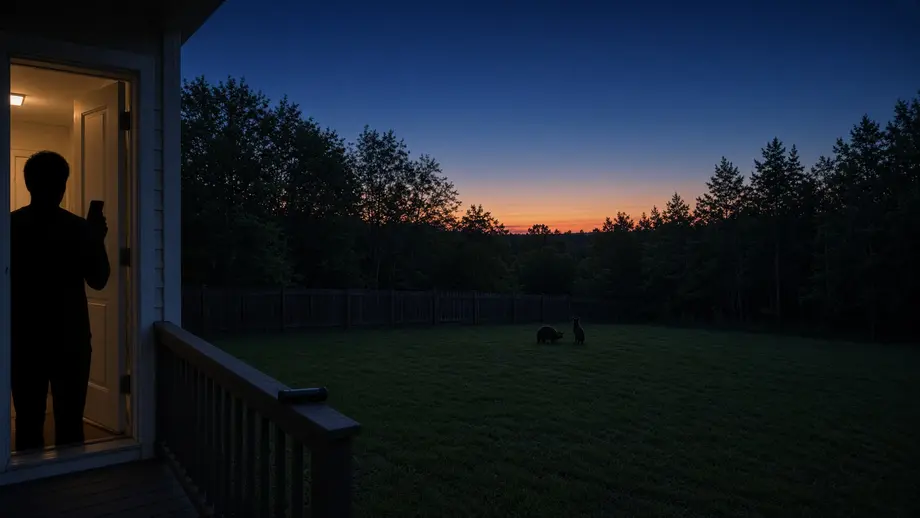
Something crosses your yard after dark. The trash can is tipped, the dog stares at the fence, and the trail camera shows a gray blur at 2:14 a.m. Switch on the porch light and it is gone. This guide shows how far a phone thermal camera really sees, how to tell a raccoon from a fox, and which rules apply.
This gear list shows what a backyard thermal imaging camera for wildlife setup needs, with the lowest spec worth paying for in each role.
| Use | Recommended type | Key spec minimum | Recommended model |
|---|---|---|---|
| Scanning the yard from the back door, 10 to 25 m | Phone-mounted thermal camera | 256 x 192 sensor, wide lens (50° or more across), 25 Hz | Olight OSelect TC001 Max |
| Watching a field or woodlot edge, 50 to 100 m | Handheld thermal monocular | 256 x 192 sensor, 13 mm lens, 50 Hz, own battery, IP67 | Olight OSelect TS004 |
| Knowing what visited while you slept | Trail camera with no-glow 940 nm infrared | Motion trigger, black-and-white night images | Any maker |
| A short look at eyeshine or markings, where legal | Handheld flashlight on a low setting | Dimmable low mode; red or white | Any light with a low mode |
📋 Table of Contents
- 1. Quick Answer: What Does a Thermal Imaging Camera for Wildlife Show at Night?
- 2. Phone Thermal Camera vs Thermal Monocular: Resolution, Lens and Field of View
- 3. How Big Will a Raccoon, Fox or Deer Look at 10, 25, 50 and 100 Meters?
- 4. Can You Follow a Moving Deer? Frame Rate and Time in Frame
- 5. How to Tell What Animal It Is: Size, Gait and Eyeshine
- 6. Backyard Scenarios: Back Door, Woodlot Edge and Owl Trees
- 7. Can I Use My Smartphone as a Thermal Camera?
- 8. What's the Difference Between an Infrared Camera and a Thermal Camera?
- 9. Night Camera for Watching Wildlife: Thermal, Trail Camera or Flashlight?
- 10. Common Myths: Thermal Sees Through Bushes, Windows and Water
- 11. Watching Ethics: Don't Chase, Don't Feed, Go Easy on Light
- 12. Is It Illegal to Shoot Deer With a Thermal?
- 13. Your First Backyard Thermal Session: A Checklist
- 14. FAQ
Quick Answer: What Does a Thermal Imaging Camera for Wildlife Show at Night?
A thermal imaging camera for wildlife shows warm animals as bright shapes against cooler grass, trees and fences, with no light needed. A phone-mounted camera with a 256 x 192 sensor and a wide lens finds raccoon- and fox-sized animals across a typical yard. Recognizing species past about 25 meters, or watching a far tree line, calls for a narrow-lens monocular.
NASA's infrared waves overview explains that infrared cameras let us "see" the infrared waves "emitting from warm objects such as humans and animals," and calls the 8 to 15 micron band "thermal infrared." Olight lists 8~14 μm for the TC001 Max and 7.5~14 μm for the TS004.
Because the camera only receives, it adds nothing an animal can see. Olight sells both with its other thermal imaging cameras. The catch: thermal shows surface heat, not color or markings, and a far-off warm dot can be a cat, a skunk or a sun-warmed rock.
Phone Thermal Camera vs Thermal Monocular: Resolution, Lens and Field of View
Both OSelect cameras use the same 256 x 192 sensor, so the lens decides what you see. The TC001 Max's 3.2 mm lens covers 56° x 42°, about a whole backyard at once. The TS004's 13 mm lens covers 13.5° x 10.10°, a narrow slice that makes distant animals larger. Pick by how deep your yard is, not by resolution.
This table lists Olight's published specs and what each one changes in the yard.
| Spec (Olight listing) | TC001 Max | TS004 | What it changes in the yard |
|---|---|---|---|
| Lens and field of view | 3.2mm; 56°X42° | 13mm; 13.5° x 10.10° | Whole-yard view vs a zoomed slice that reaches the tree line |
| Frame rate | 25 Hz | 50Hz | How smooth a running animal looks |
| Screen | Your phone or tablet | 0.32 inch 800x600 OLED eyepiece | A glowing phone screen vs light kept at your eye |
| Power | Drawn from the phone; no battery | 5000mAh, up to 11 hours; 4h to charge | Phone battery drain vs a separate charge |
| Color palettes | 10 listed, including white hot and black hot | Bird, White Hot, Black Hot, Red Hot, Fusion | The TS004 has a palette made for birds |
| Temperature readings | -4°F to 1,022°F, ±2° C or ±2% of reading | Not listed | Only the TC001 Max gives numbers |
| Weather and cold | IP54; works at -10 ~ 50℃ (14°F - 122°F) | IP67; 2.0m drop rating | The TS004 copes better with wet grass and winter |
| Regular price (October 2026) | $309.00 | $499.00 | $190.00 apart |
Both list NETD under 40 mK. The TS004 manual says its Bird palette "is specially designed for detecting birds or similar objects." And Olight lists the TS004's AI algorithm as able to "identify people and vehicles," not animals, so species ID is still your job.
The TC001 Max phone thermal camera ($309.00, regular price, October 2026) is the better buy for most yards. It plugs into a USB-C phone, or a Lightning iPhone with the included cable, and weighs 30g in the spec table (33 g in Olight's highlights). Its limit is reach: a fox at the back of a deep lot looks small.
The TS004 thermal monocular ($499.00, regular price, October 2026) fits a yard that opens onto a field, pasture or woodlot. Olight says it offers "clear detail visibility within 100 yards," which matches its 91m identification figure (100 yards is 91.4 m). Its limit: at 10 m it shows a strip only about 2.4 m wide. For detection and recognition distances in pixels, see our thermal monocular under $500 guide.
How Big Will a Raccoon, Fox or Deer Look at 10, 25, 50 and 100 Meters?
On the TC001 Max, a raccoon broadside at 10 m spans about 7% of the screen width; at 50 m it spans about 1.4%, roughly a warm dot. On the TS004 the same raccoon spans about 32% at 10 m and 6.4% at 50 m. A useful rule: when an animal fills less than a tenth of the screen, read its shape, not its details.
The calculation uses body lengths from the Missouri Department of Conservation field guide, which lists a raccoon's total length as "21½–38 inches." Scene width is 2 x distance x tan(half the horizontal field of view). For the TC001 Max that is 1.063 x distance (tan 28° = 0.532); for the TS004 it is 0.237 x distance (tan 6.75° = 0.118). Screen share is body length divided by scene width.
This table shows the share of screen width each animal fills (TC001 Max / TS004), from Olight's rated fields of view, not measured.
| Animal (MDC length, midpoint) | 10 m | 25 m | 50 m | 100 m | Fills 10% of the screen at |
|---|---|---|---|---|---|
| Eastern screech owl, perched (8 in, 0.20 m; height share) | 2.6% / 11.5% | 1.1% / 4.6% | 0.5% / 2.3% | 0.3% / 1.1% | 2.6 m / 11.5 m |
| Great horned owl, perched (22 in, 0.56 m; height share) | 7.3% / 31.6% | 2.9% / 12.6% | 1.5% / 6.3% | 0.7% / 3.2% | 7.3 m / 31.6 m |
| Virginia opossum (29 in, 0.74 m) | 6.9% / 31.1% | 2.8% / 12.4% | 1.4% / 6.2% | 0.7% / 3.1% | 6.9 m / 31.1 m |
| Raccoon (29.75 in, 0.76 m) | 7.1% / 31.9% | 2.8% / 12.8% | 1.4% / 6.4% | 0.7% / 3.2% | 7.1 m / 31.9 m |
| Gray fox (37.6 in, 0.96 m) | 9.0% / 40.4% | 3.6% / 16.1% | 1.8% / 8.1% | 0.9% / 4.0% | 9.0 m / 40.4 m |
| Coyote (46.5 in, 1.18 m) | 11.1% / 49.9% | 4.4% / 20.0% | 2.2% / 10.0% | 1.1% / 5.0% | 11.1 m / 49.9 m |
| White-tailed deer (about 6 ft, 1.83 m) | 17.2% / 77.3% | 6.9% / 30.9% | 3.4% / 15.5% | 1.7% / 7.7% | 17.2 m / 77.3 m |
Owl rows use height against the vertical field of view (42° and 10.10°, giving 0.768 and 0.177 x distance). Other rows assume a broadside animal; head-on it looks smaller. Lengths come from MDC pages for the Virginia opossum (24–34 inches), gray fox (31¼–44 inches), coyote (39–54 inches), white-tailed deer ("approximately 6 feet"), great horned owl (20–24 inches) and eastern screech owl (6½–9½ inches).
Read the table as a yard plan. If your lawn ends 20 m from the door, the TC001 Max keeps a raccoon above 3% of the screen everywhere. At 60 m, the TS004 gives a coyote or fox four to five times more screen. A screech owl is under 3% of the TC001 Max screen height at 10 m, so owls are a TS004 job. Its 2x to 8x digital zoom enlarges the picture but adds no sensor detail.
Can You Follow a Moving Deer? Frame Rate and Time in Frame
A deer bolting at full speed, 36 mph, crosses the TC001 Max's view at 25 m in about 1.7 seconds and the TS004's view in about 0.4 seconds. The wide camera keeps a running animal in frame longer. The TS004's 50 Hz frame rate halves how far the deer moves between frames. Use the wide view to follow, the narrow one to study.
New Hampshire Fish and Game's white-tailed deer profile says deer "can run at speeds up to 36 mph, although they typically run to the nearest cover and never for long distances." Taking that top speed (16.09 m per second) as the worst case, time in frame is scene width divided by speed.
This table shows how long a deer at 36 mph stays in each camera's view and how many frames you get, based on Olight's rated field of view and frame rate, not measured.
| Distance | TC001 Max scene width | Time in frame (frames at 25 Hz) | TS004 scene width | Time in frame (frames at 50 Hz) |
|---|---|---|---|---|
| 10 m | 10.6 m | 0.66 s (17 frames) | 2.4 m | 0.15 s (7 frames) |
| 25 m | 26.6 m | 1.65 s (41 frames) | 5.9 m | 0.37 s (18 frames) |
| 50 m | 53.2 m | 3.30 s (83 frames) | 11.8 m | 0.74 s (37 frames) |
| 100 m | 106.3 m | 6.61 s (165 frames) | 23.7 m | 1.47 s (74 frames) |
Between frames the deer moves 16.09 ÷ 25 = 0.64 m on the TC001 Max and 16.09 ÷ 50 = 0.32 m on the TS004: about a third versus a sixth of its 1.83 m body. On the TC001 Max a bolting deer looks steppy but stays on screen; on the TS004 it looks smooth, but you must pan to keep it.
Most backyard animals are slower, and raccoons and opossums near the house suit the TC001 Max. Deer and coyotes crossing a far field suit the TS004, braced on a post or a tripod (Olight lists a tripod screw hole).
How to Tell What Animal It Is: Size, Gait and Eyeshine
Name a warm shape with four clues in order: its size against something you know, the way it moves, where it goes, and only then a brief look with light. Thermal shows the first three well. Eyeshine is reflected light, as the Wisconsin DNR explains, so thermal alone will not show it.
For size, measure the distance to a fence post or tree in daylight, then use the screen-share table. For gait and habits, this table turns MDC field guide notes into thermal clues.
| Animal | MDC behavior or track note | What to look for on thermal |
|---|---|---|
| Raccoon | "Raccoons often walk in a meandering pattern"; "Expert climbers" | Wanders back and forth; may climb a tree |
| Virginia opossum | "The distance between strides is 7 inches" | Short, slow steps |
| Striped skunk | "Skunks shuffle and waddle as they walk, with an undulating, 5–6 inch stride" | A low, rocking walk; a raised tail is a warning to back off |
| Gray fox | "readily climbs trees" | A fox that climbs is a gray fox; Massachusetts calls it "one of only two canid species in the world that can climb trees" |
| Coyote | "Stride is 18–22 inches between prints (walking)"; tracks overlap | Straight travel; MDC notes "domestic dogs tend to meander" |
| White-tailed deer | Stride "can be 10–15 feet when bounding" | Tall, upright body; long bounds when it runs |
| Great horned owl | "They observe quietly from a high perch" | A warm, upright oval in a branch fork or on a pole |
Eyeshine is the last check. The Wisconsin DNR's Snapshot Wisconsin article on eyeshine says the tapetum lucidum "is a special membrane behind the retina that acts like a mirror to reflect light," and that eyeshine is observable "when any bright light is reflected back from the tapetum lucidum and you are positioned behind a single-point light source, such as a flashlight." Hold a light near your eyes on its lowest setting for a second or two. Some states regulate even that at night, as the legal section explains.
Backyard Scenarios: Back Door, Woodlot Edge and Owl Trees
Near the house you need a wide view and quiet handling. At a woodlot edge you need a narrow lens and a steady rest. In owl trees you need a narrow lens and a palette that picks out a small, still bird.
This table sets out each backyard sub-scene and what it asks of the camera, based on the calculations above.
| Sub-scene | Typical distance | Field of view needed | Weather and power needs | Better fit |
|---|---|---|---|---|
| Back door or open window | 5 to 25 m | Wide, 50° or more | Short sessions; phone battery is enough | TC001 Max |
| Woodlot edge or field | 50 to 100 m | Narrow, about 13° | Long sits; own battery and IP67 | TS004 |
| Owl trees and poles | 10 to 50 m, looking up | Narrow, with a bird palette | Long, still sits; own battery | TS004 |
Back door or open window
Stand in an open doorway, not behind glass, with screen brightness turned down. The TC001 Max manual says the shutter refreshes "automatically every 30 seconds by default," with a click; that is normal, and the manual says you can turn the automatic shutter off. Learn your yard's warm spots first: stones, a compost pile and a car hood stay warm after dark.
Woodlot edge or field
Brace the 330g TS004; give each scan a minute. MDC notes red foxes "prefer the borders of forested areas and adjacent open lands." Olight rates the TS004 IP67, yet its manual says, "Keep the thermal monocular away from water to avoid electricity leakage or short circuit." Treat the rating as rain protection, not permission to dunk it.
Owl trees and poles
Use the TS004's Bird palette on branch forks and pole tops. A great horned owl at 25 m fills about 12.6% of its screen height, against 2.9% on the TC001 Max. Keep well back from roosts and nests.
Can I Use My Smartphone as a Thermal Camera?
Not by itself. A phone camera records visible light, not the 8 to 14 micron heat band that thermal sensors read. With a plug-in module such as the TC001 Max, your phone becomes the screen, power source and storage for a 256 x 192 thermal sensor. That setup is the cheapest, lightest way to start watching backyard wildlife at night.
A phone setup has four limits for wildlife.
- Cold. The TC001 Max's working range is -10 ~ 50℃ (14°F - 122°F); pick a milder night below that.
- Wet. Olight lists IP54, and the manual says, "Keep the unit away from water to avoid leakage or short circuit." Skip rainy nights.
- Screen glow. Lower the brightness and shield the screen with your body.
- Phone battery. Olight does not publish the camera's phone battery draw, so start fully charged.
The upside is a large screen the family can share. For uses beyond the yard, see our thermal imager guide.
Warning: Both OSelect manuals warn against pointing the camera "at the sun or other strong energy sources" for long periods, which can damage the detector. At dawn and dusk, keep the lens away from the low sun when you sweep the horizon.
What's the Difference Between an Infrared Camera and a Thermal Camera?
A thermal camera reads long-wave heat that animals give off, roughly 8 to 14 microns, and needs no light at all. Trail cameras and similar "infrared" night cameras light the scene with near-infrared LEDs and record the reflection. Thermal shows warmth through darkness; near-infrared shows texture and eyeshine but only as far as its LEDs reach.
The Wisconsin DNR's Snapshot Wisconsin trail camera team explains that a "no-glow" camera emits light at "940 nanometers (nm)," "invisible to humans and most animals," while 850 nm "low-glow" light reads as "a faint red light." The passive infrared (PIR) motion trigger "has nothing to do with illumination"; it senses heat change as an animal passes.
So "infrared" can mean a motion sensor, an invisible flash or a thermal sensor; only the last makes a live image from body heat. Near-infrared also counts as light in some rules. The Wisconsin DNR's guidance on lights and illuminating devices says night vision devices that use "an active source of illumination (visible light, near infrared or shortwave infrared band)" are illegal for hunting except in set cases. It treats thermal differently, because thermal devices "do not involve the 'casting of a ray of light.'"
Night Camera for Watching Wildlife: Thermal, Trail Camera or Flashlight?
Each backyard night tool answers a different question. A phone thermal camera answers "what is in the yard right now?" A thermal monocular answers "what is out at the tree line?" A trail camera answers "what came by last night?" A flashlight answers "what color and markings does it have?" but changes the animal's behavior.
This table compares the four tools, using the specs and agency sources cited above.
| Question | Phone thermal (TC001 Max) | Thermal monocular (TS004) | Trail camera (no-glow) | Flashlight |
|---|---|---|---|---|
| Live view in total darkness | Yes | Yes | Usually reviewed later | Only where the beam lands |
| Puts light on the animal | No | No (unless you turn on its LED) | 940 nm infrared, invisible to most animals per WDNR | Yes |
| Shows color, markings, eyeshine | No | No | No color at night; eyeshine yes | Yes |
| Records while you sleep | No | No | Yes | No |
The TS004's manual says, "When TS004 is powered off, you can press this button to turn on or off the LED flashlight." Use it for the walk back, not while watching. Wisconsin's shining law, for one, defines "Light" to include "flashlights, automobile lights and other lights."
Common Myths: Thermal Sees Through Bushes, Windows and Water
Thermal cannot see through window glass, water or solid leaves, because it reads the surface it points at. Through a closed window you see the glass and your own reflection; through a hedge you see leaves, with animals only in the gaps. Open the window or step outside and scan along a clear line.
The manuals agree. The TC001 Max manual says the device "cannot detect heat through transparent materials like glass, acrylic, or water, nor through opaque objects." The TS004 manual answers "Can TS004 detect objects underwater, through glass or through a wall?" with "No," adding that the camera "can only be used to measure surface temperature."
The TS004 product page says it "effectively penetrates fog and dense vegetation." Read that as warm shapes through light fog and gaps in cover, not through solid leaves. Our thermal monocular for deer recovery guide shows how that plays out in thick brush.
Note: The TC001 Max manual also says to "avoid measuring in direct strong light or near reflective surfaces, like glass." A car door, pond or metal roof can show reflected heat.
A third myth is that the readout tells you whether an animal is healthy. The TC001 Max senses differences under 40 mK (0.04 °C), but its stated accuracy is ±2 °C or ±2% of reading: 2 ÷ 0.04 = 50, so it sees differences 50 times smaller than its own absolute error. Treat the number as a rough fur-surface reading, not a body temperature. If an animal looks injured or sick, call your state wildlife agency instead of approaching it.
Watching Ethics: Don't Chase, Don't Feed, Go Easy on Light
Watch from where you already are, and let the animal set the distance. Massachusetts wildlife officials ask residents not to feed or pet foxes and raccoons. The National Park Service notes that many species depend on natural darkness. Birding's ethics code asks for extra care at roosts and nests.
Massachusetts' fox guidance says, "Feeding, whether direct or indirect, can cause foxes to act tame and over time, may lead to bold behavior." Its raccoon guidance says, "Raccoons are wild animals and feeding, whether directly or indirectly, may cause them to lose their fear of people."
The National Park Service's night skies page says, "Many species rely on natural patterns of light and dark to navigate, nest, mate, forage, hide from predators, and cue behaviors." With thermal, keep any light brief, low and last.
The American Birding Association's Code of Birding Ethics says, "Avoid stressing birds or exposing them to danger. Be particularly cautious around active nests and nesting colonies, roosts, display sites, and feeding sites." For owls, watch a roost tree from a distance.
Federal law applies to many birds too. The U.S. Fish and Wildlife Service explains that the Migratory Bird Treaty Act "prohibits the take (including killing, capturing, selling, trading, and transport) of protected migratory bird species without prior authorization." Do not handle a grounded owl or disturb a nest.
Is It Illegal to Shoot Deer With a Thermal?
It depends on the state. Minnesota bars possessing thermal while you hold a firearm or bow, with narrow exceptions. Maine bans hunting from 30 minutes after sunset, except as its law provides, and doubles the minimum fine when thermal is involved. Wisconsin's DNR says thermal devices cast no light and are legal there. This guide covers watching only; check your state's current regulations.
Some lighting rules apply even without a weapon. This table shows how four state laws treat a night wildlife watcher, in each law's own wording.
| State and law | What the text says | Applies without a weapon? | What it means for a backyard watcher |
|---|---|---|---|
| Wisconsin, DNR shining rules | It is illegal to "Use or possess with intent to use, a light, including vehicle headlights, for shining wild animals between the hours of 10 p.m. and 7 a.m. from Sept. 15 to Dec. 31 whether or not in possession of a firearm, bow or crossbow." | Yes | No spotlight sweeps in that window; DNR guidance says thermal does not cast a ray of light |
| Minnesota, Minn. Stat. 97B.081, subd. 2(a) | "Except as provided in subdivision 3, from two hours after sunset until sunrise, a person may not cast the rays of a spotlight, headlight, or other artificial light on a highway, or in a field, woodland, or forest to spot or locate a wild animal." | Yes | Shining the woods behind your home to find animals can fall under it |
| Minnesota, Minn. Stat. 97B.086(a) | "A person may not possess night vision or thermal imaging equipment while taking wild animals or while having in possession, either individually or as one of a group of persons, a firearm, bow, or other implement that could be used to take wild animals." | Covers anyone holding a weapon; narrow exceptions in (b) to (e) | Keep thermal and weapons apart |
| Maine, 12 M.R.S. §11206 | A person may not "Hunt wild birds or wild animals from 30 minutes after sunset to 30 minutes before sunrise of the following day"; "'night vision equipment' means a light amplification or thermal imaging device." | Hunting only | Watching is not hunting; a weapon changes that |
Sources: Wisconsin DNR shining rules, Minn. Stat. 97B.081, Minn. Stat. 97B.086, 12 M.R.S. §11206.
Minnesota's subdivision 3(b)(2) exempts light used for "outdoor recreation as defined in section 97B.001 that is not related to spotting, locating, or taking a wild animal," so walking the dog is fine; searching for animals with a light is not. Maine's minimum fine for night hunting is $1,000, rising to $2,000 with night vision equipment, which includes thermal.
Wisconsin adds, "Check with the local sheriff's department or local officials for local shining restrictions." Treat the table as examples. For more states, see our hunting with a light laws guide.
Safety note: Stay inside your property line while watching, and keep the camera, and any light, off your neighbors' windows.
Your First Backyard Thermal Session: A Checklist
Plan your first thermal imaging camera for wildlife session for a calm, dry evening, after sun-warmed surfaces have had time to cool. Mark landmarks in daylight, set up the camera indoors, and watch for 20 to 30 minutes from one spot.
- In daylight, measure three landmarks: a fence post, a tree and the back of the lot.
- Pick the camera by yard depth. Under 25 m: TC001 Max. A field or woodlot 50 to 100 m away: TS004.
- Set up indoors. Connect the TC001 Max to the TopInfrared app, or charge the TS004, which its manual says takes "about four hours."
- Choose a palette. White hot or black hot for mammals; the TS004's Bird palette for trees.
- Dim and silence the phone, then open the door or window. Never scan through glass.
- Scan slowly, then sit still. Do not walk toward what you see.
- Name it by size, gait and habits. Use light briefly, on low, and only where shining rules allow.
- Log time, distance, direction and weather. A week of notes shows which animals use which routes.
FAQ
Changelog
- October 1, 2026: First published.