


⚡ TL;DR
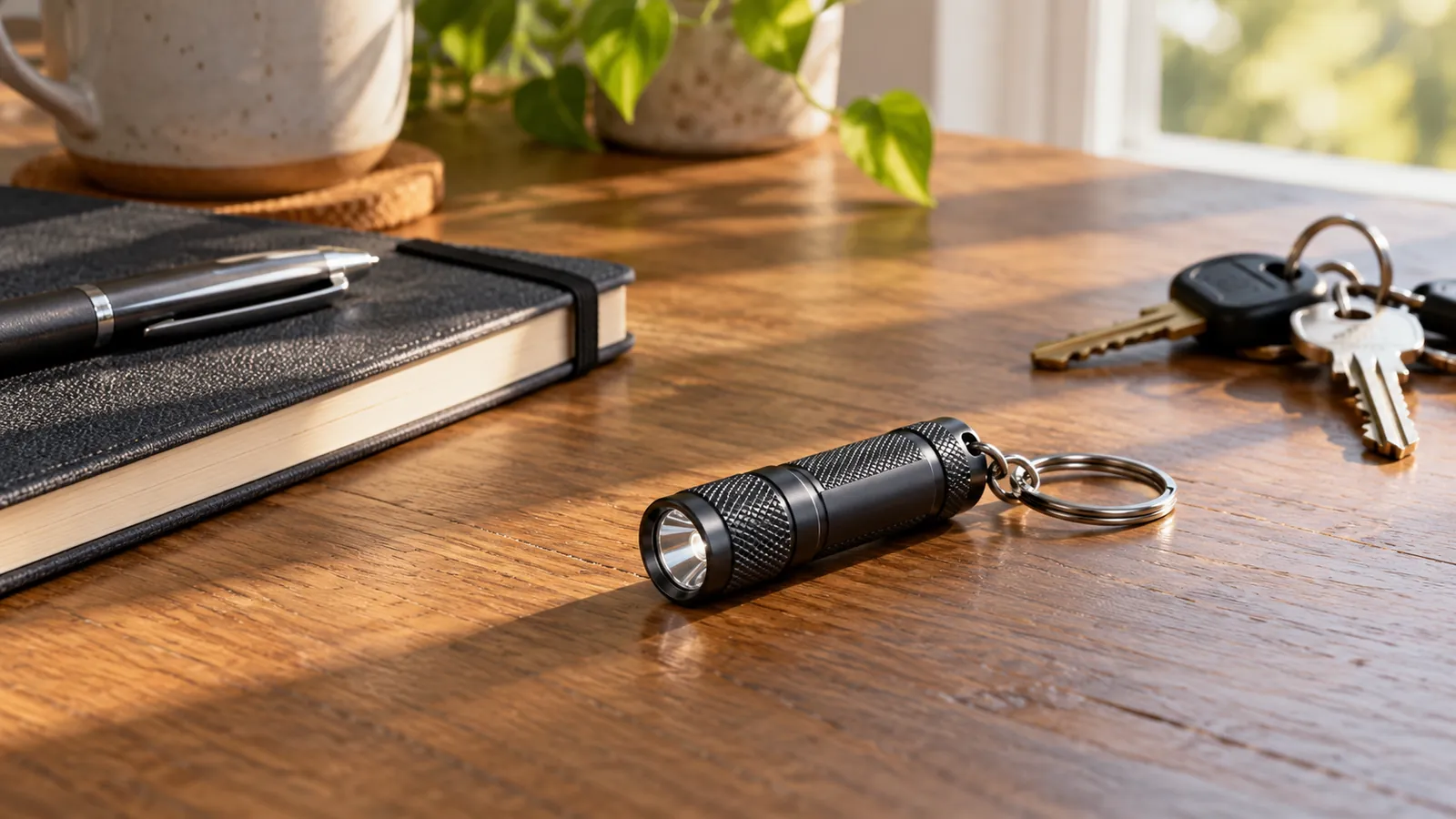
The Olight i3E EOS is a small keychain light powered by one AAA cell and operated by twisting its head and body relative to one another. Olight lists 90 lumens and a 44-meter beam distance. Compare its simple replaceable-cell design with the charging routine and controls you want to carry.
| Question | i3E EOS at a glance | What to check |
|---|---|---|
| How is it powered? | One AAA cell; an alkaline cell is included | Battery type and the cell maker's instructions |
| How is it operated? | Twist the light's threaded parts | Keep the light attached securely to your keys |
| What is the rated output? | 90 lumens; one listed output | A maximum figure is not a guarantee of task visibility |
| How small is it? | 60.5 mm long; 19.4 g including battery | A key ring adds its own size and weight |
| Does it charge by USB? | No built-in USB charging | A compatible rechargeable cell needs its own charger |
Check Olight's published specifications and package contents for the exact version you buy.
📋 Table of Contents
- 1. i3E EOS Single-AAA Design and Carry Trade-Offs
- 2. i3E EOS Twist Operation and First Setup
- 3. i3E EOS AAA Battery Compatibility and Cell Restrictions
- 4. AAA Battery Chemistry and i3E Brightness
- 5. i3E EOS Rated Runtime and Its Limits
- 6. Comparing Two Single-AAA Olight Lights
- 7. Replaceable AAA Versus Built-In Rechargeable Design
- 8. Charging a Compatible AAA Outside the i3E
- 9. What a Small AAA Light Can and Cannot Do
- 10. Police Use: What Is and Is Not Verified
- 11. Who Should Choose the i3E EOS
- 12. i3E EOS Setup and Storage Checklist
- 13. FAQ
i3E EOS Single-AAA Design and Carry Trade-Offs
The i3E EOS is designed around a single replaceable cell and a simple twist action rather than a built-in charging port. That is convenient if you already keep suitable AAA batteries, prefer carrying a spare or do not want to find a cable for a quick replacement. The trade-off is that you must track the cell and dispose of or recharge it appropriately.
Its compact format also limits the space for controls. The Olight product page describes one 90-lumen output rather than separate low and high settings. If you need a very dim level for close reading or several brightness choices, this particular design may not be the best match. Output alone does not tell you whether a beam is comfortable for a given task.
On October 31, 2026, Olight's page listed the i3E EOS variant with SKU I3E19TH at $12.99 before shipping. Other finishes can have different prices and availability; verify the exact selection and current price before purchase.
The page lists a 44-meter beam rating. Treat Olight's published rating as a comparison point, not a promise that you can read a sign or identify an object at that distance. Surface color, size, weather, surroundings and battery condition all influence what can be seen.
i3E EOS Twist Operation and First Setup
The product page describes activating the light with a head twist. The supplied manual describes tightening the threaded parts to turn it on and loosening them to turn it off; the manual's activation paragraph calls one part the tailcap while its setup diagram identifies the light head. Follow the current instructions for your own unit and avoid forcing or over-loosening the parts.
Before first use, the manual tells the owner to unscrew the light head, remove the insulating film and reinstall the head. It also says the battery's positive end points toward the head. Check that the light is off and the parts are properly seated before attaching it to keys. Do not aim the light into anyone's eyes.
The current Olight listing describes a single-output light. Do not assume a brief twist accesses another mode or that a tail button is present. If you need multiple settings or a switch that can be used without twisting, compare other models and their instructions separately.
i3E EOS AAA Battery Compatibility and Cell Restrictions
The supplied manual lists an included alkaline AAA and also uses the wording “NiMH / L92” under available batteries. The product page says a single AAA and does not provide separate performance data for every chemistry. Read the specific battery manufacturer's restrictions as well as the light's instructions; a same-size battery does not establish that every chemistry or product is appropriate.
AAA describes a size category, while alkaline, nickel-metal hydride and lithium identify different chemistries. A 10440 rechargeable lithium-ion cell may resemble an AAA physically, but size is not a compatibility claim. The i3E page and the supplied manual do not list 10440; do not transfer a different flashlight's battery permissions to this one. The term “dual fuel” is not a battery standard: check the exact model and approved cells instead of assuming that any two similarly sized cells can be used.
The Olight manual names an eneloop pro cell in a historical runtime test, but Panasonic says not to use eneloop pro batteries in waterproof flashlights or devices with airtight battery compartments. Olight lists the i3E as IPX8. Do not use that Panasonic cell in the i3E on the strength of the historical test. For another rechargeable AAA, check both manufacturers' instructions for the exact cell and light before treating it as compatible.
Use the correct charger for the actual rechargeable chemistry. Never attempt to recharge a disposable alkaline cell in a NiMH charger. Carry a spare in its original packaging or a suitable protective case rather than loose with keys, coins or other metal items. For long storage, the manual advises removing the battery to reduce leakage risk.
AAA Battery Chemistry and i3E Brightness
The Olight manual reports a 90-lumen specification and runtimes from tests using a GreenMax alkaline AAA and an eneloop pro NiMH cell rated 900 mAh. It does not provide a separate brightness curve for each cell. These results do not establish that every alkaline or rechargeable AAA will have the same brightness or runtime.
Battery chemistry, condition, temperature and the light's circuitry can all affect performance. A lower nominal voltage on one battery type does not by itself reveal the brightness this particular light will produce. Look for evidence about the exact device and cell rather than assuming a voltage difference directly translates to a fixed percentage of light.
If reliable performance matters, bring an appropriate backup and replace a weak cell before it becomes a problem. Olight's published data are a starting point, not a prediction of the exact number of days your usage will last.
i3E EOS Rated Runtime and Its Limits
The supplied manual reports 45 minutes with one GreenMax alkaline AAA and 70 minutes with one eneloop pro NiMH AAA rated 900 mAh. These are results reported in the supplied Olight manual for the named test cells, not a guarantee for all AAA batteries or all conditions. As noted above, Panasonic warns against using this cell in waterproof flashlights. The page's 90-lumen rating does not mean a constant measured output for an entire real-world run.
Short, occasional uses can make a light feel as though it lasts for many days, but dividing a continuous runtime into imagined daily uses does not account for storage, temperature, cell age or changing output. Treat a simple division only as arithmetic, not as a verified service schedule. Check the light before relying on it and keep a suitable spare if a loss of light would matter.
| Published figure | Source and limitation |
|---|---|
| 90 lumens | Olight's published output rating |
| 45 minutes | Manual test using one GreenMax alkaline AAA |
| 70 minutes | Historical manual test using one specified 900 mAh eneloop pro NiMH AAA; Panasonic warns against use in waterproof flashlights |
| 44 meters | Olight's published beam distance, not an identification guarantee |
| 19.4 g | Manual states weight includes battery; key ring weight is not specified |
Do not swap these values with the i3T 2 EOS. That different model has different controls and battery documentation. Check the name printed on the light and the actual manual before choosing cells or interpreting runtime.
Comparing Two Single-AAA Olight Lights
The i3E EOS and i3T 2 EOS both accept a replaceable alkaline AAA, but they solve different carrying problems. The i3E favors a short keychain body and a twist control; the i3T 2 adds a pocket clip, a tail switch and a low mode in a longer, heavier body. The following numbers are Olight's published specifications.
| Specification | i3E EOS | i3T 2 EOS |
|---|---|---|
| Power and control | One AAA; twist | One AAA; tail switch |
| Listed maximum and distance | 90 lm; 44 m | 200 lm; 62 m |
| Length | 60.5 mm / 2.38 in | 89 mm / 3.5 in |
| Listed weight | 19.4 g / 0.68 oz, including battery | 41.8 g / 1.47 oz, including battery |
| Low mode | No separate low mode listed | 5 lm listed |
The i3T 2 page additionally lists a 10440 lithium-ion cell with PCB protection under its own conditions. That permission is specific to the i3T 2 and must not be applied to the i3E. Higher stated output does not by itself establish a more useful beam for a particular job; compare the control, carry size and power routine first. Check the current i3T 2 listing and manual before purchase.
Replaceable AAA Versus Built-In Rechargeable Design
The i3E EOS uses a replaceable AAA cell and a twist action; a built-in rechargeable keychain light stores energy in its own battery and needs a compatible power source for recharging. Replacing the i3E's cell can be convenient away from a power outlet, while a rechargeable design may fit a routine where you can charge it regularly.
For a rechargeable example, Olight's iUltra has a built-in USB-C plug and uses a pull-apart activation design. Olight lists 80 lumens and 50 minutes for its cool-white setting, with 20 g including its battery. These are ratings for different products and test conditions. The iUltra's magnetic base is another physical difference; follow its manual and any relevant implanted-device warnings.
| Decision | i3E EOS | iUltra example |
|---|---|---|
| Power routine | Replace a compatible AAA | Recharge the built-in battery using its USB-C plug |
| Activation | Twist the threaded parts | Pull the light from its base |
| Published output | 90 lm | 80 lm cool white |
| Published runtime | 45 min alkaline; historical 70 min test with a specific NiMH cell that Panasonic warns against using in waterproof flashlights | 50 min cool white |
| Day-to-day consideration | Carry and store an appropriate spare cell | Plan a suitable charging opportunity |
Neither design is universally better. Compare controls with the way you use your keys, check the charging or battery arrangements and try to keep a backup for important tasks. Do not infer a difference in useful visibility from the two lumen numbers alone; beam shape and conditions matter.
Charging a Compatible AAA Outside the i3E
A rechargeable AAA cell must be charged outside the i3E EOS using a charger designed for that specific chemistry and cell. The i3E has no built-in USB charging port. Remove the cell and follow both the cell and charger instructions; do not place an alkaline disposable battery in a charger intended for rechargeable NiMH cells.
Olight's Ostation X includes a version for AAA NiMH batteries. Verify the exact model, package and compatibility before purchase. The Ostation X is a separate charger, not something required to use the included alkaline cell, and its listed NiMH support should not be generalized to 10440 lithium-ion cells.
A reusable battery can suit a household that already uses compatible cells and a charger. A traveler who rarely uses the light may value a packaged spare instead. Check the specific manufacturer's guidance on safe storage, temperatures, and the use of its rechargeable cell in an IP-rated flashlight before choosing either option.
For broader definitions and safety considerations, see the flashlight battery types guide. Cells of different dimensions or chemistry are not interchangeable merely because they power flashlights.
What a Small AAA Light Can and Cannot Do
It can be useful for brief tasks such as checking a bag, finding a keyhole or illuminating a nearby object. Olight lists 90 lumens for the i3E EOS, but the suitability of that output depends on the task, the beam and the surroundings. A listed distance or lumen number does not establish how well you can read a small label at a particular range.
Its small size and single output also impose trade-offs. A single 90-lumen setting cannot be dimmed using a separate low mode listed on the current page. If you need sustained area lighting, hands-free work, several settings or a dependable primary light for a long outing, assess a different tool and carry an appropriate backup.
The best use is the one that matches the design. A keychain light can make light accessible, but an exposed battery, loose key ring or missing cell can prevent it working when needed. Inspect the ring and casing, test the light periodically and follow storage guidance.
Police Use: What Is and Is Not Verified
Olight offers lights for several uses, and individual officers may select equipment according to their needs and department rules. Usage by individual officers does not establish an agency-wide approval or suitability as a primary duty light.
The i3E page describes keychain, everyday carry and gift use. For professional work, check the employer's approved equipment list, the task and backup requirements. A small personal keychain light should not be assumed to meet an agency's duty-light standard.
Who Should Choose the i3E EOS
The i3E EOS can suit someone who wants a compact keychain backup with a replaceable AAA and a straightforward control. It can also suit a person who already maintains compatible cells and wants a light without a proprietary charging cable. The key question is whether the size and replacement routine fit your day.
Choose another product if you need a rechargeable port in the light, multiple brightness levels, a headband or a longer continuous operating plan. Olight's published i3E specifications do not establish that it meets every workplace, travel or emergency-lighting requirement. Compare the specific application with the product instructions and a suitable backup.
For broader choices for outdoor trips, see Olight's outdoor flashlights guide. For an everyday carry collection, see EDC flashlights. The Oclip 2 Pro is a different rechargeable clip-light format for hands-free placement; it does not share the i3E's replaceable-AAA power routine.
i3E EOS Setup and Storage Checklist
Before adding the light to your keys, read the included manual and verify that the exact model and battery match the instructions. The following checks bring the power source, attachment and storage plan together without assuming that a keychain light replaces a task-specific primary light.
- Remove the insulating film as directed and insert the battery in the orientation shown in the manual.
- Turn the light on and off as instructed; ensure the parts are seated without forcing them.
- Attach the ring securely and keep small parts and batteries away from children.
- Store an appropriate spare cell in protective packaging, away from loose metal objects.
- Remove the cell for long-term storage as the manual advises and inspect for damage or leakage.
- Never recharge a disposable cell; use the correct charger and follow the exact cell's instructions.
- Keep a backup suitable for the task and check it before you depend on it.
FAQ
Changelog
- October 31, 2026: Reviewed product information and battery guidance.




