Olight makes the lights discussed here. Olight specs and regular prices come from its US product pages and user manuals as of September 2026; standard wording comes from PLATO and the IEC. Night lengths, drop heights and battery-indicator hours below are calculations from published figures, not measurements.
⚡ TL;DR
Outdoor flashlights are lights you can trust after rain, a cold night, a fall onto rock and a long walk back to camp. Four published numbers show it: the water rating, the rated drop height, the listed working temperature and how long the working mode runs. Check those four before lumens, then run a 10-minute check at home before you leave.
Every box in the store says outdoor, tactical or waterproof. One page lists IPX8, another IP68, a third says nothing about cold, and a 4,600-lumen headline tells you nothing about the third hour. This guide turns those labels into four checks you can run on any spec sheet, shows the arithmetic, and ends with a pre-trip routine.
This table sums up the four checks for outdoor flashlights, with the number to read and the point where a light passes.
| Check | What to read | Passes for most trips when | Example from Olight's ratings |
|---|---|---|---|
| Water | IP code, plus any seawater or immersion warning | IPX7 or better, with no "do not immerse" line | Perun 3: IP68 |
| Drops | Impact height in meters | At or above the height the light rides at | Warrior Ultra: 2 m |
| Cold | Working temperature in the manual | Covers the forecast low, or you have a warm-pocket plan | Seeker 4 Pro: 0-40°C |
| Runtime | The working mode's lumens and hours | Covers the longest night of the trip on one charge | Perun 3 Medium: 120 lumens for 25 hours |
📋 Table of Contents
- 1. Quick Answer: Check Water, Drops, Cold and Runtime Before Lumens
- 2. What Is the Best Flashlight for Outdoor Use?
- 3. Outdoor Flashlights vs Household Flashlights: Seals, Grip, Switches and Finding the Light
- 4. How to Read a Water Rating for Rain, a Dropped Light and a Soak
- 5. What Is the Best Waterproof Flashlight?
- 6. Does Cold Make a Flashlight Dimmer or Shorter-Running?
- 7. What Does a Drop Rating Test, and Where Does It Fall Short?
- 8. How Long Does Maximum Output Last Before It Steps Down?
- 9. Outdoor Flashlight Shapes Compared: Straight, High-Power, Headlamp and Flat
- 10. Laser Safety on Multi-Light Outdoor Flashlights
- 11. Which Flashlight Do Navy SEALs Use?
- 12. Common Mistake: A Tactical Flashlight Is Automatically an Outdoor Flashlight
- 13. Your 10-Minute Pre-Trip Check: Charge, Lockout, Seals and a Backup Light
- 14. FAQ
Quick Answer: Check Water, Drops, Cold and Runtime Before Lumens
Read outdoor flashlights in this order: water rating, rated drop height, working temperature, then the hours the working mode lasts. Peak lumens come fifth, because the lights here hold their peak for only two to three minutes. A light that passes the first four will still be working at 2 a.m. in the rain; a bright light that fails one of them may not.
Standards cover some of these checks and leave others to you. This table maps each trip risk to the standard text that covers it and to what you still have to check yourself.
| Trip risk | What the standard text says | What it leaves to you |
|---|---|---|
| Rain or a light dropped in water | IEC: the second numeral "uses a scale from 0 (no protection) to 9 (high-pressure hot water from different angles)" | Salt water, open ports, and how long the light stays under |
| Dust and sand | PLATO: FL 1-2025 responds "by introducing dust ingress testing and associated markings" | Whether your light was rated under that edition |
| A fall | Streamlight's FL1 summary: samples "must remain fully functional in order to pass the Impact Resistance test" | Drops higher than the rating, and repeated drops |
| Cold | No FL1 or IEC 60529 test of low-temperature output | The manual's working range and a warm-pocket plan |
| Short turbo bursts | PLATO: turbo runtime runs "until output drops to 90% of the highest measurement recorded during the first 10 seconds" | Which edition your manual cites |
The IEC line comes from its IP ratings page and the PLATO lines from its summary of ANSI/PLATO FL 1-2025, the current edition of the U.S. flashlight standard. The three Olight manuals here that name an edition cite FL 1-2019, so their ratings predate the new dust and turbo methods.
What Is the Best Flashlight for Outdoor Use?
The best flashlight for outdoor use, for most trips, is a headlamp-flashlight such as the Olight Perun 3: IP68, a 1.5 m drop rating, and 120 lumens for 25 hours on one charge, at $89.99. Choose the Warrior Ultra when falls onto rock are the main risk, since it carries a 2 m rating, and the Seeker 4 Pro for a vehicle or base camp.
Olight groups its outdoor LED flashlights on one category page. This table scores four of them, one per common shape, on the four checks, using only Olight's published ratings.
| Light (regular price, September 2026) | Water | Rated drop | Working temperature | Working mode | Peak, then first step |
|---|---|---|---|---|---|
| Perun 3 ($89.99) | IP68 | 1.5 m | 0-40°C | Medium 120 lumens, 25 hours | 3,000 lumens for 2 min, then 800 |
| Warrior Ultra ($139.99) | IPX8 | 2 m | 0-40°C | Medium 200 lumens, 13 hours | 2,500 lumens for 2.5 min, then 800 |
| Seeker 4 Pro ($139.99) | IPX8 | 1.5 m | 0-40°C | Medium 300 lumens, 11 hours | 4,600 lumens for 2.5 min, then 1,200 |
| ArkPro Ultra ($129.99) | IPX7, no seawater | Not listed | 0~45 ℃ | Medium 100 lumens, 13 hours (Pure Flood) | 1,700 lumens for 3 min, then 520 (Pure Flood) |
The Olight Perun 3 headlamp ($89.99 regular price, September 2026, Black; every color is the same price) is the only one that frees both hands, and it ships with a headband, MCC3 magnetic cable and lanyard. Its limit is reach: 6,400 candela and 160 m. It is also the pick in our guide to the best camping flashlights, which builds a campsite kit around it.
The Olight Warrior Ultra tactical flashlight ($139.99 regular price, September 2026, Navy Blue; all colors the same price) is the drop pick, with 26,000 candela and 320 m of reach at 178 g. The Olight Seeker 4 Pro flashlight ($139.99 regular price, September 2026, Matte Black CW; every color the same price, including a neutral-white Matte Black NW) ships with a vertical holster that charges by USB-C and a wall bracket; the MCC3 magnetic cable is optional. It weighs 205 g, and the page lists 350 g for a Silver-Plated Bronze body.
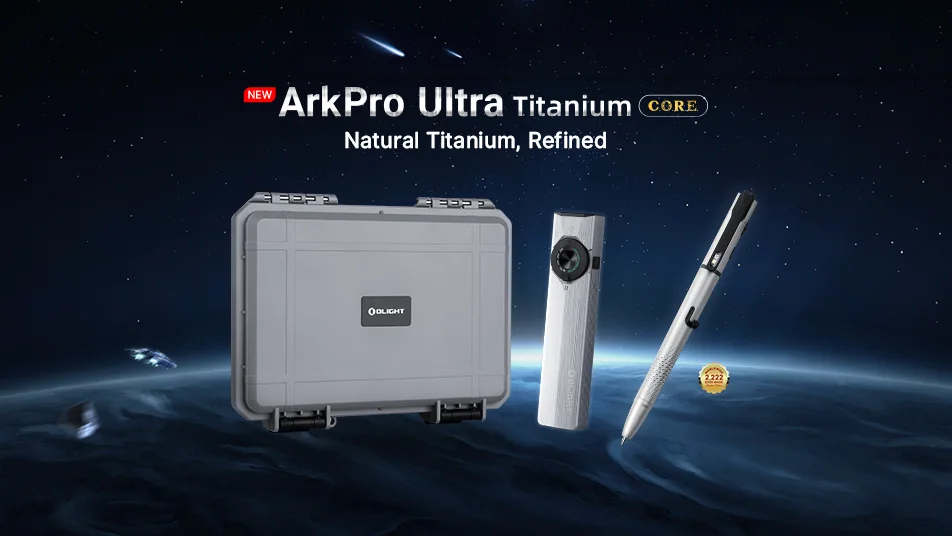
The Olight ArkPro flat EDC flashlight series page defaults to the ArkPro Ultra at $129.99 (regular price, September 2026); the standard ArkPro starts at $99.99 in Matte Black CW, with some colors at $109.99. The ArkPro Ultra page lists 120 g, while the series page's specs show 115 g, the standard ArkPro's figure. It is a strong second light and the wrong main light for a winter night or a sea kayak.
Outdoor Flashlights vs Household Flashlights: Seals, Grip, Switches and Finding the Light
Outdoor flashlights differ from household lights in four places: seals that survive rain and a dunk, a grip that holds in wet gloves, a switch that will not turn on in a pack, and a way to find the light in the dark. A trail light needs all four, plus a working mode that lasts a whole night.
Switches show the difference best. The Seeker 4 Pro locks itself 10 seconds after its indicators go off, and the Perun 3 and Warrior Ultra lock with a press and hold of about 2 seconds from off. The ArkPro manual's exclusion clause names "using the product without the recommended lockout mode" among the uses Olight is not liable for. For gloves, Olight says the Perun 3's side button enables "simple, glove-friendly operation," and the Seeker 4 Pro's rotary switch allows "easy operation even with heavy gloves."
This parameter table explains each number an outdoor flashlight spec sheet shows, its unit, the range you will see and how to judge whether it is enough.
| Concept | Unit | Typical range on outdoor lights | How to judge it |
|---|---|---|---|
| Water rating | IP code | IPX4 to IP68 | IPX7 or higher if the light could fall in a creek |
| Impact rating | meters | 1 to 2 m | At or above where the light rides: head, shoulder or hand |
| Working temperature | °C | 0 to 40 or 45 °C on these rechargeable lights | Compare the low end with the forecast night low |
| Working-mode runtime | hours | 11 to 25 hours at 100 to 300 lumens here | One full night of darkness on one charge |
| Beam distance | meters | 160 to 320 m here | 150 m covers most trails; more helps across water |
How to Read a Water Rating for Rain, a Dropped Light and a Soak
An IP code has two numerals: the first rates dust and solid objects from 0 to 6, the second rates water from 0 to 9, and an X means that part was not rated. For a trip, IPX4 handles rain, IPX7 a short dunk, and IPX8 or IP68 a longer one on the maker's terms. Then check the manual for seawater and port warnings.
The IEC says the code "Avoids confusion over vague marketing terms like 'waterproof.'" For the full split between the immersion codes, our guide to IPX7 vs IPX8 vs IP68 reads each one against makers' spec lines. The short version: with the 8, the maker sets depth and time, and PLATO says FL 1-2025 "allows testing depth and duration to vary."
For a pre-trip check, the more useful question is where water could get in. This audit lists how each light charges, which parts you can open, and the water limits Olight states.
| Light | Rating | How it charges | Parts to check | Water limit stated by Olight |
|---|---|---|---|---|
| Perun 3 | IP68 | MCC3 magnetic cable | Threaded tail cap (the manual shows it unscrewed to remove the battery's insulating film) | None beyond the code |
| Warrior Ultra | IPX8 | MCC3 magnetic cable | Threaded tail cap (same insulating-film step) | None beyond the code |
| Seeker 4 Pro | IPX8 | USB-C through the holster, or an optional MCC3 | Threaded tail cap; holster with its own USB-C port | The page says its laser micro-pierced indicator holes keep "IPX8 waterproof"; no rating is listed for the holster |
| ArkPro Ultra | IPX7 | USB-C port, or MCC magnetic cable | USB-C port on the light | "Do not immerse the flashlight in seawater or other corrosive media as it will damage the product." |
Three habits follow. Screw every tail cap fully closed after the first charge. Keep the Seeker 4 Pro's holster in the tent or truck. And keep the ArkPro out of the ocean; its manual also says, "Keep the charging port clean and dry."
Note: None of the three IPX8 or IP68 pages here prints a depth or a time beside the code. Treat them as rated for a drop you can recover quickly, not for a light left underwater.
What Is the Best Waterproof Flashlight?
Among these four, the best waterproof flashlight is the Olight Perun 3, because it is the only one rated IP68: immersion-rated like the IPX8 lights, plus dust-tight. The IPX8 Warrior Ultra and Seeker 4 Pro charge without an open port on the light. The IPX7 ArkPro Ultra suits rain and fresh water, and its manual rules out seawater.
No page here states a depth, so on a boat or a dock the best waterproof flashlight is the one you can still reach. Carry an immersion-rated light with no port on the body, on a lanyard; Olight ships one with the Perun 3. In rain, charging is the weak point, not the code. The ArkPro manual says, "Do not use the product while charging," so charge it in the tent, not on the picnic table.
Does Cold Make a Flashlight Dimmer or Shorter-Running?
Cold mainly makes a lithium-ion flashlight run shorter, and it can also cap its output. The LED starts fine in cold air; the battery is the weak link. Battery University says internal resistance rises when cold, which "affects discharge performance noticeably with Li-ion." Three of the four Olight manuals here list a working range of 0-40°C, so a night below freezing is outside it.
The National Park Service puts it plainly on its winter safety page for Katahdin Woods and Waters: "Electronics and batteries drain faster in the cold, prepare accordingly!" Charging is stricter than use. Battery University's guide to charging at high and low temperatures says: "Many battery users are unaware that consumer-grade lithium-ion batteries cannot be charged below 0°C (32°F)."
For how much runtime a cold or aged cell gives up, see our guide to flashlight runtime. This guide checks the other side of the cold problem: how long the night is.
The darkness check: does one charge cover the longest night?
Nights get longer as temperatures fall. U.S. Naval Observatory data for a point near Estes Park, Colorado (40.37° N, 105.52° W) put civil twilight from 3:59 to 20:09 on June 20, 2026, from 5:48 to 17:46 on October 17, and from 6:50 to 17:09 on December 19. Subtracting each span from 24 hours leaves 7.83, 12.03 and 13.68 hours of darkness. You can repeat it for your trip with the USNO one-day sun and moon table.
Now divide each light's rated runtime by those hours. A result of 1.0 or more means one charge could light the whole night in that mode, the worst case for a light left on as a camp marker or during a long search. The figures are based on Olight's rated runtimes, not measured, and a cold night will cut them further.
| Light and mode (Olight rating) | June 20 (7.83 h) | October 17 (12.03 h) | December 19 (13.68 h) |
|---|---|---|---|
| Perun 3 Medium, 120 lumens, 25 h | 25 ÷ 7.83 = 3.19 nights | 2.08 nights | 1.83 nights |
| Warrior Ultra Medium, 200 lumens, 13 h | 13 ÷ 7.83 = 1.66 nights | 1.08 nights | 0.95 of a night |
| ArkPro Ultra Medium (Pure Flood), 100 lumens, 13 h | 1.66 nights | 1.08 nights | 0.95 of a night |
| Seeker 4 Pro Medium, 300 lumens, 11 h | 11 ÷ 7.83 = 1.40 nights | 0.91 of a night | 0.80 of a night |
| Seeker 4 Pro Low, 50 lumens, 60 h | 7.66 nights | 4.99 nights | 4.38 nights |
In June every light covers a full night on Medium. By mid-October the Seeker 4 Pro's brighter Medium does not, and by late December only the Perun 3 clears a full night on Medium. Dropping the Seeker 4 Pro to its 50-lumen Low turns 0.80 of a night into more than four.
Tip: Charge before you leave, indoors. Battery University recommends charging between 10°C and 30°C (50°F and 86°F) for best results, so a frozen tent is the wrong place to top up.
What Does a Drop Rating Test, and Where Does It Fall Short?
A drop rating says test samples fell from the stated height onto a hard surface and still worked with no cracks. Streamlight's one-page FL1 summary defines impact resistance as "The degree to which a portable light resists damage when dropped on a solid surface." It does not promise survival from higher up, after many drops, or onto a sharp rock edge.
Olight's manuals list 1.5 m for the Perun 3 and Seeker 4 Pro and 2 m for the Warrior Ultra; neither the ArkPro page nor its manual lists a height. The useful question is how high your light rides. The CDC's body measurements page lists the average height of U.S. adults 20 and older as 68.9 inches for men and 63.5 inches for women: 175.0 cm and 161.3 cm (× 2.54). The offsets in this table are our assumptions: a headlamp about 10 cm below the top of the head, a light held up to scan about 25 cm below it.
| Where the light is | Average man | Average woman | Within 1.5 m (Perun 3, Seeker 4 Pro)? | Within 2 m (Warrior Ultra)? |
|---|---|---|---|---|
| Headlamp on the forehead | 1.75 - 0.10 = 1.65 m | 1.61 - 0.10 = 1.51 m | No: 1.65 ÷ 1.5 = 1.10 times; 1.51 is just over | Yes |
| Held up at shoulder height | 1.75 - 0.25 = 1.50 m | 1.61 - 0.25 = 1.36 m | At the limit for a man; yes for a woman | Yes |
| Headlamp, standing on a 0.5 m boulder or tailgate | 1.65 + 0.5 = 2.15 m | 1.51 + 0.5 = 2.01 m | No | No, 0.15 m and 0.01 m over |
A headlamp knocked off an average man's forehead falls about 10% farther than a 1.5 m rating covers, so a snug headband, not the rating, is your first defense. Standing on anything puts even a 2 m rating at its limit. Surface matters too: the rating describes a hard surface, and broken granite can be harsher than flat ground. For drop energy and mud on job sites, see our guide to durable flashlights.
How Long Does Maximum Output Last Before It Steps Down?
On these four lights, maximum output lasts 2 to 3 minutes before the first step-down: 2 minutes on the Perun 3, 2.5 on the Warrior Ultra and Seeker 4 Pro, and 3 on the ArkPro Ultra's Pure Flood. The step that follows is the brightness you will actually hike by.
The Seeker 4 Pro shows the shape. Its Turbo line reads 4,600~1,200~600 lumens for 2.5 + 122 + 35 minutes, and its manual puts those steps at 100%, 26% and 13%. The ArkPro Ultra page lists Pure Flood Turbo at 1,700~520 lumens for 3 + 140 minutes, while the series page specs show the standard ArkPro's 1,500~520 lumens for 4 + 140 minutes. PLATO says FL 1-2025 now measures turbo output "between one and 10 seconds" so buyers can "distinguish a brief burst of maximum output from performance that can be sustained over a longer period."
Read the battery indicator as hours
The runtime check you can do at home is reading the battery indicator before you pack. Each Olight manual maps indicator colors or bars to a charge band, and multiplying that band by the rated Medium runtime turns it into hours. The table assumes runtime falls in step with charge, a simplification based on Olight's rated figures, not measured.
| Light (Medium rating) | Indicator in the manual | Charge band | Estimated hours left on Medium |
|---|---|---|---|
| Perun 3 (120 lumens, 25 h) | Green | Over 60% | Over 15 h (25 × 0.6) |
| Perun 3 | Orange | 10% to 60% | 2.5 to 15 h |
| Seeker 4 Pro (300 lumens, 11 h) | Green, top band | 75% or more | 8.25 h or more (11 × 0.75) |
| Seeker 4 Pro | Red | Under 10% | Under 1.1 h |
| Warrior Ultra (200 lumens, 13 h) | Bars for 50% to 75% | 50% to 75% | 6.5 to 9.75 h |
| Warrior Ultra | Lowest indicator glows red | Under 10% | Under 1.3 h |
The Perun 3 rows carry the warning. Orange covers anything from 2.5 to 15 hours of Medium, too wide a range to plan on, so charge until it turns green. Against the December night above, only the Perun 3's green band clears 13.68 hours.
Outdoor Flashlight Shapes Compared: Straight, High-Power, Headlamp and Flat
Each outdoor flashlight shape trades one strength for one weakness. A straight tactical-style light gives reach and drop resistance but needs a hand. A high-power light gives the most output but weighs the most. A headlamp hybrid frees your hands but reaches less far. A flat multi-light carries extra beams in a pocket but gives up water and drop margin.
This comparison table sets out each shape's strength and weak spot outdoors, with the Olight light that represents it.
| Shape | Olight example | Strength outdoors | Weak spot outdoors | Best trip |
|---|---|---|---|---|
| Straight tactical-style | Warrior Ultra | 2 m drop rating, 320 m reach, dual switches | Needs a free hand; strobe and strike bezel add nothing at camp | Rocky trails, river banks, night drives |
| High-power with holster | Seeker 4 Pro | 4,600 lumens, rotary dimming in gloves, wall-mount holster | 205 g; holster lists no water rating | Vehicle camping, base camp, farm |
| Headlamp hybrid | Perun 3 | Hands-free, IP68, red light, 25 h on Medium | 160 m reach; head-height drops exceed 1.5 m | Backpacking, camp chores |
| Flat multi-light | ArkPro Ultra | Flood and spot beams, UV and green laser, 120 g | IPX7, no seawater, no listed drop height, laser rules | Day hikes, travel, a second light |
Laser Safety on Multi-Light Outdoor Flashlights
If an outdoor flashlight has a laser, treat that beam by laser rules, not flashlight rules. Never aim it at a person, an animal's eyes, a vehicle or an aircraft. The ArkPro Series manual rates its green laser at a maximum output of 5 mW at 510 to 530 nm, and its table lists Class 3R, so use it only to point at terrain or objects.
The FDA's consumer guidance on laser pointers says, "Never aim or shine a laser pointer at anyone," and "Don't buy laser pointers for your children." It warns that "The light energy from a laser pointer aimed into the eye can be more damaging than staring directly into the sun."
The FAA's laser safety page states, "Pointing a laser at an aircraft is a federal crime." The law, 18 U.S.C. § 39A(a), reads: "Whoever knowingly aims the beam of a laser pointer at an aircraft in the special aircraft jurisdiction of the United States, or at the flight path of such an aircraft, shall be fined under this title or imprisoned not more than 5 years, or both."
Safety note: The ArkPro manual warns, "Do not look directly at the light source or shine it into your eyes, as this may cause temporary blindness or permanent damage to your eyes." It also says, "Do not store, charge, or use this light in a car where the temperature inside may exceed 60°C or in similar environments."
Which Flashlight Do Navy SEALs Use?
There is no public answer. We could not find a U.S. Navy or Naval Special Warfare document that names the handheld flashlight SEALs carry, and the lists online come from retailers and forums. What transfers to a civilian trip is the habit behind any field kit: know your light's limits on water, drops, cold and runtime before you need it, and carry a second light.
The second light is the part most campers skip. The National Park Service's Ten Essentials says lighting "can help you find your way out or signal for help" and adds, "Be sure to pack extra batteries." With built-in rechargeable lights, the extra battery is a second charged light or a power bank.
Common Mistake: A Tactical Flashlight Is Automatically an Outdoor Flashlight
A tactical flashlight is not automatically an outdoor flashlight. Tactical design targets short, intense use: instant Turbo, strobe, a strike bezel and a tail switch. Outdoor use is long and dim: a whole night at 100 to 300 lumens, in rain and cold. One light can do both, as the Warrior Ultra does, but only if you set it up for camp first.
The Warrior Ultra manual says the tail switch's factory setting gives Medium with a light tap and Turbo with a firm press, while Configuration 2 puts Strobe on a firm press and hold. For a trip, leave it in Configuration 1 and lock it in the pack. Olight's Warrior series page groups the Warrior duty lights if you want to compare more.
This misconception table lists five common outdoor-flashlight mistakes, the fact and its basis.
| Misconception | Fact | Basis |
|---|---|---|
| "Tactical means trail-ready." | Strobe and strike bezels do nothing for runtime, water or cold | Warrior Ultra page and manual |
| "Waterproof means any water." | The ArkPro is IPX7, and its manual rules out seawater | ArkPro Series manual |
| "A drop rating covers any fall." | A head-height fall for an average man is about 1.65 m, above a 1.5 m rating | CDC heights; Olight manuals |
| "The peak lumens are what you get." | Peak lasts 2 to 3 minutes on all four lights | Olight runtime lines |
| "It charges anywhere." | Consumer lithium-ion cannot be charged below 0 °C (32 °F) | Battery University |
Your 10-Minute Pre-Trip Check: Charge, Lockout, Seals and a Backup Light
Run this outdoor flashlight check the night before you leave, indoors at room temperature. It takes about 10 minutes for two lights and covers the four checks in this guide: water, drops, cold and runtime.
- Charge to full, indoors. Stop when the Perun 3 indicator is green, the Seeker 4 Pro shows its top band, or the Warrior Ultra cable light turns from red to green.
- Read the indicator as hours. Multiply the charge band by the Medium runtime and compare it with the darkness hours for your dates.
- Set the mode for camp. Leave Medium or Low as the memorized mode, and keep the Warrior Ultra tail switch in Configuration 1.
- Lock it. Press and hold about 2 seconds from off on the Perun 3 and Warrior Ultra; the Seeker 4 Pro locks itself, or when you seat it in the holster.
- Close the seals. Screw tail caps fully home, check that the ArkPro's USB-C port is clean and dry, and leave the Seeker 4 Pro holster in the vehicle.
- Plan for drops and cold. Snug the Perun 3 headband, use a lanyard near water, and if the low is below 0 °C (32 °F), carry lights in an inside pocket.
- Pack the backup. Bring a second charged light or a power bank and the right cable: MCC3 for the Perun 3 and Warrior Ultra, USB-C for the Seeker 4 Pro holster.
- Read the warnings once. Laser rules and no seawater for the ArkPro, and no hot cars for any of them.
FAQ
Changelog
- September 26, 2026: First published.