Olight makes some of the lights discussed here. Olight specs and regular prices come from its US product pages and user manuals as of September 2026. Traffic data, laws and safety advice come from the agencies and peer-reviewed studies linked in each section. The warning-time, crossing-gap and battery figures are calculations from those published numbers, not measurements.
⚡ TL;DR
How to run at night safely comes down to one order of operations: be seen, then see, then be findable. Wear a white light in front, a red light and reflective bands behind and on your ankles, run facing traffic where there is no sidewalk, pick a lit loop you know, and share your live location before you leave.
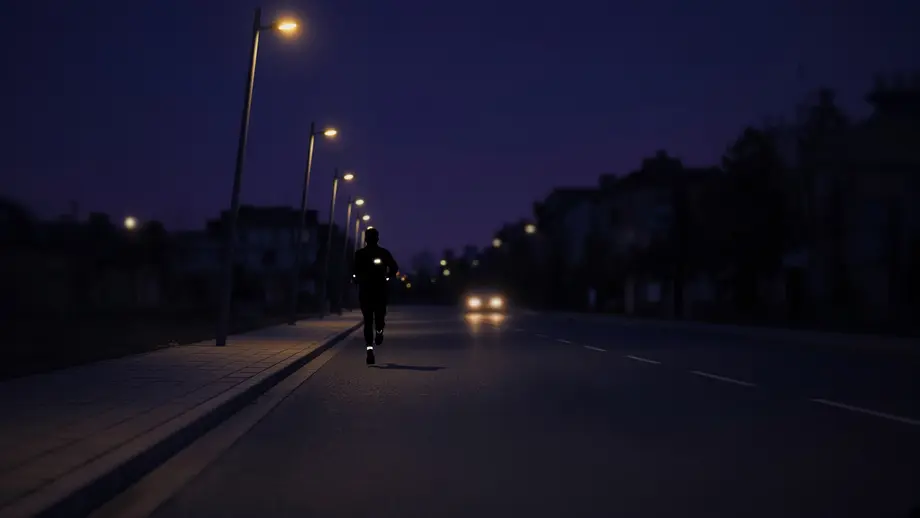
If you can only run after work, winter turns every run into a night run. The streetlights leave gaps, the car that brushed past you last week never slowed down, and nobody at home knows your route. This guide turns those worries into a step-by-step routine, with the numbers behind each step.
This table lists the most common problems on dark roads, their likely cause and the fix to try first; it is the core of how to run at night safely.
| Problem | Likely cause | Fix to try first |
|---|---|---|
| Drivers pass close or brake late | Dark clothes; reflective material only on your torso | Reflective bands on ankles, knees and wrists, plus a white light facing traffic |
| You trip on curbs and potholes between streetlights | Streetlights leave unlit stretches between poles | A wide floodlight at chest or waist height on about 100 lumens |
| Turning cars cut across you at corners | A turning driver may not see you at all | Stop, make eye contact, and cross only in a gap you can measure (see the gap table) |
| Your light dies mid-run | A weekly routine that outruns one charge | A fixed charging day and a keychain backup light |
| Nobody knows where you are | No plan left at home | A timed Check In or live location sharing |
| You never hear the car behind you | Earbuds turned up loud | Volume low enough to hear traffic, and a route that faces it |
📋 Table of Contents
- 1. How to Run at Night Safely: The Short Version
- 2. When Does a 6 p.m. Run Become a Night Run?
- 3. Step 1: The 5-Minute Pre-Run Check (Lights, Battery, Reflectors, Phone)
- 4. Step 2: How to Pick a Night Running Route (Streetlights, Sidewalks, Speed)
- 5. What Happens If You Run Without a Light?
- 6. What Should You Wear to Run at Night Safely?
- 7. Step 3: Wear a Light Front and Back (Which Lights, How Bright)
- 8. Step 4: How to Cross Streets at Night Without Guessing
- 9. Step 5: Share Your Location and Set a Check-In Time
- 10. Is It Safe to Run at Night?
- 11. Is It Safe to Go Running at 3am?
- 12. Running at Night Tips That Backfire: Common Mistakes
- 13. When Should You Change the Plan Instead of Pushing On?
- 14. Your Night Run Checklist
- 15. FAQ
How to Run at Night Safely: The Short Version
Learning how to run safely at night takes six steps: check your gear in five minutes, choose a route by sidewalk, speed limit and lighting, wear light and reflective material front and back, cross only where drivers expect you, share your location with a check-in time, and change the plan when conditions turn. Each step below comes with a checklist or a worked number you can reuse.
- Run the five-minute pre-run check (Step 1).
- Score your route before the first dark run (Step 2).
- Wear reflective bands on moving joints, a white light in front and a red light behind, with a small backup (Step 3).
- Cross at signals, with eye contact and a measured gap (Step 4).
- Leave a check-in time with someone who will act on it (Step 5).
- Shorten, reroute or move the run indoors when conditions remove a layer.
This routine covers roads and city streets. If your night runs are on single-track, our trail running headlamp guide covers roots, fog and two-light setups. If you walk rather than run, our guide to flashlights for walking at night covers handheld beams and rural shoulders. For the full range of hands-free lights, see Olight's headlamps.
When Does a 6 p.m. Run Become a Night Run?
A 6 p.m. run becomes a night run once evening civil twilight ends, which in the four cities below happens before 6 p.m. from mid-November through December. The U.S. Naval Observatory says that after civil twilight ends, "artificial illumination is normally required to carry on ordinary outdoor activities." Plan your lights by that time, not by sunset.
The USNO twilight definitions set the end of civil twilight at the moment the Sun's center is 6 degrees below the horizon. This table uses times from the USNO sun and moon data service for four cities and counts how many minutes of a 6:00 to 7:00 p.m. run fall after that point.
| City | Oct 15, 2026 | Nov 16, 2026 | Dec 21, 2026 | Feb 15, 2027 |
|---|---|---|---|---|
| Minneapolis | Ends 6:58 p.m.: 2 dark minutes | Ends 5:15 p.m.: 60 | Ends 5:08 p.m.: 60 | Ends 6:11 p.m.: 49 |
| Philadelphia | Ends 6:48 p.m.: 12 | Ends 5:13 p.m.: 60 | Ends 5:09 p.m.: 60 | Ends 6:04 p.m.: 56 |
| Dallas | Ends 7:19 p.m.: 0 | Ends 5:52 p.m.: 60 | Ends 5:52 p.m.: 60 | Ends 6:38 p.m.: 22 |
| Portland, Oregon | Ends 6:55 p.m.: 5 | Ends 5:11 p.m.: 60 | Ends 5:04 p.m.: 60 | Ends 6:08 p.m.: 52 |
October times are daylight time; the others are standard time. By mid-November the whole hour is dark in all four cities and stays that way through December. Even in mid-February, most of the hour is still dark everywhere except Dallas. NHTSA's 2024 pedestrian fact sheet reports that in the winter months, "one-third (33%) of pedestrian fatalities occurred from 6 to 8:59 p.m." NHTSA counts runners in that data: it defines a pedestrian as "any person on foot, walking, running, jogging, hiking, sitting, or lying down." Our guide to daylight saving time ends covers the first week after the clocks change.
Step 1: The 5-Minute Pre-Run Check (Lights, Battery, Reflectors, Phone)
The five-minute pre-run check confirms four things before you step outside: both lights turn on and have charge, reflective material is on your moving joints, your phone is charged and sharing your location, and someone knows your return time. Do it at the door every time, because each item fixes one of the problems in the table above.
- Minute 1, lights. Turn on the front white light and the rear red light. If either blinks a low-battery warning, charge it or take the backup. The Oclip 2 series manual says the light "flashes to indicate low battery when the battery level drops below 10%."
- Minute 2, reflectors. Bands on both ankles, then knees or wrists. In the research below, a vest alone was recognized later than a vest plus joint markers.
- Minute 3, phone and ID. RRCA calls the phone "The best safety tool you own" and advises you to "Slip it in your cell phone case or consider a Road ID that has pertinent medical information."
- Minute 4, check-in. Start a timed Check In or live location share with one person (Step 5 shows how).
- Minute 5, ears and lock. Set audio low or off. Lock clip lights you carry in a pocket; the Oclip 2 manual says, "If the product is carried or transported, please lock it."
Step 2: How to Pick a Night Running Route (Streetlights, Sidewalks, Speed)
Pick a night route that keeps you on sidewalks or paths, on streets with low speed limits, with steady lighting, signal-controlled crossings and ground you know from daylight runs. NHTSA's first reminder for pedestrians is to "Walk on a sidewalk or path when one is available." Speed matters next, because a car's impact speed sharply changes a pedestrian's chance of surviving.
The AAA Foundation for Traffic Safety estimates that "The average risk of death for a pedestrian reaches 10% at an impact speed of 23 mph, 25% at 32 mph, 50% at 42 mph, 75% at 50 mph, and 90% at 58 mph." GHSA's July 2026 pedestrian data release, which analyzes NHTSA's 2024 crash data, adds that in 2024, 9.2% of urban pedestrian crashes were fatal, "compared to 15.1% in rural areas," citing higher speeds and longer EMS response times as potential reasons.
This scorecard turns those sources into a route check. Score each factor from 0 to 2 on a daylight walk-through.
| Factor | 2 points | 1 point | 0 points | Source behind it |
|---|---|---|---|---|
| Separation | Continuous sidewalk or path | Wide shoulder | No sidewalk or shoulder | NHTSA pedestrian reminders |
| Posted speed | 25 mph or less | 30 to 35 mph | 40 mph or more | AAA Foundation impact-speed risk |
| Lighting | Streetlights the whole way | Lit in parts | Unlit | USNO twilight definition |
| Crossings | Signals with countdown timers | Marked crosswalks without signals | Mid-block or unmarked | NHTSA: cross "at crosswalks or intersections" |
| Familiarity | You ran it by day in the last month | Once, long ago | Never | RRCA: "Run in familiar areas" |
A score of 8 to 10 is a good night route. At 5 to 7, run it only with your full kit, and fix the weakest factor first. At 4 or below, choose another loop. A 1-mile loop near home that scores 9 beats a scenic 5-mile route that scores 4.
Tip: Build the loop so you pass your front door every lap, where you can swap a dying light or add a layer.
What Happens If You Run Without a Light?
Without a light, you depend on drivers seeing dark clothes in their headlights, and research shows they often cannot. In one closed-road study, recognition distances fell to 0.0 m for older drivers on low beams when the pedestrian wore black. You also lose the ground: curbs, potholes and ice sit in the gaps between streetlights.
That study in Human Factors (2005) found that "Drivers recognized only 5% of pedestrians in the most challenging condition (low beams, black clothing, glare)." Worse, people on foot tend not to know it. In an on-road study in the Journal of Safety Research, "Pedestrians overestimated their visibility and dramatically underestimated the benefit of conspicuity treatments." A later Clemson study found that drivers' own estimates of when they would respond to a pedestrian "were, on the average, over three times greater than actual recognition distance." Seeing a car's headlights does not tell you whether its driver sees you.
The road surface is the other half: a wide floodlight aimed a few steps ahead fills the dark stretches between streetlights.
Warning: Treat every approaching car as if the driver has not seen you. NHTSA's fact sheet says: "Never assume a driver sees you (he or she could be distracted, under the influence of alcohol and/or drugs, or just not see you)."
What Should You Wear to Run at Night Safely?
To run at night safely, wear reflective material on the parts of you that move (ankles, knees, wrists and elbows), plus a white light facing traffic and a red light behind. Closed-road studies show drivers recognize a pedestrian much sooner when reflectors trace the motion of the limbs than when only a vest reflects.
In a 2017 study in Ophthalmic and Physiological Optics, drivers "recognised pedestrians from a significantly greater distance (p < 0.05) when the pedestrian's clothing included the biomotion configuration (319.1 m) than when the biomotion markings were absent (184.5 m)." Every pedestrian wore black clothes and a reflective vest; only the added markers changed. Biomotion markers are reflectors on a person's major joints, which a 2012 study describes as placed "to facilitate the perception of biological motion." This table converts those two distances into seconds of warning at three driving speeds. It is our calculation from the published distances (speed in m/s = mph x 0.44704).
| Driver speed | Vest only: 184.5 m | Vest plus biomotion markers: 319.1 m | Extra warning |
|---|---|---|---|
| 25 mph (11.2 m/s) | 184.5 / 11.18 = 16.5 s | 319.1 / 11.18 = 28.5 s | 12.0 s |
| 35 mph (15.6 m/s) | 184.5 / 15.65 = 11.8 s | 319.1 / 15.65 = 20.4 s | 8.6 s |
| 45 mph (20.1 m/s) | 184.5 / 20.12 = 9.2 s | 319.1 / 20.12 = 15.9 s | 6.7 s |
Read these as best cases: the 14 drivers were young, on a closed road, and had to respond as soon as they recognized a pedestrian, so they were looking for one. A distracted driver has less time. The useful part is the gain: at every speed, joint markers buy several extra seconds.
Markers also tell drivers which way you are going. In a 2021 Journal of Safety Research study, drivers judged a crossing pedestrian's walking direction correctly 80% of the time with biomotion markers, against 33% for black street clothes.
Be careful with lights alone. In that 2012 study of bicyclists, "The presence of a bicycle light, whether static or flashing, did not enhance the conspicuity of the bicyclist," while ankle and knee reflectors did. Riders are not runners, but treat your light as a way to see the road and catch a driver's eye, not as a substitute for reflectors. RRCA's advice covers both: "Wear reflective clothing or a lighted vest when running in the dark." The CDC likewise suggests "wearing reflective clothing and crossing streets at a designated crosswalk or intersection whenever possible."
Step 3: Wear a Light Front and Back (Which Lights, How Bright)
For road running, wear a white floodlight at chest or waist height facing forward and a red light on your back, and set the white light near 100 lumens, tilted down onto the pavement rather than at drivers' eyes. Charge both on a fixed day, and carry a small keychain light as a spare.
This table lists the gear and consumables for the routine, with Olight's regular prices in September 2026.
| Item | Job | Olight option (regular price) | Limitation |
|---|---|---|---|
| Front white light | See the pavement; face oncoming drivers | Oclip 2 Pro, 530 lm floodlight, 75.5 g ($54.99) | One beam at a time: white or red, not both |
| Rear red light | Show your back to overtaking drivers | Oclip Pro S, red 40 lm, 53 g ($39.99) | IPX6; the manual says do not immerse |
| Head mount (optional) | Light that follows your eyes | Oclip Series Headlamp Strap ($7.99), fits Oclip Pro, Oclip Pro S and Oclip Ultra | Not listed for the Oclip 2 series |
| Backup light | Get home if the main light fails | i1R 2 Pro, 180 lm, 22 g ($21.99) | No red or strobe mode |
| Signal whistle | Call for help without a free hand | Titanium Emergency Whistle, 7 g ($15.99) | Sound only; no light |
Front light. The Olight Oclip 2 Pro ($54.99, regular price, September 2026) clips to straps up to 14 mm thick, and its head tilts 115° while the clip rotates 360°, so you can aim the floodlight down at the road from a vest strap or waistband. Olight rates the floodlight at 100 lumens for 3 hours 45 minutes on Medium and 10 lumens for 25 hours on Low. Red light runs at 40 lumens for 4 hours or 4 lumens for 27 hours, with a 20-lumen red strobe. It is IP66 with a 2.0 m impact rating, but its manual says, "Do not immerse the product in water or other liquids, as it will damage the product." Below freezing, the manual adds, "the white light is limited to Low and Medium modes."
Rear light. The Olight Oclip Pro page now lists the Oclip Pro S ($39.99, regular price, September 2026): 600 lumens white, red at 40 lumens for 3.5 hours or 4 lumens for 26 hours, 53 g and IPX6. Olight says its red, green and blue lights come "with both steady and flashing modes." It also fits the Oclip Series Headlamp Strap if you prefer a head-worn front light; our best headlamp for hiking and running guide covers that strap setup and headlamp bounce in detail.
Safety note: The Oclip 2 series, Oclip Pro and Oclip Pro S manuals all state: "If you have an ICD or pacemaker, avoid close or prolonged contact with this product to prevent possible interference." These clips are magnetic. If you use one of these devices, follow that warning and do not wear these lights clipped to your chest or in a shirt pocket.
How many miles does one charge cover?
Runners count weeks in miles, so this table converts Olight's rated runtimes into miles per charge at two easy paces (miles = minutes of runtime / minutes per mile). These are calculations from rated runtimes, not measurements.
| Light and mode | Rated runtime | Miles at a 10:00 mile | Miles at a 12:00 mile | Role on a road run |
|---|---|---|---|---|
| Oclip 2 Pro floodlight, Medium 100 lm | 3 h 45 min = 225 min | 22.5 | 18.8 | Main front light on dark stretches |
| Oclip 2 Pro floodlight, Low 10 lm | 25 h = 1,500 min | 150 | 125 | Front marker on fully lit sidewalks |
| Oclip Pro S red, High 40 lm | 3.5 h = 210 min | 21.0 | 17.5 | Rear light on roads with traffic |
| Oclip Pro S red, Low 4 lm | 26 h = 1,560 min | 156 | 130 | Rear light on quiet, lit streets |
| i1R 2 Pro, High 180 lm | 23 min | 2.3 | 1.9 | Get-home spare only |
Hold your weekly mileage against the first and third rows. A 20-mile week at a 10:00 pace fits inside one Medium charge of the Oclip 2 Pro (22.5 miles) and one High charge of the red rear light (21 miles), so one charging day a week works. At a 12:00 pace the same 20 miles outruns both (18.8 and 17.5 miles), so charge midweek as well. The Olight i1R 2 Pro ($21.99, regular price, September 2026) is the spare: 180 lumens for 23 minutes on High or 5 lumens for 12 hours on Low, 22 g, IPX8, twist to switch. Its 1.9 to 2.3 miles on High is why a loop that stays within about 2 miles of home is easier to finish if the main light fails.
The limit: none of these lights is sold as a running beacon with a stated visibility distance. If you want the best headlamp for running in the dark with a bigger battery, compare the best headlamps.
Step 4: How to Cross Streets at Night Without Guessing
Cross at signals or marked crosswalks, stop at the curb, make eye contact with approaching drivers, and cross only when the gap is long enough for your crossing time. NHTSA tells pedestrians to "Make eye contact with drivers as they approach" and to "Be predictable." Its fact sheet adds, "Cross streets at crosswalks or intersections when possible. This is where drivers expect pedestrians." At night, judging that gap by headlights alone is harder than it looks.
Where there is no crosswalk, NHTSA says to "locate a well-lit area, wait for a gap in traffic that allows you enough time to cross safely, and continue to watch for traffic as you cross." To put a number on "enough time," this table uses the design walking speed in the MUTCD 11th Edition (December 2023), Section 4I.06, which times signals so a pedestrian can "travel at a walking speed of 3.5 feet per second to at least the far side of the traveled way." The jogging column assumes a 10:00 mile, which is 8.8 ft/s.
| Oncoming car speed | 24 ft crossing, walking (6.9 s) | 24 ft crossing, jogging (2.7 s) | 48 ft crossing, walking (13.7 s) | 48 ft crossing, jogging (5.5 s) |
|---|---|---|---|---|
| 25 mph (36.7 ft/s) | 251 ft | 100 ft | 503 ft | 200 ft |
| 35 mph (51.3 ft/s) | 352 ft | 140 ft | 704 ft | 280 ft |
| 45 mph (66.0 ft/s) | 453 ft | 180 ft | 905 ft | 360 ft |
Each cell is the minimum distance the car must be from the crosswalk when you step off: crossing time (width / your speed) x car speed. Walking across a 48 ft road in front of a 45 mph car needs about 905 ft, three football fields, and at night you judge that distance from two points of light. That is why signals matter more after dark.
Tip: At the curb, keep your clip light tilted down onto the crosswalk, not at drivers' windshields; the Oclip 2 manual warns not to shine the light into eyes, as this "may cause temporary blindness or permanent damage to your eyes."
Step 5: Share Your Location and Set a Check-In Time
Before a night run, share your live location or start a timed check-in with one person, and tell them your route and return time. RRCA advises, "Text a friend or family member so they know you are out on your run." iPhone's Check In and Google Location Sharing can automate the watching.
Apple's Check In guide says Check In "monitors your journey and notifies your friend if your iPhone isn't progressing for an extended period of time or if it doesn't reach your destination as expected." It requires iOS 17 or later for both people, and Apple notes that if your iPhone loses service or powers off, your contact "may get a delayed or early notification." On Android, Google Location Sharing lets the people you choose see your name, profile picture, "Real-time location" and "Battery status."
A simple protocol: text the route and a return time ("Loop A, back by 7:10"), start Check In or location sharing, and agree that no reply 15 minutes after that time means your contact calls you, then drives the loop.
Carry the Olight Titanium Emergency Whistle ($15.99, regular price, September 2026), which weighs 7 g, on your key ring. Ready.gov's basic emergency kit lists a "Whistle (to signal for help)" for the same reason: it works when your phone does not.
Is It Safe to Run at Night?
Running at night can be safe when you control the known risks, but darkness is where most pedestrian deaths happen. NHTSA reports that in 2024, "More pedestrian fatalities occurred in the dark (76%) than in daylight (20%), dusk (2%), and dawn (2%)." Visibility, route choice and a check-in plan are the parts you control.
NHTSA also found that 73% of pedestrian deaths happened at locations that were not intersections, so the stretches between corners deserve as much care as the corners, and mid-block crossings score zero on the route card. GHSA reports that "Distraction on the part of the pedestrian was cited in 29.2% of fatal crashes in 2024, nearly double the 15.3% level in 2019." For personal safety, RRCA's first tips apply at any hour: "Be Alert," "Trust your intuition," and "Run with a club/crew" when you can.
Is It Safe to Go Running at 3am?
Running at 3 a.m. is harder to make safe: it is fully dark in every season and fewer people are around who could help. NHTSA reports that alcohol, for the driver or the pedestrian, was involved in 43% of fatal pedestrian crashes in 2024. If 3 a.m. is your only window, use a lit, short loop, a group, or a treadmill.
NHTSA's summer data shows that 17% of pedestrian fatalities in June to August occurred "from midnight to 2:59 a.m.," second only to 9 to 11:59 p.m. If you do run then, pick a route that scores 9 or 10.
Running at Night Tips That Backfire: Common Mistakes
The most common night-running mistakes are assumptions: that streetlights make you visible, that running with traffic is the same as facing it, and that a vest alone is enough. Each one sounds reasonable, and each has evidence against it.
"I run under streetlights, so I don't need a light." GHSA counts 76.5% of pedestrian deaths with known lighting as after dark, "regardless of whether there was artificial lighting," so lit streets are part of that total. Streetlights help you see the ground, but they do not guarantee a driver sees you, and the studies above show that people on foot tend to overrate how visible they are.
"Running with traffic is the same as facing it." It is not. NHTSA says that if there is no sidewalk or path, walk "on the shoulder, facing traffic," and RRCA says, "Run against traffic." Facing traffic lets you see each car and step aside. California, for one, writes this into law. Its Vehicle Code Section 21956(a) says, "A pedestrian shall not walk upon a roadway outside of a business or residence district otherwise than close to the pedestrian's left-hand edge of the roadway." Check your own state's current code.
"A reflective vest is enough." In the 2017 study above, every pedestrian wore a vest, and adding joint markers still raised recognition distance from 184.5 m to 319.1 m.
"Brighter is safer." Turbo is short: Olight rates the Oclip 2 Pro floodlight at 530 lumens for 1 minute before it steps down. The Oclip 2 manual also warns, "Do not activate Turbo mode multiple times in succession to avoid surface overheating." Medium at about 100 lumens is the planning level in this guide.
"I'll run in the middle of the empty road." RRCA says plainly: "Don't run in the middle of the road when it's dark".
When Should You Change the Plan Instead of Pushing On?
Change the plan when a condition removes one of your three layers: being seen, seeing, or being findable. Heavy fog or rain cuts drivers' view, a dead light cuts yours, and a dead phone cuts the check-in. NHTSA reminds drivers that pedestrians are hard to see "especially in poorly lit conditions, including dusk/dawn/night and poor weather."
This table shows when to shorten, reroute or move the run indoors.
| Situation | What it removes | Better choice |
|---|---|---|
| Fog, heavy rain or snow | Drivers' view of you | Shorter loop on sidewalks with streetlights, or a treadmill |
| Front light flashing its low-battery warning at the door | Your view of the road | Charge it and run later, or run a lit loop with the backup |
| Cold nights with an Oclip 2 light | Turbo from 0 to 10 °C; High and Turbo below 0 °C (32 °F) | Plan on Medium; below 0 °C the manual limits white light to Low and Medium |
| Phone battery low | The Check In and your call for help | Charge first; Apple notes a powered-off phone may send a delayed or early alert |
| Route scores 4 or less | Separation, speed or lighting margin | Switch to a higher-scoring loop |
| Something feels wrong on the route | Your safety margin | RRCA: "Avoid a person or area if it feels unsafe" |
Your Night Run Checklist
Use this checklist to run at night safely every time. It follows the order of the guide: route first, then gear, then the plan someone else holds. Keep it by the door until the five-minute check becomes a habit.
- Score one or two night loops by day; keep only loops that score 8 or more.
- Check the end of civil twilight for your city once a month and plan lights from that time.
- Put reflective bands on ankles first, then knees and wrists.
- Front: white floodlight near 100 lumens, aimed down. Back: red light.
- Charge clip lights on a fixed day; add a midweek charge once your weekly miles pass the miles-per-charge figure for your pace.
- Carry a keychain backup light and stay within its reach of home.
- Face traffic when there is no sidewalk; cross at signals with eye contact.
- Share your location or start a Check In with a return time and a rule for what happens if you miss it.
FAQ
Changelog
- September 25, 2026: First published.