


⚡ TL;DR
A UV flashlight is not a children's play light. Keep UV-capable tools under adult control, avoid exposing eyes or skin, and choose ordinary visible lighting for a child's reading, games, and nighttime activities. A faint purple glow, a low setting, or a parent's presence does not establish a safe exposure.
For a family that already owns a UV light, the useful question is what happens before and after an adult needs it. Identify the exact model, understand its separate light sources, control access, and keep the instructions with the tool. That approach is more useful than trying to turn a wavelength label into permission to play.
📋 Table of Contents
- 1. Is UV light harmful for kids?
- 2. What 365nm and 395nm labels tell a parent
- 3. Photobiological standards are not a household exposure timer
- 4. Identify the exact UV-capable Olight model
- 5. A practical adult-control routine at home
- 6. Do children need UV goggles for a flashlight activity?
- 7. Charging and storage belong in the same plan
- 8. Is it safe to leave a UV light on all night?
- 9. Is UV light from a flashlight bad for you?
- 10. FAQ
Is UV light harmful for kids?
UV radiation can harm eyes and skin, so children should not look into a UV emitter or aim one at another person. Keep the beam away from pets, too. A child who can repeat a rule may still turn a small light around to inspect its front, pass it to a sibling, or follow an interesting reflection.
The World Health Organization's explanation of UV health effects notes that a child's eye is more sensitive to UV radiation and needs protection. It also distinguishes skin and eye effects across the UV spectrum. That guidance supports preventing exposure; it does not supply a universal safe distance or countdown for a handheld flashlight.
Adult supervision should mean control of the equipment, not simply being somewhere in the room. For a household UV task, the adult should decide whether the task is necessary, follow the exact product instructions, and prevent anyone from entering the beam path. If those conditions cannot be maintained, leave the UV light off and use another method.
A family does not need a UV beam to practice observation. Reading a map, sorting objects by color, or finding a misplaced toy can usually be organized under ordinary visible lighting. Choose equipment appropriate to the child's age and its own instructions. Do not assume that a powerful multipurpose adult flashlight becomes a children's product when its white-light mode is selected.
| Household need | Better starting decision | What still needs checking |
|---|---|---|
| Reading, games, or moving through a room | Ordinary visible lighting appropriate to the child | Glare, beam direction, product warnings, and adult oversight |
| A specific adult inspection task | The exact tool and instructions for that task | UV mode, exposure prevention, surrounding people, and suitable protection |
| A child asking to see a glowing object | Discuss the effect without handing over a UV-capable tool | Whether the activity can be replaced with a visible-light alternative |
| Storing a family utility light | Adult-controlled storage separate from toys | Access to the whole device, charging equipment, and loose batteries |
The distinction is about who controls the source and what the activity requires. A compact size, attractive color, or convenient clip describes the equipment. None of those features establishes suitability for a child.
What 365nm and 395nm labels tell a parent
The number on a UV flashlight identifies a wavelength, not a safety rating. A 365nm label and a 395nm label do not describe how much radiation reaches a person's eye or skin in a particular situation. They also do not explain the complete emitted spectrum, beam geometry, operating mode, or exposure circumstances.
The FDA's overview of ultraviolet radiation explains that UV lies outside visible light and that UVA and UVB can damage skin. The color a person notices should therefore not be used as a measure of UV exposure. A light that looks less purple is not automatically safer than a visibly brighter one.
Keep visible appearance and product identification separate. Read the model name and its documented light sources instead of deciding from a photograph of a glowing surface. Different versions in the same product family can have different emitters and controls. A familiar product name does not remove the need to check the selected version.
A lower setting also needs context. It may be useful for an adult's specified task, but the setting name alone does not establish a harmless exposure. Do not invent a family rule such as “low is safe for children,” or convert a manufacturer's maximum runtime into an allowed viewing time.
For a broader explanation of wavelength terminology, the guide to what is a UV flashlight addresses the equipment category. Use this family guide for the separate question of access, exposure prevention, and choosing an activity that does not require children to handle the UV source.
Photobiological standards are not a household exposure timer
IEC 62471 provides a framework for evaluating light sources. The IEC's public description of IEC 62471:2006 identifies exposure limits, measurement techniques, and a classification scheme for photobiological hazards from specified sources, including LEDs. A standard describes how an assessment is made. Its existence does not assign a classification to every flashlight sold online.
When a product makes a safety-classification claim, the relevant information is the assessment for that exact product and configuration, including its conditions. A wavelength printed on a box is not that assessment. Neither is a general statement that the light contains an LED, uses UVA, or belongs to a familiar brand.
A parent should not recreate a professional assessment with a phone camera, a color-changing card, or a child's reaction to brightness. A photograph can record an appearance. It does not by itself establish the radiation reaching the eye, the protective performance of eyewear, or a suitable exposure limit.
This distinction matters when advice arrives as a precise-sounding shortcut. “Keep it an arm's length away” leaves the source, output, aim, and person's position unspecified. “Only a few seconds” has the same problem. Do not turn an incomplete statement into permission for a child to aim the light or inspect its emitter.
A useful documentation check begins with the device in front of you. Compare the complete model name, the selected configuration, the manual cover, and the control diagram. Shared shopping pages can list several related versions. A paragraph about a different version is not evidence for the one in your cupboard, even when the housings look familiar.
This is particularly useful with a borrowed or secondhand light. Ask for the instructions rather than accepting a remembered explanation of its buttons. If a control marking, accessory, or feature does not match the document, resolve that mismatch with the manufacturer before use. Keep the correct instructions with the equipment so the next adult does not repeat the identification problem.
Use documentation as a decision point instead. If an adult cannot identify the model, understand its warnings, and manage the task without exposing another person, keep the tool stored. There is no need to settle every technical question before choosing a different family activity.
Identify the exact UV-capable Olight model
A household inventory should record the complete model name, not just “the clip light.” The Oclip Pro S and Oclip Ultra combine visible lighting with UV capability. Their versatility is useful for an adult who needs the specified functions, but it also means that choosing a white-light task does not remove the UV source from the device.
When comparing a flashlight, separate product features from the decision about child access. Beam options, charging convenience, and carry hardware answer equipment questions. They do not certify a children's activity or replace the warnings for the particular light.
Oclip Pro S: recognize the separate selector positions
The Black Olight Oclip Pro S has white, UV, and RGB lighting options. Its published white-light maximum is 600 lumens, while its manual lists a typical UV wavelength of 365–370nm. These describe different light sources and measurement types; a visible-light lumen figure is not a UV safety limit.
The side selector distinguishes UV, white, and RGB functions. That separation helps an adult identify the intended source before a task. It also gives a parent a clear reason to keep the entire light controlled: a multipurpose device should not be treated as a white-only play light because that was its last intended use.
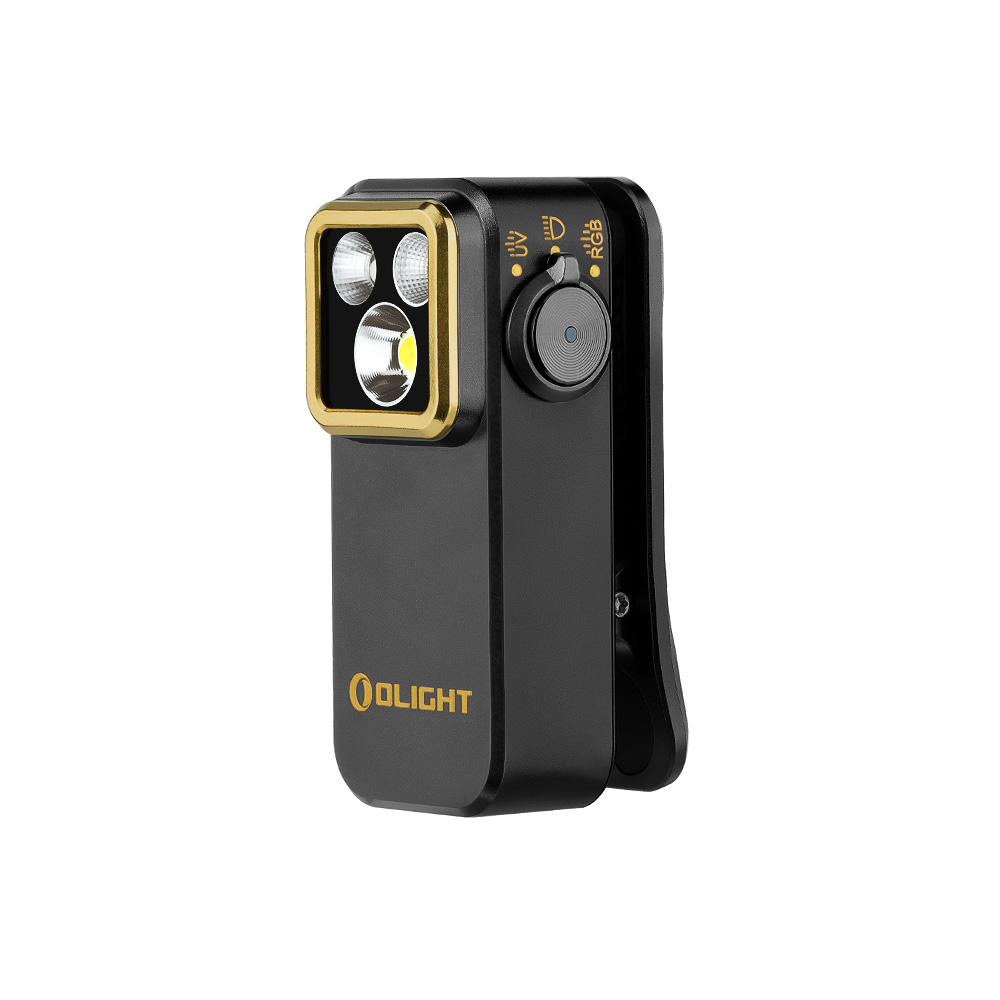
Official Oclip Pro S control layout. Separate light-source positions help identify the mode; they do not make the device a children's toy.
The manual specifies a low default when UV is switched on and does not memorize UV brightness. That is operating behavior, not a child-safety feature. Do not describe the low start as harmless, or expect a colored indicator to tell you whether an exposure is acceptable.
For an adult preparing the tool, the useful benefit is deliberate source selection. Read the markings with the light off and the instructions available, away from children. Learn the actual controls before the equipment is needed. Avoid demonstrating the UV source simply to prove that a selector position works.
USB-C charging and a compact clipped form can make the light easy to keep with an adult's equipment. They can also make it easy to leave in a jacket, on a bag, or on a low shelf. Decide where the light will return after use before choosing where to carry it. Convenience should shorten the route back to controlled storage.
Oclip Ultra: keep its three sources distinct
The Olive Green Olight Oclip Ultra provides flood, spot, and UV sources. Its published visible-light maximums are 530 lumens for floodlight and 450 lumens for spotlight. The UV function is a separate source; its manual lists a typical wavelength of 365–370nm.
The flood and spot options give an adult different ways to illuminate an ordinary task. A broader view and a more concentrated beam serve different needs. Neither choice makes the UV function disappear from the same small device, so the family storage decision should cover the whole light.

Official Oclip Ultra component diagram. Identify the UV emitter and source selector from the exact model's instructions before adult use.
Before buying either model, write down the adult tasks that actually require its extra light sources. If the household need is simply to read a label, illuminate a drawer, or provide a child with suitable everyday lighting, UV capability may add a management responsibility without answering that need. Choose for the job rather than for the number of functions on the package.
That does not make a multipurpose design unsuitable for every household. It means the buyer should account for its complete set of functions. An adult who needs separate visible and UV tasks may value one compact tool, provided the use and storage arrangement fits. A family looking for a child's first light has a different decision to make.
A clip and magnetic mounting can help an adult position a light for a suitable task. They are attachment methods, not access controls. A device on a refrigerator, bag strap, or accessible metal cabinet can still be reached or moved. Choose storage based on who can obtain the light, rather than how firmly a magnet holds it.
The manuals for both models warn against looking directly at the source or shining it into eyes. They also address lockout for carrying and transport. Follow those instructions, while keeping a separate household rule: an electronic lockout is not a substitute for physically restricting a child's access.
A practical adult-control routine at home
Start with the activity rather than the flashlight. Ask what needs to be seen and whether ordinary room lighting or a visible-light tool can answer the question. A child's curiosity does not create a requirement to use UV. Choosing a different activity is a complete decision, not a failed demonstration.
If an adult genuinely needs the UV function, arrange the task according to the exact instructions before bringing the light out. Keep children and other people away from the work area. Do not place a child in charge of holding an object, adjusting a beam, or watching a countdown. Those roles put attention on completing the activity instead of keeping clear.
Keep the work surface free of unrelated objects and plan where the tool will be set down. Avoid a routine that leaves the light active while someone searches for another item. Switch it off before changing the arrangement or moving away. The purpose is to avoid an unmanaged source, not to create a timed exposure experiment.
Family rules should be brief enough that every caregiver can apply them consistently. “Ask an adult” is incomplete unless the adult knows where the equipment belongs and what its warnings say. Agree who controls it, where it is stored, and what happens if a child finds it outside that location.
Use the same rule with visitors. A tool that remains controlled in its usual household may be left on a guest-room table or borrowed without its instructions. Before travel or a visit, decide whether the UV-capable light needs to come along. If it does, keep it with the responsible adult's equipment and follow its transport instructions.
Do not rely on a child distinguishing UV from white or colored light. The adult can explain that the device has different functions without asking the child to identify an active mode. Use a picture of the controls or the manual's diagram instead of pointing an operating emitter toward someone for inspection.
A school visit, club, or shared activity space needs its own responsible organizer and equipment rules. A parent's willingness to supervise at home does not establish that a UV activity is appropriate for a classroom or group. Before bringing equipment, discuss the proposed activity with the organizer. If the setting cannot prevent exposure and maintain control, choose a visible-light activity instead of changing the rules during the event.
A useful handover between adults includes the model, the storage location, and the fact that the device contains UV. It should not sound like permission to improvise a new activity. If another caregiver has not reviewed the instructions, leave the tool stored until the responsible adult can manage it.
Do children need UV goggles for a flashlight activity?
Do not use a pair of glasses as permission to give a child a UV flashlight. The first decision is whether to avoid the activity or replace it with ordinary visible lighting. For an adult task requiring eye protection, protection needs to be appropriate to the actual source and task, with suitable fit and coverage.
The National Eye Institute's eye-protection guidance distinguishes UV-blocking sunglasses for sunlight from protective eyewear for particular activities. Its sunlight advice is not a certification for direct viewing of a handheld UV emitter. Keep that boundary when reading a UV400 label or general eyewear advertisement.
A parent should not guess from lens color, darkness, price, or a picture of somebody wearing glasses. Nor should a UV card or a photograph through a lens be treated as proof that the complete arrangement protects a child's eyes. Ask a qualified eye-care professional or safety specialist about the actual source when protection is needed.
Bring the model information and instructions to that discussion. Explain who would be present and what the task involves. If the necessary protection, fit, or control cannot be established, do not proceed with a children's activity. Buying an accessory does not resolve an unsuitable activity.
Individual circumstances also matter. The FDA notes that some medicines and cosmetics can increase sensitivity to UV. If a child has a relevant condition, takes medicine, or has been given specific eye or skin advice, ask the treating professional about that situation. Do not use a general flashlight article to overrule it, and do not stop prescribed treatment in order to make an optional activity possible.
Do not forget the rest of the arrangement. Eyewear does not authorize directing a beam toward skin, another person's face, or a pet. An adult still needs to manage where the source is pointed, who can enter the area, and when the light is turned off and put away.
Charging and storage belong in the same plan
A rechargeable flashlight still needs an adult-managed home between uses. Charging can be the point where a controlled tool becomes accessible: a cable reaches a low table, the device is taken out of its usual case, and the adult walks away to do something else.
For the Oclip Pro S, the visible USB-C port cover and clip are useful parts to identify before establishing that routine. Follow its charging instructions and use the specified equipment. Keep the charging setup away from children, then return the light to controlled storage when the task is complete.
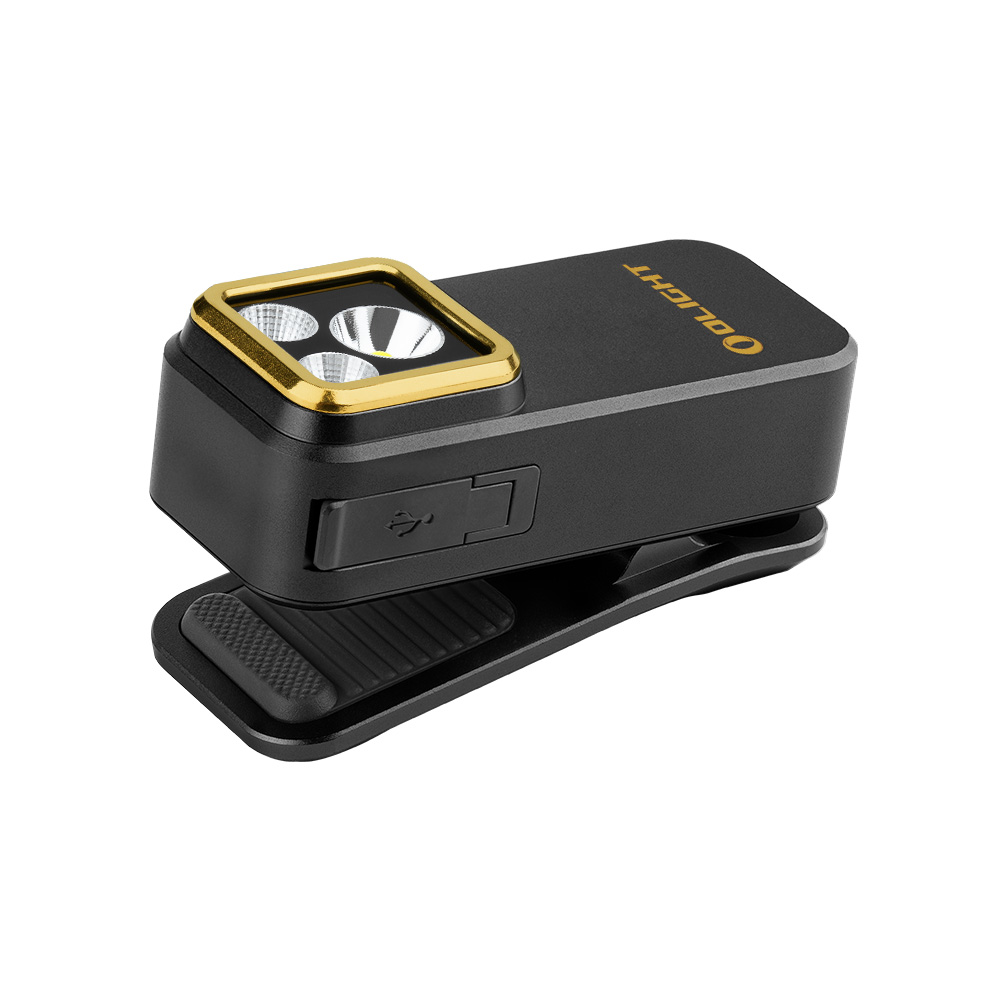
Official Oclip Pro S port cover and clip. Charging access and convenient attachment require their own adult-managed storage routine.
The manuals say to keep the charging-port cover closed when the port is not in use, and not to immerse these products in water or other liquids. Those are equipment-care instructions. Do not let a water-resistance label replace the instructions, and do not turn cleaning the light into a children's activity.
Let the light cool before putting it in a fabric bag or plastic container. Both manuals warn against enclosing a hot light in those materials. Plan for a suitable cooling position that remains inaccessible to children, rather than choosing between an exposed tool and immediate enclosure.
Avoid leaving a charging cable attached where someone could pull the device down. Put the cable and any necessary equipment away after charging. A storage arrangement should be easy for the responsible adult to use every time, rather than depending on remembering an improvised hiding place.
A small equipment record can make the storage routine easier for another adult to follow. Include the complete model name, the location of its instructions, the compatible charging equipment, and where the inactive light belongs. Keep that record with adult equipment rather than on a child's play instructions. Review it when a product is replaced, because a familiar case can end up holding a different model with different controls.
Keep loose batteries and battery-changing work separate from children. The CPSC's button-cell and coin-battery guidance warns about swallowing hazards and says to seek immediate medical attention if one is swallowed. This is a general household warning, not a claim that either Oclip model uses a replaceable coin cell.
Do not open a sealed light to show its battery. Follow the product's instructions and keep service questions with the manufacturer or a qualified service provider. If a device or its charging equipment is damaged, take it out of the family activity plan instead of letting a child investigate the problem.
Both model manuals also warn that people with an ICD or pacemaker should avoid close or prolonged contact with the magnetic product. Consider the actual household and the intended carrier when deciding where equipment belongs. A pocket clip or magnet can be convenient without being appropriate for every person or storage location.
Is it safe to leave a UV light on all night?
Do not leave a handheld UV inspection light running as a child's night-light or unattended room decoration. Nighttime comfort and inspection are different tasks. Choose appropriate visible lighting for the room and follow that product's instructions rather than adapting a UV-capable tool to a role it was not selected for.
An adult should not assume that putting the UV light across the room, behind furniture, or under a cover makes the arrangement acceptable. Those changes do not establish controlled exposure, and covering a light may conflict with its warnings. A convenient place to hide an active device is not a substitute for switching it off.
Build the bedtime routine around putting adult tools away. Check bags, coat pockets, and the place where charging occurs. If more than one caregiver uses the light, agree who returns it to storage. The final action should be a stored, inactive tool, not an operating device that someone hopes will be forgotten.
Keep ordinary nighttime needs simple. A child who wants to read, find a door, or feel comfortable in a room does not need to learn a multipurpose light's mode selection. Separate the family lighting decision from the adult's utility equipment.
Is UV light from a flashlight bad for you?
UV from a flashlight needs the same careful attention to avoiding eye and skin exposure as other UV sources. Do not assume that handheld size, low visible brightness, or a household setting makes it harmless. The actual source, operating conditions, and exposure matter; the label alone cannot answer for a particular person.
If someone has looked into the emitter, been exposed in a way that concerns you, or develops eye or skin symptoms after an incident, stop using the light and obtain appropriate medical advice. Do not repeat the exposure to see what happened, or use the flashlight to examine the person's eyes or skin.
Have the exact model and instructions available when seeking advice. Describe what actually occurred, including the selected mode and circumstances if known. Be honest about details you do not know. Do not replace them with a guessed distance, output level, or duration.
A product's visible-light output or maximum runtime should not be used to dismiss a concern. Equally, avoid diagnosing an injury from an online photograph or a change in fluorescence. A qualified health professional can advise about the person; a flashlight specification describes the equipment.
FAQ
Changelog
- November 18, 2026: Product information and buying guidance reviewed.




