


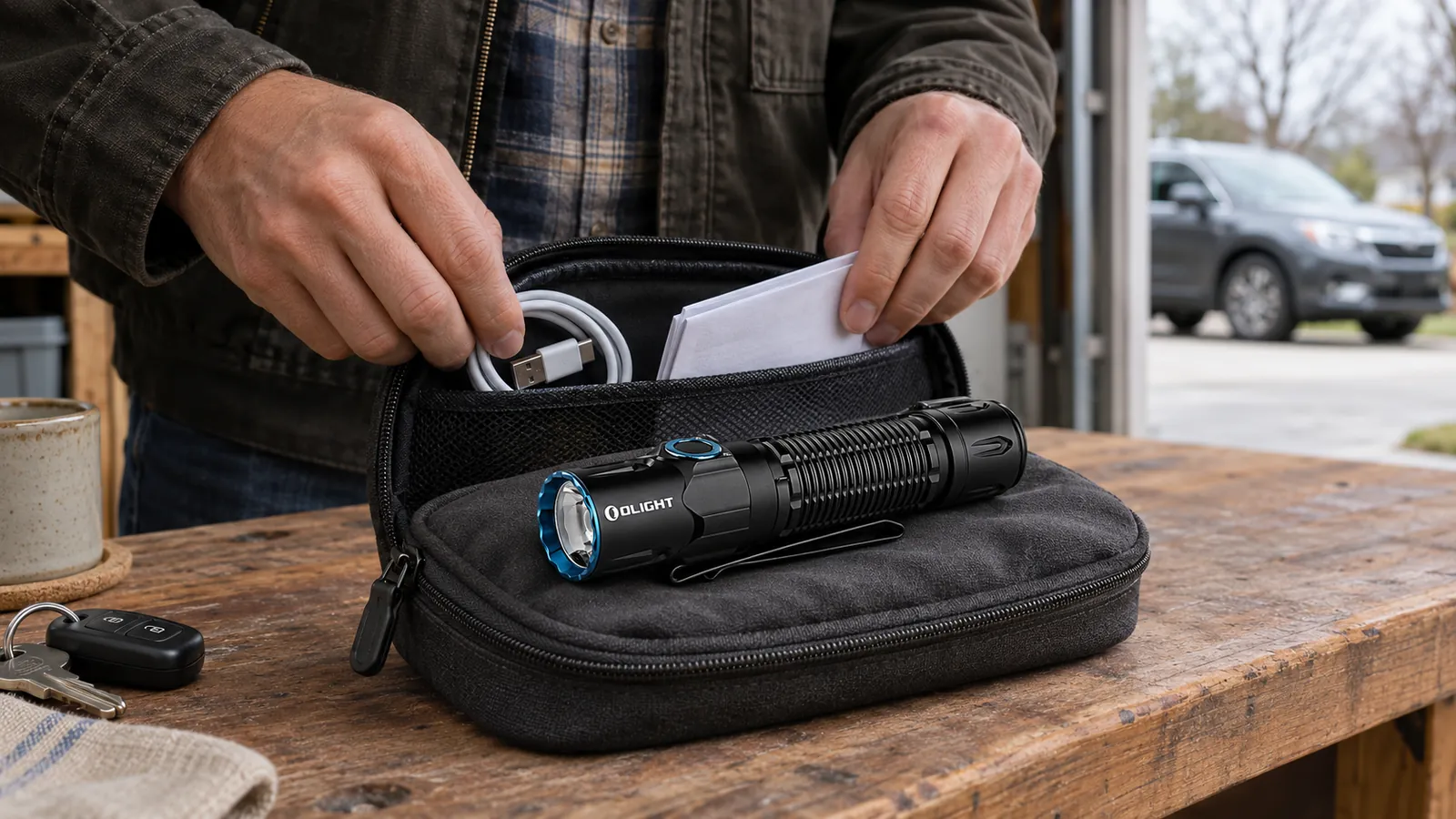
TL;DR: Choose a car flashlight around access, useful low settings, familiar controls, and a complete charging setup. A larger handheld, a compact light with a charging case, and an adjustable clip light solve different problems. None makes a dangerous roadside location safe. Carry rechargeable lights in a removable trip kit rather than treating a hot glovebox as permanent battery storage. Keep road-warning equipment separate, and check the whole lighting kit before departure.
📋 Table of Contents
- 1. What should a car flashlight actually do?
- 2. Glovebox access and battery storage are different questions
- 3. Warrior 3S: a handheld for deliberate aiming
- 4. Baton 4 Premium Edition: a small light with a separate energy reserve
- 5. Oclip 2 Pro: direct the light without tying up a hand
- 6. Compare the complete setup, not just the lamp
- 7. Build access around the person who needs the light
- 8. Brightness, glare, and warning signals need separate decisions
- 9. Make the charging plan survive a flat vehicle battery
- 10. Choose controls for the people who share the car
- 11. Check the kit before a trip and after it has been used
- 12. Frequently asked questions
What should a car flashlight actually do?
A good car flashlight helps you read a document, find a dropped item, identify your belongings, and communicate clearly from a safe position. Those tasks need controlled light at a useful angle. They rarely benefit from putting the largest possible bright spot onto a nearby reflective surface. Choose for the jobs you can responsibly perform, then decide how much output and equipment those jobs require.
Start with the circumstances in which the light will be available. A compact lamp in the bag you carry into the car can be more useful than a larger one buried beneath luggage. A familiar switch can matter more than an additional lighting mode. A charged light with its correct cable is a complete tool; a light and an unrelated cable are two objects that happen to share a pouch.
The NHTSA roadside-kit checklist includes a flashlight alongside a phone, charger, and other emergency supplies. That is a useful distinction: illumination supports the rest of the kit. It does not replace communication, appropriate warning equipment, or professional assistance. Keep those roles separate when comparing products or deciding what to pack.
| Job | Feature worth checking | Limit to recognize |
|---|---|---|
| Read a roadside-assistance card | Comfortable close output and easy aiming | More maximum output can add glare |
| Locate an item in a parked vehicle | Reachable light and familiar controls | Reaching the light must not require unsafe movement |
| Keep hands available for paperwork | Suitable clip or stable supported placement | Attachment needs a safe, stationary location |
| Keep a small light ready between trips | Complete compatible charging equipment | A charging case does not provide temperature protection |
| Make a stopped vehicle conspicuous | Vehicle-approved warning arrangements | A flashlight is not a substitute for warning equipment |
Glovebox access and battery storage are different questions
The glovebox is a convenient description of size, but a poor substitute for a storage plan. A lamp can fit easily inside it and still be unsuitable for being forgotten there through hot weather. Being out of sight does not establish that its battery is within the conditions specified by the manufacturer. A water-resistance rating does not answer that question either.
The U.S. Fire Administration's battery guidance advises storing lithium-ion batteries at room temperature when possible and keeping them out of hot cars and direct sunlight. It also identifies unusual heat, odor, leaking, shape changes, and odd noises as reasons to stop using a battery. These warnings apply to the storage decision before any comparison of flashlight brightness.
A practical arrangement is a removable lighting pouch that travels with the driver. Bring it into suitable indoor storage after the trip, charge it under the product's instructions, and put it back into the departure routine. The important improvement is a repeatable handoff between home and vehicle. The pouch itself is organization, not insulation or a promise of a safe temperature.
For a shared vehicle, decide who performs that handoff. Otherwise, one person may assume the kit stayed in the car while another assumes it came indoors. A named storage place at home and a familiar transport location reduce that ambiguity. If a dedicated vehicle light is part of the plan, choose its battery chemistry and storage conditions from its actual instructions rather than assuming all emergency lights tolerate the same environment.
Cold-weather preparation needs the same attention to instructions. Operating, charging, and storage are separate conditions, and an operating specification does not automatically authorize charging at that temperature. Do not improvise a rapid warming method or assume a light that turns on is ready to recharge. Check the exact model guidance and allow appropriate conditions before connecting power.
Warrior 3S: a handheld for deliberate aiming
The Olight Warrior 3S suits a driver who prefers a substantial handheld and wants to control its direction independently of head movement. The exact Black version considered here has a side switch, a separate tail switch, and brightness and battery indicators around the side control. Those are useful handling differences, not reasons to use its highest output for every task.
Independent aiming matters when reading information while speaking to someone. You can hold the light on the page instead of moving its beam across the other person's face as you turn. It also lets you change the lighting angle without changing your stance. The tradeoff is that a handheld occupies a hand, so it is less convenient when the immediate task already needs both hands.
The two sets of indicators answer different questions. A brightness indication tells you about the selected output; the battery indication concerns remaining energy. Learning their positions at home is more useful than trying to decode them during an interruption. Neither display measures how long a particular mixed sequence of tasks will last, and a brief successful switch-on is not a complete readiness check.
The official page lists maximum output up to 2,300 lumens. Treat that as available peak capability rather than the brightness required to read a phone number, sort documents, or look inside a nearby bag. Start with a suitable working level and judge whether the actual object is readable without uncomfortable reflection. A lower setting that preserves detail can serve the task better than a bright washed-out patch.
The proximity sensor is an additional feature, not permission to pack the light carelessly or leave it active inside fabric. Prevent unintended activation using the exact model's instructions, and keep the light clear of items that can press a control. The sensor does not verify battery storage temperature, secure the lamp in a moving vehicle, or determine whether a roadside location is safe.

Official Warrior 3S control and indicator overview. For starting states, configuration, and button sequences, follow the exact model manual.
Baton 4 Premium Edition: a small light with a separate energy reserve
The Olight Baton 4 Premium Edition addresses a different problem: keeping a compact light and its charging case together in a small travel kit. The OD Green Premium configuration is the specific version considered here. Its case is part of the equipment choice; do not assume a standalone Baton 4 purchase includes the same package.
The small flashlight is convenient when space near documents, keys, and a phone is limited. That convenience brings a handling tradeoff. A tiny light can be easier to misplace in a crowded compartment, so give it a consistent pocket or sleeve rather than dropping it among loose objects. Returning it to the same place after use is part of making its compact size useful.
The Premium case contains a separate battery and can replenish the flashlight. The official page describes a case capacity of 5,000 mAh and up to five full charges of the Baton 4. That can reduce dependence on finding a vehicle power source immediately, provided the case was charged beforehand. It does not create unlimited energy, and using the case for another device draws from the same reserve.
The case also provides USB-C charging for mobile devices. That is potentially useful when communication is the more urgent need, but the phone still needs a suitable cable. A reserve that exists only in a product description will not help if the required connector is missing. Pack the cable for the actual phone, and consider the phone's energy needs before planning to share one small reserve between several devices.
Keep the flashlight's maximum output separate from its longest-runtime claims. The page's peak-output and maximum-duration labels do not describe one simultaneous operating condition. More importantly for vehicle use, the case does not make either battery safe for permanent hot-car storage. Treat the complete Premium set as equipment to maintain and carry, rather than a maintenance-free item to leave behind.
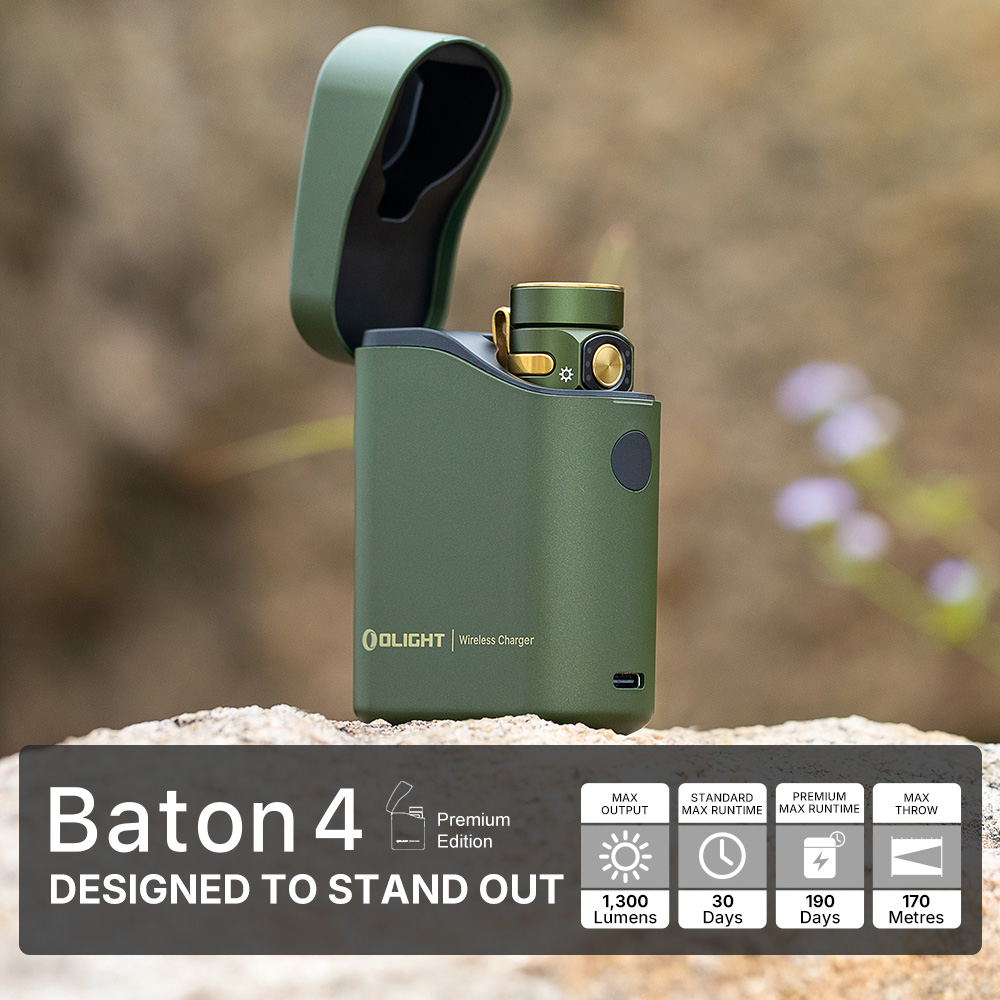
Official Baton 4 Premium Edition configuration. Maximum-output and longest-runtime labels describe different conditions; the case is not temperature-protective storage.
Oclip 2 Pro: direct the light without tying up a hand
The Olight Oclip 2 Pro is useful when the problem is placement rather than handheld reach. The exact Black light has an independently adjustable head and clip: the head tilts through 115 degrees, while the clip rotates through 360 degrees. That separation lets you aim the beam after choosing a suitable attachment point.
Consider an ordinary parked-vehicle task such as reading a printed checklist while organizing a small bag. If the chosen support is secure and stationary, the adjustable head can direct light onto the paper without requiring someone to keep holding it. The benefit is task separation: hands manage the objects while the light remains aimed. It is not a reason to begin work in an unsafe traffic position.
The official clip specification covers objects up to 14 mm thick, and magnets are provided at the tail and clip. Thickness alone does not establish a secure hold. Material shape, surface suitability, movement, and the direction of the load also matter. A magnet needs an appropriate surface; a thin-looking panel is not automatically magnetic. Confirm stable placement in the actual safe setting before relying on it.
Beam choice also matters. The model offers flood, spot, and red light, with the official page listing up to 530 lumens for the floodlight and a rated spotlight reach of 125 meters. Close paperwork and a farther object are different lighting jobs. A distance specification does not tell you whether fine print will be comfortable to read, and a red mode does not certify the light as road-warning equipment.
This light supports USB-C and magnetic charging, while the Premium version adds a Mobile Charging Dock. Keep those purchase configurations distinct. A Black Oclip 2 Pro and a Premium set are not interchangeable descriptions of what arrives in the box. For a car kit, choose the complete arrangement you can maintain; adding a dock creates another battery and component to check, as well as extra reserve capability.
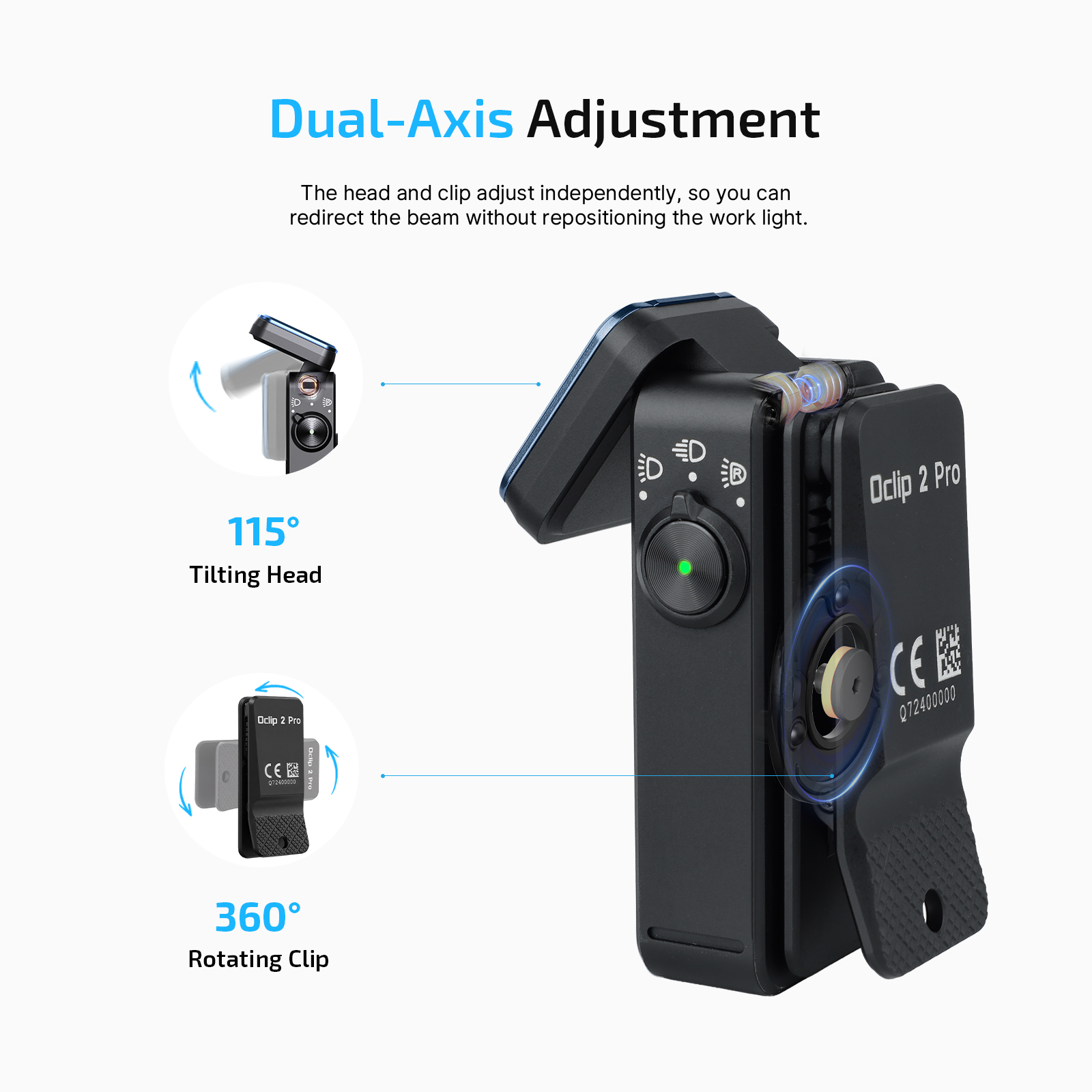
Official Oclip 2 Pro adjustment diagram. Independent aiming does not establish that every attachment point is stable or suitable for vehicle use.
Compare the complete setup, not just the lamp
A useful buying comparison includes the items that make the chosen light ready for the intended trip. That may mean the correct charging cable, a suitable power source, a case included in a particular bundle, or a safe attachment arrangement. Leave price out of the decision until those components are clear. A cheaper incomplete setup can create a more expensive problem when a necessary part is missing.
The Warrior 3S manual specifies the MCC3 magnetic charging cable and states that other MCC versions are not compatible. That makes the correct cable a real packing requirement, even when another Olight cable looks similar. Its USB power source must also meet the manual's requirements; the vehicle socket or a borrowed adapter is not automatically a complete solution.
For the Baton 4 Premium Edition, distinguish the small flashlight from the complete case-equipped set. For the Oclip 2 Pro, distinguish the light's own charging options from the additional Premium dock. Shared branding does not make every magnetic cable, case, or accessory interchangeable.
| Priority | A sensible direction | Question before buying |
|---|---|---|
| A familiar full-hand grip and independent aiming | Warrior 3S Black | Is its size comfortable, and is compatible charging equipment included? |
| A compact light carried with an energy reserve | Baton 4 Premium Edition | Is this the complete Premium configuration with the case? |
| Adjustable light placement for stationary tasks | Oclip 2 Pro Black | Is the actual support suitable, and is the required charging setup complete? |
| Permanent exposure to vehicle temperature extremes | Reconsider the storage plan first | Do the exact manufacturer's conditions permit that environment? |
If you are comparing battery formats as well as lights, the flashlight battery-type guide explains why a battery name is only part of compatibility. Do not select a replacement merely because it appears to fit. The device's requirements, protection arrangement, contacts, and approved charging method still govern the choice.
Build access around the person who needs the light
Choose a place that can be reached from an appropriate position when the vehicle is parked. Check it with ordinary trip luggage in place, not only with an empty vehicle in the driveway. If a lamp sits under a packed cooler or behind a bulky child-seat accessory, its theoretical brightness has little bearing on whether it will be useful at the moment it is needed.
A removable pouch should have a consistent place and should not be loose near pedals or other driving controls. Choose a location compatible with the vehicle's storage arrangements and instructions. Keep straps and cables contained rather than dangling. This is an organization decision to make before travel, not a reason to search compartments or handle equipment while driving.
Think through access after a change of driver. Someone who did not pack the kit should be able to identify the lighting pouch without emptying unrelated bags. A simple label or recognizable pouch helps more than an elaborate collection of accessories. If there are two lights, distinguish their roles so that someone can choose the compact paperwork light without learning every feature of the larger one.
Give the correct cable a dedicated place beside the light or case that uses it. If the cable is removed for household charging, return it as part of the same task. One missing component is enough to interrupt the whole routine. Keeping a short written packing list inside the pouch can help a shared household distinguish a complete kit from a nearly complete one.
Brightness, glare, and warning signals need separate decisions
For close work, inspect the object rather than the apparent brightness of the beam in open air. A glossy assistance card, a phone screen, and a pale interior panel can reflect light toward the eyes. Changing the beam angle or reducing output may make the information easier to read. If it remains uncomfortable, change the arrangement instead of continuing to increase brightness.
Keep light out of another person's face and away from drivers. A handheld should illuminate the task, not become a moving distraction as conversation changes direction. A clip light needs the same attention after someone shifts position. Independent adjustment is useful precisely because it lets you choose a better angle; it does not guarantee that the first angle will suit everyone nearby.
Do not build an emergency-signaling plan around a flashlight's strobe or a colored mode. Such features do not establish compliance with road-warning requirements, and an intense flashing beam can interfere with other people's view. Use the vehicle's instructions, appropriate warning equipment, and guidance from emergency or roadside-assistance personnel for the circumstances. Keep the ordinary task light's role modest and clear.
A safe decision may be to leave a task undone and wait for help. No beam pattern can tell you that approaching a vehicle, standing near traffic, or retrieving equipment is safe. If there is an immediate danger or uncertainty about where to wait, seek appropriate emergency guidance. The right equipment supports that decision; it does not replace it.
Make the charging plan survive a flat vehicle battery
A vehicle-powered charging arrangement has an obvious weakness: the vehicle may be the reason assistance is needed. Plan for the light to arrive charged rather than relying on charging it after the interruption. An independently charged case or suitable portable power source may add reserve, but it should be a deliberate part of the kit rather than a reason to postpone checking the light itself.
Work backward from each connector. Identify the port or charging contact on the actual light, the cable that is compatible with it, and the power source the cable requires. Then do the same for the phone. A cable that physically connects to the phone may have no role in charging the handheld. A magnetic charging end also needs its own compatible power input; the magnetic attachment alone does not supply energy.
Keep charging separate from the roadside task whenever possible. A cable stretched across seats or an open storage area makes an already awkward arrangement harder to manage. Completing the charging routine beforehand allows the light to be used where its beam is useful, without tying its placement to a socket. After the trip, reconnect the complete setup in the suitable charging location specified by the manufacturer.
If reserve energy is shared with a phone, decide which device has priority. A compact case may keep a small lamp ready and provide emergency phone charging, but those uses compete for its stored energy. There is no need to calculate an imaginary number of future calls from a capacity label. Check both devices before departure, keep the necessary cable, and preserve communication as a separate responsibility.
Choose controls for the people who share the car
The person buying a light may enjoy learning its features; another driver may simply want to read a number and put it away. Let both people handle the actual model in a safe indoor setting. The useful question is whether each can identify the intended control, hold the light comfortably, and obtain a modest working output without searching for an unfamiliar shortcut.
Consider the way the light will be held alongside ordinary objects. A large handheld can be easier to locate inside a pouch but awkward beside a phone and folded document. A compact lamp can leave more room, yet require more care when it is returned to its pocket. A clip light can free a hand only when there is somewhere appropriate to attach it. Those tradeoffs are about the complete task, not a universal ranking of body shapes.
Gloves, glasses, and reading preferences can change which arrangement is comfortable. Check whether the actual user can distinguish the switch from the charging contact and read the relevant indicator. If someone cannot comfortably operate the selected model, simplify the equipment choice rather than writing a long set of emergency instructions that they would have to decipher under pressure.
A shared kit should also have an understandable return rule. If the small lamp comes out for a household task, the person borrowing it returns it to the identified sleeve and checks its condition. If the case is used to charge a phone, that person restores the case's reserve. These small assignments prevent an apparently complete pouch from containing equipment that is absent, depleted, or separated from its charging parts.
Check the kit before a trip and after it has been used
Start with identification and condition. Confirm that the intended light is in the pouch and that its body, lens, charging parts, and case appear undamaged. If something has leaked, changed shape, developed an unusual odor, or become abnormally hot, stop treating the kit as ready. Follow the manufacturer's safety guidance rather than trying to make damaged equipment last through one more trip.
Then check ordinary operation in a suitable indoor setting. Confirm that the person carrying it can turn it on, select a comfortable working output, and turn it off using that exact model's instructions. Learn the lockout or transport precautions before packing. Do not substitute a remembered sequence from a different Olight model just because the switch looks familiar.
Check both parts of a case-equipped set. A small flashlight can appear ready even when its reserve case has been depleted by charging another device. Conversely, a charged case does not prove that the light is properly seated or that every contact is clean. Follow the charging instructions and verify the expected indications for the actual configuration, without leaving the process to assumption.
Keep the maintenance record simple: identify the light and configuration, note when the kit was checked, and list anything that needs replacing. After a trip or actual use, restore it before returning it to its normal indoor storage place. A record is a reminder of completed tasks, not evidence of a guaranteed future runtime or a promise that the battery will hold charge for a fixed number of months.
If the same household also maintains a power-outage lighting kit, assign equipment deliberately. Borrowing the only car light for a room can leave the trip pouch empty, while leaving the household's only charged light in a vehicle can create the opposite problem. A written home-versus-trip allocation is often more useful than buying another lamp without deciding where it belongs.
Frequently asked questions
Changelog
- November 18, 2026: Product information and buying guidance reviewed.




