


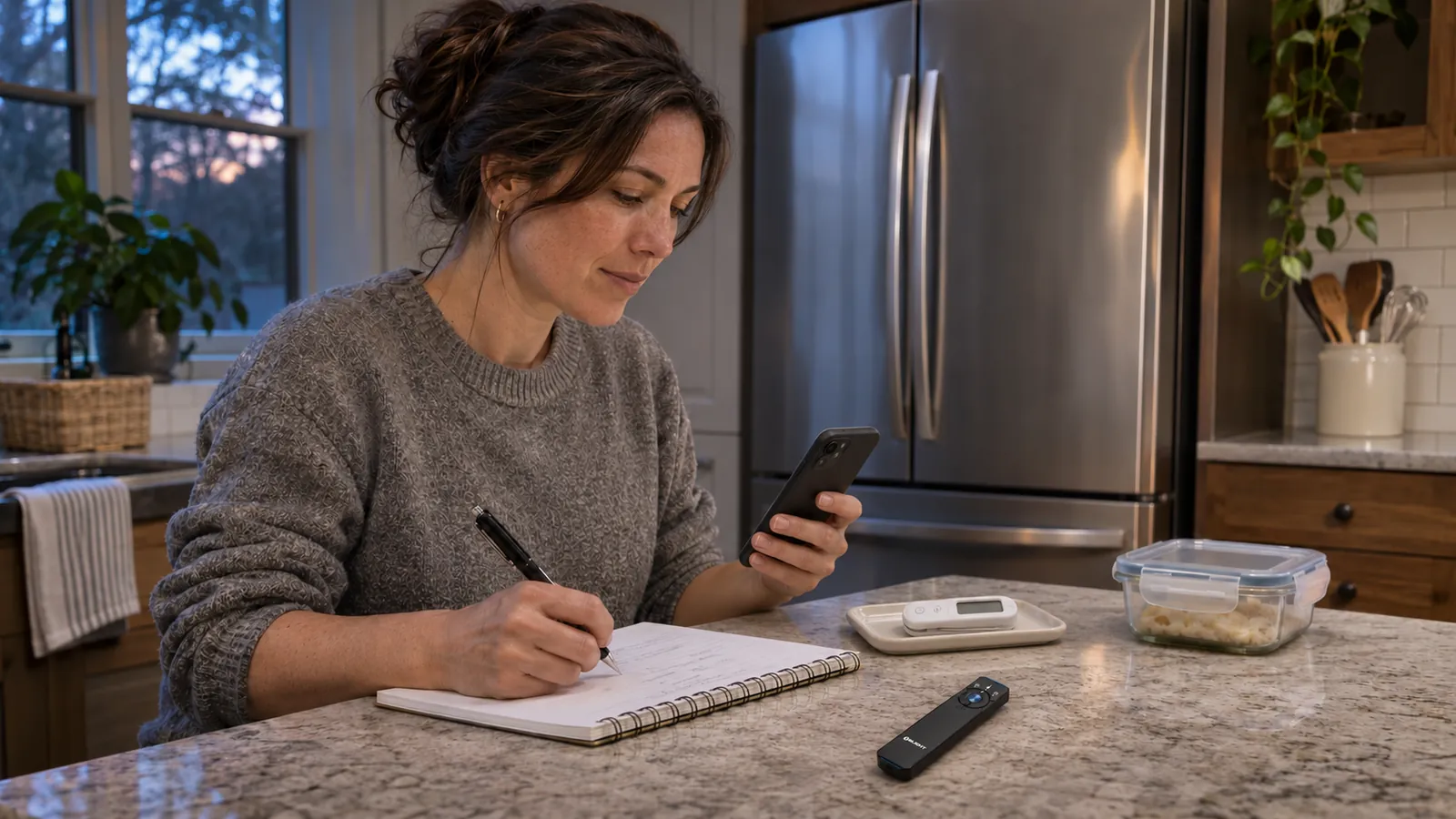
⚡ TL;DR
Keep refrigerator and freezer doors closed during an outage. An unopened refrigerator generally protects food for about four hours; a full freezer holds its temperature for approximately forty-eight hours, or twenty-four hours when half full. Decisions also depend on the individual food and its temperature history. Use a thermometer and official food-specific guidance. A flashlight helps read that information; brightness, smell, color, and taste cannot establish safety.
📋 Table of Contents
- 1. Start with the information you actually have
- 2. Understand the different clocks before using a cutoff
- 3. Make one organized check instead of repeated searches
- 4. Sort refrigerated foods by category, not appearance
- 5. Check frozen foods separately, including the exceptions
- 6. Use white light to read the evidence
- 7. When timing is unknown, do not manufacture a reassuring history
- 8. Moving food does not reset the clock
- 9. After cooling returns, close the record before restocking
- 10. Frequently asked questions
- 11. Leave the next person a clear decision
Start with the information you actually have
The difficult outage is often the one discovered in the morning. The kitchen is quiet, a clock is blinking, and nobody knows whether the refrigerator stopped cooling before midnight or shortly before breakfast. Opening packages to see whether they still look normal cannot answer that timing question. Begin with the outage information and any temperature records that already exist.
Write down when power was last known to be on, when its loss was discovered, and whether anyone opened the refrigerator. Keep an uncertain interval as an interval. A utility message can help establish when service was interrupted in the area, but it cannot tell you the temperature of every package inside your appliance. A family member's recollection is useful context without becoming a thermometer reading.
Next identify what you are trying to protect. A package of raw chicken, an unopened shelf-stable drink, a cut melon, and a loaf of bread do not share the same storage requirements. Treating everything on one shelf as a single category can lead either to unnecessary waste or to keeping something that requires refrigeration. Read labels and use the food's actual description.
Do not repeatedly open the door while deciding where to begin. Gather the thermometer instructions, official chart, light, and a way to record decisions first. If another adult is available, that person can read the guidance while you describe the item. A short, organized check is more useful than leaving the appliance open during a search for a charger or a misplaced list.
For wider household priorities, the existing power outage over twelve hours guide covers lighting and other practical needs. The food decision deserves its own record. A room becoming comfortable again, a working phone, or restored electricity does not by itself establish what happened to refrigerated perishables while cooling was unavailable.
Understand the different clocks before using a cutoff
The familiar four-hour figure describes an unopened refrigerator during a power outage. It assumes the appliance began properly cold and that its door remains closed as much as possible. It is a planning limit for the appliance, not a guarantee about a refrigerator that was already warm, repeatedly opened, or loaded with food that had not yet cooled.
The federal power-outage food chart advises discarding refrigerated perishables such as meat, poultry, fish, eggs, and leftovers after four hours without power. Its detailed refrigerator table addresses foods exposed to temperatures of forty degrees Fahrenheit or above for more than two hours. These are different descriptions of the situation, rather than two allowances to add together.
Do not assume that a closed refrigerator gets four hours and then every food automatically gets another two hours on the counter. Moving packages to a room-temperature worktop does not create a fresh safety period. Previous warm exposure still matters. When reliable temperature information is missing, a detailed arithmetic exercise can give an uncertain estimate an appearance of precision it does not deserve.
Temperature measurements also have different meanings. An appliance thermometer reports conditions where it is located; a food thermometer can check an individual food according to its instructions. A thermostat setting marked “cold” is not an actual temperature measurement. A single reading at one shelf should not be treated as a complete record of every package, especially when the appliance has already begun cooling again.
The FDA's refrigerator thermometer guidance recommends keeping a refrigerator at forty degrees Fahrenheit or below and a freezer at zero degrees. It also advises discarding food when the duration at or above the refrigerator threshold is uncertain. If the available information cannot establish an acceptable history for a perishable item, do not replace that missing history with a guess.
| Information available | What it helps establish | What it cannot establish |
|---|---|---|
| Known outage start and an unopened refrigerator | Whether the usual closed-door outage window has been exceeded | The exact temperature of every food |
| Appliance thermometer reading | Current temperature at its location | Earlier peaks if there is no temperature history |
| Food thermometer used correctly | Current temperature of the food checked | How long it was warmer earlier |
| A package that looks or smells normal | Its visible condition | Whether harmful organisms are present |
| Restored power and a cold reading later | That cooling has resumed | That the earlier storage history was acceptable |
Make one organized check instead of repeated searches
Prepare a clear place for notes before opening the appliance. Record the food, its location, the available time information, any relevant measurement, and the decision. The purpose is to keep the same questionable item from being reconsidered by different people throughout the day. A brief entry such as “raw chicken, outage timing unknown, discard” is clearer than an unexplained mark on a shopping list.
Have the official chart available before sorting. Its categories distinguish foods that can look similar inside a crowded refrigerator. If the internet connection is unreliable, a previously saved chart or printed copy is useful. Check that the chart concerns household outage storage and the correct refrigerator or freezer section; a cooking-temperature chart answers a different question.
Use the thermometer according to its instructions, including placement, reading time, and cleaning between foods where applicable. Keep raw-food handling separate from ready-to-eat items. An illuminated display is easier to read, but extra light cannot correct a measurement taken in the wrong place or before the instrument has stabilized. Avoid turning an unfamiliar thermometer into an improvised surface scanner.
If a lid or label cannot be read easily, adjust the viewing angle rather than holding the door open while experimenting with brighter settings. Glossy plastic can reflect a concentrated beam back toward your eyes. Lighting the label from the side can make print easier to see, but that is a reading aid. It provides no information about bacterial growth or the temperature inside the food.
Keep decisions tied to the item you actually inspected. A sealed package is not automatically shelf stable; some unopened products still require refrigeration. Conversely, an item stored in the refrigerator for convenience may not need cold storage for safety. The manufacturer's storage directions and the federal chart are more informative than the shelf on which somebody happened to place it.
If someone interrupts the check, close the door and leave a clear note about where you stopped. Do not leave uncertain food out while answering calls or looking for another container. A separate written list of discarded items can help with replacement planning afterward, without requiring repeated handling or reopening packages that have already been designated for disposal.
Sort refrigerated foods by category, not appearance
The outage chart's refrigerator recommendations apply to the stated warm-exposure condition. Meat, poultry, seafood, milk, shell eggs, cooked rice, cooked pasta, soups, and many leftovers belong among the foods that require particular attention. A covered casserole is still a refrigerated perishable. Its lid protects against some contamination during storage; it does not preserve a safe temperature during a lengthy outage.
Produce needs a more careful distinction than “vegetables are fine.” The federal table separates fresh uncut produce from cut produce and cooked vegetables. Precut, prewashed packaged greens also have their own discard recommendation. A bowl of cooked potatoes and whole raw potatoes are different foods for this decision, even though both may have been stored in the same kitchen.
Cheese provides another reason to consult the actual category. The chart distinguishes hard cheeses from soft cheeses and shredded cheeses. Do not use the outcome for a block of hard cheese as permission to keep a container of soft cheese. When the package description is unclear, identify the product before assigning it to a category rather than relying on its color or apparent firmness.
Condiments can have product-specific exceptions, so avoid a blanket rule for everything in the door. Some sauces and spreads have different recommendations from creamy dressings or opened pasta sauce. Follow the precise chart entry and package directions. A mixed container or a homemade preparation should not be assigned the least restrictive rule simply because one ingredient would normally keep.
| Common comparison | Why the distinction matters |
|---|---|
| Whole fruit versus cut fruit | The refrigerator chart gives different recommendations |
| Uncooked whole vegetables versus cooked vegetables | Cooking and preparation change the relevant category |
| Hard cheese versus soft or shredded cheese | “Cheese” alone is not specific enough |
| Shelf-stable unopened food versus food labeled “Keep Refrigerated” | An intact package does not settle storage requirements |
| A single ingredient versus a prepared dish | The finished food needs the appropriate category |
Never taste a spoonful to decide whether a doubtful food can stay. Harmful organisms do not reliably announce themselves through flavor, smell, or visible changes. A normal-looking lunchbox meal can still have an unacceptable storage history. Good lighting may help reveal a leaking package or identify a label, but an attractive appearance does not cancel a discard decision.
If there is uncertainty about a refrigerated perishable after the applicable outage or temperature limits, the safer choice is disposal. Do not serve it to another person to avoid wasting it. Keep the practical loss separate from the safety decision: replace the meal with suitable shelf-stable food, then use the notes to plan a smaller replacement purchase when dependable refrigeration is available.
Check frozen foods separately, including the exceptions
A freezer usually retains cold longer than a refrigerator. The federal guidance gives approximately forty-eight hours for a full freezer and twenty-four hours for a half-full freezer when the door stays closed. These are approximate planning figures. They are not permission to ignore the food's condition, appliance history, or the effects of repeated opening during an extended interruption.
The frozen-food chart allows many foods to be refrozen when they still contain ice crystals or are at forty degrees Fahrenheit or below. It also identifies exceptions and different outcomes by food type. Ice cream and frozen yogurt are marked for discard in both columns. Do not turn the general ice-crystal guidance into a promise that every partly thawed frozen product can be saved.
Inspect individual packages according to the appropriate chart entry. A frozen center in one package does not establish the condition of all the food around it. Use a suitable thermometer when a measurement is needed, following the instrument's instructions. A flashlight can help you see the package and read the instrument; it cannot determine whether a glossy surface is ice, condensation, or a safe temperature.
Quality and safety are separate considerations. Some foods may lose texture or flavor after thawing and refreezing even when their category permits refreezing under the stated conditions. That quality loss is not the same question as a known unsafe warm exposure. Label any retained food accurately so another household member understands what happened and does not mistake it for an untouched package.
Do not cook a food with an unacceptable temperature history as a rescue method. The FDA explains that some organisms can produce toxins that survive cooking. Refreezing also does not erase earlier handling. A decision to discard should remain in place when power returns, rather than being reversed because the freezer can make the package look frozen again.
Use white light to read the evidence
A useful outage light helps you identify labels, see the thermometer, and write a readable record while keeping appliance doors closed between checks. Those tasks rarely require the highest available output. Choose a working level that makes print clear without washing out a display, and keep the beam away from another person's face when sharing the kitchen.
The Olight Arkfeld Pro, in its Black cool-white configuration, has a flat rectangular body, a circular selector, and a five-level battery indicator. Its shape suits carrying between the appliance and a separate writing surface. The indicator helps an adult notice remaining charge before starting a check, reducing the chance of searching for charging equipment with the door open.
The model combines white light, UV, and a green laser, but this food task calls for ordinary white illumination. UV fluorescence does not establish whether a meal is safe to eat, and a laser point does not measure food temperature. Identify the white-light selection before approaching the appliance and keep the beam directed at the label or instrument rather than treating the additional emitters as inspection tools.
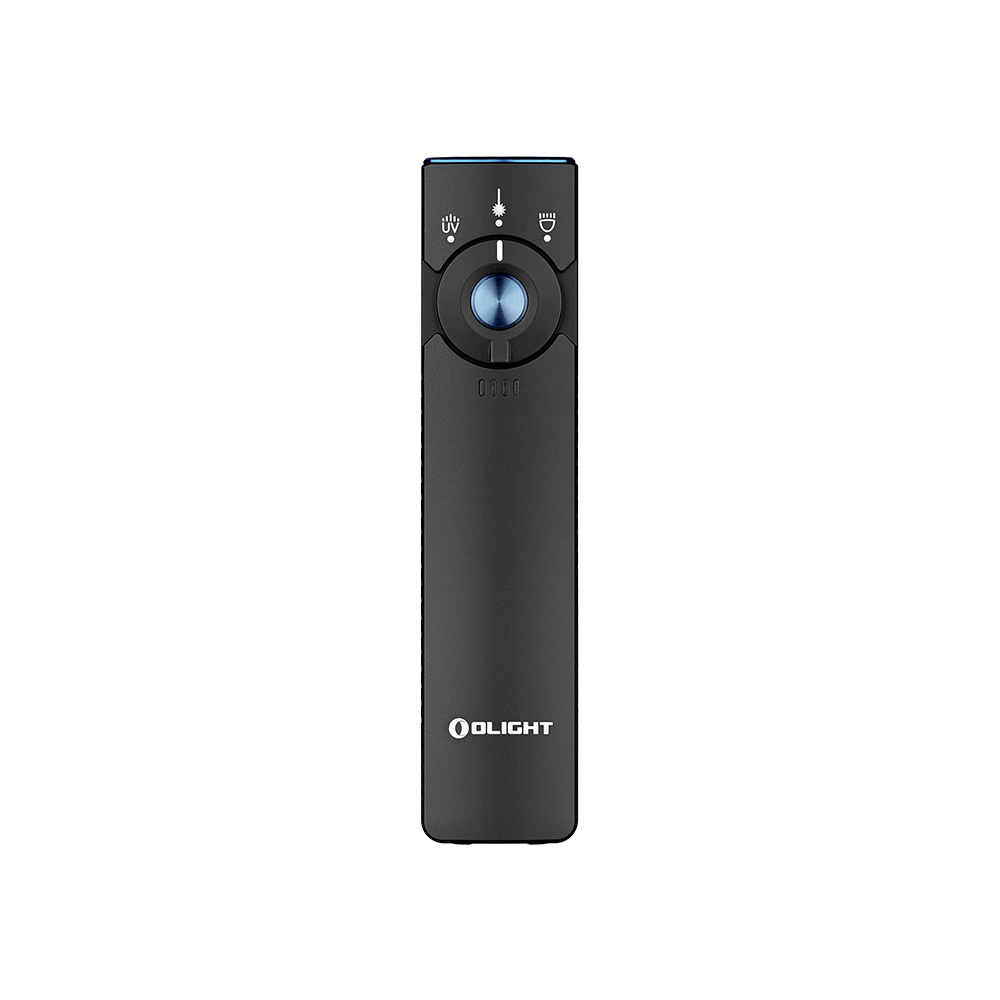
Official Arkfeld Pro selector, with distinct white-light, UV, and laser positions; this task uses ordinary white light.
The Arkfeld Pro's manufacturer-listed maximum white output is thirteen hundred lumens, and its listed battery capacity is fifteen hundred milliamp-hours. Neither figure specifies how long a particular household check will take or guarantees operation through an entire outage. Start with a useful reading level, check the charge indicator, and keep a separate suitable light available instead of planning around a maximum-output demonstration.
The Olight Baton 4 offers another compact option. Its metal switch and separate brightness and power indicators can help distinguish the chosen setting from remaining charge. A smaller body may suit a person carrying a notebook and thermometer, but it still needs a secure grip and a clear beam path. Do not balance it on a food container or hold it in your mouth.
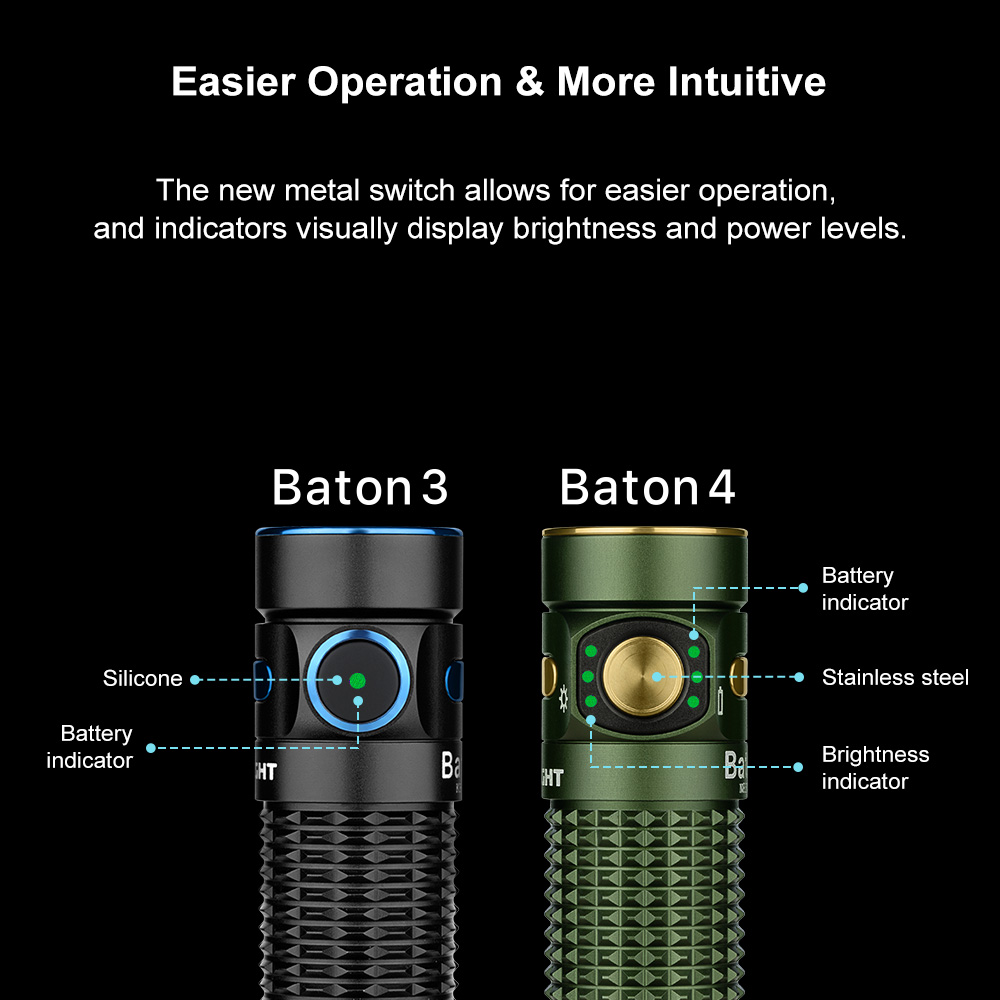
Official control comparison: the OD Green Baton 4 on the right has separate brightness and battery indicators around its metal switch.
For the OD Green Premium configuration, the charging case is part of the equipment choice. Olight lists a five-thousand-milliamp-hour case battery, a digital remaining-power display, and a USB-C port capable of charging mobile devices. That can help support access to a saved chart or outage messages, provided the case is charged and the correct cable is available. Shared energy still needs to be managed; charging a phone consumes energy that is no longer reserved for the light.
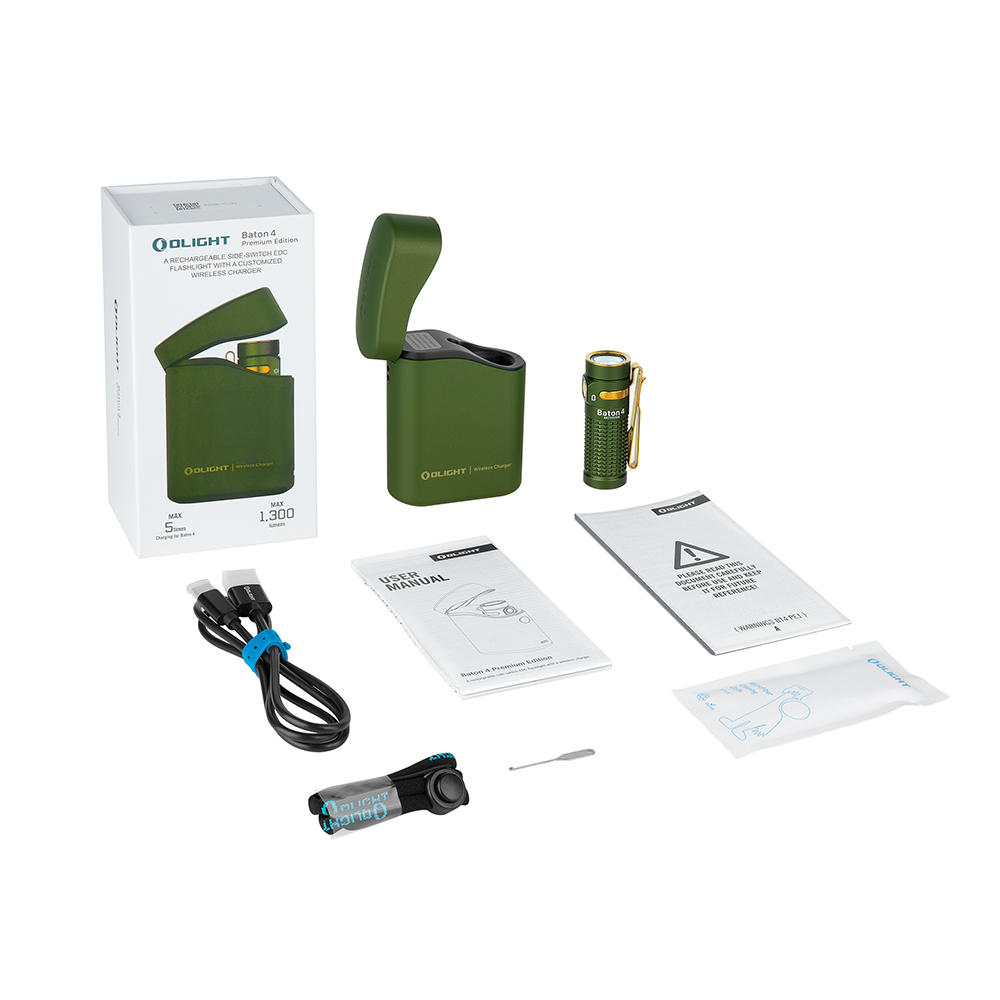
Official OD Green Baton 4 Premium kit. Keep the flashlight, case, and correct charging equipment together; the case belongs to this Premium package.
The Premium case features should not be attributed to a standalone Baton 4 purchase. Olight also describes case-button lighting and stepless adjustment, which can offer a controlled reading setup while the light is held with its case. Check the exact package and instructions before relying on that arrangement. A case does not become a substitute for stable placement or appropriate care around food, spills, and a crowded counter.
When comparing an EDC flashlight for this job, prioritize controls you can identify, a readable charge indication, and a charging arrangement that is actually ready. An unfamiliar set of extra modes adds little if the household cannot select ordinary white light confidently. Keep equipment clean according to its own instructions and outside food containers; illumination should support the check without adding another handling problem.
When timing is unknown, do not manufacture a reassuring history
Suppose power is working when you arrive home, but a neighbor reports an earlier outage. The refrigerator now reads cold. That reading tells you about current conditions, not necessarily the warmest point during the interruption. Look for reliable outage timing and an existing temperature record if available. Do not infer a complete history from the fact that the compressor has restarted.
Likewise, a clock that reset does not reveal exactly when food crossed a temperature threshold. A frozen bottle, a coin resting on ice, or the way a package feels cannot replace the missing time-and-temperature information. These observations may prompt questions, but they are not a validated record of the food's earlier condition. Keep the uncertainty explicit when applying the official guidance.
If the appliance has a genuine temperature-history feature, understand what it records before using it. A maximum air-temperature value may not tell you how long every food was at that temperature. A missing connection or interrupted recording period is a gap, not evidence that nothing happened. Consult the appliance or monitor instructions rather than interpreting an unfamiliar graph by appearance alone.
For shared homes, leave a concise note with the decision and its reason. “Discarded after an outage of unknown duration” communicates more than “smelled okay.” It also prevents a second person from reversing the decision based on a quick look. Keep any retained food clearly distinguished from items awaiting a decision, without allowing uncertain perishables to sit out while people debate them.
If the household uses more than one refrigerator or freezer, make a separate entry for each appliance. One may have remained closed while another was opened repeatedly, or their starting temperatures may differ. Do not carry a favorable reading from the basement freezer over to the kitchen refrigerator. Identify which appliance and which compartment supplied each observation before deciding what it tells you about a particular food.
For similar containers, include enough description to prevent mix-ups: the food name, whether it was prepared or uncut, and the storage location are often more useful than a vague note such as “vegetables.” Keep the decision separate from any later shopping or reimbursement record. Photographing a label can help retain its identity, but a photograph of the food is not evidence of an acceptable temperature history. The record should make the reasoning understandable without implying that visual documentation proves safety.
Moving food does not reset the clock
A cooler can be useful only when it actually maintains the appropriate cold conditions. Prepare suitable ice or frozen packs and a thermometer before transferring food you have reason to retain. Do not move food that already requires disposal into a cooler as a way to restart its history. Record the transfer and continue monitoring conditions rather than assuming that the word “cooler” guarantees refrigeration.
Avoid using an outdoor temperature reading as a substitute for controlled storage. Sun, changing weather, animals, and an unmonitored container introduce different problems. A cold porch is not automatically equivalent to a functioning refrigerator. Keep the focus on measured food-storage conditions and contamination protection rather than finding a place that merely feels chilly when you step outside.
For food removed from refrigeration, the federal four steps to food safety include prompt chilling and limits on time at room temperature, with a shorter limit in very hot conditions. Do not confuse time spent sorting on a counter with time in an unopened cold appliance. Plan the check so food that can be retained does not acquire a new handling problem.
Prepared infant formula and temperature-sensitive medicines need their own directions rather than a general household-food shortcut. Follow the specific product guidance and obtain appropriate professional advice when needed. Do not extend a recommendation for one refrigerated food to a medication, formula preparation, or another product with different requirements. A readable label helps identify the correct instructions; the flashlight does not supply them.
After cooling returns, close the record before restocking
When electricity returns, confirm actual appliance temperatures before treating cooling as dependable. A powered display and a running fan do not establish that the refrigerator has reached its storage temperature. Keep any safe alternative cold storage in use until appropriate conditions are established, and follow the appliance manufacturer's guidance if cooling does not recover normally.
Keep discarded food out of use and deal with leaks carefully. The FDA advises cleaning spills, particularly drips from thawing raw meat, to reduce cross-contamination. Follow appropriate cleaning instructions for the appliance and food-contact surfaces. Keep raw-food handling separate from retained ready-to-eat items, and avoid placing a notebook, phone, or flashlight in contaminated liquid while sorting.
Restock from the list rather than trying to rebuild a crowded refrigerator immediately. Check that replacement groceries can be chilled promptly and stored without blocking normal air circulation. The next outage is easier to manage when containers are labeled clearly and a suitable appliance thermometer is already in place. An organized refrigerator also reduces the door-open time needed to identify what belongs in each category.
Include lighting in that reset without making it the main safety instrument. Recharge a rechargeable flashlight with its correct equipment, confirm the ordinary white-light setting, and keep it near the record materials. Store thermometer instructions and an accessible official chart with the household plan. The useful preparation is a readable, repeatable decision process supported by measurements.
Frequently asked questions
Leave the next person a clear decision
The final check is whether another adult could understand what was kept, what was discarded, and why without repeating the entire search. Record uncertainty honestly, keep questionable food out of use, and preserve the distinction between refrigerator, freezer, and room-temperature exposure. Clear notes and accurate measurements are more valuable than an improvised visual test under a brighter beam.
Changelog
- November 18, 2026: Product information and buying guidance reviewed.




