


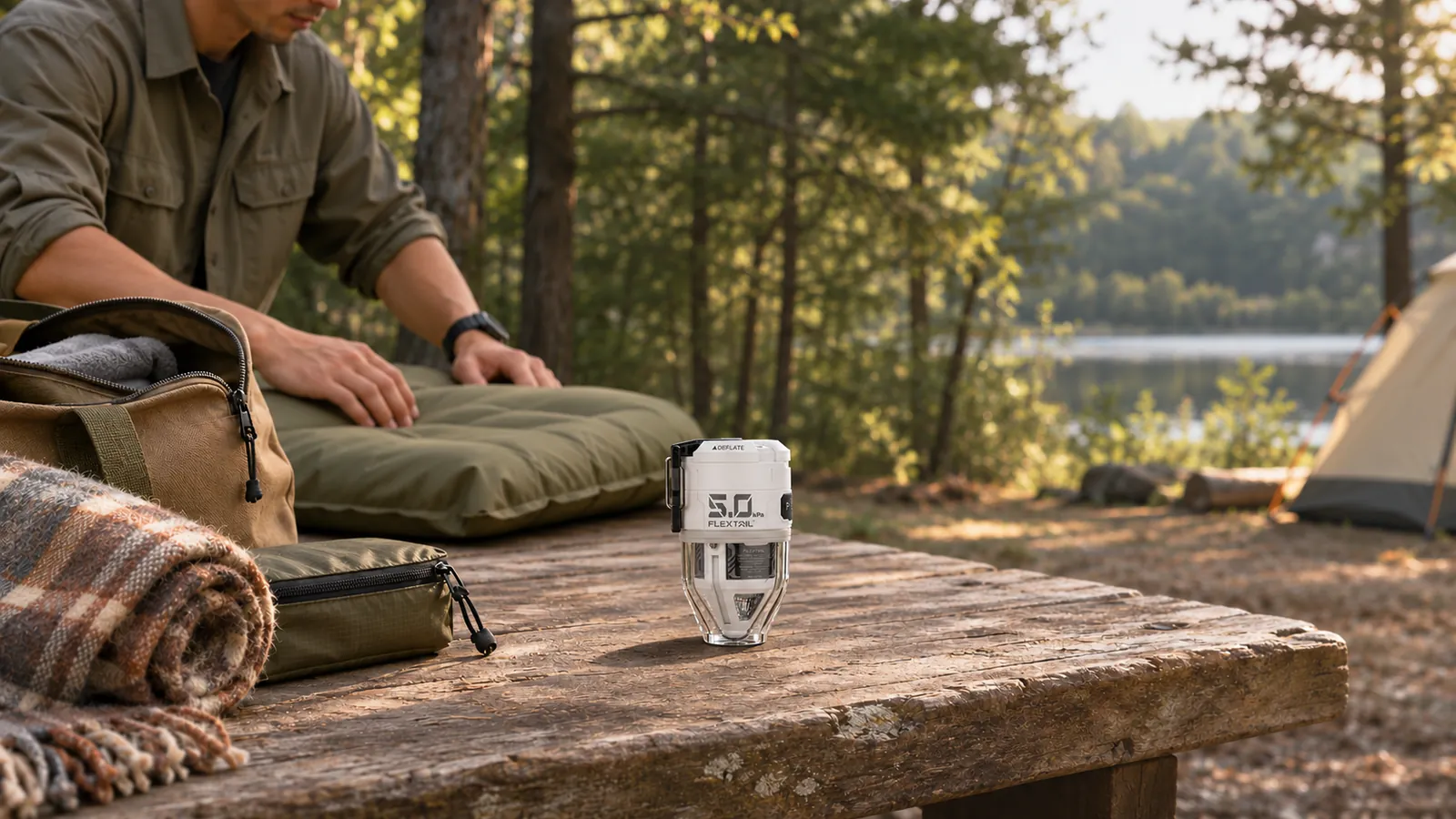
⚡ TL;DR
A car tire inflator and a low-pressure camping pump do different jobs. Choose a tire-rated inflator for the pressure and tire size specified for your vehicle; choose an appropriate low-pressure pump for compatible airbeds and other inflatables. Check the target pressure, valve, power requirements, and operating limits before packing. Neither a nozzle adapter nor a high airflow figure makes a camping pump suitable for car tires.
📋 Table of Contents
- 1. Start with the object that needs air
- 2. Read pressure and airflow as separate specifications
- 3. Use the vehicle's pressure information
- 4. What the MAX PUMP 3 actually adds to a camping trip
- 5. Match the nozzle without treating it as a universal adapter
- 6. Choose a tire inflator around the actual vehicle
- 7. Resolve the uncertain specification before buying
- 8. Plan for heat, pauses, and finite power
- 9. Keep lighting and location part of the decision
- 10. Pack by task and check the kit before leaving
- 11. Frequently asked questions
- 12. Pack the capability, not just the product name
Start with the object that needs air
The phrase “portable air pump” covers equipment with very different capabilities. One device may move a large volume of air into an air mattress, while another compresses air to the pressure needed by a vehicle tire. A camping trip can involve both jobs, but that does not mean the same small pump can perform them. Identify the job before comparing battery size or price.
For a car, record the vehicle's recommended cold tire pressure, the tire size, and the intended task. Maintaining a slightly low tire before departure is different from dealing with a tire that has suffered damage or lost pressure rapidly. An inflator adds air; it does not establish why the pressure fell or make a damaged tire safe to drive on.
For camping equipment, identify the particular airbed, sleeping pad, cushion, or other inflatable. Check its valve and instructions, including whether an electric pump is allowed. Two items that look similar can have different pressure limits or valve designs. A nozzle fitting the opening is only one part of compatibility, and a pump's maximum pressure is not the recommended pressure for everything attached to it.
Separate transportation equipment from recreation equipment in the packing list. The vehicle needs its own tire-pressure gauge and appropriately rated support plan. The airbed needs the correct adapter and inflation method. Keeping those requirements on separate lines makes it harder to arrive with a camping pump and discover that nobody packed equipment intended for the vehicle tires.
The existing printable camping and vehicle checklist can help organize the wider trip. Add the exact pump, accessories, instructions, and charging equipment to the relevant section. A list that says only “air pump” leaves the most important purchasing decision unresolved until somebody opens the bag beside a flat tire or an uninflated bed.
Read pressure and airflow as separate specifications
Pressure describes how strongly air is compressed; airflow describes how much air moves over time. A high-flow low-pressure pump can be convenient when filling a large compatible mattress. A tire inflator needs to develop the required pressure as well as deliver useful airflow under the relevant conditions. The largest airflow number on a product page is not an automatic indication of tire capability.
Units matter. Specifications may use kilopascals, pounds per square inch, liters per minute, or other units. Compare like with like rather than reading every large number as the same kind of performance. Five kilopascals is less than one pound per square inch. That is a very different pressure range from ordinary car-tire requirements, regardless of how quickly a pump fills a camping inflatable.
Maximum pressure is also different from useful performance throughout a job. A tire inflator that can reach a particular pressure may take different amounts of time with different tire volumes and starting conditions. Check the manufacturer's stated application and limitations. Do not assume that a passenger-car example establishes suitability for a large motorhome tire or repeated use across several vehicles.
The same care applies to battery claims. A number of inflations, a maximum runtime, and a battery's energy capacity answer different questions. They do not establish that an inflator can run continuously for that period or complete every tire on your vehicle without a pause. Look for the operating instructions that explain duty limits, cooling, and power requirements for the specific model.
| Equipment or specification | What it helps with | What it does not prove |
|---|---|---|
| Low-pressure, high-flow camping pump | Filling compatible larger-volume inflatables | Suitability for car tires |
| Tire-rated inflator | Supplying compressed air within its stated applications | Repair of a damaged tire |
| Nozzle assortment | Connecting to specified valve types | Correct pressure or universal valve compatibility |
| Automatic stop setting | Stopping toward a selected target under stated conditions | Guaranteed accuracy in every setup |
| Maximum battery runtime | Understanding a manufacturer's energy-use claim | Continuous-duty permission |
Use the vehicle's pressure information
NHTSA's tire maintenance guidance directs drivers to the vehicle manufacturer's recommended cold inflation pressure on the tire-information label or in the owner's manual. The number molded on the tire sidewall is not the vehicle's recommended setting. Identify the correct vehicle information before choosing a target on an inflator, including any specified difference between front and rear tires.
NHTSA describes cold tires as those on a vehicle that has not been driven for at least three hours. A reading after highway driving is not directly interchangeable with the usual cold reading. Do not invent a universal pressure adjustment for every vehicle or tire. Follow the vehicle and tire guidance, and seek help if the correct setting or the tire's condition is uncertain.
A tire-pressure monitoring warning is not a substitute for routine checks. NHTSA notes that the warning generally concerns significant underinflation and recommends regular pressure checks with a gauge. A dashboard light remaining off does not establish that every tire is at its recommended pressure. Include the spare where applicable and follow its separate instructions rather than assuming it shares the road tires' target.
The inflator's display should be understood in the context of its instructions. Some readings can behave differently while air is flowing or when a connector is not seated as intended. Use the specified reading procedure and keep an appropriate pressure gauge available. Do not promise that any portable unit will be more accurate than every gas-station gauge; accuracy depends on the equipment and how it is used.
If pressure will not remain correct, or the tire has damage, unusual noise, vibration, or another concern, consult a tire service professional. Adding more air repeatedly is not a diagnosis. A useful trip kit includes a way to request assistance and the vehicle's tire or mobility-system instructions, so the decision does not depend on forcing a pump to solve a problem outside its role.
What the MAX PUMP 3 actually adds to a camping trip
The MAX PUMP 3 portable air pump, offered through Olight's OSelect range, is a low-pressure option for compatible camping inflatables. Its listed pressure is five kilopascals, with manufacturer-listed airflow of five hundred liters per minute. Those features address moving air into items such as pillows, swim rings, and air mattresses. They do not make it a car-tire inflator.
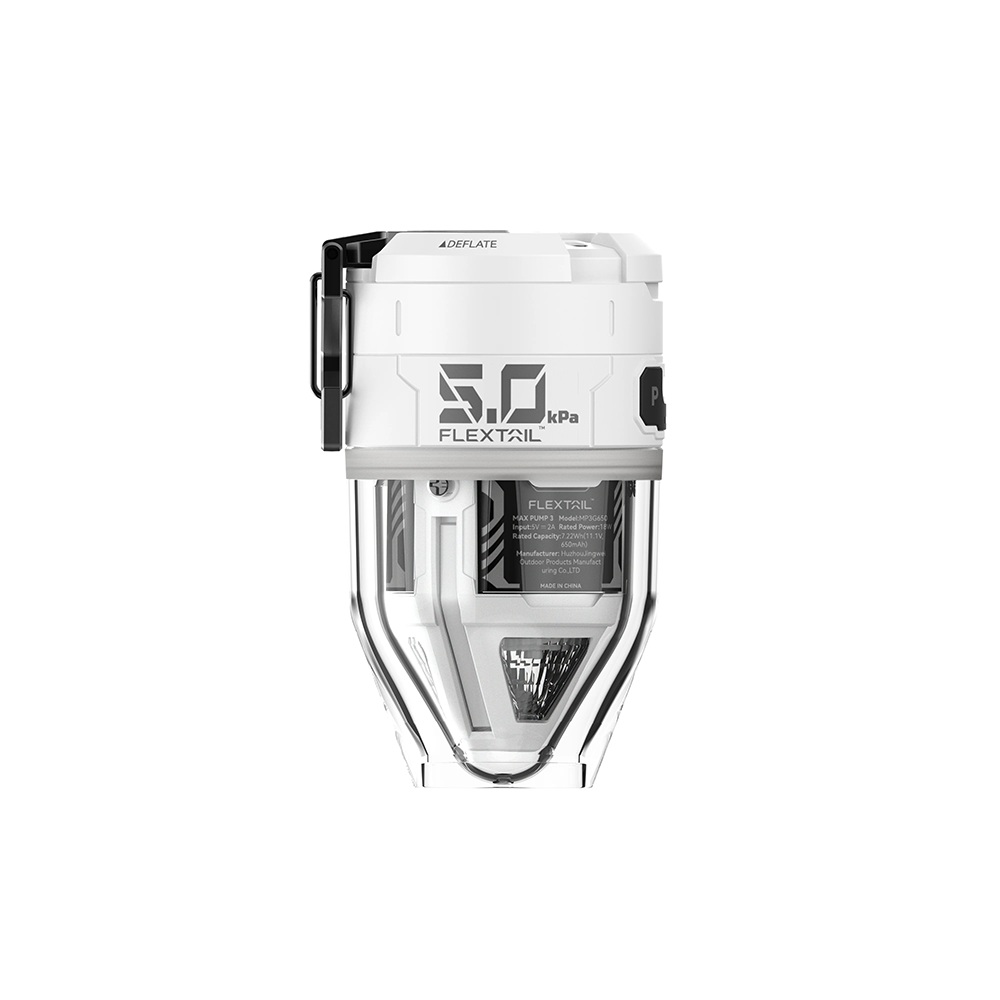
Official white MAX PUMP 3. The printed pressure specification is not a live gauge reading or evidence of suitability for car tires.
For a family unloading at a campsite, that distinction can be useful rather than disappointing. A separate camping pump can handle a compatible bed while the vehicle's tire equipment stays packed for its own purpose. The benefit is the right tool being available for the right job. It avoids expecting one compact purchase to cover two pressure ranges simply because both tasks involve air.
Olight lists six nozzles with the MAX PUMP 3. The practical benefit is having several connection options, provided the correct one matches the inflatable's valve and instructions. Keep the assortment together and identify the required adapter before departure. Six pieces do not mean compatibility with every product, and a tightly fitting connection is not evidence that the pump's pressure is appropriate.
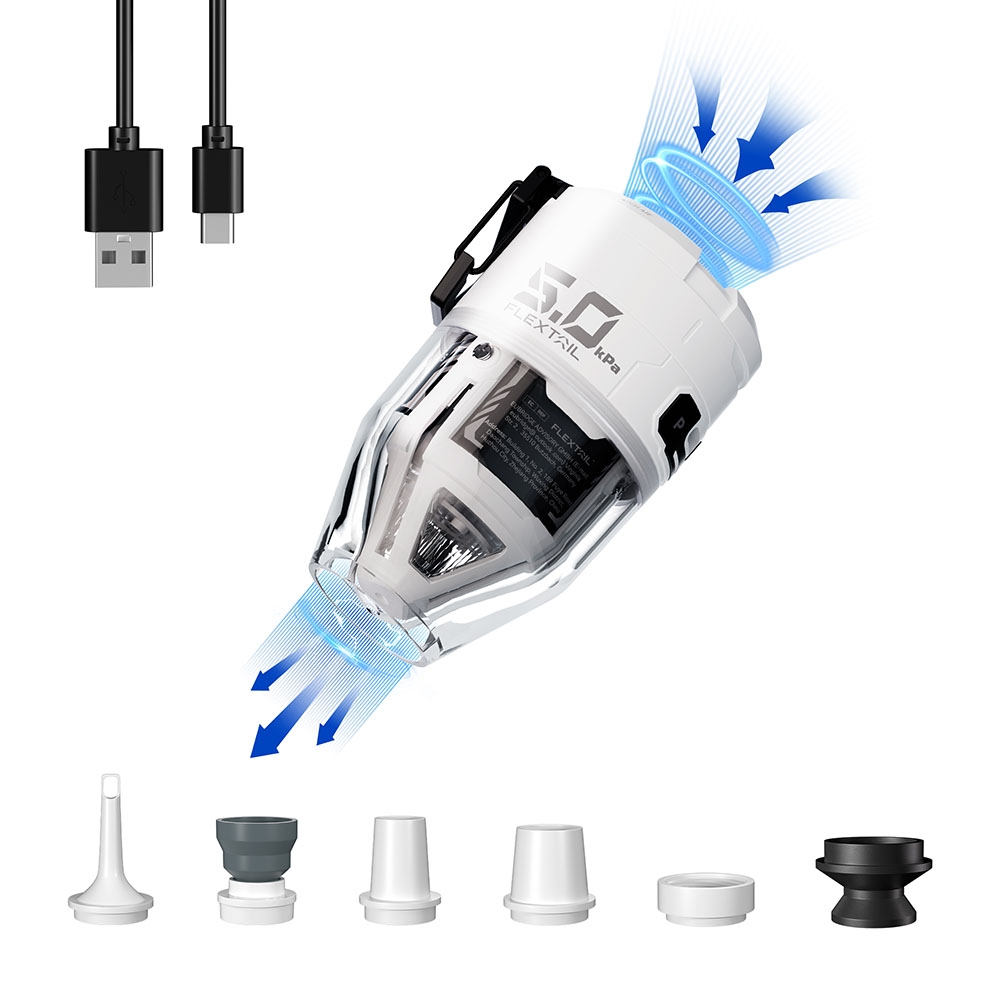
Manufacturer interface and accessory overview. Match the required part and pressure to the inflatable instructions; the set does not establish universal valve compatibility.
The product also includes an integrated camping light with three brightness levels. That can support a stationary activity around the compatible inflatable or gear area when it is placed appropriately. The listed lighting runtime range is four to eleven hours. Treat that as a manufacturer specification with operating conditions, not a promise of the longest lighting duration while the pump is also being used.
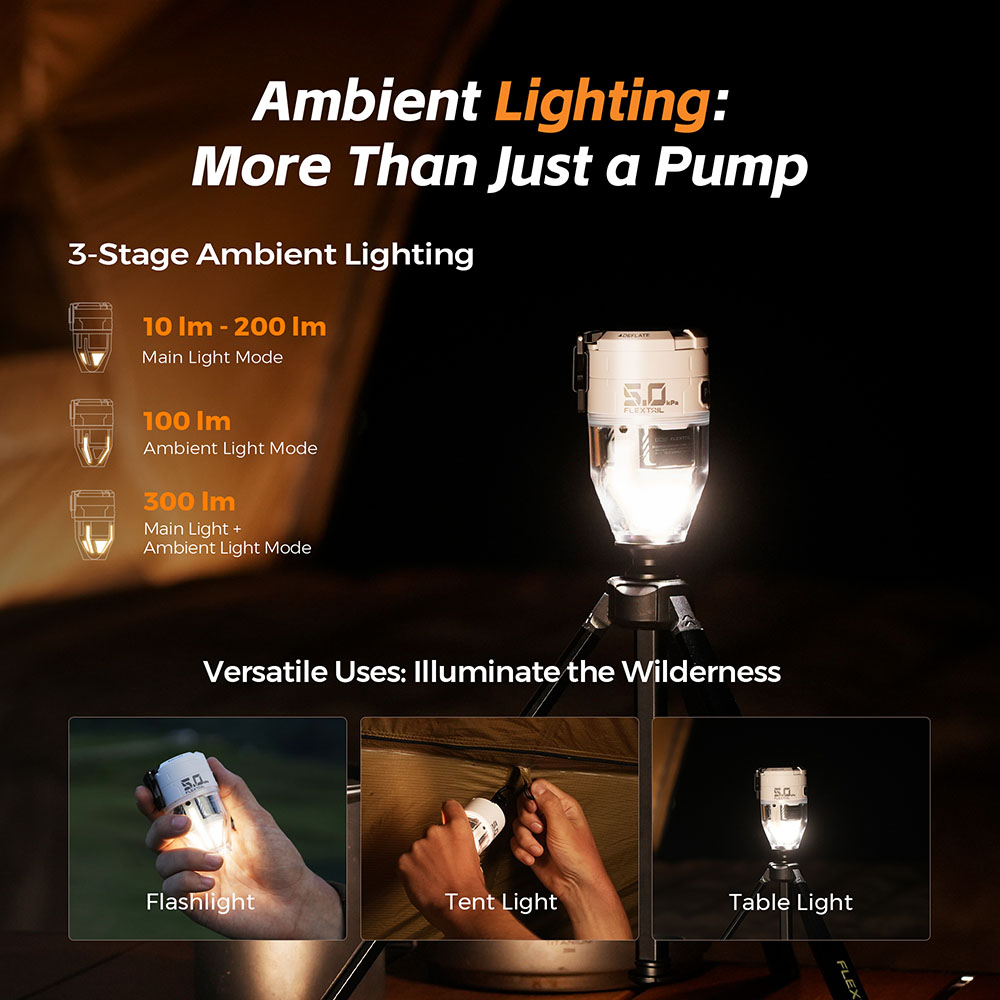
Manufacturer lighting examples. Verify separately supplied supports and the selected kit; lighting-mode labels do not promise pumping and lighting runtime together.
The listed pump-use maximum is up to sixty minutes on a charge. That is an energy-use claim, not a statement that continuous running for that long is permitted. Read the exact product instructions for operation, pauses, care, and charging. Plan the number and type of inflatables around appropriate use rather than adding together maximum lighting and pumping figures as though both were independently available from the same charge.
The MAX PUMP 3 is listed at approximately four point three ounces, which can make a dedicated camping pump easier to allocate its own pocket in a gear bag. The small size does not remove the need to protect its openings, keep adapters with it, and store it appropriately. A compact pump is convenient only when the equipment required to use it has also made the trip.
Match the nozzle without treating it as a universal adapter
Check the inflatable's instructions before attaching a powered pump. Some valves use an additional closure or a particular adapter, and some products require a different pump for the final pressure. Do not force a nozzle, modify the valve, or assume a loose connection can be solved by running the pump longer. A damaged valve can turn a convenient campsite task into a repair problem.
Organize adapters by their actual purpose. A small labeled pouch or a clear inventory can help another adult identify the correct part without trying every nozzle. Keep the product instructions accessible so compatibility does not depend on one person's memory. If an adapter is lost, obtain the correct replacement instead of improvising a connection with material that can obstruct the opening or damage the valve.
Large recreational inflatables deserve particular care. An item being physically large does not make it tolerant of arbitrary pressure, and an electric pump's airflow figure does not establish a safe final inflation level. Follow the inflatable manufacturer's instructions. A mattress feeling firm, a float looking full, or a pump sounding different is not a universal pressure standard for every product.
Keep water-safety equipment and vehicle tires out of casual adapter experiments. Use the equipment, gauges, and procedures specified for those items, and obtain appropriate help when the requirements are unclear. Do not make a flotation-safety claim based on the fact that a pump can move air into an object. Inflation, condition, intended use, and supervision are separate questions.
When packing afterward, keep the nozzle set separate from dirty or wet equipment until it can be cared for according to the instructions. Check for missing pieces before leaving the campsite. Finding an adapter in the grass beside the pitch is easier before the car is loaded, and a complete kit prevents the next trip from starting with an avoidable compatibility problem.
Choose a tire inflator around the actual vehicle
For the vehicle side of the kit, start with a model expressly intended for the required tire application. Check its supported tire types, pressure range, connector, and operating limits. A product advertised for bicycles, balls, or airbeds should not be promoted to a car-tire role without explicit support. A larger vehicle can also require different capabilities from the passenger car shown in an advertisement.
Check reach while planning the kit, including the tires farthest from the power point and any spare you are expected to maintain. Hose length and cable length affect where the device can be placed. The useful setup does not require a stretched lead across a walking route or a pump dangling from its connector. Work out whether the equipment fits the vehicle while it is safely parked before the trip.
Power-source compatibility needs more than a matching plug. A vehicle accessory outlet has its own rating and operating instructions. A battery-powered inflator has its own charging and storage requirements. A separate portable power supply must be suitable for the connected device. Do not assume that every socket, adapter, or jump starter can support an inflator merely because the connection can be made physically.
If the device combines several functions, identify which components are actually built in. A jump starter that supplies power to an external compressor is different from a unit containing a compressor. Peak starting current does not describe tire-inflation capability. Read the contents and interfaces rather than inferring an air pump from a vehicle-emergency product's name or a photograph of a tire nearby.
Check which accessories are included in the exact package and which are separate purchases. An inflator, a power cable, a hose, and a storage case may not be supplied in every configuration. A useful buying comparison includes the complete equipment needed for your vehicle and task. The lowest advertised price is less informative if it excludes the connection on which the entire roadside plan depends.
Resolve the uncertain specification before buying
If a product description lists a very high maximum pressure but gives little information about the intended tire size or workload, ask the manufacturer about your actual application. State the vehicle, tire specification, power arrangement, and whether the job is routine maintenance or something else. A useful answer should address those conditions. A repeated maximum-pressure number does not resolve a question about repeated use on a larger tire.
Ask how the displayed pressure is meant to be read and checked. If the instructions require a pause or a particular connection state, include that in the comparison. An automatic stopping feature can reduce the need to watch a rising target continuously, but the selected target still has to be correct and the result still needs the specified check. Convenience does not eliminate the need to understand the equipment.
For a camping pump, ask about the exact inflatable and valve instead of requesting a universal adapter. A photograph of the valve and the inflatable's model information can make the question clearer, provided you also consult its own instructions. If the pump only provides initial filling and the inflatable requires another method to reach its specified final pressure, account for that second piece of equipment before choosing the kit.
A longer RV trip makes these distinctions more important. The vehicle's tires, a towed vehicle, bicycles, and camping mattresses can all have different requirements. Do not select one target pressure for the entire group or assume that a pump suited to one vehicle covers every other tire. Label the equipment by its supported application, and use the appropriate vehicle or product information for each task.
Keep a readable copy of the vehicle's pressure information with its instructions if that helps trip preparation. Preserve the units and any front, rear, or spare distinction rather than transcribing a single unexplained number. If the vehicle or tires have been modified, obtain the appropriate guidance instead of relying on an old note. The buying decision should match the equipment currently on the trip, not a previous vehicle's requirements.
Plan for heat, pauses, and finite power
Inflating takes energy, and a pump's hose or body can become warm during use. Follow its instructions for operating intervals and cooling. Do not use discomfort as the planned signal to keep going until the next tire is finished. If the unit is damaged, behaving abnormally, or showing warning signs, stop using it and follow the manufacturer's support and safety guidance.
Keep ventilation and placement appropriate to the model. A soft bag, loose clothing, or camping bedding should not become an improvised support around a running pump. Do not cover a device to make it quieter. Noise, heat, and the need for stable placement belong in the selection decision, especially if the intended job involves several tires or multiple large inflatables.
The available battery capacity also supports only a finite amount of work. Recharging a phone from a multifunction device, running its light, and operating its pump may share the same stored energy. Check how the manufacturer describes those functions and whether concurrent use is supported. Longest-runtime figures from different modes should not be added together as a single trip guarantee.
Before departure, verify that the charging method is available where the equipment will actually be stored or used. A cable left at home defeats a rechargeable device's convenience once its charge is depleted. Keep the correct charging instructions with the kit and plan appropriate storage conditions. Do not assume a vehicle's hot cargo space is acceptable long-term battery storage for every product.
Assign the household's equipment deliberately. The camping pump should not be borrowed for another bag while everybody assumes it is still in the car. The tire gauge should remain available even when someone takes the inflator inside to charge. A short inventory checked before departure prevents these small changes from undermining an otherwise sensible equipment choice.
Keep lighting and location part of the decision
A pump light can illuminate its immediate area, but it does not make a hazardous stopping location suitable for work. Traffic, visibility, weather, and the condition of the tire still determine whether attempting a task is reasonable. Follow the vehicle's instructions and local emergency guidance. If a safe working location or an appropriate response is uncertain, obtain roadside assistance rather than letting the presence of a pump force the decision.
At a campsite, a camping lantern can serve the broader gear area while the pump is used for its intended inflatable. Arrange the light so the valve, instructions, and small adapters can be seen without directing glare toward another pitch. Keep cables and equipment out of walking routes. A pump's built-in light and a separate area light can have complementary roles rather than competing maximum-output numbers.
For reading a vehicle label or a gauge in an otherwise suitable parked location, a rechargeable flashlight can make the information easier to see. Use a working brightness that preserves readable detail rather than reflecting a bright spot into your eyes. The light does not assess tire damage, determine pressure, or substitute for traffic safety measures and the right equipment.
Do not treat decorative or general-purpose flashing modes as an approved roadside warning system. Follow the vehicle and local requirements for warning equipment. An equipment kit can make some ordinary tasks more manageable, but it cannot turn every breakdown into a safe do-it-yourself job. Keep a charged phone and assistance information available independently of the pump's extra functions.
Pack by task and check the kit before leaving
A practical vehicle pouch can contain the appropriate tire inflator, gauge, required leads, and the instructions for the exact equipment. A camping pouch can hold the low-pressure pump and its nozzle assortment. Keeping those roles visible helps another adult choose the correct bag. It also prevents a busy departure from substituting whichever device happens to be closest to the door.
Check the kit while there is time to replace a missing part or ask a compatibility question. Confirm the required target information, readable units, proper power arrangement, and complete accessories without deliberately deflating a tire or manufacturing a roadside scenario. For an inflatable, confirm its stated pump requirements and valve before the trip instead of discovering the mismatch after dark.
If bicycles are traveling with the group, keep their pump and lighting requirements distinct as well. Bicycle tires can have different valve and pressure requirements from the car or the camping equipment. The existing bike light rules by state guide addresses a separate part of that travel plan. Neither bicycle lighting nor a pump adapter establishes compliance or suitability for the vehicle's equipment.
After a trip, record any actual problem that needs attention: an incomplete nozzle set, a cable that did not reach, an unfamiliar display setting, or a tire that failed to maintain pressure. Correct the equipment issue before relying on the kit again, and refer tire concerns to an appropriate professional. A clearer packing decision is more useful than inventing a performance ranking from one hurried stop.
Frequently asked questions
Pack the capability, not just the product name
Before leaving, be able to identify which device serves the vehicle tires, which serves the camping inflatables, and where the gauge, adapters, and correct power equipment are stored. Use the vehicle's recommended pressure information and the inflatable's instructions. A well-matched kit can reduce avoidable inconvenience while keeping a clear boundary between adding air, diagnosing damage, and obtaining help.
Changelog
- November 18, 2026: Product information and buying guidance reviewed.




