Olight makes some of the lights discussed here. State rules are quoted from each legislature's official code website, checked in September 2026. Olight specs and regular prices come from Olight's product pages as of September 2026. This guide is general information, not legal advice.
⚡ TL;DR
Bike light laws in every state checked here require a white front lamp after dark, usually visible from 500 feet, plus a red reflector or light on the rear. Whether a rear light is mandatory depends on the state: Florida and New York require one, Virginia requires one on roads with a 35 mph or higher speed limit, and the rest accept a reflector.
If you commute after dark, you probably have two worries. The first is a ticket, or a crash claim where the other side says you had no legal lights. The second is simpler: a driver at 45 mph never saw you. This guide handles both. It quotes the actual statutes, turns the distances into seconds of warning, and ends with a setup that satisfies all nine states covered here.
This table is the short version of the bike light laws covered below: what to put on the bike, the minimum spec to look for, and an example of each part.
| Purpose | Recommended type | Minimum spec to look for | Example |
|---|---|---|---|
| Required front lamp | White bike headlight mounted on the bike | Visible from 500 feet ahead; steady mode available | A dedicated bicycle headlight; a rider-worn light counts only in California, Minnesota and Oregon |
| Rear reflector (required in most states checked) | Red reflex reflector of an approved type | Visible out to 600 feet in headlights; keep the factory reflector | The red rear reflector sold with a new bike |
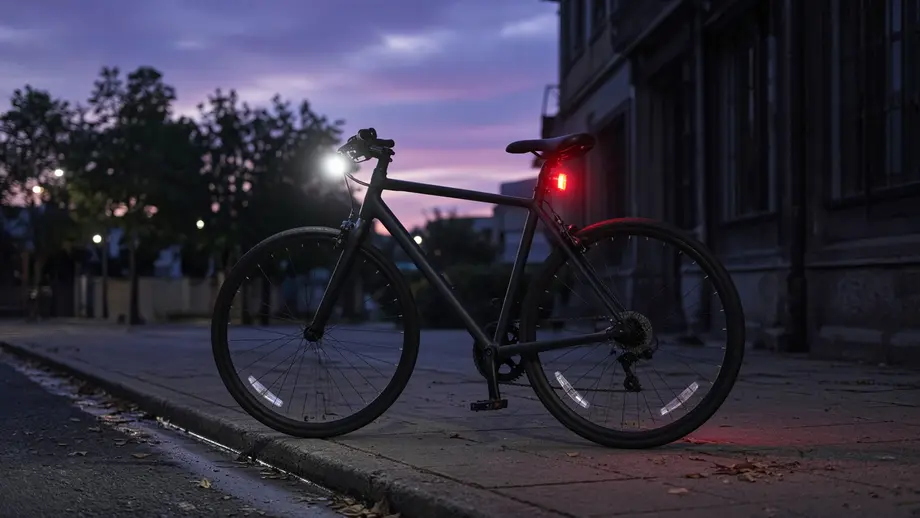
| Rear light (required in some states) | Red taillight, steady or flashing | Visible from 500 to 600 feet behind you | A dedicated bicycle taillight; the Olight Oclip red mode as a backup |
| Side visibility | Wheel reflectors or reflective tires, plus reflective ankle bands | Visible from the side at 200 to 300 feet | Factory spoke reflectors; the reflective hanger on the Obag Bike-ST Bike Saddle Bag |
| Spare and fix-it light | Small clip light | Low mode with several hours of runtime | The Olight Oclip or Oclip 2 Pro |
📋 Table of Contents
- 1. Do You Legally Have to Have Lights on Your Bike at Night?
- 2. Bike Light Laws by State: What Nine Statutes Require
- 3. Required Lamp, Required Reflector, or Recommended Extra?
- 4. How Far Must a Bike Light Be Visible?
- 5. Are Flashing Bike Lights Legal?
- 6. Is Side Visibility Required on a Bike?
- 7. Is It Legal to Ride a Bike at Night Without a Light?
- 8. What Are the Laws Regarding Bicycle Lights in Florida?
- 9. How to Look Up Your State's Bike Light Law
- 10. A Bike Light Setup That Meets All Nine States' Rules
- 11. FAQ
Do You Legally Have to Have Lights on Your Bike at Night?
Yes. In every state statute checked for this guide, riding at night on a public road requires a white front lamp and something on the rear: a red reflector, a red light, or both (New York also accepts amber). The window varies. Florida and Virginia start at sunset, while New York, California, Texas and Washington start half an hour after sunset.
The rules cover the bike, not a particular brand or wattage. None of the nine statutes below sets a lumen figure. They set a color and a distance: a white light visible from at least 500 feet to the front is the standard in Florida, Texas, Arizona, Washington, Virginia, New York, Minnesota and Oregon. California is the exception at 300 feet, but it adds a second test: the lamp must also light up the road in front of you.
The clock matters because "at night" doesn't mean the same thing everywhere. This table shows when each state's bike light rule starts, using the statute's own term and the definition it points to.
| State | Term in the statute | When lights are required |
|---|---|---|
| Florida | "between sunset and sunrise" | From sunset |
| Virginia | "between sunset and sunrise" | From sunset |
| California | "during darkness" | Half an hour after sunset to half an hour before sunrise, or when you can't see 1,000 feet (VC 280) |
| New York | Stated in the section | Half an hour after sunset to half an hour before sunrise |
| Texas | "at nighttime" | Half an hour after sunset to half an hour before sunrise (Transportation Code 541.401) |
| Washington | "hours of darkness" | Half an hour after sunset to half an hour before sunrise, or when you can't see 1,000 feet (RCW 46.37.020) |
| Oregon | "limited visibility conditions" | Sunset to sunrise, or when you can't see 1,000 feet ahead (ORS 801.325) |
| Minnesota | "at nighttime" | Half an hour after sunset to half an hour before sunrise (the definition in section 169.011 is written for motor vehicles); reflective surfaces are also required whenever you can't see 500 feet |
| Arizona | "at nighttime" | Not defined in section 28-817; treat sunset as the start |
The safe habit is to switch on at sunset in every state. That meets the earliest start time on the list, and the half-hour grace in some states is no help in fog, rain or a dark wooded road.
Daytime riding is mostly exempt, with a notable exception. Since January 1, 2026, California requires an electric bicycle to carry its rear reflector or red light "during all hours," according to California Vehicle Code section 21201. If you ride an e-bike there, the rear part of the rule applies at noon too.
Bike Light Laws by State: What Nine Statutes Require
The nine statutes below all require a white front lamp at night; they differ on the rear light, side visibility and flashing modes. Florida and New York mandate a rear light, Virginia mandates one only on faster roads, and the other six accept a red reflector alone. Each row links to the legislature's official text, read in September 2026.
This table compares the bicycle light requirements in each statute, in the order a rider usually asks about them.
| State and statute | Front white lamp | Rear requirement | Rear light required? | Worn by rider allowed? | Flashing mentioned |
|---|---|---|---|---|---|
| Florida 316.2065(7) | 500 ft | Red lamp and red reflector, each visible 600 ft | Yes | No; the bicycle must carry it. Extras may be on the rider | Not addressed |
| California VC 21201(d) | 300 ft ahead and to the sides, and must light the road | Red reflector, or a solid or flashing red light with a built-in reflector, 500 ft | No, reflector is enough | Yes, a lamp "attached to the operator" can replace the bike lamp | Rear: flashing allowed |
| Texas 551.104 | 500 ft | Red reflector (50 to 300 ft) or red lamp (500 ft) | No, either one | No; the bicycle must carry it | Not addressed |
| New York VTL 1236 | 500 ft | Red or amber light, 300 ft | Yes | No; the bicycle must carry it | Not addressed |
| Arizona 28-817 | 500 ft | Red reflector, 50 to 300 ft; red lamp optional | No | No; the bicycle must carry it | Not addressed |
| Washington RCW 46.61.780 | 500 ft | Red reflector, up to 600 ft; red lamp optional | No | No; the bicycle must carry it | LED flashing taillight allowed |
| Virginia 46.2-1015 | 500 ft | Red reflector, 600 ft | Yes, where the speed limit is 35 mph or more | Headlight no; taillight may be on "bicycle, or its rider" | "Steady burning or blinking" allowed |
| Minnesota 169.222 | 500 ft | Red reflector, 100 to 600 ft, or a rear lamp visible 500 ft | No | Yes, "bicycle or its operator" | Front white and rear red flashing allowed |
| Oregon ORS 815.280 | 500 ft | Red reflector, lighting device or material, up to 600 ft | No | Yes, "bicycle or its rider" | Not addressed |
Two patterns stand out. First, the front lamp rule is nearly uniform: eight of nine states use 500 feet. Second, "is a rear light required" has three different answers: yes (Florida, New York), sometimes (Virginia), and no, provided you have the reflector (the rest). Third, six of the nine statutes put the required front lamp on the bicycle itself, so a light on your body only counts in California, Minnesota and Oregon. If you ride across state lines, build to the strictest version, which is Florida's lamp plus reflector at 600 feet.
Required Lamp, Required Reflector, or Recommended Extra?
Bike light laws sort equipment into three groups. A required lamp must produce its own light, such as the white headlight. A required reflector only returns light from car headlamps, such as the red rear reflector. Recommended extras, like helmet lights or a second taillight, are allowed but not demanded. Mixing up the three is the most common way riders end up technically out of compliance.
A reflector does nothing until a car's headlights hit it. Arizona and Texas set the rear reflector test at all distances from 50 to 300 feet in front of "lawful upper beams" of a car's headlamps. Washington, Minnesota, Oregon and Virginia test with lower beams at distances up to 600 feet. That is why the statutes pair the rear reflector with a front lamp: a driver coming toward you may not have headlights aimed at your reflector at all.
Several states also say the reflector must be "of a type approved by" a state agency. Arizona and Texas name their state department, Washington names the state patrol, Minnesota names the Department of Public Safety, and Virginia says the Superintendent. Virginia goes further: its headlight and taillight must also be "of types approved by the Superintendent." The simplest way to satisfy that wording is to keep the reflector your bike came with. Federal rules at 16 CFR 1512.16 require new bicycles to ship with an essentially colorless front reflector, a red rear reflector, pedal reflectors, and side reflectors or reflective tire sidewalls.
Use this three-question check before any night ride:
- Is there a white lamp on the front that you can switch to a steady mode?
- Is the factory red rear reflector still on the bike, clean, and pointing straight back?
- Does your state, or a state you will ride through, also require a rear light? If yes, is it charged?
Extras are where helmet lamps and clip-on EDC flashlights belong. Florida says "a bicycle or its rider may be equipped with lights or reflectors in addition to those required," and Virginia has almost identical wording. Extras help, but in six of these nine statutes they don't replace the lamp that must be on the bike itself.
How Far Must a Bike Light Be Visible?
Most statutes here set 500 feet for the front lamp, while rear distances run from 300 feet (New York's rear light) to 600 feet (Florida's rear lamp and reflector). In metric terms, 300 feet is about 91 meters, 500 feet is about 152 meters, and 600 feet is about 183 meters. The law measures how far away someone can see your light, not how far your light reaches.
That difference matters when you read a flashlight spec sheet. A beam distance rating tells you where the beam still lights up the ground. It's based on candela, and the math is simple: illuminance in lux equals candela divided by distance squared, as our explainer on beam distance shows. A lamp can be seen from much farther than it can light the road, because a driver is looking straight into the source.
The statutes' distances translate into warning time. This table divides each legal distance by a car's speed, assuming the car is heading toward you or you are stopped. It shows how many seconds a driver has between first seeing your light and reaching you.
| Car speed | 200 ft (side, New York) | 300 ft (front, California) | 500 ft (front, most states) | 600 ft (rear, Florida) |
|---|---|---|---|---|
| 25 mph (36.7 ft/s) | 5.5 s | 8.2 s | 13.6 s | 16.4 s |
| 35 mph (51.3 ft/s) | 3.9 s | 5.8 s | 9.7 s | 11.7 s |
| 45 mph (66.0 ft/s) | 3.0 s | 4.5 s | 7.6 s | 9.1 s |
| 55 mph (80.7 ft/s) | 2.5 s | 3.7 s | 6.2 s | 7.4 s |
Read the 45 mph row as the typical suburban arterial case. A red reflector rated only out to 300 feet, the Arizona and Texas test distance under high beams, gives that driver about 4.5 seconds. A taillight visible at 600 feet doubles that to about 9 seconds. When a car overtakes you from behind, the closing speed is lower: at 45 mph against your 15 mph, 600 feet works out to roughly 13.6 seconds. Those extra seconds are the practical case for running a rear light even in states that accept a reflector.
For the front, spec sheets can help you check the "lights the road" part of California's rule. This table applies the lux formula to two Olight clip lights' maximum published candela at the same distances.
| Light (max published intensity) | 100 ft | 200 ft | 300 ft | 500 ft |
|---|---|---|---|---|
| Olight Oclip 2 Pro (3,906 candela) | 4.20 lux | 1.05 lux | 0.47 lux | 0.17 lux |
| Olight Oclip (1,156 candela) | 1.24 lux | 0.31 lux | 0.14 lux | 0.05 lux |
As a cross-check, 0.25 lux is the level at which Olight's published beam distances end: the square root of 3,906 ÷ 0.25 is 125 meters, and the square root of 1,156 ÷ 0.25 is 68 meters, which match the two product pages. These are peak figures from the brightest mode. They explain reach, not the legal visibility test.
Are Flashing Bike Lights Legal?
None of the nine statutes checked here bans flashing bike lights, and four say directly that flashing is allowed. Washington allows an "LED flashing taillight," Minnesota allows a white flashing front lamp and a red flashing rear lamp, Virginia says added lights "may be steady burning or blinking," and California accepts a "solid or flashing red light with a built-in reflector" on the rear.
The other five are silent, so the safer reading is to keep a steady mode available for the required front lamp. Florida, Texas, Arizona, New York and Oregon describe a lamp that "emits" or "exhibits" a white light visible from 500 feet, and they don't mention flashing either way. A steady front beam also lets you see the road surface, which a strobe doesn't do well.
Here is a setup rule that works in all nine states:
- Front: steady white for the required lamp. Add a flashing helmet or bar light as an extra if you like.
- Rear: keep the red reflector. Run the taillight in whatever mode your state allows; flashing is explicitly fine in Washington, Minnesota, Virginia and California.
- Don't point a strobe at oncoming drivers' eyes. Olight's Oclip user manual warns, "Do not look directly at the light source or shine it into your eyes," and a flash in a driver's face works against you.
Warning: Virginia adds that bicycle headlights "shall not have any aftermarket modifications that cause the headlights to appear as a blue light." Use a plain white headlight on the front and red on the rear.
Is Side Visibility Required on a Bike?
Some states require it. New York says at least one of your lights must be "visible for two hundred feet from each side." California requires the front lamp to be visible from the sides at 300 feet, plus white or yellow pedal, shoe or ankle reflectors and side reflectors or reflective tires. Minnesota requires 20 square inches of reflective material on each side when light is poor.
Side visibility matters at driveways and intersections, where a driver pulling out sees you broadside rather than head-on. The federal rule already covers part of this: 16 CFR 1512.16 requires new bikes to have "retroreflective tire sidewalls or, alternatively, reflectors mounted on the spokes of each wheel." If you removed the spoke reflectors to save weight, you may have removed your only side reflectors.
Night riding carries real risk in the evening. The Insurance Institute for Highway Safety's bicyclist fatality facts show 1,075 bicyclists killed in crashes with motor vehicles in 2024, and deaths peaked from 6 p.m. to 9 p.m. (23%). Adding the 9 p.m. to midnight share (17%), about 39% of those deaths occurred between 6 p.m. and midnight, by our count from the IIHS table.
Cheap fixes for side visibility:
- Keep or re-fit the spoke reflectors, or switch to tires with reflective sidewalls.
- Wear reflective ankle bands. California counts white or yellow shoe or ankle reflectors toward its pedal rule.
- Choose a front light whose beam spills sideways, not only a narrow spot. The trade-off between a wide flood and a narrow throw is covered in our guide to flashlight throw vs flood.
Is It Legal to Ride a Bike at Night Without a Light?
No. Every statute checked here makes night riding without the required white front lamp a violation, and none offers a reflector-only option for the front. The penalty is usually a traffic infraction rather than a crime. Florida treats it as a pedestrian violation, Oregon classes it as a Class D traffic violation, and both states can also hold a parent responsible for a child's ride.
Florida gives riders a way out of the first ticket. Under Florida Statute 316.2065, "The court shall dismiss the charge against a bicycle rider for a first violation of this subsection upon proof of purchase and installation of the proper lighting equipment." Keep the receipt when you buy lights.
A ticket is the smaller risk. After a night crash, the other side's insurer may look for any equipment violation. Riding with the required lights, and being able to show it, keeps that question off the table. A few habits help:
- Switch lights on at sunset, not when it "feels" dark. New York's and California's windows start half an hour after sunset, Florida's at sunset.
- Photograph your bike's light setup once a season, with the date visible on your phone.
- Carry a backup light in a saddle bag, because a dead battery puts you back at "no light."
What Are the Laws Regarding Bicycle Lights in Florida?
Florida requires three things on every bicycle ridden between sunset and sunrise: a front lamp showing white light visible from at least 500 feet, a rear lamp showing red light visible from 600 feet, and a red rear reflector visible from 600 feet. It is one of the strictest rear rules checked here, because it demands both a lamp and a reflector.
The exact wording in section 316.2065(7) is "a lamp on the front exhibiting a white light visible from a distance of at least 500 feet to the front and a lamp and reflector on the rear each exhibiting a red light visible from a distance of 600 feet to the rear." The same subsection allows extra lights and reflectors on the bike or the rider.
Florida's bicycle light laws in practice:
- Before sunset, check that the front lamp is charged and set to a steady or legal mode.
- Check both rear parts. A taillight alone does not satisfy Florida; you also need the reflector.
- If you get stopped, an officer may give a safety brochure and verbal warning, or a citation. A first citation is dismissed with proof you bought and installed the lights.
The same statute requires riders and passengers under 16 to wear a bicycle helmet, so a family night ride in Florida needs both lights and helmets.
How to Look Up Your State's Bike Light Law
Search your state legislature's own code website, not a blog summary. Look in the vehicle or traffic code under bicycle equipment, then find the section with the words "lamp" and "reflector." Note the section number, the distance in feet, and whether the rule says the light may be on the rider. The whole process usually takes five to ten minutes.
Use this path, which worked for each state in the table above:
- Search for "[your state] legislature statutes" and open the site that ends in .gov or is run by the legislature.
- Open the vehicle, motor vehicle, traffic or transportation code. Texas files bicycles under the Transportation Code, New York under Vehicle and Traffic Law.
- Look for a chapter or article on bicycles, then a section named "equipment," "lamps," or "lights."
- Read the whole section, not just the first sentence. Rear-light and flashing rules often sit in a later paragraph, as in Virginia's subsection B.
- Check the history line at the bottom for recent amendments. California's section 21201 was amended effective January 1, 2026.
- Check the definitions chapter for "nighttime" or "darkness." That tells you whether the rule starts at sunset or half an hour later.
- Check your city code too. Local rules can add to the state's; Texas, for example, lets a local authority ban bicycles on sidewalks.
Statutes change. California's rule changed on January 1, 2026, so read your state's current text before you rely on any summary, including this one. If a local officer or court reads a rule differently, their reading is the one that applies to your ticket.
Tip: Search inside the page for "500 feet," "600 feet," and "flashing." Those three terms find most of what you need in under a minute.
A Bike Light Setup That Meets All Nine States' Rules
A setup built to Florida's standard satisfies every statute in this guide: a white front lamp mounted on the bike, visible from 500 feet with a steady mode, a red rear light visible from 600 feet, the factory red rear reflector, and side reflectors or reflective tires. Add reflective ankle bands for California and a light that shows to the sides for New York.
Riding conditions change what you need beyond the legal minimum. This table sets out practical targets by type of ride; the legal floor is the same in each case.
| Ride type | Front output target | Runtime target | Water resistance | Rear light |
|---|---|---|---|---|
| City commute with streetlights | Enough to be seen; a steady 100 to 300 lumen mode is plenty for being seen | Round trip plus 50% margin | Splash-resistant (IPX4 or better) | Yes, flashing where allowed |
| Suburban or rural roads without streetlights | Enough to see potholes at your speed; brighter steady beam | Round trip plus 50% margin | Splash-resistant (IPX4 or better) | Yes, steady or flashing |
| E-bike in California | Same as above | Same as above | Same as above | Rear reflector or light at all hours |
| Winter commuting | As above | Plan for shorter runtime in the cold | As above | Yes |
The runtime margin comes from simple math. Say your dark commute is 40 minutes each way, or 80 minutes a day. The Olight Oclip 2 Pro lists 3 hours 45 minutes on its 100-lumen Medium floodlight. That's 225 minutes, or 2.8 days of that commute per charge. The 530-lumen Turbo is a burst: Olight lists "530~300~100 lumens" over "1+58+5 minutes," so plan around Medium.
Where Olight lights fit, and where they don't
None of the Olight lights below is sold as a bicycle headlight, so be clear about what these clip lights can and can't do on a bike. The legal line for using a flashlight as a bike light is simple. In six of the nine states, the required front lamp must be on the bicycle, so a flashlight counts only if it is mounted to the bike and meets the distance test. A flashlight held in your hand isn't "equipped" on anything and costs you a hand on the bars. In Virginia, the headlight must also be of a type approved by the Superintendent, which a general-purpose flashlight isn't sold as. For the required lamp, buy a dedicated bike headlight; our guide to mountain bike lights covers what to look for.
The Oclip 2 Pro ($54.99 regular price, September 2026) is a good extra or rider-worn light. It has a 530-lumen floodlight, a spotlight rated to 125 meters, and red light, with a 115° head tilt and IP66 protection. Its clip grips objects up to 14 mm thick, which suits a chest strap, backpack strap or handlebar-bag strap, but not a bare handlebar. In California, Minnesota and Oregon, a white lamp worn by the rider can count, as long as it meets the state's distance test (and in California, lights the road ahead while you ride). In Florida, Texas, Arizona, Washington, New York and Virginia, the required lamp is written as part of the bike, so treat a worn Oclip 2 Pro as an addition. Olight lists its uses as everyday carry, work light and safety alert, and doesn't rate it against any bicycle lighting standard. The Oclip 2 user manual adds a caution for anyone with an implanted heart device: "If you have an ICD or pacemaker, avoid close or prolonged contact with this product to prevent possible interference."
The Olight Oclip ($29.99 regular price, September 2026) makes a good backup rear light. Its red light is rated at 4 lumens for 5 hours, and it has a 1 Hz red strobe. That's modest output, and Olight publishes no visibility distance for the red mode. In Florida and New York, where a rear light is required, use a dedicated bicycle taillight as the main one and the Oclip as the spare. Its manual also notes that below 0°C (32°F), the light can only output at the low and medium brightness levels, which matters for winter rides.
The Obag Bike-ST Bike Saddle Bag ($15.95 regular price, September 2026) holds 0.8 L under the saddle and has a "Reflective Taillight Hanger" that Olight says lets "an optional taillight" be attached. It's a tidy place to clip the Oclip and carry a spare. Its reflective hanger is an extra, not an approved rear reflector, so keep the factory one.
One Olight product that doesn't belong on a bike: the Olight Ostrip LED strip. It's rated IP24, its manual says to "keep the controller dry" and warns that prolonged sunlight may damage the strip. It's USB-powered decorative lighting. Use it to light a garage bike rack, not a moving bike.
Note: If you want a light worn on your head for the ride, our best headlamp under 50 guide compares budget options, and our list of the best flashlights for night running covers lights built to be seen on the move.
Your pre-ride checklist
- Front white lamp on the bike, charged, set to steady.
- Factory red rear reflector clean and aimed straight back.
- Red taillight on and charged if your state requires one, or in Virginia on any road with a 35 mph or higher speed limit.
- Side reflectors or reflective tires present; reflective ankle bands on.
- A backup light in the saddle bag.
- Receipt for your lights saved, in case you need Florida's first-offense dismissal.
Safety note: Aim your front light slightly down at the road. A beam pointed straight ahead shines into oncoming drivers' eyes, which can blind them for a moment, the opposite of what bike light laws are meant to achieve.
FAQ
Changelog
- September 23, 2026: First published.