⚡ TL;DR
Backpacking gear for toddlers should include adult-managed lighting for retrieving supplies, two-handed work and an adult leaving the shared work area. Keep an independent backup accessible. Our Oclip Ultra provides a clip-format white task light for nearby supplies, while Perun 3 provides head-worn lighting for two-handed adult work.
📋 Table of Contents
- 1. Organize Family Camp Supplies Around Adult Nighttime Tasks
- 2. How Should Adults Divide Camp Lights Between People and Tasks?
- 3. Use Oclip Ultra as a Compact Adult Task Light
- 4. Position Adult Task Lighting Before Opening the Pack
- 5. Choose Head-Worn Lighting for Two-Handed Adult Work
- 6. When Should Adults Use White Light Instead of Red?
- 7. Read Camp-Light Runtime Alongside the Planned Job
- 8. Pack the Correct Charging Equipment With the Adult Kit
- 9. Separate Camp Gadgets From Accessible Small Batteries
- 10. Keep Access and Return Practical When the Bag Changes
- 11. Repack Camp Lighting for the Next Stage of the Outing
- 12. Compare the Complete Adult Lighting Load
- 13. FAQ
Organize Family Camp Supplies Around Adult Nighttime Tasks
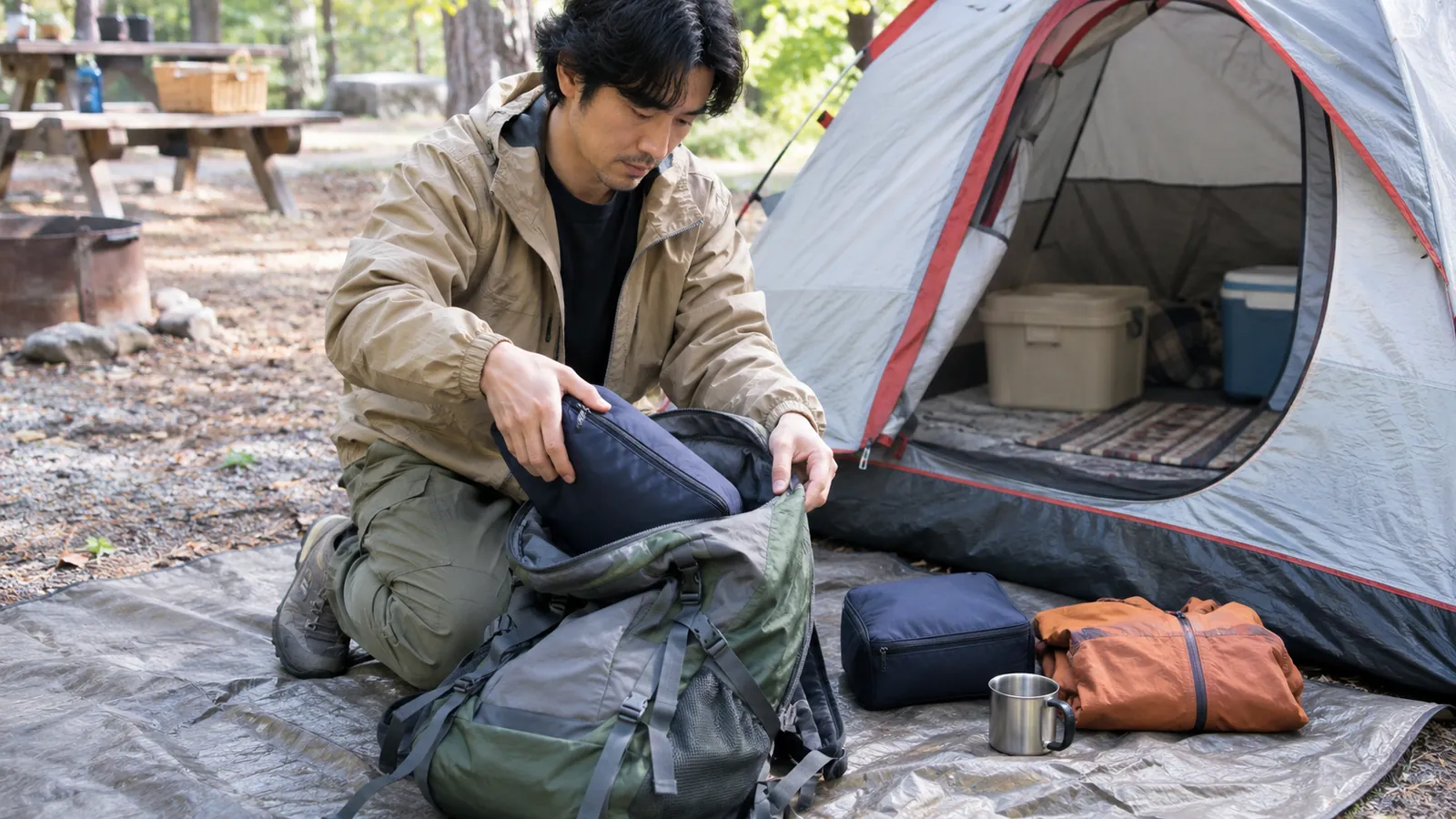
Start with the actual objects you expect to handle. Group a spare layer with the other clothing it replaces, keep the water container identifiable, and decide where footwear goes before removing it. These choices determine where illumination is needed. A light aimed into the main backpack will not necessarily illuminate the pouch on the ground beside it.
Use separate bags or compartments for supplies that need different handling. Clean, dry clothing should have a clear destination, while used or damp items need a separate place. Keep a light accessible before opening the larger pack so that finding the light does not require unpacking the supplies it is supposed to illuminate. This is particularly important when the bag has a deep main compartment and several identical dark pouches.
The adults' positions affect the lighting arrangement. One person might hold a bag open while another finds a labeled item. A head-worn light follows its wearer's attention, while a stationary light can continue illuminating a shared surface. Choose between these roles according to the task. Buying the brightest device first leaves the position and direction of its beam unresolved.
| Adult task | Lighting role to consider | Equipment decision before packing |
|---|---|---|
| Find a particular pouch | Directed light into the adult's open bag | Keep the light accessible before opening the main compartment |
| Read a label or inspect a color | White light directed at the item | Check that the relevant detail is actually distinguishable |
| Open supplies with both hands | Head-worn or securely positioned adult task light | Choose a position that leaves the work area visible |
| Collect an item away from the shared surface | Independently carried adult light | Leave another usable device with the person who stays |
| Return used equipment | Enough light to see the correct compartment | Separate damp items from clean supplies and electronics |
How Should Adults Divide Camp Lights Between People and Tasks?
Allocate lights by person and location before counting spare devices. If one adult carries the only light while collecting a forgotten item, the other person's work area loses illumination. A second device can solve that particular interruption. Adding more modes to the first light cannot keep it in two places at once.
For two adults, distinguish a personal light from one assigned to a shared work surface. Decide whether the surface light stays there or travels with the person finishing the task. For a single adult, place the backup where it can be reached without undoing the same bag closure that contains the main light. The objective is access during a specific interruption, such as a dropped device or depleted battery.
A backup needs an independent source of usable light. Two LEDs in one housing share that housing and usually share its battery. A charging cable can connect a compatible device for replenishment, but it does not supply a second beam while the light itself is elsewhere. Account for these physical dependencies when dividing equipment between the adults' bags.
Keep the child's decorative pack separate from the adult lighting plan. The adult who owns a task also carries its essential light and power arrangements. This lets you change who carries the larger family bag without making access to the light depend on a smaller bag that may be put aside. Clothing, shelter and other child-specific equipment should follow their own makers' instructions.
Use Oclip Ultra as a Compact Adult Task Light
Oclip Ultra is a clip flashlight offering separate white floodlight and spotlight choices. Its applicable manual lists a weight of 55 g including the battery and dimensions of 57 by 28.3 by 27.9 mm. These measurements describe the light itself. Any pouch, cable or separate power source adds to the equipment the adult carries.
The white floodlight provides a useful starting point for a nearby bag or work surface because it offers a different beam choice from the spotlight. The Ultra manual lists white floodlight Moonlight at 1 lumen and Low at 10 lumens. Those are selectable published outputs, so choose the setting that allows the adult to identify the actual object. An output number alone cannot establish how well a light reaches into a particular bag.
The clip gives the adult an alternative to holding the body throughout a task. Check the actual attachment and beam direction together. If the chosen edge points the beam away from the pouch opening, the clip's presence has not solved the positioning problem. Keep the lens clear and follow the light's instructions rather than covering it with fabric to dim its output.
Before packing Ultra, familiarize yourself with its white Moonlight entry. With the light unlocked and off and a white floodlight or spotlight source selected, the English manual describes holding the button for one second or more to enter Moonlight. The selector chooses the light source, while the button controls its operation. Keep those two controls distinct when preparing the device for a close task.
Position Adult Task Lighting Before Opening the Pack
Keep the selector and button reachable after choosing a clip position. Ultra's selector changes the light source, so the adult needs access to it as well as the operating button. A location deep beneath a folded bag flap could leave the beam pointed correctly while making a control difficult to reach. Choose the attachment with the bag's closures in their working positions.
Consider a pouch resting beside an open pack. An adult can first choose a stable, permitted attachment location, then direct the beam toward the pouch opening. Check the arrangement with the pack in the position it will actually occupy. A soft bag changes shape as items come out, so an attachment that worked on the full bag may point elsewhere once it is partly empty.
A convenient edge is only a candidate attachment point. It does not establish that a tent loop, fabric seam or improvised overhead attachment can support a light. Select a location consistent with the equipment instructions, keep the device clear of fabric covering its lens, and use another arrangement if the body or beam cannot stay in a suitable position. A reachable adult work area can be more practical than an overhead location that requires repeated reaching.
Ultra also provides a separate battery indication before a task starts. Its manual says to rotate the selector with the light off to check the battery level. In Lockout mode the indicator briefly turns red for about two seconds. Identify that starting state before treating the indication as a battery assessment.
Choose Head-Worn Lighting for Two-Handed Adult Work
A headlamp can help when both hands are needed to open a pouch, hold a bag upright or sort several items. Perun 3 includes a headband and can also be used as a handheld light. Its listed light weight is 150 g including the battery. Allow separately for the headband and other carried parts when comparing the complete arrangement with a smaller clip light.
Head-worn lighting follows the adult's head, which can be convenient while moving attention between a bag opening and an item in hand. It also moves when the wearer looks toward another person. Adjust where you stand and point the light toward the work instead of using the other person's face as the center of the beam. A stationary light may be preferable when several people need a consistent shared work area.
Published low modes also differ between models. Perun 3 lists white Moonlight at 5 lumens and Low at 30 lumens, while Oclip Ultra lists 1-lumen white Moonlight. The same mode name therefore does not identify the same output. Decide what detail the adult needs to see before choosing a device, especially if the intended job is close to the face or inside a small compartment.
Use the headband as the supplied adult equipment arrangement and check its fit and orientation on the intended wearer. A light's ability to attach to a headband does not supply information about fit for a toddler or compatibility with unrelated headwear. This article's equipment roles remain with adults, including the adult who packs and retrieves the headband.
When Should Adults Use White Light Instead of Red?
White light is the straightforward choice when the task depends on recognizing an object's color or reading a printed label in its ordinary appearance. Keep it available even when a device also has red light. Before relying on a dim setting, check whether the adult can distinguish the correct bottle, clothing item or printed instruction without moving the beam toward another person's eyes.
Red light for camping changes the appearance of colored objects. An adult may find it suitable for a familiar, simple task, but should switch to white light when the needed information becomes unclear. Choose the setting according to visible task details and where the light falls.
The published numbers also need their model and mode names. Perun 3 lists red Low at 15 lumens and High at 60 lumens. Its manual lists 70 hours for the Low red setting and 14 hours for High. These are our published reference figures for those specific settings. Changing outputs changes the conditions behind the runtime figure. Ultra's third source is UV, so the white-light roles described here use its floodlight or spotlight selection.
Begin a familiarization session with the exact manual beside the light and identify the controls needed for ordinary use. Avoid treating a sequence learned on another model as interchangeable. Once the adult can select the intended output reliably, check the real bag opening or label in that light. The result you need is a clearly visible item and a manageable beam direction.
Read Camp-Light Runtime Alongside the Planned Job
A long runtime can be relevant to repeated brief tasks, but the published figure must stay attached to its output. Oclip Ultra lists 144 hours for its 1-lumen white Moonlight setting and 27 hours for its 10-lumen white floodlight Low setting. Neither figure describes operation at the model's maximum white output. Compare the modes you expect to use rather than pairing a headline maximum with the longest listed duration.
Perun 3 illustrates a different tradeoff. Its manual lists 89 hours for white Low at 30 lumens and 25 hours for Medium at 120 lumens. Those figures help distinguish two settings on the same device. They do not predict the duration of a mixed evening involving different modes, battery states and conditions. Keep the published mode information available when deciding how much replenishment equipment to carry.
Write the anticipated jobs in plain language before interpreting these figures. Briefly finding clothing has a different duty pattern from keeping a shared surface illuminated while adults pack an entire shelter. If a light is repeatedly left on between jobs, that changes the amount of operating time required. Switching it off after a completed task preserves the distinction between task time and unattended illumination.
For a longer outing, decide whether you will recharge at an established power source or carry another complete charged light. A power bank can support replenishment, but it must be connected through the appropriate cable and available at the necessary time. A separate light lets the work continue while the first device is unavailable, subject to the instructions and output limits of each model.
Pack the Correct Charging Equipment With the Adult Kit
Match the charging method to the device. Oclip Ultra uses USB-C charging and its manual lists a 5 V, 1 A input. Perun 3 uses its MCC3 cable, whose manual specifies a USB Type-A 5 V, 2 A input. A bag containing only a USB-C lead would leave that Perun 3 charging arrangement incomplete unless the necessary compatible equipment was also packed.
Ultra's USB-C connection has a protective cover. Its manual calls for keeping that cover closed when the charging port is not in use to prevent dust or foreign objects from entering. Check that step when moving the light from the charging location back to the supplies. A cable left in the port and a light ready to be packed are different arrangements.
Choose a charging location where the adult can inspect the connection and keep the equipment within its own operating and charging instructions. Do not arrange a lead across the opening used to retrieve supplies. Disconnect and put away a completed setup so that moving the bag does not pull on a cable still attached to another object.
The Ultra manual also states that High output and brighter settings are inactive during charging. If an adult's intended work requires one of those settings, connect Ultra when another suitable device is available for that task. Charging access and operating access need separate consideration even when a cable reaches the work area. Use the applicable manual's charging instructions to plan when the device can return to its assigned job.
Separate Camp Gadgets From Accessible Small Batteries
Review other electronics in the family equipment as well as the lights. The CPSC's button-cell and coin-battery guidance says to keep products with accessible button or coin batteries away from children when their compartments lack a screw closure. It also calls attention to damaged battery compartments. Check the actual battery arrangement of each small accessory rather than assuming that its size or familiar appearance settles the issue.
This guidance concerns button and coin batteries. The Oclip Ultra and Perun 3 rechargeable power arrangements discussed here should be identified from their own instructions. An adult's review can include a separate small remote, decorative light or other gadget with a different battery type. Do not transfer a statement about one battery compartment to the rest of the equipment bag.
Keep replacement cells, removable parts and charging accessories in adult-controlled storage rather than spreading them across a shared surface during a task. Set aside an item with a damaged battery compartment instead of returning it to the ready-to-use pouch. This makes the equipment review specific to what is present, including optional gadgets that may have been added after the main bag was packed.
Keep Access and Return Practical When the Bag Changes
Packing positions often change during a trip. A full clothing pouch becomes smaller, a damp layer needs a different destination, or the adult carrying the main bag changes. Leave enough space around the light's compartment that another item cannot hide its opening. If you move the light, tell the other adult its new location while you still have enough light to show it.
At the end of the outing, check the physical condition of the light and its attachment before repacking it. Follow the model's cleaning and drying instructions, and keep damp gear separate during this process. The Oclip Ultra manual warns against putting a hot light into fabric bags or fusible plastic containers. Apply that instruction to the actual device rather than closing a pouch around it immediately after use.
Repack Camp Lighting for the Next Stage of the Outing
Morning packing creates a different work area from an evening supply check. The shelter may be partly packed while clothing and food bags remain open. Move the task light before folding away the surface or bag that supports it. Check the area where the light was attached so that it does not disappear inside a rolled item or travel in a different person's pack unnoticed.
Separate the light that will remain available during departure from equipment being packed for later use. An adult who has finished using a headband can store that assembly while keeping another suitable light accessible. This avoids reopening the packed shelter compartment simply to retrieve a device that was convenient beside the sleeping equipment the night before. Plan the transition around the adult's next job.
Check the attachments after changing clothing or rearranging straps. A clip placed on an outer pocket may become covered by a jacket or compressed beneath a pack strap. Move it to an appropriate location permitted by its instructions, and verify that the lens and controls remain clear. The original position need not remain suitable after the wearer changes layers or puts on the larger bag.
Keep an account of borrowed equipment at this stage. A headband, light and charging cable may have come from different owners, so return them as the actual agreed set. Record a missing cable while the other adult can still identify its last location. If a borrowed light returns home before the next outing, remove it from the family's ready-to-pack list and arrange its replacement role.
Compare the Complete Adult Lighting Load
Weigh the arrangement you will carry after choosing its parts. Published device weights can establish which light is being discussed, but the combined bag load also includes the selected attachments, protective storage, cables and any separate power supply. Two kits with the same light can therefore impose different carrying demands. Compare the complete set assigned to the adult who will actually transport it.
Avoid counting the same shared equipment twice in the packing list. If a power bank and its appropriate lead already belong to the adult electronics pouch, decide whether the lighting plan can use that arrangement at the needed time. Account for competing use by other devices and for connectors that differ. Add a dedicated accessory only when it resolves a specific connection or availability gap.
FAQ
Changelog
- November 7, 2026: Product information and buying guidance reviewed.