Olight makes some of the lights discussed here. Olight specs and regular prices come from its product pages and user manuals as of September 2026; other brands' specs come from their makers' own pages.
⚡ TL;DR
The best headlamp for mountain biking, if you already run a handlebar light, is the Olight Perun 3. This guide compares seven helmet-light options on published specs, and the Perun 3 wins on staying power: its 600-lumen High mode runs 300 minutes before stepping down, it is rated IP68, and its large side button works with gloves. Its 150 g weight is the trade-off.
Your bar light points where the front wheel points, so on a switchback the corner exit stays dark until you are committed. Dedicated helmet bike lights fix that, but the two examples here cost $135 and £240 and are built around helmet mounts rather than camp chores. A regular headlamp is cheaper and useful at camp, but it can slide on a smooth shell and add weight you feel on every drop.
This table is the short answer on the best headlamp for mountain biking for each kind of night ride.
| Scenario | Recommended light | Key specs (maker ratings) | Price (regular, September 2026) | Why |
|---|---|---|---|---|
| Best overall helmet headlamp | Olight Perun 3 | High 600~120 lumens for 300 + 30 minutes; 3,000-lumen Turbo; IP68; 150 g with battery | $89.99 (regular price, September 2026) | Longest High mode of the in-stock Olight options; glove-friendly button |
| Lightest Olight kit for the head | Olight Oclip Pro S on the Oclip Series Headlamp Strap | 600 lumens max; High 300~180~100 lumens for 1 + 95 + 10 minutes; 53 g light; IPX6 | $47.98 ($39.99 + $7.99, regular prices) | About a third of the Perun 3's weight |
| Chest strap light and trailside repairs | Olight Oclip 2 Pro | 125 m spotlight; 115° head tilt; clip grips up to 14 mm; 75.5 g; IP66 | $54.99 (regular price, September 2026) | Tilts down onto a chain or tire from a chest strap |
| Long rides with a recharge in your pocket | Olight Oclip 2 Ultra Premium | 580-lumen floodlight; 130 m spotlight; dock that doubles total runtime | $94.99 (Premium bundle, regular price, September 2026) | The dock refills the light without a cable |
| Race-pace descents | A dedicated helmet bike light such as the Outbound Lighting Hangover or Exposure Diablo 15 | Hangover 105 g lighthead; Diablo 15 2,000 lumens for 1 hour | $135 (Hangover); £240 (Diablo 15, UK store) | Helmet mounts in the box |
📋 Table of Contents
- 1. What Is the Best Headlamp for Mountain Biking?
- 2. Why Does a Helmet Light See Corners a Bar Light Misses?
- 3. Headlamp vs Dedicated Helmet Bike Light: Weight, Mount, Use and Price
- 4. How Do You Mount a Headlamp on a Bike Helmet So It Stays Put?
- 5. How Bright Should a Helmet Light Be Next to Your Bar Light?
- 6. Best Mountain Biking Headlamp Picks by Ride Type
- 7. What Is the Best Headlamp for Biking?
- 8. What Are the Best Headlamps for Biking at Night?
- 9. What Are the Best Mountain Bike Lights for Night Riding?
- 10. Common Mistake: The Brightest Helmet Light Wins
- 11. Helmet Light Etiquette When You Meet Other Riders
- 12. How This Guide Compared the Lights
- 13. Before Your Next Night Ride: A Helmet Light Checklist
- 14. FAQ
What Is the Best Headlamp for Mountain Biking?
The best headlamp for mountain biking holds a steady 300 to 600 lumens for your whole ride, mounts firmly to your helmet, and switches modes with a gloved thumb. Among Olight's in-stock headlamps, the Perun 3 fits best: High is rated at 600~120 lumens for 300 + 30 minutes, the body is IP68, and it lifts out of its band as a handheld light for a trailside fix.
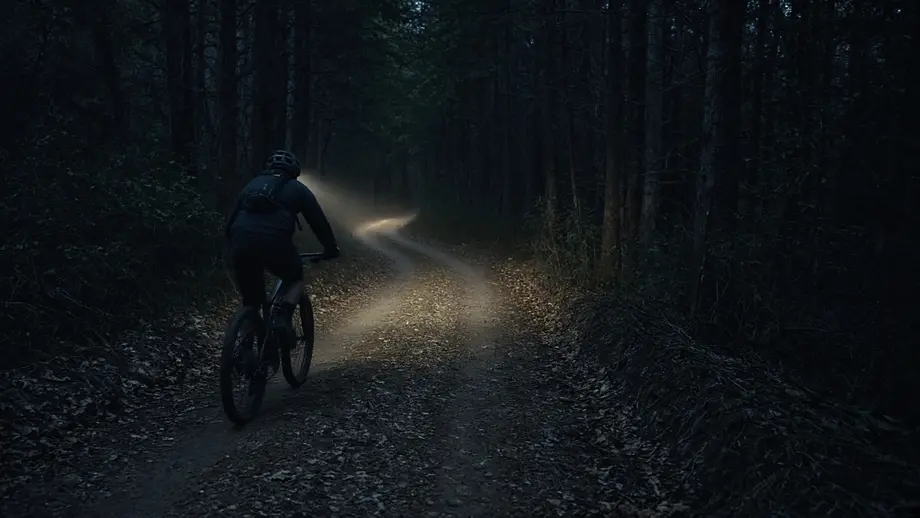
Think of a helmet light as a second beam. The bar light does the wide, steady work in front of the wheel; the helmet light goes where your eyes go, into the corner exit or over a rock garden. Three things decide the choice: mass on the head, a mount that holds its aim, and runtime on the mode you will ride. Olight lists riding among the Perun 3's uses, but none of its headlamps is sold as a bicycle helmet light or ships with a helmet mount.
Why Does a Helmet Light See Corners a Bar Light Misses?
A helmet light sees corners because it points where you look, while a bar light points close to the bike's direction of travel. On a tight bend, the spot you need to see sits well off to the side: by the geometry below, 51° to 102° away from the bike's heading at the curve radii and speeds used to design paved paths. Only a light on your head swings that far.
Washington State DOT's design manual, chapter 1515 on shared-use paths, gives a bicycle stopping sight distance formula based on a 2.5-second reaction time: S = V² ÷ (0.30 × (f − G)) + 3.67 × V, with S in feet, V in mph, f set at 16 and G the grade in percent. The same chapter pairs each design speed with a minimum curve radius, from 166 ft at 30 mph down to 12 ft at 8 mph.
On a curve of radius R, a point S feet ahead along the path lies S ÷ (2R) radians off your current heading, because a tangent-chord angle is half the arc's central angle. This table applies both formulas to WSDOT's pairs on flat ground.
| Design speed | Minimum curve radius (WSDOT) | Stopping sight distance, flat | Angle off the bike's heading (S ÷ 2R) | Straight-line distance to that point |
|---|---|---|---|---|
| 30 mph | 166 ft | 297.6 ft (90.7 m) | 51.4° | 259.3 ft |
| 20 mph | 74 ft | 156.7 ft (47.8 m) | 60.7° | 129.0 ft |
| 15 mph | 41 ft | 101.9 ft (31.1 m) | 71.2° | 77.6 ft |
| 12 mph | 27 ft | 74.0 ft (22.6 m) | 78.6° | 52.9 ft |
| 10 mph | 18 ft | 57.5 ft (17.5 m) | 91.6° | 36.0 ft |
| 8 mph | 12 ft | 42.7 ft (13.0 m) | 101.9° | 23.5 ft |
Check the 15 mph row by hand: 15² ÷ (0.30 × 16) + 3.67 × 15 = 46.9 + 55.05 = 101.9 ft. The central angle is 101.9 ÷ 41 = 2.485 radians (142.4°), half of that is 71.2°, and the straight line is 2 × 41 × sin(71.2°) = 77.6 ft.
Distance is not the problem: at 15 mph the point is under 80 ft away, well inside every light's rated reach. Angle is. At 10 mph on an 18 ft radius, the stop point sits 91.6° off your heading, beside your shoulder, where no bar light reaches.
Descents make it worse: with a 10% downgrade in the same formula, the 15 mph stopping distance grows from 101.9 ft to 180.1 ft, so you need to see even farther around the bend.
Note: These are geometry and design-standard calculations, not measurements of any light. They assume the bend keeps the same radius for the whole stopping distance, as on a switchback; on a shorter bend the angle is smaller. They show where a beam must point, not how bright it must be; paved-path numbers stand in for trail.
Headlamp vs Dedicated Helmet Bike Light: Weight, Mount, Use and Price
A headlamp on a helmet costs less and works off the bike, while a dedicated helmet bike light ships with helmet mounts and a beam shaped for trail riding. The Perun 3 at $89.99 weighs 150 g with its battery; Outbound Lighting's Hangover is $135 with a 105 g lighthead plus a 20 g mount. Choose by where else you will use the light.
Outbound Lighting writes that "Most 'helmet lights' are flashlights with a strap" and that its Hangover helmet light was designed for a helmet from the start. Exposure Lights calls its Diablo 15 its "most popular helmet light," with a 12° spot beam and 2,000 lumens held for 1 hour.
The Hangover uses an action-camera mount on 3M VHB tape, and the Diablo 15 comes with a helmet mount and two bolt lengths for helmets 22 mm to 40 mm thick. The Perun 3 rides in its included headband, and the Oclip Pro S clips to a strap Olight lists as compatible.
Weight is easier to judge as a share of the helmet you already wear. Giro lists the Manifest Spherical at 340 g (size M), and Smith lists the Payroll MIPS at 400 g (size M). Olight doesn't publish headband weights, so this table assumes 20 to 40 g for a band; that range is an assumption, not an Olight figure.
This table shows how much each light adds to those two helmets, from rated weights, not measurements.
| Light on the helmet | Added mass | Total with a 340 g helmet | Increase over 340 g | Total with a 400 g helmet | Increase over 400 g |
|---|---|---|---|---|---|
| Olight Perun 3 + band (assumed 20 to 40 g) | 170 to 190 g | 510 to 530 g | 50.0% to 55.9% | 570 to 590 g | 42.5% to 47.5% |
| Outbound Hangover + mount | 125 g | 465 g | 36.8% | 525 g | 31.3% |
| Exposure Diablo 15 (mount weight not listed) | 118 g | 458 g | 34.7% | 518 g | 29.5% |
| Olight Oclip Pro S + strap (assumed 20 to 40 g) | 73 to 93 g | 413 to 433 g | 21.5% to 27.4% | 473 to 493 g | 18.3% to 23.3% |
| Olight Oclip 2 Pro on a chest strap | 0 g on the helmet | 340 g | 0% | 400 g | 0% |
Check one row: 150 g + 20 g = 170 g, and 170 ÷ 340 = 50.0%. The Perun 3 adds about half again to a light trail helmet; the Oclip Pro S kit adds a fifth to a quarter. For hours of rough terrain, pick the lighter kit or a dedicated helmet light; for an hour of flowing trail and then camp, the Perun 3's runtime and off-bike use usually win. Band pressure over hours is covered in our guide to headlamp comfort.
How Do You Mount a Headlamp on a Bike Helmet So It Stays Put?
Mount a headlamp on the outside of the helmet shell, never under it, and use a band that reaches around the shell without full stretch. Center the lamp above your brow line, tilt it so the hotspot lands about 7 to 24 m (23 to 78 ft) ahead, then nod and shake your head hard. If the beam moves, tighten or reroute the band before you ride, not on the first descent.
The federal bicycle helmet standard is written for helmet makers, not riders, but it explains the caution. Under 16 CFR 1203.5, "Any unfaired projection extending more than 7 mm (0.28 in.) from the helmet's outer surface shall break away or collapse" under impact forces, and "There shall be no fixture on the helmet's inner surface projecting more than 2 mm into the helmet interior." 16 CFR 1203.7 says helmets must pass "both with and without any attachments that may be offered by the helmet's manufacturer." A strap-on headlamp from a light maker is not one of those attachments, so follow your helmet maker's manual first.
Fit also depends on the helmet. Exposure says the Diablo 15's mount is "Not compatible with MIPS Spherical or Integra / Integra Split helmets," which rules out the 340 g Giro above, and Outbound says helmets "are like snowflakes, none are the same, and this makes mounting a challenge." Check your model before you buy any mount.
Use this routine for a headband-style light:
- Band below the shell's widest point, so the curve holds it; leave vents and pads alone unless the helmet manual allows straps through them.
- Center the lamp on the brow and clear the visor. Off-center mass twists the helmet on rough ground.
- Wall check. Photograph the hotspot on a wall from a fixed spot, ride one rough loop, then check again. If it moved more than a hand's width, tighten the band.
Perun 3 owners should know one line from Olight's listing: "Headlamp mounting bracket is METAL - it is expected to scratch the body of the torch if taken in / out repeatedly." Swap it between head and hand often and expect cosmetic wear.
Safety note: In its Resellers Guide to Selling Safer Products, CPSC staff advise destroying any bicycle helmet that "Shows evidence of involvement in a crash or impact, such as a cracked, broken, or scuffed outer shell." After a crash, inspect the shell under the light mount too, where a band or adhesive can hide damage.
How Bright Should a Helmet Light Be Next to Your Bar Light?
A helmet light should usually run below your bar light, in the 300 to 600 lumen range for steady riding, with short bursts higher for fast sections. The bar light fills the trail in front of the wheel, and the helmet light only needs to reach the corner exit, roughly 23 to 78 ft (7 to 24 m) away at 8 to 15 mph by the geometry above. Runtime at that level matters more than peak output.
There is also a shadow reason. A light near your eyes hides the shadows behind rocks and roots, while the lower bar light casts shadows you can see. If the helmet light overpowers the bar light, the trail looks flatter than it is.
This table checks which Olight modes cover a 90-minute night ride without a recharge, from rated runtimes. For comparison, Outbound lists the Hangover's High at 1.1 hr and Exposure rates the Diablo 15 at 2,000 lumens for 1 hour.
| Light and mode | Rated output | Rated runtime | Covers 90 minutes? |
|---|---|---|---|
| Olight Perun 3, High | 600~120 lumens | 300 + 30 minutes | Yes, and the 600-lumen stage lasts the whole ride |
| Olight Oclip Pro S, High | 300~180~100 lumens | 1 + 95 + 10 minutes | Yes, mostly at 180 lumens |
| Olight Oclip 2 Pro, spotlight High | 270~90 lumens | 60 + 5 minutes | No; use spotlight Medium (90 lumens, 3 hours 45 minutes) |
| Olight Oclip 2 Ultra, spotlight High | 270~90 lumens | 60 + 5 minutes | No on its own; the Premium dock doubles total runtime |
Best Mountain Biking Headlamp Picks by Ride Type
The best mountain biking headlamp depends on the ride: the Perun 3 for long or technical night rides, the Oclip Pro S on its strap when weight matters most, the Oclip 2 Pro as a chest-strap and repair light, and the Oclip 2 Ultra Premium when you want recharging in a pocket. For race-pace descents, a dedicated helmet bike light is the better tool.
This table lists every light compared in this guide with the same columns, from makers' published figures as of September 2026.
| Light | Max output | Peak intensity | Beam distance | Runtime (High) | Weight | Water rating | Regular price (September 2026) |
|---|---|---|---|---|---|---|---|
| Olight Perun 3 | 3,000 lumens | 6,400 candela | 160 m (524 ft) | 600~120 lumens, 300 + 30 minutes | 150 g with battery | IP68 | $89.99 |
| Olight Perun 3 Mini (CW) | 1,250 lumens | 6,000 candela | 155 m (508 ft) | 500~350 lumens, 2 + 75 minutes | 54 g with battery | IPX8 | $64.99; Orange CW option and Premium editions sold out on September 24, 2026 |
| Olight Oclip Pro S | 600 lumens | 1,600 candela | 80 m (262 ft) | 300~180~100 lumens, 1 + 95 + 10 minutes | 53 g with battery | IPX6 | $39.99 (+ $7.99 strap) |
| Olight Oclip 2 Pro | 530 lumens (floodlight) | 3,906 candela | 125 m | Spotlight 270~90 lumens, 60 + 5 minutes | 75.5 g with battery | IP66 | $54.99 |
| Olight Oclip 2 Ultra | 580 lumens (floodlight) | 4,225 candela | 130 m | Spotlight 270~90 lumens, 60 + 5 minutes | 79.5 g with battery | IP66 | $94.99 (Premium bundle) |
| Outbound Lighting Hangover | ~1,000 or approx. 900 lumens (both listed) | Not listed | Not listed | High 1.1 hr | 105 g plus 20 g mount | Not listed | $135 |
| Exposure Diablo 15 | 2,000 lumens | Not listed | Not listed; 12° spot beam | 2,000 lumens for 1 hour | 118 g | IP67 | £240 (UK store) |
Olight lists both Oclip 2 throws as 426.5 ft, with 125 m for the Pro and 130 m for the Ultra, so this table uses the meter values.
Olight Perun 3: best overall for night trail rides
The hard part of a helmet headlamp is holding a useful beam for a whole ride. The Olight Perun 3 does it with a High mode rated at 600~120 lumens for 300 + 30 minutes on a customized 3.6V 5000mAh 21700 battery. Olight describes a "Large Metal Side Button" that "Enables simple, glove-friendly operation, and is concave to avoid unwanted activation during transit or storage." The manual adds a shortcut for trail stops: "When the flashlight is off, double press the switch to access Low."
It also has red light at 60 lumens for 14 hours. The limits: at 150 g it is the heaviest option here, and the manual lists a working temperature of 0-40°C, so freezing rides leave less margin. It costs $89.99 (regular price, September 2026).
Olight Oclip Pro S with Oclip Series Headlamp Strap: lightest kit
The Olight Oclip Pro S weighs about 53 g, and Olight lists the Oclip Series Headlamp Strap as compatible with the Oclip Pro, Oclip Pro S and Oclip Ultra. Together they cost $47.98 ($39.99 + $7.99, regular prices, September 2026). The light gives 600 lumens max, 1,600 candela, an 80 m throw and IPX6 protection.
Runtime is the catch: High is 300~180~100 lumens for 1 + 95 + 10 minutes. Olight doesn't publish the strap's length, so check that it wraps your shell without full stretch. If you also run in the dark, our guide to the best headlamp for hiking and running covers strap setups for both. The manual warns, "Do not immerse the product in water or other liquids, as it will damage the product," and below 0°C (32°F), "the white light is limited to Low and Medium modes."
Olight Oclip 2 Pro: chest strap light and trailside repairs
The Olight Oclip 2 Pro is not a helmet light, and Olight doesn't list it for the Oclip head strap. Its job on a mountain bike is lighting your hands. Olight lists a "115° head tilt with 360° clip rotation" and says the clip "grips objects up to 14 mm thick, including collars, straps, and MOLLE webbing," which fits a pack or hydration-vest chest strap. The Oclip 2 user manual adds a caution for anyone with an implanted heart device: "If you have an ICD or pacemaker, avoid close or prolonged contact with this product to prevent possible interference."
Stopped, you tilt the head onto a chain or tire bead. It weighs 75.5 g, is rated IP66 and costs $54.99 (regular price, September 2026). Ride on spotlight Medium (90 lumens for 3 hours 45 minutes) and save High for repairs. Its manual says, "In 0°C to 10°C conditions, the white light Turbo will be unavailable."
Olight Oclip 2 Ultra Premium: a recharge in your pocket
The Olight Oclip 2 Ultra Premium bundle costs $94.99 (regular price, September 2026). According to Olight, the Premium version "includes the 1,000 mAh Mobile Charging Dock for automatic top-ups and twice the total runtime." It adds a 580-lumen floodlight, a 130 m spotlight and an 800 mW UV mode; never shine the UV beam at anyone's eyes.
It shares the Oclip 2 Pro's limits: 60 + 5 minutes on spotlight High, IP66 with the same no-immersion warning, and no listed head-strap fit. The manual lists the MCC cable as an optional accessory. For the rest of the family, see the Olight Oclip series.
Not picked: Perun 3 Mini and Oclip Ultra
The Perun 3 Mini would be the lightest dedicated Olight headlamp for a helmet at 54 g, but the Orange CW option on its page showed Sold Out on September 24, 2026, and the page listed the Premium editions as sold out. The original Oclip Ultra, which also fits the head strap, showed "Estimated Time Until Availability: 09/22/2026" with no stock that day.
What Is the Best Headlamp for Biking?
The best headlamp for biking is one you treat as an extra light, not your only one. In six of the nine state statutes we checked, the required white lamp must be on the bicycle, so a headlamp can't replace it there. On trails, a headlamp is a second beam for corners. For both, the Olight Perun 3 fits best among Olight's in-stock models because of its long 600-lumen High mode.
Our summary of bike light laws covers nine states. Florida, Texas, Arizona, New York, Washington and Virginia write the front lamp as equipment on the bicycle. California, Minnesota and Oregon accept a lamp on the rider. Under California Vehicle Code 21201(e), a white lamp "attached to the operator and visible from a distance of 300 feet in front and from the sides of the bicycle" may be used in place of the bike-mounted lamp. Minnesota section 169.222, subdivision 6, applies its 500-foot white lamp rule when "the bicycle or its operator is equipped," and Oregon's ORS 815.280 uses "a bicycle or its rider."
Statutes change, and these are state rules, not city or park rules. Read your state's current text on the legislature's own site before you rely on a headlamp as your required front lamp. On the road, pair a bar-mounted bike headlight with a headlamp on a lower setting.
What Are the Best Headlamps for Biking at Night?
The best headlamps for biking at night last your whole ride at 300 lumens or more, reach a steady mode without cycling through a strobe, include a red or low mode for stops, and carry at least an IPX6 rating for rain. The Perun 3 meets all four. The Oclip Pro S on its strap meets three at about a third of the weight, but its High mode holds 300 lumens for only 1 minute before stepping to 180.
Two checks deserve detail:
- Water rating. Under IEC 60529, a second digit of 6 means "Protected Against Powerful Water Jets" and 8 means "Protected Against Continuous Immersion," according to testing body Intertek.
- Cold behavior. None of these Olight lights is rated for riding below freezing. The Oclip 2 and Oclip Pro S manuals limit white light to Low and Medium below 0°C (32°F), and the Perun 3 manual lists a working temperature of 0-40°C. On winter rides, carry a dedicated bike light as the main beam.
For headlamps for hiking, work and running as well, our guide to the best headlamps compares ten models.
What Are the Best Mountain Bike Lights for Night Riding?
The best mountain bike lights for night riding are a two-light system: a wide, bright handlebar light for the trail in front of the wheel, and a lighter, aimable helmet light for corners and obstacles. One light on the bars leaves corner exits dark, and one light on the helmet flattens the shadows that show you the ground. Budget runtime for both.
Build the system bar light first: a wide pattern with a runtime longer than your longest ride. None of the Olight lights here is a handlebar bike light, and our older guide to the best mountain bike lights covers that choice. Add the helmet light second, aimed about 7 to 24 m ahead, then a clip light on a chest strap for flats, and a spare Olight customized 21700 5000mAh battery ($26.95, regular price, September 2026; Olight lists it for the Perun 3) or the Oclip 2 dock for rides that run long.
Common Mistake: The Brightest Helmet Light Wins
A frequent mistake is buying the helmet light with the biggest lumen number. On the lights in this guide, peak output lasts minutes: the Perun 3's 3,000 lumens lasts 2 minutes before stepping to 800, and the Oclip 2 Pro's 530-lumen floodlight lasts 1 minute before stepping to 300. A brighter helmet beam also adds weight, glare and a flatter-looking trail.
The fix is simple: ride on a steady mode that lasts the whole ride, keep the bar light as the main beam, and aim the helmet light about 7 to 24 m ahead, the straight-line stop distances at 8 to 15 mph in the corner table, so you turn your head into corners instead of lighting trail 50 m away.
Helmet Light Etiquette When You Meet Other Riders
Dip or turn your helmet light away whenever you face another rider, hiker or driver, and drop to Low or red at stops. A helmet beam goes straight into the eyes of anyone you look at. The FAA warns that if dark-adapted eyes are exposed to a bright light source for more than one second, night vision is temporarily impaired, and a rider coming at you needs that vision.
That warning comes from the FAA's Pilot Vision brochure, written for pilots, but eyes work the same way on a trail. Look at the trail edge when someone approaches, keep strobe for emergencies, and check posted trail closing hours.
Warning: The Oclip 2 manual says, "Do not look directly at the light source or shine it into your eyes, as this may cause temporary blindness or permanent damage to your eyes." The same goes for other riders' eyes.
How This Guide Compared the Lights
This guide compared seven helmet-light options using makers' published specs, Olight user manuals, a state DOT design formula and the federal helmet standard. No light was ridden, weighed or run for it; every number traces to a maker page, a manual or a formula shown with its working.
This table lists what was compared, where each figure came from and how it was used.
| Item compared | Source | Basis | How often checked |
|---|---|---|---|
| Lumens, candela, beam distance, runtime, weight, IP rating, price | Olight product pages | Copied as listed, including step-down stages | Once, from page captures dated September 24, 2026 |
| Operation, cold limits, immersion warnings | Olight user manuals (Perun 3, Oclip Pro S, Oclip 2) | Quoted word for word | Each quote checked against the manual |
| Competitor output, runtime, weight, mounts, price | Outbound Lighting and Exposure Lights product pages | Copied as listed; conflicting figures shown side by side | Once, September 2026 |
| Stopping distance, curve radii, corner angle | WSDOT Design Manual chapter 1515 (M 22-01.23, September 2024); tangent-chord geometry | Formula applied to WSDOT's speed and radius pairs; angle = S ÷ (2R) | Each row recalculated |
| Added helmet weight | Giro and Smith helmet pages plus light weights | Light plus assumed 20 to 40 g band, divided by helmet weight | Each row recalculated |
Before Your Next Night Ride: A Helmet Light Checklist
Before a night ride, confirm that your helmet light lasts the ride on the mode you'll use, sits outside the shell and passes the nod test, and that your bar light remains the main beam. Charge both lights and know how to reach Low or red without looking.
- Pick by ride length. Under 90 minutes on moderate trail: the Oclip Pro S on its strap. Longer or more technical: the Perun 3, the best headlamp for mountain biking among Olight's in-stock options.
- Read your helmet manual on accessories; nothing goes under the liner.
- Mount, aim about 7 to 24 m ahead, then do the nod test and wall check.
- Run the helmet light below the bar light and save bursts for fast sections.
- Carry a stop light, such as an Oclip 2 Pro on a chest strap, and look down when you meet people.
Tip: Charge the helmet light and the bar light on the same schedule. A helmet light that dies first leaves you riding corners blind; a bar light that dies first leaves you on a head beam that flattens the trail.
FAQ
Changelog
- September 24, 2026: First published.