Olight publishes this guide and makes every light in it. Specs, regular prices, and stock status come from Olight's US product pages and user manuals as of September 24, 2026. Model counts, price bands, ratios, and watt-hour figures are our own arithmetic from those published numbers, not measurements.
⚡ TL;DR
Here is the Olight series explained in one sentence: each series name tells you how the light is carried and what job it was built for. Baton and ArkPro are pocket lights, Warrior and Seeker are belt-size handhelds, Perun is the headlamp line, Oclip clips on, Marauder is a bag-size searchlight, and Osight is red dots. Pick the carry style first, then the job.
The names do not help. A Warrior Ultra and a Baton Ultra share a word but differ by 63 grams and $40. A Warrior X 4 throws light more than twice as far as a Warrior 3S, and nothing in either name tells you that. Add Pro, Mini, S, EOS, and limited colors, and a first-time buyer faces dozens of product pages with no map. This guide is that map: every current line, what it is for, what it costs, and where two lines overlap.
This table is the Olight series explained in short form: it answers "which Olight series should I look at?" based on where the light will live.
| Where the light will live | Series to look at | Regular price band (September 2026) |
|---|---|---|
| On your keys | i-series (i3E EOS, i1R 2 Pro, iUltra) | $12.99 to $29.99 |
| Clipped to a pocket, strap, or collar | Oclip | $29.99 to $94.99 |
| In a pants pocket | Baton, ArkPro, Arkfeld | $54.99 to $129.99 |
| On your head | Perun | $64.99 to $89.99 |
| On a belt or duty holster | Warrior, Seeker | $119.95 to $169.99 |
| In a truck, boat, or pack | Marauder | $199.99 to $369.99 |
📋 Table of Contents
- 1. Olight Series Explained: The Quick Answer
- 2. Which Olight Series Is Which? All Ten Lines Side by Side
- 3. Sort by Carry Style: Key Ring, Clip, Pocket, Head, Belt, Bag
- 4. Sort by Job: Everyday, Tactical, Search, Long Throw, Work, Optics
- 5. What Do Pro, Ultra, Mini, and S Mean in Olight Model Names?
- 6. Where Do Olight Series Overlap, and How Do You Choose?
- 7. Which Battery Does Each Olight Series Use, and Can You Fly With It?
- 8. How Do You Read an Olight Spec Sheet?
- 9. What Are the Common Myths About Olight Series?
- 10. What Is the Difference Between Olight Models?
- 11. Why Does Olight Have a Bad Reputation?
- 12. Do Police Officers Use Olight?
- 13. A Three-Step Olight Model Guide for First-Time Buyers
- 14. FAQ
Olight Series Explained: The Quick Answer
Olight groups its lights into named series, and each series maps to one carry style and one main job. Pocket EDC lights are Baton, ArkPro, and Arkfeld. Tactical handhelds are Warrior. High-output handhelds for home and outdoors are Seeker. Headlamps are Perun. Clip lights are Oclip. Searchlights are Marauder. Pistol red dots are Osight. Weapon lights sit in separate Odin, Baldr, and PL lines.
So the fastest way to use the Olight series explained here is two questions in order. First, where will the light ride: keys, clip, pocket, head, belt, or bag? That choice cuts the field to one or two series. Second, what is the one job it must do well: walk the dog, clear a yard, search a field, fix a sink, or sit on a rail? That picks the model inside the series.
Only then compare lumens. A common way to go wrong is to do it the other way round: a buyer sees 4,600 lumens on a Seeker 4 Pro, then finds a 205 g light too heavy for a front pocket. You can browse every current model in Olight's range of Olight flashlights, but the sections below will tell you which three or four pages actually matter to you.
Which Olight Series Is Which? All Ten Lines Side by Side
The ten lines people ask about are Warrior, Baton, Seeker, Perun, Marauder, Javelot, Arkfeld, ArkPro, Oclip, and Osight. Nine of them had products for sale on Olight's US store on September 24, 2026. Javelot, the long-throw line, had only accessories listed. The table below counts current models and the regular price band for each line.
To build it, we sorted every light and optic product page in Olight's US store as of September 24, 2026. We counted each model once, and we left out accessories, refurbished units, new-customer duplicate pages, live-stream offers, and bundles. A model counts as "in stock" if its default color could be added to the cart that day.
| Series | Carry style | Main job | Models listed (in stock) | Regular price band | Battery family | Example model |
|---|---|---|---|---|---|---|
| Warrior | Belt holster | Tactical handheld, patrol | 3 (3) | $119.95 to $139.99 | Customized 21700, 5,000 mAh | Warrior 3S |
| Baton | Pants pocket | Everyday carry | 3 (3) | $54.99 to $99.99 | 16340 or 18650 | Baton 4 |
| Seeker | Belt or vertical holster | High output for home and outdoors | 2 (2) | $139.99 to $169.99 | Customized 21700 | Seeker 4 Pro |
| Perun | Head, or hand | Headlamp and right-angle light | 2 (1) | $64.99 to $89.99 | 16340 or 21700 | Perun 3 |
| Marauder | Bag or vehicle | Search and flood | 3 (3) | $199.99 to $369.99 | 32650 or 46950 | Marauder Mini 2 |
| Javelot | Bag or vehicle | Long throw | 0 lights; accessories only | Not applicable | Battery packs | None listed |
| Arkfeld | Pants pocket | Flat 3-in-1 (white, UV, green laser) | 2 (2) | $89.99 to $119.99 | Built-in 1,500 mAh | Arkfeld Pro |
| ArkPro | Pants pocket | Flat 4-light EDC | 2 (2) | $99.99 to $129.99 | 2,000 mAh on ArkPro | ArkPro |
| Oclip | Clip or magnet | Hands-free work and visibility | 5 (4) | $29.99 to $94.99 | 600 mAh on Oclip 2 | Oclip 2 Pro |
| Osight | Pistol slide or rail | Red dot sight | 11 (9 with a listed price) | $169.99 to $299.99 | CR1620 or built-in rechargeable | Osight K |
Two lines hide big internal ranges. The Oclip band runs from a $29.99 two-color clip light to a $94.99 four-light model, and the Osight band spans open and enclosed emitters. The notes below cover each line in one short block, with its standout spec and its main limit.
Warrior
Warrior is Olight's tactical handheld line: 21700 battery, holster in the box, and a tail switch for instant turbo or strobe. The Olight Warrior 3S lists 2,300 lumens, 23,000 candela, and 300 m for $119.95 (regular price, September 2026). The Warrior Ultra adds OAL material and 26,000 candela for $139.99. The Warrior X 4 is the thrower, at 99,310 candela and 630 m for $129.99. The limit is size: at 176 g to 249 g, none of them is a comfortable front-pocket light.
Baton
Baton is the compact everyday line. The Baton 4 lists 1,300 lumens from a 63 mm, 52.5 g body for $54.99. The Baton 4 Pro ($69.99) and Baton Ultra ($99.99) step up to an 18650 cell and add a tail switch. The limit is stamina on the smallest model: the Baton 4 holds 1,300 lumens for 1.5 minutes before it steps down. Our Baton 4 vs Baton 4 Pro comparison works through that trade.
Seeker
Seeker is the high-output handheld with a rotary knob instead of a clicky tail switch. The Seeker 4 Pro lists 4,600 lumens and 260 m for $139.99, and the Seeker Ultra lists 4,800 lumens and a 5,800 mAh cell for $169.99. Both ship with a vertical holster that doubles as a USB-C charging dock. The limit is weight: 205 g for the standard Seeker 4 Pro and 220 g for the Seeker Ultra.
Perun
Perun is the headlamp line, and each Perun light comes out of its headband base for handheld use; Olight describes the Perun 3 as a light you can use "as a headlight or flashlight." The Perun 3 lists 3,000 lumens, a red light, and a 21700 cell for $89.99. The Perun 3 Mini lists 1,250 lumens at 54 g for $64.99, but its default Orange CW color showed Sold Out on September 24, 2026. The limit is reach: Perun beams are built wide for close work, so the 160 m Perun 3 is not a search light.
Marauder
Marauder is the searchlight line, sized for a pack or vehicle rather than a pocket. The Marauder Mini 2 lists 10,000 lumens, 140,000 candela, and 750 m for $219.99, with separate flood and spot beams. The Marauder 3 lists 25,000 lumens, 250,000 candela, and 1,000 m for $369.99. The limit: at 465 g and 840 g, these lights travel in a bag, and the Marauder 3's 118 Wh battery raises questions for air travel (see the battery section below).
Javelot
Javelot is Olight's long-throw line, but no Javelot flashlight was listed for sale on Olight's US store on September 24, 2026. The store still listed Javelot accessories: a Javelot Turbo 2 battery pack at $45.99, filters, and a wireless remote switch. If you need long reach today, the Warrior X 4 (630 m) and Marauder Mini 2 (750 m) are the in-stock options with the longest rated beams under $250.
Arkfeld
Arkfeld is the flat 3-in-1 line: white light, 365 nm UV, and a Class 3R green laser in one 16 mm thick body. The Arkfeld Pro lists 1,300 lumens and 102 m for $89.99, and the Arkfeld Ultra lists 1,400 lumens in O-Aluminum for $119.99. The limit is reach: at 2,608 candela, the Arkfeld Pro puts out about a quarter of the ArkPro's 10,640 candela peak.
ArkPro
ArkPro is the flat four-light line: a pure flood beam, a spot beam, UV, and a green laser, with USB-C and magnetic charging. The Olight ArkPro lists 1,500 lumens flood, 800 lumens spot, and 205 m. The standard ArkPro lists $99.99 (regular price, September 2026) in Matte Black, while some colors, such as Nebula Violet, list $109.99. The ArkPro Ultra lists 1,700 lumens in OAL for $129.99, and it is the default choice on the ArkPro series page, so check which model is selected before you add it to the cart. The limit is water: IPX7, not the IPX8 of Baton and Warrior. For how a flat body carries against a round one, see our flat flashlight comparison.
Oclip
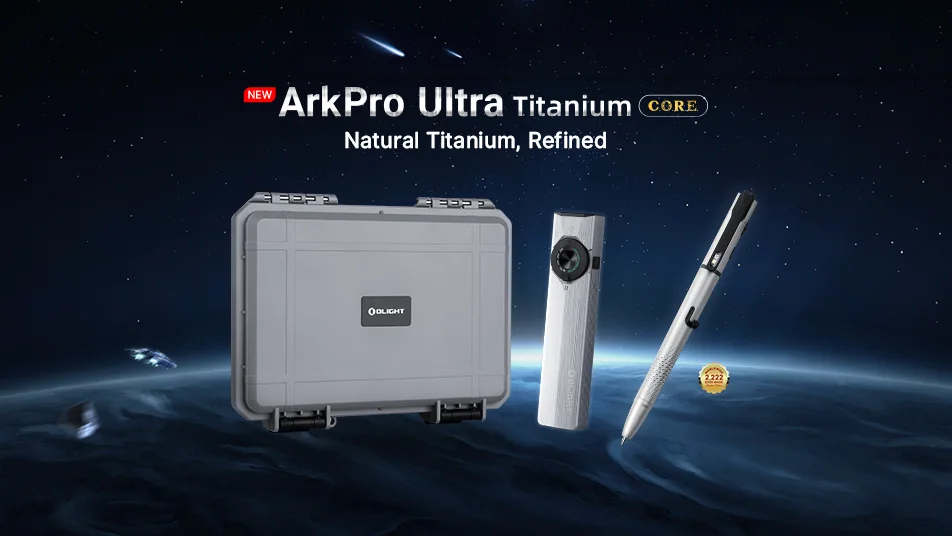
Oclip is the clip-on line for hands-free light. The Olight Oclip lists 300 lumens of white light plus a 4-lumen red light in a 30 g body for $29.99. The Olight Oclip 2 Pro ($54.99) adds a separate floodlight and spotlight, a 115° head tilt, and a 360° rotating clip. The Oclip 2 Ultra ($94.99, the price shown for its Premium bundle) adds UV. The limit is battery: 600 mAh runs the 100-lumen flood for 3 hours 45 minutes on the Oclip 2 Pro. Compare all four current models on the Olight Oclip series page.
Osight
Osight is Olight's red dot line, and it has the most models of any series we counted: 11 product pages. Priced models run from the $169.99 Osight K (open emitter, 6 MOA green dot, CR1620 battery) to the $299.99 Osight XR (enclosed emitter, RMR footprint). Many Osight models list magnetic charging covers or side-loading batteries. The limit is fit: each optic lists a footprint, and it must match your slide cut or plate.
Beyond the Ten: Odin, Baldr, PL, i-Series, and O'Pen
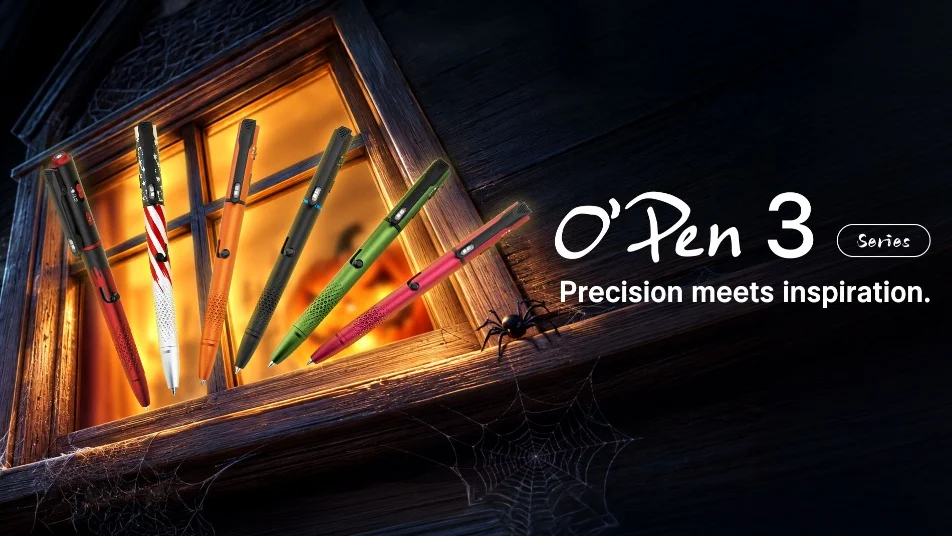
Five smaller lines round out the catalog. Odin, Baldr, and PL are weapon-mounted lights: we counted 12 models from $79.99 (PL-MINI 2) to $209.95 (Odin GL). The i-series holds six small lights from $12.99 (i3E EOS) to $29.99 (iUltra), and five of them list keychain carry as a use or series name. O'Pen is the pen light line, with the O'Pen 3 at $79.99.
Sort by Carry Style: Key Ring, Clip, Pocket, Head, Belt, Bag
Carry style is the first filter because weight rises fast between styles. Across current Olight lights, a key-ring model weighs 19.4 g to 41 g, a pocket light 52.5 g to 120 g, a belt light 176 g to 249 g, and a searchlight 462 g to 840 g. Decide where the light rides, and most series drop out.
This weight ladder uses Olight's listed weights with the battery installed, and it shows how many times heavier the heaviest model in each style is than the lightest.
| Carry style | Series | Lightest model | Heaviest model | Heaviest ÷ lightest |
|---|---|---|---|---|
| Key ring | i-series | i3E EOS, 19.4 g | i3T EOS, 41 g | 2.1× |
| Clip or magnet | Oclip | Oclip, 30 g | Oclip 2 Ultra, 79.5 g | 2.7× |
| Pants pocket | Baton, Arkfeld, ArkPro | Baton 4, 52.5 g | ArkPro Ultra, 120 g | 2.3× |
| Head | Perun | Perun 3 Mini, 54 g | Perun 3, 150 g | 2.8× |
| Belt holster | Warrior, Seeker | Warrior 3S, 176 g | Warrior X 4, 249 g | 1.4× |
| Bag or vehicle | Marauder | Marauder Mini, 462 g | Marauder 3, 840 g | 1.8× |
Read the table across the rows and one pattern stands out. The jump between styles is bigger than the spread inside most styles. The lightest belt light (176 g) weighs 1.5 times the heaviest pocket light (120 g), and the lightest searchlight (462 g) weighs 1.9 times the heaviest belt light (249 g). That is why "I'll just carry the bigger one" rarely lasts.
Here is how each style tends to work in practice:
- Key ring: a light you never leave home without, for keyholes, dropped items, and dark parking lots. It is backup, not your main light.
- Clip: rides on a shirt placket, backpack strap, or cap brim, so both hands stay free. Oclip lights also stick to steel with a magnet. The Oclip Pro, Oclip Pro S, Oclip Ultra and Oclip 2 user manuals add a caution for anyone with an implanted heart device: "If you have an ICD or pacemaker, avoid close or prolonged contact with this product to prevent possible interference."
- Pants pocket: the everyday main light. Round Baton bodies roll; flat ArkPro and Arkfeld bodies sit thinner.
- Head: for tasks where you need both hands and the light must follow your eyes, such as camping, repairs, and fishing.
- Belt: a duty or outdoor light that is too big for a pocket but must be reachable in a second.
- Bag or vehicle: searchlights for property checks, boats, and search work, carried to the job rather than on you.
Tip: If you already own a light in one of these styles, add a second light from a different row rather than a brighter copy of the first. Our second flashlight guide shows which pairs fill each other's gaps.
Sort by Job: Everyday, Tactical, Search, Long Throw, Work, Optics
The second filter is the job, and for most jobs the deciding number is rated beam distance, not lumens. Each Olight series covers a fairly narrow reach band. Knowing that band tells you which series can do the job before you open a single product page.
This reach ladder lists the shortest and longest rated beam distance inside each series, from Olight's product pages. For dual-beam models we used the longer-reaching beam.
| Series | Shortest rated beam | Longest rated beam | Reach band | Jobs that fit the band |
|---|---|---|---|---|
| i-series | 21 m (iMini 2) | 62 m (i3T 2 EOS) | Room to driveway | Keyholes, bags, a dark stairwell |
| Oclip | 68 m (Oclip) | 130 m (Oclip 2 Ultra spotlight) | Workbench to backyard | Hands-free repairs, being seen on a walk |
| Arkfeld | 102 m (Arkfeld Pro) | 103 m (Arkfeld Ultra) | Room to yard | Close inspection, UV checks, pointing |
| Perun | 133 m (Perun 3 Mini HCRI NW) | 160 m (Perun 3) | Campsite | Camp chores, fishing, attic and engine work |
| Baton | 170 m (Baton 4) | 300 m (Baton Ultra) | Yard to tree line | Everyday carry with some reach |
| ArkPro | 205 m (ArkPro, ArkPro Ultra spotlight) | 205 m | Yard to field edge | Flat pocket carry with a spot beam |
| Seeker | 260 m (Seeker 4 Pro) | 265 m (Seeker Ultra) | Yard to field edge, lit wide | Power outages, property walks |
| Warrior | 300 m (Warrior 3S) | 630 m (Warrior X 4) | Field to fence line | Patrol, identifying things at distance |
| Marauder | 600 m (Marauder Mini) | 1,000 m (Marauder 3) | Open ground and water | Search, boats, large properties |
Read the bands in pairs and the series logic shows. Baton and Seeker overlap on distance: the Baton Ultra is rated for 300 m from 1,800 lumens, and the Seeker 4 Pro for 260 m from 4,600 lumens. The Seeker puts 2.6 times the light into a shorter reach, so it lights a much wider patch, while the Baton Ultra sends a tighter beam farther from a pocket-size body. The Warrior line is the only belt light that crosses 300 m, and the Warrior X 4 reaches 2.1 times as far as the Warrior 3S (630 ÷ 300) on the same 5,000 mAh 21700 cell. Only Marauder goes past 630 m.
Now match the job to the series:
- Everyday carry: Baton for round and short, ArkPro or Arkfeld for flat, Oclip for clip-on. A rated beam of 60 m to 200 m covers most daily tasks.
- Tactical and duty: Warrior for handheld use; Odin, Baldr, and PL for rails. Look for a tail switch and a holster.
- Home and outdoor high output: Seeker. Wide beam, high lumens, and a rotary knob for quick brightness changes.
- Search and long throw: Warrior X 4 in a belt size, and Marauder for the most reach. The Javelot line had no light for sale in the US store in September 2026.
- Hands-free work: Perun on the head, Oclip on a strap or magnet.
- Optics: Osight, which projects a dot rather than lighting anything.
Beam distance on Olight pages is a rated figure. For how ratings like lumens, candela, and beam distance are defined, see our explainer on the ANSI FL1 standard.
What Do Pro, Ultra, Mini, and S Mean in Olight Model Names?
Olight's suffixes follow loose patterns rather than strict rules. On current product pages, every light named Ultra uses Olight's OAL (O-Aluminum) body. Mini always means a smaller battery than the full-size model. Pro usually adds features or battery over the base model. S has no single meaning. Check the spec sheet rather than trusting the suffix.
Here is the evidence for each pattern from Olight's own spec sheets.
- Ultra: the Warrior Ultra, Baton Ultra, Seeker Ultra, ArkPro Ultra, Arkfeld Ultra, Oclip Ultra, Oclip 2 Ultra, and iUltra all list OAL or O-Aluminum as the body material. That is 8 of 8. OAL is not exclusive to Ultra, though: the Osight S and Osight X list OAL too.
- Mini: each Mini carries a smaller cell than its full-size sibling (see the table below).
- Pro: the Baton 4 Pro swaps the Baton 4's 16340 cell for an 18650 and adds a tail switch. The Oclip Pro adds UV and colored lights to the Oclip's white and red. The Arkfeld Pro and Seeker 4 Pro are the base models of their current lines, so Pro there is just part of the name.
- S: the letter appears on a tactical handheld (Warrior 3S), two rail-mounted lights (Odin S and Baldr S), and a clip light (Oclip Pro S). Four products, four product types, and no shared spec change.
This table compares each Mini with its full-size model on Olight's listed battery and weight. The percentages are our arithmetic.
| Pair | Mini battery | Full-size battery | Mini as % of full-size battery | Mini weight vs full-size |
|---|---|---|---|---|
| Perun 3 Mini vs Perun 3 | 650 mAh 16340 | 5,000 mAh 21700 | 13% | 54 g vs 150 g (36%) |
| Odin Mini vs Odin | 2,040 mAh 18500 | 5,000 mAh 21700 | 41% | 176 g vs 216 g (81%) |
| Marauder Mini 2 vs Marauder 3 | 27.75 Wh 32650 | 118 Wh 46950 | 24% | 465 g vs 840 g (55%) |
Sample math: 650 ÷ 5,000 = 0.13, and 54 ÷ 150 = 0.36. The Perun 3 Mini keeps about a third of the weight but only about an eighth of the battery, so its medium mode runs 4.5 hours against the Perun 3's 25 hours. Mini saves grams, and you pay for it in runtime.
Where Do Olight Series Overlap, and How Do You Choose?
Olight series overlap in four places: Warrior vs Seeker on the belt, ArkPro vs Arkfeld in the flat pocket slot, Baton Ultra vs Warrior 3S for reach, and Oclip 2 vs Perun 3 Mini for hands-free light. In each pair, one published number usually settles the choice, so find that number before you compare anything else.
This table names the deciding number in each overlap and who should pick each side, using Olight's rated specs and regular prices.
| Overlap | Deciding number | Pick the first if | Pick the second if |
|---|---|---|---|
| Warrior 3S ($119.95) vs Seeker 4 Pro ($139.99) | 23,000 vs 16,895 candela, 2,300 vs 4,600 lumens | You need to identify things at distance and want a tail switch | You want to light a whole yard or room and prefer a dimming knob |
| ArkPro ($99.99) vs Arkfeld Pro ($89.99) | 10,640 vs 2,608 candela | You want a spot beam that reaches 205 m plus a flood | You mainly need close light, UV, and a laser, and want to save $10 |
| Baton Ultra ($99.99) vs Warrior 3S ($119.95) | 115 g vs 176 g | You want 300 m of reach in a pocket-size body | You want a 21700 cell, a holster, and 13 hours on 200 lumens |
| Oclip 2 Pro ($54.99) vs Perun 3 Mini ($64.99) | 115° tilt clip vs headband | You clip to straps, caps, and pockets, and want a flood and a spot | You wear the light on your head for long tasks and want 1,250 lumens |
Two notes on this table. The Baton Ultra and Warrior 3S both list 300 m; the Warrior 3S lists 23,000 candela and the Baton Ultra 22,500, so reach is a tie on paper and the choice comes down to size and battery. And the Perun 3 Mini's default color was Sold Out on September 24, 2026, so check stock before you settle on it.
Note: If the choice is still close, ask which light you would carry on a day you are running late. The light you have with you beats the better light in the drawer.
Which Battery Does Each Olight Series Use, and Can You Fly With It?
Most Olight series use customized lithium-ion cells: 16340 and 18650 in pocket lights, 21700 in Warrior, Seeker, Perun 3, and Odin, 32650 in Marauder Mini, and a 46950 cell in the Marauder 3. All but one fall well under the FAA's 100 Wh limit for spare cells. The Marauder 3's 118 Wh battery does not.
The FAA's PackSafe rules for lithium batteries say spare lithium ion batteries "must be carried in carry-on baggage only" and that rechargeable cells "are limited to a rating of 100 watt hours (Wh) per battery." With airline approval, passengers may carry "up to two spare larger lithium ion batteries (exceeding 101–160 Wh)." The FAA also gives the formula: "To calculate Wh, multiply the battery voltage by the Amp hours (Ah)."
This table places the largest Olight battery families against those limits. Where Olight lists watt-hours we use its figure; the Seeker Ultra figure is our calculation from its listed voltage and capacity.
| Battery | Series that use it | Watt-hours | Source of the figure | FAA status as a spare cell |
|---|---|---|---|---|
| 46950, 31,900 mAh | Marauder 3 | 118 Wh | Olight spec sheet | 101 to 160 Wh band: airline approval required, two spares max |
| 32650, 7,500 mAh | Marauder Mini 2 | 27.75 Wh | Olight spec sheet | Under 100 Wh: carry-on only |
| 32650, 6,500 mAh | Marauder Mini | 24 Wh | Olight spec sheet | Under 100 Wh: carry-on only |
| 21700, 5,800 mAh | Seeker Ultra | 3.59 V × 5.8 Ah = 20.8 Wh | Our calculation | Under 100 Wh: carry-on only |
Every other cell in the current lineup has a smaller rated capacity than the 5,800 mAh 21700, so it sits far below the 100 Wh line. Tape the terminals or keep spares in a case; the FAA says terminals "must be protected from short circuit."
Warning: The FAA limits above apply to spare cells. Airlines can set stricter rules, so check with your carrier before you fly with a Marauder 3 or its spare battery.
How Do You Read an Olight Spec Sheet?
An Olight spec sheet answers five questions: how much light (lumens), how far (candela and beam distance), how long (runtime per mode), how wet (IP rating), and how big (weight and battery). The same fields appear across every series, so once you can read one page, you can compare any two lines side by side.
This table sets the typical range across current Olight series next to a quick test of whether a number is enough.
| Spec | Unit | Range across current Olight lights | Is it enough? |
|---|---|---|---|
| Max output | Lumens | 50 (iMini 2) to 25,000 (Marauder 3) | 300 to 1,500 covers most daily tasks; more is for search |
| Peak intensity | Candela | 115 (iMini 2, lowest listed) to 250,000 (Marauder 3) | Higher candela means more reach for the same lumens |
| Beam distance | Meters | 14 m (O'Pen 3 pen light) to 1,000 m (Marauder 3) | Match it to the farthest thing you need to see |
| Runtime | Hours per mode | Read the mode you will actually use | Turbo runs for minutes; medium modes run for hours |
| Water resistance | IP code | IPX4 (Baldr) to IPX8 and IP68 | IPX4 for rain; IPX7 or IPX8 if it may go under water |
| Weight | Grams, battery included | 19.4 g (i3E EOS) to 840 g (Marauder 3) | Pocket lights stay near or under 120 g |
Two standards sit behind these numbers. The IEC's guide to IP ratings says the code exists to avoid "confusion over vague marketing terms like “waterproof.”" Its first digit covers solids from 0 to 6, and its second covers liquids from 0 to 9. For lumens, candela, and beam distance, the current edition is ANSI/PLATO FL 1-2025. PLATO's summary of the FL 1-2025 revision says the biggest change is a separate method for turbo modes, in which output and intensity "are measured between one and 10 seconds." Olight's user manuals, though, name the edition each light was tested to, and none of the current manuals we checked names the 2025 edition.
This table lists the FL 1 edition that each series' user manual cites, word for word, so you know which rulebook sits behind the numbers you are comparing.
| Series | Models whose manual we checked | Edition named in the Olight user manual |
|---|---|---|
| Baton | Baton 4 | ANSI/PLATO FL 1-2019 |
| Seeker | Seeker 4 Pro, Seeker Ultra | ANSI/PLATO FL 1-2019 |
| Perun | Perun 3, Perun 3 Mini | ANSI/PLATO FL 1-2019 |
| Arkfeld | Arkfeld Pro, Arkfeld Ultra | ANSI/PLATO FL 1-2019 |
| Oclip | Oclip Pro, Oclip Pro S, Oclip Ultra | ANSI/PLATO FL 1-2019 |
| Oclip | Oclip (original) | ANSI/NEMA FL 1-2009 |
| Marauder | Marauder Mini, Marauder Mini 2 | ANSI/NEMA FL 1-2009 |
| Odin | Odin, Odin Mini | ANSI/NEMA FL1-2009 |
| Odin | Odin S | ANSI/PLATO FL 1-2019 |
| i-series | iUltra | ANSI/PLATO FL 1-2019 |
Two lights in the same series can sit under different editions, as the Oclip and Odin rows show. When you compare turbo figures across series, compare lights tested to the same edition, and treat step-down times as the maker's rating rather than a figure measured under the 2025 method.
What Are the Common Myths About Olight Series?
The most common myths are that more lumens means more reach, that Ultra means brighter, that every Olight light is tactical, and that one charger fits all. Each one leads buyers to the wrong series, and Olight's own spec sheets correct them.
This myth table sets each belief against what Olight's published specs show.
| Myth | Fact | Basis |
|---|---|---|
| More lumens always means a longer beam | The Seeker 4 Pro has 4,600 lumens and 260 m; the Warrior X 4 has 2,600 lumens and 630 m | Olight spec sheets: candela sets reach |
| Ultra means the brightest model | Ultra models all list OAL bodies; the Oclip 2 Ultra adds 50 lumens over the Oclip 2 Pro | Olight spec sheets: 580 vs 530 lumens |
| Every Olight light is a tactical light | 19 current models list law enforcement as a use; none of them is a Baton, Perun, Arkfeld, ArkPro, or Oclip | Use field on Olight product pages |
| All Olight lights charge the same way | Oclip and Marauder 3 list USB-C only; Warrior 3S lists MCC3 magnetic only; ArkPro and Seeker 4 Pro list both | Charging type field on each spec sheet |
| All Olight lights are fully waterproof | Ratings run from IPX4 on Baldr weapon lights to IPX8 and IP68 on Warrior and Perun 3 | Olight spec sheets |
What Is the Difference Between Olight Models?
The difference between Olight models comes down to four things: carry size, battery, beam shape, and switch. Models in the same series share a job and a carry style, then differ in battery size and output. Models in different series differ in job. Compare a Baton to a Baton, not a Baton to a Seeker.
Inside a series, the differences are usually a step in battery and switch. The Baton 4 runs on a 650 mAh 16340 and a single side switch; the Baton 4 Pro moves to a 3,500 mAh 18650 and adds a tail switch, for $15 more. Inside the Warrior line, the Warrior 3S and Warrior X 4 share the same 5,000 mAh 21700, yet the X 4 lists 4.3 times the candela (99,310 ÷ 23,000 = 4.3). Same battery, different optic, different job.
Across series, the differences are about form. The Warrior 3S and Perun 3 both use a customized 5,000 mAh 21700, but one is a straight tactical light with a tail switch and the other is a right-angle headlamp with a red light. If you already know which series you want, compare models inside it on three numbers: the medium-mode runtime, the peak candela, and the weight.
Why Does Olight Have a Bad Reputation?
Criticism of Olight usually points to three things you can check: a 2022 U.S. recall, customized batteries and magnetic chargers that tie owners to Olight parts, and product pages that often show a sale price beside the regular price. The recall involved one current series name: the Warrior Mini, along with the M2R Pro. Current Seeker, Marauder, Oclip, and ArkPro manuals all describe lockout modes.
The CPSC recall notice, dated March 9, 2022, says the lights "can be turned on inadvertently and overheat while stored in the holster or a consumer’s pocket, posing a burn hazard to consumers." It covered about 215,100 M2R Pro and Warrior Mini flashlights sold from November 2019 through November 2021.
Here is how current series manuals address accidental activation. The Seeker 4 Pro manual says: "After being turned off, it will be locked out automatically if no operation is made within 10 seconds after the indicators are off." The Marauder Mini 2 manual describes the same 10-second auto-lockout. The Oclip 2 manual tells owners that if "the product is carried or transported, please lock it."
Safety note: Lock any high-output light before it goes into a pocket, bag, or holster. If you still own an M2R Pro or Warrior Mini from the recall period, check the CPSC notice before you use it.
The battery and charger complaints are fair trade-offs rather than safety issues. Our is Olight worth it guide prices those trade-offs line by line, with spare-battery and cable costs.
Do Police Officers Use Olight?
Some police officers carry Olight lights, and Olight lists law enforcement as a use for 19 current products across seven families: Warrior, Seeker, Marauder, Odin, Baldr, PL, and one Osight optic. Whether an officer may carry one is an agency decision. Departments set approved equipment lists, and weapon-mounted lights usually need a separate approval.
The Norman, Oklahoma police department policy manual shows how that works in one agency. Its uniform rules list a "flashlight in approved holsters and holders" as part of the duty belt, and its firearms section says tactical lights "may only be installed on a firearm carried on- or off-duty after they have been examined and approved by the Rangemaster." In that agency, a handheld light and a weapon light are two separate approvals.
This table counts the current models whose Olight spec sheet lists law enforcement as a use, by series. It is our count of Olight's own labels, not a record of agency purchases.
| Series | Current models listing law enforcement | Form |
|---|---|---|
| Warrior | 3 (Warrior 3S, Warrior Ultra, Warrior X 4) | Handheld, tail switch |
| Seeker | 2 (Seeker 4 Pro, Seeker Ultra) | Handheld, rotary knob |
| Marauder | 1 (Marauder Mini) | Handheld searchlight |
| Odin | 5 (Odin, Odin Mini, Odin GL, Odin IR, Odin S) | Rifle rail |
| Baldr | 3 (Baldr Mini, Baldr Pro R, Baldr S) | Pistol rail |
| PL | 4 (PL-3R, PL-MINI 2, PL X, PL X GL) | Pistol rail |
| Osight | 1 (Osight C) | Pistol red dot |
For a handheld duty light, the Warrior line is the natural starting point because of its tail switch, holster, and IPX8 rating. Ask your equipment officer before you buy anything that goes on a firearm.
A Three-Step Olight Model Guide for First-Time Buyers
This Olight model guide takes about five minutes. Step one: pick the carry style, which narrows the field to one or two series. Step two: name the single job the light must do. Step three: inside that series, compare medium-mode runtime, peak candela, and weight, then check the price you see against the regular price.
- Pick the carry style. Key ring means i-series. Clip means Oclip. Pocket means Baton, ArkPro, or Arkfeld. Head means Perun. Belt means Warrior or Seeker. Bag means Marauder.
- Name the job. Everyday tasks want a rated beam of about 60 m to 200 m. Identifying things at distance wants 300 m or more. Hands-free work wants a clip, magnet, or headband. A pistol wants an Osight or a PL or Baldr light that fits your holster.
- Compare three numbers inside the series. Medium-mode runtime tells you how long the light is useful. Peak candela tells you how far it reaches. Weight tells you whether you will keep carrying it.
- Check the extras. UV and green lasers (ArkPro, Arkfeld, Oclip 2 Ultra) need care around eyes. The Olight user manual for the ArkPro series says, "Do not look directly at the light source or shine it into your eyes." The FDA's laser product hazard classes say a Class 3R laser "can be momentarily hazardous when directly viewed or when staring directly at the beam with an unaided eye." Keep laser models away from children.
- Check red light if you work in the dark. Perun and Oclip lights list a red mode. An article on the National Park Service site notes that "a dim red light is best for maximizing after-dark eye behavior," in its guide to red flashlights and dark adaptation.
- Confirm stock and price. Buy at a price you would still pay if no sale were running.
If you want picks across brands rather than series, our roundup of the best flashlights ranks lights by use case. When you come back to the Olight series explained above, start at step one and let the carry style do most of the sorting.
FAQ
Changelog
- September 24, 2026: First published.