Olight publishes this guide and makes two of the five lights in it. Olight's lights are general-purpose lights, not diagnostic instruments. Olight specs and regular prices come from its US product pages and user manuals as of September 2026; other makers' specs come from their own product pages. The clinical steps below summarize published nursing and medical references; always follow your facility's policies and training.
⚡ TL;DR
The best pen light for patient care is a laser-free exam penlight that puts one small spot on one pupil, the kind your facility issues or approves. Pen lights with lasers, such as the Olight O'Pen 3, suit writing and non-clinical work. For charts and labels, a laser-free Low mode helps; for inspection, compare output and beam distance.
The problems show up on a night shift. The light in your pocket floods both eyes, so you can't read the direct reaction. A colleague's pen has a green laser that should never be near a patient. The battery dies at 3 a.m., or the wipe your unit uses isn't in the maker's care notes. This guide sorts pen lights by job, names the checks to make before you buy, and shows where each light stops being the right tool.
This table matches each pen light job to the type of light that suits it and an example model.
| Job | Light that fits | Key specs (maker ratings) | Why it fits |
|---|---|---|---|
| Bedside pupil and mouth checks | A laser-free exam penlight your facility approves, such as the ADC Adlite Pro | LED lamp, 2 × AAA, 5 5/8 in brass body | ADC markets it for evaluating the pupillary reflex, and it has no laser |
| Single-use penlight with a pupil gauge | A disposable penlight, such as the ADC Adlite | Sealed concentric beam, clip-activated | Available with a pupil gauge for recording pupil size |
| Charts, labels and pump screens without a laser | Olight i3T 2 EOS ($19.99, regular price, September 2026) | 200 lm, Low 5 lm for 21 h, 1 × AAA, IPX8 | Laser-free, and it can be set to start in its 5-lumen Low |
| Writing plus a light for non-clinical tasks | Olight O'Pen 3 ($79.99, regular price, September 2026) | 120 lm, 14 m, red light, green laser, 0.4 lm tip light | Pen and light in one; not a diagnostic penlight, and its laser stays off near patients |
| Inspection and field work | A high-output pen light, such as the Streamlight Stylus Pro USB | 350 lm, 109 m, IPX4, 1 m impact rating | Highest published output and reach of the five |
📋 Table of Contents
- 1. What Pen Light Do Nurses Use?
- 2. What to Look for in a Medical Pen Light
- 3. What Is the Best Pupil Light?
- 4. Is a Pen Light With a Laser Safe Around Patients?
- 5. The 5 Lights in Detail
- 6. All Five Pen Lights Compared
- 7. How Long Do Rechargeable Pen Lights Run?
- 8. Are Pen Lights Bright Enough for Inspection?
- 9. Can You Wipe a Pen Light With Disinfectant?
- 10. FAQ
What Pen Light Do Nurses Use?
Nurses use a basic penlight for bedside checks rather than one standard model. Open RN's Nursing Skills textbook lists a penlight as the first supply for its neurological and head and neck assessment checklists, where it tests pupil reactions, guides eye-movement tests and lights the nose and mouth. Each checklist tells nurses to follow agency policy for the skill.
In the textbook's neurological assessment chapter, the penlight does two jobs. First, the patient follows it with their eyes as the nurse moves it "left to right, right to left, up and down" and along both diagonals, which tests cranial nerves III, IV and VI, the nerves that move the eyes. Then the nurse shines it on each pupil to check how the pupils react to light.
The head and neck assessment chapter uses the same light at close range. Its checklist has nurses inspect the nose with a penlight "for drainage and occlusion" and the oral cavity "for lesions, tongue position, movement of uvula, and oral health." Every one of these steps happens within arm's reach of the patient, so a well-aimed beam counts for more than throw.
Physicians use the same bedside checks. ADC markets its Adlite Pro as "the physician's choice for evaluation of the pupillary reflex," and the StatPearls review cited below lists a healthcare provider and a nurse among the personnel for pupil testing. For the wider picture of who carries a pen light on the job and why, see our guide to pen lights at work.
Pen lights for clinical and everyday use fall into four broad types. Olight groups its small pocket lights under EDC flashlights, and the laser-free ones there are the type to carry near patients.
| Type | What it is | Example in this guide | Trade-off |
|---|---|---|---|
| Disposable penlight | A penlight meant to be discarded when its included battery runs down | ADC Adlite | No charging or battery changes, but no reuse either |
| Reusable medical penlight | A metal-bodied penlight with replaceable batteries | ADC Adlite Pro | Simple controls; ADC doesn't publish lumen output |
| Laser-free pocket flashlight | A small flashlight with a clip and a low mode | Olight i3T 2 EOS | Good for charts and labels; not sold as an exam light |
| Multi-function light pen | A writing pen with a clip light, and often a laser or red light | Olight O'Pen 3 | Handy for writing and non-clinical tasks, but not a diagnostic penlight, and its laser must stay off around patients |
What to Look for in a Medical Pen Light
A good medical pen light lets you aim a small beam at one pupil at a time, tolerates the disinfectant your facility approves (check the maker's care instructions), clips securely to a scrub pocket, and runs on power you can replace or recharge during a shift. A pupil gauge on the barrel also helps you record pupil size in millimeters.
This checklist turns those points into things you can confirm before you buy.
| What to check | Why it matters | Where to find it |
|---|---|---|
| A beam you can aim at one pupil | Open RN has you shine the light on one pupil, then the other | The beam description on the maker's page |
| A pupil gauge | Normal pupils usually measure two to five millimeters, according to Open RN | Models sold with a gauge, such as the ADC Adlite |
| Cleanability | The CDC classifies items that touch only intact skin as noncritical and lists low-level disinfectants for them | The maker's care instructions and your disinfectant's label |
| Power | Rechargeable lights need a charger nearby; AAA lights take spare cells | Battery type and rated runtime |
| Extra modes | Red light and writing tips add convenience; a laser adds risk around patients | The mode list and laser class |
Light color is harder to judge from a spec sheet. None of the five makers in this guide publishes a color rendering index (CRI) figure. Olight lists color temperatures: 6500K for the O'Pen 3's clip light, 5000K for its tip light and 5,700K to 6,700K for the i3T 2 EOS. ADC describes the Adlite Pro's output as "bright, white illumination for true tissue rendering" but doesn't list a color temperature or CRI. If color accuracy matters for your work, ask the maker for measured CRI data.
What Is the Best Pupil Light?
No single penlight is the best pupil light, and published references disagree. Open RN's Nursing Skills textbook uses a standard penlight in a dimmed room, shone on one pupil at a time from the side. A StatPearls review of the pupillary light reflex says, "A pocket penlight is inadequate," and lists a Finoff transilluminator with halogen light or an ophthalmoscope instead.
Open RN's Nursing Skills describes the bedside routine in four steps:
- "Dim the lights of the room before performing this test."
- Check that both pupils are round and equal in size. Their diameter "usually ranges from two to five millimeters."
- "Using a penlight, approach the patient from the side, and shine the penlight on one pupil."
- Watch the lit pupil constrict (the direct reaction) and the other pupil constrict with it (the consensual reaction), then repeat on the other eye.
Open RN adds that charts often record a normal result as PERRLA, an acronym it defines as "pupils are equal, round and reactive to light and accommodation."
The StatPearls review of the pupillary light reflex, by Belliveau, Somani and Dossani, describes its own setup. Its room lights "should be dim, barely allowing you to see the iris and pupil," and it lists a healthcare provider and a nurse as the personnel for the test. Which light you use is set by your facility's equipment policy and training. This guide summarizes published references; it isn't clinical instruction. For pupil and mouth checks outside the hospital, our medical penlight guide covers what EMS providers look for.
Never use a laser for a pupil check. The references above use a penlight or a dedicated diagnostic instrument. The O'Pen 3 carries a green laser that should stay off around patients, as the next section explains, and neither Olight light in this guide is sold as a pupil light.
Is a Pen Light With a Laser Safe Around Patients?
Only if the laser stays off. The O'Pen 3 includes a green laser pointer, and the FDA's consumer guidance on laser pointers is direct: "Never aim or shine a laser pointer at anyone." A penlight with a laser is a presentation tool with a light attached, so for patient care, carry a laser-free light and keep the laser pen for the nurses' station.
The FDA's guidance for laser pointer makers limits pointers to Class IIIa, or 5 milliwatts of visible output, and states that "Class IIIa or IEC Class 3R lasers can be dangerous." It adds that Class IIIa lasers "can cause temporary visual effects such as flash blinding, which could distract or startle the person exposed." Olight rates the O'Pen 3's higher laser setting as Class 3R, so that warning applies to it directly. The FDA's consumer advice adds, "Don't buy laser pointers for your children." Keep laser-equipped pens out of children's reach, and never aim the laser at people, animals or aircraft.
Olight's product page rates the O'Pen 3 laser at two classes, and its manual describes two laser versions: a Class 1 version and a Class 3R version whose laser starts on High (Class 3R) and switches to Low (Class 1) when you press and hold the button. This table lists each laser setting and what it means for a clinical workplace.
| O'Pen 3 laser setting | Max output (Olight rating) | Laser runtime | What to do in a clinical setting |
|---|---|---|---|
| Class 3R (High on the Class 3R version) | 5 mW or less | 3 hours | Keep it off near patients; ask whether your facility allows it on the unit at all |
| Class 1R (the Class 1 version, and Low on the Class 3R version) | 0.39 mW or less | 7.5 hours | Still a laser: keep it off near patients and away from eyes |
| Laser-free alternative | None | Not applicable | Carry a laser-free light such as the i3T 2 EOS for anything near a patient's face |
The O'Pen 3 manual notes that the laser "Complies with 21 CFR 1040.10 and 1040.11 except for conformance with IEC 60825-1 Ed. 3., as described in Laser Notice No. 56, dated May 8, 2019," and lists a maximum output of 5 mW at 510 to 530 nm. That is a product compliance statement, not approval for clinical use.
Warning: Never switch on a laser pen while you stand at a bedside, and never use one to point at a monitor, chart or patient. If your workplace restricts laser pointers, ask your manager before you carry any laser version on shift.
The 5 Lights in Detail
Two of these lights come from diagnostic-equipment maker ADC, one from Streamlight and two from Olight. They differ most in power source and extras. ADC's penlights keep controls to a single switch or clip, Streamlight puts the most output in a pen-sized body, the O'Pen 3 adds a writing pen, a tip light and a laser, and the i3T 2 EOS drops the laser altogether.
ADC Adlite Pro: The Benchmark Exam Penlight
The ADC Adlite Pro (model 355BK; LED lamp, 2 × AAA, 5 5/8 in long) has a CNC-machined brass body with a black matte finish, a pocket clip and what ADC calls a "positive feel power switch." ADC says its LED lamp "provides 10,000 hours of use eliminating the high cost of replacement lamps," and it covers the LED with a lifetime warranty and the penlight with a two-year warranty. ADC describes it as "the physician's choice for evaluation of the pupillary reflex."
ADC doesn't publish lumens, beam distance or runtime for the Adlite Pro, so you can't compare its output on paper. It runs on two AAA batteries, which are easy to replace during a shift. Use it as the reference point: whatever your facility issues for pupil checks should match its single-purpose design.
Olight O'Pen 3: Pen and Light in One for Non-Clinical Tasks
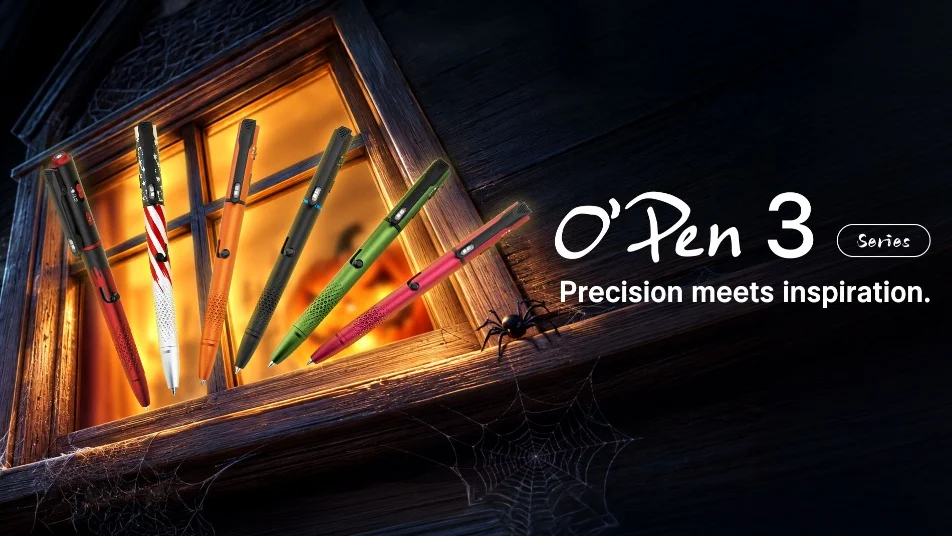
The Olight O'Pen 3 ($79.99, regular price, September 2026; 120 lumens, 14 m, 33.5 g) is a 156 mm aluminum pen with a clip-mounted white light, a red light, a red SOS mode, a 0.4-lumen tip light for writing in the dark and a green laser pointer. According to Olight, a USB-C port fully charges its built-in 130 mAh battery in about an hour.
Olight lists office and job-site use, outdoor use and daily carry for the O'Pen 3, and it isn't sold as a diagnostic penlight. Its best use in a hospital is at the desk or the nurses' station: writing notes, reading a label under the tip light, or finding a dropped cap. Keep its laser switched off around patients, and never point it toward anyone's eyes, animals or aircraft.
The small battery limits runtime. Olight rates the O'Pen 3 at 120 lumens for 14 minutes before it drops to 60 lumens for 25 minutes, 60 lumens for 60 minutes on medium, 20 lumens for 2 hours 20 minutes on low and 2 lumens for 26 hours on moon mode. Charge it between shifts. Olight doesn't list a water rating, and the manual says that if the pen gets wet, you should dry the refill to keep it from rusting, so don't rinse or soak it. For a full rundown of its modes, see our O'Pen 3 feature overview.
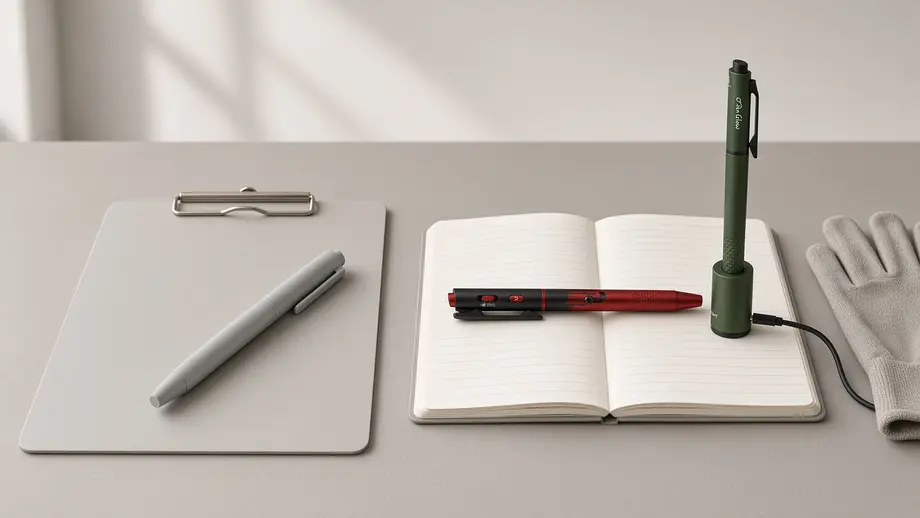
If you'd rather dock a pen on a desk than plug in a cable, the Olight O'Pen Glow ($79.99, regular price, September 2026) charges in its own base. Olight lists a clip light adjustable from 5 to 120 lumens, a 0.2-lumen tip light and a green pointer beam on a separate switch, with an IPX4 rating for the upper part. It carries a laser too, so the same rule applies: use it at the desk or in a presentation, never near a patient's eyes.
Olight i3T 2 EOS: Laser-Free Pocket Light for Charts and Labels
The Olight i3T 2 EOS flashlight ($19.99, regular price, September 2026; 200 lumens, 62 m, IPX8, 41.8 g) is an 89 mm aluminum light with a pocket clip and no laser. It runs on one AAA battery: High gives 200 lumens for 7 minutes, then 100 lumens for 28 minutes, and Low gives 5 lumens for 21 hours.
The useful detail for night rounds is the start mode. The i3T 2 EOS manual says you can set the initial brightness level, and a slight press turns it on momentarily. Set it to start in Low, and a half-press gives you 5 lumens on a pump screen or an IV bag label without lighting the whole room.
It is not an exam penlight. Its 200-lumen High is far too bright for an eye, and the manual warns, "Do not look directly at the light source or shine on the eyes, it may cause temporary blindness or permanent damage to the eyes." Keep it for labels, charts and dark corners, and use your facility's penlight for pupils.
Streamlight Stylus Pro USB: The Benchmark for Inspection Output
The Streamlight Stylus Pro USB (350 lumens, 109 m, IPX4) is a 151 mm anodized aluminum pen light with a gasket-sealed glass lens, a push-button tail switch for momentary or constant light, a removable pocket clip and a holster. Streamlight rates it at 350 lumens and 2,950 candela for 1.5 hours on high and 90 lumens for 3.5 hours on low. Streamlight lists a 1 m impact resistance rating, and the light recharges in 2.5 hours.
Its 350-lumen high mode and 90-lumen low mode are built for inspection, not pupil checks, so keep the beam away from faces. It weighs 51 g, the most of the three lights here with a published weight.
ADC Adlite: Disposable Penlight With a Pupil Gauge
ADC describes the Adlite as a "Disposable diagnostic penlight with a sealed concentric beam" that turns on when you press the pocket clip. It measures 4 1/2 in long and 1/2 in in diameter, comes with its battery, isn't made with natural rubber latex, according to ADC, and is available with or without a pupil gauge. ADC sells it in packages of six and lists single units under a separate model, and it doesn't publish output or runtime.
All Five Pen Lights Compared
Among the five, Streamlight publishes the highest output at 350 lumens, the i3T 2 EOS follows at 200 lumens, the O'Pen 3 reaches 120 lumens, and ADC doesn't publish lumens for either of its penlights. The i3T 2 EOS is the only one rated for immersion (IPX8), and the O'Pen 3 is the only one with a laser.
Here are each maker's published ratings side by side.
| Light | Max output | Beam distance | Power | Length | Weight | Water rating | Other modes | Laser |
|---|---|---|---|---|---|---|---|---|
| ADC Adlite Pro (355BK) | Not published | Not published | 2 × AAA | 5 5/8 in (143 mm) | Not published | Not published | None listed | No |
| Olight O'Pen 3 | 120 lm | 14 m | Built-in 130 mAh, USB-C | 156 mm | 33.5 g | Not listed | Red light, SOS, tip light | Yes, green |
| Olight i3T 2 EOS | 200 lm | 62 m | 1 × AAA (included) | 89 mm | 41.8 g | IPX8 | Low 5 lm | No |
| Streamlight Stylus Pro USB | 350 lm | 109 m | Rechargeable Li-ion pack | 151 mm | 51 g | IPX4 | Low mode, 90 lm | No |
| ADC Adlite | Not published | Not published | Included battery | 4 1/2 in (114 mm) | Not published | Not published | Pupil gauge version | No |
Candela tells you how hard a beam hits what it lands on. The O'Pen 3 manual lists 50 candela, the i3T 2 EOS is rated at 963 candela and Streamlight lists 2,950 candela for the Stylus Pro USB. Divide one by the other (2,950 ÷ 50 = 59) and the Stylus Pro USB puts about 59 times as much light on a target as the O'Pen 3 at the same distance. For a face, that is the wrong direction to go; for a crawl space, it is the right one.
How Long Do Rechargeable Pen Lights Run?
Rechargeable pen lights run from under an hour to more than a day, depending on the mode. Streamlight rates the Stylus Pro USB at 1.5 hours on 350 lumens and 3.5 hours on 90 lumens, while Olight rates the slimmer O'Pen 3 at 60 minutes on 60 lumens and 26 hours on its 2-lumen moon mode.
Published runtimes for the three lights with published runtimes appear below, mode by mode. The i3T 2 EOS runs on a replaceable AAA battery, so its figures are per battery.
| Mode | Olight O'Pen 3 | Olight i3T 2 EOS (per AAA) | Streamlight Stylus Pro USB |
|---|---|---|---|
| Highest | 120 lm for 14 min, then 60 lm for 25 min | 200 lm for 7 min, then 100 lm for 28 min | 350 lm for 1.5 h |
| Middle | 60 lm for 60 min | No middle mode listed | 90 lm for 3.5 h |
| Low | 20 lm for 2 h 20 min | 5 lm for 21 h | No third mode listed |
| Lowest | 2 lm for 26 h | Low is the lowest | No moon mode listed |
| Tip light | 0.4 lm for 26 h | None | None |
| Red light | 10 lm for 1 h 20 min; 5 lm for 2 h 10 min | None | None |
| Battery and charging | Built-in 130 mAh; USB-C, about 1 h to full | 1 × AAA, replace when flat | Li-ion pack; 2.5 h to full |
Battery size explains most of the gap. The O'Pen 3 fits its battery inside a writing pen, so its brightest mode lasts minutes rather than hours. For a light you only switch on for a few seconds at a time, that rarely matters. For long inspections, the Stylus Pro USB's larger pack lasts longer. The i3T 2 EOS and the two ADC penlights avoid charging altogether: you swap a battery instead, though ADC doesn't publish runtimes.
Tip: Keep one spare AAA in your locker if your light takes them. A flat rechargeable pen at 3 a.m. means borrowing a light; a flat AAA light means a quick battery swap.
Are Pen Lights Bright Enough for Inspection?
It depends on the distance. A pen light like the Olight O'Pen 3, rated at 120 lumens with a 14-meter beam distance, handles close work such as reading labels or looking inside a cabinet. For ceilings, crawl spaces or machinery, the Streamlight Stylus Pro USB's 350 lumens and 109-meter rating reach much farther.
This table matches common inspection tasks to the pen light features that matter.
| Task | What matters | Light that fits |
|---|---|---|
| Reading labels or charts in a dim room | Low output you can control | Olight O'Pen 3 moon mode (2 lm) or tip light (0.4 lm); Olight i3T 2 EOS Low (5 lm) |
| Looking inside cabinets, panels or engine bays | About 100 lumens or more in a slim body | Olight O'Pen 3 at 120 lm, or the i3T 2 EOS at 200 lm |
| Checking ceilings, crawl spaces or machinery | Reach and sustained output | Streamlight Stylus Pro USB: 350 lm, 109 m, 1.5 h |
| Working where the light may get wet | A published water rating | Olight i3T 2 EOS: IPX8; Streamlight Stylus Pro USB: IPX4 (splash resistant) |
A pen light and a compact flashlight do different jobs. A pen light clips next to a pen and reaches into tight gaps, while a compact flashlight lights a whole room or a long corridor. If your work regularly calls for more than 350 lumens, compare pocket lights by job in our best flashlights guide.
Can You Wipe a Pen Light With Disinfectant?
Yes, if the disinfectant's label and the maker's care notes allow it. Clean a pen light the way your facility cleans other noncritical equipment. The CDC defines noncritical items as those that "come in contact with intact skin but not mucous membranes" and lists low-level disinfectants for them. Use a disinfectant your facility approves, follow its label, and check the pen light maker's care instructions before wiping.
Whatever brand of wipe you use, follow its label. The CDC notes that "Federal law requires all applicable label instructions on EPA-registered products to be followed," and those instructions cover material compatibility and safe use. Olight's product pages for the O'Pen 3 and i3T 2 EOS don't list approved disinfectants, so ask Olight or your infection prevention team before you use a new cleaning product on either light.
Keep the light from touching the patient. Some medical makers say this outright: Welch Allyn's user manual states that its Professional PenLite "is for general, NON-CONTACT illumination only." If a light does touch mucous membranes, it no longer fits the CDC's noncritical category, which notes that "Semicritical items contact mucous membranes or nonintact skin," so follow your facility's reprocessing policy.
This table turns the CDC categories into what to do with a pen light after each kind of contact.
| What happened | CDC category | What to do with the light |
|---|---|---|
| The light stayed in the air, near the patient | No patient contact; handle like noncritical equipment | Wipe with a facility-approved low-level disinfectant at your unit's usual interval |
| The light touched intact skin | Noncritical | Wipe with a facility-approved disinfectant, following its label contact time |
| The light touched mucous membranes or broken skin | Semicritical | Take it out of use and follow your facility's reprocessing policy, or discard a disposable penlight |
| The light fell on the floor | Not a CDC category | Wipe it before it goes back in your pocket |
Water ratings also limit how you clean. Of the five lights, only the i3T 2 EOS carries an immersion rating (IPX8); the Stylus Pro USB is rated IPX4, and Olight lists no water rating for the O'Pen 3. Wipe them; don't rinse or soak them.
Note: Olight doesn't sell the O'Pen 3 or the i3T 2 EOS as medical devices or for patient examination. Use them for lighting tasks around the patient, and follow your facility's equipment policy for anything that touches a patient.
FAQ
Changelog
- September 25, 2026: First published.