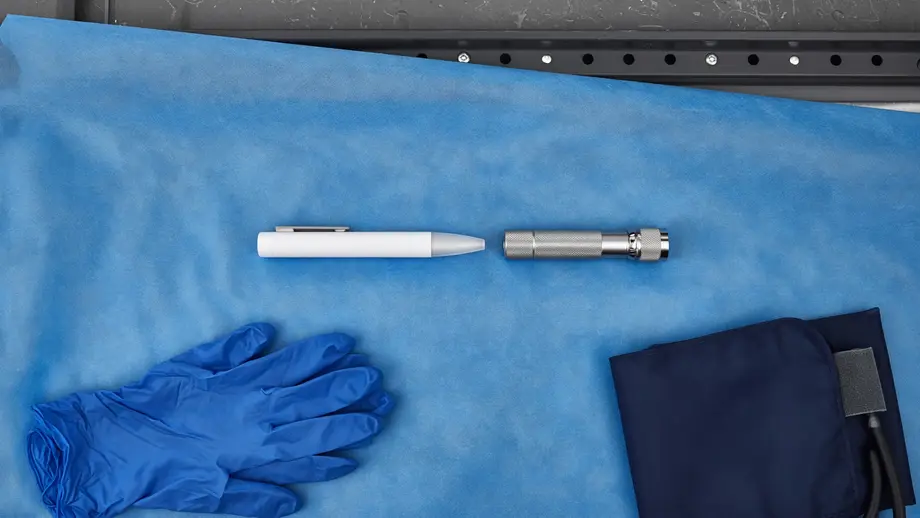
Olight makes some of the lights discussed here. Olight specs and regular prices come from its product pages and user manuals as of September 2026; other sources are linked where they are used. The lux and runtime figures are our own arithmetic from published ratings, not measurements, and nothing here is medical advice.
⚡ TL;DR
A medical penlight is a small, laser-free exam light that puts one concentrated spot on one pupil, one mouth or one patch of skin. In the field, carry two lights: a medical penlight for eyes and mouth, and a separate pocket flashlight for scenes, labels and lines. A phone flashlight does neither job well, because it floods both eyes and wipes clean poorly.
This kit list matches each field job to the kind of light it needs, the minimum spec worth checking and a model that fits. It is the medical penlight setup the rest of this guide explains.
| Use | Recommended type | Key spec floor | Recommended model |
|---|---|---|---|
| Pupil checks | Exam penlight sold for medical use | Single aimable spot, same output every time, no laser | The penlight your agency issues or approves |
| Mouth and throat looks | The same exam penlight, with a tongue blade | Beam you can keep below eye level | The same medical penlight |
| Labels, vials, IV lines, pump screens | Laser-free pocket flashlight on Low | About 5 lumens, no laser, instant on | Olight i3T 2 EOS or Olight i1R 2 Pro on Low |
| Scene, cabinet and vehicle interior | Laser-free pocket flashlight on High | 180 to 200 lumens, IPX8, one-hand switch | Olight i3T 2 EOS |
| Writing a run report in a dark cab | Laser-free pocket flashlight on Low | About 5 lumens, aimed at the page, not at people | Olight i1R 2 Pro or Olight i3T 2 EOS on Low |
| Backup power | Spare cell or a charge plan | AAA spare, or USB-C cable in the rig | AAA for the i3T 2 EOS; USB-C for the i1R 2 Pro |
📋 Table of Contents
- 1. What Is a Medical Penlight Used For?
- 2. Why a Phone Flashlight Falls Short for Patient Checks
- 3. What Makes a Good Pupil Check Light?
- 4. Oral and Throat Checks: Why Spot Shape Matters
- 5. Does Color Rendering Matter When You Judge Skin Color?
- 6. How Do You Clean a Penlight Between Patients?
- 7. Choosing an EMS Flashlight: Where an Olight Pocket Light Fits
- 8. What Is the Best Penlight for Medicine?
- 9. What Is the Best Light Pen for Doctors?
- 10. Rules and Standards Behind These Checks
- 11. Before Your Next Shift: A Medical Penlight Checklist
- 12. Scope of This Guide
- 13. FAQ
What Is a Medical Penlight Used For?
A medical penlight is used to light a small area during a physical exam: pupil size and reaction, eye movement, the mouth and throat, and skin. The FDA's rule for a battery-powered medical examination light describes a device "used to illuminate body surfaces and cavities during a medical examination." That is the job in one line.
EMS training treats the penlight as standard kit. The National Registry of Emergency Medical Technicians' EMT psychomotor examination users guide (Maine EMS version) lists a "Penlight" in the equipment for both the trauma and the medical patient assessment stations, alongside examination gloves, a blood pressure cuff and a stethoscope.
Nursing textbooks describe the same checks in plain steps. Open RN's Nursing Skills chapter on assessing cranial nerves tells the nurse to "Stand 1 foot in front of the patient" for eye movement. For pupils, it says to "Dim the lights of the room before performing this test," then "approach the patient from the side, and shine the penlight on one pupil." If you want the wider picture of which jobs carry a pen light and why, that guide covers nurses, EMTs and the trades.
What an exam penlight is not: a flashlight for the scene. It lights a pupil at one foot, not a driveway or a car interior. That split is why the kit above has two lights, and why a small laser-free pocket light from the EDC flashlights category earns the second slot.
Why a Phone Flashlight Falls Short for Patient Checks
A phone flashlight falls short in three ways. Its wide beam comes from the back of a large slab, so it is hard to light one pupil without lighting both. Its brightness is a slider with no marked levels, so two checks are hard to match. And its maker limits which disinfectants you may use on it, which clashes with wiping a light between patients.
The first problem is aim. Pupils react to light in both eyes at once. StatPearls' chapter on the pupillary light reflex explains that because of crossing nerve fibers, "there is not only a direct pupillary reflex but also a consensual pupillary light reflex." A light that spills into both eyes blurs the direct and consensual responses you are trying to compare.
The second problem is repeatability. Apple's flashlight support page says you change brightness by pressing and holding the flashlight control and dragging a slider up or down, and newer Pro models can also change the beam's width and length. That is flexible, but the slider has no numbered stops. Two checks ten minutes apart can end up at different settings.
The third problem is cleaning. Apple's iPhone cleaning guidance allows a 70 percent isopropyl alcohol wipe, a 75 percent ethyl alcohol wipe or Clorox Disinfecting Wipes, and then says: "Don't use products containing bleach or hydrogen peroxide." If your agency's wipes are bleach or hydrogen peroxide based, the phone is off the list.
There is also a simple workflow cost. The phone is your clock, your protocol app and sometimes your radio backup. Every time it doubles as a penlight, it leaves your hand, touches a patient's space and goes back into your pocket.
What Makes a Good Pupil Check Light?
A good pupil check light puts one small, steady spot on one eye while the room stays dim, gives the same output every time, has no laser, and turns on instantly with a gloved hand. StatPearls describes the technique as pointing "the focal light into one eye" in a room where the lights are dim, "barely allowing you to see the iris and pupil."
Context matters for that advice. The same StatPearls procedure chapter lists "A pocket penlight is inadequate" under equipment and names a Finoff transilluminator with a halogen light, an eyeshield and an ophthalmoscope instead. Open RN's nursing text, by contrast, does the bedside check with a penlight. The practical reading is that a penlight is a screening tool; a detailed eye exam uses better instruments.
In the field, you rarely control the room, and how you adapt the check on scene is a matter for your protocols and training. From a lighting standpoint, the goal in both references is the same: less competing light, and one light brought to one eye. Open RN has the nurse approach from the side and watch the lighted pupil constrict. StatPearls then withdraws the light for a few seconds and stimulates the same eye again while watching the other eye for the consensual response.
Safety note: Olight's general-purpose flashlights are not exam lights. The i1R 2 Pro user manual says, "DO NOT shine the light directly into human eyes," and the i3T 2 EOS manual warns against shining it "on the eyes." Use your exam penlight for pupils, and keep pocket flashlights for everything else.
Here is why that warning is more than fine print. Illuminance equals candela divided by distance squared. Under the ANSI FL1 method, as flashlight maker Peli summarizes it, beam distance is "the distance from the device at which the light beam is 0.25 lux," so candela equals 0.25 times beam distance squared. That lets you check any published beam figure.
Two checks show the math holds. Olight rates the i1R 2 Pro at 48 m, and 0.25 × 48² = 576, within 1 percent of its listed 580 candela. The i3T 2 EOS is rated at 62 m, and 0.25 × 62² = 961, against a listed 963 candela. For the O'Pen 3, which Olight lists at 14 m with no candela figure, the same formula gives 0.25 × 14² = 49 candela.
This table estimates the light each Olight model puts on a target at 30 cm (about 1 ft, the exam distance in Open RN) and 50 cm, assuming candela scales with lumens within one beam.
| Light and mode (Olight rating) | Candela | At 30 cm (1 ft) | At 50 cm (20 in) |
|---|---|---|---|
| i1R 2 Pro High, 180 lumens | 580 (rated) | about 6,444 lux | about 2,320 lux |
| i1R 2 Pro Low, 5 lumens | about 16 (estimated) | about 179 lux | about 64 lux |
| i3T 2 EOS High, 200 lumens | 963 (rated) | about 10,700 lux | about 3,852 lux |
| i3T 2 EOS Low, 5 lumens | about 24 (estimated) | about 268 lux | about 96 lux |
| O'Pen 3 High, 120 lumens | about 49 (from 14 m) | about 544 lux | about 196 lux |
| O'Pen 3 Moon, 2 lumens | about 0.8 (estimated) | about 9 lux | about 3.3 lux |
Read the High rows against the O'Pen 3. At one foot, the i3T 2 EOS on High delivers roughly 20 times the light of a 120-lumen pen light (10,700 ÷ 544 ≈ 19.7), because its optic packs 4.8 candela into each lumen (963 ÷ 200) against about 0.41 for the O'Pen 3's clip light (49 ÷ 120). A pocket flashlight's tight, intense spot is useful across a room and wrong for an eye at one foot.
Phones don't appear in the table for a reason: Apple's flashlight support page doesn't list a lumen or candela rating for the iPhone flashlight, so there is no published figure to calculate from.
Oral and Throat Checks: Why Spot Shape Matters
For a mouth and throat look, you want a spot about the size of the open mouth, aimed from below eye level, so light reaches the back of the throat without flooding the patient's face. A broad beam lights the cheeks and eyes. A tight, intense spot creates glare off wet surfaces. An exam penlight with a tongue blade sits between the two.
Open RN's steps show what the light has to reach. It tells the nurse to "Ask the patient to open their mouth and say 'Ah'," then note the symmetry of the palate and check that the uvula and tongue sit midline. For the gag reflex, it uses "a cotton swab or tongue blade to touch the patient's posterior pharynx." Every one of those targets sits deep in a small, wet cavity.
The exam technique itself comes from your training. On the lighting side, three habits make the light work better:
- Hold the penlight low, near the chin, and tilt it up into the mouth. The beam then travels away from the eyes.
- Keep the tongue blade in your other hand, so the light hand never has to reposition mid-look.
- If glare bounces off saliva, move the light a few inches back instead of angling it harder. Distance softens the spot; angle only moves the glare.
A general-purpose pocket flashlight is a poor substitute here, for the same reason as at the eye: its spot is intense and its manual warns against shining it at eyes, which sit just above the mouth. Keep it for the tasks in the next sections.
Does Color Rendering Matter When You Judge Skin Color?
Yes. Color rendering describes how faithfully a light shows colors, and it matters whenever you judge the color of skin, lips, nail beds or mucous membranes. A cool-white light with modest color rendering can shift reds and pinks. When a color call matters, do not rely on a small cool-white spot alone; look again under broader, better light, such as daylight, and follow your protocol for the assessment itself.
The U.S. Department of Energy's fact sheet on LED color characteristics explains the scale. It says a source with a CRI "in the 70s would be considered acceptable for interior applications, whereas the 80s would be considered good and the 90s excellent." It adds that the strong red sample, R9, "is especially pertinent since the rendition of saturated red is particularly important for the appearance of skin tones."
Now apply that to the lights in this guide. Olight's user manuals list CRI 70 for the i3T 2 EOS (cool white, 5,700~6,700K) and CRI 70 for both the O'Pen 3's clip light (6500 K) and tip light (5000 K). Olight lists the i1R 2 Pro only as "High Performance Cool White LED," with no CRI figure. None of them is a color-accurate light by the DOE's scale.
That is fine for reading a vial label or tracing an IV line, where contrast matters more than hue. It is not fine for deciding whether a patient looks pale or blue. The same DOE fact sheet warns that two sources with the same color temperature and CRI "may not render colors the same way," so no spec sheet replaces a second look under better light.
Note: Color temperature is not the same as color rendering. A Kelvin figure tells you whether the light looks warm or cool; CRI tells you how accurately it shows the colors of the things it lights.
How Do You Clean a Penlight Between Patients?
Wipe it with your agency's approved disinfectant after each patient contact, following the product label's wet contact time, then let it dry. A penlight that touches only intact skin falls under what the CDC calls noncritical items; one that touches mucous membranes or broken skin does not. Choose a light with a sealed body and a published water rating, because liquid in seams and switches is where cleaning fails.
The CDC's Guideline for Disinfection and Sterilization in Healthcare Facilities defines noncritical items as "those that come in contact with intact skin but not mucous membranes," with blood pressure cuffs and crutches among its examples. The same guideline puts items that "contact mucous membranes or nonintact skin" in the stricter semicritical category, so a light that touches the lips, the mouth or a wound needs your agency's policy, not just a quick wipe. For noncritical items, it lists low-level disinfectants and notes that "Federal law requires all applicable label instructions on EPA-registered products to be followed."
OSHA's bloodborne pathogens standard, 29 CFR 1910.1030, adds a workplace rule. It says equipment that may become contaminated with blood or other potentially infectious materials "shall be examined prior to servicing or shipping and shall be decontaminated as necessary." A penlight that touched a bloody glove belongs in that category until it is cleaned.
Water ratings tell you how much wiping a light can take. The IEC's ingress protection page explains that the second numeral of an IP code rates protection against liquids "from 0 (no protection) to 9 (high-pressure hot water from different angles)." Olight's manuals rate both the i1R 2 Pro and the i3T 2 EOS at IPX8 to 1.5 m. Olight lists no water rating for the O'Pen 3, and its manual says to dry the refill if the pen gets wet.
This table turns those rules into a cleaning plan for each light in the kit.
| Light | Water rating (Olight or maker) | Cleaning approach | Watch out for |
|---|---|---|---|
| Exam penlight | Check the maker's instructions | Wipe per your agency's disinfectant label | Confirm the maker allows your agency's disinfectant |
| Olight i1R 2 Pro | IPX8, 1.5 m | Wipe the body and lens, keep the charging joint closed | Twist the tailcap fully closed before wiping; it opens to reveal the USB-C port |
| Olight i3T 2 EOS | IPX8, 1.5 m | Wipe the body, lens and tail switch | Olight's manual says not to immerse it in seawater or other corrosive media, so wipe rather than soak |
| Olight O'Pen 3 | No rating listed | Wipe only, away from the refill and port | Keep it out of patient care entirely because of its laser |
| Phone | Maker's guidance | 70 percent isopropyl, 75 percent ethyl or the wipes Apple names | Apple says no bleach or hydrogen peroxide products |
Tip: Olight does not publish chemical compatibility data for its flashlight finishes. If your agency's disinfectant is strong, test a wipe on the clip or tail first, and replace any light whose lens clouds or whose seals stiffen.
Choosing an EMS Flashlight: Where an Olight Pocket Light Fits
An Olight pocket light fits the non-diagnostic half of EMS lighting: finding the address number, checking under a seat, reading a vial or expiration date, tracing an IV line to the pump, and lighting a dressing site on an arm or leg with the beam kept below the face. It does not replace the exam penlight for eyes and mouth.
For that role, look for four things in an EMS flashlight: no laser, a low mode near 5 lumens, a one-hand switch that works with gloves on, and a sealed body you can wipe. The two Olight lights below meet all four in different ways. Neither is a medical device.
Olight i3T 2 EOS: one-hand switch, AAA power
The Olight i3T 2 EOS flashlight ($19.99 regular price, September 2026) runs on one AAA battery, which is its biggest field advantage: a spare weighs next to nothing and fits any glove pocket. Olight also lists 10440 lithium-ion cells as compatible, and the manual adds AAA NiMH.
Its two modes are High at 200~100 lumens for 7 + 28 minutes and Low at 5 lumens for 21 hours. It is rated at 963 candela, 62 m and IPX8, weighs 1.47 oz (41.8 g) with the battery and is 3.5 in (89 mm) long. The tail switch clicks on, and a light press gives momentary light, which suits a quick look with gloves on.
The manual explains how to set the starting brightness, so you can make Low come on first and avoid 200 lumens in a dark bedroom. Its limits: cool white at CRI 70, no red mode, and a working temperature of 0~40°C, so a winter night on a cold rig is outside its rated range.
Olight i1R 2 Pro: the lightest option on a key ring
The Olight i1R 2 Pro keychain light ($21.99 regular price, September 2026) weighs 0.78 oz (22 g) and is 2.02 in (51.3 mm) long, small enough to live on a rig key ring. Olight rates it at 180 lumens on High for 23 minutes and 5 lumens on Low for 12 hours, with 580 candela, 48 m and IPX8.
It uses a CSP LED behind a TIR optic lens and a built-in 3.7V 130mAh 10220 battery that charges over USB-C with the included USB A-C cable. There is no switch: per the manual, you slightly tighten the tailcap for Low, fully tighten it for High, and twist it back to turn off.
That twist is also its main limitation. It takes two hands, which is awkward when one hand holds a patient's arm or a clipboard. It has no replaceable cell, so it needs a charge plan. If one-hand use matters more than weight, pick the i3T 2 EOS.
Will one light last a shift?
Yes, for a light workload, if you save High for the moments that need it. This table uses an example shift of 10 calls, not a measurement: 90 seconds of High per call for scene, cabinet and dressing-site looks, and 3 minutes of Low per call for labels and lines.
| Task per shift (example) | Mode | Light-on time | i1R 2 Pro share of rated runtime | i3T 2 EOS share of rated runtime |
|---|---|---|---|---|
| Scene, cabinet and dressing-site looks, 10 × 90 s | High | 15 min | 15 ÷ 23 min ≈ 65% | 15 ÷ 35 min (7 + 28) ≈ 43% |
| Labels, vials and IV lines, 10 × 3 min | Low, 5 lumens | 30 min | 30 ÷ 720 min ≈ 4% | 30 ÷ 1,260 min ≈ 2% |
| Total | Both | 45 min | about 69% of a charge | about 45% of one AAA |
The i1R 2 Pro finishes that shift with about 31 percent left, so charge it at the end of every shift. The i3T 2 EOS covers about two such shifts per AAA (100 ÷ 45 ≈ 2.2), so carry one spare. This math treats each mode's rated runtime as a share of the battery. Step-downs and cold weather will change it, so use it as a planning estimate.
What Is the Best Penlight for Medicine?
The best penlight for medicine is a laser-free exam light made and sold for that purpose, with one steady output, a spot you can aim at a single pupil, a body you can disinfect, and ideally a printed pupil gauge. Your agency's or facility's approved model comes first, because it matches your protocols and your cleaning products.
Exam penlight makers design for exactly that narrow job. MDF Instruments, for example, says in its penlight FAQ that its penlights "are not adjustable or dimmable, but use a warm LED light for safe eye examination," that they run on 2 AAA batteries, and that its LUMiNiX II "features a pupil gauge reference and ruler on the side of the penlight."
Use this checklist when you choose one:
- Laser-free: no pointer of any class.
- Fixed, repeatable output: the same light for the first check and the tenth.
- One aimable spot: enough to light one pupil without flooding the other eye.
- Replaceable or rechargeable power you can manage: AAA spares or a charger in the rig.
- A gauge: printed pupil sizes help you describe what you see.
- A cleanable body: smooth barrel, sealed switch, a clip that won't trap debris.
A flashlight-maker's pocket light can score well on power and water rating and still fail the first three points, which is why it belongs in the second slot of the kit.
What Is the Best Light Pen for Doctors?
For patient care, the best light pen for doctors is a plain laser-free penlight carried next to an ordinary pen. Pen-and-light combinations with a green laser are useful for charting and presentations, but a laser has no place near a patient's eyes. A laser pen belongs in an office or lecture hall, not in the rig or a uniform pocket.
The FDA's consumer guidance on laser pointers warns that "The light energy from a laser pointer aimed into the eye can be more damaging than staring directly into the sun." Its advice is direct: "Never aim or shine a laser pointer at anyone."
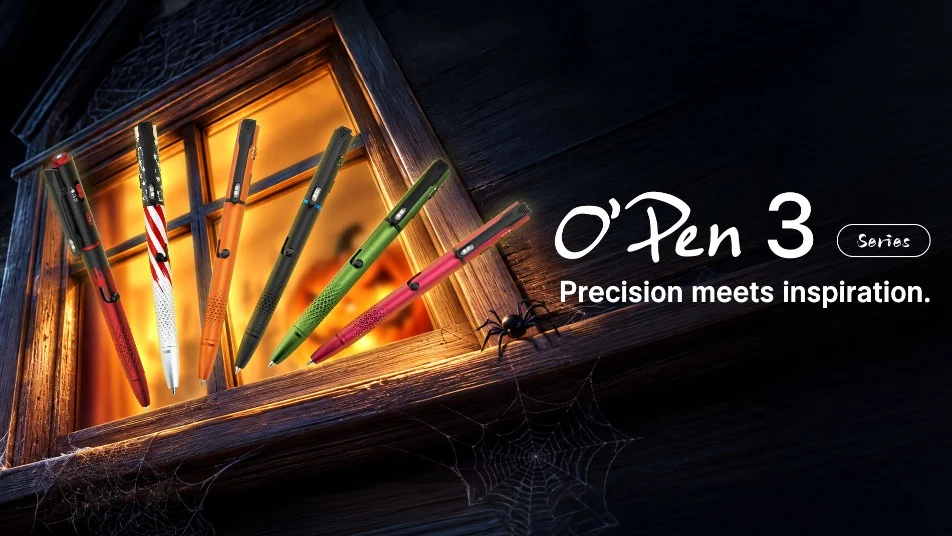
The Olight O'Pen 3 pen light ($79.99 regular price, September 2026) shows both sides of that trade-off. It writes, and its clip light runs High 120~60 lumens for 14 + 25 minutes, Medium 60 lumens for 60 minutes, Low 20 lumens for 2 hours 20 minutes and Moon 2 lumens for 26 hours. Its red light gives 10 lumens for 1 hour 20 minutes or 5 lumens for 2 hours 10 minutes, with a red SOS mode.
Its 0.4-lumen tip light runs 26 hours, which is handy for writing in a dim office or lecture hall. It also carries a green laser that Olight lists as Class 3R at no more than 5 mW for 3 hours and Class 1R at no more than 0.39 mW for 7.5 hours; the manual says the Class 3R version starts on High when the laser is selected.
That is why the O'Pen 3 is not an exam penlight, and we do not recommend it for patient care or for an EMS or nursing kit. It suits office, classroom and presentation work. Olight's O'Pen Glow also has a green pointer beam, so the same rule applies. For the exam, carry the laser-free penlight your agency approves.
Rules and Standards Behind These Checks
No single rule names a lumen figure for an exam penlight. Instead, federal device rules define what an exam light is, FDA guidance keeps lasers away from people, CDC and OSHA set the cleaning expectations, and EMS training and scoring tools show why pupil findings must be repeatable. Together, they explain the two-light kit.
This table turns each source into something you can act on with the lights in your pocket.
| Rule or source | What it says | What to do with your lights |
|---|---|---|
| FDA, 21 CFR 880.6350 | A battery-powered medical examination light is "used to illuminate body surfaces and cavities during a medical examination"; Class I, exempt from premarket notification within stated limits | Use a light sold as an exam light for exams; a general flashlight isn't sold as one |
| FDA laser pointer guidance | "Never aim or shine a laser pointer at anyone." | No laser pen lights at the patient's side |
| CDC disinfection guideline (Spaulding categories) | Noncritical items touch intact skin; follow EPA-registered label instructions | Wipe the penlight between patients with your approved product |
| OSHA 29 CFR 1910.1030 | Potentially contaminated equipment must be examined and decontaminated as necessary | Treat a penlight touched by bloody gloves as contaminated until cleaned |
| NREMT EMT psychomotor guide | Lists a penlight for the trauma and medical assessment stations | Keep a real penlight in the kit, not just a phone |
| Glasgow Coma Scale, GCS-P | Pupil reactivity is scored and subtracted from the GCS total | Pupil findings get recorded, so use a light that gives the same stimulus every time |
| IEC IP code | Second numeral rates liquid protection from 0 to 9 | Check a light's water rating before you wipe it wet |
The Glasgow Coma Scale's official site explains the GCS Pupils Score: a Pupil Reactivity Score of 2 when both pupils are unreactive to light, 1 for one pupil and 0 for neither, subtracted from the GCS total (GCS-P = GCS - PRS). It adds that GCS-P "is not intended to replace the role of separate assessment and reporting" of each component, so you still record the pupils themselves.
Warning: This guide describes lighting tools only. It does not tell you how to interpret a pupil, mouth or skin finding. Follow your agency's protocols, your medical director's guidance and your training for every assessment.
Before Your Next Shift: A Medical Penlight Checklist
Before your next shift, confirm you have two lights and a plan for each: a laser-free medical penlight for eyes and mouth, and a sealed pocket flashlight for everything else, both clean and powered. Then check the habits that make each light useful. The list below takes about two minutes at the rig.
- Exam penlight: it turns on, the output looks the same as last shift, and the pupil gauge is readable.
- No lasers: any pen light with a laser stays at the station, not in your uniform pocket.
- Pocket flashlight: Low comes on first, and you can switch it with gloves on. The electrician flashlight comparison covers when a hands-free light beats a handheld one.
- Power: a spare AAA for the i3T 2 EOS, or the i1R 2 Pro charged at the end of the last shift.
- Cleaning: both lights wiped with your approved product after every patient, lens included.
- Color calls: judge skin and lip color under the broadest light available, not a cool-white spot.
- Pupils in bright surroundings: reduce competing light as your protocol allows, then bring the exam penlight in from the side.
Scope of This Guide
This guide covers the lighting tools EMS providers carry, not clinical decisions. It explains what each light can and cannot do, using official product ratings, federal rules and published nursing and medical references. Where a figure is our own arithmetic, the text says so. For any assessment, your protocols and training take priority over anything written here.
A few boundaries are worth stating plainly. The lux figures above are calculations from rated candela, not light-meter readings. The shift budget uses an example workload. Olight's flashlights and pen lights are general-purpose products, and their manuals warn against shining them into eyes. None of the Olight products named here is a medical device.
FAQ
Changelog
- September 23, 2026: First published.