Olight makes some of the lights discussed here. Olight specs and regular prices come from its US product pages and user manuals as of September 2026. Weight shares, beam angles and illuminance figures are our arithmetic on published numbers, not field measurements.
⚡ TL;DR
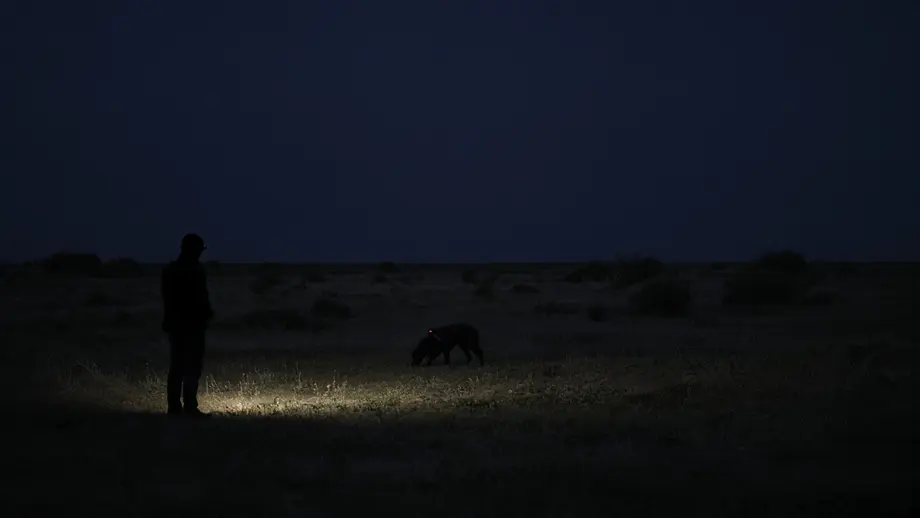
The best dog training light at night goes on the dog, not in its eyes. Dogs see far better than people in dim light, so the handler is the one who needs help: a small, steady marker on the dog's back, a low floodlight on your own head aimed at the ground, and one long-reach light for a dog that has gone out of sight.
Anyone who has worked a dog after dark knows the two failures. The dog swings back toward you, your headlamp hits it in the face, and it stops working to stare at the glare. Or it moves 30 feet out on the line, drops its head into the grass and disappears. Add a second dog, rain and a creek, and lights start falling off or dying mid-session.
This table is the short version of a dog training light at night kit, with one Olight option per job at its regular price as of September 2026.
| Job | Recommended type | Minimum spec | Olight option (regular price) |
|---|---|---|---|
| Marker on the dog, dry ground | Clip light on the back strap, red | About 4 lm, 5 h or more, 30 g or less, lockout | Olight Oclip: red 4 lm for 5 h, 30 g ($29.99) |
| Marker on the dog, wet work | Sealed twist light on a D-ring | Immersion rating, no button to bump | Olight i1R 2 Pro: Low 5 lm for 12 h, IPX8, 22 g ($21.99) |
| Handler, hands-free | Tilting clip light on a cap brim | 10 lm flood, dim red, 20 h or more at Low | Olight Oclip 2 Pro: flood 10 lm for 25 h, red 4 lm for 27 h ($54.99) |
| Finding a dog out of sight | Long-throw handheld | Over 1 lux at 100 m on a sustained level | Olight Marauder Mini with RGB: 90,000 cd spotlight ($199.99) |
| Passive visibility | Reflective strips | Back and both sides of the dog | Reflective tape or vest |
📋 Table of Contents
- 1. Quick Answer: What Is the Best Dog Training Light at Night?
- 2. Can Dogs See in the Dark?
- 3. Does Light Bother Dogs at Night?
- 4. What Light Do You Put on a Hunting Dog?
- 5. Where Should You Aim Your Headlamp So You Don't Blind the Dog?
- 6. Multi-Dog Color Codes: Telling Two or Three Dogs Apart
- 7. Does Light Affect a Tracking Dog's Nose? Evidence vs Lore
- 8. Finding a Dog at 100, 200 and 300 Meters
- 9. Light Settings by Session Type
- 10. Water, Mud and Knocks: What Dog-Worn Lights Go Through
- 11. Night Tracking Rules: Leashes, Permits and Lights
- 12. A Handler-and-Dog Lighting Setup That Works
- 13. Your Night Session Checklist
- 14. FAQ
Quick Answer: What Is the Best Dog Training Light at Night?
The best dog training light at night is a pair of lights with separate jobs. Put a dim marker, about 4 lumens of red, on the dog's back so you can see where it is. Wear a low white floodlight yourself, aimed at the ground between you and the dog, never at its head. Carry one long-throw light for searches beyond 100 m.
A tracking dog light is really for the handler. Dogs need little light to move; you need a reference point to follow them, and a marker gives you one without lighting the dog's world. A thrower like the ones Olight groups under hunting flashlights covers the rare moment when the dog is out of sight.
For a short leash in town, see our best headlamp for dog walking guide; on rural roads, the advice on flashlights for walking at night applies to you. This guide is for work: tracking lines, hound casts and multi-dog sessions.
Can Dogs See in the Dark?
Dogs see much better than people in dim light, but not in total darkness. Their retinas are rich in rods, the cells that work in low light, and most dogs have a reflective layer behind the retina that gives light a second pass. The trade-off is color and detail: dogs see fewer hues and less sharply than people do.
The AKC's guide to whether dogs can see in the dark says, "Rods gather dim light, which enables better night vision." It calls the tapetum "a special layer of reflective cells behind the retina," and notes that "Some dogs, most commonly those with blue eyes, don't have a tapetum."
The standard veterinary review is "Vision in dogs" by Paul Miller and Christopher Murphy in the Journal of the American Veterinary Medical Association (1995, volume 207, pages 1623 to 1634). It reports that "the central 25° of the retina in dogs consists predominantly of rods," where people have mostly cones.
This table lines up the differences that matter on a night session and what each means for your lights.
| Trait (source) | Dog | Person | What it means for your lights |
|---|---|---|---|
| Central retina (JAVMA) | Mostly rods | Mostly cones | The dog works in light you find too dark |
| Rhodopsin recovery (JAVMA) | Over an hour after extensive bright exposure | Faster | Long bright exposure costs the dog more night vision |
| Flicker fusion (JAVMA) | About 70 Hz by ERG; 70 to over 80 Hz in a behavioral study | About 50 to 60 Hz | Dogs can see flicker you may miss |
| Color (JAVMA) | Dichromatic | Trichromatic | Color codes on markers are for you |
On motion, the review cites a 1936 study of 14 police dogs in which "the most sensitive dogs could recognize moving objects at a distance of 810 to 900 m, but could recognize the same object, when stationary, at a distance of only 585 m or less." One old study, but it supports a habit: keep your beam still while the dog works.
Does Light Bother Dogs at Night?
Bright light aimed at a dog's eyes can interrupt its night vision and pull its attention, so treat the dog's face as off-limits. Research shows dogs recover dark adaptation slowly after long, bright exposure. It does not show that a dim marker or a low floodlight on the ground harms dogs, and we found no study of glare on working dogs.
The JAVMA review says dog rhodopsin, the pigment rods use in dim light, "takes over an hour to completely regenerate after extensive exposure to bright light." Note "extensive exposure": the paper does not measure a brief flashlight flick, so the cautious reading is only that long bright exposure is slow to undo.
Attention is the second issue. AKC chief veterinary officer Dr. Jerry Klein is quoted saying, "Dogs have a higher flicker fusion threshold than humans." A strobe or swinging beam is visual noise in a scent job.
Safety note: The Oclip manual says, "Do not look directly at the light source or shine it into your eyes, as this may cause temporary blindness or permanent damage to your eyes." The warning is written for people; we apply the same rule to dogs and keep every beam below their heads.
What Light Do You Put on a Hunting Dog?
Put a small, dim, sealed light on the dog's back, where you can see it from behind and the dog cannot chew it or see it. A red or white marker of about 4 to 5 lumens is enough to follow a dog on a line. Keep it small (the markers here weigh under 0.5% of even a 16 lb Dachshund), lock the switch and add reflective strips.
That is the catch with a hunting dog collar light: it sits by the eyes and mouth and lights the grass in front of the nose; a back-strap light sits behind the head, out of reach of teeth. The AKC Tracking Regulations (amended to July 1, 2023) already require a pliable body rig with the line attached on top, so there is a natural place to clip a marker.
Reflective material is the backup that never runs flat. The AKC's guide to choosing a dog collar lists reflective stripes and says, "These elements promote both your and your dog's safety while walking at night or in dark areas." Put strips on the sides too, so your beam catches a dog standing broadside.
No agency publishes a weight limit for dog-worn lights, so this table divides each light's rated weight by the low end of the AKC breed standard (1 lb = 453.6 g), based on Olight's ratings, not weighed on dogs. The last column scales the Oclip's share to an 80 kg person.
| Dog (AKC standard, low end) | i1R 2 Pro, 22 g | Oclip, 30 g | Oclip 2 Pro, 75.5 g | Oclip share on an 80 kg person |
|---|---|---|---|---|
| Standard Dachshund, 16 lb (7,258 g) | 0.30% | 0.41% | 1.04% | 331 g |
| Beagle, 13 to 15 in, 20 lb (9,072 g) | 0.24% | 0.33% | 0.83% | 265 g |
| Labrador Retriever, female, 55 lb (24,948 g) | 0.09% | 0.12% | 0.30% | 96 g |
| Bloodhound, female, 80 lb (36,288 g) | 0.06% | 0.08% | 0.21% | 66 g |
Worked example: 30 ÷ 7,258 = 0.41%, and 0.0041 × 80,000 g = 331 g. Breed weights come from the AKC pages for the Dachshund, Beagle, Labrador Retriever and Bloodhound. The small markers stay far below 1%; the 75.5 g Oclip 2 Pro passes 1% on a Dachshund, one reason it belongs on the handler. Fix any marker flat so it cannot swing or snag.
Where Should You Aim Your Headlamp So You Don't Blind the Dog?
Aim the brightest part of your beam at the ground about 3 m ahead of your feet, not at the dog. With the dog 20 to 40 feet out on a line, aiming at its feet puts its eyes only 1 to 5 degrees above the center of your beam. Aiming at the ground 3 m ahead moves its eyes 16 to 23 degrees away.
The AKC Tracking Regulations say "The leash will be between twenty (20) and forty (40) feet in length," and the handler follows at "no less than twenty (20) feet" in most tests: 6.1 m to 12.2 m. We assume a head-worn light at 1.6 m and the dog's eyes at 0.3 m nose-down or 0.6 m with the head carried about level with the shoulder (the AKC standard puts a male Labrador's shoulder at 22.5 to 24.5 inches). Measure your own heights and redo the sums.
The angle below horizontal is arctan(height difference ÷ distance). This table shows where the dog's eyes sit relative to two aiming choices, based on those assumptions.
| Dog distance | Angle to feet | Eyes, head up (0.6 m) | Eyes, nose down (0.3 m) | Eyes above beam center, aiming at feet | Eyes above beam center, aiming 3 m ahead (28.1°) |
|---|---|---|---|---|---|
| 20 ft (6.1 m) | arctan(1.6 ÷ 6.1) = 14.7° | arctan(1.0 ÷ 6.1) = 9.3° | arctan(1.3 ÷ 6.1) = 12.0° | 5.4° and 2.7° | 18.8° and 16.0° |
| 40 ft (12.2 m) | arctan(1.6 ÷ 12.2) = 7.5° | arctan(1.0 ÷ 12.2) = 4.7° | arctan(1.3 ÷ 12.2) = 6.1° | 2.8° and 1.4° | 23.4° and 22.0° |
Olight does not publish beam angles, so the eyes may still sit inside the beam, just well away from its brightest part. Keep output low too: 10 lumens of flood shows the line and your footing.
A tilting head holds the angle for you. On a cap brim, the Olight Oclip 2 Pro pairs "a 115° head tilt with 360° clip rotation," and Olight says, "Set the angle once and it holds."
Tip: When the dog turns and comes back toward you, drop your chin or switch to red. Let the marker on its back tell you where it is.
Multi-Dog Color Codes: Telling Two or Three Dogs Apart
Code each dog with a different color and pattern, such as steady red, slow-blink red and steady low white. Pattern matters more than color, because rain, fog and color-deficient eyes blur colors but not blink rates. The code is for you: dogs are dichromatic and cannot tell red from green anyway.
The JAVMA review notes dogs' "inability to differentiate among middle to long wavelengths of light, which appear to people as green, yellow-green, yellow, orange, or red." People vary too. The AKC's page on whether dogs can see color says "As many as 8 percent of men and 0.5 percent of women with Northern European ancestry have red-green color blindness." On a crew of four men, taking 8%, the chance at least one is color deficient is 1 − 0.92⁴ = 28%. A red-versus-green code can fail that person; steady versus blinking does not.
This table is a three-dog code built from modes Olight lists for two small lights.
| Dog | Marker | Mode | Pattern you see | Rated runtime |
|---|---|---|---|---|
| Dog 1 | Oclip | Red, constant | Steady red | 5 hours at 4 lm |
| Dog 2 | Oclip | Red blink (Red Strobe listed at 1 Hz, 4 lm) | One red flash per second | Not listed |
| Dog 3 | i1R 2 Pro | Low | Steady white, 5 lm | 12 hours (to 50% of initial output) |
The Oclip manual says: "In the red light mode, press and hold for more than 0.5 seconds to switch to red light blink." Skip its white strobes on a dog: the White Strobe runs at 13 Hz and the Signal Strobe at 0.33 Hz, both at 300 lumens.
Does Light Affect a Tracking Dog's Nose? Evidence vs Lore
The research says light makes little difference to scenting. In a 2003 study of explosives detection dogs, light or its near absence made no measurable difference to detection. A 2023 food-search study found dogs chose more accurately in the dark. We found no research behind claims that a beam color "helps the nose."
Irit Gazit and Joseph Terkel of Tel Aviv University worked six sniffer dogs under "virtually dark (very low light intensity) and full light conditions." Their abstract in Applied Animal Behaviour Science, listed in the university's research portal, concludes that "neither the presence nor the virtual absence of light was demonstrated to differentially affect the dogs' detection ability."
Khan and colleagues, in a 2023 Scientific Reports study available through PubMed Central, had pet dogs find a hidden treat among three choices. Dogs "performed with higher accuracy (p < 0.0001) and were less likely to show biased selection strategy (p < 0.01) in the dark-phase than light-phase." That was an indoor food search, not a track in the woods.
So train at night as you do by day, keep light off the ground ahead of the dog's nose, and treat red as dim, not invisible: dogs lump red with green and yellow. The dog does not need a colored light to find blood; you may, when you confirm a find. Our guide to the blood light for hunting covers that side.
Finding a Dog at 100, 200 and 300 Meters
To find a dog beyond your floodlight you need candela, not lumens. At 200 m, a 90,000-candela spotlight puts 2.25 lux on the target at full output, based on Olight's rated figures, not measured. At a 200-lumen level it is 0.5 lux, still above the 0.25 lux the flashlight standard uses to define beam distance.
Illuminance is candela divided by distance squared. The Olight Marauder Mini with RGB spotlight is rated at 90,000 candela and 600 m at 900 lumens; for lower levels we scale candela by the level's share of 900 lumens, assuming the beam keeps its shape. Streamlight's ANSI/PLATO FL1 summary defines beam distance as "The distance from the device at which the light beam is 0.25 lux." The Marauder Mini manual cites ANSI/NEMA FL 1-2009; the current edition is FL 1-2025.
This table shows estimated illuminance on a dog at three distances, based on Olight's rated candela and lumens, not measured.
| Spotlight level (Olight rating) | Estimated candela | Lux at 100 m | Lux at 200 m | Lux at 300 m | Distance to 0.25 lux |
|---|---|---|---|---|---|
| Level 7, 900 lm (first 10 min) | 90,000 | 9.0 | 2.25 | 1.0 | 600 m (rated) |
| Level 3, 200 lm (11.5 h) | 90,000 × 200 ÷ 900 = 20,000 | 2.0 | 0.5 | 0.22 | about 283 m |
| Level 1, 50 lm (43.5 h) | 5,000 | 0.5 | 0.125 | 0.056 | about 141 m |
Worked example: Level 3 at 300 m is 20,000 ÷ 90,000 = 0.22 lux; the last column is √(candela ÷ 0.25). Level 3 covers a 200 m search for 11.5 hours. Move the beam off the dog's head as soon as you find it. If a dog slips its collar and does not return, switch to a search plan; our guide on how to find a lost pet at night covers the method.
Warning: Sweeping a spotlight across a field can fall under shining rules even with no weapon. Michigan's deer digest, quoted below, says you cannot use an artificial light "to locate wild animals at any time during November and all other days of the year between 11 p.m. and 6 a.m." Check your state's artificial-light rules before you search open ground, even for your own dog.
Light Settings by Session Type
Sessions differ in light level, runtime and water exposure. Yard obedience needs almost nothing; a hound cast along a creek needs all-night runtime and lights that survive a dunking. Match your marker and handler light to the wettest, longest session you run, not the easiest one.
This table gives suggested settings for four session types, built from the Olight modes in this guide.
| Session type | Dog marker | Handler light | Runtime to plan for | Water exposure |
|---|---|---|---|---|
| Yard or field obedience | Red, 4 lm | Flood 10 lm; red 4 lm for the lead | 1 hour | Dew, light rain |
| Tracking line, 20 to 40 ft | Red, 4 lm on the back strap | Flood 10 lm aimed 3 m ahead | 3 hours or more | Wet grass and brush |
| Hound casting and treeing | GPS collar plus marker | Headlamp to walk, thrower for the tree | All night | Creek crossings |
| Water retrieves | Sealed IPX8 marker only | Flood 10 lm; thrower for the far bank | 1 to 2 hours | Full immersion |
For hound nights, see our coon hunting headlamp guide. The weak link on any long night is the dog's marker. The Oclip's 5-hour red mode covers a three-hour session with 2 hours to spare, but not two sessions, so charge it after every long night.
Water, Mud and Knocks: What Dog-Worn Lights Go Through
A dog-worn light gets soaked, dragged, rolled on and sometimes chewed. Use a sealed light near water, lock it before it goes on the dog and check the clip and lens after every run. Olight's manuals rule several clip lights out of immersion, and the Oclip manuals list them as "Non-pet toys."
This table compares the four Olight lights here on the published ratings that bear on rough use.
| Light | Water rating | Immersion guidance in the manual | Drop rating | Worn by |
|---|---|---|---|---|
| Oclip | IPX5 | "Do not immerse the product in water or other liquid as it will damage the product." | 1.5 m | Dog, dry sessions |
| i1R 2 Pro | IPX8 | No immersion warning listed | Not listed | Dog, wet sessions |
| Oclip 2 Pro | IP66 | "Do not immerse the product in water or other liquids, as it will damage the product." | 2.0 m | Handler |
| Marauder Mini | IPX8 | "Do not immerse the flashlight in seawater or other corrosive media as it will damage the product." | 1.5 m | Handler |
We read "Non-pet toys" as a plain warning that these lights are not made for a dog to play with or chew. A dog that mouths its gear should wear only reflective tape. The imini 2, at 19.5 g, runs 60 minutes on its single 50-lumen mode and switches on when pulled from its magnetic cap, so we do not suggest it as a marker.
Note: The Oclip 2 manual says, "In environments below 0°C (32°F), the white light is limited to Low and Medium modes," and the Oclip manual gives a similar low and medium limit below 0 °C. The Oclip and Marauder Mini manuals list a working temperature of 0 to 40 °C.
Night Tracking Rules: Leashes, Permits and Lights
Some states write lights and dogs into their wounded-deer recovery rules, and Michigan is a clear example. Its DNR allows hand-carried or body-worn lights when a dog tracks a deer at night, requires the dog to be leashed or under the tracker's control, and requires dog trackers to hold a permit and log every track. Check your own state's current rules before any night track.
The DNR's 2026 Deer Hunting Regulations Summary says a dog may locate a down or mortally wounded deer "if the dog is kept on a leash or the tracker can demonstrate control of the dog and those in attendance do not possess a bow, crossbow or firearm." It adds: "If the tracking is done at night, artificial lights ordinarily carried in the hand or on the person may be used. A dog that barks while tracking the deer may not be used on public lands."
The DNR's dog tracking page says, "If you are a tracker using a dog to locate wounded game, you must obtain a permit," and that you "must use the tracking registration form to log the start and end of each dog track."
This table turns those two Michigan texts into points for your light and dog plan.
| Rule point (Michigan DNR) | What the text says | What it means for your kit |
|---|---|---|
| Lights at night | Lights "ordinarily carried in the hand or on the person" | A headlamp, a clip light and a handheld fit the wording |
| Dog control | On a leash, or the tracker can show control of the dog | A back-strap marker helps you keep the dog in sight on a long line |
| Weapons | None in attendance; with a licensed dog tracker, the hunter may have one only at the time and point of kill | Your lights serve the track and the dog, not a shot |
| Permit and log | Tracker permit; log the start and end of each track | Note start and end times as you switch lights on and off |
| Public lands | No dogs that bark while tracking | Choose a quiet dog for public-land tracks |
Warning: This is one state's rule, quoted as published in September 2026. Rules differ by state, land and season, and the ones in force on the day you track apply, so read your state wildlife agency's current text first.
A Handler-and-Dog Lighting Setup That Works
A complete night setup has four pieces: a dim marker on each dog, a tilting clip light on the handler, a long-throw light in the pack and reflective strips on every dog. Each pick below solves one job and has a limit.
Olight Oclip: The Dry-Ground Dog Marker
The Olight Oclip ($29.99, regular price, September 2026, black) weighs 30 g, clips to material up to 14 mm thick and has constant red at 4 lumens for 5 hours plus a red blink. Limits: IPX5 with a no-immersion warning, and a magnetic clip that collects metal grit. The manual says, "If the product is carried, transported, please lock the product."
Olight i1R 2 Pro: The Wet-Work Marker
The Olight i1R 2 Pro ($21.99, regular price, September 2026, Flow finish) is IPX8 and 22 g. The manual says, "Slightly tighten the tailcap clockwise to turn on the light and access low mode. Fully tighten the tailcap to access high mode." Low is 5 lumens for 12 hours; High is 180 lumens for 23 minutes. Limits: white only, and runtimes run to "50% of the initial value," not FL1's 10%. Check the tailcap is on low before each run; the manual warns, "DO NOT shine the light directly into human eyes."
Olight Oclip 2 Pro: The Handler's Light
The Oclip 2 Pro ($54.99 regular price, September 2026, Tidal Blue; Olight also offers a Premium version that adds a 1,000 mAh charging dock) has a 530-lumen floodlight, a 400-lumen spotlight and red. Flood: Medium 100 lumens for 3 hours 45 minutes (3 hours 30 minutes in the manual), Low 10 lumens for 25 hours. Red: 40 lumens for 4 hours or 4 lumens for 27 hours.
Limits: IP66, not submersible, 75.5 g. On a chest strap, heed the manual: "If you have an ICD or pacemaker, avoid close or prolonged contact with this product to prevent possible interference." A cap brim keeps it off your chest.
Olight Marauder Mini with RGB: The Search Light
The Marauder Mini ($199.99, regular price, September 2026, black) pairs a 90,000-candela, 600 m spotlight with a 7,000-lumen floodlight and a rotary knob for seven levels. Its RGB LEDs add red, green and blue, and it is IPX8. Limits: 462 g, about 5 hours to charge, and more light than most nights need. The manual warns, "Do not look directly at the light source or shine on the eyes," and says to "Keep the light locked out when carrying or transporting."
Your Night Session Checklist
Run this checklist before every session with your dog training light at night. It takes five minutes at the truck and catches what ends sessions early: a dead marker, a beam in the dog's face, a forgotten code and an unchecked rule.
- Charge the markers. The Oclip's red mode gives 5 hours; charge after any long night.
- Mount markers on the back strap, facing up and back, locked, with reflective strips on the sides.
- Say the codes out loud: steady red, blinking red, steady white.
- Set your head light once, aimed about 3 m ahead on 10 lumens of flood.
- Use red between runs and when the dog comes back to you.
- Keep the thrower on a mid level, such as 200 lumens, and off the dog's head.
- Check your state's rules before any session involving game, and add these steps to your hunting season gear check.
- Afterward, rinse off mud, check clips and lenses, and recharge.
FAQ
Changelog
- September 25, 2026: First published.