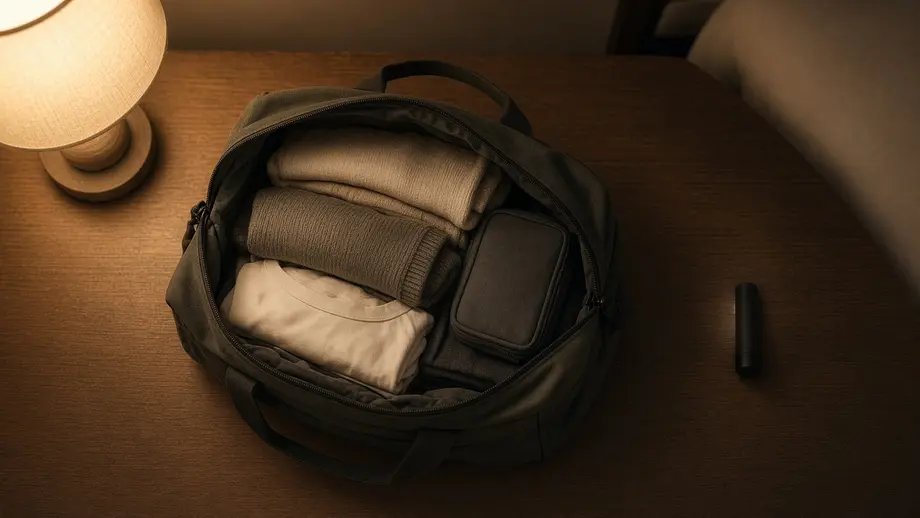
Olight makes the lights discussed here. Olight specs and regular prices come from its US product pages and user manuals as of September 2026. Airline rules are quoted from the FAA, TSA and other aviation authorities, with each page's update date. Size, runtime and threshold figures below are calculations from those published numbers, not measurements.
⚡ TL;DR
A small pocket flashlight can fly with you in a carry-on bag, and U.S. rules also allow it in checked bags. The simple plan is to carry it on, locked or twisted off, and keep any charging case with you. The Olight Baton 4 is the easiest pocket light to fly with: 52.5 g, a 2.34 Wh cell and a documented lockout.
Pocket lights cause small, annoying problems on a travel day. The light rides in your pocket to the checkpoint and ends up loose in a bin. A button gets pressed in a packed bag and the light is dead, and warm, when you land. A charging case goes into a gate-checked bag when it should stay with you. This guide covers which pocket-size lights suit a flight, how to lock each one, and what to do at the checkpoint.
This table is a small pocket flashlight carry-on kit: each travel-day job, the type of light, the minimum spec that matters and the Olight model that meets it.
| Use | Recommended type | Minimum spec | Recommended model |
|---|---|---|---|
| Main light for a late arrival | Side-switch pocket light with a lockout | Lockout, 150 m throw, under 60 g | Olight Baton 4 (52.5 g, 170 m, lockout) |
| No button to bump in a packed bag | Twist-switch keychain light | No side switch, USB-C charging | Olight i1R 2 Pro (twist on, 22 g) |
| A battery you can buy anywhere | AAA keychain light | Runs on alkaline or NiMH AAA | Olight i3E EOS (90 lm, 19.4 g) |
| Reading light in a dark cabin row | Clip light with a red mode | Red under 5 lm, electronic lockout | Olight Oclip 2 Pro (red Low 4 lm for 27 h) |
| Backup with no switch at all | Magnetic-cap mini light | Off while capped, under 20 g | Olight imini 2 (19.5 g, turns on off its cap) |
| Extra charges on a long trip | Charging case, kept in the cabin | Carry-on only, counts as a spare battery | Baton 4 Charging Case ($39.99) |
📋 Table of Contents
- 1. Small Pocket Flashlight Carry-On Rules at a Glance
- 2. Can I Bring a Flashlight on a Plane?
- 3. Are Lithium Batteries Allowed in Carry-On?
- 4. What Size Battery Is Banned on Flights?
- 5. How Do You Stop a Pocket Flashlight Turning On in Your Bag?
- 6. Flight-Day Stages: What Each One Asks of a Pocket Light
- 7. Airport Security Checkpoint Steps for a Pocket Flashlight
- 8. Which Small Pocket Flashlight Is Best for Flying?
- 9. Do Flashlight Rules Differ Outside the U.S.?
- 10. Your Small Pocket Flashlight Flight Checklist
- 11. FAQ
Small Pocket Flashlight Carry-On Rules at a Glance
For U.S. flights, TSA lists flashlights as allowed in both carry-on and checked bags, and FAA rules govern the battery inside. A small pocket flashlight with its lithium-ion cell installed may be checked if it meets the device rules, but spare cells and charging cases must ride in the cabin. The practical answer is to carry the light itself on board, locked.
This table sums up the rules that apply to a pocket light, with the source for each and what it means in practice.
| Rule | Source | What it means for a pocket light |
|---|---|---|
| Flashlights are allowed in carry-on and checked bags | TSA flashlights page, updated July 14, 2026 | The light itself is not the issue; the battery and switch are |
| Electronics larger than a cell phone come out of the bag for X-ray | TSA security screening page | A pocket light can stay in the bag; a charging case is closer to the line |
| A lithium device in checked baggage must be off and protected from activation; devices of 2.7 Wh or less need not be switched off | 49 CFR 175.10(a)(18) | Lock it anyway; the rule still requires protection from unintentional activation |
| Spare lithium batteries and phone charging cases go in carry-on only | TSA lithium battery page, updated March 29, 2023 | A spare Baton 4 cell or its charging case stays with you |
| Spares must leave a bag that is gate-checked | FAA PackSafe, updated August 11, 2026 | Pull the case out before the bag goes below |
| Alkaline and NiMH AAA cells are allowed in both bags | TSA dry batteries page, updated March 29, 2023 | An i3E EOS with a spare AAA is the simplest light to pack |
For the lights themselves, Olight's range of rechargeable EDC flashlights lists every current pocket model, and our roundup of the best pocket flashlight picks compares them for daily carry.
Can I Bring a Flashlight on a Plane?
Yes. TSA's flashlights item page, last updated July 14, 2026, marks flashlights "Yes" for carry-on bags and "Yes" for checked bags. It adds, "If you have questions regarding regulations, please see the FAA website." For a small pocket flashlight, the light is the easy part. What needs attention is the cell inside, any spare or charging case, and a switch that can wake up in a packed bag.
Size matters at the X-ray belt. TSA's security screening page (no update date shown) says, "You will be asked to remove personal electronic devices larger than a cell phone from your carry-on bag and place them into a bin with nothing placed on or under them for X-ray screening." TSA's examples are laptops, tablets, e-readers and handheld game consoles. A pocket flashlight is much smaller than a phone, but charging cases are closer to the line.
To see how far below that line each item sits, the table below sets Olight's published dimensions against Apple's iPhone 17 specifications: 149.6 × 71.5 × 7.95 mm and 177 g. It compares each item's largest face (length × width, or length × diameter for round lights) with the phone's face, 149.6 × 71.5 = 10,696 mm², plus weight and longest side.
This table compares each pocket light's footprint and weight with the phone, based on Olight's rated dimensions, not measured.
| Item (Olight dimensions) | Largest face | Share of phone face | Weight | Share of phone weight | Longest side vs 149.6 mm |
|---|---|---|---|---|---|
| i1R 2 Pro (51.3 mm long; diameter not published) | Not calculable | n/a | 22 g | 12.4% | 34% |
| i3E EOS (60.5 × 14 mm head) | 60.5 × 14 = 847 mm² | 7.9% | 19.4 g | 11.0% | 40% |
| imini 2 (55 × 15.1 mm) | 55 × 15.1 = 831 mm² | 7.8% | 19.5 g | 11.0% | 37% |
| Baton 4 (63 × 21 mm) | 63 × 21 = 1,323 mm² | 12.4% | 52.5 g | 29.7% | 42% |
| Oclip 2 Pro (60.2 × 28 × approx. 35 mm) | 60.2 × 35 = 2,107 mm² | 19.7% | 75.5 g | 42.7% | 40% |
| Oclip 2 Pro Premium, light on its dock (92.3 × 32 × 37.8 mm) | 92.3 × 37.8 = 3,489 mm² | 32.6% | 136 g | 76.8% | 62% |
| Baton 4 Charging Case (65 × 32 × 88 mm; 194 g with the light) | 88 × 65 = 5,720 mm² | 53.5% | 194 g | 110% | 59% |
Every light on its own covers less than a fifth of a phone's face and weighs under half as much. The cases change the picture. The Baton 4 case covers just over half the phone's face, is about four times as thick (32 mm against 7.95 mm) and, with the light inside, outweighs the phone. Whether it comes out of the bag is the officer's call, so pack it where you can reach it.
Are Lithium Batteries Allowed in Carry-On?
Yes. Lithium batteries are allowed in carry-on bags, and spare ones are allowed only there. TSA's lithium battery page, last updated March 29, 2023, allows batteries of 100 Wh or less in a device in both bags, but keeps spare cells, power banks and phone charging cases in carry-on only. TSA says these limits "allow for nearly all types of lithium batteries used by the average person in their electronic devices."
That split decides where each part of a pocket-light kit goes:
- The light with its cell inside is a device. It can go in either bag under the device rules, but carry it on.
- A spare rechargeable cell, such as an extra customized 16340 for the Baton 4, is a spare battery: carry-on only. The FAA's PackSafe lithium battery page, last updated August 11, 2026, lists ways to protect terminals: "leaving the batteries in their retail packaging, covering battery terminals with tape, using a battery case, using a battery sleeve in a camera bag, or putting them snugly in a plastic bag or protective pouch."
- A charging case or dock has its own battery, so it follows the spare-battery rule. Olight says the Baton 4 case "can also charge your mobile devices for emergencies with its USB-C port," which makes it work like a power bank.
- A spare AAA for the i3E EOS is simpler. TSA's dry batteries page, last updated March 29, 2023, covers "typical non-lithium dry batteries (alkaline, nickel metal hydride, nickel cadmium, etc.)" in both bags. They "must be protected from damage and creating sparks or a dangerous evolution of heat."
One more rule catches people at the gate. The PackSafe page says, "When a carry-on bag is checked at the gate or at planeside, all spare lithium batteries and power banks must be removed from the bag and kept with the passenger in the aircraft cabin." Keep the case in the small bag that stays at your seat, not in the roller that might get tagged.
Safety note: The FAA's airline passengers and batteries page, last updated August 10, 2026, says: "Passengers should notify the flight crew immediately if their lithium-ion battery or portable electronic device is overheating, expanding, smoking, or burning."
What Size Battery Is Banned on Flights?
Lithium-ion batteries over 160 Wh are banned from passenger aircraft, and those from 101 to 160 Wh need airline approval. The FAA's passenger battery page says: "Rechargeable batteries with a capacity of 0-100 Wh are allowed on passenger aircraft, while those with a capacity of 101-160 Wh require approval from the air carrier, and batteries exceeding 160 Wh are forbidden." Non-rechargeable lithium metal cells are limited to 2 grams of lithium each.
No pocket flashlight comes near those limits, so the 100 Wh line is not the useful one here. For how full-size 18650, 21700 and CR123A cells compare with it, see our guide to flashlight battery types.
The line that does touch pocket lights is lower. The federal rule itself, 49 CFR 175.10(a)(18) (eCFR text current to September 24, 2026), says: "When carried in checked baggage, portable electronic devices powered by lithium batteries must be completely switched off (i.e., not in sleep or hibernation mode) and protected to prevent unintentional activation or damage, except portable electronic devices powered by lithium batteries with lithium content not exceeding 0.3 grams for lithium metal batteries and 2.7 Wh for lithium ion batteries are not required to be switched off."
This table checks each pocket-size item against the 2.7 Wh device line, using the energy Olight prints; margins are 2.7 minus the printed figure.
| Item | Battery (Olight figure) | Printed energy | Against the 2.7 Wh line |
|---|---|---|---|
| Baton 4 | 650mAh 3.6V customized 16340 | 2.34 Wh (user manual) | 2.7 − 2.34 = 0.36 Wh under |
| imini 2 | 10180 80mAh lithium | 0.296 Wh (user manual) | 2.7 − 0.296 = 2.404 Wh under |
| i1R 2 Pro | 3.7V 130mAh 10220, built in | Not printed | Under; the cell holds one fifth of the Baton 4's 650 mAh |
| i3E EOS | One AAA alkaline or NiMH | Not lithium | Rule does not apply; dry-battery rules do |
| Baton 4 Charging Case | Built-in 21700 5000mAh | Not printed on the product page | A spare battery that charges phones; carry-on only |
Two readings matter. The exemption only waives switching off; the same sentence still requires protection "to prevent unintentional activation or damage." And the Baton 4 sits only 0.36 Wh under the line, so check the Wh your light's manual prints rather than assume. Carry the light on and lock it, and the fine print never comes up.
This guide covers the flight day for one pocket light. For a multi-week kit, our guide to choosing a travel flashlight for a long trip lists the Oclip 2 Pro, its charging dock and other kit items by watt-hour rating, with charging plans for weeks on the road.
How Do You Stop a Pocket Flashlight Turning On in Your Bag?
Use the lockout if the light has one, and a full twist to off if it doesn't. Olight's Oclip 2 manual names "using the product without the recommended lockout mode" among the uses it is not liable for. The Baton 4 and Oclip 2 Pro have electronic lockouts. Twist lights like the i1R 2 Pro and i3E EOS turn off by twisting counterclockwise, and the imini 2 stays off only while seated on its magnetic cap.
This lockout checklist lists how each light switches on, how to secure it and how to confirm, from Olight's manuals and product pages.
| Light | How it turns on | How to secure it (Olight) | How to confirm |
|---|---|---|---|
| Baton 4 | Side button press | Manual: "when the flashlight is off, press and hold the button (for about 2 seconds) until the Moonlight mode turns on and off" | A single press shows battery level without light |
| Oclip 2 Pro | Side button press | Manual lockout: hold the side button more than 2 seconds from off; hold again to unlock | A press gives no beam |
| i1R 2 Pro | Twist; page says head, manual says tailcap | Manual: "Twist the tailcap counterclockwise to turn off the light." | Point it at your palm; no glow |
| i3E EOS | Twist; page says head, manual says tailcap | Manual: "Twist the tailcap counter-clockwise to turn off the light." | Point it at your palm; no glow |
| imini 2 | Pulling the body off the magnetic cap | Olight: it turns on "by simply detaching the body from the magnetic cap" | Cap fully seated |
The Baton 4 manual's confirm step is handy in a checkpoint line: "When the button is locked, press the button once to display the remaining battery level without turning on the flashlight." To unlock, "Press and hold the button for 1 second or more to unlock the button and activate Moonlight mode," so the first light you see is 0.5 lumens, not a beam in someone's face.
What a Stray Press Costs on a 5-Hour Flight
Here is what happens if a pocket light switches on in a bag at takeoff on a 5-hour (300-minute) flight. The figures compare the rated runtime of the mode it wakes in with the flight time, based on Olight's rated runtimes, not measured.
| Light and how it wakes | Output it wakes at | Rated runtime | At landing (300 min) |
|---|---|---|---|
| Baton 4, single press, last used on Medium | 60 lumens | 8 hours (480 min) | Still on; 300 ÷ 480 = 62.5% of that runtime used |
| Baton 4, single press, last used on High or Turbo | High for 1 minute, then Medium | About 8 hours on Medium | Still on, as above |
| Baton 4, single press, last used on Low | 12 lumens | 35 hours (2,100 min) | Still on; 300 ÷ 2,100 = 14.3% used |
| Baton 4, accidental double press | Turbo, 1,300~600~300 lumens | 1.5 + 2.5 + 73 = 77 minutes | Rated runtime ends 300 − 77 = 223 minutes before landing |
| i1R 2 Pro, full twist | High, 180 lumens | 23 minutes, to 50% output (manual) | Rated runtime ends 277 minutes before landing |
| i3E EOS, full twist | 90 lumens | 45 min alkaline, 70 min NiMH (manual) | Rated runtime ends at least 230 minutes before landing |
| imini 2, cap knocked off | 50 lumens | 60 minutes | Rated runtime ends 240 minutes before landing |
The Baton 4's mode memory softens a single stray press. Its manual says "Turbo mode will be memorized as High mode; High mode output will last for 1 minute before switching to Medium mode." A double press is the costly one: Turbo steps down through its full rated 77 minutes in the bag. The twist lights and the imini 2 run past their rated runtimes long before landing, so their fix is mechanical: twist off fully, or keep the imini 2 in a zip pocket.
Tip: In a dark cabin, set the Baton 4's Auto Shut-Off before you put it down. Its manual says: "double-press and hold the button when the flashlight is on"; one flash sets 3 minutes and two flashes set 9. A light left on under the seat then turns itself off.
Warning: Olight's Oclip 2 manual warns: "Do not obstruct the lens, or else the energy emitted from the light may cause the object to burn." A light that wakes face-down in a packed bag has its lens blocked, which is why the lock matters more than the battery math.
Flight-Day Stages: What Each One Asks of a Pocket Light
A flight day moves a pocket light through stages with different constraints. At home, in the security line and at the gate, the rules are about packing: locked, in the bag, spares at your seat. In the cabin, the limit is your neighbors, so red light or 12 lumens at most. After landing, rain and unlit curbs call for 60 lumens or more and a water rating.
This table lists each stage of a flight day with where the light belongs, the rule or courtesy that applies, and the output, water rating and mode that fit.
| Stage | Where the light belongs | Rule or courtesy | Output | Water rating that matters | Light and mode |
|---|---|---|---|---|---|
| Packing the night before | Carry-on, locked | 49 CFR: protect against activation | Off | None | Baton 4 or Oclip 2 Pro locked; twist lights fully off |
| Security line | Out of your pocket, into the carry-on | TSA advice on emptying pockets into the bag | Off | None | Keys with a keychain light go in the bag too |
| Gate, bag tagged for the hold | Personal item at your seat | FAA: spares leave a gate-checked bag | Off | None | Charging case and spare cells come out first |
| Dropped earbud, dark cabin | In hand, beam at the floor | Keep light off your neighbors | 0.5 to 12 lm | None | Baton 4 Moonlight or Low |
| Seat number or boarding pass | Clipped to a bag strap | Keep light off your neighbors | Red, 4 lm | None | Oclip 2 Pro red Low |
| Rain on the walk to a rideshare pickup | In hand | Be visible to drivers | 60 lm or more | Rain | Baton 4 Medium (IPX8) |
| Unlit road to the hotel door | In hand | See the path ahead | 300 lm or more | Rain | Baton 4 Turbo, double press |
Safety note: The Oclip 2 manual warns: "Do not look directly at the light source or shine it into your eyes, as this may cause temporary blindness or permanent damage to your eyes." In a cabin, the people around you sit within arm's length of the beam.
Airport Security Checkpoint Steps for a Pocket Flashlight
Clear the checkpoint with your pocket flashlight by moving it from your pocket into your carry-on before you reach the bins, locked and with any charging case packed where you can reach it. In a June 20, 2024 TSA press release on summer travel, Bart R. Johnson, TSA's Federal Security Director for 13 Upstate New York airports, said "travelers can save time by removing items from their pockets and placing them in a carry-on bag, instead of putting items directly into bins at the conveyor belt."
- At home, charge the light, then lock it (Baton 4, Oclip 2 Pro) or twist it fully off (i1R 2 Pro, i3E EOS).
- Pack spares and cases in the personal item that stays at your seat, with cell terminals covered.
- In the line, move the light from your pocket into your carry-on. A keychain light can stay on your keys; put the keys in the bag, too.
- At the belt, don't bury the charging case under other items. If an officer asks, take it out.
- If asked about the light, a locked Baton 4 shows its battery level with one press and no beam.
- At the gate, if your roller gets tagged, pull out spare cells and charging cases first.
- After landing, unlock only when you need light.
Which Small Pocket Flashlight Is Best for Flying?
For most flyers, the Olight Baton 4 is the best small pocket flashlight to carry on: 52.5 g, 63 mm long, a lockout that confirms itself, and 1,300 lumens and 170 m for the dark walk after landing. Choose a twist keychain light if you want no buttons at all, or the Oclip 2 Pro if you want hands-free red light.
This table compares five pocket-size Olight lights on the specs that matter for flying, at regular prices from September 2026.
| Model | Regular price | Weight | Max output and throw | Power | Water rating | Lockout |
|---|---|---|---|---|---|---|
| Baton 4 | $54.99 | 52.5 g | 1,300 lm, 170 m | 2.34 Wh customized 16340 | IPX8 | Electronic |
| Oclip 2 Pro | $54.99 | 75.5 g | 530 lm flood, 125 m spot | 600 mAh built in | IP66 | Electronic |
| i1R 2 Pro | $21.99 | 22 g | 180 lm, 48 m | 130mAh 10220, built in | IPX8 | Twist off |
| i3E EOS | $12.99 | 19.4 g | 90 lm, 44 m | One AAA | IPX8 | Twist off |
| imini 2 | $19.99 | 19.5 g | 50 lm, 21 m | 10180 80mAh | IPX6 | Cap on |
Olight Baton 4: The Pocket Light to Fly With
The problem on a travel day is a light small enough to forget in a pocket that still lights an unlit road. The Olight Baton 4 EDC flashlight ($54.99, regular price, September 2026, default OD Green Standard listing) weighs 52.5 g and measures 63 × 21 mm. Olight rates Turbo at 1,300~600~300 lumens for 1.5 + 2.5 + 73 minutes, High at 600~300~60 lumens for 7 + 72 + 16 minutes, Medium 60 lumens for 8 hours, Low 12 lumens for 35 hours and Moon 0.5 lumens for 30 days, with 7,225 candela, 170 m and IPX8.
Its limits: the Standard version charges through the MCC 1A magnetic cable, not a USB-C port, so a forgotten cable means no charge. The charging case solves that; it comes with the Premium Edition (194 g with the light) and sells alone for $39.99 (regular price, September 2026). The case is a carry-on-only battery, and the manual lists a 0 to 40 °C working range, so it is not a winter-trek light. Our long-trip travel guide pairs a keychain light with a headlamp for weeks on the road; for the flight day itself, the Baton 4 is the one light to pocket.
Olight Oclip 2 Pro: Hands-Free Red Light in Your Seat
The Olight Oclip 2 clip flashlight (Oclip 2 Pro, $54.99, regular price, September 2026, Tidal Blue standard version) clips to a bag strap up to 14 mm thick and offers red light at 40 lumens for 4 hours or 4 lumens for 27 hours. The floodlight runs Low at 10 lumens for 25 hours and Moon at 1 lumen for 144 hours.
Its limits are specific. It is rated IP66, and its manual rules out immersing it in water. In environments below 0°C (32°F), the manual limits white light to Low and Medium. The same manual carries a magnet warning: "If you have an ICD or pacemaker, avoid close or prolonged contact with this product to prevent possible interference." A clip light tends to ride on a collar or shirt pocket for a whole flight, so if you use a cardiac device, keep it on your carry-on strap instead. Olight's other EDC clip lights share the clip format.
Olight i1R 2 Pro and i3E EOS: No Buttons to Press
Twist lights have no button to bump. The Olight i1R 2 Pro keychain light ($21.99, regular price, September 2026) gives Low 5 lumens for 12 hours and High 180 lumens for 23 minutes at 22 g, charging through a USB-C port under the tailcap. The Olight i3E EOS keychain flashlight ($12.99, regular price, September 2026) runs on one AAA and gives 90 lumens; its manual rates 45 minutes on alkaline and 70 minutes on NiMH.
Their weak spot is the twist itself: a partial turn on a key ring can switch the i1R 2 Pro to Low, because its manual puts Low at a slight clockwise turn of the tailcap and High at a full turn. The i3E EOS has a single mode and no low output. For more tiny lights compared on a key ring, see our best keychain flashlight picks.
Olight imini 2: The Lightest Backup
The imini 2 ($19.99, regular price, September 2026) weighs 19.5 g, gives 50 lumens for 60 minutes and charges through a USB plug in its magnetic cap. Its catch for travel: it turns on when the body leaves the cap, so a loose bag pocket can switch it on. It is IPX6, so keep it out of standing water.
Do Flashlight Rules Differ Outside the U.S.?
The core limits are similar abroad, but rules on power banks are tightening, and charging cases are where pocket-light kits meet them. The Civil Aviation Authority of Macao, applying new ICAO requirements, set this rule from March 29, 2026: "each departing air passenger can carry no more than two power banks in their carry-on baggage, and charging power banks during flights is strictly prohibited."
That Macao notice, dated March 29, 2026, follows the International Civil Aviation Organization. Canada's screening authority, in its 2026 travel guide (modified August 20, 2026), puts it plainly: "Spare lithium batteries and power banks must travel in your carry-on. They should never be packed in checked baggage." The same guide says, "Keep devices charged and easy to reach in your carry-on, as they may need to undergo additional screening."
Use this count before an international flight:
- List every battery that can charge something else: phone power bank, Baton 4 Charging Case, Oclip 2 Premium Charging Dock.
- Count them against a two-unit cap where one applies. A phone power bank plus the Baton 4 case is already two.
- If you are over, leave one at home or ask the airline in writing whether a flashlight charging case counts. Carriers decide how their rules apply.
- Don't charge the case in flight where the rules ban charging power banks on board, and check each airline on the route.
Your Small Pocket Flashlight Flight Checklist
Before you fly with a small pocket flashlight, run this list the night before. Each step comes from a rule or manual quoted above, and the result is a charged, locked light in your carry-on with every spare battery at your seat.
- Charge the light, and the case if you bring one.
- Lock the Baton 4 or Oclip 2 Pro; twist the i1R 2 Pro or i3E EOS fully off; seat the imini 2 on its cap.
- Put spare cells in a case or cover the terminals.
- Pack the charging case in the personal item, not the roller.
- Count power banks if any leg is international.
- In the security line, move the light from your pocket into your carry-on.
- At the gate, pull spares and cases out of any bag that gets checked.
- In the cabin, use Moonlight, Low or red, and set Auto Shut-Off on the Baton 4.
FAQ
Changelog
- September 25, 2026: First published.