TL;DR: A useful scorpion inspection light has a clearly documented UV mode, a control you can select on purpose, and handling that fits a repeatable route. Olight’s U.S. Arkfeld Pro and ArkPro Ultra pages list 365 nm UV modes. A glow helps locate a scorpion; it does not identify its species or replace a licensed pest plan.
📋 Table of Contents
- 1. What is the best UV flashlight for scorpion inspections?
- 2. Can UV light detect scorpions?
- 3. Do UV lights hurt scorpions?
- 4. Why nighttime inspection can add useful information
- 5. Treat fluorescence as a clue, not an identification
- 6. Compare exact U.S. product specifications
- 7. What type of UV flashlight is best for rock hunting?
- 8. Plan the route before dark
- 9. Inspect exterior zones without reaching into hazards
- 10. Build notes that a client can understand
- 11. Explain the value of a night visit without overpromising
- 12. Licensing and treatment decisions belong to the qualified operator
- 13. Keep People and Animals Out of the Beam Path
- 14. Common mistakes that weaken an inspection record
- 15. A practical inspection sequence
- 16. Frequently Asked Questions
- 17. Give the client a useful next step
What is the best UV flashlight for scorpion inspections?
For a professional night inspection, start with a handheld light whose U.S. specifications state its UV wavelength and whose controls make the UV mode easy to confirm. Arkfeld Pro and ArkPro Ultra list 365 nm UV. Choose between their body and mode layouts, then use the light as an observation aid rather than as a species test or treatment tool.
| Need | Published option | Decision |
|---|---|---|
| UV selection | Arkfeld Pro: 365 nm; 560–900 mW UV optical power | Output does not predict how many scorpions a route will reveal. |
| Multiple UV settings | ArkPro Ultra: 365 nm; high 1,200–580 mW; low 360 mW | Figures do not guarantee distance or faster inspection. |
| Repeat visits | Record route, access limits, conditions, and observations | Notes aid comparison; a partial route is not a property-wide census. |
| Treatment | Follow the licensed operator’s approved process and applicable rules | A UV sighting alone does not identify a treatment site. |
The figures above come from the current U.S. product specifications. The pages do not define one shared field distance and method for comparing how many scorpions each light reveals. That is why a product “winner” based on UV output alone would overstate what the specifications show. The choice should follow the technician’s need for mode selection, carry, and a clear record of what was actually observed.
Can UV light detect scorpions?
Yes. The University of California Integrated Pest Management scorpion guide says a portable black light can be used to survey for scorpions around a home and that scorpions glow brightly under black light. That makes UV useful as a visual search aid after dark. It does not turn a glow into a species identification, a population estimate, or a diagnosis of where a treatment should be applied.
That distinction matters on a service visit. The beam may help a technician notice an animal that was difficult to see under ordinary lighting. The observation is still only one part of the inspection. Access, route coverage, the animal’s location, the customer’s concern, and the licensed professional’s approved service process determine what the finding means.
A concise record might say, “One fluorescent arthropod observed on the lower exterior wall beside the north gate. Exact species not identified. Area access limited by stored materials.” The note records what the technician saw and what remained unknown. It does not claim every wall was checked, that the site has a particular species, or that a treatment is automatically warranted.
For a broader explanation of UV wavelength and common flashlight applications, start with Olight’s UV flashlight guide. For a product-level overview, see Olight’s guide to the UV flashlight. For a related collector-focused example, see Olight’s guide to screening uranium glass. A search for a compact flashlight may also help technicians compare carry styles, but form factor does not replace a verified UV specification.
Do UV lights hurt scorpions?
The university guidance cited here describes black light as a survey aid, not a control method. It does not establish that a handheld UV exposure safely or effectively harms scorpions. Do not use a UV flashlight to injure or deter wildlife. Keep the beam on an authorized inspection surface, avoid direct eye exposure, and follow the exact light’s manual. Pest decisions belong to the licensed operator and the applicable service plan.
Why nighttime inspection can add useful information
Scorpions are nocturnal animals. The UC IPM overview explains that they are active at night and notes that a portable black light may help survey around the home. That context helps explain why a customer may see a technician return after dark. It does not support a universal start time. A route should fit the appointment, site conditions, access agreement, and the service provider’s own procedures.
A daytime visit can still be useful for questions that do not require a night survey. The technician may document the layout, note exterior access restrictions, ask where the customer has seen activity, and identify areas the customer wants included. A night visit can then use an agreed route and a consistent observation record. The two visits answer different questions. Neither should be described as a guaranteed count of all animals on the property.
When a customer asks why the technician is not simply spraying during daylight, explain the distinction between locating activity and selecting an approved control response. The UV observation can make an animal visible at a particular place and time. It cannot by itself determine whether the animal is entering a living area, whether a barrier or sanitation measure is relevant, what the species is, or which service is permitted. Those are separate professional judgments.
Timing also changes what a customer should expect from the visit. A technician should not promise that a single inspection will reveal every scorpion. The visible observation depends on the actual route, areas that can be reached safely, the site’s lighting, and whether the customer has permission to inspect a location. When access is limited, write that limitation down rather than calling an incomplete route a full inspection.
Treat fluorescence as a clue, not an identification
A fluorescence response is visually useful, but it answers a narrower question than many customers assume. “Something fluoresced under this source” is an observation. “This is a bark scorpion,” “the property has a specific infestation,” or “this exact crack needs treatment” are different claims. Each requires a different basis.
A label such as “scorpion” may be appropriate when the animal is clearly recognized by a qualified professional. If it is not, preserve the distinction in the record: “scorpion-like animal,” “fluorescent arthropod,” or “species not identified,” as appropriate to the operator’s procedures. A photograph may help a supervisor review the observation, but camera exposure and color balance can alter its appearance. A picture should not be promoted into a confirmed species record when the specimen was not identified.
Different specimens can respond differently to UV wavelengths. The University of Colorado Boulder’s fluorescent minerals demonstration compares the same collection under long-wave 365 nm and short-wave 254 nm light. That example is a reason to keep the source and conditions with an observation, not a shortcut to identify an unknown mineral or animal.
Keep observation and conclusion in separate fields. A customer-facing note can state where a signal appeared and what the technician could verify. An internal service record can preserve route details, product mode, access limitations, and any follow-up assigned by the supervisor. The separation prevents an early clue from quietly becoming a certainty in the next report.
Compare exact U.S. product specifications
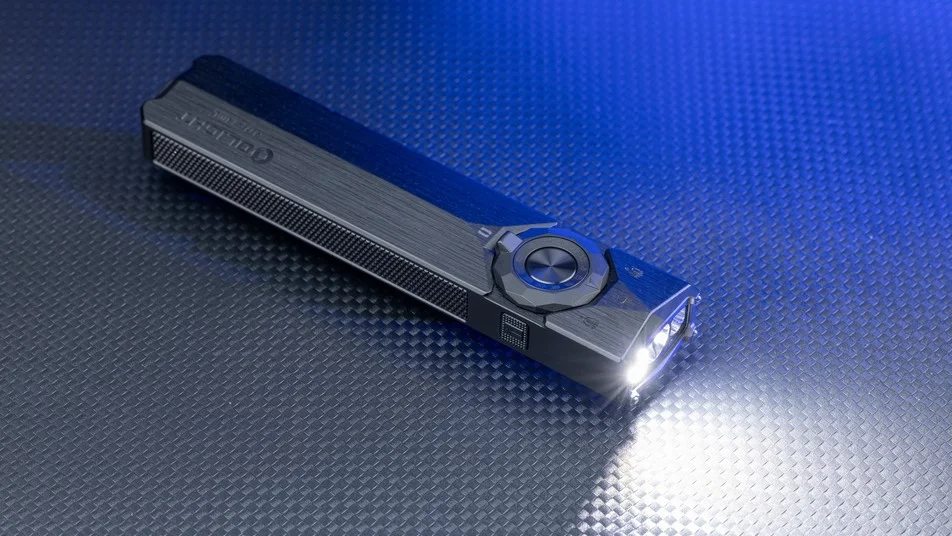
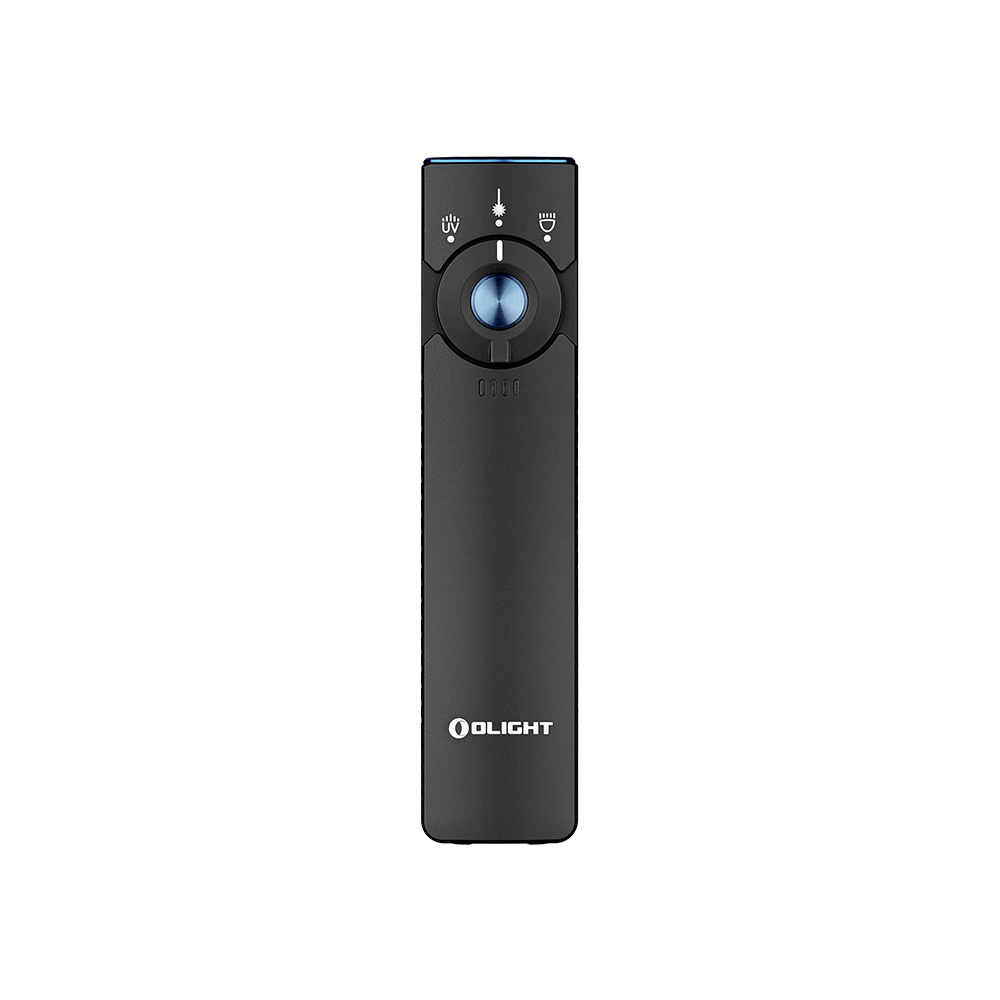
The two Olight options below both have a U.S.-listed 365 nm UV mode. Their published figures use different labels and do not establish a shared wall-distance comparison. The exact variants are Arkfeld Pro Black CW (ARKFELDPRO3RBKCWV3) and ArkPro Ultra Amber Orange CW (ARKPROULTRAAOG). Compare mode descriptions, controls, carry, charging, and handling rather than assuming a larger number guarantees more useful observations.
| Model | UV specs | Carry & controls |
|---|---|---|
| Arkfeld Pro Black CW | 365 nm; UV optical power 560–900 mW | 111 g with battery; IPX7; central button and selector; flat form. |
| ArkPro Ultra Amber Orange CW | 365 nm; UV high 1,200–580 mW; low 360 mW | 120 g with battery; IPX7; USB-C/MCC; separate UV settings. |
These numbers are exact labels from the U.S. Olight product pages. They are not equivalent to an inspection radius. A product page does not show how a wall, distance, angle, outdoor lighting, surface color, or a particular animal will look during a technician’s visit. Keep those environmental factors in the field note rather than using product specifications to make an unsupported promise.
A customer who already carries a documented 365 nm product may prefer the selector and carry shape they can operate reliably. Another technician may value a second published UV level. In both cases, verify the exact model and variant before the appointment. Product families can contain different modes and controls, so a name that sounds similar is not enough to establish the details of the light in a technician’s hand.
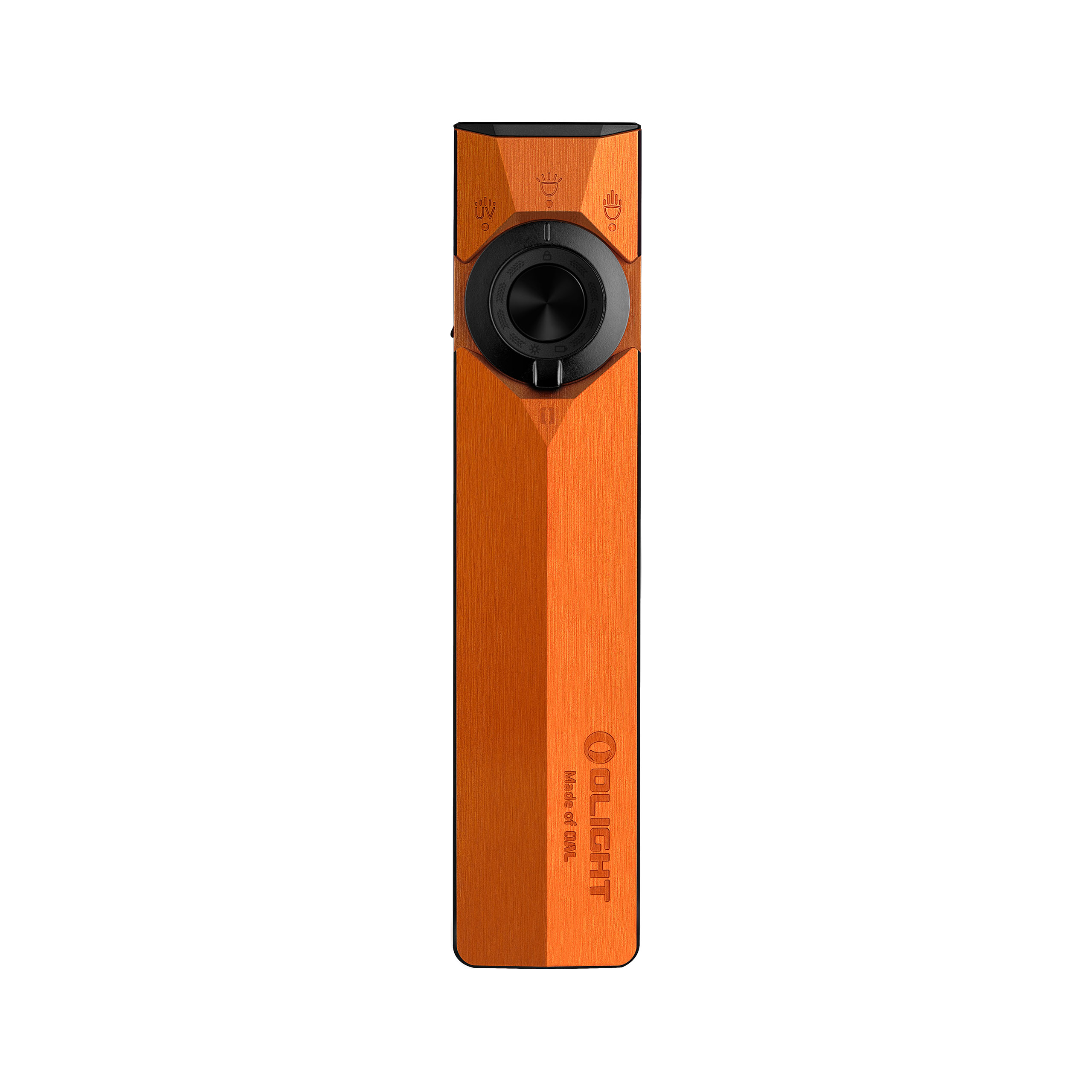
Reading the ArkPro Ultra selector
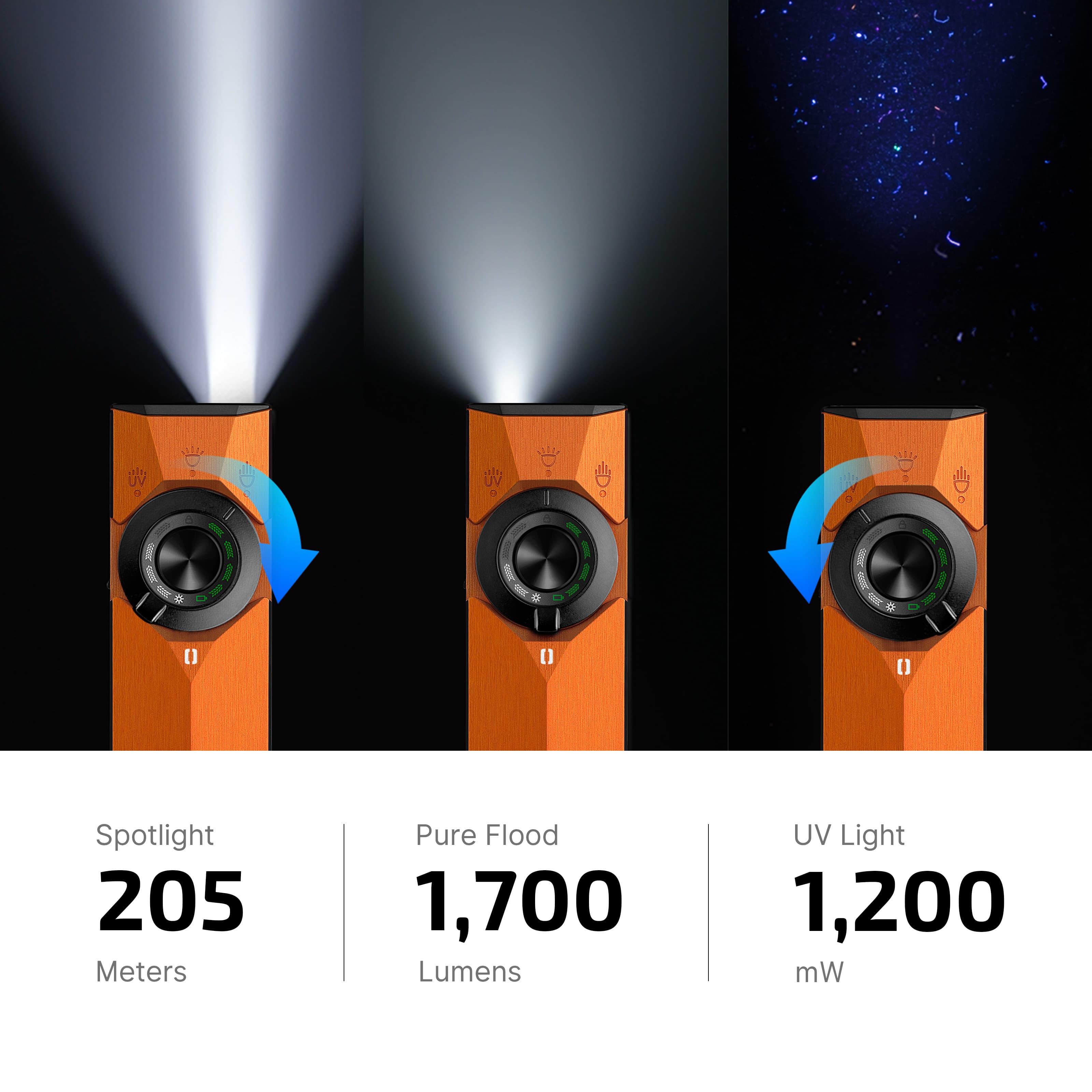
Three official gallery views show the Amber Orange CW ArkPro Ultra in spotlight, pure flood, and UV modes.
A mode selector is useful only when the operator can identify the setting and follow the manual. Before a customer-facing route begins, confirm the selected source in a safe direction and ensure that the route plan accounts for ordinary visibility as well as the UV observation. Do not direct any source at a person, a pet, or a passing vehicle. Keep the laser off during this inspection.
What type of UV flashlight is best for rock hunting?
Choose a 365 nm long-wave light when a reliable reference for the specimens you plan to examine documents a response at that wavelength. Some minerals respond differently under short-wave UV. The University of Colorado Boulder’s fluorescent-minerals demonstration compares the same collection at 365 nm and 254 nm, so check a specimen-specific museum or mineral reference before choosing. No single wavelength is the right answer for every rock.
Plan the route before dark
A repeatable route improves the quality of a report because the technician can say where the inspection covered and what was excluded. It also prevents an improvised search from drifting into areas that the customer did not authorize or the operator should not enter.
Before the visit, confirm the customer’s concern and the requested exterior areas. Ask whether there are access restrictions, locked gates, pets, children, shared walkways, pool areas, outdoor lighting controls, or surfaces that should not be approached. The technician should use the employer’s visit procedure for permissions and site hazards. If an area is outside the agreement or access cannot be made safe, record it for the supervisor instead of entering it.
A simple route can use visible landmarks rather than an invented measurement. For example, note the front entry, north-facing wall, side gate, detached shed, and rear patio. The team can then write each observation against a landmark that the property owner recognizes. A route map or marked diagram is valuable when it is made for that property and reviewed with the customer. Do not present a generic sketch as a record of an actual inspection.
The order of the route should make sense for the property. Start with an agreed point, follow the perimeter that can be safely reached, and record transitions at gates or structures. If the inspection is interrupted, resumed later, or stopped by an access issue, document the break. The next person should not have to guess whether a section was missed, skipped, or checked without a finding.
Keep ordinary-light navigation separate from the UV scan. A UV source has a specific observation purpose. Steps, hoses, uneven paths, retaining walls, and pools require normal awareness and the team’s approved lighting and safety practice. Do not darken a public path just to make a fluorescence response easier to notice.
Inspect exterior zones without reaching into hazards
Exterior route notes are most useful when they tell the next person exactly what was visible. They should not encourage a technician to reach into concealed spaces, move heavy objects, or disturb a place that belongs to the customer.
Wall edges and door thresholds
Walls and thresholds are understandable landmarks for both a technician and the customer. A note such as “lower west wall, two feet left of the gate post” is more useful than “near the back.” Use the site’s fixed features, and include which side of the wall or entry was viewed.
A UV signal at a threshold does not prove that an animal came from inside the home. Record the outside location and ask the customer or supervisor to decide what follow-up is warranted. If the area is blocked by stored items, construction materials, or a closed barrier, mark it as inaccessible. Never push hands, tools, or a light into a crack, gap, or concealed void to get a closer look.
When the wall is painted, textured, or partly hidden by landscaping, note the viewing condition. A property owner can later distinguish “not observed” from “nothing present.” That distinction is useful for scheduling and expectations. It also avoids turning a limited line of sight into a blanket statement about the entire building envelope.
Stone, bark, and decorative yard features
Stone piles, yard borders, mulch, stacked materials, and decorative bark may be part of a customer’s concern. They can also hide uneven surfaces, insects, or sharp objects. The visual inspection should remain from an accessible position, using the team’s route and PPE standards. It is not a reason to lift a rock or move an object without the customer’s permission and a safe work plan.
Use a precise landmark and describe what was visible. “One observation on the outside face of the low stone border by the driveway” gives a clearer record than “scorpions in the yard.” If a surface was not viewed because the material could not be moved safely, state that boundary plainly. The follow-up can be assigned to the licensed professional or property owner who has authority to decide what happens next.
Pools, patios, and shared walkways
Pool decks and patios combine slip hazards, electrical equipment, furniture, and other people using the space. A UV inspection should not take priority over safe access. Keep out of water and away from electrical fixtures, respect posted restrictions, and avoid disrupting residents or guests. A locked gate or wet surface may be a clear stop condition under the operator’s normal procedure.
For shared walkways, consider the public-facing effect of using a distinctive light at night. Let the customer know what the technician is doing, keep the beam directed toward the authorized inspection surface, and pause if a neighbor or resident asks what is happening. A calm explanation protects trust better than a broad beam across a window or property line.
When the route passes an outdoor lamp, note whether it was on or off as an observation condition. UC IPM explains that outdoor lights can attract insects and that scorpions feed on insects, but a single lamp does not establish why an animal appeared at a specific location. The technician can document a light near an observation, then let the licensed operator decide whether any prevention conversation is appropriate.
Gates, service areas, and restricted spaces
A technician should not assume that a utility enclosure, crawlspace, mechanical room, garage, or neighboring yard is part of an exterior route. Confirm permission and scope first. If entry is not authorized, leave the space untouched and make a note for the customer or supervisor. A glowing animal seen through a gate is still outside the authorized access boundary.
The same principle applies to work areas that may require specialized PPE, confined-space training, or additional authorization. A flashlight does not make an unsafe space safe. If the site conditions differ from the approved visit plan, pause and escalate through the employer’s procedure.
Build notes that a client can understand
Good inspection notes need enough detail to support a follow-up without sounding like a diagnosis the technician did not make. Keep the facts, uncertainty, and recommendations in separate sentences.
A compact record can include:
- Date and approximate visit window, using the employer’s record system.
- Technician, property zone, and landmarks used to follow the route.
- Exact light model and selected mode, if that information is required by the service record.
- What was visibly observed, including count only for the inspected area and actual route.
- Areas that were not accessible or were excluded from the visit.
- Customer statements, clearly attributed to the customer.
- Any item assigned for supervisor review or a separate licensed decision.
Avoid language such as “infestation confirmed” when the observation supports only one visible animal. Avoid “no scorpions present” when the route was partial, the surroundings were bright, or the site had obstructions. Prefer “none observed on the accessible north and west perimeter during this visit.” The phrase is narrower and more reliable.
Before sending the report, check that a reader can distinguish three categories: what the technician saw, what the customer reported, and what the professional recommends next. These categories are often collapsed when a technician writes in a hurry. A clean note may read: “Customer reported recurring activity near the side entry. One scorpion was observed on the exterior threshold. The shed perimeter was not inspected because the gate was locked. Supervisor review requested for follow-up scope.” Each sentence carries a different source and status.
If the customer requests a before-and-after comparison, reuse the same authorized route and the same recording fields. Compare only like with like. If one visit covered a gate and wall that the other did not, identify that difference. Do not describe counts from two different routes as proof that a treatment worked or failed. The technician can preserve the data for the licensed operator to interpret under the company’s service plan.
Photographs should be purposeful and privacy-conscious. Capture only what the service record requires, avoid people, license plates, neighboring windows, and personal items, and follow the customer’s permission and company policy. A phone photo under UV may alter brightness and color. Label it as a visual record, not as a species or chemical identification.
Explain the value of a night visit without overpromising
A client may ask why a technician is charging for an after-dark inspection. The answer should explain the scope and the reason for the timing, not promise a result that the method cannot guarantee.
A clear explanation might be: “Scorpions are nocturnal, and the extension guidance describes black-light surveying as one way to look for them. This visit follows the accessible exterior route we agreed on. The report will list any visible observations and any areas that could not be inspected. A sighting helps the licensed operator decide whether more follow-up is appropriate.”
That explanation is more defensible than “UV finds every scorpion” or “we need exactly two hours after sunset.” The first claim guarantees detection. The second invents a universal schedule. If the company has a documented service window, use it. If not, coordinate timing with the customer and state the limits of the route.
Clients also benefit from knowing what a flashlight does not do. It does not show a hidden nest through a wall, determine how many animals are out of sight, identify an exact species from brightness, or select a pesticide. It makes certain visual observations easier under a suitable process. A licensed professional still needs to interpret those observations within the service plan and local requirements.
When an observation suggests the customer should seek a different kind of assessment, the technician can document the concern and refer it through the company’s approved channel. Do not improvise a treatment prescription, remove an animal, or tell the customer a household measure is guaranteed to solve the problem. Those decisions belong to the qualified person responsible for the service.
Licensing and treatment decisions belong to the qualified operator
Pest-control rules are not identical across the United States. The National Pesticide Information Center maintains a state pesticide regulatory agency directory that can help a reader find the appropriate state authority. Use it as a starting point, then confirm current rules with the agency responsible for the location, the employer’s license, and the specific service being provided.
This guide does not tell a technician where to spray, what chemical to use, or how to apply a product. The UV observation can be included as one piece of an inspection record. Treatment site selection, label compliance, required notices, and customer recommendations remain with the licensed professional and applicable regulations.
For consumers, the same boundary is helpful. A visible scorpion may justify a call to a qualified pest professional, especially when the customer is unsure of the species or has repeated activity. A flashlight is a way to look, not a reason to handle, trap, or disturb the animal.
Keep People and Animals Out of the Beam Path
Olight’s U.S. manuals warn against looking directly at the UV source. The Arkfeld Pro warning manual specifically says not to look directly at the ultraviolet source, and the ArkPro manual warns against looking at or shining the light into eyes. Treat those instructions as product-use rules. Point the beam at the inspection surface, keep bystanders outside its path, and switch the product off when the observation ends.
The CDC’s overview of non-ionizing radiation explains that ultraviolet radiation is part of the non-ionizing region of the electromagnetic spectrum and that intense exposure can damage tissue. This does not set a job-specific exposure duration for a flashlight. The useful takeaway is to follow the exact product manual and avoid direct eye exposure rather than assuming that a small handheld product is harmless at any distance.
Do not use UV illumination as a way to deter or control scorpions. The university guidance describes it as a survey aid, not a treatment. Keep the inspection at a safe viewing distance and follow the operator’s pest-management procedures. Never encourage a customer, child, or technician to touch or corner an animal for a better picture.
If a sting occurs, follow the company’s emergency process and seek appropriate medical or poison-center guidance. The National Capital Poison Center’s scorpion guidance explains that most U.S. scorpion stings are not very dangerous but that serious effects can occur, and it identifies emergency medical treatment for prolonged pain or body-wide symptoms. If the situation is severe or rapidly changing, use emergency services. Do not delay care to finish an inspection or photograph an animal.
Common mistakes that weaken an inspection record
Calling a glow an exact species
A bright response can draw the eye to a scorpion, but the intensity of a photograph or a beam is not a field identification key. Use the identification process available to the technician. If the animal cannot be identified with confidence, record that fact and preserve the observation without upgrading it to a species claim.
Reporting a property-wide count from a partial route
A count means only what was actually counted in the area actually inspected. A locked gate, an inaccessible wall, a dense planting feature, or an interrupted appointment changes the coverage. Put those limits beside the observation, not in a note that is likely to be missed.
Treating a UV flashlight as a control method
The black-light survey is an observation tool. Treatment plans must follow the licensed operator’s training, product labels, and local rules. Do not use the light to decide a pesticide, dose, placement, or timing.
Reaching into gaps or moving customer property
A stronger desire to see the animal does not create authorization to move a stone, lift stored equipment, or put a hand into a crack. Photograph or note the visible area from a safe position, then ask the supervisor or customer to decide the next step.
Promising a fixed time or guaranteed result
The source material supports nocturnal behavior and UV surveying. It does not create one universal appointment time or guarantee that every scorpion will be visible. Schedule around the customer and service process. Write down the route and actual coverage so a later visit can be compared fairly.
A practical inspection sequence
A consistent sequence helps a technician focus on the property rather than improvising the workflow at every wall. The sequence below is a communication structure, not a treatment protocol. Use it only within the company’s approved procedures.
- Confirm scope. Verify the customer’s request, the authorized area, access conditions, and any site restrictions before beginning.
- Confirm equipment. Check the exact model, selected UV setting, battery status, and ordinary-light backup according to the product manual and company process.
- Mark the route. Use property landmarks that will make sense in the final report. Include any zone that is intentionally excluded.
- Observe from an accessible position. Scan only surfaces within the authorized route. Do not reach, disturb, or handle an animal or property item.
- Record each observation. Note location, time window, mode, visibility, and what could not be verified. Separate customer statements from technician observations.
- Close the visit. Switch the UV source off, check that the route is clear, and summarize the record and next decision with the customer or supervisor.
This sequence keeps the technical task small: observe, locate, record, and hand off the decision that belongs to the licensed professional. A checklist does not eliminate judgment. It makes sure that access and communication are handled before the technician is focused on the light.
Frequently Asked Questions
Give the client a useful next step
A strong close to the visit is specific, calm, and easy to act on. Share the route actually covered, the observations actually made, any area excluded from the route, and who owns the next decision. If there was no sighting, say “none observed on the accessible route” rather than “none are present.” If there was a sighting, give the landmark and preserve uncertainty about species unless a qualified identification was made.
Clients often want one sentence that resolves the concern. A responsible answer may be less absolute, but it is more useful: the technician can explain what the UV survey showed, what it could not show, and whether a licensed follow-up is appropriate. That makes the next visit easier to plan and prevents a fluorescence cue from becoming a promise of treatment or safety.
Changelog
- November 20, 2026: Verified U.S. Olight UV specifications and reviewed university, public-health, and state-agency guidance for a scorpion-inspection guide.