⚡ TL;DR
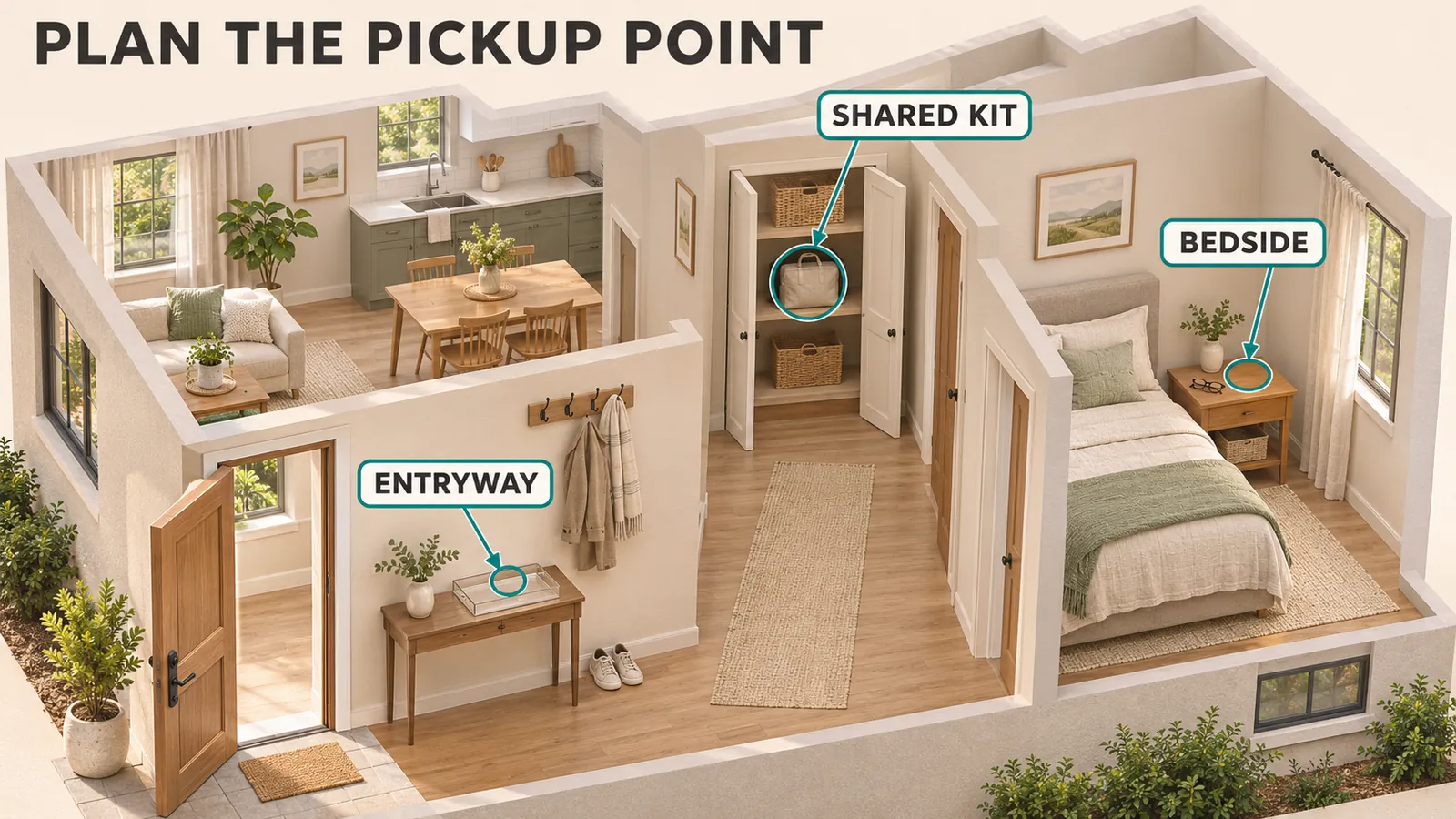
Place a home flashlight where the person who needs it can retrieve it before starting the task. We recommend planning separate roles for arrival at the door, bedside use, and an outage kit. Choose the light, its first useful setting, and its supporting equipment for each location before buying more lights.
📋 Table of Contents
- 1. Match Home Flashlight Placement to the First Task
- 2. Keep an Entryway Flashlight Clear of Door and Bag Clutter
- 3. How Should You Place a Bedside Flashlight for Seated Reach?
- 4. Separate a Compact Light From Its Charging Case
- 5. Which Flashlight Runtime Applies to Your Household Task?
- 6. Place a Headlamp Where Household Tasks Need Both Hands
- 7. Separate Household Retrieval From Charging Access
- 8. Choose a Useful Beam Position Beside the Work
- 9. Give the Outage Kit a Portable Lighting Role
- 10. Account for Visitors, Shared Rooms, and Changed Routines
- 11. Check the Finished Home Flashlight Plan in Normal Lighting
- 12. FAQ
Match Home Flashlight Placement to the First Task
A light beside the front door might help you read a parcel label or find something dropped near your shoes. A bedside light might help you locate glasses without turning on the room lighting. An outage light may need to travel through several rooms while another person stays with the household supplies. These jobs place different demands on size, output choices, and whether you can spare a hand.
Start with a simple map of the home. Mark the places where someone begins a lighting task, then note what happens immediately afterward. Does the person leave the house, stay seated, carry a bag, or need both hands? A flashlight kept in a distant utility cupboard may suit planned maintenance, while adding an inconvenient detour to a brief bedside task.
Use the map to identify overlapping roles. A small apartment may need fewer separate locations because the entry table and living area are close together. A home with bedrooms on another floor may need a light upstairs and another in the shared kit. The floor plan determines how many separate locations are useful. Our flashlight selection includes different formats, so decide which roles genuinely need separate equipment.
| Starting location | First useful task | Placement question |
|---|---|---|
| Entryway | Read a label or find an item near the door | Can you reach the light while holding your usual bag? |
| Bedside | Locate glasses, clothing, or a nearby object | Can you distinguish the light from other items on the table? |
| Shared outage kit | Take supplies to the room where people gather | Can someone carry the lighting equipment with the kit? |
| Utility area | See a shelf or work on an ordinary household task | Will the task occupy both hands? |
Keep an Entryway Flashlight Clear of Door and Bag Clutter
An entryway collects objects that change each day. Shopping bags, outgoing parcels, coats, and footwear can cover a small light even when it remains in its usual general area. Give the light a defined part of the shelf or tray that stays separate from items waiting to leave the house. Check the arrangement with the door fully open so the door itself does not conceal the location.
Consider which side of the doorway you normally use and what you carry. Someone arriving with a shoulder bag may reach the console differently from someone carrying groceries in both arms. Put the bag down before reaching for the light if that gives you a stable, uncomplicated movement. Shelf height should follow the actual household members and furniture, without assumptions about hand size, gender, or a universal mounting height.
The i3E EOS illustrates a small arrival-light option. Our US specifications list a length of 60.5 mm and a single AAA battery, and the light uses twist activation. That format can accompany keys for a quick task at the door. Decide whether this keychain light belongs to a person's key set or to the household. A light attached to keys leaves when those keys leave, so it may be unavailable to someone who stays home.
The i3E's published 90-lumen output is a single lighting level. It does not offer a lower bedside setting to select. That distinction makes it useful to compare with a multi-mode light before assigning it to a room. Choose it when its small format and straightforward operation suit the intended brief task, while allowing a different light to handle longer indoor use.
Its manual also separates runtime by battery condition. The listed alkaline result is 45 minutes, while the NiMH result is 70 minutes. The footnote names a GreenMax AAA alkaline and an eneloop pro 900 mAh NiMH battery for those ratings. Those conditions help explain why “one AAA” alone cannot predict an evening's available light. For frequent household tasks, consider how replacement batteries or the appropriate separate battery charger fit the person's existing supplies. The i3E itself has no built-in charging arrangement to maintain at the entry shelf.
How Should You Place a Bedside Flashlight for Seated Reach?
Arrange a bedside light while seated or lying in the position from which you expect to retrieve it. Locate the table edge, glasses, and phone first. Choose an uncluttered area where you can grasp the light without reaching across a drink or pulling a charging lead. A shallow organizer may help separate objects, provided it leaves the switch and gripping area accessible.
Think about the person sharing the room. Direct the beam toward the object or floor area you need to see, keeping it away from faces. Set the light down with its output off when the task finishes. Soft furnishings can surround a bedside table, so the operating light needs space around its lens. Keep its lens clear of bedding and clothing, and follow the applicable product instructions.
Our Baton 4 offers several output choices in a 63 mm body. The US lighting table lists Moonlight at 0.5 lumens, Low at 12 lumens, and Medium at 60 lumens. These are useful distinctions when choosing a starting output for finding a small object or looking farther across a room. The lowest useful setting depends on the surroundings and the person's vision, so the numbers do not establish a universal bedside requirement.
For an unlocked Baton 4 that is off, its manual describes holding the side button for one second or more to activate Moonlight. Its ordinary single press recalls a memorized setting under the manual's stated rules. A person expecting a low starting level should learn that specific entry method while the room is normally lit. Keep the required action familiar to each intended user, especially if another household flashlight has a different switch sequence.
Separate a Compact Light From Its Charging Case
The Baton 4 Standard and Premium packages support different placement arrangements. The Standard package includes the flashlight and an MCC 1A magnetic charging cable. The Premium package includes a Baton 4 charging case and a USB-C charging cable, along with the light and listed accessories. Check the edition when deciding what needs a place on the furniture and what needs a separate charging location.
Our published dimensions put the case at 65 × 32 × 88 mm. The flashlight alone measures 63 × 21 × 21 mm. A narrow shelf might accommodate the loose light comfortably while leaving little clearance for an open case lid. Account for the space needed to remove the light, not simply the closed case's footprint. Avoid wedging the case between objects that prevent normal access.
The US weight entries distinguish the Standard light at 52.5 grams with its battery from the Premium system at 194 grams including the charging case and battery. A household member who carries the light upstairs can leave the case at its designated location if that arrangement suits the task. Someone taking the whole kit to another room should account for the larger object and the extra space it occupies beside other supplies.
Decide whether the case belongs with the bedside light or with the shared outage supplies. Keeping both together makes the charging arrangement easy to identify. Separating them can free space on a small bedside table, but requires a clear destination for charging. Base that decision on how you will recharge the light during ordinary use.
Which Flashlight Runtime Applies to Your Household Task?
Match the listed output to the work before comparing hours. Baton 4's published Low rating is 12 lumens for 35 hours, while Medium is 60 lumens for eight hours. These are our published mode figures. Repeated switching, battery condition, temperature, and the selected brightness affect an actual household's use.
The highest advertised output may be brief. Baton 4's Turbo table lists 1,300, 600, and 300 lumens over successive periods of 1.5, 2.5, and 73 minutes. A plan for an evening's repeated tasks should use the relevant lower-mode information instead of assuming that the initial 1,300 lumens lasts throughout that sequence. Reserve a higher setting for a task that benefits from it, then choose a suitable lower level when that task ends.
Perun 3 provides another set of published choices. Its white-light Low mode is 30 lumens for 89 hours, and Medium is 120 lumens for 25 hours. Those figures describe different output levels from Baton 4's Low and Medium. The shared mode names cannot make the two products an equal-brightness runtime comparison. They help you choose the output and operating format that fit the room or task.
For a shared plan, write the intended mode name next to the light's role. A note such as “bedside, use Moonlight when suitable” communicates more than copying the maximum lumen rating onto an inventory sheet. Someone using the light later can understand the reason for its location and distinguish a brief high-output task from the setting intended for longer use.
Place a Headlamp Where Household Tasks Need Both Hands
A handheld light becomes awkward when you also need to hold a bag open, find supplies on a shelf, or handle an ordinary repair item. Assign a headlamp to the equipment used for those tasks. Store it where you can put it on before your hands become occupied. Avoid starting a task with a handheld light balanced on an unstable object when a suitable hands-free arrangement is available.
Perun 3 includes a headband, MCC3 magnetic charging cable, and lanyard in its US package. Its published product information also describes a magnetic tail and clip. For a head-worn task, keep the headband available with the light so the household member can use that arrangement without searching another drawer for the accessory.
Our US product information notes that Perun 3's metal mounting bracket can scratch the light's body through repeated removal and insertion. If its main household role is head-worn work, leaving the normal assembly together can reduce unnecessary changes between arrangements. This is also a useful reason to distinguish a ready headlamp from a loose light that happens to fit a headband kept elsewhere.
Perun 3's manual lists 150 grams including the battery. That figure describes the light and battery, without establishing the weight of every complete wearing arrangement. Use our headlamp setup checklist to prepare the actual headband and light before assigning it to extended tasks. Confirm that the person can see the work area with the beam aimed appropriately and can operate the side button without losing the desired position.
Separate Household Retrieval From Charging Access
The most convenient place to pick up a light may have no suitable power outlet nearby. Choose the retrieval location first, then establish how the equipment reaches its charging point. A bedside table beside a doorway may be a good place for the light but a poor place for a cable stretched across the walking route. A nearby dry surface can hold the charging equipment while the usual retrieval location stays clear.
Keep the charging method specific to the light and edition. Baton 4 Standard uses its listed MCC 1A cable, the Premium case uses USB-C, and Perun 3 includes MCC3. Similar-looking magnetic fittings do not establish universal compatibility. Group each cable with a label identifying the device it serves, particularly when several rechargeable products share a household drawer.
A light that has moved for charging creates a temporary gap in the placement plan. Make that gap visible to the people who rely on the location. A small note or an empty marked space can indicate where the light has gone. If the task still needs coverage, use another prepared light whose operation the household member understands. Avoid silently moving the only shared light to a private room.
The AAA-powered i3E needs a different replenishment arrangement. Its manual identifies the supported battery types and instructs users to remove the battery for long-term storage to reduce leakage risk. A deliberately stored light with its battery removed needs preparation before use. Our flashlight storage guide covers that longer-term arrangement. Distinguish the stored spare from a ready-to-use arrival light.
Choose a Useful Beam Position Beside the Work
The place where a light waits and the place where it operates can differ. A flashlight kept on an entry shelf may need to move into your hand to illuminate a label. A headlamp kept with utility supplies may need aiming after you put it on. Evaluate the beam from the position in which you will use it, especially when your hands or the edge of a shelf can obstruct the work area.
For an ordinary cabinet task, position the light so the cabinet door and your forearm leave the object visible. Looking at an item on a glossy surface may call for a different angle than reading a matte label. Move the beam or your viewing position if reflected light makes the detail harder to distinguish. Increasing output can consume more power without solving an obstruction or an unhelpful reflection.
Perun 3's magnetic tail provides a positioning option where an appropriate iron surface exists. Confirm that the chosen surface actually holds the light in the required orientation before leaving your hands to the task. Painted furniture, wood, and other household materials do not become suitable magnetic supports merely because they offer a convenient location. Keep the light within an ordinary reachable working area, and choose the headband when that provides the more practical arrangement.
Leaving a light perched on a narrow edge creates another problem. A drawer opening or a sleeve passing nearby can disturb it. Give the operating light a stable position with room for the lens, or hold or wear it as designed. Plan for movement around the task as well as the initial beam direction. This avoids assigning a permanent household lighting role to a temporary balancing arrangement.
Give the Outage Kit a Portable Lighting Role
A shared outage kit should serve the people who may need to carry it. Put the lighting equipment in a compartment that opens without unpacking unrelated items. A kit buried under seasonal decorations may be difficult to retrieve when the room lighting is unavailable. Choose an ordinary accessible location and keep the surrounding floor clear as part of the household arrangement.
An unheated garage or enclosed porch introduces a temperature condition that a living-room cupboard may not share. The Baton 4 and Perun 3 manuals list a working temperature of 0–40°C. That operating range does not specify a charging or long-term storage range. If you expect to use the light in an area outside its stated working conditions, choose a different suitable location or equipment arrangement. Keep the relevant instructions with the kit instead of treating an indoor address as proof that every room has the same conditions.
Consider what happens when the kit reaches the room where people gather. One person may want to locate a particular item while another reads a supply label. A light assigned to the kit can travel with those supplies while a separate bedside light remains available upstairs. If you have only one light, decide which person and task takes priority before relying on it for several simultaneous jobs.
The Baton 4 Premium case contains its own 5,000 mAh battery, while the flashlight uses a customized 650 mAh battery. The case adds a rechargeable reserve associated with the compact light. Treat its available charge as part of the kit's preparation. A stored case that has already supplied power to other devices has a different remaining reserve from one kept for the flashlight.
Our product information describes the case's USB-C emergency mobile-device charging function. Decide in advance whether the case's role includes that use, especially if phones have their own power bank in the same kit. The case capacity does not establish a promised number of full phone charges. Keeping separate labels for lighting power and other device power helps a household make that allocation deliberately.
Account for Visitors, Shared Rooms, and Changed Routines
A guest may have no knowledge of the drawer or switch that regular household members use automatically. Explain the light's location during an ordinary daytime introduction to the room. Show the intended user how to turn it on and off using the applicable manual. A complicated sequence that requires recalling several different products may be a poor fit for a temporary guest room.
Changes to furniture can alter reach without moving the light far. A taller bedside table, a newly fitted shelf, or a door opening in a different direction deserves a fresh look at the actual retrieval movement. Check from the relevant position with the usual objects present. A location that works on an empty table may become awkward after adding a book, glasses, or another device.
Homes with children need adult decisions about access and supervision. Place lights, batteries, and accessories according to their instructions and the household's circumstances. A convenient adult retrieval location does not establish that a light or a small battery is appropriate for a child. Give the adults responsible for the equipment a clear arrangement without presenting a consumer flashlight as child-approved.
Check the Finished Home Flashlight Plan in Normal Lighting
Walk through the chosen locations while normal room lighting is available. Use the bags, clothing, and furniture arrangement that usually surround each task. You can evaluate reach, drawer clearance, and whether an open case lid hits a shelf without staging a blackout or attempting a hazardous movement in the dark.
FAQ
Changelog
- November 7, 2026: Product information and buying guidance reviewed.