


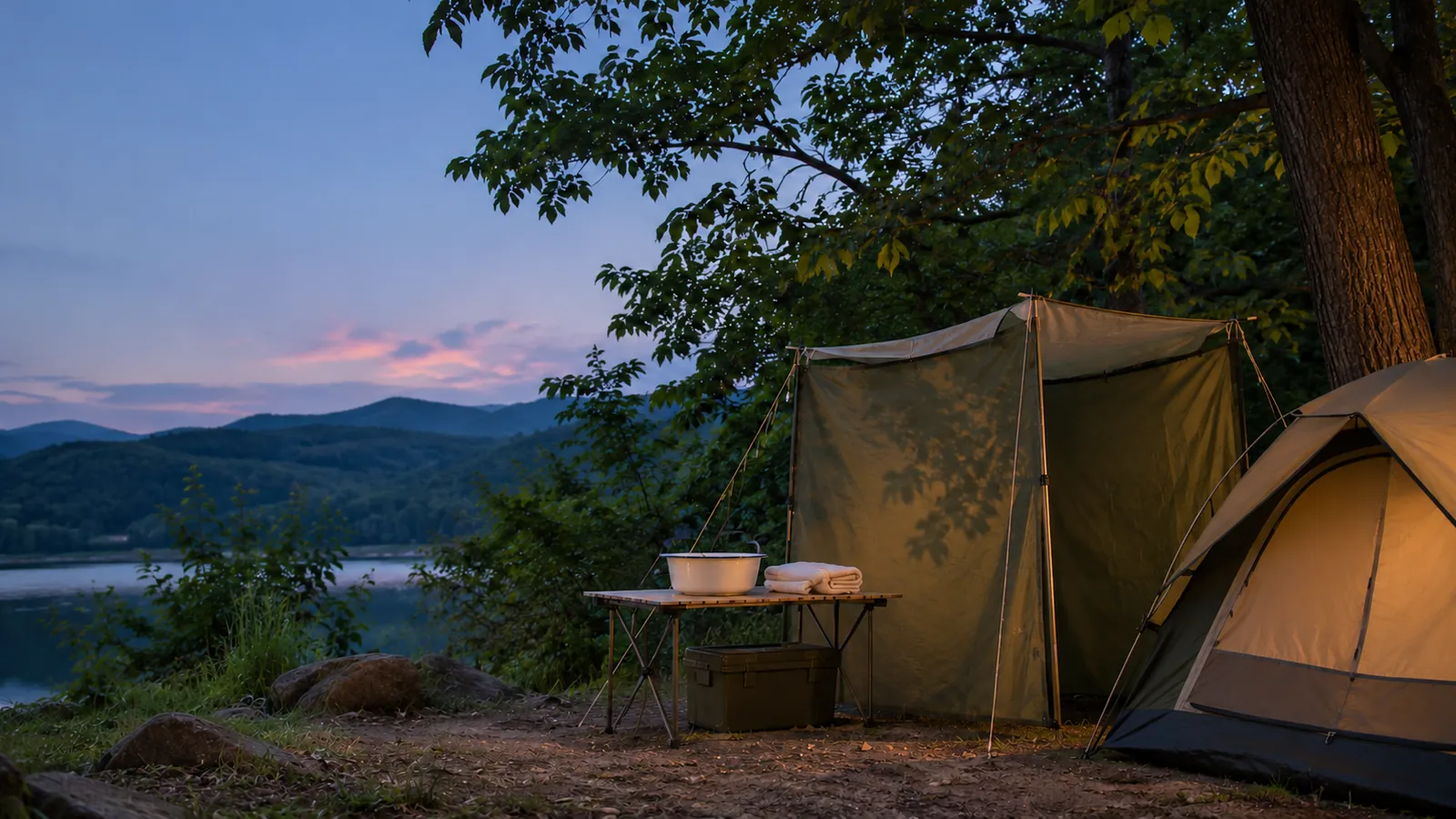
A portable camping shower is most useful as a short, planned rinse: bring only the water available after drinking and cooking needs, measure your setup’s flow, pause the spray while washing, and choose a private durable site away from water and camp. In cold weather, have dry clothes ready before anyone gets wet.
📋 Table of Contents
- 1. TL;DR
- 2. What a portable camping shower can and cannot do
- 3. Build a water budget around your routine
- 4. Estimate shower time from your real flow rate
- 5. Match the shower format to the trip
- 6. Warm water without guessing at a temperature
- 7. Create privacy without damaging the campsite
- 8. Choose a low-impact wash site
- 9. Make the setup work in cold weather and at altitude
- 10. A useful packing and setup checklist
- 11. Frequently Asked Questions
- 12. Is a camping shower worth it?
- 13. How long does a 5 gallon camp shower last?
- 14. What is the best way to shower while camping?
- 15. The short version
TL;DR
Plan the wash around the trip’s water supply and local campsite rules. Measure flow rather than trusting a generic runtime, use the smallest amount of soap that works, and follow the site’s graywater instructions. A basin and cloth can be the simpler choice when water, warmth, or privacy is limited.
What a portable camping shower can and cannot do
A portable shower solves a few specific problems well. It can direct a small amount of water where you want it, make rinsing easier than pouring from a bottle, and let you wash at a time that suits the campsite instead of waiting for a shared facility. A pump can make the stream easier to control. A privacy shelter can make changing less awkward. Neither turns a dry campsite into a campground bathhouse.
The useful question is not “How much does this look like a shower at home?” It is “What task needs clean water, and how much water am I willing to spend on it?” A rinse after a dusty hike, a quick wash before getting into a sleeping bag, and a full hair wash are different jobs. They have different water, time, privacy, and cleanup needs. Campers planning a broader campsite kit can also browse Olight’s outdoor collection.
For many campers, a basin and washcloth are the better first step. They are quiet, have fewer parts, and make it easy to stop using water between steps. A shower head becomes more useful when rinsing is the hard part: long hair, sandy feet, muddy legs, or a group that wants to share one water container without sharing a washcloth. A pump is most useful when gravity alone cannot place water comfortably or consistently.
| Need | Simple setup | When a pump shower adds value | Main trade-off |
|---|---|---|---|
| Face, hands, and underarms | Small pour bottle and cloth | Usually little | Least water, but not a full rinse |
| Dusty legs or feet | Basin, cup, or low-flow nozzle | Easier targeted rinse | More equipment and setup |
| Hair rinse | Container plus cup or nozzle | More convenient directional flow | Can use water quickly if left running |
| Shared group wash | Labeled containers and a planned sequence | Repeats a controlled routine | Requires privacy and graywater planning |
| Cold-weather cleanup | Warm cloth and dry layers | Only if the site and conditions support it | Wet skin and clothing can chill you |
A “shower” can also be a sequence rather than a continuous stream. Wet the area, stop the water, wash, then rinse. That small change often matters more than the advertised maximum flow of a nozzle. Continuous spray is convenient; controlled spray is easier to budget.
A portable setup also has limits. It does not make untreated water potable, guarantee a safe water temperature, or override campground rules. A pump may move water; it does not heat water unless the exact unit is specifically designed to do so. Sunlight can warm a dark water container, but the result depends on cloud cover, air temperature, wind, container color, fill level, and exposure time. Do not assume a container is comfortable just because it has been sitting in the sun.
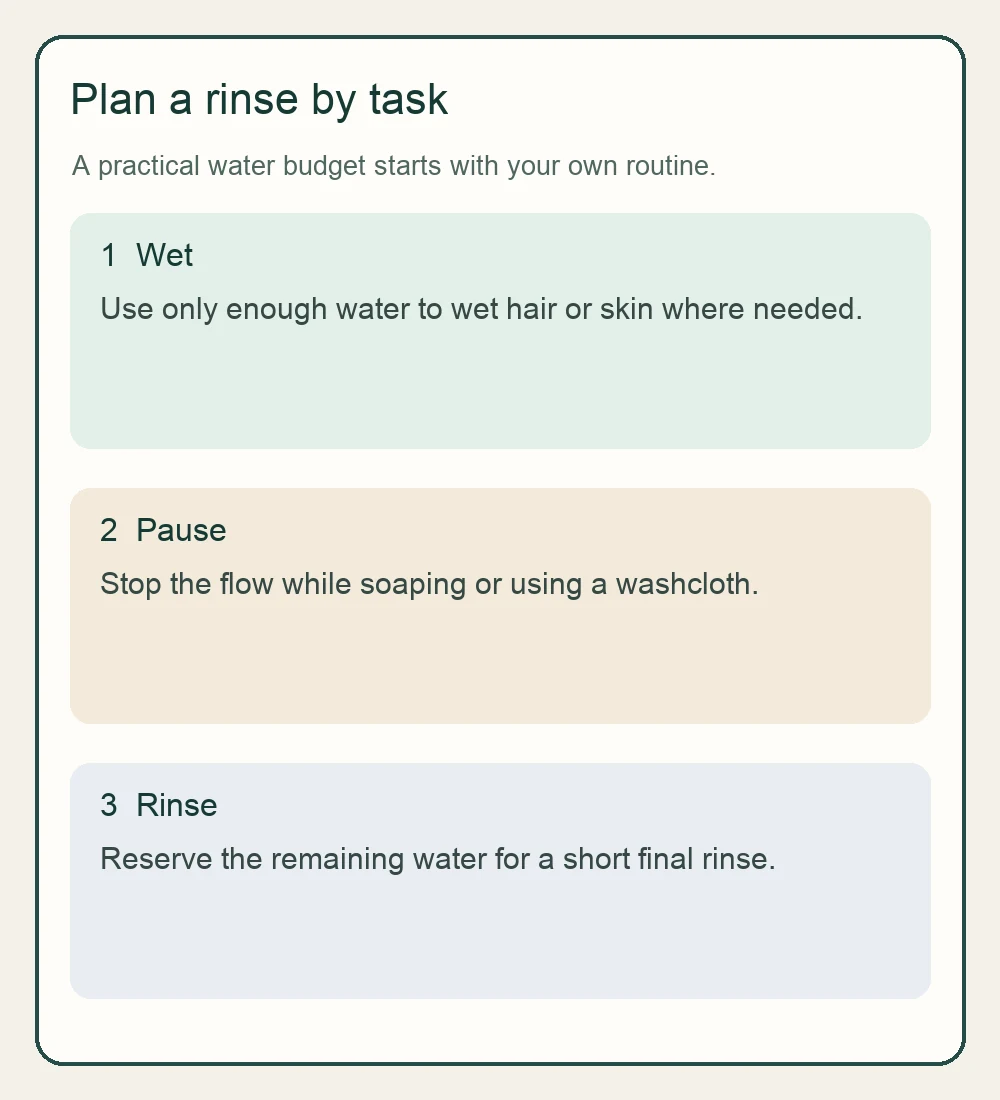
Illustration: A short rinse routine with the spray paused during washing. This is a process diagram, not a measured water-use result.
Build a water budget around your routine
Start with the water available at the campsite, not with a product’s largest advertised container. Some developed campgrounds have potable taps and showers. Some hike-in sites have no reliable refill. In dry regions, the same water may also be needed for drinking, cooking, handwashing, and an unexpected delay. Keep those needs separate before deciding how much can go to bathing.
A practical water budget has four parts:
- Essential water: drinking, food preparation, and any required personal needs.
- Shared hygiene water: handwashing or a quick cloth wash for more than one person.
- Rinse water: water reserved for a targeted rinse rather than an uninterrupted spray.
- Contingency: a reserve for a longer hike, a hotter day, a missed refill, or a change in plans.
Do not treat the contingency as spare shower water. The point of a reserve is that the plan can change without making the group choose between a rinse and hydration. If the site has limited water, consider a wipe-down or a washcloth routine and save a full rinse for a facility or a location where water is abundant and rules permit it.
A useful way to estimate personal use is to do one ordinary wash at home with the water turned off during the pauses. Catch the water used in a marked container, or read the meter if that is practical. Repeat the same routine with the same hair length and soap. This gives a personal planning estimate. It is not a universal camping standard: people, hair, temperatures, and routines vary.
If you cannot measure at home, make a small trial at camp before committing the group’s supply. Pour a known amount into the shower container, complete the planned routine, and note what remains. Use that observation for your next trip, not as a claim that every camper needs the same amount. A bit of masking tape on the container can mark a starting level and a reserve line.
A simple three-part rinse plan
Wet: Use a brief spray or a damp cloth to wet only the areas you plan to clean. Move hair aside before starting if the goal is a hair rinse. This avoids spending the first part of the water supply figuring out what to do next.
Wash: Stop the flow. Apply a small amount of soap to a cloth or hands if soap is appropriate at that site. Use a no-rinse option only when its label and the land manager’s rules allow it, and pack out wipes rather than leaving them behind.
Rinse: Restart with the nozzle close to the target area. Begin with the highest-priority rinse, such as soap from hair or grit from feet. If the water is running low, switch to a damp cloth rather than chasing a perfect, endless rinse.
This routine is easier with two containers: one for clean water and one basin for controlled washing or catchment when allowed. Label them. A cook pot should be clean before it returns to food use. Keep soap, dirty clothing, and wastewater away from the water source and from the food-preparation area.
Think in group routines, not only per-person amounts
For two or more campers, plan the order and reset between people. One person can manage the nozzle while another has a towel ready, but only if everyone is comfortable with that arrangement. In a family, set out each person’s clean clothes and towel before the first rinse. At a group site, a clear “clean water / used water” system prevents the classic camp mystery of a container nobody wants to claim.
A shared water plan can include a quick wash for everyone and a longer rinse for the person who needs it most. It does not have to be identical. Someone with dusty feet may need a targeted rinse while someone else is fine with a cloth wash. The fairest plan is the one that meets the real need without turning every wash into an open tap.
Estimate shower time from your real flow rate
A five-gallon container is a volume, not a promise of five gallons of shower time. Actual time depends on usable fill, the pump and nozzle, head height, battery condition, hose bends, and whether the water runs continuously. The most useful number is the flow rate from the exact setup you will take camping.
Measure it with a clean container and a stopwatch. Run the shower for a short, repeatable interval, such as 15 seconds. Measure the collected volume in ounces, cups, or liters. Multiply by four to estimate volume per minute. Repeat once with a fresh battery or the same power state you expect on the trip. If the device has adjustable flow, measure each setting separately and label the result as your setup’s measurement.
Flow per minute = collected volume in 15 seconds × 4.
Then calculate continuous spray time:
Continuous spray minutes = usable water volume ÷ measured flow per minute.
For example, if a particular setup collects 20 fluid ounces in 15 seconds, its measured flow is about 80 fluid ounces per minute under that test. A one-gallon supply contains 128 fluid ounces, so continuous spray would be roughly 1.6 minutes. This is an illustration of the arithmetic, not a claim about any product or shower. Your own nozzle may produce a different result, and repeated measurements may vary.
The formula estimates water-limited spray time, not how long the wash lasts on the clock. If the spray is stopped while you soap, the activity can take several minutes while using only a fraction of that time as actual spray. Conversely, a high-flow nozzle can empty a container quickly even if its pump has plenty of battery life. Battery runtime and water runtime answer different questions.
Before a trip, record four things: container volume at the start, measured flow setting, battery state, and water left after the routine. A tiny trip note makes the next plan more accurate. If the nozzle is shared, agree on the setting before starting rather than turning the first person into an accidental test subject.
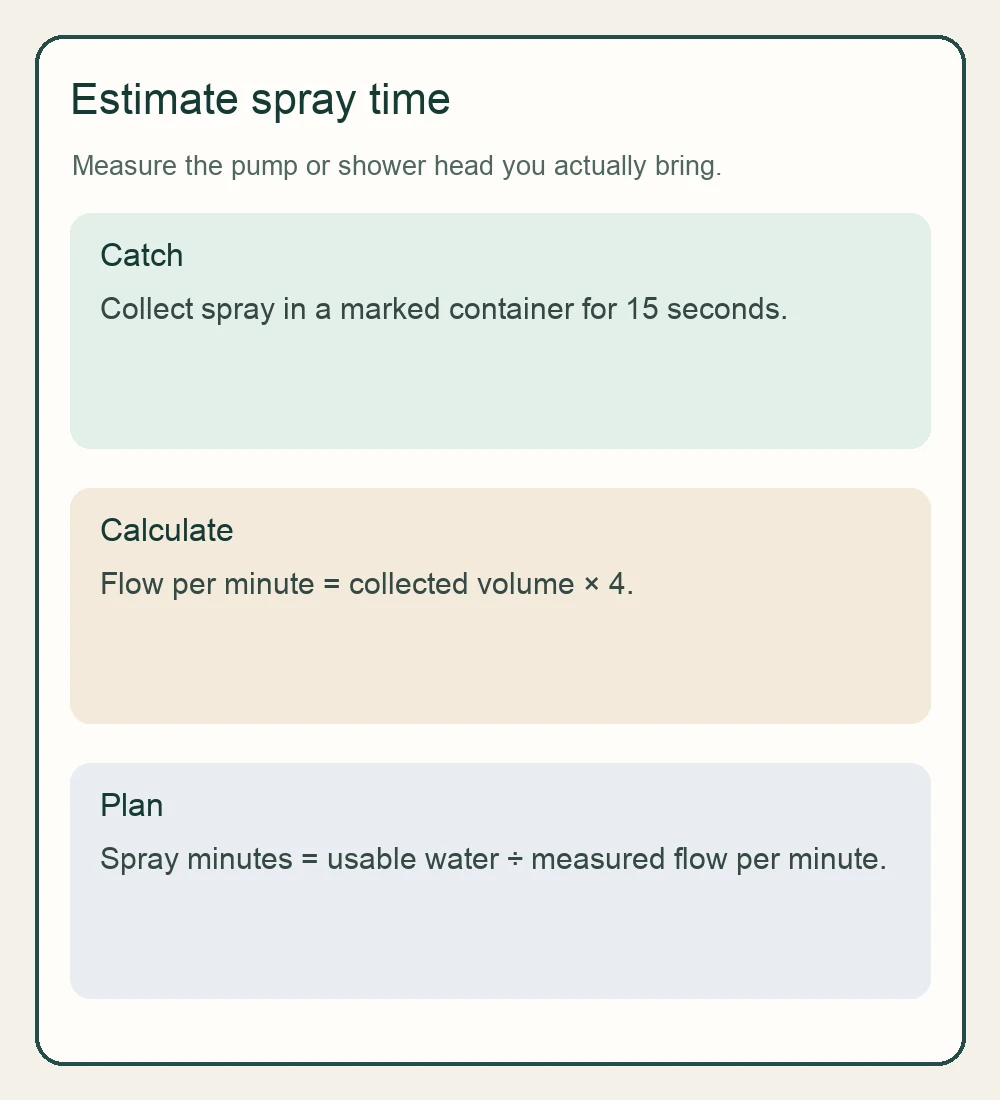
Illustration: Measure the flow from the exact shower setup before using the formula.
Match the shower format to the trip
For car camping, a portable shower can be a comfort item because the container and shelter do not have to be carried far. The deciding factors are usually campsite rules, privacy, water access, and where wastewater may go. Check whether the campground already has a shower building before packing a second one. A facility may be easier to heat, drain, and clean than a portable setup.
For backpacking, every container, pump, hose, battery, and shelter adds weight and volume. A small bottle and washcloth may meet the hygiene need with fewer parts. If the trip crosses dry terrain or has long stretches between reliable water sources, prioritize the water plan over a full shower. The shower can wait; the group’s drinking supply cannot.
For long hair, decide before filling the container whether a rinse is a priority. Comb out knots while dry, separate hair into manageable sections, and keep the spray close to the area being rinsed. A wide spray can feel pleasant but may use water faster than a narrow stream. If the rinse water runs out, a damp cloth can remove some residue, but it will not replace a full hair rinse. Pick the routine that fits the available water rather than promising a salon finish beside the trail.
For a group, plan one clean workflow. Keep a clean-water container closed except while filling or dispensing. Keep a separate basin for used water, and do not dip a dirty cloth into the clean container. Each camper can have a small labeled cloth or towel. This is a simple organizational step, but it keeps everyone from guessing which container is the rinse supply.
Check the equipment before it goes in the bag
Inspect the hose, nozzle, seals, and pump connections before departure. A slow leak can waste water while the setup sits on the ground. If the shower uses a rechargeable battery, check its state and charging instructions at home. Do not assume that “one charge” translates to a fixed number of showers: spray setting, pump design, battery condition, and how long the pump runs all matter. Measure water separately from battery runtime.
A first setup should be a dry run. Lay out the shelter, see whether the container hangs at the intended height, route the hose so it does not kink, and confirm that the spray can be turned off quickly. Practice without a person under it. This checks the arrangement without making anyone stand around wet while a hose is being untangled.
After use, empty the container and follow the manufacturer’s cleaning and storage instructions. Let parts dry before packing them away if the instructions permit. Store soap separately from clean-water equipment, and keep a small repair item only if it is compatible with the hose or seals. These checks are not glamorous, but they beat discovering a leaking connector after the last water refill.
Warm water without guessing at a temperature
Warm water can make a wash more comfortable, but “sun warmed” is not a temperature. A dark container in direct sunlight may warm faster than a light one, yet shade, wind, clouds, starting temperature, and container material can change the result. A container left in a vehicle or against hot surfaces may become hotter than expected. If comfort matters, check the water before it touches a large area of skin.
Three common approaches have different trade-offs:
| Approach | What it does well | What to watch |
|---|---|---|
| Sun-warmed container | No stove fuel and little setup | Heating is slow and weather-dependent; verify the water before use |
| Warm water mixed from a safe source | Lets you adjust a small amount at a time | Mix thoroughly and check temperature; avoid scalding hot spots |
| Cool or room-temperature rinse | Simple and predictable when conditions are mild | Can be uncomfortable or risky when a person is already chilled |
If using a camp stove to warm water, follow the stove and pot instructions, keep flames outside tents and enclosed spaces, and never leave heating water unattended. Transfer it carefully into a stable container and mix it with cooler water before use. Metal pots and hot water can burn; the outside may be hot even when the water looks calm. A camping shower pump is not a heater unless its manufacturer says it is.
A thermometer is more reliable than a hand hovering over a container. If a thermometer is unavailable, add warm water gradually, mix it, and test a small amount cautiously before a full rinse. Do not pour hot water directly onto skin or into a flexible bag that is not rated for it. Follow the container manufacturer’s temperature limits. There is no single ideal shower temperature for every person or setting.
A rinse can be shortened or skipped when the weather is cold, the wind is rising, or dry clothing is not ready. A warm washcloth for face, hands, and high-sweat areas may be a better trade than getting wet from head to toe. In hot weather, shade the wash area and do not leave a sealed container in direct sun if that can overheat it. Keep drinking water separate from water warmed in a non-food container.
Create privacy without damaging the campsite
Privacy is more than placing a fabric wall around a shower. The best setup also keeps the routine short, avoids walking through another campsite, and leaves the ground and vegetation intact. Check the campground map and posted rules first. Some sites prohibit portable shower tents, stakes, drainage, or washing in certain areas. A designated shower building is usually the simplest option when available.
A privacy tent gives a defined changing space, but it can be bulky and conspicuous. A tarp can be lighter and more flexible, but it needs secure anchors and may provide less coverage in wind. A vehicle hatch or door can screen one side, but never block traffic, access routes, or another camper’s space. A towel wrap or changing robe can be enough for a quick washcloth routine.
Choose the wash location before you unfold the shelter. Look for a durable surface where water will not pool around the tent, flow toward a stream, or cross a trail. Avoid fragile plants and crusts, unstable slopes, wildlife paths, and areas where graywater is prohibited. Do not dig trenches unless the land manager expressly requires or allows a specific method.
Set out the towel, dry clothes, sandals, soap, and water before changing. Keep a small bag for wet items. Put the phone and valuables away from splashes. If using a hanging water container, use a support point designed for that load and do not damage live trees or attach lines where they could injure wildlife. A shower is not a reason to create a new campsite anchor.
One practical trick is to separate “changing privacy” from “spray privacy.” If the actual wash can happen with a cloth at a discreet spot, the shelter may only need to cover changing. That reduces the amount of gear and setup, and it can make the whole routine easier in a crowded campground. For a family, establish a clear boundary and one person at a time; privacy rules should be agreed upon rather than improvised after the water is running.
Choose a low-impact wash site
Land-manager rules come first. They can differ between a national park, state park, forest, private campground, and backcountry zone. Read posted notices and ask the host when the graywater policy is unclear. A generic outdoor guideline cannot replace a site-specific rule.
The NPS camping hygiene guide recommends bathing at least 200 feet from camp and water. Some park-specific rules also name trails: Point Reyes backcountry guidance tells campers to carry wash water at least 60 meters (200 feet) from water sources, trails, and campsites. These are local examples, not one rule for every campground. Bring water to the wash spot rather than washing directly in a lake or stream.
Even biodegradable soap can affect water quality. Use the smallest amount that works, and do not assume “biodegradable” means “safe to use in a waterway.” Use the NPS guidance to carry water away from water sources and use little soap; then follow the campground or land manager’s specific wastewater instructions. Some places ask campers to scatter graywater; others have different instructions. Follow the local rule rather than treating one method as universal.
Keep wastewater separate from drinking-water containers. If a site permits scattering, spread it broadly on durable ground away from water, camp, and trails, and avoid leaving food particles or scented residue. If the site requires pack-out or a designated drain, do that. Do not dump graywater into a storm drain, sink, or campground faucet unless the site specifically directs it.
Privacy and low impact often point to the same location: a discreet, durable spot away from shared paths and water. The site should still be easy to reach safely in low light and should not force a long walk in wet clothing. Pick the route before bathing, use a light if necessary, and leave the area cleaner than it was found.
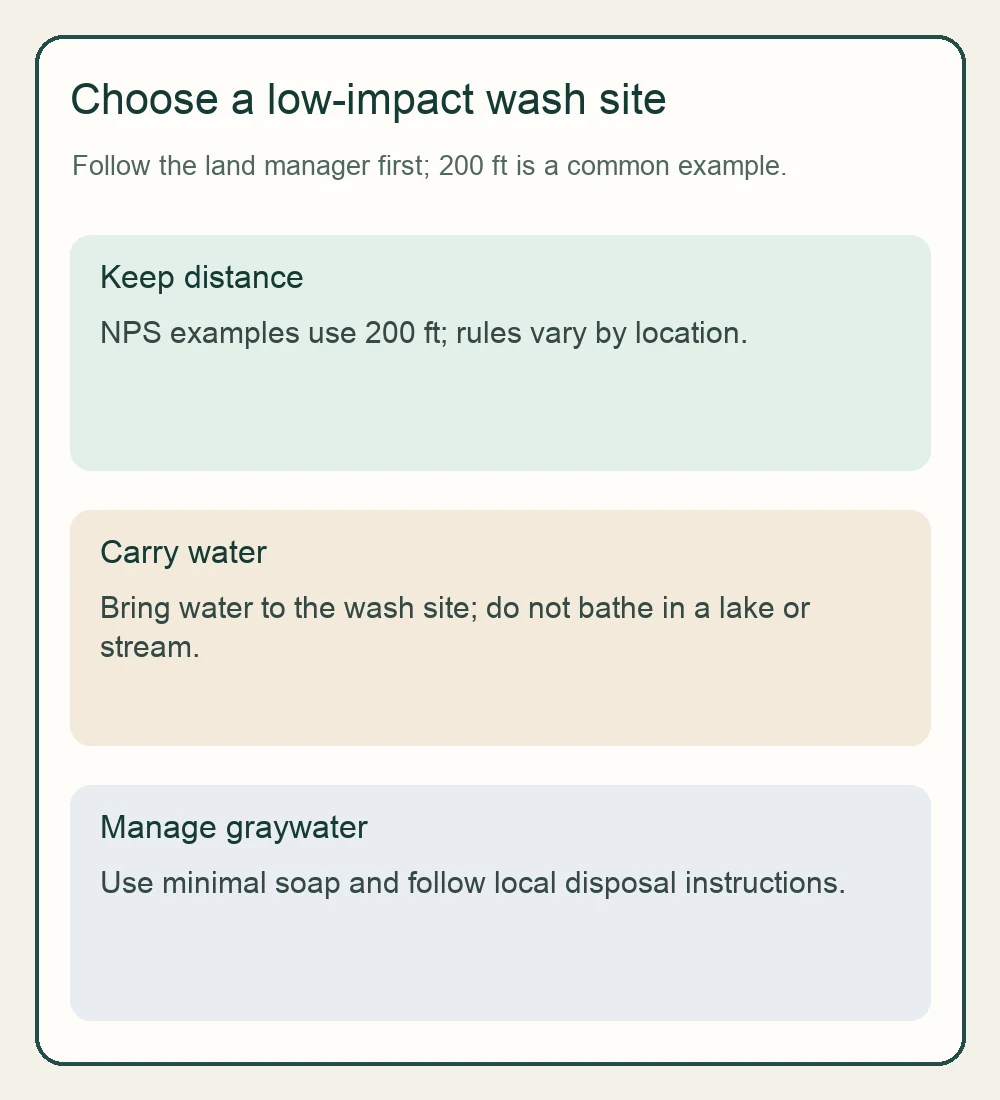
Illustration: A 200-foot separation is common guidance in the cited sources; local instructions take precedence.
Make the setup work in cold weather and at altitude
Cold changes the calculation. A rinse that feels refreshing after a warm hike can become unpleasant when the wind picks up or the sun drops. Wet skin and clothing lose heat faster, and the CDC notes that hypothermia can happen even above 40°F when someone is wet and becomes chilled. CDC cold-weather guidance recommends getting out of the cold, removing wet clothing, and warming the person if hypothermia is suspected.
For ordinary camp hygiene, plan the exit before the water starts. Have a towel and dry layers within reach, use a sheltered spot, and keep the wash short. Shivering, exhaustion, confusion, fumbling hands, memory loss, slurred speech, and drowsiness can be warning signs of hypothermia. Treat suspected hypothermia as urgent: get the person into warm shelter, remove wet clothing, and seek medical attention promptly. Do not wait for symptoms to worsen.
At altitude, wind and changing weather can make a wet wash harder to manage. That is a practical planning concern, not a reason to assume a specific water temperature or heating time. Check the forecast, use the warmest part of the day when feasible, and keep the option of a cloth wash. If the weather deteriorates, comfort and safety outweigh a full shower. For a broader trip plan, Olight’s guide to desert camping at night covers temperature swings and other preparation concerns.
In winter, keep the pump, hose, and water container from freezing. Follow the maker’s storage and temperature guidance; water left in a hose or pump may freeze before a larger container does. Drain equipment after use if the instructions call for it. Do not pour boiling water into a cold plastic reservoir to thaw it. A cloth wash with a small amount of warm water may be the more dependable choice.
Water heating deserves extra care at elevation too. A stove may behave differently in wind or cold, and the time to warm water varies with volume, pot, flame, and starting temperature. Rather than relying on a generic “minutes to hot” number, heat only the quantity needed, protect the stove from wind according to its manual, and check the water directly. Keep combustion devices outside tents and enclosed spaces.
A useful packing and setup checklist
Before leaving
- Confirm whether the campsite has a shower, potable water, and a graywater rule.
- Decide whether the trip calls for a full rinse, targeted rinse, or washcloth routine.
- Measure the setup’s flow rate at home if a pump shower is part of the plan.
- Pack bathing water separately from drinking and cooking reserves.
- Bring a towel, dry clothes, a small basin or catch container, and a wet-item bag.
- Check the shower container, hose, pump, seals, battery, and charging method.
- Confirm that soap and wipes are allowed; plan to pack out wipes.
At camp
- Read posted instructions and identify the permitted wash area.
- Carry water to a durable, private spot away from streams, lakes, trails, and campsites according to local guidance.
- Set out everything needed before undressing.
- Test the water temperature and confirm that the container and hose can handle it.
- Wet, pause, wash, and rinse. Keep the spray off while soaping.
- Collect or dispose of wastewater exactly as the site directs.
- Dry, change into warm clothes if needed, and pack out all wipes and trash.
- Drain and store the pump and hose according to their instructions.
The best setup is the one the group will actually use correctly. If a complicated shelter and pump make a five-minute cleanup into a half-hour construction project, simplify it. A small cloth, a container with a known fill line, and a dry change of clothes can be a better system than an elaborate shower that never leaves the trunk.
Frequently Asked Questions
Is a camping shower worth it?
It can be worth packing when a targeted rinse solves a real problem, such as sandy feet, dusty legs, or a hair rinse at a site without facilities. It is less useful when water is scarce, temperatures are low, or a washcloth routine already does the job. Compare its weight and setup time with the comfort it adds on the trips you actually take.
How long does a 5 gallon camp shower last?
There is no single runtime. Five gallons is about 18.9 liters, but spray time depends on the actual nozzle flow and usable fill. Measure the setup: collect spray for 15 seconds, multiply that volume by four to estimate flow per minute, then divide usable water by that flow. Pausing while washing extends elapsed time without changing the amount of water used.
What is the best way to shower while camping?
Check the site rules, carry water to a private durable spot away from water and camp, and use a short wet-pause-wash-rinse routine. Keep the spray off while soaping, use minimal soap where allowed, and follow the local graywater rule. In cold or windy weather, choose a quick cloth wash or a facility instead of getting wet outside.
The short version
A portable camping shower is a useful tool when it fits the campsite, water supply, weather, and cleanup rules. A measured flow rate makes the water plan personal; a pause between wetting and rinsing keeps spray from running while no one needs it. Warmth and privacy come from preparation as much as equipment. Set out dry clothes, choose the wash site first, and let the land manager’s rules decide what happens to the wastewater.
Changelog
- November 19, 2026: Product information and buying guidance reviewed.




