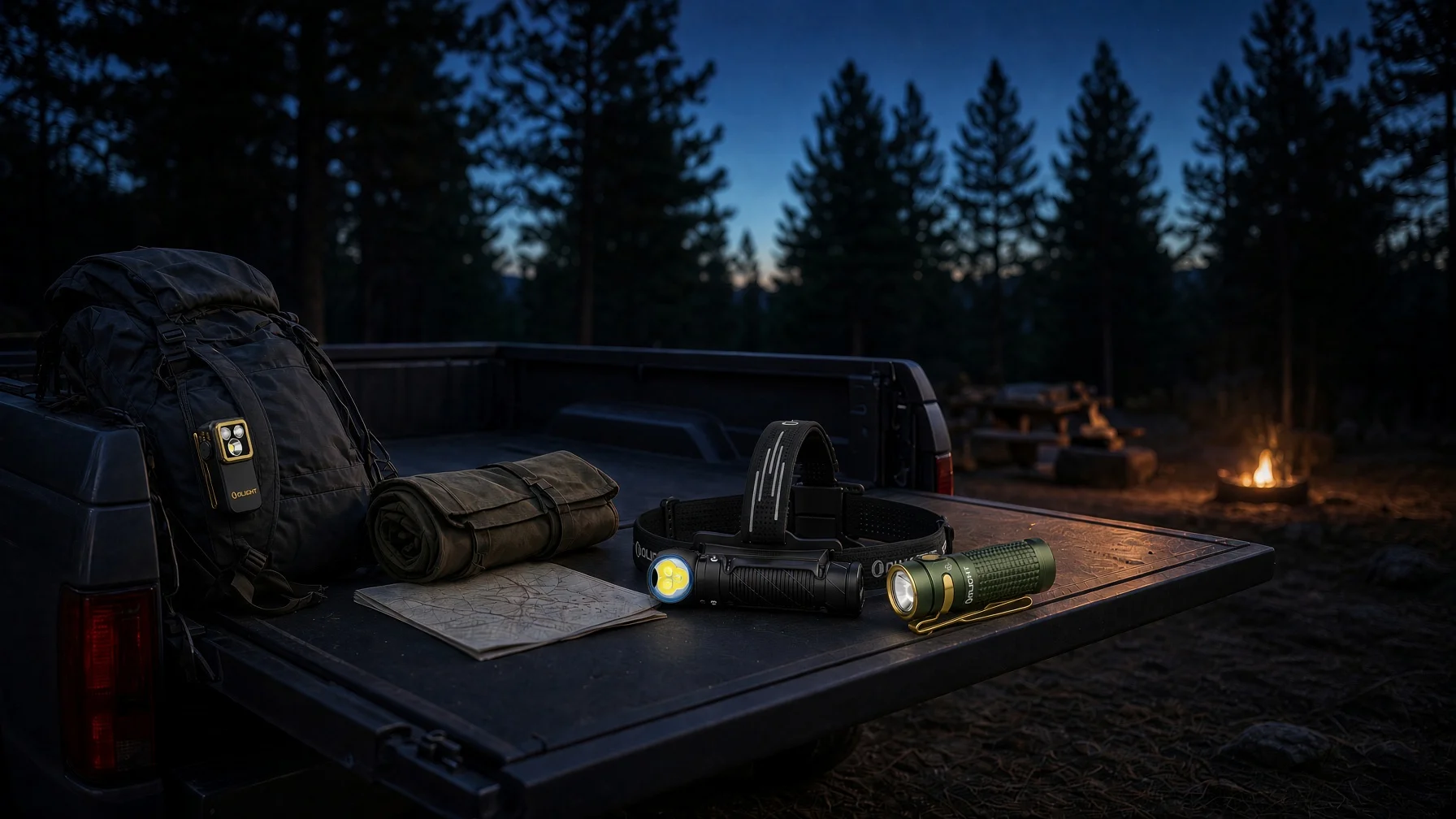
Olight makes some of the lights and mounts discussed here. Olight specs and prices come from its product pages as of September 2026; rail dimensions come from the military standard, Magpul and the other makers linked in each section.
⚡ TL;DR
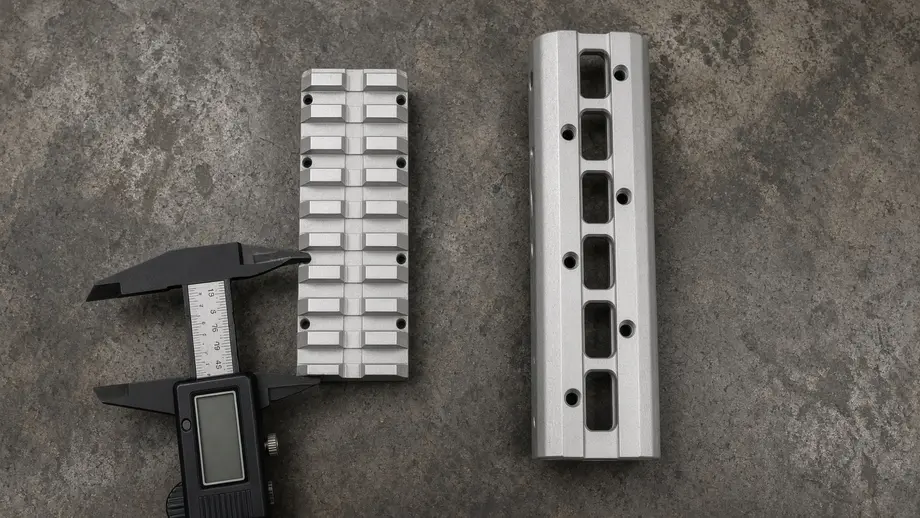
Picatinny vs M-LOK comes down to a raised rail versus holes in the handguard. Picatinny (MIL-STD-1913) is a rail with cross slots 0.394 in apart. M-LOK is a row of 7 mm by 1.260 in windows cut into the handguard itself. A light mount made for one will not fit the other, so check which system you have before you order a mount.
This table gives the quick answer for the five rail types you are most likely to find on a rifle, shotgun or pistol.
| System | What it looks like | Number to check | Takes a Picatinny light mount? | What to buy |
|---|---|---|---|---|
| Picatinny (MIL-STD-1913) | Raised rail with evenly spaced cross slots | 0.206 in slot width, 0.394 in slot spacing | Yes | Any 1913 mount |
| M-LOK | Long rectangular windows in the handguard | 7 mm (0.276 in) wide, 1.260 in long | Only with a Picatinny rail section | A direct M-LOK mount, or a short M-LOK rail section |
| Weaver | Raised rail with narrower, often uneven slots | 0.180 in slot width | Not if the mount has a full-size Picatinny lug | A mount labeled Weaver compatible |
| KeyMod | Keyhole shaped slots | Keyhole shape, not a rectangle | Only with a KeyMod rail section | A KeyMod mount or rail section |
| Pistol rails (1913, Glock and proprietary) | Short rail under the dust cover | Number and width of cross slots | Depends on the light's key | A light with the key for your pistol |
The problem most first-time buyers hit is simple. The slots on handguards all look alike in product photos, so the mount arrives and the screws don't line up, or the clamp slides loose in a slot that is too wide. A pistol light can wobble on the rail even when it seems to click in. The sections below cover each system by the numbers, then show which Olight mount fits which rail.
📋 Table of Contents
- 1. Picatinny vs M-LOK Dimensions: Slot Width, Spacing and Fasteners
- 2. Are M-LOK and Picatinny Compatible?
- 3. Is Picatinny Obsolete?
- 4. Are There Any Disadvantages to Using M-LOK?
- 5. What Is the Difference Between M-LOK and KeyMod?
- 6. Does a Weaver Mount Fit a Picatinny Rail?
- 7. Why Pistol Rails Are Different: 1913, Glock and Proprietary Rails
- 8. Where Should You Mount a Weapon Light: 3, 6, 9 or 12 O'Clock?
- 9. Do Rail Adapters Affect Zero and Return to Zero?
- 10. Which Olight Mount Fits Your Rail?
- 11. Common Misconceptions About Rail Compatibility
- 12. How to Install a Weapon Light Mount Step by Step
- 13. Your Rail Compatibility Buying Checklist
- 14. FAQ
Picatinny vs M-LOK Dimensions: Slot Width, Spacing and Fasteners
Picatinny and M-LOK use different geometry and different fasteners. A MIL-STD-1913 rail is 0.835 in wide across the top, with cross slots 0.206 in wide, 0.118 in deep and 0.394 in apart, center to center. M-LOK slots are 7 mm wide and 1.260 in long, with 8 mm of material between them. Accessories lock in with T-nuts that turn 90 degrees.
The Picatinny numbers come straight from the drawings in MIL-STD-1913, Dimensioning of Accessory Mounting Rail for Small Arms Weapons, dated February 3, 1995. The standard calls the rail "a grooved dovetail feature that serves as a mounting platform used to mount accessories." Its recoil grooves exist to stop "forward and aft movement of an accessory."
M-LOK is not a military standard. Magpul describes it on its M-LOK system page as "a direct attachment method for hard mounting accessories to a negative space mounting point," released in 2014 as a free licensed platform. The slot sizes below come from licensee Daniel Defense's M-LOK vs Picatinny guide.
This parameter table puts the key numbers side by side, with a note on how to judge each one.
| Parameter | Unit | Picatinny (MIL-STD-1913) | M-LOK | How to use the number |
|---|---|---|---|---|
| Slot width | in (mm) | 0.206 (5.23), up to +0.008 | 0.276 (7.0) | Calipers tell you which system you have in seconds |
| Slot length | in | Runs the full width of the rail | 1.260 | A long window means M-LOK or KeyMod, not a rail |
| Slot spacing | in (mm) | 0.394 (10.0) center to center | About 1.575 (40) from slot to slot | Sets how finely you can move a mount fore and aft |
| Slot depth | in | 0.118, up to +0.008 | Through the handguard wall | Picatinny clamps grip the rail; M-LOK nuts grip the wall |
| Top width | in (mm) | 0.835 (21.2), minus up to 0.005 | No rail; flush with the handguard | Clamp mounts are sized to this width |
| Fastener | n/a | Cross bolt, thumbscrew or lever clamp | T-nut that turns 90 degrees | Tells you which tools you need |
| Max install torque | in-lb | Set by each mount maker | 35 metal on metal, 15 with polymer | Never exceed the maker's value |
The M-LOK slot spacing is a calculation: a 1.260 in slot plus 0.315 in of material gives about 1.575 in from one slot to the next. One M-LOK step spans about four Picatinny slots. Magpul notes that an M-LOK accessory "can be adjusted in 20mm increments," which is half of that 40 mm pitch.
Because this topic involves a published standard, this table turns the MIL-STD-1913 clauses into plain instructions.
| MIL-STD-1913 clause | What it says | What it means for you |
|---|---|---|
| 1.1 Scope | Rails should be "interchangeable among the different units of the Defense Department" | A true 1913 mount fits any true 1913 rail |
| 3.4 Recoil groove | The groove "prevents forward and aft movement of an accessory" | The mount's cross bolt must sit in a slot, not on the flat |
| Figure 2 note 2 | "Center to center dimension applies between adjacent grooves" | Slot spacing is fixed at 0.394 in, so lugs line up anywhere |
| 5.3 Length | Rail length "is dependent upon the particular application" | Count the free slots before you buy a mount |
| 6.3 Application | Placement should consider "the effect on the arms user" | Place the light where your hand can reach the switch |
Are M-LOK and Picatinny Compatible?
M-LOK and Picatinny are not directly compatible. A Picatinny clamp has nothing to grip on a flat M-LOK handguard, and M-LOK T-nuts cannot lock into a raised rail. You connect them with a short M-LOK rail section that bolts into the slots and gives you Picatinny grooves, or you skip the rail and buy a light mount made for M-LOK.
There are only a few practical paths, and each one changes height, weight and cost. This table maps them out.
| Your handguard | Your light or mount | What connects them | Trade-off |
|---|---|---|---|
| M-LOK | Picatinny clamp mount | M-LOK Picatinny rail section (2 or more slots) | Adds height and a second joint |
| M-LOK | Light sold with an M-LOK mount | Nothing extra | Lowest profile; mount tied to M-LOK |
| Picatinny (quad rail or top rail) | Picatinny clamp mount | Nothing extra | Bulkier handguard; easy to move lights between guns |
| Picatinny | Light sold with an M-LOK mount | Swap to the maker's Picatinny mount | Buy a second mount |
| KeyMod | Picatinny clamp mount | KeyMod rail section | Same as the M-LOK section path |
Method Dynamics, a mount maker, sums up the downside of stacking adapters in its Picatinny vs M-LOK light mount guide: the adapter "adds the very height that M-LOK was designed to save." If your light comes with both mount types, use the direct one.
Tip: Before you buy a rail section, count the M-LOK slots at the spot where your support hand can reach the light switch. A 2-slot section needs two open slots in a row.
Is Picatinny Obsolete?
Picatinny is not obsolete. MIL-STD-1913 still defines the top rail on most AR-style uppers, the accessory rail on many pistols, and the rail sections that M-LOK and KeyMod handguards bolt on to accept standard mounts. What has faded is the full-length quad rail handguard, which many modern rifles have traded for slimmer M-LOK designs.
The 2017 NSWC Crane presentation to the National Defense Industrial Association, KeyMod vs M-LOK Modular Rail System Comparison, notes that "MIL-STD-1913 Quad-rail Handguards currently in use" at the time included the MK18 Mod 1 carbine. It also describes the shift: "Industry developed, low profile handguards with 'as needed' accessory mounting panels."
Pistols tell the same story. Streamlight's TLR-7 and TLR-8 compatibility list, revised July 15, 2026, assigns a 1913 rail key to Gen 5 Glocks, the SIG M17 and M18, the H&K VP9 and many other current pistols.
So the choice is where each system goes. Picatinny stays the default on top rails and pistol dust covers. M-LOK now covers most rifle handguards.
Are There Any Disadvantages to Using M-LOK?
M-LOK has three main disadvantages. It needs tools and correct T-nut setup, so it is slower to change than a Picatinny lever clamp. It is less forgiving of bad installation: Crane measured an average 18.4 MOA shift when M-LOK parts were installed at the wrong angle. And lights or lasers made with a Picatinny foot need an extra rail section.
Magpul's own M-LOK installation tips show where things go wrong. The T-nut gap must be "slightly greater than the thickness of the mounting surface." If the nut sits too far out, it "will rotate freely without stopping and tightening." If it sits too close, the nut "will not rotate into place" and clamps against the accessory instead of the handguard.
There are smaller trade-offs too:
- Slower swaps between guns. Moving an M-LOK mount means loosening screws and retorquing. A Picatinny lever clamp moves in seconds.
- Coarser position steps. Magpul lists 20 mm steps for M-LOK, against 0.394 in (10 mm) for Picatinny slots.
- Hardware wear. Magpul notes the nylon patch on the screws "may eventually wear" after many installs and can be restored with a blue threadlocker stick.
- Polymer handguards need care. On polymer, the T-nuts "may embed slightly" into the surface, and Magpul's maximum torque drops to 15 in-lb.
None of these outweighs M-LOK's lower weight and smaller profile on a rifle you set up once. They matter if you move one light between several guns.
What Is the Difference Between M-LOK and KeyMod?
M-LOK uses rectangular slots and T-nuts that rotate 90 degrees to lock. KeyMod uses keyhole shaped slots: you drop the nuts through the wide end, slide the part forward into the narrow end and tighten. In a Naval Surface Warfare Center (NSWC) Crane evaluation, M-LOK held its position far better after repeated installs and stayed attached through every drop.
KeyMod came first. Crane lists it as "Originated by VLTOR Weapon Systems and released in 2012." Crane bought matching KeyMod and M-LOK handguards from three makers (Aero Precision, Midwest Industries and Seekins), for 18 handguards in total. It then ran repeatability, endurance, rough handling, drop and failure load trials.
This table pulls the headline results from the Crane presentation.
| Trial | KeyMod | M-LOK | What it tells a light owner |
|---|---|---|---|
| Repeatability: average point of aim shift after 5 reinstalls | 4.9 MOA | 1.3 MOA | M-LOK returned closer to zero |
| Repeatability: largest single shift | 14.6 MOA | 6.6 MOA | Both can shift; check a laser after remounting |
| M-LOK installed at the maximum wrong angle | n/a | 18.4 MOA average | Installation matters more than the system |
| Endurance: 10,200 simulated rounds | No failures or loosening | No failures or loosening | Both hold a light under recoil |
| Drop: 6 drops from 5 ft onto steel | 1 of 3 rails stayed attached | 3 of 3 stayed attached, 2 slid rearward | M-LOK kept the light on the gun |
| Failure load | Baseline | Average over 3 times higher | M-LOK failed at the light mount, not the handguard |
Two details matter for weapon light owners. Crane mounted a weapon light "at 9 o'clock position" for the endurance and rough handling trials, and a simulated weapon light on the rail for the drop and failure load trials, so these are light-mount results, not just optic results. And in the failure load trial, "All M-LOK system tests failed at weapon light mount or mount to accessory rail interface." The handguard outlasted the light mount.
KeyMod and M-LOK parts do not interchange. If your rifle has a KeyMod handguard, buy a KeyMod rail section, then use a standard Picatinny light mount on it.
Does a Weaver Mount Fit a Picatinny Rail?
A Weaver mount usually fits a Picatinny rail, but a Picatinny mount often does not fit a Weaver rail. Weaver slots are 0.180 in wide, while Picatinny slots are 0.206 in wide and evenly spaced. A narrow Weaver cross bolt drops into the wider Picatinny slot. A full-size Picatinny lug is about 0.026 in too wide for a Weaver slot.
Weaver's own guide, Picatinny vs Weaver Rails: What's the Difference and Why It Matters, puts it plainly: "Weaver rails don't have a standardized spacing," and "A Picatinny-only accessory will not fit on a Weaver rail if it has a full-size Picatinny recoil lug."
Scope mount maker Warne explains the extra play in its Weaver vs Picatinny base guide. A Weaver-size lug has "more forward and back play in a picatinny slot," and Warne's fix is to push the mount forward before tightening. That seats the recoil key against the front of the slot, where recoil pushes it anyway.
To tell the two apart, measure a slot with calipers. About 0.18 in means Weaver. About 0.21 in means Picatinny. Uneven gaps between slots also point to Weaver. You will mostly see Weaver bases on older hunting rifles and airguns, not on modern handguards.
Why Pistol Rails Are Different: 1913, Glock and Proprietary Rails
Pistol rails are short, and the cross slot a light's key locks into is not the same on every frame. Some pistols use a 1913-style slot. Glocks up to Gen 4 use a Glock-style slot that light makers key separately. Several small carry pistols use closed or proprietary rails. A pistol light fits only if its key or insert matches your frame.
Streamlight's compatibility list shows how much this varies. The TLR-7 and TLR-8 ship with interchangeable keys, and the list pairs each pistol with one. This table reproduces a sample.
| Pistol (Streamlight list) | Rail key Streamlight assigns | What that tells you |
|---|---|---|
| Most Glock full-size and compact models with rails, up to Gen 4 | UNIV-1 | Glock-style slot, not 1913 |
| Most Glock full-size and compact models with rails, Gen 5 | 1913-1 | Same brand, different key by generation |
| Springfield Armory XD and Hellcat Pro | UNIV-1 | Not only Glocks use this style |
| Beretta APX | UNIV-1, "Loosely front to back" | A key can fit and still allow play |
| SIG SAUER 320 Carry and Full Size, M17/M18 | 1913-3 | 1913 slot, different key position |
| Smith & Wesson M&P (Full Size) | 1913-2 | 1913 slot, different key position |
| Heckler & Koch VP9/VP40 | 1913-1 | 1913 slot |
Small carry pistols add a third category. Streamlight's TLR-7 X sub page lists separate fits for the SIG SAUER P365 and P365 XL "(closed rail systems)," the Springfield Armory Hellcat, and the Glock 43X and 48 in both MOS and Rail versions. It also warns that the P365 and XL models "do not fit the P365 XMACRO," which uses a 1913-style rail.
For Olight pistol lights, the Baldr S product page says it is "Compatible with both Glock (insert already installed) and Picatinny sized rails (insert included in the package)." The Baldr Pro R and Baldr Mini pages list GL and PIC rails. The Olight user manuals for the Baldr Pro R and Baldr Mini say each light "can be used on most Glock or Picatinny" rails, with the GL adapter installed at the factory and a 1913 adapter in the box. The Baldr Pro R manual adds one check: "Make sure that the adapter fits inside your rail notch." The manuals do not name Glock generations. On a Gen 5 Glock, where Streamlight switches to a 1913 key, try both the GL and the 1913 adapter and keep the one that locks up with no play. Olight does not list a closed-rail P365 or Hellcat fit for these Baldr models.
Tip: A correct pistol fit has no fore and aft play once the clamp is closed. If the light rocks, try the other insert or key. If neither sits tight, that light is not made for your rail.
Where Should You Mount a Weapon Light: 3, 6, 9 or 12 O'Clock?
Mount the light where your support hand can work the switch without changing grip, and where the barrel blocks as little of the beam as possible. On a rifle, that usually means a side position at 3 or 9 o'clock, or an offset slot at 1 or 11 o'clock. The 6 o'clock spot suits bottom-rail pressure switches. The 12 o'clock rail usually belongs to your optic.
Each position trades something. This table compares the common choices for a right-handed shooter; flip the sides if you shoot left-handed.
| Position | Switch access | Barrel shadow | Snag and bulk | Best fit |
|---|---|---|---|---|
| 12 o'clock | Hard to reach without a remote switch | Least, but competes with the optic | Adds height on the top rail | Short rails with no side slots |
| 11 o'clock offset (M-LOK) | Support thumb reaches the tail switch | Low | Tucked close to the handguard | Most M-LOK rifles with offset slots |
| 9 o'clock | Support thumb or remote switch | Shadow falls on the right side | Wider profile | Handguards with side slots only |
| 3 o'clock | Needs a remote switch for most grips | Shadow falls on the left side | Wider profile on the firing side | Left-handed shooters |
| 6 o'clock | Remote switch or support fingers | Moderate | Can crowd a bipod or grip | Shotguns and short handguards |
Barrel shadow is simple geometry. The farther the light sits behind the muzzle and off to one side, the more of the beam the barrel, muzzle device or suppressor blocks. Pushing the light forward to the front slots and closer to the bore line reduces it. The 9 o'clock position is also the one Crane used for the weapon light in its endurance and rough handling trials, so those results apply to a common real-world setup.
Your mount type changes the math. Method Dynamics lists a typical light center of "~1.0 to 1.3 in" from the handguard with a Picatinny mount and "~0.6 to 0.9 in" with an M-LOK mount. On an M-LOK rifle, a direct mount keeps the light about half an inch closer. For a full walkthrough of rail mount hardware, see Olight's guide to rail mount options for a tactical flashlight.
Do Rail Adapters Affect Zero and Return to Zero?
An adapter can shift your point of aim, but for a white light that shift rarely matters. It matters for a laser or aiming module. In Crane's evaluation, M-LOK rails moved an average 1.3 MOA after each reinstall, and KeyMod rails 4.9 MOA. Every added joint, such as an M-LOK rail section under a Picatinny clamp, is one more place for that kind of shift.
Crane measured this with "a laser sight mounted on a 9-slot accessory rail," zeroed to a boresighter. It removed and reinstalled the rail five times "without re-zeroing the laser sight." The numbers only become useful once you turn them into inches at the distances where you would use a weapon light.
This table converts Crane's shifts into inches, using 1 MOA as about 1.047 in at 100 yards.
| Shift (Crane) | At 10 yards | At 25 yards | At 50 yards |
|---|---|---|---|
| 1.3 MOA (M-LOK average, correct install) | 0.14 in | 0.34 in | 0.68 in |
| 4.9 MOA (KeyMod average) | 0.51 in | 1.28 in | 2.57 in |
| 6.6 MOA (M-LOK largest single shift) | 0.69 in | 1.73 in | 3.45 in |
| 14.6 MOA (KeyMod largest single shift) | 1.53 in | 3.82 in | 7.64 in |
| 18.4 MOA (M-LOK installed at the wrong angle) | 1.93 in | 4.82 in | 9.63 in |
Read the table two ways. For a white light, even the worst case moves the hotspot a few inches at room distance, which you would not notice. For a green laser like the one on the Olight Odin GL or Baldr Pro R, a 4.82 in shift at 25 yards can put the dot off a small target, so re-check the laser after every remount.
You can shrink the shift with one habit. Magpul says to "bias" an M-LOK accessory before final tightening. That means applying "just enough lateral pressure to the accessory to make solid contact with one side and the front (towards muzzle) of the slot." Warne gives the same advice for Picatinny and Weaver: push forward, then tighten.
Warning: Always unload the firearm, remove the magazine and check the chamber before you install or adjust any light, laser or mount. Never point a laser at people, vehicles or aircraft, and never look into the emitter.
Which Olight Mount Fits Your Rail?
Olight lights mount in three ways. Odin rifle lights use a slide rail mount that comes in Picatinny or M-LOK versions, and the other version is sold separately. Baldr pistol lights use swappable GL and PIC inserts for pistol rails. Handheld Warrior lights clamp to a Picatinny rail with the E-WM25 mount. Match the mount to your rail first, then the light. For the full lineup of weapon lights by mount type, browse Olight's rail mount lights.
This compatibility table uses Olight's product page wording for each model, checked on September 24, 2026.
| Olight light | Mount in the box (Olight) | Fits directly | For the other rail | Price (as of September 2026) |
|---|---|---|---|---|
| Odin | Slide rail mount with mechanical lock; "Pic Rail Adapter x 1" | Picatinny | "Compatible with MLOK rails with the optional MLOK Adapter" | $159.95 |
| Odin Mini | "M-LOK Rail Mount x 1," M-LOK socket screws and nuts | M-LOK | "Compatible with Picatinny rails with the optional Pic Rail Adapter" | $139.95 |
| Odin IR | "Picatinny Rail Mount x 1" | Picatinny | "Compatible with MLOK rails with the optional MLOK Adapter" | $169.95 |
| Odin GL M | "M-LOK Rail Mount × 1," M-LOK nuts and screws | M-LOK | Buy the Odin GL P edition; the Pic Rail Adapter "is not compatible with Odin GL M" | $209.95 |
| Odin GL P | "Picatinny Rail Mount × 1" | Picatinny | Needs a Picatinny section on M-LOK; Picatinny Black shown as sold out | $209.95 |
| Odin S | Integrated bracket with a screw-locking rail clamp | The edition you buy | Buy the M-LOK or Picatinny edition; Picatinny Matte Black shown as sold out | $149.99 |
| Baldr S | Glock insert installed; "Picatinny (MIL-STD-1913) Rail Mount Adapter x 1" | Glock and Picatinny pistol rails | Needs a Picatinny section on M-LOK | $129.95 |
| Baldr Pro R | Locking swing arm; GL adapter installed; "Picatinny (MIL-STD-1913) Rail Mount Adapter x 1" | GL and PIC rails | Needs a Picatinny section on M-LOK | $169.95 |
| Baldr Mini | Adjustable sliding rail; GL adapter installed, 1913 adapter included (Olight user manual) | GL and PIC rails | Needs a Picatinny section on M-LOK | $124.95 |
| Warrior 3S, Warrior X Pro and other listed Warriors | None | n/a | E-WM25 mount, "Compatible with Picatinny rails" | Mount $12.95 |
Several Odin models showed a lower sale price on the day these specs were checked. The table lists the regular price.
M-LOK rifles with a Picatinny-mount Odin. The hard part is a clean fit on a slim handguard without stacking a rail section. The Olight M-LOK Rail Mount is a "rotate-to-lock slide rail mount with a mechanical lock," and Olight lists it as compatible with the Odin, Odin Mini, Odin Turbo, Odin IR and Odin GL M. It costs $29.95. The limit is that list: the Odin S and the Odin GL P are not on it. For those two, buy the M-LOK edition or bolt an M-LOK Picatinny rail section to the handguard.
A light that ships ready for M-LOK. If your rifle has M-LOK slots and you want one purchase, the Olight Odin Mini weapon light comes with an M-LOK mount, M-LOK screws and nuts, and an RM3R pressure switch mount in the box. It weighs 6.21 oz with its battery and puts out 1,250 lumens. The limit: moving it to a Picatinny rail means buying the optional Olight Pic Rail Adapter for Odin series for $29.95. Olight lists that adapter for the Odin, Odin Mini, Odin Turbo, Odin IR, Odin GL Mini and Odin GL P, and says it "is not compatible with Odin GL M."
Recoil and a fixed setup. The Olight Odin S rail-mounted light uses "an enhanced integrated mounting bracket and a screw-locking rail clamp," which Olight says "offers reliable stability even under intense recoil." It runs on one 18650 or two CR123A batteries. The limit is flexibility: Olight sells separate M-LOK and Picatinny editions and says to "choose the right edition for your setup," and it does not list the Odin S for either Odin adapter. Decide on your rail before you order.
A handheld light on a rail. The Olight E-WM25 flashlight mount clamps the Warrior Ultra, Warrior 3, Warrior 3S, Warrior X3, Warrior X, Warrior X Pro, M2R and M2R Pro to a Picatinny rail for $12.95. The longer E-WM25L fits bodies from 24.4 mm to 27 mm but showed only a "Notify me" button when checked. The honest limit: a handheld in a ring mount has no remote pressure switch, so it is not the right setup if you need momentary activation from your support hand. A dedicated WML such as an Odin is a better choice there.
For pistols, the Baldr family covers GL and PIC rails; see Olight's PL series weapon lights for the rest of the lineup and the guide to the best pistol lights under $100 for budget picks. If you are setting up a rifle for night hunting, Olight's rifle light setups for hog hunting covers beam choice; check your state wildlife agency's rules on hunting with lights first.
Safety note: The Baldr S, Baldr Pro R, Baldr Mini and Odin GL include a laser. Olight lists the green laser on the Odin GL and Baldr Pro R as under 5 mW, and the Baldr S BL blue beam as Class IIIa. Avoid eye and skin exposure, never aim a laser at a person or aircraft, and keep laser models away from children.
Common Misconceptions About Rail Compatibility
The most common mistake is assuming that any slot fits any mount. Rail systems that look alike in photos have different widths, spacing and fasteners, and a clamp that closes is not proof of a correct fit. This table lists the misconceptions that lead to returns, with the fact and the source behind each one.
| Misconception | Fact | Source |
|---|---|---|
| "Picatinny and Weaver are the same rail" | Picatinny slots are 0.206 in wide; Weaver slots are 0.180 in | MIL-STD-1913; Weaver |
| "An M-LOK handguard takes Picatinny lights" | Only through a rail section or an M-LOK mount | Magpul; Method Dynamics |
| "KeyMod and M-LOK parts are interchangeable" | Different slot shapes and nuts; neither fits the other | NSWC Crane |
| "If the clamp closes, the fit is right" | Streamlight notes some keys fit "Loosely front to back" | Streamlight compatibility list |
| "All Glock rails are the same" | Streamlight keys Gen 5 Glocks differently from Gen 4 and earlier | Streamlight compatibility list |
| "More torque is safer" | Magpul's values "are not minimums, they are recommended limits" | Magpul M-LOK tips |
| "Any Olight Picatinny adapter works for a light" | The Rail Mount Adapter for Osight Picatinny "is only suitable for Osight / Osight X" red dots | Olight product page |
| "Adapters always ruin zero" | Correctly installed M-LOK averaged 1.3 MOA shift; bad installs caused the big shifts | NSWC Crane |
How to Install a Weapon Light Mount Step by Step
Installing a light mount takes about ten minutes with the right tools. Identify the rail, match the mount, unload the gun, seat the mount forward in its slot, tighten to the maker's torque, then mark and check it. For M-LOK, Magpul lists a 7 mm box wrench, a 1/8 in hex key and a 5/32 in hex key as the tools you need.
- Identify the rail. Measure a slot. About 0.21 in wide and 0.39 in apart is Picatinny. About 0.18 in is Weaver. Long 7 mm windows are M-LOK. Keyholes are KeyMod.
- Unload the firearm. Remove the magazine, lock the action open and check the chamber by sight and touch.
- Pick the slot. Place the light where your support hand reaches the switch, as far forward as the handguard allows to cut barrel shadow.
- Set the M-LOK T-nuts. Adjust the gap so it is just wider than the handguard wall. Magpul notes the nuts should turn into the lock position "with a ¼ turn of the screw."
- Seat and bias forward. Push the mount down and toward the muzzle so the lug or T-nut touches the front of the slot.
- Tighten to spec. For M-LOK, stay at or under 35 in-lb for metal on metal and 15 in-lb with polymer. For Picatinny clamps and Olight mounts, follow the included manual.
- Pull test and witness mark. Pull on both ends of the mount, then draw a paint line across the screw head and mount so you can spot movement later.
- Function check, then confirm at the range. Check the switch and cable routing with the gun unloaded. If the light has a laser, confirm its point of aim at the range before you rely on it.
Tip: A threadlocker stick is for restoring a worn nylon patch on M-LOK screws. Do not use permanent threadlocker on a light mount you may want to move.
Your Rail Compatibility Buying Checklist
Buy the mount after you know your rail system, your open slot count and your switch position, not before. That order prevents almost every compatibility return. Use the checklist below with calipers and your gun in hand, then match the result to the Olight table above or to your light maker's fit list.
- Measure one slot and name your system: Picatinny, Weaver, M-LOK or KeyMod.
- Count the open slots at the spot where your support hand sits.
- Choose the clock position: 11 or 1 o'clock offset on M-LOK, 9 or 3 on side rails, 6 for bottom-mounted pressure switches.
- Prefer a light that ships with a mount for your system. Add a rail section only when you must.
- For a pistol, find your model on the light maker's fit list and use the matching key or insert.
- Check the mount's torque value before you tighten, and bias it forward in the slot.
- If the light has a laser, plan a range trip to confirm its point of aim after every remount.
FAQ
Changelog
- September 22, 2026: First published. Olight specs and prices checked September 24, 2026.