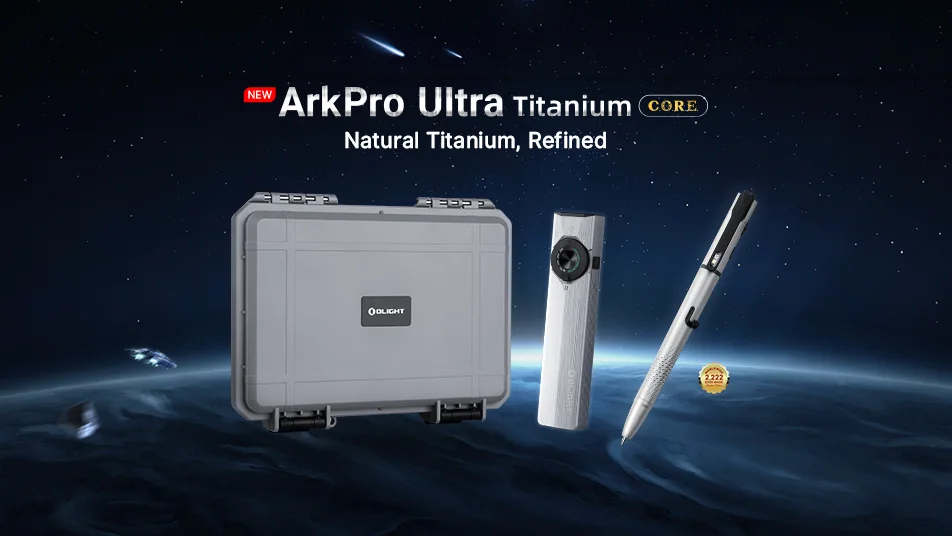
Olight makes the lights compared here. Olight specs and regular prices come from its US product pages and user manuals as of October 2026. The runtime, walking-time and battery-share figures are calculations from published numbers, not field measurements.
⚡ TL;DR
The best emergency light for camping is a headlamp you can grab in the dark, and the Olight Perun 3 ($89.99) is the overall pick: IP68, a 600-lumen High rated for 300 minutes before it steps down, and SOS in both white and red. We compared four Olight lights and a whistle on published specs. Add one handheld flashlight for the group and a whistle for each person.
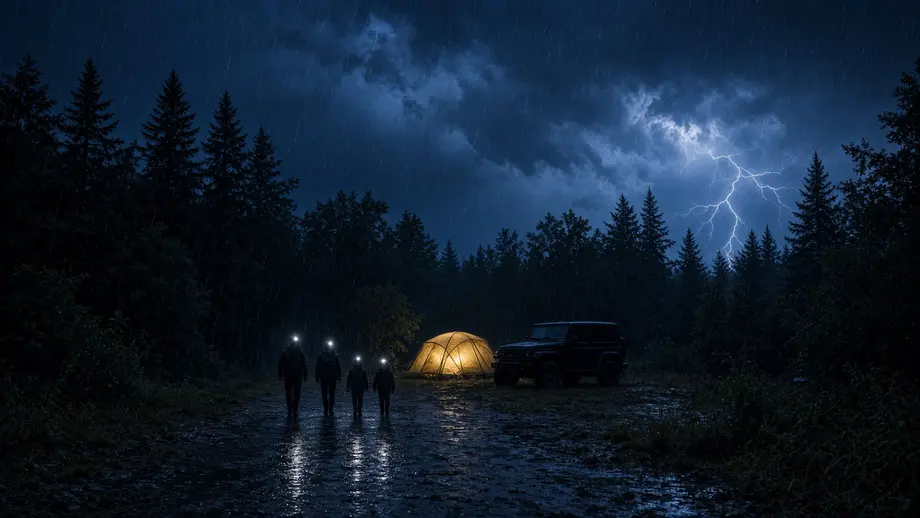
Thunder at 1 a.m. turns a campsite into a scramble. Someone holds a phone light in one hand while trying to zip the tent with the other. The lantern on the table has blown over. Nobody can find the car keys or the kids' shoes, and nobody is sure whether the tent is a safe place to wait.
This table shows the best emergency light for camping for each job on a storm night, with Olight's ratings and regular prices.
| Job on a storm night | Pick | Key specs (Olight ratings) | Regular price | Why |
|---|---|---|---|---|
| One light on every adult's pillow (overall) | Olight Perun 3 | 3,000 lm, 160 m, IP68, white and red SOS, 120 lm for 25 h | $89.99 | Hands-free, immersion-rated and easy to signal with |
| Lighter headlamp for a teen or second adult | Olight Perun 3 Mini | 1,250 lm, 155 m, IPX8, 54 g, red SOS | $64.99 | A third of the Perun 3's weight, same head-to-hand design |
| Path and search light for the walk to the car | Olight Seeker 4 Pro | 4,600 lm, 260 m, IPX8, no SOS mode | $139.99 | Longest reach here for finding the trailhead lot |
| Hanging light for the tent or car | Olight Oclip 2 Pro | 530 lm, IP66, red light 4 lm for 27 h | $49.99 | Clips and magnets free both hands |
| Signal backup that needs no battery | Olight Titanium Emergency Whistle | Titanium, 7 g, 2.09 in long | $15.99 | Works when every light is flat |
📋 Table of Contents
- 1. Quick Answer: What Is the Best Emergency Light for Camping in a Storm?
- 2. Is a Tent Safe in a Thunderstorm?
- 3. How Far Away Is the Storm? Count the Seconds, Then Move
- 4. The Night Storm Evacuation Plan: Wake, Shoes, Keys, Vehicle
- 5. Headlamp vs Waterproof Flashlight vs Lantern vs Phone in a Rainstorm
- 6. Best Emergency Light for Camping Compared: Four Lights and a Whistle
- 7. How Much Battery Does One Storm Evacuation Use?
- 8. Where Should the Emergency Light Go in the Tent?
- 9. Survival Kit for Camping: The Storm Bag Checklist
- 10. Signaling in the Rain: SOS Modes and the Whistle
- 11. Common Mistake: Waiting Out the Storm in the Car With the Lantern On
- 12. What Is the Most Reliable Emergency Light for a Power Outage?
- 13. What Is the Best Portable Light for Camping?
- 14. Which Rechargeable Emergency Lantern Is the Best?
- 15. How the Numbers in This Guide Were Worked Out
- 16. Your Storm-Night Action List
- 17. FAQ
Quick Answer: What Is the Best Emergency Light for Camping in a Storm?
The best emergency light for camping in a night storm is a waterproof headlamp beside each sleeper, plus one bright handheld flashlight for the group. Headlamps leave both hands free for zippers, shoes, children and keys. A bright flashlight finds the path and the vehicle. A large camp lantern helps least, because wind can knock it over and it lights the table, not your feet.
The National Park Service puts it plainly in its Ten Essentials list: "Headlamps are the recommended light source because they are hands-free." Olight's range of outdoor flashlights and its headlamps cover both roles. The Perun 3 wins overall because it is a headlamp that also clips off as a handheld flashlight, and because it is the only light here with a white SOS mode.
Is a Tent Safe in a Thunderstorm?
No. A tent offers no protection from lightning. The National Park Service's lightning safety page states, "Tents do not protect you from lightning." The National Weather Service lightning safety overview names the safe options: "Substantial buildings and hard-topped vehicles are safe options. Rain shelters, small sheds, and open vehicles are not safe." When you hear thunder at camp, move to one of those.
The NWS describes this exact camp scenario on its outdoor lightning safety page. You are cooking when you hear distant thunder, your tent and a picnic shelter are nearby, and your vehicle is about a quarter of a mile away. Its answer: "Go to your vehicle! The tent and picnic shelter are NOT safe places." It then says to "Wait 30 minutes until after the last rumble of thunder before going back to the campsite."
Inside the vehicle, the NPS says, "Make sure the windows are rolled up and avoid contact with metal surfaces outside or inside the vehicle."
Safety note: If no building or hard-topped vehicle is within reach, the NPS advises: "Keep moving towards safe shelter. If you are caught out in the open, do not stop." Pick your shelter before dark, while you can still see the route.
How Far Away Is the Storm? Count the Seconds, Then Move
Count the seconds between a lightning flash and its thunder, then divide by 5 to get the distance in miles. That is the National Weather Service's method, and the count is not a waiting game. The NWS says thunder "can be heard for a distance of only about 10 miles," and that hearing it means you are "within striking distance of the storm."
The NWS thunder page gives the rule: "5 seconds = 1 mile, 15 seconds = 3 miles, 0 seconds = very close." It also says, "you should be in a safe place while counting." This table applies that rule to the counts you are likely to hear from a tent.
| Seconds from flash to thunder | Distance (seconds divided by 5) | What the official guidance means for your campsite |
|---|---|---|
| 0 to 5 | 0 to 1 mile | Very close. You should already be in the vehicle |
| 15 | 3 miles | Inside range. The NWS myths page says "Bolts from the blue" can strike 10 to 15 miles from the storm |
| 30 | 6 miles | Still inside range. Go now |
| 50 | 10 miles | About the farthest thunder carries. If you heard it, you are within striking distance |
Any thunder you can hear means "go," so the minutes spent hunting for a light come straight out of your margin.
The Night Storm Evacuation Plan: Wake, Shoes, Keys, Vehicle
A night storm evacuation from a tent takes four steps: wake everyone with a calm voice and a dim light, get shoes on, take the keys and one small bag, and walk to the vehicle together. Each step needs hands. A phone flashlight uses one of them, which is why headlamps make the move faster and safer for a family.
Follow this sequence, and walk through it once in daylight on the first afternoon:
- Switch your headlamp to red or a low white mode before you wake anyone.
- Put on your own headlamp, then each child's, then shoes.
- Take the keys and the storm bag described below. Leave everything else.
- Zip the tent closed and walk to the vehicle in single file, brightest handheld light at the front.
- In the vehicle, roll the windows up, keep hands off metal surfaces, and wait at least 30 minutes after the last thunder.
How many hands does each task take?
This table counts the hands each task takes, using this guide's estimates for a family of four with two young children.
| Evacuation task | Hands it takes | Hands left holding a phone light | Hands left wearing a headlamp |
|---|---|---|---|
| Unzip the inner door and the rainfly | 2 | 1 (one short) | 2 |
| Put on and fasten a child's shoes | 2 | 1 (one short) | 2 |
| Find keys in a bag in the dark | 2 (hold and search) | 1 (one short) | 2 |
| Carry a sleeping 4-year-old | 2 | 1 (one short) | 2 |
| Hold a child's hand and carry the storm bag | 2 | 1 (one short) | 2 |
| Open the vehicle door | 1 | 1 | 2 |
The phone light leaves you a hand short on 5 of the 6 tasks; a headlamp covers all six. The phone has another job that night: alerts and a 911 call. The NPS notes that "It is safe to use a cell phone during a storm," so keep its battery for that.
Headlamp vs Waterproof Flashlight vs Lantern vs Phone in a Rainstorm
In a rainstorm at night, a headlamp is the most useful emergency light for each person, a waterproof handheld flashlight is the best group light for the path, a lantern is useful only once you are sheltered, and a phone light is the last resort.
This table compares the four light types on the jobs that matter during a storm.
| Light type | Hands free? | Wind and rain | Reach on the path | Best storm-night role |
|---|---|---|---|---|
| Headlamp (Perun 3, Perun 3 Mini) | Yes | IP68 or IPX8 on these models | 155 to 160 m rated | Every person, from waking to the vehicle |
| Waterproof handheld (Seeker 4 Pro) | No | IPX8 | 260 m rated | Leader at the front of the line |
| Lantern or ambient light (Sphere C) | Yes, once set down | IP56; 93 g, so wind can move it unless the magnetic base holds it to metal | Short; a glow, not a beam | Inside the vehicle or the tent, after the move |
| Phone flashlight | No | Varies by phone | Short | Backup only; save the battery for alerts and calls |
Water ratings deserve a closer look, because "waterproof" means different tests. The IEC, which publishes the IP code in IEC 60529, says the code exists to avoid "confusion over vague marketing terms like 'waterproof.'" Under IEC 60529, as summarized by the test lab Castle Compliance, IPX6 is "Powerful water jets," IPX7 is "Temporary immersion" (1 m for 30 minutes), and IPX8 is "Immersion with depth and duration > IPX7. (Test level by agreement)." The same summary warns that "IP67 does not automatically cover IP66," because immersion and jet tests are different. No IP digit is a rainstorm test. In practice, an IP68 or IPX8 light is rated for a drop into a puddle, while an IP66 light is rated for jets, not standing water.
Best Emergency Light for Camping Compared: Four Lights and a Whistle
Among Olight's current lights, the Perun 3 is the best emergency light for camping overall, the Perun 3 Mini is the lighter headlamp, the Seeker 4 Pro is the long-reach path light, and the Oclip 2 Pro is the hanging light.
This table compares the four lights on Olight's published specs.
| Spec (Olight rating) | Perun 3 | Perun 3 Mini (CW) | Seeker 4 Pro | Oclip 2 Pro |
|---|---|---|---|---|
| Max output | 3,000 lumens | 1,250 lumens | 4,600 lumens | 530 lumens (floodlight) |
| Peak intensity | 6,400 candela | 6,000 candela | 16,895 candela | 3,906 candela |
| Beam distance | 160 m | 155 m | 260 m | 125 m |
| High mode | 600~120 lumens, 300 + 30 minutes | 500~350 lumens, 2 + 75 minutes | 1,200~600~300 lumens, 135 + 35 + 10 minutes | Floodlight 300~100 lumens, 60 + 5 minutes |
| Medium mode | 120 lumens, 25 hours | 100 lumens, 4.5 hours | 300 lumens, 11 hours | Floodlight 100 lumens, 3 hours 45 minutes |
| Red light | 60 lumens 14 h; 15 lumens 70 h | 45 lumens 150 min; 5 lumens 19 h | None | 40 lumens 4 h; 4 lumens 27 h |
| SOS or flashing mode | SOS (white and red) | SOS (red only) | Strobe only, 13 Hz at 4,600 lumens | Strobe |
| Weight with battery | 150 g | 54 g | 205 g | 75.5 g |
| Water rating | IP68 | IPX8 | IPX8 | IP66 |
| Regular price (October 2026) | $89.99 | $64.99 | $139.99 | $49.99 |
Olight Perun 3: Best Overall Emergency Light for Camping
The Olight Perun 3 headlamp ($89.99, regular price) solves the storm night's main problem: it is on your head when you need both hands, and it unclips into a flashlight when you need to point it. Olight rates it IP68, with a headband, magnetic tail, clip and lanyard. Its 18 Wh battery runs Med at 120 lumens for 25 hours and Low at 30 lumens for 89 hours.
Its manual adds two details. A triple press starts SOS. And in lockout mode, which stops the light turning on in a bag, "you can press and hold the switch (for less than 1 second) to access Moonlight." A locked light still gives you 5 lumens. The limits: at 150 g it is the heaviest headlamp here, and a full charge takes under 4 hours.
Olight Perun 3 Mini: The Lighter Headlamp
The Olight Perun 3 Mini headlamp ($64.99, regular price) weighs 54 g, is rated IPX8 and reaches 155 m. Its weak point is the High mode: 500 lumens for 2 minutes, then 350 lumens for 75 minutes. Its SOS works only in red light. Its manual warns, "Keep new and used batteries away from children," so an adult should handle charging.
Olight Seeker 4 Pro: The Path Light for the Group Leader
The Olight Seeker 4 Pro flashlight ($139.99, regular price) reaches a rated 260 m. It has no SOS. A triple press starts a 13 Hz strobe at 4,600 lumens, which is too harsh for a family walking in a tight line. It also locks itself 10 seconds after the indicators go out; to unlock, "Rotate the switch more than 90° in any direction within 1 second." Practice that before the trip.
Olight Oclip 2 Pro: The Hanging Light
The Olight Oclip 2 Pro clip light ($49.99 regular price; $54.99 in blue) clips to a tent loop or a vehicle grab handle and holds red light at 4 lumens for 27 hours. It is rated IP66 and 2.0 m impact, not immersion, so keep it out of puddles.
How Much Battery Does One Storm Evacuation Use?
One storm evacuation uses about 5% of a Perun 3 charge and about 22% of a Perun 3 Mini charge, if you walk both ways on High. That estimate assumes a quarter-mile walk each way, 5 minutes of setup on Low and a 30-minute vehicle wait on low red light.
Here is the math. The NWS scenario puts the vehicle about a quarter of a mile away, which is 1,320 feet. The Federal Highway Administration's MUTCD, 2009 edition, Section 4E.06 times pedestrian crossings at "a walking speed of 3.5 feet per second," and at "3 feet per second" for the full crossing. This guide assumes a family in the dark and rain walks no faster than the slower figure: 1,320 ÷ 3 = 440 seconds, or about 7.3 minutes each way. Two walks take about 14.7 minutes.
This table divides each phase by the rated runtime of the mode used, based on Olight's rated runtimes, not measured.
| Light | Walks, 14.7 min on High | Setup, 5 min on Low | Wait, 30 min on lowest red (or Moon) | Share of one charge | Storm events per charge |
|---|---|---|---|---|---|
| Perun 3 | 14.7 ÷ 330 = 4.45% | 5 ÷ 5,340 = 0.09% | 30 ÷ 4,200 = 0.71% | About 5.3% | About 19 |
| Perun 3 Mini | 14.7 ÷ 77 = 19.09% | 5 ÷ 1,800 = 0.28% | 30 ÷ 1,140 = 2.63% | About 22.0% | About 4.5 |
| Perun 3 Mini, walking on Med | 14.7 ÷ 270 = 5.44% | 0.28% | 2.63% | About 8.4% | About 12 |
| Seeker 4 Pro (Moon for the wait) | 14.7 ÷ 180 = 8.17% | 5 ÷ 3,600 = 0.14% | 30 ÷ 21,600 = 0.14% | About 8.4% | About 12 |
| Oclip 2 Pro (floodlight) | 14.7 ÷ 65 = 22.62% | 5 ÷ 1,500 = 0.33% | 30 ÷ 1,620 = 1.85% | About 24.8% | About 4 |
Each mode's runtime is the total of its published stages. Perun 3 High is 300 + 30 = 330 minutes, Perun 3 Mini High is 2 + 75 = 77 minutes and Seeker 4 Pro High is 135 + 35 + 10 = 180 minutes. Treating battery use as proportional to time in each mode is a simplification. Olight's manuals say their figures are "tested per ANSI/PLATO FL 1-2019 standard in Olight's labs for reference," and the Perun 3 Mini manual adds that runtime "may vary depending on the external temperature and ventilation conditions."
Tip: On the Perun 3 Mini and Oclip 2 Pro, walk on Medium. You give up some brightness but cut the battery share of each evacuation by more than half.
Where Should the Emergency Light Go in the Tent?
Keep each person's emergency light in the same spot every night: in the tent pocket at the head end, on the side closest to the door, with the switch locked. Put shoes by the door and keys in one zipped pocket. In the dark, you should be able to find all three by feel, without turning on a light first.
A short placement checklist:
- Head-end pocket, door side. You reach for it lying down and move toward the exit at the same time.
- Lockout on. The Perun 3 and Perun 3 Mini lock with a 2-second hold from off. The Seeker 4 Pro locks itself and shows the battery level when you press the switch.
- Red first. On both Perun models, a double press from off goes straight to red light, so you never start with a bright white beam.
- Keys and phone go together in one waterproof bag clipped beside the light.
Note: If insects at the door are also a problem, our guide to camping lights that don't attract bugs covers which light colors draw fewer of them.
Survival Kit for Camping: The Storm Bag Checklist
A survival kit for camping should include a small storm bag that leaves the tent with you: one light per person, a whistle each, a NOAA Weather Radio or charged phone, a first aid kit, rain shells, a power bank and the vehicle keys. It should weigh little enough to grab in one hand.
This table lists each storm-bag item and the official source behind it.
| Item | Why it is in the bag | Source |
|---|---|---|
| Headlamp per person, charged | Hands-free light for the move | NPS Ten Essentials |
| One handheld flashlight | Path and search light for the leader | NPS: lighting can "signal for help" |
| Whistle per person | "Whistle (to signal for help)" | Ready.gov basic kit |
| NOAA Weather Radio with tone alert | Warnings where phones lose signal | Ready.gov kit; NPS lightning page |
| First aid kit | Injuries during the move | NPS Ten Essentials |
| Rain shell for each person | Cold and wet while waiting | NPS: "raincoat, jacket, hat, or gloves" |
| Phone and power bank | Alerts and 911 | NPS: "Pack an extra battery for your phone" |
| Vehicle keys, plus a spare | No keys, no shelter | This guide's plan |
The Ready.gov kit list includes a "NOAA Weather Radio with tone alert." For the best survival kit for camping beyond one storm, our family survival kit under $100 prices a full kit line by line.
Signaling in the Rain: SOS Modes and the Whistle
In a storm, signal with sound first and light second. A whistle needs no battery, and Ready.gov lists one "to signal for help." For light, use a slow, steady signal such as the Perun 3's SOS rather than a fast strobe. Agree on your family's signals before dark, so a child knows what three whistle blasts mean.
What each light can actually do, from its manual:
- Perun 3: "Quickly press the switch three times or more to enter SOS mode." In red light, "Press and hold the switch to switch between the normal mode and SOS mode." SOS is not memorized, so the next press starts normally.
- Perun 3 Mini: red light only. "Press and hold the button to switch between the Low mode, High mode, and SOS mode."
- Seeker 4 Pro: no SOS. Triple press gives a 4,600-lumen strobe, too harsh for close-range signaling.
The Olight Titanium Emergency Whistle ($15.99) is 7 g of titanium and 2.09 in long. Olight does not publish a loudness rating for it, so any sturdy whistle you already own does the same signaling job.
Warning: Do not aim a high mode at faces in a tent or a vehicle. The Perun 3 manual states, "Caution: Do not stare at operating light source."
Common Mistake: Waiting Out the Storm in the Car With the Lantern On
The common mistake is treating the vehicle as a place to wait for the rain to stop, with a lantern glowing on the dashboard. The NWS says to wait 30 minutes after the last thunder, not until the rain eases. Floodwater and falling trees can also make a parked vehicle unsafe.
Three corrections, each from an official source:
- Time the wait from the last thunder. The CDC lightning guidance says, "Don't resume outdoor activities for at least 30 minutes after the storm."
- Check where you parked. The NWS flood safety page says, "If you live in a flood prone area or are camping in a low lying area, get to higher ground immediately," and "12 inches of water can float a car or small SUV." The NWS Turn Around Don't Drown page adds that "A mere 6 inches of fast-moving flood water can knock over an adult."
- Watch for trees. The NWS wind safety page says to "move your car to a location where it is less likely to be hit by falling trees or power lines."
Use a dim red light inside, and keep the handheld ready to check water around the tires.
What Is the Most Reliable Emergency Light for a Power Outage?
For a power outage, the most reliable emergency light is a rechargeable flashlight or headlamp with a long medium mode and a sealed body, one per person. Ready.gov's power outage page says, "Have flashlights for every household member." Among these lights, the Perun 3 fits best: 120 lumens for 25 hours, IP68, and a headband for hands-free work.
What Is the Best Portable Light for Camping?
The best portable light for camping is a rechargeable headlamp that also works handheld, such as the Olight Perun 3. It gives you hands-free light at camp, a 160 m beam on the trail and red light for the tent. If weight matters most, the 54 g Perun 3 Mini trades runtime for a third of the weight.
This matches the pick in our roundup of the best headlamps, which names the Perun 3 its overall winner across 10 models. For keeping a whole campsite charged over a weekend, our comparison of rechargeable camping lights and solar ones explains when a cable or power bank beats a panel.
Which Rechargeable Emergency Lantern Is the Best?
The best rechargeable emergency lantern for a storm night is a sealed, stable lantern you use after you reach shelter, not during the walk. Look for at least IPX4 splash resistance, a low red mode and a base that will not tip in wind. Olight's lantern-style option, the Sphere C ($17.99), is a tent marker, not a primary light.
The Sphere C is rated IP56, with 75 lumens max and 1 lumen for 40 hours, with a red flash mode and a magnetic base. Its manual warns, "Do not store the product in a car or places where the temperature may exceed 60°C," so take it out of the vehicle on hot days. For bright camp lanterns from several makers, see our guide to the best lantern for camping by price tier.
How the Numbers in This Guide Were Worked Out
Every Olight number here is copied from Olight's US product pages or user manuals, checked in October 2026, and every safety rule is quoted from an official page. This table shows the source, method and count behind each figure.
| Measure | Source | Method | Count |
|---|---|---|---|
| Lumens, candela, beam, runtime, water rating, weight | Olight product pages and manuals | Copied as published | 4 lights, all white and red modes |
| Regular prices | Olight US store, October 2026 | Non-promotional price by edition and color | 5 products |
| Storm distance | NWS thunder page | Seconds divided by 5 = miles | 5 example counts |
| Walking time | MUTCD 2009, Section 4E.06; NWS quarter-mile scenario | 1,320 ft divided by 3 ft per second | 2 walks |
| Battery share per evacuation | Rated runtime of each mode | Minutes in mode divided by rated minutes, summed | 5 light setups, 3 phases each |
| Hands per task | This guide's estimate | Hands each task takes versus hands left | 6 tasks, 2 light types |
Your Storm-Night Action List
Set up the best emergency light for camping as a system, not a single purchase. Every person gets a charged headlamp and a whistle, one adult carries the handheld, and the family rehearses the walk to shelter in daylight before the first night.
- On arrival, find your shelter: a substantial building or your hard-topped vehicle. Note the route and the distance.
- Park away from trees and out of low ground near water.
- Give every person a headlamp and a whistle. Lock each light and put it in the head-end pocket.
- Check charge at bedtime. A Perun 3 Mini or Oclip 2 Pro that shows low gets charged first.
- Pack the storm bag: keys, phone, power bank, first aid kit and rain shells.
- At the first thunder, go. Wait at least 30 minutes after the last thunder before returning.
- Inside the vehicle, windows up, hands off metal, red light on.
FAQ
Changelog
- October 1, 2026: First published.