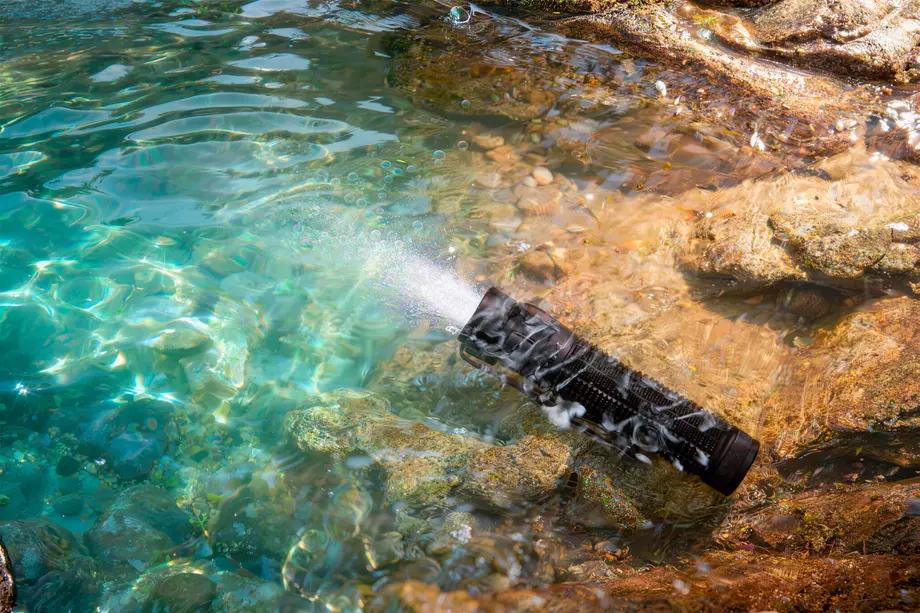
TL;DR:Understanding an IPX rating is the easiest way to determine whether your flashlight is truly waterproof. While ratings such as IPX4, IPX7, and IPX8 all offer different levels of water resistance, only higher ratings are designed for submersion. This guide explains what an IPX rating means, answers common questions like “is my flashlight waterproof?” and “what does IPX8 mean,” and helps you choose the right flashlight waterproof protection for your environment.
When you venture into the outdoors, equipment reliability becomes a matter of safety. A flashlight that fails during a heavy downpour is not just an inconvenience; it is a hazard. Understanding how manufacturers measure water protection allows you to choose the right tool for your specific environment. The industry uses a standardized system to communicate these capabilities, ensuring that users know exactly what their gear can handle.
Table of Contents
1. Why Water Resistance Matters in Modern Flashlights 2. What Is an IPX Rating? 3. IPX4 vs IPX6 vs IPX7 vs IPX8: What's the Difference? 4. What "Waterproof" Really Means for Flashlights 5. Using Flashlights in Rain, Snow, and Underwater Conditions 6. Olight Waterproof Rating Chart 7. Care Tips: How to Maintain Your Flashlight's Waterproof Performance 8. FAQ
Why Water Resistance Matters in Modern Flashlights
Modern high-performance flashlights use complex electronic circuits, high-capacity lithium batteries, and sensitive LED modules. Moisture is the primary enemy of these components. If water enters the internal housing, it causes short circuits, corrosion of the contacts, and permanent damage to the emitter.
For outdoor enthusiasts, water resistance is essential because weather is unpredictable. Hikers often face sudden storms, hunters may need to cross streams, and search and rescue teams operate in the worst possible conditions. A reliable light must remain functional even when saturated with moisture.
Furthermore, water resistance is a proxy for overall build quality. A flashlight with a high rating typically features precision-machined threads, high-quality silicone O-rings, and robust seals. These features also help keep out dust, sand, and pocket lint, extending the total lifespan of the device.
What Is an IPX Rating?
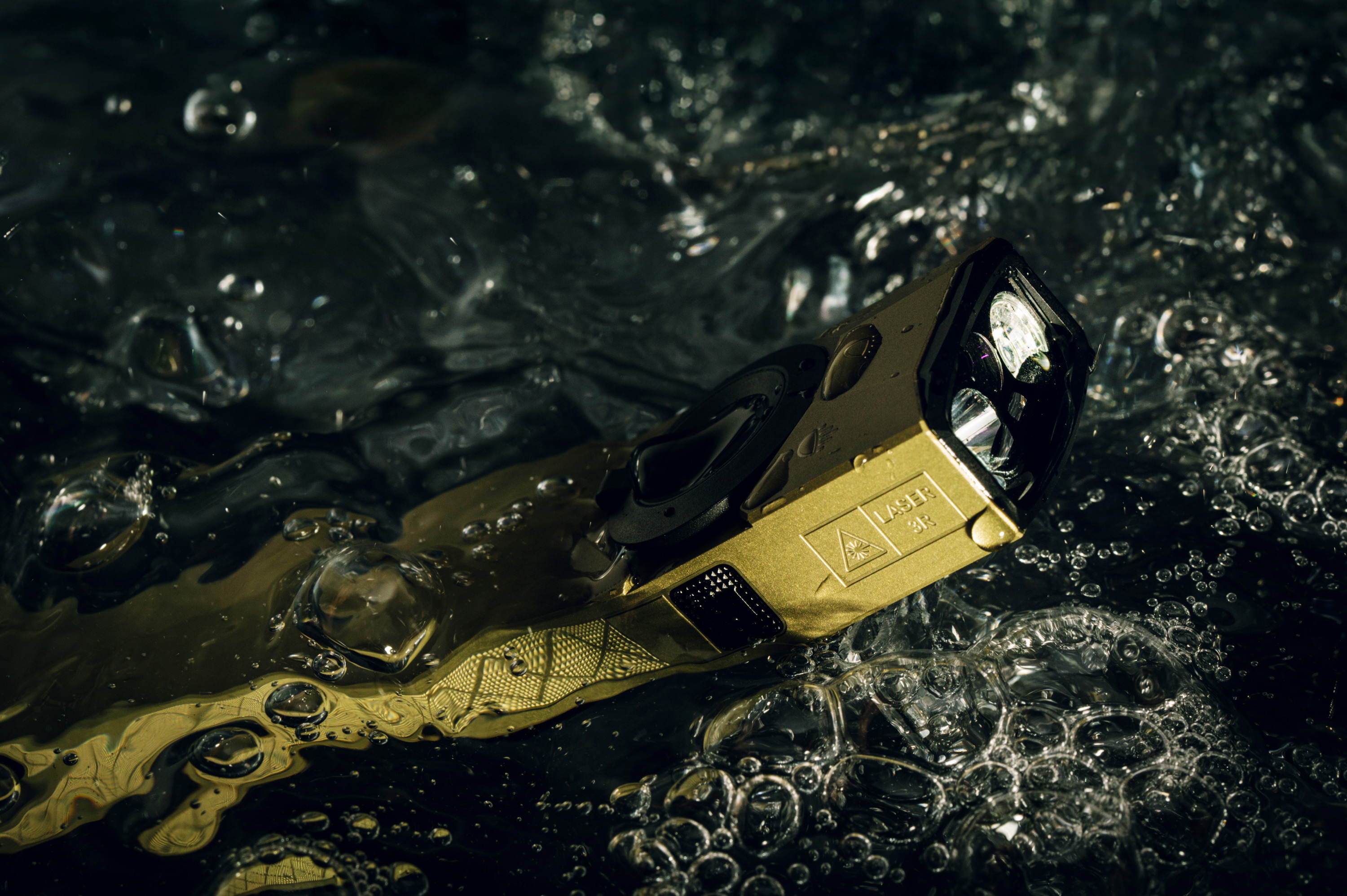
According to the International Electrotechnical Commission (IEC), the IP (Ingress Protection) Code defined in IEC 60529 is the internationally recognized standard used to classify how effectively an enclosure protects against the ingress of solid objects and water. The system was created to replace vague marketing descriptions with standardized laboratory testing, allowing consumers to compare products using objective criteria rather than subjective claims (Source:IEC-IP ratings)
Understanding the IP (Ingress Protection) Standard
An IP rating usually consists of two digits.The first digit (0 to 6) indicates protection against solid objects like dust and grit.The second digit (0 to 9) indicates protection against liquids, primarily water.For example, a device rated IP68 is completely dust-tight and can survive prolonged submersion in water. If a device has not been tested for one of these categories, the digit is replaced with the letter "X."
What Does the “X” in IPX Mean?
In the flashlight industry, you often see ratings like IPX4 or IPX8. The "X" does not mean the flashlight has zero protection against dust. It simply means the product was not formally tested for solid ingress or that the manufacturer chose to focus purely on water testing. Most high-end aluminum flashlights are inherently dust-resistant due to their sealed designs, even if they only carry an IPX rating.
IPX4 vs IPX6 vs IPX7 vs IPX8: What’s the Difference?
Each level of the IPX scale involves a specific testing protocol. Knowing these differences helps you match a flashlight to your intended activity.
IPX4: Splash Resistant
A device with an IPX4 rating is protected against splashing water from any direction.
- The Test: Water is sprayed at the device from all angles for at least five minutes.
- Practical Use: This is suitable for general household use or walking through light rain. It is the minimum requirement for a professional tool used outdoors.
IPX6: Powerful Water Jets
IPX6 protection means the device can handle high-pressure, heavy sprays of water.
- The Test: Water is projected at the device through a 12.5mm nozzle at a rate of 100 liters per minute from any direction.
- Practical Use: This rating is ideal for heavy storms, sea spray on a boat, or high-pressure splashes. It ensures the light survives where others would fail due to water force.
IPX7: Temporary Submersion
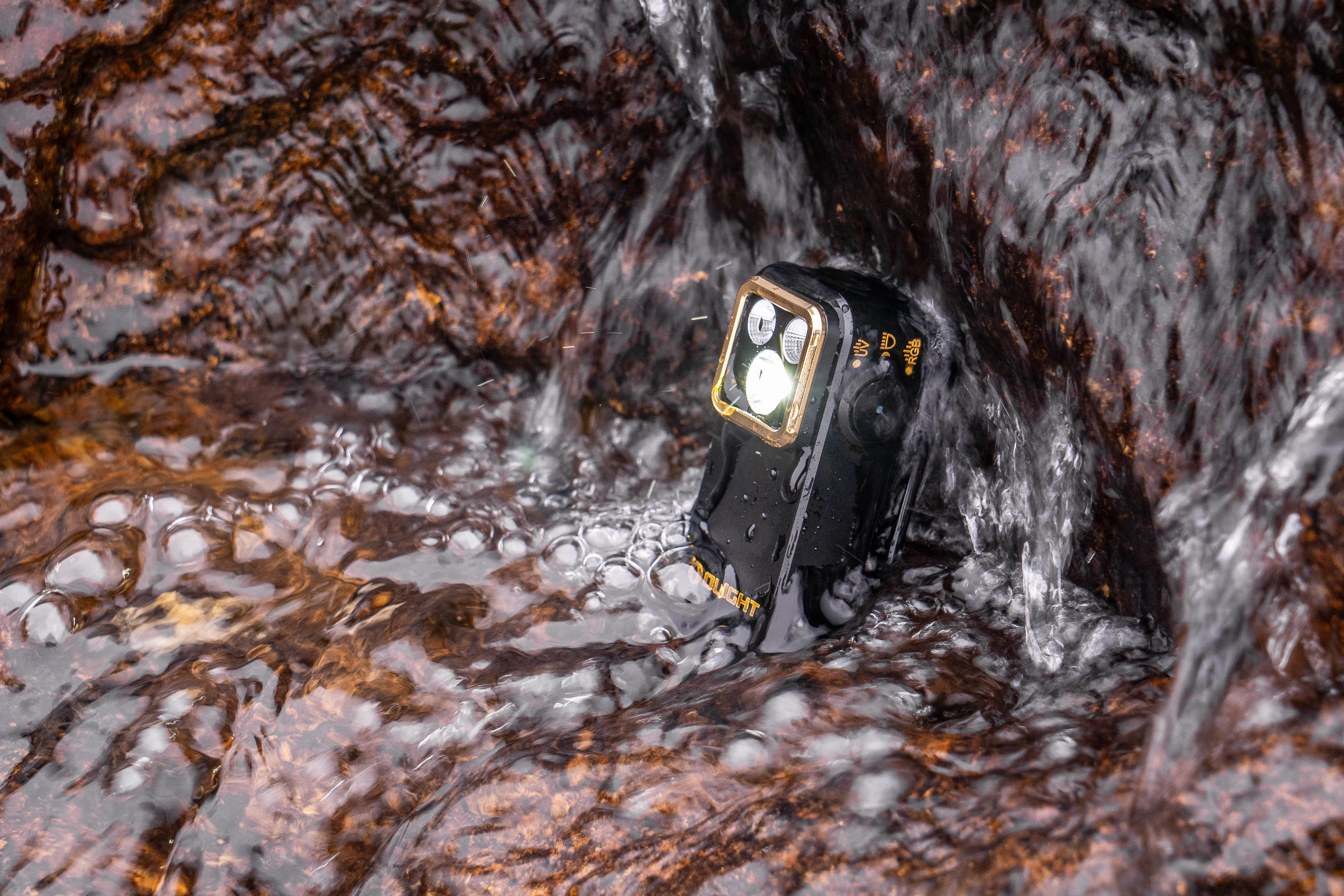
IPX7 is a significant step up because it involves pressure under the surface of the water.
- The Test: The device is submerged in water at a depth of 1 meter (about 3.3 feet) for exactly 30 minutes.
- Practical Use: This is perfect for fishing or hiking near water. If you drop your light into a shallow puddle or a stream, it will continue to function as long as you retrieve it quickly.
IPX8: Continuous Submersion
IPX8 is the highest common rating for premium flashlights. It implies the device is suitable for continuous immersion in water under conditions specified by the manufacturer.
- The Test: Usually, this involves submersion at depths of 2 meters or more for a duration longer than 30 minutes.
- Practical Use: This is the standard for tactical, search and rescue, and extreme outdoor lights. It offers the ultimate peace of mind. Even if the light stays at the bottom of a pond overnight, it should work perfectly upon retrieval.
What “Waterproof” Really Means for Flashlights
The term "waterproof" is often used loosely in marketing, but in the technical world, it is relative.
Water Resistant vs Waterproof
- Water Resistant: Generally refers to IPX4 through IPX6. These lights can repel water but may fail if forced under the surface. The seals are designed to stop liquid from entering under atmospheric pressure or surface tension.
- Water Waterproof: Generally refers to IPX7 and IPX8. These lights are designed to withstand the increased pressure that occurs as you move deeper into a body of water.
Common Misconceptions About IPX Ratings
One common mistake is assuming that a higher rating automatically covers lower ratings. While usually true, the tests for IPX7 (submersion) and IPX6 (high-pressure jets) are different. A light might be able to sit in a bucket of water (IPX7) but fail if hit by a high-pressure fire hose (IPX6). However, most top-tier manufacturers design their IPX8 lights to pass all lower-level tests as well.
Another misconception is that "waterproof" applies to all liquids. IPX ratings are specifically for fresh water. Salt water, chlorinated pool water, and oil can degrade seals or corrode metal much faster than fresh water.IEC 60529 treats immersion tests (IPX7/IPX8) and water-jet tests (IPX5/IPX6) as separate evaluations. A product certified for immersion is not automatically certified for high-pressure water jets unless it has passed both test protocols.
Why No Flashlight Is Completely Waterproof
Every seal has a failure point. As depth increases, water pressure rises. Eventually, the pressure will exceed the structural strength of the O-rings or the lens, forcing water inside. Most IPX8 flashlights are rated for 2 meters. Attempting to use a standard IPX8 flashlight for deep-sea diving at 50 meters will result in failure. Specialized diving lights are required for those pressures.
Using Flashlights in Rain, Snow, and Underwater Conditions
When using a flashlight in wet environments, performance changes.
In Rain: Rain rarely creates enough pressure to bypass seals. Even an IPX4 light handles most rain. However, the real danger is "capillary action," where water sits in the threads or around the button and gets pulled in when you click the switch. Higher ratings like IPX7 prevent this.
In Snow: Snow is essentially frozen water, but it poses a unique threat: melting. When a high-output flashlight gets hot, it melts the snow touching it. If the light then cools down quickly, it can create a vacuum effect that sucks moisture into the seals. Professional lights with high IPX ratings are tested to handle these temperature and pressure shifts.
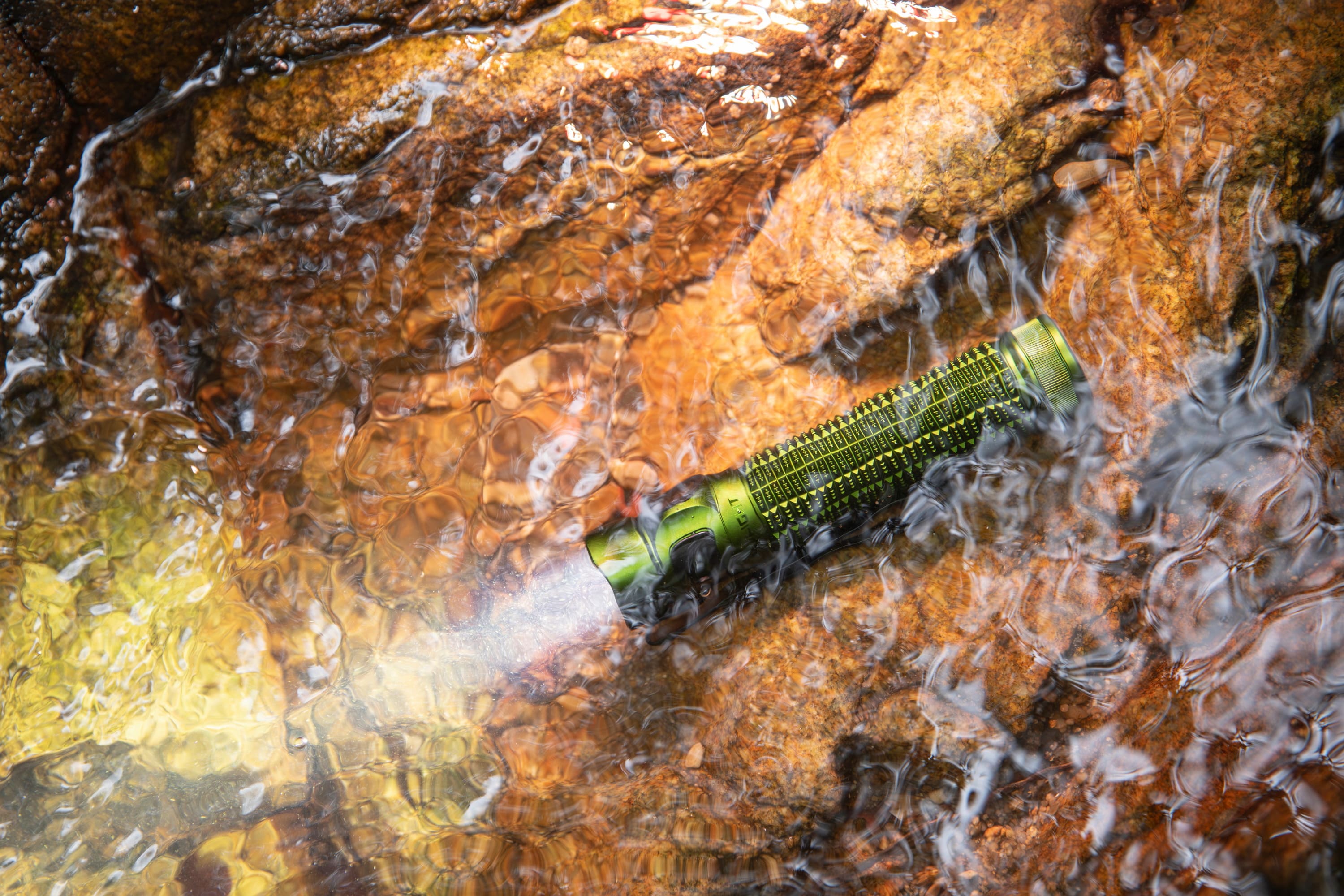
Underwater: Under the surface, the primary concern is the integrity of the seals. You should never cycle the mechanical switches or open the battery compartment while the light is submerged unless the manual specifically states it is safe to do so.
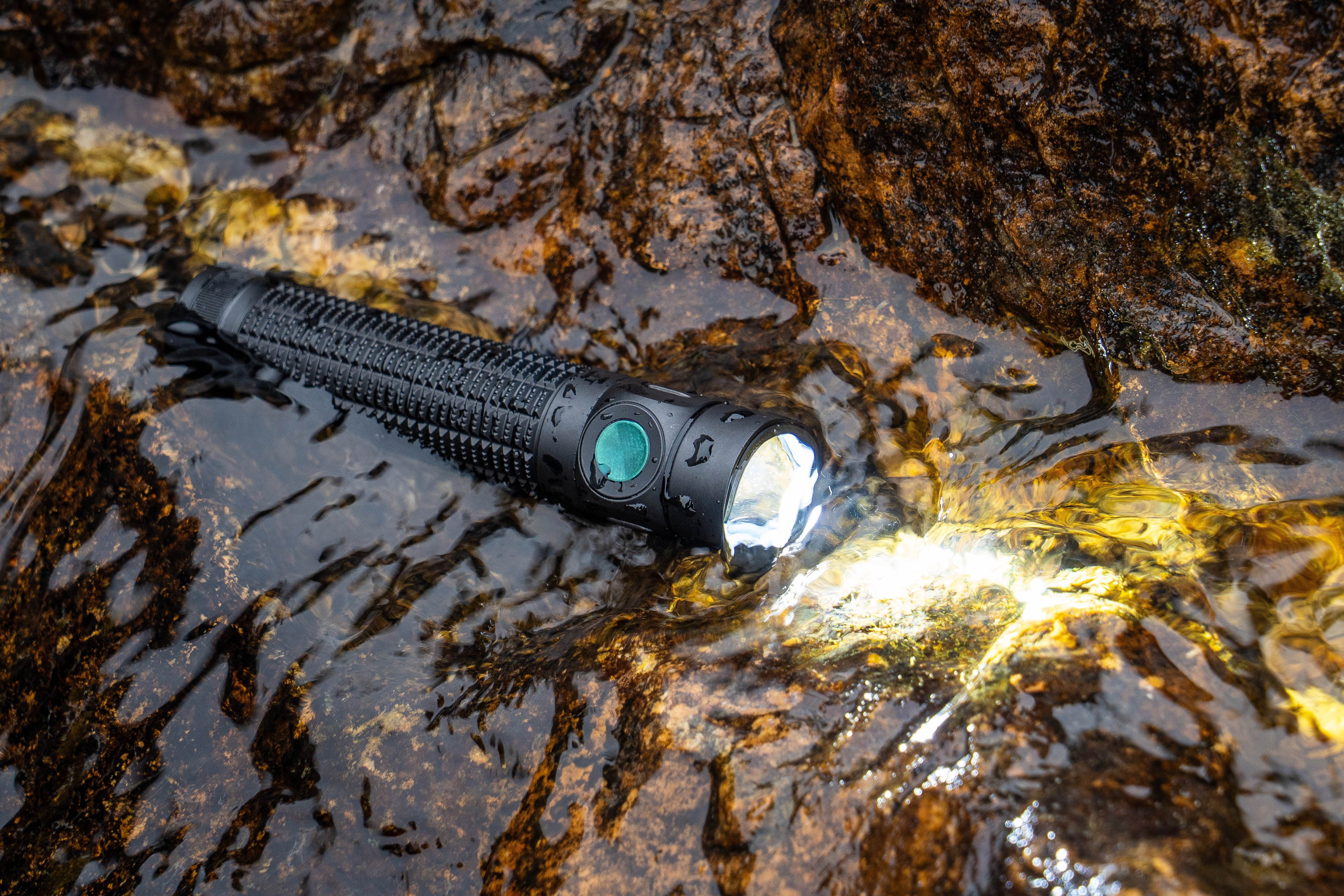
Olight Waterproof Rating Chart
Olight categorizes products based on their intended use case. High-intensity tactical lights receive the highest ratings, while everyday carry items balance size with sufficient protection.
Comparing Olight Flashlights by IP Rating
| IP Rating | Series / Model | Ideal Environment |
|---|---|---|
| IPX8 | Baton Series (Baton 4, Baton 4 Pro, Baton Ultra) | Extreme outdoors, heavy storms, accidental submersion |
| Warrior Series (Warrior Ultra, Warrior 3S) | Tactical use, law enforcement, professional rescue | |
| Seeker 4 Pro / Marauder Mini 2 / Marauder Mini | Search and rescue, forest exploration | |
| Perun 2 Min / I3E EOS | Hands-free work, keychains, daily emergency | |
| IPX7 | Arkfeld Pro / ArkPro Series (ArkPro, Lite, Ultra) | Modern EDC, work inspections, camping |
| IPX7 | PL X | Tactical weapon mounting, short-term wet conditions |
| IPX6 | Oclip Series (Oclip Pro, Oclip Ultra) | Clipping to gear, jogging in rain, urban EDC |
| IPX4 | O'pen Glow | Office work, medical checks, light rain |
Care Tips: How to Maintain Your Flashlight's Waterproof Performance
Inspecting and Replacing O-Rings
The O-ring is a small rubber circle located at the junction of the head, body, and tail cap.
- Check regularly: Look for flat spots, cracks, or tears.
- Lubricate: Use a tiny amount of silicone grease on the O-rings and threads. This helps the rubber stay supple and creates a better hydraulic seal.
- Replace: Most Olight products come with spare O-rings. If the original looks worn, replace it immediately to maintain the IPX rating.
Cleaning After Exposure to Water, Salt, or Mud
If your flashlight is exposed to salt water or dirty swamp water, rinse it with fresh tap water immediately after use. Salt is highly corrosive and can eat through the anodized coating and the rubber seals. After rinsing, dry the exterior with a soft cloth. Do not open the flashlight until the exterior is completely dry to prevent moisture from falling into the battery compartment.
Storage and Maintenance Best Practices
- Avoid extreme heat: Storing a flashlight in a hot car can cause the seals to expand and degrade.
- Tighten components: Ensure the head and tail cap are screwed on firmly. A loose tail cap is the most common reason for water entry.
- Battery check: If water does enter the light, remove the battery immediately and let the components air dry for 48 hours before attempting to use it again.
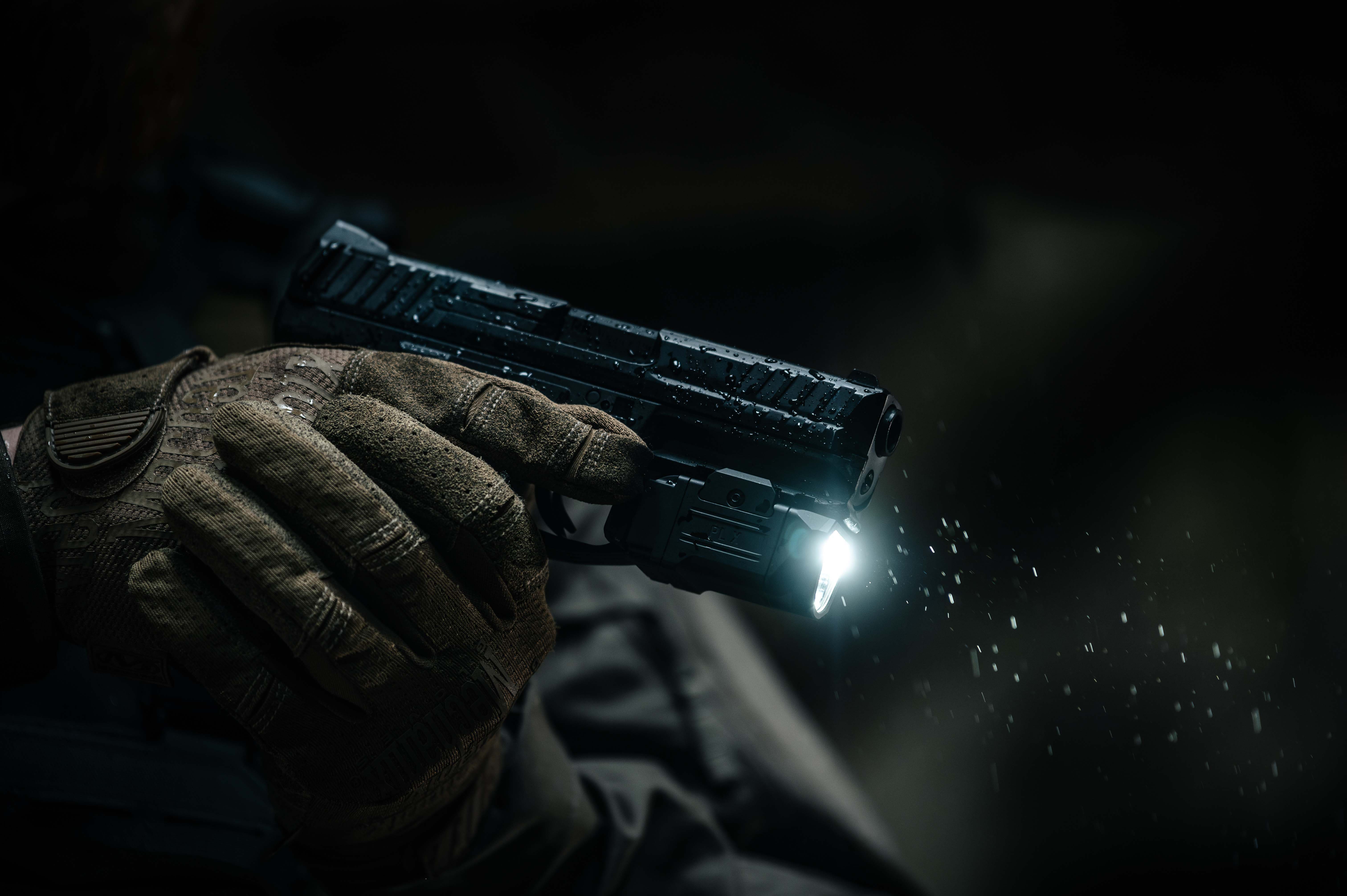
Olight PL X Tactical Weapon Light | IPX7 Waterproof