Table of Contents
If your flashlight looks brand new after a year, you probably aren't using it hard enough. But what if it could look brand new AND survive everything you throw at it?
Let's be honest — the EDC (Everyday Carry) community doesn't settle for "good enough." You don't invest in a premium flashlight just for basic illumination; you carry it because every detail reflects a commitment to quality. From the precision of the knurl pattern to the tactile response of the switch and a beam profile free of green tint, true craftsmanship is a standard, not a marketing buzzword.
Despite rapid technological shifts, most EDC flashlights in 2026 are still constructed from the same materials used a decade ago, such as 6061 aluminum. While functional, these materials often fall short of the durability required for rugged, long-term pocket carry.
It’s time to redefine "next-level" performance—not just through lumens or modes, but through the fundamental material science of the tool itself.
The Evolution of Tactical Flashlight Materials
The progression of flashlight materials has been a steady climb toward durability and weight efficiency.
For years, 6061-T6 aluminum has remained the industry benchmark. Lightweight and corrosion-resistant, it offers a Vickers hardness of approximately 107 HV. While sufficient for casual use, it often struggles under the demanding conditions of professional or enthusiast-level EDC.
The introduction of 7075-T6 aluminum—often marketed as "aircraft-grade"—marked a significant upgrade, offering a hardness of 150–175 HV. However, 7075 is notoriously difficult to anodize uniformly and can be susceptible to stress corrosion. Despite its strength, it still accumulates wear and tear faster than many users prefer.
While exotic materials like titanium, copper, and brass offer unique aesthetics and patinas, they often introduce trade-offs in weight or cost that limit their practicality for true daily utility. The industry needed a solution that made the aluminum itself fundamentally superior.
Redefining Toughness: Meet OAL (The Hardest Aluminum)
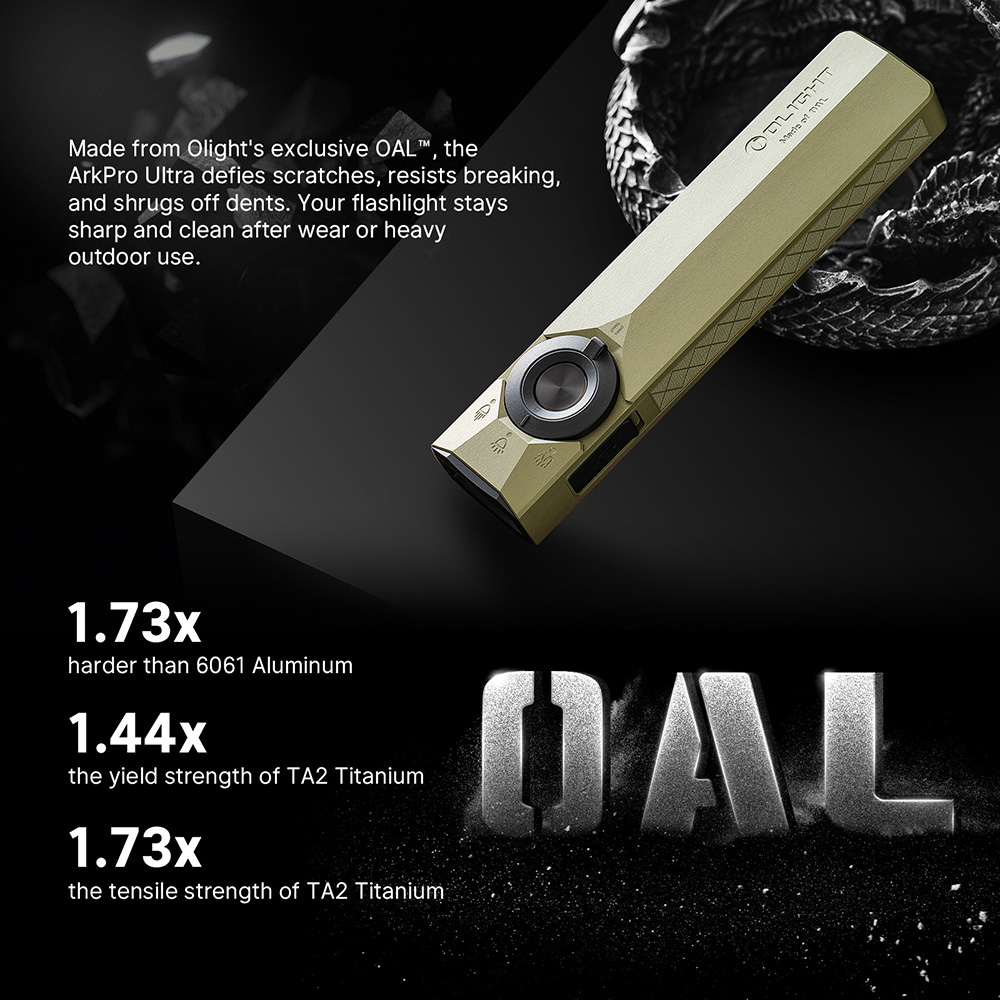
Olight has disrupted the traditional material hierarchy with the introduction of OAL (Olight O-aluminum). This proprietary material is engineered specifically to be the hardest aluminum ever utilized in a production flashlight.
| Material | Vickers Hardness (HV) | Application |
|---|---|---|
| 6061-T6 Aluminum | ~107 HV | Standard flashlights |
| 7075-T6 Aluminum | ~150–175 HV | Premium / tactical tools |
| OAL (O-aluminum) | 230 HV (1.73x harder than 6061) | Olight ArkPro Series |
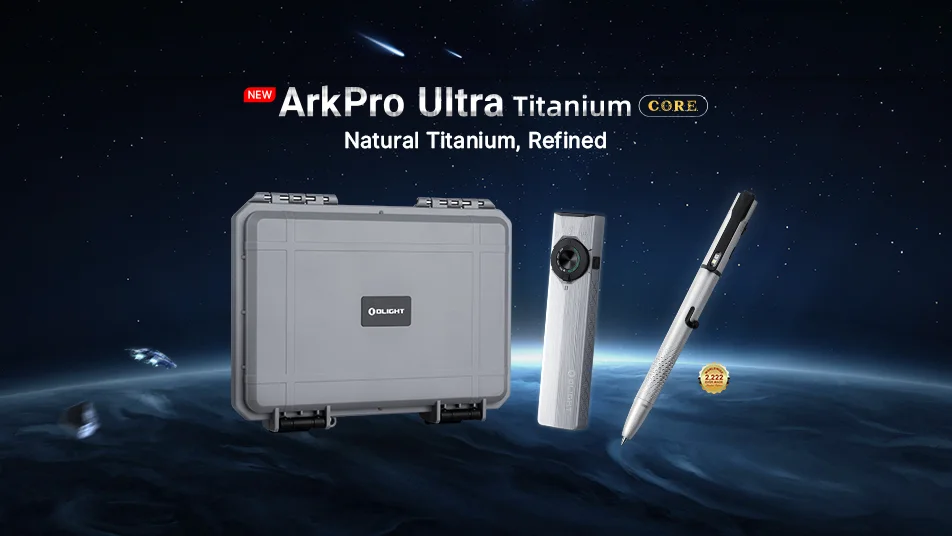
OAL is 1.73x harder than standard 6061 aluminum, reaching 230 HV—a level of toughness that rivals certain hardened steels. This material science breakthrough is a core feature of Olight's ArkPro Series.
What does this mean for the user? The benefits of OAL extend beyond simple durability:
- Ultimate Scratch Resistance: OAL easily withstands friction from keys and other metal tools in your pocket, maintaining its pristine finish.
- Lasting Precision Textures: Unlike softer alloys that wear smooth, OAL preserves intricate knurling and machining details indefinitely.
- Impact Integrity: The material resists deforming or denting during accidental drops, ensuring internal components remain protected.
- Superior Surface Finishing: OAL supports advanced anodizing processes, resulting in a more consistent and robust visual appeal.
Seeing is Believing: The EIP 1 LED Advantage
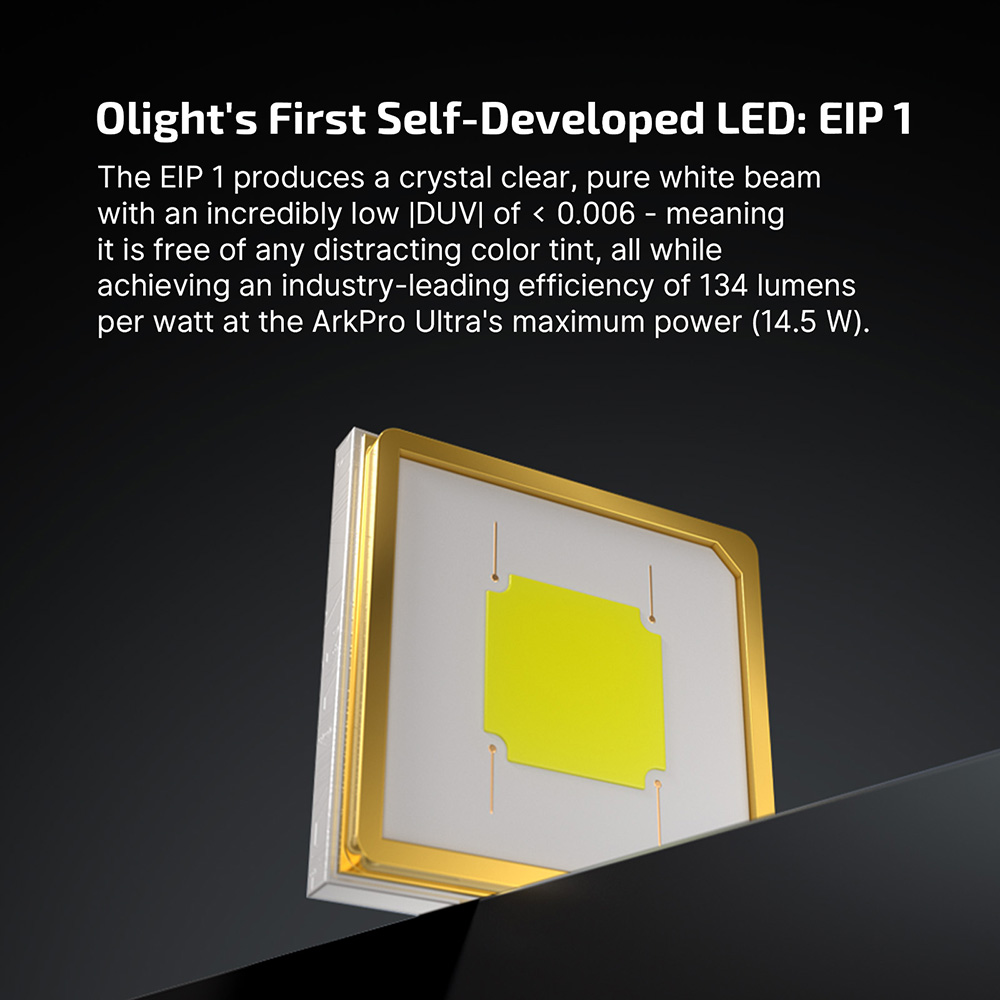
Exceptional hardware requires exceptional light. Olight's self-developed EIP 1 LED chip prioritizes beam quality and color purity alongside high-lumen output.
Optimized brightness with minimal heat generation.
A pure white beam without distracting color shifts.
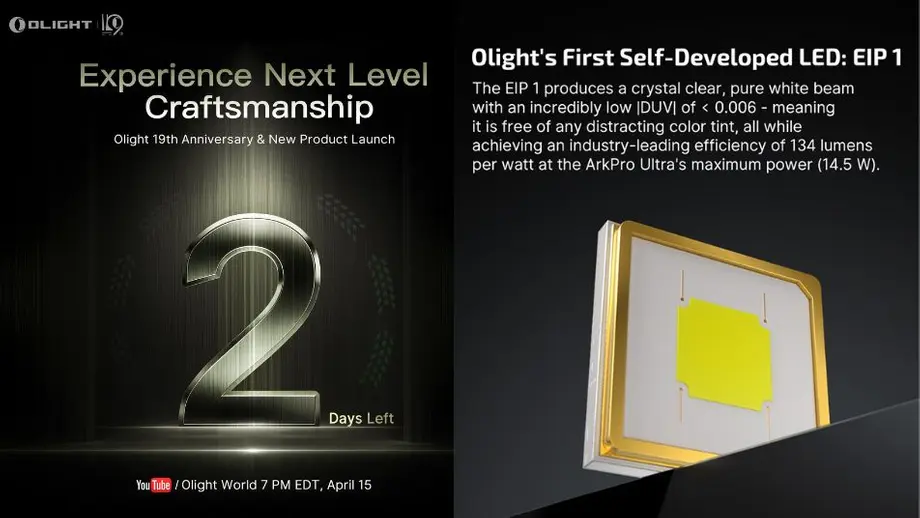
Many LEDs suffer from chromaticity deviation, resulting in "tint shift"—a beam that looks green or yellow. The EIP 1 solves this by maintaining a deviation of less than 0.006 Duv, ensuring a neutral, natural light output that mimics daylight.
The Importance of High-Purity Light in the Field
Color purity isn't just an aesthetic preference; it's a critical functional requirement for professional use:
- Accurate Identification: Whether identifying wire colors or performing inspections, neutral light reveals true colors.
- Reduced Eye Fatigue: Pure white light is easier on the eyes during prolonged use compared to high-tint beams.
- Superior Visual Clarity: The ArkPro Ultra's beam profile combines power with precision, offering 1700 lumens of "Pure Flood" and 800 lumens of focused spotlighting.
Olight 19th Anniversary 2026: A Teaser of What's Coming
As Olight celebrates its 19th anniversary, the fusion of OAL and EIP 1 technology is just the beginning.
We are entering a new era of flat EDC flashlights where premium materials, advanced LED technology, and evolving design languages meet the high expectations of the enthusiast community. The ArkPro Series has proven that these innovations are production-ready and battle-tested.
- Material Mastery: OAL (230 HV) is set to redefine durability standards.
- Visual Evolution: Harder materials allow for aesthetic details previously impossible with standard aluminum.
- No Compromise: Expect tools that disappear in the pocket but command attention in the hand.
Stay Tuned for the Reveal
Join us for the Olight 19th Anniversary Online Launch Event to witness the next chapter in EDC craftsmanship. Experience the culmination of OAL and EIP 1 technology.
FAQ
What is OAL aluminum in Olight flashlights?
OAL (O-aluminum) is Olight's proprietary aluminum alloy, engineered to be 1.73× harder than standard 6061 aluminum. Used in the ArkPro Series, it delivers superior scratch resistance, structural integrity, and anodizing compatibility compared to conventional flashlight materials.
What does Duv <0.006 mean in a flashlight LED?
Duv measures how far a light source deviates from pure white on the Planckian locus. A Duv below 0.006 means the beam is exceptionally close to natural white light — no green, purple, or yellow tint — resulting in accurate color rendering and reduced eye fatigue.
Is 7075 aluminum better than 6061 for EDC flashlights?
7075-T6 aluminum (≈150–175 HV) is significantly harder than 6061-T6 (≈107 HV), making it a better choice for tactical and EDC flashlights. However, Olight's O-aluminum (OAL) surpasses both, offering 1.73× the hardness of 6061 with superior anodizing compatibility.