- The Thrower's Dilemma: The Burden of Big Reflectors and Batteries
- Debunking the Myth: How the New Baton Achieves 300m in a 4-inch Body
- Visualizing 300 Meters: What It Looks Like in Real Life
- Who is the Compact Thrower For?
- Conclusion: Get the Power of a Searchlight with the Convenience of an EDC
For years, the flashlight community has accepted a fundamental compromise: if you want to illuminate an object 300 meters away, you have to carry a device that feels like a brick in your pocket. Traditional long-range illumination relies on the laws of classical optics—big reflectors equal tighter beams. This "bigger is better" philosophy has turned many high-performance throwers into "shelf queens"—lights that are too cumbersome for daily carry and are only brought out for specific missions.
But what if you could shrink that massive searchlight into a form factor no larger than a tube of lip balm? Imagine a long range EDC flashlight that disappears into your jeans but, when clicked, punches a hole through the darkness with the intensity of a lighthouse. This is no longer a "what if." We are entering a new era where high candela pocket light gear is redefining the boundaries of physics. The upcoming New Baton is designed to solve the ultimate EDC paradox: delivering class-leading long-range performance within a footprint that fits in the palm of your hand.
The Thrower's Dilemma: The Burden of Big Reflectors and Batteries
To understand why a compact thrower flashlight is such a breakthrough, we must first look at the "Thrower’s Dilemma." In traditional flashlight design, "throw" (distance) is determined by center beam intensity, measured in candela (cd). To achieve high candela, manufacturers typically use two methods:
- Deep, Wide Reflectors: A larger diameter reflector captures more light from the LED and focuses it into a narrow parallel beam. This results in the "lollipop" shape—a tiny handle with a massive, flared head that is impossible to holster comfortably.
- High Current Drive: Pushing massive amounts of power through an LED to force more light out. This requires large 21700 or 26650 batteries and heavy copper heat sinks to prevent the light from melting, further increasing the bulk.
For the average user, this means choosing between a Baton 4—which is wonderfully portable but lacks the "punch" for long-distance spotting—and a dedicated searchlight that requires its own carrying case. The gap between "convenient" and "capable" has been a chasm for a decade. The New Baton was engineered specifically to bridge this gap, utilizing revolutionary materials and photonics to eliminate the need for a "mega-head" reflector.
Debunking the Myth: How the New Baton Achieves 300m in a 4-inch Body
It seems impossible: a light only 113 mm (approx. 4.4 inches) long achieving a 300-meter throw. In the past, a light this size would be lucky to reach 150 meters before the beam dissipated into a dim glow. The secret to the New Baton's performance isn't just a bigger battery or a brighter LED—it's a fundamental shift in how light is generated and directed.
The construction itself plays a role. By using exclusive OAL™ (O-aluminum) material, which is 1.73x harder than standard 6061 aluminum alloy, the chassis can be thinner yet more rigid. This saves internal space, allowing for a more sophisticated optical stack without increasing the outer diameter of the sleek "straight tube" design.
The Science of EIP
The heart of this revolution is EIP (Olight's self-developed LED technology). While standard LEDs scatter light in a wide 120-degree arc (requiring a massive reflector to catch and redirect it), EIP technology focuses on the emission source itself.
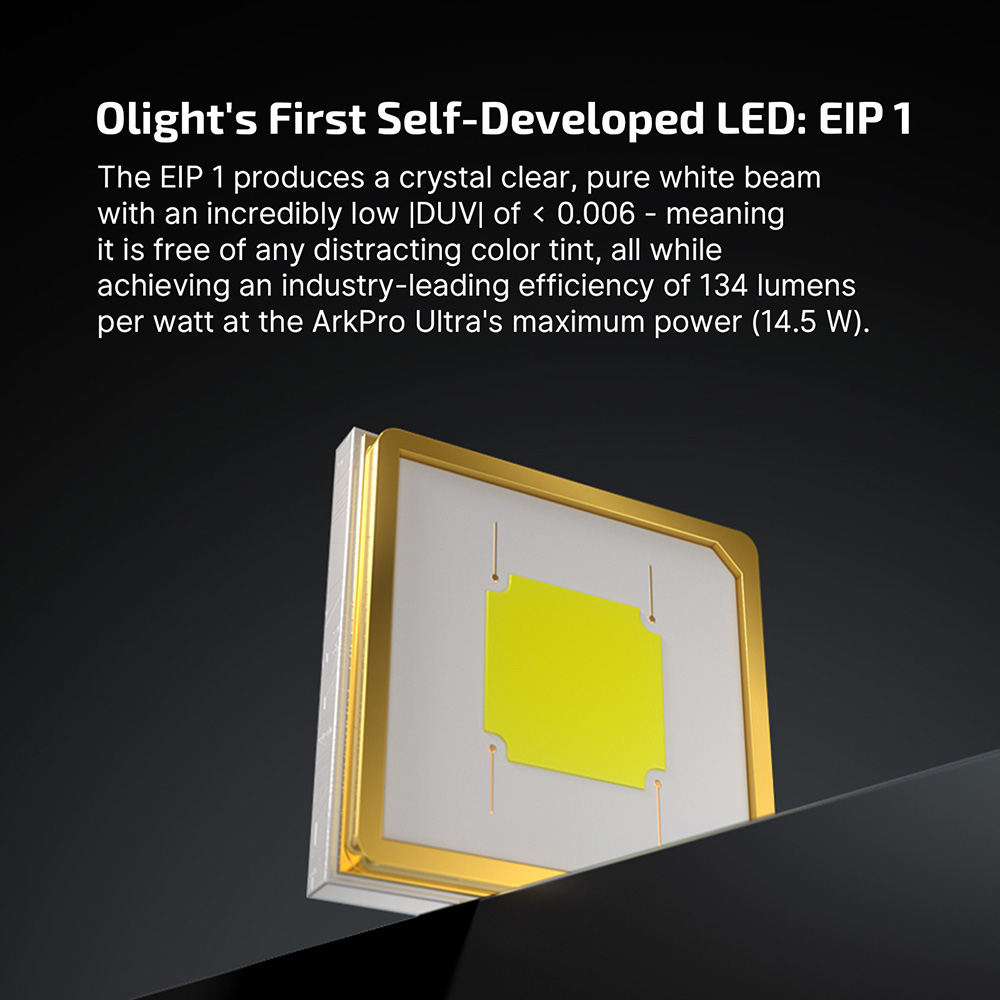
The self-developed EIP LED chip functions with a high efficiency of 134 lumens per watt. More importantly, it features a High Candela/Low Die Area ratio. By concentrating the light emission into a much smaller, denser point, the optical system can focus the beam with much higher precision.
With a center light intensity of 22,500cd, the New Baton creates a concentrated "hotspot" that maintains its integrity over long distances. Unlike traditional EDC lights that produce a "wall of light" (high lumens but low throw), this high candela pocket light creates a surgical beam. It utilizes a custom-designed TIR (Total Internal Reflection) lens that replaces the bulky hollow reflector, allowing the light to remain a sleek 111mm cylinder while throwing light further than many lights twice its size.
Visualizing 300 Meters: What It Looks Like in Real Life
To the average person, "300 meters" is just a number. In practice, it is the length of three American football fields. When you are standing in a pitch-black forest or a dark suburban street, 300 meters is the difference between seeing a "shape" and identifying an object.
- At 50 Meters: A standard EDC light illuminates the grass at your feet, but fades quickly.
- At 150 Meters: Most pocket lights begin to wash out; colors become muted, and the beam spreads too wide to see detail.
- At 300 Meters (New Baton): The EIP-powered beam remains tight. You can clearly see the bark on a tree, the license plate of a car at the end of a long driveway, or the reflection of an animal's eyes in a distant field.
The contrast is staggering. When you hold a tool this small, your brain expects a soft, wide beam. Instead, the New Baton produces a "light saber" effect—a distinct, powerful column of light that cuts through humidity and dust to reach its target. This is the experience of a new era: searchlight-level performance coming from a device that weighs less than your smartphone.
Who is the Compact Thrower For?
While everyone can appreciate a good flashlight, the compact thrower flashlight serves specific needs where portability and distance are non-negotiable.
For the Hiker: Spotting Trail Markers from Afar
Weight is the enemy of any hiker. Carrying a dedicated 500g thrower for "just in case" scenarios is rarely justifiable. However, the New Baton adds negligible weight to a pack. If you lose the trail at dusk, you don't need to flood the woods with light—you need to find a single reflective trail marker 200 meters away. The high candela beam allows you to "scan" the horizon and find your path without exhausting your battery on useless spill.
For the Prepper: Long-Range PID without the Weight
In emergency preparedness, PID (Positive Identification) is critical. Being able to see who or what is approaching from a distance provides the most valuable commodity in a crisis: time. A long range EDC flashlight allows you to identify potential threats from a safe distance. Because the New Baton is small enough for 24/7 carry, you are never caught without "reach," ensuring tactical-level illumination even in casual attire.
For the Land Owner: Scanning Your Property Line
If you live on several acres, checking the perimeter usually requires a heavy spotlight. With the New Baton, you can perform a nightly security sweep from your back porch. The 22,500cd beam is powerful enough to light up a fence line or a barn door at the edge of your property, allowing you to check for predators or open gates without ever lugging around a heavy lantern.
Conclusion: Get the Power of a Searchlight with the Convenience of an EDC
The era of the bulky thrower is coming to an end. We are moving toward a future where "tactical" distance and "pocketable" size are no longer mutually exclusive. The New Baton, powered by EIP technology and encased in ultra-durable OAL™ (O-aluminum) material, represents the pinnacle of this evolution.
It is a tool for those who refuse to be weighed down but demand the ability to see across the valley. It is the realization of the "One Light" philosophy—a single device that is small enough for the office, yet powerful enough for the mountain.
The wait is almost over.
Don't miss the moment we redefine what a pocket light can do. The full reveal is almost here — mark your calendar for April 15.
Be First to See the New Baton
Date: April 15, 2026
Time: 7:00 PM EDT
Location: Olight Official Store & YouTube Live
Be among the first to witness the power of EIP and secure your spot for the exclusive launch window. The darkness doesn't stand a chance.
Tired of Bulky Throwers? 👉 Buy Olight New Baton Ultra & 4 Pro: Bright Beyond Its Size