


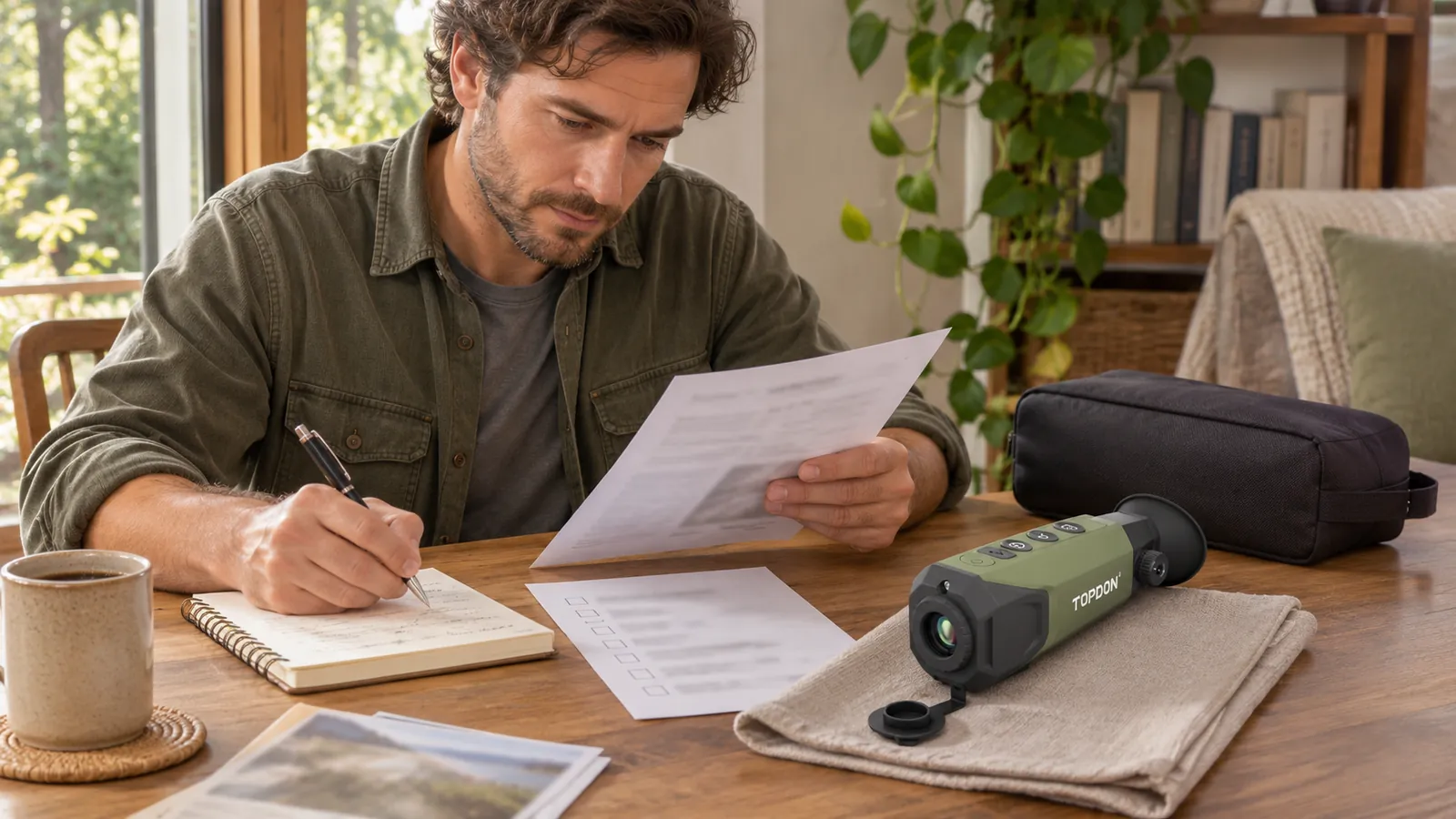
TL;DR: Before buying a thermal monocular for use around deer, confirm the intended activity, land access, dates, and applicable equipment rules with the responsible agencies and land manager. Describe every relevant device function, including a separate LED light or recording connection. A thermal image can prompt a question about an animal, but it does not establish identity, lawful use, or permission to approach.
📋 Table of Contents
- 1. Describe the actual outing before comparing equipment
- 2. Find the responsible rules instead of a generic online verdict
- 3. Prepare an equipment sheet another person can understand
- 4. Give the agency a complete equipment description
- 5. Read an answer together with its conditions
- 6. Separate land access from wildlife and equipment questions
- 7. A thermal receiver can share a device with an ordinary light
- 8. What the TOPDON TS004 actually contributes
- 9. Keep ordinary route lighting independent
- 10. Record observations without turning a shape into a conclusion
- 11. Leave wildlife behavior unchanged
- 12. Recheck when the outing changes
- 13. Make a purchase decision from the completed checklist
- 14. Frequently asked questions
- 15. Keep capability and permission in the same plan
Describe the actual outing before comparing equipment
A person watching wildlife from an approved location, a participant in a hunting activity, and someone responding to a possible injured animal may face different questions. Start by describing what you intend to do in plain language. Include the place, date, access arrangement, and whether the equipment will be carried during another regulated activity. Do not substitute a more convenient description for the real purpose of the trip.
This step matters because a product page describes equipment capabilities, while the relevant authorities determine the rules for the activity and location. A retailer's statement that a monocular is suitable for outdoor observation does not answer every legal question. Landowner approval to enter also should not be treated as an answer to every equipment or wildlife-use question.
For an outing connected with the season, begin preparation before departure. An opening-day gear check provides a separate framework for organizing ordinary equipment. Add the device and permission questions described here to that preparation. Keep the actual activity clear when seeking guidance, including whether hunting is involved rather than describing every trip as casual wildlife watching.
| Information to establish | What to write down | Why it changes the question |
|---|---|---|
| Actual purpose | Wildlife viewing, participation in hunting, or another stated activity | Rules may address different conduct and equipment contexts |
| Exact location | Property, public unit, access point, and responsible manager | A statewide starting point may not contain every site condition |
| Date and time | Intended visit and any relevant season or access window | A saved answer may not address a later visit |
| Device functions | Thermal sensor, visible-light feature, recording, and connection options | The model name alone may not describe the whole device |
| Access approval | Who granted access and what it covers | Entry permission and equipment approval are separate questions |
Find the responsible rules instead of a generic online verdict
Use the wildlife agency for the state in which the activity will occur as a starting point. Then identify the land manager and any site-specific requirements. Search results, forum comments, and a manufacturer's product category can help identify questions, but they should not replace the current official material or an answer from the responsible authority.
The following official pages are starting points for three states. They are not a list of states where thermal use is allowed or prohibited. Follow the current documents and relevant categories from the appropriate page, and verify that the material applies to the intended date, species, place, and conduct. A rule about one animal or activity should not be carried over to deer by analogy.
| State | Official starting point | What to locate next |
|---|---|---|
| Pennsylvania | Game Commission regulations | The applicable Hunting & Trapping Digest and current requirements for the activity |
| Texas | Outdoor Annual hunting regulations | The relevant general rules, means and methods, and public-land or local conditions |
| California | Current mammal and big-game regulations | The applicable current regulations and provisions addressing the planned conduct and equipment |
Record the actual title and effective period of the document you consult. A search engine can return an older digest even when an agency has a current landing page. Keep the page address and the relevant section with your trip notes. If the document does not answer the device question clearly, ask the agency rather than turning the absence of a familiar phrase into permission.
Specific words can matter. Ask whether a rule concerns using equipment, possessing it during a defined activity, illuminating wildlife, recording, or another condition. Do not assume that keeping a light switched off answers a question about possession. Likewise, identifying a device as handheld does not by itself resolve every rule concerning its use around wildlife.
Prepare an equipment sheet another person can understand
Put the model name and manufacturer at the top of a short equipment sheet. Add the exact product page and manual version you consulted. If the seller uses a different listing name, record that too so that the authority can connect the inquiry to the actual device. Avoid describing a complete monocular only as an infrared camera when its additional functions matter to the question.
List the receiving, emitting, and recording features separately. For the TS004, that means distinguishing the thermal camera, the independent LED flashlight, and the wireless connection used for viewing or recording through the app. A plain-language description is more useful than a page of promotional adjectives. If a feature is unclear, mark the question and ask the manufacturer rather than supplying an interpretation from a similar model.
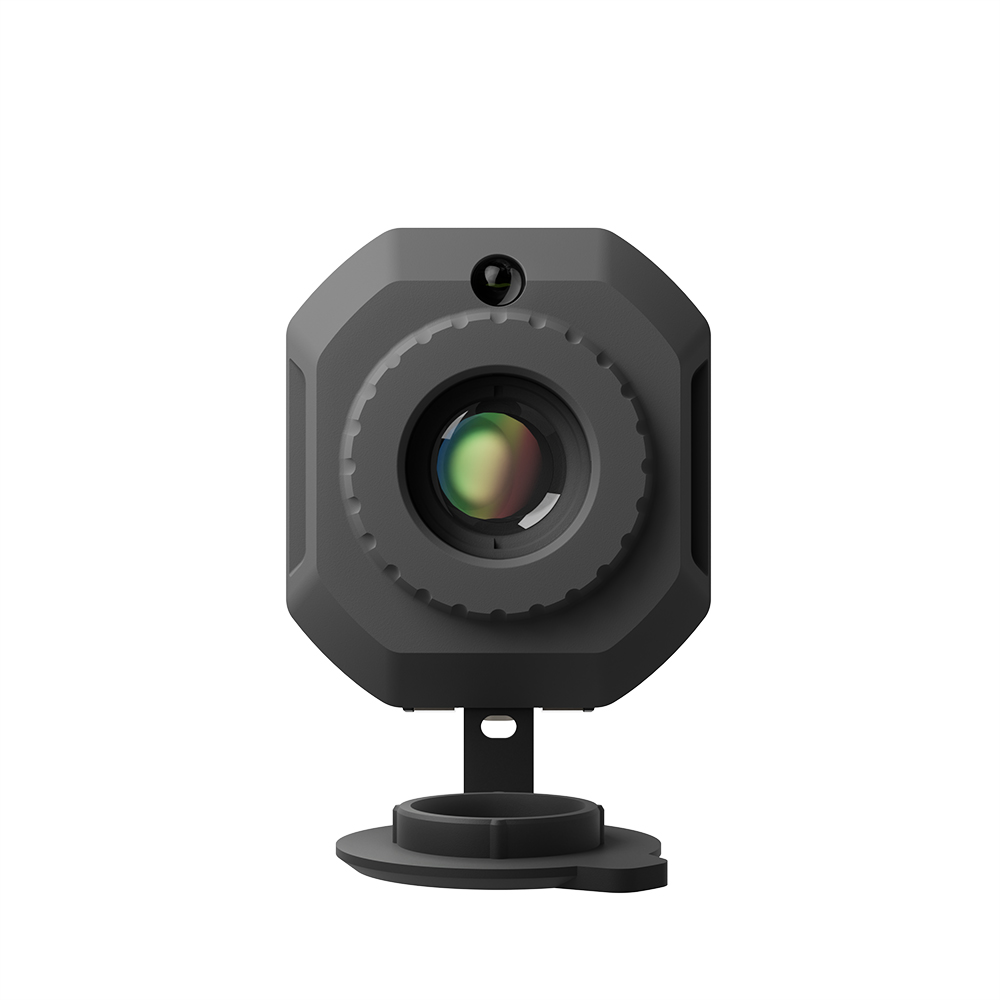
Official TS004 front view: the thermal camera and separate LED flashlight are different functions to include in an equipment description.
Add the other equipment you actually intend to carry. A separate headlamp, phone, or conventional viewing tool can change the practical plan even when the monocular remains the same. Identify the purpose of each item and which person is responsible for it. This keeps a question about a single device from concealing a more complicated group activity that the authority has not been asked to assess.
Keep manufacturer facts separate from assumptions. A statement about sensor resolution belongs in the equipment description. A belief that a device will identify an animal through vegetation does not become a fact because it appears beside those specifications. The equipment sheet should help the recipient understand the proposed activity, not make an uncertain capability appear settled.
Include the information needed to find the question again: the date prepared, the proposed visit, the person making the inquiry, and an appropriate reply address. Keep personal contact information out of any publicly shared copy. A useful document remains short enough for another person to read while preserving the distinctions that would be lost in a one-line question about whether thermal is allowed.
Give the agency a complete equipment description
A useful inquiry identifies the exact model and explains the functions relevant to the proposed activity. Attach the manufacturer's product information or manual when appropriate. If the device has both a thermal imaging sensor and an independent visible-light feature, describe both. Leaving out a function because you do not plan to use it can leave the authority answering an incomplete question.
State whether a phone connection or recording feature will be involved. Explain the intended location and the actual activity, including its relationship to hunting if there is one. Ask which provisions apply and whether another authority needs to address site access or related conditions. Avoid a broad question such as whether thermal is legal without enough context to produce a useful answer.
An inquiry might say that you are considering a particular handheld thermal monocular, identify its separate LED flashlight and recording functions, and describe the planned visit. Then ask whether carrying and using that equipment for the stated purpose is permitted at the location and time. This is an information template, not a strategy for changing how an otherwise restricted activity is described.
Keep the reply with the question that produced it. A short answer detached from its context can be easy to misapply. If the date, property, purpose, or equipment changes, identify that change before relying on the same response. A person joining the outing should receive the actual conditions, not only an informal summary that everything was cleared.
Read an answer together with its conditions
When a reply arrives, compare it with the question you sent. Check that the location, proposed activity, dates, and device description still match. A response about access may not answer an equipment question, and a response about equipment may not grant access to the property. Identify any part that remains unanswered before treating the exchange as complete.
If the reply refers to a document or section, keep that reference with the response. Read the conditions instead of reducing the answer to a single word such as yes. Ask a follow-up question when a term is unclear. The aim is an accurate understanding of the actual requirements, not a collection of favorable phrases detached from their context.
For a group outing, share the conditions accurately with the people involved. Someone borrowing the monocular should know which functions were described and what the activity was understood to involve. Do not let one participant add a different purpose or piece of equipment on the assumption that the original inquiry covers every variation. A brief discussion before departure is easier than resolving conflicting assumptions at the site.
Keep an unanswered question open. A delayed response does not resolve it, and a website search that turns up nothing does not establish permission. If the planned outing can be changed to an activity that is clearly understood and appropriate, make that change honestly. Otherwise, postpone the questionable part while seeking guidance from the responsible authority.
Separate land access from wildlife and equipment questions
Establish where you are allowed to be before considering what a thermal display might show. A possible heat pattern beyond a boundary does not create permission to cross it. Verify the property or public-land unit and the conditions of access through the appropriate owner or manager. Include arrangements for leaving the site if a gate, route, or access period changes.
For private property, communicate the intended activity accurately. Approval for a daytime visit should not silently become an assumption about a later night visit or a different purpose. Confirm what the owner actually permits and what additional agency requirements apply. Keep contact information accessible without making private details part of a publicly shared observation record.
For public land, identify the particular unit. Agency ownership, general access, and the rules of a specific site can require separate checks. Consult posted information and the current instructions of the responsible manager. Do not assume that a device allowed on one property is automatically acceptable at another location with a similar appearance or a nearby boundary.
If an answer remains unresolved, change the plan before leaving. A daytime visit without the questionable equipment, a different approved activity, or postponing the outing can be a more practical decision than carrying an unresolved issue into the field. The benefit of a permission checklist is that it exposes those decisions while they are still easy to make.
A thermal receiver can share a device with an ordinary light
Thermal imaging and a visible-light flashlight perform different jobs. The thermal channel responds to infrared radiation from surfaces within its view. An independent LED flashlight emits visible light. A product can contain both, so a description of thermal imaging as passive does not necessarily describe every function of the complete device.
This is a particularly useful distinction when preparing an equipment inquiry. Identify which features are present, what the manufacturer calls them, and which ones you intend to use. Let the responsible authority determine the implications for the actual activity. Do not decide that a restriction concerning illumination is irrelevant solely because the thermal channel itself does not require the same visible beam as an ordinary flashlight.
A separate headlamp or handheld light should also be included when relevant. Its ordinary purpose may be reading instructions or safely following an approved route. That purpose should be stated clearly rather than being combined with wildlife observation. Keep the equipment roles separate so that the lighting needed for people does not become an unexamined assumption about lighting animals.
Recording and wireless sharing create another set of practical questions. They can help preserve an observation, but they do not turn it into confirmed identification. Obtain the relevant permissions for the activity and respect other people's privacy. A device's ability to make a file is not a reason to record people, neighboring private areas, or information unrelated to the intended outing.
What the TOPDON TS004 actually contributes
The TOPDON TS004 thermal imaging monocular, sold through OSelect, provides a standalone viewing format. Its official manual identifies an eyepiece, a diopter adjustment, a thermal camera, and a separate LED flashlight. That layout allows a buyer to distinguish the receiving and emitting features when describing the equipment instead of assuming the entire device has only one optical function.
The published infrared resolution is 256 × 192, with a 50 Hz refresh rate and a 13 mm lens. Resolution describes the thermal image's native pixel dimensions; refresh rate describes image updates. Neither figure identifies an animal on its own. A smoother display can be easier to follow visually, but it does not supply missing detail about an obscured object or establish what species is present.
The manual lists digital magnification options. Enlarging the displayed image should not be mistaken for creating additional native sensor pixels. Consider whether the original information is sufficient for the intended observation rather than judging confidence by the apparent size of the enlarged shape. An uncertain image should remain uncertain in the notes, even when a larger display makes it more visually striking.
Wireless connection through the TopInfrared app can support live viewing and the capture of images or video. That can help an adult preserve context or discuss an observation without repeatedly passing the eyepiece between people. It also adds a phone, connection, storage, and battery routine to the outing. Prepare those requirements before relying on sharing as an essential part of the plan.
The current product description gives an up-to battery-life figure of eleven hours with a 5000 mAh battery. Treat this as a manufacturer maximum rather than a guarantee for every combination of recording, wireless use, conditions, and battery state. Plan the actual outing with an appropriate margin and keep a separate way to manage ordinary route lighting and communication.
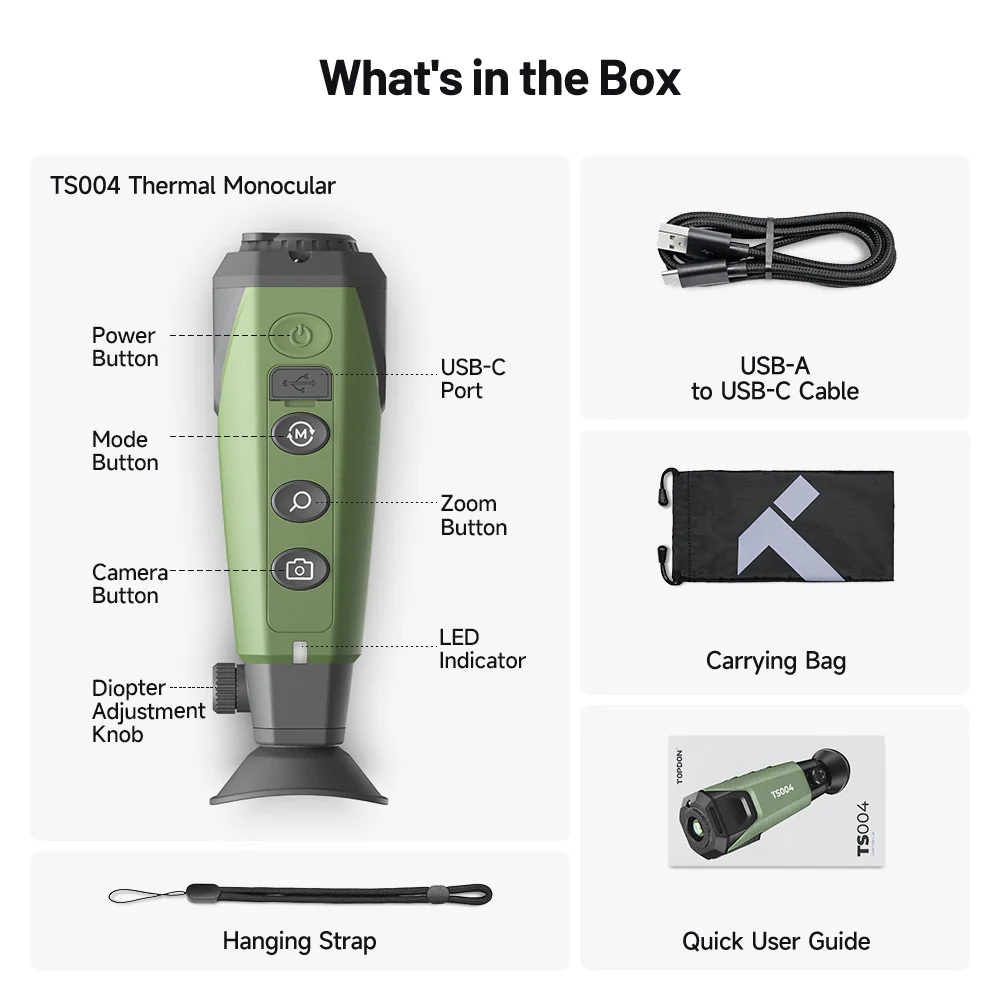
Official TS004 kit illustration showing its USB-A to USB-C cable, carrying bag, strap, and guide; check the selected package before planning the outing.
The manual states that the TS004 does not detect objects through glass, through walls, or underwater. Do not treat a view through a closed window as equivalent to an unobstructed view of the same scene. Physical barriers and incomplete views can leave you with information about the visible surface rather than the object you hoped to examine.
Manufacturer detection language should also remain separate from animal identification. A range claim without the exact target and conditions does not tell you where a particular deer can be reliably identified. Do not buy the device around an assumption that every warm shape at a stated distance will become a clear, recognizable animal. Ask what the available specification actually establishes for the intended noninvasive observation.
Keep ordinary route lighting independent
A thermal display is not a substitute for seeing the route, reading signs, or recognizing obstacles in ordinary visible light. A headlamp can serve those separate human tasks when its use is permitted and appropriate. Keep enough attention on the surroundings to walk safely rather than moving while concentrating only on a monocular's display.
The Olight Perun 3 includes a headband and offers both white and red lighting modes. The head-mounted format can leave hands available for ordinary equipment handling, while its beam follows head movement. That also means it can swing toward another person when the wearer turns. Choose an appropriate documented setting and remain considerate of people and wildlife.

Official Perun 3 headband configuration for separate ordinary lighting tasks; head-mounted light follows the wearer's head movement.
Red light should not be treated as proof of invisibility to deer or as an exemption from an equipment rule. Include it in a complete description when seeking guidance. If the intended activity requires limiting disturbance, follow the site's instructions and change the plan when necessary. The color of a light is not a substitute for the relevant permission or the animal's actual response.
The Perun 3's large concave metal side button is intended to support handling while reducing unintended activation. That physical shape is not the same thing as a documented lockout procedure. Consult the correct instructions for storage and operation. The manufacturer also notes that repeated removal from and insertion into the metal headband bracket can scratch the light's body, a useful consideration when deciding how frequently to change its carrying arrangement.
If a head-mounted format does not suit the ordinary task, a suitable rechargeable flashlight may serve another role. The important decision is how the person will see and manage the route, not how to add more light to an animal observation. Keep the thermal monocular, navigation needs, and everyday illumination responsibilities distinct.
Record observations without turning a shape into a conclusion
Write down what was actually visible and what remains unknown. A partial warm shape behind an obstruction is not a confirmed deer count, an assessment of health, or evidence that an area contains no other animals. Ordinary contextual information can help explain the observation, but uncertainty should remain explicit rather than disappearing when the image is saved.
Keep records proportionate to the purpose. A date, a permitted location description, the device used, and a brief account of the visible pattern may be enough. Avoid publishing sensitive location information, private access arrangements, or images of people unrelated to the task. A useful record is one that supports the appropriate follow-up without encouraging unnecessary intrusion.
If the situation concerns a missing household animal instead of a planned wildlife outing, use an appropriate response plan. The lost-pet-at-night guide addresses that different purpose. Do not assume an unidentified thermal shape is a deer or a pet, and do not let the display override reliable information from the owner or appropriate local responders.
A thermal image also cannot establish whether an animal is alive, dead, or injured, or provide a dependable time since death. Do not approach or handle wildlife to resolve that uncertainty. If there is a concern about an injured or dead animal, contact the appropriate wildlife authority and follow its instructions. A device's presence does not make the observer responsible for personally investigating every uncertain image.
Leave wildlife behavior unchanged
The National Park Service's guidance on watching wildlife emphasizes distance and responsible observation. Follow the requirements of the specific place, which can differ by animal and location. A monocular's magnification or display does not reduce the importance of those boundaries or create a reason to move closer for a more satisfying image.
Do not follow, surround, call, feed, or move an animal to improve a view. If your activity causes a change that concerns you, give the animal space and follow the site's directions. The useful outcome is an observation made within appropriate conditions, not a photograph obtained at the cost of disturbing wildlife or crossing an access boundary.
Plan a clear stopping point. Weather, declining visibility, a changed access situation, or uncertainty about the permitted activity can all justify leaving. Avoid treating the purchase of a device as a commitment to use it regardless of the circumstances. Equipment is useful when it fits the outing that is actually allowed and manageable.
For group visits, make sure everyone understands the same limits. Identify who holds the permissions and contact information, who manages ordinary lighting, and what will happen if the group separates or the plan changes. Do not leave one person relying on an informal summary while another carries the only record of the actual conditions.
Recheck when the outing changes
Consider a familiar location visited on a different date. The property may be the same while the access period, season, planned activity, or management instructions have changed. Refer to the actual conditions rather than relying on the fact that the equipment was used there before. Prior experience is useful background, but it is not a substitute for checking a changed plan.
A borrowed device can create a similar gap. A person may think they are bringing the same type of monocular while the new model includes an additional light or connection feature. Compare the exact equipment description before relying on an earlier answer. This is also a reason to keep the manual with the device instead of depending on another owner's recollection of how it works.
If an unexpected situation arises, avoid turning the original outing into a different activity without considering the implications. A possible injured animal, an uncertain property boundary, or a request from another person can introduce questions that were not part of the plan. Contact the appropriate authority and explain what changed. The presence of a thermal monocular does not require an immediate personal intervention.
Make a purchase decision from the completed checklist
A good outcome can be deciding to wait. If the intended use remains unclear, the location has unresolved restrictions, or the observation would require information the device cannot provide, buying more hardware does not remove those gaps. Resolve the important questions before treating price or a range headline as the deciding factor.
If the task is appropriate, compare the complete equipment arrangement. A standalone monocular and its charging needs differ from a phone attachment that depends on the connected device. The TS004's eyepiece and separate LED, wireless sharing, and carrying requirements should each have a stated purpose. Leave unnecessary features out of the outing's plan rather than inventing a job for them after purchase.
Keep the exact model, manual, relevant agency response, and access conditions together. Check them again when the date, place, activity, or equipment changes. That small administrative habit helps preserve the difference between having a capable device and having an appropriate, permitted use for it.
Frequently asked questions
Keep capability and permission in the same plan
A useful thermal monocular purchase begins with an honest activity description, current official information, and clear land-access arrangements. Then match the device's documented functions to a limited, appropriate task. Keep ordinary lighting independent, preserve uncertainty in observations, and choose a simpler or postponed outing when an important permission or capability question remains unresolved.
Changelog
- November 18, 2026: Product information and buying guidance reviewed.




