Olight makes the lights discussed here. Olight specs and regular prices come from its US product pages and user manuals as of October 2026. The fog figures below come from a textbook visibility model and published droplet sizes. They are calculations, not field measurements.
⚡ TL;DR
The best headlamp for fog is the Olight Perun 3 Mini ($64.99). It has a 10-lumen Low and a 100-lumen Med for walking in mist, and a quick-release bracket that lets the same light leave your head and ride at your waist. We compared four Olight lights on published specs only. Light position and brightness matter more than tint.
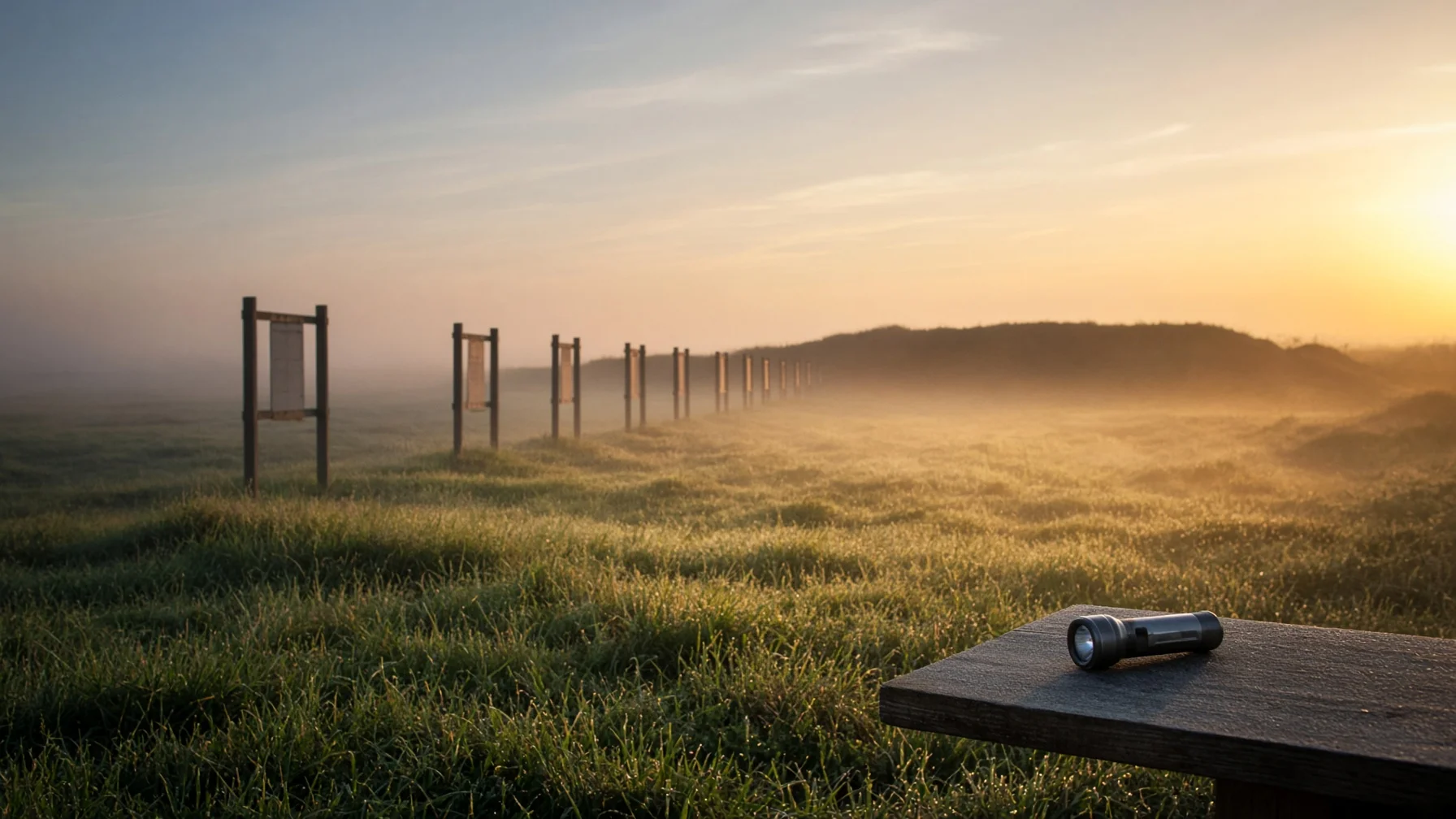
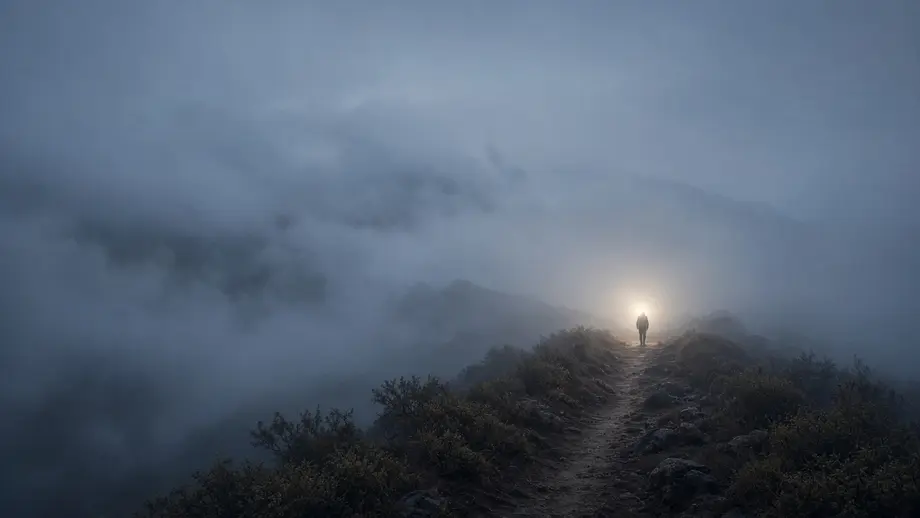
You switch on your headlamp on a foggy ridge before dawn, and the air in front of you turns into a glowing white wall. You turn the lamp up and the wall gets brighter. Then someone tells you a yellow light "cuts through fog," and you start shopping for a new tint.
This table gives the best headlamp for fog by job, using Olight's published ratings and regular prices.
| Job in fog | Pick | Key specs (Olight ratings) | Regular price | Why |
|---|---|---|---|---|
| Overall fog headlamp | Olight Perun 3 Mini | 1,250 lm max; Med 100 lm, 4.5 h; Low 10 lm, 30 h; 54 g; IPX8 | $64.99 (Standard) | The same light works on your head or in your hand at hip height |
| Waist-height handheld | Olight Baton 4 | 1,300 lm max; Med 60 lm, 8 h; Low 12 lm, 35 h; 52.5 g; IPX8 | $54.99 (Standard) | Long low modes and a switch lockout in a 63 mm body |
| Hip-belt flood light | Olight Oclip 2 Pro | 530 lm flood; flood Medium 100 lm; 115° head tilt; 75.5 g; IP66 | $49.99 (Black, Orange) | A wide flood that rides your belt and angles down at your path |
| Lightest backup | Olight Oclip | 300 lm max; Low 10 lm, 12 h; red 4 lm; 30 g; IPX5 | $29.99 (Black) | A small spare light with a red mode for the walk back to camp |
📋 Table of Contents
- 1. Quick Answer: How Do You Choose the Best Headlamp for Fog?
- 2. Why Does a Headlamp Turn Fog Into a White Wall?
- 3. Warm or Yellow Light in Fog: What Scattering Physics Says
- 4. Headlamp Position in Fog: Forehead, Brim, Chest or Waist?
- 5. Lights for Foggy Weather Compared: Perun 3 Mini, Baton 4, Oclip 2 Pro, Oclip
- 6. Finding Trail Markers, Reflective Signs and Cairns in Fog
- 7. Common Mistake: Turning the Headlamp Up as the Fog Thickens
- 8. Getting Lost in Fog: When to Stop and Wait
- 9. Reader Self-Test: How to Compare Fog Light Setups Yourself
- 10. What Type of Headlights Should I Use in Fog?
- 11. What Headlamps Do Navy SEALs Use?
- 12. What Is the Highest Rated Headlamp?
- 13. Best Headlamp for Fog: Your Action Checklist
- 14. FAQ
Quick Answer: How Do You Choose the Best Headlamp for Fog?
Choose the best headlamp for fog by its low end, not its peak. You want a white step near 10 lumens, a medium step near 100 lumens, a lockout, and a way to move the light below your eyes. In fog, use the headlamp on Low or Med for your feet and carry a second light low at your waist. A warmer tint will not make the beam reach farther.
Olight's full range of headlamps lists every model; four cover most fog setups. The Perun 3 Mini wins because its bracket releases the light into your hand in one move, turning one lamp into a waist light. The Baton 4 and the two Oclip lights are second lights for the hip.
Moving the working light down to your waist is also the core advice in our best headlamp for rain guide. Fog is different because its droplets are far smaller and hang in the air, so the glow surrounds you instead of streaking past. For long, cold nights, the larger Perun 3 has more runtime at 120 lumens; for an hour or two around dawn, the lighter Mini fits better.
Why Does a Headlamp Turn Fog Into a White Wall?
A headlamp turns fog into a white wall because the droplets nearest your face scatter part of the beam straight back toward your eyes. On a short walk, most of the light still reaches the trail. What fog takes away is contrast: the lit haze in front of a trail mark ends up brighter than the mark, so the edge your eye needs to find fades out.
The National Weather Service issues a Dense Fog Advisory when "visibilities frequently drop to one-quarter of a mile or less." Stanford's Mark Z. Jacobson gives the Koschmieder equation in his Fundamentals of Atmospheric Modeling course notes: meteorological range x = 3.912 ÷ σ, where σ is the extinction coefficient of the air.
Our best flashlight for woods guide already uses that equation to estimate how much of a beam survives the round trip to targets 10 to 100 m away in dense fog. This guide uses the same equation for a different question: why turning the light up does not bring the trail back.
Why more lumens will not bring the trail back
The Koschmieder equation is built on contrast, not brightness. Jacobson defines meteorological range as the distance from an ideal dark object "at which the object has a 0.02 liminal contrast ratio against a white background," and derives the contrast ratio as e^(−σx). Set that ratio to 0.02 and solve: σx = ln(1 ÷ 0.02) = ln(50) = 3.912. No term in that chain says how bright any light is.
When your headlamp is the only light, the sign's reflection and the droplet glow both scale with its output, so their ratio, which your eye uses to find an edge, stays put.
Here is the ratio with round numbers. Say the sign sends back 10 units of light and the lit haze in front of it adds 40, so the sign makes up 10 ÷ 50 = 20% of what reaches your eye from that direction. On Turbo at 10 times the output, the sign sends back 100 and the haze adds 400: 100 ÷ 500 = 20% again. The scene got brighter; the sign did not stand out any more.
What does change the ratio is geometry. Haze lit close to the lamp is the brightest part of the veil, because light thins out with distance from its source, and you can move the light so less of that haze lies along your line of sight. So turn the headlamp down and move the working light lower instead of buying lumens.
Warm or Yellow Light in Fog: What Scattering Physics Says
Warm or yellow light does not travel through fog much better than white light, because fog droplets are too large to scatter by wavelength. Short-wavelength scattering, the effect that makes the sky blue, only dominates for particles far smaller than a light wave. Fog droplets are 10 to 20 μm across, many times the wavelength of visible light.
Georgia State University's HyperPhysics notes on scattering say cloud droplets are "much larger than the molecules of the air and the scattering from them is almost independent of wavelength in the visible range." The page adds that Mie scattering "is not strongly wavelength dependent" and "also gives us the the white light from mist and fog."
The size parameter shows why. Jacobson's chapter defines it as α = 2πr ÷ λ, with r the particle radius and λ the wavelength, and puts the Rayleigh regime below 0.1, the Mie regime from 0.1 to 100, and the geometric regime above 100. Table 14.1 in his Chapter 14 notes lists fog drops at 10 to 20 μm in diameter.
This table shows the size parameter at two example wavelengths, a blue 450 nm and a yellow-orange 600 nm, calculated from Jacobson's particle diameters.
| Particle (Jacobson Table 14.1) | Diameter | α at 450 nm (blue) | α at 600 nm (yellow-orange) | Scattering regime |
|---|---|---|---|---|
| Gas molecule | 0.0005 μm | 0.0035 | 0.0026 | Rayleigh: strongly favors blue |
| Small fog drop | 10 μm | 70 | 52 | Mie |
| Large fog drop | 20 μm | 140 | 105 | Geometric |
Worked example for the small fog drop at 450 nm: α = 2π × 5 μm ÷ 0.45 μm = 69.8. In the Rayleigh regime, Jacobson gives scattering efficiency as proportional to (r ÷ λ)⁴, so 450 nm light scatters (600 ÷ 450)⁴ = 3.16 times more than 600 nm light. That ratio holds for air molecules. Fog drops sit about 500 to 1,400 times past the Rayleigh limit, so it does not apply to them.
Where the tint myth comes from
Two things make warm light feel better in fog, and neither is longer reach. A warmer version of a light can be dimmer, and the tint then gets credit for what lower output did. And color comfort is a perception question, separate from scattering; we have not found a verifiable source that settles it for headlamps on foot.
Olight's Perun 3 Mini page shows the brightness trap. Its Technical Details list the cool white (CW) LED at "CCT: 5,700K~6,700K; CRI:70" and the HCRI neutral white (NW) LED at "CCT: 4,000K~5,000K; CRI:90." The same page's product details describe the HCRI version as having "a CRI (Color Rendering Index) of 70," so it gives two CRI figures for that version; both are quoted here as written. The NW figures below serve only as a comparison. The CW Standard Edition is the version this guide recommends.
This table compares the two versions mode by mode, using the ratings on Olight's Perun 3 Mini page.
| Mode (Olight rating) | Perun 3 Mini CW | Perun 3 Mini HCRI NW | NW as a share of CW |
|---|---|---|---|
| Turbo | 1,250~350 lm | 920~276 lm | 74% at start, 79% after step-down |
| High | 500~350 lm | 400~280 lm | 80% |
| Med | 100 lm | 85 lm | 85% |
| Low | 10 lm (one value listed) | 10 lm (one value listed) | 100% |
| Peak intensity | 6,000 cd | 4,416 cd | 74% |
Switch from CW to NW on Med and you lose 15% of the light before color plays any part. Olight says so: "The HCRl Version's overall brightness is slightly lower than the Standard Version's white beam." Only Low and Moon list the same output, so judge tint on Low. Yellow filters follow the same logic: a filter only removes light, so part of any glare drop comes from having less of it.
Headlamp Position in Fog: Forehead, Brim, Chest or Waist?
In fog, the lower the light sits below your eyes, the less of the lit haze lands in your line of sight. A headlamp on your forehead puts the brightest droplets almost exactly where you look. A chest clip helps somewhat. A light at your waist helps most, especially paired with a dim headlamp.
- Forehead, lamp level: the brightest glow. Use Low only, for your feet.
- Forehead, lamp tilted down hard: the brightest haze moves lower in your view. The easiest fix with one light.
- Cap brim clip: about headlamp height, so the same glare. Our clip on light guide compares brim, collar and belt positions for other jobs.
- Chest strap or shirt pocket: lower than your eyes, but the light swings as you move.
- Waist or hip, handheld or clipped: the lowest practical spot.
Safety note: The Oclip 2 manual warns: "If you have an ICD or pacemaker, avoid close or prolonged contact with this product to prevent possible interference." With an implanted device, the waist position suits you anyway: clip the Oclip 2 Pro to the side of a hip belt, away from your chest, and skip the chest strap and shirt pocket.
Olight says the Perun 3 Mini's "quick-release bracket lets you switch from headlamp to handheld flashlight instantly." When the white wall builds, pop the light out, hold it at your hip on Low or Med, and aim at the trail a few steps ahead.
Lights for Foggy Weather Compared: Perun 3 Mini, Baton 4, Oclip 2 Pro, Oclip
On paper, only the Perun 3 Mini ships with a headband, so it is the head light; the Baton 4, Oclip 2 Pro and Oclip ride at the hip. The Baton 4 has the longest Low runtime at 35 hours, and the Oclip is the lightest at 30 g. None lists a warm-white LED.
This table lists each light's official ratings, with regular prices from Olight's US pages as of October 2026.
| Spec (Olight rating) | Perun 3 Mini (CW) | Baton 4 | Oclip 2 Pro | Oclip |
|---|---|---|---|---|
| Regular price | $64.99; Premium $94.99 | $54.99; Premium $94.99 | $49.99; blue $54.99; Premium $74.99 to $79.99 | $29.99 (Black) |
| Max output | 1,250 lm | 1,300 lm | 530 lm flood | 300 lm |
| Max intensity | 6,000 cd | 7,225 cd | 3,906 cd | 1,156 cd |
| Beam distance | 155 m | 170 m | 125 m | 68 m |
| Med | 100 lm, 4.5 h | 60 lm, 8 h | Flood 100 lm, 3 h 45 min | 100 lm, 90 min |
| Low | 10 lm, 30 h | 12 lm, 35 h | Flood 10 lm, 25 h | 10 lm, 12 h |
| Red light | 45 lm, 150 min; 5 lm, 19 h | None | 40 lm, 4 h; 4 lm, 27 h | 4 lm, 5 h |
| Weight | 54 g | 52.5 g | 75.5 g | 30 g |
| Water rating | IPX8 | IPX8 | IP66 | IPX5 |
The Oclip 2 manual lists flood Medium at 100 lm for 3 h 30 min, 15 minutes less than the product page; plan on the shorter figure.
Olight Perun 3 Mini: best headlamp for fog overall
The Olight Perun 3 Mini headlamp costs $64.99 for the Standard Edition, with headband, headlamp base and MCC cable. The $94.99 Premium Edition comes with a wireless charger and a USB charging cable instead of the MCC cable. White modes: Turbo 1,250~350 lumens (2 + 60 minutes), High 500~350 lumens (2 + 75 minutes), Med 100 lumens (4.5 hours), Low 10 lumens (30 hours) and Moon 2 lumens (10 days).
Its user manual says a press and hold cycles "Low-Medium-High (Moonlight and Turbo are not in the cycle)," so adjusting never jumps to Turbo. A double press from off goes to red light, and holding about 2 seconds from off sets the lockout. It solves the white wall with one light: wear it on Low, then pull it from the bracket and hold it at your hip when the glare builds. Skip it if you need Med all night; Med lasts 4.5 hours, against 25 hours at 120 lumens on the Perun 3.
Olight Baton 4: best flashlight for fog at waist height
The Olight Baton 4 flashlight costs $54.99 for the Standard Edition, with an MCC magnetic cable and a pouch. The $94.99 Premium Edition comes with a charging case that Olight says "can fully charge the Baton 4 flashlight 5 times," so it needs no MCC cable.
At hip height, Med (60 lumens, 8 hours) and Low (12 lumens, 35 hours) are the fog modes; Moon (0.5 lumens, 30 days) is for waiting. The manual locks the button with a press and hold "for about 2 seconds" from off. Pick it if you already wear a headlamp and want a pocket light to hold low; Olight calls it "Almost shorter than your index finger." Skip it if you want red light for map checks or a hands-free mount. Other sizes are in the Baton flashlights range.
Olight Oclip 2 Pro: best hip-belt light for fog
The Olight Oclip 2 Pro clip light costs $49.99 in Black or Orange and $54.99 in blue; the Premium version, $74.99 to $79.99, adds a 1,000 mAh Mobile Charging Dock. For fog, the useful parts are the selector and the hinge. One selector picks the floodlight, which tops out at 530 lumens, over the 125 m spotlight, and Olight lists a "115° head tilt," so the head can angle down at the path while the body hangs on your hip belt.
Cold fog is the catch. The Oclip 2 manual says: "In environments below 0°C (32°F), the white light is limited to Low and Medium modes," and white Turbo is unavailable from 0°C to 10°C. In freezing fog that costs little. It also says: "Do not immerse the product in water or other liquids, as it will damage the product." Skip it if you ford streams with gear at your waist.
Olight Oclip: the lightest backup
The Olight Oclip costs $29.99 in Black. It weighs 30 g and offers Low (10 lumens, 12 hours), Moon (1.5 lumens, 30 hours) and red light (4 lumens, 5 hours), with a white LED listed at 5,700K to 6,500K. It clips to a pack strap as the spare for map checks in red, and Olight says the clip can "clamp objects up to 14mm thick." Skip it as your only waist light: Med runs 100 lumens for only 90 minutes. Its manual warns: "Do not immerse the product in water or other liquid as it will damage the product."
Finding Trail Markers, Reflective Signs and Cairns in Fog
To find trail markers in fog, keep your main light low and dim, and stop to search instead of searching while you walk. When you expect a reflective sign, give a short burst from the headlamp.
- Walking: headlamp on Low for your feet, waist light on Low or Med aimed a few steps ahead.
- Searching for a painted blaze or cairn: stop, switch the headlamp off, and sweep the waist light slowly where the next mark should be.
- Searching for a reflective marker: headlamp on Med for two or three seconds, look for a bright point, then back to Low.
- Checking a map: use red light or Moon.
Tip: Before the fog builds, note the compass bearing between the last two trail marks. If the next mark does not appear within a few steps, go back to the last one you saw instead of guessing.
Common Mistake: Turning the Headlamp Up as the Fog Thickens
The most common fog mistake is answering the white wall with Turbo. More output lights more droplets in front of your eyes and does almost nothing for the contrast of the trail. The National Weather Service's fog-driving advice rules out high beams because they cause glare that makes the road ahead harder to see. On foot the fix runs the same way: drop to Low, then move the light lower.
- Leaving Turbo one press away. Lock the light in a pocket, and learn which press reaches which mode.
- Forgetting the eye warning. The Oclip manual warns: "Do not look directly at the light source or shine it into your eyes, as this may cause temporary blindness or permanent damage to your eyes."
Getting Lost in Fog: When to Stop and Wait
Stop when you cannot see the next trail mark from the last one, or when you no longer know which way the trail runs. The National Park Service's outdoor emergency plan starts with "Stop and breath" and, only if it is safe, retracing your steps. If that fails, call 911, then "Stay put," because "Changing location will make it difficult for authorities to find you."
The same NPS plan adds: "Move only if there is an immediate threat to life." It also tells you to "Conserve energy" and to "Inventory and conserve your resources." While you wait, run the lowest mode that shows your gear. This table shows how long each light's lowest modes last on one charge, from Olight's runtime ratings.
| Light | Lowest white mode | Runtime | 12-hour blocks covered | Red light low | Runtime |
|---|---|---|---|---|---|
| Perun 3 Mini | Moon 2 lm | 10 days (240 h) | 20 | 5 lm | 19 h |
| Baton 4 | Moon 0.5 lm | 30 days (720 h) | 60 | None | None |
| Oclip 2 Pro | Flood Moon 1 lm | 144 h | 12 | 4 lm | 27 h |
| Oclip | Moon 1.5 lm | 30 h | 2.5 | 4 lm | 5 h |
The arithmetic is runtime divided by 12 hours: 240 ÷ 12 = 20 and 30 ÷ 12 = 2.5. The Perun 3 Mini manual notes that "runtime may vary depending on the external temperature and ventilation conditions," so treat these room-temperature ratings as an upper limit in cold fog.
Warning: If you are lost or hurt, call for help first, then stay put. Save your brightest mode for signaling searchers; Turbo pointed into fog only lights the cloud around you.
Reader Self-Test: How to Compare Fog Light Setups Yourself
You can run a fair fog-light comparison on your own in one foggy morning. Mark targets at 5 m and 15 m, compare three light setups from the same spot, take photos at fixed exposure, and have three people score the glare. This plan is untested by us; we have not measured fog visibility or photographed these setups.
Note the visibility from your nearest NWS observation before each run, so you can compare one foggy morning with the next. This table lays out each test, the equipment, the method and how many times to repeat it.
| Test | Equipment | Method | Repeats |
|---|---|---|---|
| Can you recognize the target? | Trail markers or reflective cards at 5 m and 15 m | Headlamp at High; headlamp at Low; headlamp on Low plus a waist light on Low | 3 tries per setup, per target |
| Same-exposure photos | Camera or phone on a fixed mount | One frame per setup from the same spot, exposure locked | 3 frames per setup |
| Glare score | Three people, a 1 to 5 scale | Each person scores each setup without knowing which it is | 1 score per person, per setup |
| Tint at matched brightness | Two lights rated at the same output on the mode you use, one cool white and one warmer | Same position and target; swap only the light | 3 tries per light |
What Type of Headlights Should I Use in Fog?
In a car, use your low beams in fog, along with your fog lights if the car has them, and never your high beams. The National Weather Service's fog driving advice says to use "your low-beam headlights since this means your taillights will also be on. Use fog lights if you have them." Check your state's driver manual for its own rules.
In "extremely dense fog where visibility is near zero," the NWS says to turn on your hazard lights and pull into a safe location. On foot, the same idea applies: dim the light near your eyes and put the working light low.
What Headlamps Do Navy SEALs Use?
The Navy has not published a SEAL headlamp model that we could locate, so a brand named on a "SEAL headlamp" list is a guess, not a documented fact. For a foggy trail, ask questions a product page can settle instead: how dim is the lowest white step, can a press and hold land on Turbo by accident, and can the light leave your head? The Perun 3 Mini answers 10 lumens, no, and yes.
What Is the Highest Rated Headlamp?
No single model is the "highest rated headlamp" everywhere: a store's star average, a magazine's ranking and a spec comparison each score something different, and this guide assigns no star score. For an all-round answer, our best headlamps guide compares 10 models from six brands and names the Olight Perun 3 its overall pick.
For fog, the Perun 3 Mini ranks first here on four published facts: a 10-lumen Low that runs 30 hours, a hold cycle that skips Turbo, a bracket that moves the light to your hand, and a 54 g weight.
Best Headlamp for Fog: Your Action Checklist
Before your next foggy start, set your light up for the low end and plan a second light at your waist. The best headlamp for fog is the one you can keep on Low without reaching for Turbo. Practice these steps at home, in the dark:
- Head: the Perun 3 Mini on Low (10 lumens), or Med (100 lumens) for short stretches.
- Waist: the Baton 4 in your hand, an Oclip 2 Pro on your hip belt, or the Perun 3 Mini popped out of its bracket.
- Never answer the white wall with Turbo. Go dimmer first, then lower.
- Judge tint only at matched brightness, such as Low against Low.
- Note the bearing between marks; stop at the last known mark if the next will not appear.
- Lock every light for the pack.
FAQ
Changelog
- October 31, 2026: First published.