Olight makes the lights discussed here. Olight specs and regular prices come from its US product pages and manuals as of October 2026. Drop counts, angles and glare ratios are calculations from published sources, not measurements.
⚡ TL;DR
The best headlamp for rain is the Olight Perun 3 ($89.99): IP68 protection, a large concave metal button Olight calls glove-friendly, and a 120-lumen Med mode rated for 25 hours. We compared five Olight lights on published specs and manuals only. For the glare from lit raindrops, add a second light carried at waist height.
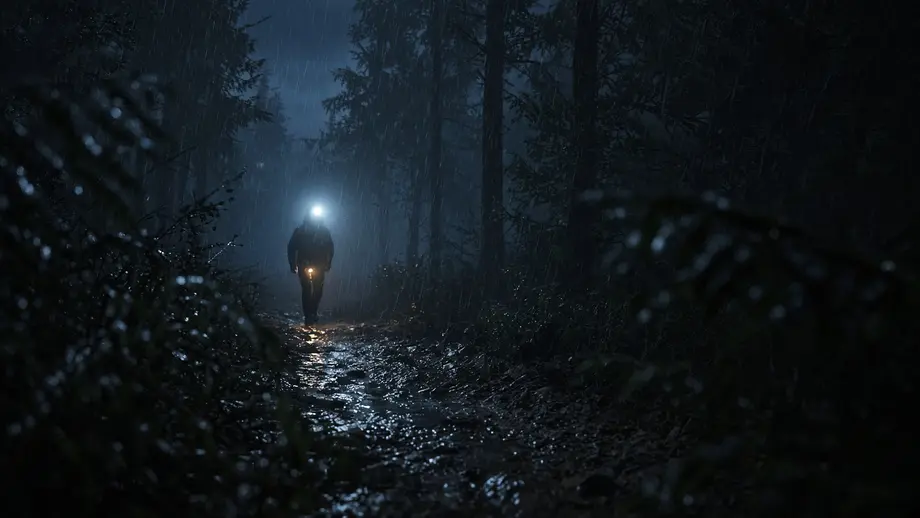
Halfway down a wet trail, bright streaks fill the air in front of your face. Turn the lamp up and they get brighter while the trail stays gray. Your gloves slide off the button, the band soaks through and creeps down, and you wonder whether the light will survive the night.
This table gives the best headlamp for rain by situation, using Olight's published ratings and regular prices.
| Situation | Pick | Key specs (Olight ratings) | Regular price | Why |
|---|---|---|---|---|
| Overall rain headlamp | Olight Perun 3 | 3,000 lm max; Med 120 lm for 25 h; IP68; 150 g | $89.99 | Highest water code here, glove-friendly button, headband in the box |
| Lightest head-worn option | Olight Perun 3 Mini | 1,250 lm max; Low 10 lm for 30 h; IPX8; 54 g | $64.99 (Standard) | Immersion-rated, red light, breathable band with reflective stripes |
| Low second light for glare | Olight Baton 4 Pro | 1,600 lm max; Med 120 lm for 18 h 30 min; IPX8; 114 g | $69.99 | Carried at the hip, it moves the lit rain out of your line of sight |
| Clip-on waist light | Olight Oclip 2 Pro | 530 lm flood; 115° head tilt; IP66; 75.5 g | $49.99 (Black, Orange) | Clips to a hip belt and tilts forward; rain-rated but not for immersion |
| Budget clip light | Olight Oclip Pro | 500 lm flood or 120 m spot; IPX6; 53 g | $39.99 | Rotating selector picks flood, spot or red; never submerge it |
📋 Table of Contents
- 1. Quick Answer: What Makes the Best Headlamp for Rain?
- 2. Why Does a Headlamp Make Rain Look Worse? Raindrop Backscatter Explained
- 3. A Rain Flashlight at Waist Height: How Far Does It Move the Glare?
- 4. Five Checks That Decide What Lights to Use in Rain
- 5. What Do IPX4, IPX6, IPX7 and IPX8 Mean for a Rain Headlamp?
- 6. Headlamp Rain Comparison: Output, Runtime, Weight, Water Code and Price
- 7. Hood, Brim and Soaked Strap: Keeping a Wet Headlamp Aimed
- 8. How to Rain-Check a Headlamp Yourself: A Reader Test Plan
- 9. Common Mistakes: "Waterproof Means Submersible" and "Brighter Is Safer"
- 10. After the Hike: Drying the Light and Checking the Charging Port
- 11. What Is the Best Waterproof Headlamp?
- 12. What Headlights Should I Use in the Rain?
- 13. What Headlamps Do Navy SEALs Use?
- 14. Best Headlamp for Rain: Your Action Checklist
- 15. FAQ
Quick Answer: What Makes the Best Headlamp for Rain?
The best headlamp for rain gives you a floodlit beam you can turn down to 30 to 120 lumens, a button you can find in wet gloves, a band that holds when soaked, and a water code printed on the product page. Then carry a second light low, at your hip. Turning a headlamp up in rain mostly lights more raindrops in front of your eyes.
The Olight headlamps and clip lights here print different codes: IP68 (Perun 3), IPX8 (Perun 3 Mini), IPX6 and IP66 (Oclip Pro, Oclip 2 Pro, whose manuals forbid immersion). Our best headlamps guide also picks the Perun 3; here the reasons are water code, button and Med runtime.
Why Does a Headlamp Make Rain Look Worse? Raindrop Backscatter Explained
A headlamp makes rain look worse because every drop near your face catches its light and sends part of it back toward your eyes, a few centimeters from the lamp. Raindrops are large, clear spheres that act like tiny lenses, and they fall fast enough to smear into streaks. A brighter lamp means brighter streaks.
A Columbia University study of vision and rain by Garg and Nayar gives the physics. Rain particles "are 1000 times larger (0.1-10 mm) than those in steady weather," such as fog, and "Each raindrop acts as a spherical lens that refracts and reflects light from a large field of view towards the camera." Their drop model concludes that "a drop tends to be much brighter than its background."
Speed adds the streak. The paper gives terminal velocity as v = 200√a for a drop of radius a and notes that "at long exposures, due to fast motion, raindrops produce severely motion-blurred rain streaks." With a in meters, a 2 mm drop falls at 200 × √0.001 = 6.3 m/s, so rain draws lines in a beam, while fog makes a haze.
How many drops are in front of you?
The Marshall-Palmer drop size distribution answers that. Chapter 14 of Mark Jacobson's textbook Fundamentals of Atmospheric Modeling, posted by Stanford, gives n0 = 8.0 × 10⁻⁶ drops per cm³ per μm (8,000 per m³ per mm) and a slope of 4.1 × 10⁻³ R^-0.21 per μm, for "R = rainfall rate (1 - 25 mm hr-1)." The total count is n0 divided by the slope.
This table applies those constants to five rain rates; it models average rain, not any measured storm.
| Rain rate | Drops per m³ | Drops larger than 1 mm per m³ | Drop shadow area per m³ | Beam cross-section shadowed over 10 m |
|---|---|---|---|---|
| 1 mm/h | 1,951 | 32 | 182 mm² | 0.18% |
| 2.5 mm/h | 2,365 | 80 | 325 mm² | 0.32% |
| 5 mm/h | 2,736 | 147 | 503 mm² | 0.50% |
| 10 mm/h | 3,165 | 253 | 778 mm² | 0.78% |
| 25 mm/h (about 1 in/h) | 3,836 | 477 | 1,385 mm² | 1.39% |
Worked example for 5 mm/h: the slope is 4.1 × 5^-0.21 = 2.92 per mm, so the count is 8,000 ÷ 2.92 = 2,736 per m³, matching the 0.0027 drops per cm³ in Jacobson's own example. Drops over 1 mm are 2,736 × e^-2.92 = 147. Shadow area is π/4 × 8,000 × 2 ÷ 2.92³ = 503 mm².
From 1 to 25 mm/h the drop count only doubles, but large drops rise about 15 times and shadow area about 7.6 times, so streaks get bigger and brighter. Yet even at 25 mm/h the drops shadow under 1.5% of the beam over 10 m. The beam still reaches the trail; the problem is glare from the drops in between.
A Rain Flashlight at Waist Height: How Far Does It Move the Glare?
A rain flashlight held at your hip moves the brightest lit drops about 19° to 26° away from where you are looking, against about 2° for a headlamp, and keeps its beam out of your central view until about halfway to the trail. Based on a published glare formula, that cuts veiling glare from the near drops by roughly 80 to 160 times.
The offsets come from the public ANSUR II body-size dataset of 4,082 men and 1,986 women, hosted by Penn State's OPEN Design Lab, which "is still not an approximation of the US Civilian population." Its CSV means give standing eye height (stature minus sitting height plus sitting eye height) of 1,642 mm for men and 1,520 mm for women, hip bone (iliocristale) height of 1,062 and 996 mm, wrist height of 848 and 794 mm, and half hip breadth of 173 and 177 mm.
The model assumes you look at the trail 5 m ahead, every light aims there, and a headlamp sits 50 mm above your eyes. The 5° cut-off is our assumption, not a vision standard; 3° or 10° keeps the same order. Our clip on light guide measures how far each clip spot sits off your sight line at a target; this model asks where the lit raindrops sit.
This table shows each light's offset, the angle to a lit drop 1 m out and where the beam enters your central 5°, men / women, calculated from ANSUR II means, not measured.
| Light position | Offset from your eyes | Angle to a lit drop 1 m out | Lit beam enters your central 5° at | Glare from that 1 m drop vs headlamp |
|---|---|---|---|---|
| Headlamp | 50 mm above, centered | 2.1° / 2.1° | 0.5 m / 0.5 m | 1 (reference) |
| Clip light centered on a hip belt | 581 / 524 mm below, centered | 20.2° / 19.0° | 2.7 m / 2.6 m | about 1/94 / 1/80 |
| Handheld at the hip | 581 / 524 mm below, 173 / 177 mm to the side | 21.1° / 20.0° | 2.8 m / 2.7 m | about 1/102 / 1/89 |
| Handheld with the arm hanging | 795 / 725 mm below, 173 / 177 mm to the side | 26.4° / 25.3° | 3.1 m / 3.0 m | about 1/159 / 1/142 |
Worked example for the men's belt clip: the drop 1 m out sits at 1,062 × 0.8 = 849 mm, so your eye looks down atan((1,642 − 849) ÷ 1,000) = 38.4°, against atan(1,642 ÷ 5,000) = 18.2° for the trail spot: a 20.2° gap. Read the entry column as a share of the 5 m path: with a headlamp, about 90% of the beam path lies inside your central 5°; with a hip light, under half.
The glare column uses the Stiles-Holladay relation. J. J. Vos's 2003 paper on disability glare in Clinical and Experimental Optometry states that "Disability glare is due to intraocular scatter" and gives an equation in which veiling glare falls with the square of the glare angle, "with validity domain between one degree and 30 degrees." So the belt clip gives (20.23 ÷ 2.09)² = about 94. Treat it as a ranking: the abstract notes "great individual spread," and the ratio assumes each drop sends you the same light.
Tip: In steady rain, set the headlamp to Low or Med for your feet and let the hip light do the reaching. With only one light, hold it at your side.
Five Checks That Decide What Lights to Use in Rain
A good rain headlamp passes five checks: a named flood beam, at least three white steps at or below 150 lumens, a control called glove-friendly or a rotating selector, a headband in the box, and an immersion code (IPX7 or higher). The Perun 3 passes all five; each other light here passes two or three.
This table scores the five lights on those checks, using only Olight's product pages and manuals.
| Light | Flood beam named by Olight | White steps at or below 150 lm | Glove control | Head-worn out of the box | Immersion code | Checks passed |
|---|---|---|---|---|---|---|
| Perun 3 | Yes ("floodlight beam") | Moon 5, Low 30, Med 120 | Yes ("glove-friendly") | Yes | IP68 | 5 of 5 |
| Perun 3 Mini | Not stated | Moon 2, Low 10, Med 100 | Not stated | Yes | IPX8 | 3 of 5 |
| Oclip 2 Pro | Yes | Moon 1, Low 10, Med 100 | Rotating selector | No; strap sold separately | IP66 (no) | 3 of 5 |
| Oclip Pro | Yes | Moon 1, Low 10, Med 100 | Rotating selector | No; strap sold separately | IPX6 (no) | 3 of 5 |
| Baton 4 Pro | Not stated | Moon under 1, Low 15, Med 120 | Not stated | No | IPX8 | 2 of 5 |
The Baton 4 Pro's low score is the point: it is built to be held, which is what the waist position needs.
What Do IPX4, IPX6, IPX7 and IPX8 Mean for a Rain Headlamp?
IPX4 means splashing water, IPX5 and IPX6 mean water jets, IPX7 means temporary immersion, and IPX8 means continuous immersion under conditions the maker states. Any of them handles rain. The difference shows up when the light falls in a stream or gets hosed off. The X means no dust rating was claimed; IP68 adds a dust-tight rating to IPX8.
These numerals come from IEC 60529, current consolidated Edition 2.2, published in 2013. The IEC's own IP ratings page gives only the two scales and adds: "For a full description of the IP ratings, including their testing conditions, please refer to IEC 60529." For IPX8 the maker states depth and time; Olight's Perun 3 Mini page says submersible under 2 meters for 30 minutes.
The trap is the jump from IPX6 to IPX7. Olight says the Oclip Pro is IPX6 "even with the cover open," yet its manual states: "Do not immerse the product in water or other liquid as it will damage the product." For the clause-by-clause view, see our IPX7 vs IPX8 vs IP68 comparison and our guide to IPX8 meaning.
Headlamp Rain Comparison: Output, Runtime, Weight, Water Code and Price
On paper, the Perun 3 leads on water code and runtime, the Perun 3 Mini on weight among head-worn lights, the Baton 4 Pro on reach, and the two clip lights on price. Only the two Peruns are headlamps out of the box, so pair one with a waist light.
This table lists every light in this guide on Olight's published ratings, with regular prices as of October 2026.
| Spec (Olight rating) | Perun 3 | Perun 3 Mini (CW) | Oclip 2 Pro | Oclip Pro | Baton 4 Pro |
|---|---|---|---|---|---|
| Regular price | $89.99 | $64.99; Premium $94.99 | $49.99; blue $54.99 | $39.99 | $69.99 |
| Max output | 3,000 lm | 1,250 lm | 530 lm flood | 500 lm flood | 1,600 lm |
| Max intensity | 6,400 cd | 6,000 cd | 3,906 cd | 3,600 cd | 10,000 cd |
| Beam distance | 160 m | 155 m | 125 m | 120 m | 200 m |
| Turbo | 3,000~800~600 lm, 2 + 180 + 30 min | 1,250~350 lm, 2 + 60 min | Flood 530~300~100 lm, 1+58+5 min | Flood 500~300~100 lm, 1 + 50 + 30 min | 1,600~600 lm, 2 + 198 min |
| Med | 120 lm, 25 h | 100 lm, 4.5 h | Flood 100 lm, 3 h 45 min | Flood 100 lm, 3.5 h | 120 lm, 18 h 30 min |
| Low | 30 lm, 89 h | 10 lm, 30 h | Flood 10 lm, 25 h | Flood 10 lm, 27 h | 15 lm, 155 h |
| Red light | 60 lm, 14 h; 15 lm, 70 h | 45 lm, 150 min; 5 lm, 19 h | 40 lm, 4 h; 4 lm, 27 h | 40 lm and 4 lm | None |
| Weight | 150 g | 54 g | 75.5 g | 53 g | 114 g |
| Water code | IP68 | IPX8 | IP66 | IPX6 | IPX8 |
The Oclip 2 manual lists flood Medium at 3 h 30 min, 15 minutes under the product page; plan on that.
Olight Perun 3: best headlamp for rain overall
The Olight Perun 3 headlamp ($89.99, regular price, every color) answers all three problems in the title. Its "3000-lumen floodlight beam" steps down to Med (120 lumens, 25 hours) or Low (30 lumens, 89 hours). Olight says its "Large metal button enables simple, glove-friendly operation, and is made concave to avoid unwanted activation during transit or storage." The headband lists an "Anti-Sweat Silicone Strip."
Its manual adds a lockout: from off, "press and hold the switch (for about 2 seconds until the flashlight is off) to enable the lockout mode." A double press from off goes straight to red light.
The limits: 150 g is heavy on a soaked band, and the page warns the bracket "is METAL - it is expected to scratch the body of the torch if taken in / out repeatedly." More options sit in the Perun series headlamps.
Olight Perun 3 Mini: lightest immersion-rated option
The Olight Perun 3 Mini headlamp costs $64.99 for the Standard Edition, with headband, base and MCC cable, and $94.99 for the Premium Edition, which swaps the MCC cable for a wireless charging case. At 54 g it is about a third of the Perun 3's weight, rated IPX8, with a headband Olight calls "25% lighter with 3D-breathable mesh and anti-sweat strip."
The tradeoff is runtime: Med runs 100 lumens for 4.5 hours, so a long descent leans on Low (10 lumens, 30 hours).
Olight Oclip 2 Pro: the clip-on waist light
The Olight Oclip 2 Pro clip light is $49.99 in Black or Orange, $54.99 in blue, and $74.99 to $79.99 as the Premium version with a 1,000 mAh charging dock. Its clip "grips objects up to 14 mm thick" and its "115° head tilt" lets it ride a hip belt and still point at the trail.
It is rated IP66, and its manual states: "Do not immerse the product in water or other liquids, as it will damage the product." It adds that "In environments below 0°C (32°F), the white light is limited to Low and Medium modes," which matters in sleet.
Safety note: The Oclip 2 and Oclip Pro manuals both warn: "If you have an ICD or pacemaker, avoid close or prolonged contact with this product to prevent possible interference." If that applies to you, carry the clip light on a hip belt or in your hand, not on a chest strap or shirt pocket.
Olight Oclip Pro: the budget clip light
The Olight Oclip Pro is $39.99; the same page sells the Oclip Pro S at $39.99 in most colors and $45.99 in Teal Blue. A rotating selector picks a 500-lumen flood, a 120 m spot or red light. Olight's $7.99 Oclip Series Headlamp Strap fits it and the Oclip 2 Pro.
It is rated IPX6, its manual forbids immersion, and it notes that "In 0°C to 10°C conditions, the white light Turbo will be unavailable."
Olight Baton 4 Pro: the handheld for the hip
The Olight Baton 4 Pro flashlight ($69.99, regular price, every color) is the reach light for the waist: 1,600 lumens, 10,000 candela, 200 m, IPX8, 114 g, with side and tail switches. Med runs 120 lumens for 18 hours 30 minutes, a full night beside a Perun 3.
It has no headband or red light, and the box has an MCC3 cable but no USB-C cable. The manual warns: "Do not immerse the flashlight in seawater or other corrosive media as it will damage the product."
Hood, Brim and Soaked Strap: Keeping a Wet Headlamp Aimed
In rain, wear the headlamp band over the hood, not under it, so the hood cannot push the lamp down or shade the beam, and tighten it once the hood is up. A short cap brim under the hood acts as a drip edge. If the band is soaked after night one, a spare band or a hip-belt clip light is your dry option.
General fit is covered in our headlamp comfort guide. For a band-free setup, put the clip light on the hip belt, as in the angle table above.
How to Rain-Check a Headlamp Yourself: A Reader Test Plan
You can rain-check a headlamp yourself in one evening: compare glare at three brightness levels and two light positions, count correct mode changes in wet gloves, and measure band slip after a soak. This plan is for your own trial; we have not run it.
This table sets out each test, the equipment, the method and the number of tries.
| Test | Equipment | Method | Tries |
|---|---|---|---|
| Glare by brightness | Phone camera on a fixed mount, garden hose on spray or real rain | Same spot, headlamp on Low, Med and High; same exposure | 3 photos per level |
| Glare by position | Same setup plus a handheld | Headlamp on Low, then Low plus a handheld at the hip | 3 photos per setup |
| Wet-glove mode changes | Rain gloves, a bucket of water | Wet gloves: Low to Med to Low, red on and off | 10 tries per action |
| Band slip | Soft tape measure, marker | Mark the band edge, walk 30 minutes in rain, measure the drop | 1 walk per band |
Fix the shutter speed if you can. Garg and Nayar note "the typical exposure time T ≈ 30 ms of a video camera." In 30 ms a 2 mm drop at 6.3 m/s travels about 19 cm, a streak; at 1 ms it moves under 1 cm, a dot.
Warning: Don't aim the lights at anyone's eyes during the test. The Perun 3 manual states: "Caution: Do not stare at operating light source."
Common Mistakes: "Waterproof Means Submersible" and "Brighter Is Safer"
The two costliest rain mistakes are treating a rain rating as an immersion rating and turning the headlamp up when the streaks appear. IPX6 and IP66 clip lights must stay out of water, by their own manuals, so unclip them before a crossing. And Turbo lights the near drops about 2° from your sight line, while the trail needs no extra power to reach.
A third is packing a light unlocked, where wet gear can press the button. The Baton 4 Pro manual says to "ensure the flashlight is locked" when carrying it.
After the Hike: Drying the Light and Checking the Charging Port
After a wet night, wipe the light, open nothing until the outside is dry, and check the charging port before you plug in. Olight's manuals say to keep the Baton 4 Pro's port "clean and dry," keep Oclip dust covers closed, and charge only inside each light's temperature range.
The Baton 4 Pro manual says to "Charge the product only in environments with temperatures between 0 °C and 45 °C." The Perun manuals give no port rule for their magnetic contacts; the same "clean and dry" habit is the cautious choice.
If the lens fogs inside, stop using the light. Olight's warranty page excludes "Damage caused by improper storage, accidents, or abnormal operating conditions," so submerging a light whose manual forbids it may fall outside that cover.
What Is the Best Waterproof Headlamp?
Among Olight's current headlamps, the best waterproof headlamp is the Perun 3, rated IP68: dust-tight and protected for continuous immersion. The Perun 3 Mini is rated IPX8, which its page describes as submersible under 2 meters for 30 minutes. Neither is a dive light, but both suit rain, stream crossings and an accidental dunk.
For rain alone, any code from IPX4 up covers falling water, which is why the IPX6 and IP66 clip lights ride the waist.
What Headlights Should I Use in the Rain?
If you mean a car, use your headlights whenever rain cuts visibility or your wipers run steadily, and low beams for oncoming traffic, as state codes such as Virginia's require; check your own state's driver manual. If you mean a headlamp for walking, use a low or medium floodlit setting and a second light at your hip.
Code of Virginia § 46.2-1030, subsection A, reads in part: "Every vehicle in operation on a highway in the Commonwealth shall display lighted headlights and illuminating devices as required by this article (i) from sunset to sunrise; (ii) during any other time when, because of rain, smoke, fog, snow, sleet, insufficient light, or other unfavorable atmospheric conditions, visibility is reduced to a degree whereby persons or vehicles on the highway are not clearly discernible at a distance of 500 feet; and (iii) whenever windshield wipers are in use as a result of fog, rain, sleet, or snow." Section 46.2-1034 then requires low beams whenever you approach an oncoming vehicle within 500 feet.
On foot, that answers what lights to use in rain: keep the brightest light away from your eyes.
What Headlamps Do Navy SEALs Use?
No official U.S. Navy source names a SEAL headlamp model, so we can't name one; our best deer hunting headlamp guide explains why retail "SEAL" lists don't hold up. A wet trail asks for three documented features: an immersion code, a lockout and a red mode. The Perun 3 lists IP68, a 2-second lockout and red light from off. Read "military grade" as marketing unless the maker names the test.
Best Headlamp for Rain: Your Action Checklist
Before your next wet night, check five things: a water code on the product page, a Low or Med step you can reach without Turbo, a button you can find in wet gloves, a dry backup for the band, and a second light for your hip. Then practice the lockout and the red-light shortcut at home, in gloves.
- Head light: the Perun 3 for IP68 and runtime, or the Perun 3 Mini to save weight.
- Hip light: the Baton 4 Pro for reach, or an Oclip 2 Pro on the hip belt (mind the pacemaker warning).
- Set Low or Med before the rain; never answer streaks with Turbo.
- Band over the hood, brim under it; unclip Oclip lights before creek crossings.
- Lock every light for the pack, and charge only when dry and above 0°C.
FAQ
Changelog
- October 31, 2026: First published.