⚡ TL;DR
Choose a lantern for a shared table or sitting area, a handheld flashlight for directing light around the home, and a headlamp for walking or working with both hands available. An emergency flashlight kit works best when those jobs are assigned separately. Compare sustained output, controls and charging arrangements before choosing by maximum lumens.
📋 Table of Contents
- 1. Choose Emergency Lighting by Room, Movement and Task
- 2. Is a lantern better than a flashlight for power outages?
- 3. How many lumens do I need to light a room?
- 4. Can I use a flashlight to light a whole room?
- 5. Use a Handheld Flashlight for Directed Indoor Checks
- 6. Keep Both Hands Available With a Headlamp
- 7. Position a Clip Light for a Separate Task
- 8. Compare Sustained Modes Before Planning a Long Evening
- 9. Treat Turbo as a Short Initial Stage
- 10. Compare Battery Energy and the Complete Carrying Arrangement
- 11. Plan Charging Connections Before the Wall Outlet Is Unavailable
- 12. Give the Light a Stable Place and Room for Heat
- 13. Build a Household Combination Around Simultaneous Needs
- 14. FAQ
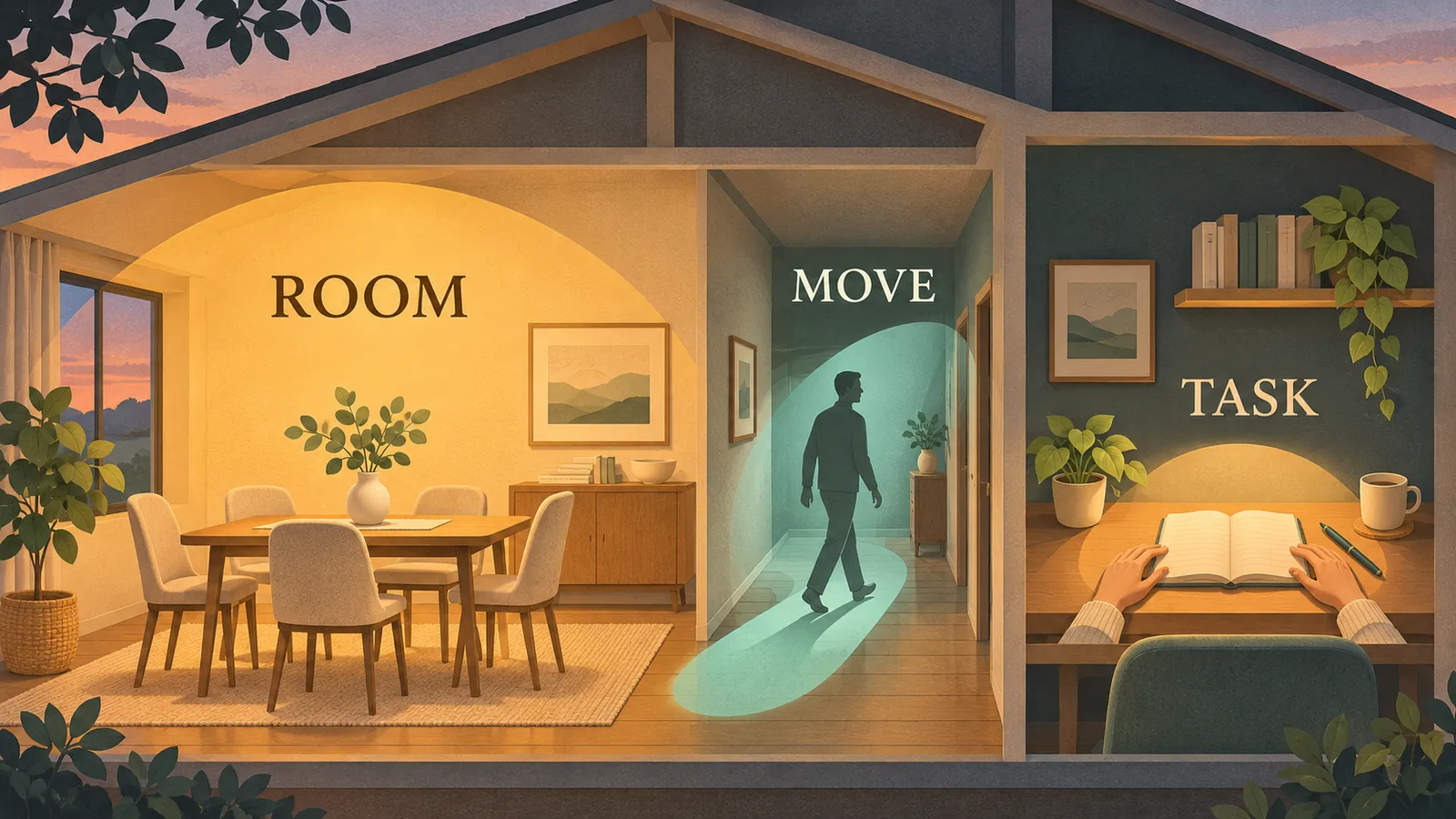
Choose Emergency Lighting by Room, Movement and Task
Start with what people will do after the room lights go out. Someone sitting with family needs a common pool of light. Someone collecting supplies needs illumination that travels. Someone reading instructions while handling equipment needs light aimed at the work without occupying a hand. Those are three different requirements, even within one small home.
| Lighting form | Strongest indoor role | Placement decision |
|---|---|---|
| Battery-powered lantern | Shared table or occupied room area | Choose a stable position that distributes light where people are sitting |
| Handheld flashlight | Directing light toward a route, cupboard or object | Keep the beam under the user's control and away from other people's eyes |
| Headlamp | Moving or completing a task with both hands available | Adjust the headband and aim for the actual work surface |
A lantern can stay with the people gathered in one place while another person carries a light elsewhere. With only one device, every trip to another room moves the household's lighting with it. Count simultaneous activities when choosing the combination. A second light may solve that problem more directly than a higher maximum output on the first.
For the wider household plan, Olight's power-outage flashlight guide covers the room-by-room equipment role. This comparison focuses on what changes when a light is placed in the room, held in a hand or worn on the head.
Is a lantern better than a flashlight for power outages?
A battery-powered lantern is usually the more convenient choice when several people need light around the same table or seating area. A flashlight is more useful when one person must direct the beam, look into a cupboard or move between rooms. For a household doing both, keep a shared light in place and give the moving person a separate portable light.
Consider the lantern's actual light distribution. A source that spreads light around its body can serve several directions at once, but furniture may still block part of that light. Place it for the people using the space. A bright source behind a tall object will not make the far side of that object equally easy to see.
The shared position also needs to remain practical. A dining table used for paperwork has different needs from a small bedside surface. Leave room for normal movement and keep the light clear of items that could cover its outlet. If someone must carry the lantern away, make that change visible to everyone relying on it.
Choose a battery-powered camping lantern for this indoor role, following its own instructions. Fuel-burning and battery-powered equipment have different operating hazards. A familiar camping shape alone does not establish whether a particular lantern belongs in an indoor emergency kit.
How many lumens do I need to light a room?
No single lumen number establishes useful lighting for every room. The answer depends on where light reaches, the size and arrangement of the space, and whether people need to find a doorway or read small print. Begin with the task and beam distribution, then choose a brightness level that makes that task clear without unnecessary glare.
Lumens describe light output. Illuminance describes the light arriving at a surface. The International Commission on Illumination's definition of illuminance relates incident luminous flux to area and expresses illuminance in lux. A flashlight's lumen rating therefore cannot, by itself, specify the illumination on a book, floor or countertop elsewhere in the room.
Distance and aiming change which surfaces receive the beam. A concentrated spot can make one small area prominent while leaving neighboring objects harder to distinguish. A broader distribution can serve more of the immediate space, but the same advertised output does not establish identical visibility at every position. Keep the actual work surface in the decision.
Check the arrangement from the position where the person will use it. Can the reader distinguish the printed instructions? Does a standing person block the shared light? Can someone approaching the table see without looking directly into the emitter? These observations help choose placement and setting without treating a product specification as a room-lighting measurement.
Can I use a flashlight to light a whole room?
A flashlight can provide useful general illumination in a room when its beam and permitted placement suit the space. A narrow beam may leave substantial areas outside it, and a handheld light moves whenever its user moves. For several people staying in one room, a shared lantern arrangement is often easier to maintain, with a flashlight kept available for directed tasks.
Use the flashlight's intended support or mounting arrangement. Keep the light-emitting opening unobstructed and avoid balancing a device where ordinary movement can dislodge it. Adding a homemade cover, fabric diffuser or improvised enclosure creates a different arrangement from the product's documented use. The light's instructions still apply when the aim is wider room illumination.
One illuminated area also does not establish that the route to another room is clear. Doors, furniture and a person standing in the beam can change the view. If people will leave the shared space, give that movement its own lighting plan instead of expecting one stationary source to cover every turn.
Use a Handheld Flashlight for Directed Indoor Checks
The Olight Baton 4 Pro gives a concrete handheld example. Its standard specification lists a 111 mm body and 114 g weight, including its battery. Its side switch selects ordinary brightness settings, while the tail button provides a separate control path. This format suits a person who wants to direct light into a particular area and then carry it to the next task.
The starting control matters when other people are nearby. The shared Baton 4 Pro and Baton Ultra manual lists High from a tail-button press when the light is off. For a low-output indoor task, identify the side-switch method before relying on a familiar-looking rear button. Control location alone does not tell the next person which output will appear.
Keep the flashlight aimed at the object being examined. When the conversation moves back to another person, lower or redirect the light before turning toward them. The handheld format makes aiming deliberate, but it also occupies a hand. A person who must hold instructions and handle equipment may prefer a different form for that part of the job.
When choosing a flashlight, consider the complete control and carrying arrangement alongside output. A pocketable body is useful for moving between rooms. It does not remove the need for a separate shared light if others are still sitting in the original space.
Keep Both Hands Available With a Headlamp
The Olight Perun 3 includes a headband, MCC3 charging cable and lanyard in its manual's box list. The light can serve a head-worn role or be used separately as a right-angle flashlight. For indoor preparation, that flexibility is useful when a person alternates between looking along a route and working on something held in both hands.

A headlamp follows the wearer's head, so aiming remains part of the task. Adjust it toward the work surface before beginning. If another person approaches, consider where the beam will point when the wearer looks up. A lamp that follows attention is convenient for the wearer, but it can also direct light toward someone joining the conversation.
The Perun 3 manual lists 150 g including its battery. That figure identifies the light-and-battery reference, rather than a personal comfort result. Assemble the headband correctly and check its adjustment before an outage. Olight's headlamp comparison provides the broader selection context if head-worn fit is the main buying decision.
Perun 3 also has red modes, but their presence does not require using red for every indoor task. Select illumination that makes the actual object or text understandable. Ordinary room preparation should not depend on a flashing signal mode or on a color chosen without considering what the person needs to distinguish.
Position a Clip Light for a Separate Task
The Olight Oclip Ultra adds a compact positionable light to the household combination. Its selector separates floodlight, spotlight and UV. For ordinary visible indoor illumination, choose the intended white-light channel. UV has a different purpose and should not become the default source for finding household objects or reading instructions.
Flood and spot are separate choices even at similar control settings. The manual lists flood Medium at 100 lumens and spot Medium at 90 lumens, each with a 3-hour-30-minute reference. That gives a specific example of why a named mode needs its channel attached. A note that only says Medium leaves part of the operating arrangement unspecified.
The clip, magnet and lanyard hole provide different positioning options. Choose an actual support that holds the light in its intended orientation and leaves its opening clear. A magnet requires a suitable surface. Its presence does not establish a load rating for every coating, edge or attachment position in the home.
The manual warns that metal powder on the magnetic clip can affect attachment. Check the contact area when the light has been kept around workshop materials. For an indoor task, the useful question is whether the chosen position remains stable while people use the surrounding space, rather than whether the device can stick somewhere briefly.
Compare Sustained Modes Before Planning a Long Evening
A plan for twelve hours needs more detail than the word rechargeable. Identify the setting, its published runtime and the available charging opportunity. The following entries come from the exact product manuals. They describe different outputs and lighting arrangements, so the table supports planning by task rather than a ranking based on hours alone.
| Product and white-light setting | Published output | Published runtime |
|---|---|---|
| Oclip Ultra flood Low | 10 lumens | 27 hours |
| Oclip Ultra flood Medium | 100 lumens | 3 hours 30 minutes |
| Perun 3 Low | 30 lumens | 89 hours |
| Perun 3 Medium | 120 lumens | 25 hours |
| Baton 4 Pro Low | 15 lumens | 155 hours |
| Baton 4 Pro Medium | 120 lumens | 18 hours 30 minutes |
The low-mode entries extend beyond twelve hours in their published references. The Oclip Ultra Medium entry does not. That distinction can change whether the clip light is assigned to short individual tasks or expected to remain on throughout an evening. A longer low-mode figure is only useful if that lower output serves the intended activity.
Perun 3 and Baton 4 Pro both list 120-lumen Medium entries, but their beam patterns, mounting arrangements and reference runtimes differ. Equal lumens do not make them identical tools. A head-worn source can travel with the person doing the work while a handheld source remains available for checking another area.
Published runtimes describe the stated reference conditions. The charge present when an outage begins, battery condition, selected mode and subsequent use all affect the household's available reserve. Identify a second lighting option before assigning the entire night to a single device and its longest specification.
Treat Turbo as a Short Initial Stage
Maximum output can help distinguish something briefly, but it needs its own timing context. Baton 4 Pro's manual lists Turbo as 1,600 to 600 lumens over 2 plus 198 minutes. That entry is a staged sequence. It does not describe 1,600 lumens held continuously for the combined duration.
Perun 3's Turbo chart likewise starts at 3,000 lumens for two minutes before showing lower stages. Oclip Ultra's flood Turbo chart starts at 530 lumens for one minute before its subsequent reductions. Keep those initial intervals attached to the maximum figures when comparing the lights for sustained indoor use.
For reading, sorting supplies or staying in one room, an appropriate ordinary mode can be a more relevant reference than Turbo. Select it deliberately before handing over the light. Someone receiving an unfamiliar device should know which control and setting are intended for the current job.
A high initial output also changes heat handling. Repeatedly invoking the highest mode to recover an earlier brightness can conflict with the product's temperature precautions. Follow the named light's instructions and respond to its condition. A changing output is a reason to check the selected mode and guidance, rather than repeatedly demanding another burst.
Compare Battery Energy and the Complete Carrying Arrangement
Battery size adds another buying dimension. The Perun 3 manual identifies an 18 Wh battery, Baton 4 Pro lists 12.6 Wh, and Oclip Ultra lists 2.146 Wh. These published energy figures describe the batteries fitted to the named products. Keep them alongside the mode tables when deciding which device will handle prolonged illumination and which will handle shorter separate tasks.
Capacity markings need their accompanying voltage. Perun 3 lists 5,000 mAh at 3.6 V. Baton 4 Pro lists 3,500 mAh at 3.6 V. Oclip Ultra lists 580 mAh at 3.7 V. Preserve each complete specification when recording the equipment. A capacity number detached from its model and voltage leaves out part of the electrical description.
The carrying arrangement also includes equipment beyond the light body. A headband, charging cable or selected carrying accessory takes its own place in the kit. Decide whether those pieces will stay with one person or at a common charging location. Someone choosing a light for an evening task should be able to find the components needed for its assigned role.
Check the exact package before buying additional accessories. A photograph can illustrate a configuration that differs from another selection on the same page. Perun 3's documented headband arrangement and Baton 4 Pro's two charging routes answer different needs. Confirm the chosen package and required connection before treating two lights as interchangeable additions to the household kit.
Plan Charging Connections Before the Wall Outlet Is Unavailable
The three examples use different charging arrangements. Perun 3's MCC3 cable table specifies a USB Type-A source at DC 5 V, 2 A. Oclip Ultra's USB-C table lists 5 V, 1 A. Baton 4 Pro provides a USB-C port and an MCC charging route. Match the complete cable and power source to the light being prepared.
For Baton 4 Pro, rotating the tailcap ring reveals or conceals the USB-C port. Keep that access method distinct from the tail control used to operate the light. A household member looking for a charging connection should not need to infer its location from another model's port or charging contact.
Account for how many lights need charging at the same time. A suitable cable beside each device helps only if the available source has the required connections and output. Check the labels and complete setup in advance. A USB socket's shape alone does not establish that the entire charging arrangement matches the manual.
Oclip Ultra has another relevant condition. During charging, High output and higher brightness are unavailable. A light attached to a cable therefore has a different available operating range from the same light used untethered. Keep charging duties and active illumination duties separate when assigning the household equipment.
Read the indication at the connection being used. Perun 3's MCC illustration identifies red for charging and green for charging completed. Oclip Ultra's charging diagram gives different detail, with blinking red through its 0–95% band and green in the 95–100% band. Keep those labels attached to their respective systems when explaining them to another household member.
Give the Light a Stable Place and Room for Heat
Place shared lighting where normal use will not cover the emitter or pull on its charging cable. A table used for several activities can collect bags, folded clothing and papers. Leave a clear space around the light, and reconsider the position when those activities change. A convenient location at the start of the evening may become crowded later.
The Baton 4 Pro manual warns against obstructing the light-emitting port at close range and against putting a hot light in fabric bags or fusible plastic containers. Oclip Ultra carries corresponding obstruction and hot-storage warnings. Finish the lighting task and follow the product's heat precautions before packing either device away.
For battery-powered emergency lighting, the Centers for Disease Control and Prevention's power-outage guidance recommends flashlights and lanterns in place of candles, gas lanterns or torches to reduce fire risk. That recommendation still leaves the electric light's own placement, charging and temperature instructions to follow.
Keep responsibility for the equipment clear when children or pets share the space. A light's small size does not make it a toy. Arrange the controls and charging components for the adult managing them, while avoiding a position where play or ordinary movement can disturb the light.
Build a Household Combination Around Simultaneous Needs
For two adults staying around a table, begin with the shared illumination position and keep a handheld available for trips elsewhere. The person leaving can carry directed light without taking away the source used for the table. If the table activity involves reading small print, evaluate that surface separately from the overall impression of a bright room.
For a person moving repeatedly between rooms, a headlamp can free both hands for carrying ordinary supplies. Keep another source in the occupied room if others remain there. A head-worn light serves the wearer's changing view, while the stationary light serves the people who stay behind.
For one adult working at a fixed position, a properly supported clip light may free a hand without requiring head-worn equipment. Oclip Ultra's flood and spot choices allow the person to select the intended channel. Choose the support and output for that task before assigning the same light to a shared-room role.
Buy the missing role first. If a household already has suitable shared lighting, an additional portable source may make the combination more useful. If everyone currently relies on one handheld, the next improvement may be a stable shared light. This approach ties the purchase to an actual activity instead of accumulating several devices that all leave the room together.
FAQ
Changelog
- November 7, 2026: Product information and buying guidance reviewed.